Microbiology
Lecture 10:- The viruses
Dr. Raghda Saad Mohammed
Viruses
• Virus is unicellular ultramicroscopic particles, containing either
RNA or DNA, reproducing inside living cells .
• Characters:-
1. do not posses cellular organization
2. Contain one type of nucleic acid either RNA or DNA never
both
3. Lack enzymes necessary for protein and nucleic acid
synthesis
4. They multiply by complex process inside living cell called
replication not by binary fission
5. They are unaffected by antimicrobial or antibiotic
6. They are sensitive for interferon, which is chemical
substance give resistance to the immunity system .
Morphology of virus
• Size :-
• Viruses are very widely in size .
• The largest virus them is pox viruses measuring about 300 nm.
• The smallest virus are foot and mouth virus measuring about 20
nm
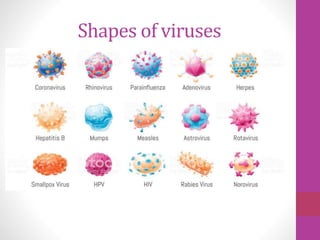
• Shape:-
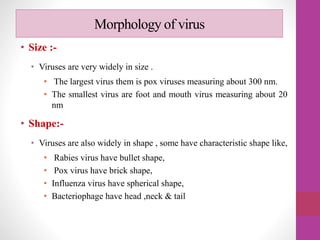
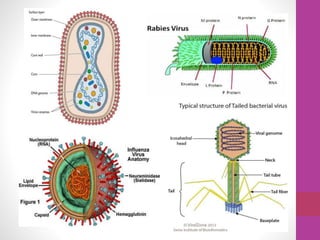
• Viruses are also widely in shape , some have characteristic shape like,
• Rabies virus have bullet shape,
• Pox virus have brick shape,
• Influenza virus have spherical shape,
• Bacteriophage have head ,neck & tail
Shapes of viruses
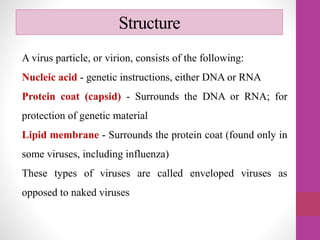
Structure
A virus particle, or virion, consists of the following:
Nucleic acid - genetic instructions, either DNA or RNA
Protein coat (capsid) - Surrounds the DNA or RNA; for
protection of genetic material
Lipid membrane - Surrounds the protein coat (found only in
some viruses, including influenza)
These types of viruses are called enveloped viruses as
opposed to naked viruses
Some virual diseaes
• Influenza virus
• Mumps virus
• Small pox virus
• Poliomyelitis virus
• Measles virus
• Coronavirus
• Hepatitis virus
• HIV
• Ebola virus
Thanks for
your attention

Lecture 10:- The viruses

  • 1.
    Microbiology Lecture 10:- Theviruses Dr. Raghda Saad Mohammed
  • 2.
    Viruses • Virus isunicellular ultramicroscopic particles, containing either RNA or DNA, reproducing inside living cells . • Characters:- 1. do not posses cellular organization 2. Contain one type of nucleic acid either RNA or DNA never both 3. Lack enzymes necessary for protein and nucleic acid synthesis 4. They multiply by complex process inside living cell called replication not by binary fission 5. They are unaffected by antimicrobial or antibiotic 6. They are sensitive for interferon, which is chemical substance give resistance to the immunity system .
  • 3.
    Morphology of virus •Size :- • Viruses are very widely in size . • The largest virus them is pox viruses measuring about 300 nm. • The smallest virus are foot and mouth virus measuring about 20 nm • Shape:- • Viruses are also widely in shape , some have characteristic shape like, • Rabies virus have bullet shape, • Pox virus have brick shape, • Influenza virus have spherical shape, • Bacteriophage have head ,neck & tail
  • 5.
  • 6.
    Structure A virus particle,or virion, consists of the following: Nucleic acid - genetic instructions, either DNA or RNA Protein coat (capsid) - Surrounds the DNA or RNA; for protection of genetic material Lipid membrane - Surrounds the protein coat (found only in some viruses, including influenza) These types of viruses are called enveloped viruses as opposed to naked viruses
  • 8.
    Some virual diseaes •Influenza virus • Mumps virus • Small pox virus • Poliomyelitis virus • Measles virus • Coronavirus • Hepatitis virus • HIV • Ebola virus
  • 9.