Counting Fast
      (Part I)

          Sergei Vassilvitskii
        Columbia University
Computational Social Science
              March 8, 2013
Computers are fast!

  Servers:
   – 3.5+ Ghz

  Laptops:
   – 2.0 - 3 Ghz

  Phones:
   – 1.0-1.5 GHz


  Overall: Executes billions of operations per second!


                              2                     Sergei Vassilvitskii
But Data is Big!

  Datasets are huge:
   – Social Graphs (Billions of nodes, each with hundreds of edges)
      • Terabytes (million million bytes)
   – Pictures, Videos, associated metadata:
      • Petabytes (million billion bytes!)


                                             3                  Sergei Vassilvitskii
Computers are getting faster
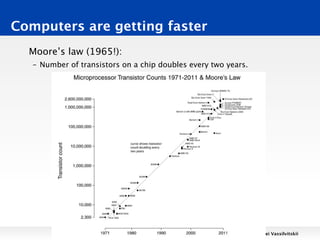
  Moore’s law (1965!):
   – Number of transistors on a chip doubles every two years.


                                    4                           Sergei Vassilvitskii
Computers are getting faster

  Moore’s law (1965!):
   – Number of transistors on a chip doubles every two years.


  For a few decades:
   – The speed of chips doubled every 24 months.


  Now:
   – The number of cores doubling
   – Speed staying roughly the same


                                      5                         Sergei Vassilvitskii
But Data is Getting Even Bigger

  Unknown author, 1981 (?):
   – “640K ought to be enough for anyone”


  Eric Schmidt, March 2013:
   – “There were 5 exabytes of information created between the dawn of
     civilization through 2003, but that much information is now created
     every 2 days, and the pace is increasing.”


                                    6                          Sergei Vassilvitskii
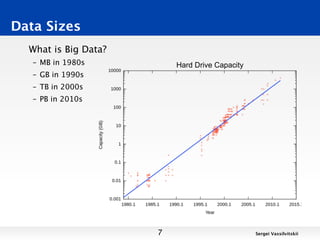
Data Sizes
  What is Big Data?
   – MB in 1980s          Hard Drive Capacity
   – GB in 1990s
   – TB in 2000s
   – PB in 2010s


                      7                         Sergei Vassilvitskii
Working with Big Data

  Two datasets of numbers:
   – Want to find the intersection (common values)
   – Why?
     • Data cleaning (these are missing values)
     • Data mining (these are unique in some way)


                                         8          Sergei Vassilvitskii
Working with Big Data

  Two datasets of numbers:
   – Want to find the intersection (common values)
   – Why?
      • Data cleaning (these are missing values)
      • Data mining (these are unique in some way)


   – How long should it take?
      •   Each   dataset   has   10 numbers?
      •   Each   dataset   has   10k numbers?
      •   Each   dataset   has   10M numbers?
      •   Each   dataset   has   10B numbers?
      •   Each   dataset   has   10T numbers?


                                                9    Sergei Vassilvitskii
How to Find Intersections?


                    10       Sergei Vassilvitskii
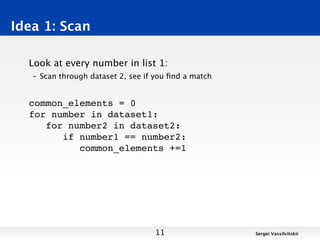
Idea 1: Scan

  Look at every number in list 1:
   – Scan through dataset 2, see if you find a match


  common_elements = 0
  for number in dataset1:
     for number2 in dataset2:
        if number1 == number2:
           common_elements +=1


                                   11                 Sergei Vassilvitskii
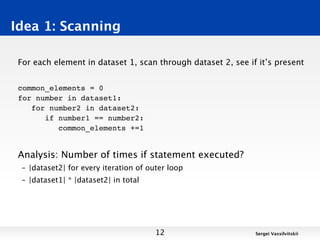
Idea 1: Scanning

 For each element in dataset 1, scan through dataset 2, see if it’s present


 common_elements = 0
 for number in dataset1:
    for number2 in dataset2:
       if number1 == number2:
          common_elements +=1


 Analysis: Number of times if statement executed?
 – |dataset2| for every iteration of outer loop
 – |dataset1| * |dataset2| in total


                                       12                     Sergei Vassilvitskii
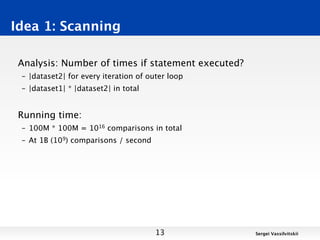
Idea 1: Scanning

 Analysis: Number of times if statement executed?
 – |dataset2| for every iteration of outer loop
 – |dataset1| * |dataset2| in total


 Running time:
 – 100M * 100M = 1016 comparisons in total
 – At 1B (109) comparisons / second


                                       13           Sergei Vassilvitskii
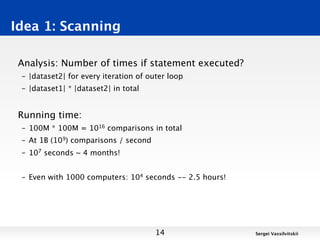
Idea 1: Scanning

 Analysis: Number of times if statement executed?
 – |dataset2| for every iteration of outer loop
 – |dataset1| * |dataset2| in total


 Running time:
 – 100M * 100M = 1016 comparisons in total
 – At 1B (109) comparisons / second
 – 107 seconds ~ 4 months!


 – Even with 1000 computers: 104 seconds -- 2.5 hours!


                                       14                Sergei Vassilvitskii
Idea 2: Sorting

  Suppose both sets are sorted
   – Keep pointers to each
   – Check for match, increase the smaller pointer


  [Blackboard]


                                    15               Sergei Vassilvitskii
Idea 2: Sorting

sorted1 = sorted(dataset1)
sorted2 = sorted(dataset2)
pointer1, pointer2 = 0
common_elements = 0
while pointer1 < size(dataset1) and pointer2 < size(dataset2):
   if sorted[pointer1] == sorted[pointer2]:
      common_elements+=1
      pointer1+=1; pointer2+=1
   else if sorted[pointer1] < sorted[pointer2]:
      pointer1+=1
   else:
      pointer2+=1

Analysis:
– Number of times if statement executed?
– Increment a counter each time: |dataset1|+|dataset2|

                                     16                  Sergei Vassilvitskii
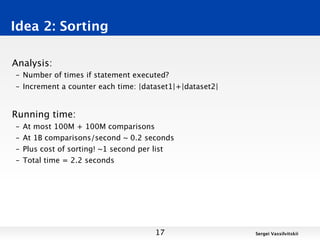
Idea 2: Sorting

Analysis:
– Number of times if statement executed?
– Increment a counter each time: |dataset1|+|dataset2|


Running time:
–   At most 100M + 100M comparisons
–   At 1B comparisons/second ~ 0.2 seconds
–   Plus cost of sorting! ~1 second per list
–   Total time = 2.2 seconds


                                       17                Sergei Vassilvitskii
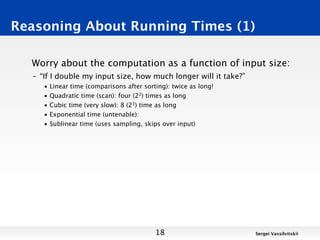
Reasoning About Running Times (1)

  Worry about the computation as a function of input size:
  – “If I double my input size, how much longer will it take?”
     •   Linear time (comparisons after sorting): twice as long!
     •   Quadratic time (scan): four (22) times as long
     •   Cubic time (very slow): 8 (23) time as long
     •   Exponential time (untenable):
     •   Sublinear time (uses sampling, skips over input)


                                            18                     Sergei Vassilvitskii
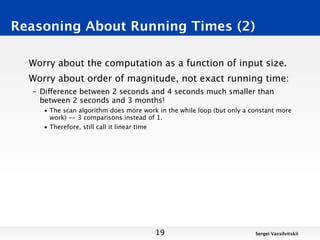
Reasoning About Running Times (2)

  Worry about the computation as a function of input size.
  Worry about order of magnitude, not exact running time:
  – Difference between 2 seconds and 4 seconds much smaller than
    between 2 seconds and 3 months!
     • The scan algorithm does more work in the while loop (but only a constant more
       work) -- 3 comparisons instead of 1.
     • Therefore, still call it linear time


                                        19                              Sergei Vassilvitskii
Reasoning about running time

  Worry about the computation as a function of input size.
  Worry about order of magnitude, not exact running time.


  Captured by the Order notation: O(.)
  – For an input of size n, approximately how long will it take?
  – Scan: O(n2)
  – Comparisons after sorted: O(n)


                                     20                            Sergei Vassilvitskii
Reasoning about running time

  Worry about the computation as a function of input size.
  Worry about order of magnitude, not exact running time.


  Captured by the Order notation: O(.)
  – For an input of size n, approximately how long will it take?
  – Scan: O(n2)
  – Comparisons after sorted: O(n)
  – Sorting = O(n log n)
     • Slightly more than n,
     • But much less than n2.


                                     21                            Sergei Vassilvitskii
Avoiding Sort: Hashing

  Idea 3.
   – Store each number in list1 in a location unique to it
   – For each element in list2, check if its unique location is empty


  [Blackboard]


                                     22                           Sergei Vassilvitskii
Idea 3: Hashing

  table = {}
  for i in range(total):
     table.add(dataset1[i])
  common_elements = 0
  for i in range(total):
     if (table.has(dataset2[i])):
        common_elements+=1

  Analysis:
   – Number of additions to the table: |dataset1|
   – Number of comparisons: |dataset2|
   – If Additions to the table and comparisons are 1B/second
   – Total running time is: 0.2s


                                   23                          Sergei Vassilvitskii
Lots of Details

  Hashing, Sorting, Scanning:
   – All have their advantages
   – Scanning: in place, just passing through the data
   – Sorting: in place (no extra storage), much faster
   – Hashing: not in place, even faster


                                     24                  Sergei Vassilvitskii
Lots of Details

  Hashing, Sorting, Scanning:
   – All have their advantages
   – Scanning: in place, just passing through the data
   – Sorting: in place (no extra storage), much faster
   – Hashing: not in place, even faster


  Reasoning about algorithms:
   – Non trivial (and hard!)
   – A large part of computer science
   – Luckily mostly abstracted


                                     25                  Sergei Vassilvitskii
Break


        26   Sergei Vassilvitskii
Distributed Computation

  Working with large datasets:
  – Most datasets are skewed
  – A few keys are responsible for most of the data
  – Must take skew into account, since averages are misleading


                                   27                        Sergei Vassilvitskii
Additional Cost

  Communication cost
   – Prefer to do more on a single machine (even if it’s doing more work) to
     constantly communicating


   – Why? If you have 1000 machines talking to 1000 machines --- that’s
     1M channels of communication
   – The overall communication cost grows quadratically, which we have
     seen does not scale...


                                    28                          Sergei Vassilvitskii
Analysis at Scale


                    29   Sergei Vassilvitskii
Doing the study

  Suppose you had the data available. What would you do?


  If you have a hypothesis:
   – “Taking both Drug A and Drug B causes a side effect C”?


                                   30                          Sergei Vassilvitskii
Doing the study

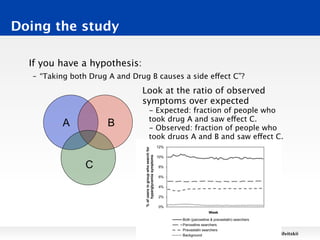
  If you have a hypothesis:
   – “Taking both Drug A and Drug B causes a side effect C”?
                                Look at the ratio of observed
                                symptoms over expected
                                  - Expected: fraction of people who
                                  took drug A and saw effect C.
           A           B          - Observed: fraction of people who
                                  took drugs A and B and saw effect C.


                 C


                                   31                          Sergei Vassilvitskii
Doing the study

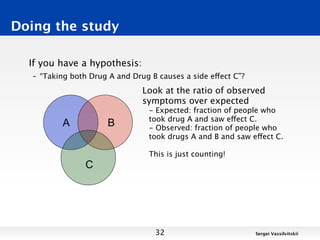
  If you have a hypothesis:
   – “Taking both Drug A and Drug B causes a side effect C”?
                                Look at the ratio of observed
                                symptoms over expected
                                  - Expected: fraction of people who
                                  took drug A and saw effect C.
           A           B          - Observed: fraction of people who
                                  took drugs A and B and saw effect C.

                                  This is just counting!
                 C


                                   32                          Sergei Vassilvitskii
Doing the study

  Suppose you had the data available. What would you do?


  Discovering hypotheses to test:
   – Many pairs of drugs, some co-occur very often
   – Some side effects are already known


                                   33                Sergei Vassilvitskii

Computational Social Science, Lecture 07: Counting Fast, Part I

  • 1.
    Counting Fast (Part I) Sergei Vassilvitskii Columbia University Computational Social Science March 8, 2013
  • 2.
    Computers are fast! Servers: – 3.5+ Ghz Laptops: – 2.0 - 3 Ghz Phones: – 1.0-1.5 GHz Overall: Executes billions of operations per second! 2 Sergei Vassilvitskii
  • 3.
    But Data isBig! Datasets are huge: – Social Graphs (Billions of nodes, each with hundreds of edges) • Terabytes (million million bytes) – Pictures, Videos, associated metadata: • Petabytes (million billion bytes!) 3 Sergei Vassilvitskii
  • 4.
    Computers are gettingfaster Moore’s law (1965!): – Number of transistors on a chip doubles every two years. 4 Sergei Vassilvitskii
  • 5.
    Computers are gettingfaster Moore’s law (1965!): – Number of transistors on a chip doubles every two years. For a few decades: – The speed of chips doubled every 24 months. Now: – The number of cores doubling – Speed staying roughly the same 5 Sergei Vassilvitskii
  • 6.
    But Data isGetting Even Bigger Unknown author, 1981 (?): – “640K ought to be enough for anyone” Eric Schmidt, March 2013: – “There were 5 exabytes of information created between the dawn of civilization through 2003, but that much information is now created every 2 days, and the pace is increasing.” 6 Sergei Vassilvitskii
  • 7.
    Data Sizes What is Big Data? – MB in 1980s Hard Drive Capacity – GB in 1990s – TB in 2000s – PB in 2010s 7 Sergei Vassilvitskii
  • 8.
    Working with BigData Two datasets of numbers: – Want to find the intersection (common values) – Why? • Data cleaning (these are missing values) • Data mining (these are unique in some way) 8 Sergei Vassilvitskii
  • 9.
    Working with BigData Two datasets of numbers: – Want to find the intersection (common values) – Why? • Data cleaning (these are missing values) • Data mining (these are unique in some way) – How long should it take? • Each dataset has 10 numbers? • Each dataset has 10k numbers? • Each dataset has 10M numbers? • Each dataset has 10B numbers? • Each dataset has 10T numbers? 9 Sergei Vassilvitskii
  • 10.
    How to FindIntersections? 10 Sergei Vassilvitskii
  • 11.
    Idea 1: Scan Look at every number in list 1: – Scan through dataset 2, see if you find a match common_elements = 0 for number in dataset1: for number2 in dataset2: if number1 == number2: common_elements +=1 11 Sergei Vassilvitskii
  • 12.
    Idea 1: Scanning For each element in dataset 1, scan through dataset 2, see if it’s present common_elements = 0 for number in dataset1: for number2 in dataset2: if number1 == number2: common_elements +=1 Analysis: Number of times if statement executed? – |dataset2| for every iteration of outer loop – |dataset1| * |dataset2| in total 12 Sergei Vassilvitskii
  • 13.
    Idea 1: Scanning Analysis: Number of times if statement executed? – |dataset2| for every iteration of outer loop – |dataset1| * |dataset2| in total Running time: – 100M * 100M = 1016 comparisons in total – At 1B (109) comparisons / second 13 Sergei Vassilvitskii
  • 14.
    Idea 1: Scanning Analysis: Number of times if statement executed? – |dataset2| for every iteration of outer loop – |dataset1| * |dataset2| in total Running time: – 100M * 100M = 1016 comparisons in total – At 1B (109) comparisons / second – 107 seconds ~ 4 months! – Even with 1000 computers: 104 seconds -- 2.5 hours! 14 Sergei Vassilvitskii
  • 15.
    Idea 2: Sorting Suppose both sets are sorted – Keep pointers to each – Check for match, increase the smaller pointer [Blackboard] 15 Sergei Vassilvitskii
  • 16.
    Idea 2: Sorting sorted1= sorted(dataset1) sorted2 = sorted(dataset2) pointer1, pointer2 = 0 common_elements = 0 while pointer1 < size(dataset1) and pointer2 < size(dataset2): if sorted[pointer1] == sorted[pointer2]: common_elements+=1 pointer1+=1; pointer2+=1 else if sorted[pointer1] < sorted[pointer2]: pointer1+=1 else: pointer2+=1 Analysis: – Number of times if statement executed? – Increment a counter each time: |dataset1|+|dataset2| 16 Sergei Vassilvitskii
  • 17.
    Idea 2: Sorting Analysis: –Number of times if statement executed? – Increment a counter each time: |dataset1|+|dataset2| Running time: – At most 100M + 100M comparisons – At 1B comparisons/second ~ 0.2 seconds – Plus cost of sorting! ~1 second per list – Total time = 2.2 seconds 17 Sergei Vassilvitskii
  • 18.
    Reasoning About RunningTimes (1) Worry about the computation as a function of input size: – “If I double my input size, how much longer will it take?” • Linear time (comparisons after sorting): twice as long! • Quadratic time (scan): four (22) times as long • Cubic time (very slow): 8 (23) time as long • Exponential time (untenable): • Sublinear time (uses sampling, skips over input) 18 Sergei Vassilvitskii
  • 19.
    Reasoning About RunningTimes (2) Worry about the computation as a function of input size. Worry about order of magnitude, not exact running time: – Difference between 2 seconds and 4 seconds much smaller than between 2 seconds and 3 months! • The scan algorithm does more work in the while loop (but only a constant more work) -- 3 comparisons instead of 1. • Therefore, still call it linear time 19 Sergei Vassilvitskii
  • 20.
    Reasoning about runningtime Worry about the computation as a function of input size. Worry about order of magnitude, not exact running time. Captured by the Order notation: O(.) – For an input of size n, approximately how long will it take? – Scan: O(n2) – Comparisons after sorted: O(n) 20 Sergei Vassilvitskii
  • 21.
    Reasoning about runningtime Worry about the computation as a function of input size. Worry about order of magnitude, not exact running time. Captured by the Order notation: O(.) – For an input of size n, approximately how long will it take? – Scan: O(n2) – Comparisons after sorted: O(n) – Sorting = O(n log n) • Slightly more than n, • But much less than n2. 21 Sergei Vassilvitskii
  • 22.
    Avoiding Sort: Hashing Idea 3. – Store each number in list1 in a location unique to it – For each element in list2, check if its unique location is empty [Blackboard] 22 Sergei Vassilvitskii
  • 23.
    Idea 3: Hashing table = {} for i in range(total): table.add(dataset1[i]) common_elements = 0 for i in range(total): if (table.has(dataset2[i])): common_elements+=1 Analysis: – Number of additions to the table: |dataset1| – Number of comparisons: |dataset2| – If Additions to the table and comparisons are 1B/second – Total running time is: 0.2s 23 Sergei Vassilvitskii
  • 24.
    Lots of Details Hashing, Sorting, Scanning: – All have their advantages – Scanning: in place, just passing through the data – Sorting: in place (no extra storage), much faster – Hashing: not in place, even faster 24 Sergei Vassilvitskii
  • 25.
    Lots of Details Hashing, Sorting, Scanning: – All have their advantages – Scanning: in place, just passing through the data – Sorting: in place (no extra storage), much faster – Hashing: not in place, even faster Reasoning about algorithms: – Non trivial (and hard!) – A large part of computer science – Luckily mostly abstracted 25 Sergei Vassilvitskii
  • 26.
    Break 26 Sergei Vassilvitskii
  • 27.
    Distributed Computation Working with large datasets: – Most datasets are skewed – A few keys are responsible for most of the data – Must take skew into account, since averages are misleading 27 Sergei Vassilvitskii
  • 28.
    Additional Cost Communication cost – Prefer to do more on a single machine (even if it’s doing more work) to constantly communicating – Why? If you have 1000 machines talking to 1000 machines --- that’s 1M channels of communication – The overall communication cost grows quadratically, which we have seen does not scale... 28 Sergei Vassilvitskii
  • 29.
    Analysis at Scale 29 Sergei Vassilvitskii
  • 30.
    Doing the study Suppose you had the data available. What would you do? If you have a hypothesis: – “Taking both Drug A and Drug B causes a side effect C”? 30 Sergei Vassilvitskii
  • 31.
    Doing the study If you have a hypothesis: – “Taking both Drug A and Drug B causes a side effect C”? Look at the ratio of observed symptoms over expected - Expected: fraction of people who took drug A and saw effect C. A B - Observed: fraction of people who took drugs A and B and saw effect C. C 31 Sergei Vassilvitskii
  • 32.
    Doing the study If you have a hypothesis: – “Taking both Drug A and Drug B causes a side effect C”? Look at the ratio of observed symptoms over expected - Expected: fraction of people who took drug A and saw effect C. A B - Observed: fraction of people who took drugs A and B and saw effect C. This is just counting! C 32 Sergei Vassilvitskii
  • 33.
    Doing the study Suppose you had the data available. What would you do? Discovering hypotheses to test: – Many pairs of drugs, some co-occur very often – Some side effects are already known 33 Sergei Vassilvitskii