Recommendation Systems
APAM E4990
Modeling Social Data
Jake Hofman
Columbia University
March 13, 2015
Jake Hofman (Columbia University) Recommendation Systems March 13, 2015 1 / 29
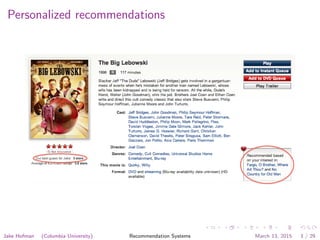
Personalized recommendations
Jake Hofman (Columbia University) Recommendation Systems March 13, 2015 2 / 29
Personalized recommendations
Jake Hofman (Columbia University) Recommendation Systems March 13, 2015 3 / 29
http://netflixprize.com
Jake Hofman (Columbia University) Recommendation Systems March 13, 2015 4 / 29
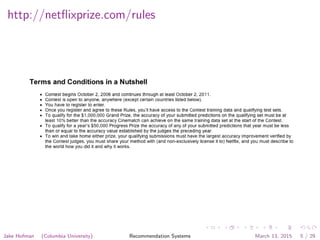
http://netflixprize.com/rules
Jake Hofman (Columbia University) Recommendation Systems March 13, 2015 5 / 29
http://netflixprize.com/faq
Jake Hofman (Columbia University) Recommendation Systems March 13, 2015 6 / 29
Netflix prize: results
http://en.wikipedia.org/wiki/Netflix_Prize
Jake Hofman (Columbia University) Recommendation Systems March 13, 2015 7 / 29
Netflix prize: results
See [TJB09] and [Kor09] for more gory details.
Jake Hofman (Columbia University) Recommendation Systems March 13, 2015 8 / 29
http://bit.ly/beyond5stars
Jake Hofman (Columbia University) Recommendation Systems March 13, 2015 9 / 29
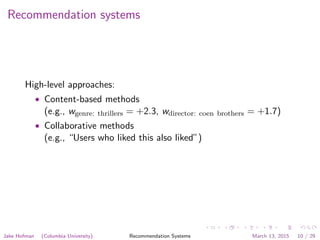
Recommendation systems
High-level approaches:
• Content-based methods
(e.g., wgenre: thrillers = +2.3, wdirector: coen brothers = +1.7)
• Collaborative methods
(e.g., “Users who liked this also liked”)
Jake Hofman (Columbia University) Recommendation Systems March 13, 2015 10 / 29
Netflix prize: data
(userid, movieid, rating, date)
Jake Hofman (Columbia University) Recommendation Systems March 13, 2015 11 / 29
Netflix prize: data
(movieid, year, title)
Jake Hofman (Columbia University) Recommendation Systems March 13, 2015 11 / 29
Recommendation systems
High-level approaches:
• Content-based methods
(e.g., wgenre: thrillers = +2.3, wdirector: coen brothers = +1.7)
• Collaborative methods
(e.g., “Users who liked this also liked”)
Jake Hofman (Columbia University) Recommendation Systems March 13, 2015 12 / 29
Collaborative filtering
Memory-based
(e.g., k-nearest neighbors)
Model-based
(e.g., matrix factorization)
http://research.yahoo.com/pub/2859
Jake Hofman (Columbia University) Recommendation Systems March 13, 2015 13 / 29
Problem statement
• Given a set of past ratings Rui that user u gave item i
• Users may explicitly assign ratings, e.g., Rui ∈ [1, 5] is number
of stars for movie rating
• Or we may infer implicit ratings from user actions, e.g.
Rui = 1 if u purchased i; otherwise Rui = ?
Jake Hofman (Columbia University) Recommendation Systems March 13, 2015 14 / 29
Problem statement
• Given a set of past ratings Rui that user u gave item i
• Users may explicitly assign ratings, e.g., Rui ∈ [1, 5] is number
of stars for movie rating
• Or we may infer implicit ratings from user actions, e.g.
Rui = 1 if u purchased i; otherwise Rui = ?
• Make recommendations of several forms
• Predict unseen item ratings for a particular user
• Suggest items for a particular user
• Suggest items similar to a particular item
• . . .
Jake Hofman (Columbia University) Recommendation Systems March 13, 2015 14 / 29
Problem statement
• Given a set of past ratings Rui that user u gave item i
• Users may explicitly assign ratings, e.g., Rui ∈ [1, 5] is number
of stars for movie rating
• Or we may infer implicit ratings from user actions, e.g.
Rui = 1 if u purchased i; otherwise Rui = ?
• Make recommendations of several forms
• Predict unseen item ratings for a particular user
• Suggest items for a particular user
• Suggest items similar to a particular item
• . . .
• Compare to natural baselines
• Guess global average for item ratings
• Suggest globally popular items
Jake Hofman (Columbia University) Recommendation Systems March 13, 2015 14 / 29
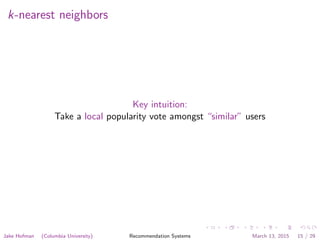
k-nearest neighbors
Key intuition:
Take a local popularity vote amongst “similar” users
Jake Hofman (Columbia University) Recommendation Systems March 13, 2015 15 / 29
k-nearest neighbors
User similarity
Quantify similarity as a function of users’ past ratings, e.g.
• Fraction of items u and v have in common
Suv =
|ru ∩ rv |
|ru ∪ rv |
= i Rui Rvi
i (Rui + Rvi − Rui Rvi )
(1)
Retain top-k most similar neighbors v for each user u
Jake Hofman (Columbia University) Recommendation Systems March 13, 2015 16 / 29
k-nearest neighbors
User similarity
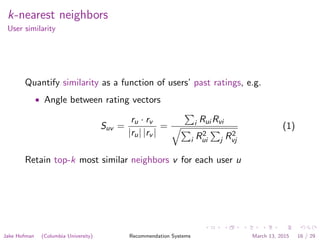
Quantify similarity as a function of users’ past ratings, e.g.
• Angle between rating vectors
Suv =
ru · rv
|ru| |rv |
= i Rui Rvi
i R2
ui j R2
vj
(1)
Retain top-k most similar neighbors v for each user u
Jake Hofman (Columbia University) Recommendation Systems March 13, 2015 16 / 29
k-nearest neighbors
Predicted ratings
Predict unseen ratings ˆRui as a weighted vote over u’s neighbors’
ratings for item i
ˆRui = v Rvi Suv
v Suv
(2)
Jake Hofman (Columbia University) Recommendation Systems March 13, 2015 17 / 29
k-nearest neighbors
Practical notes
We expect most users have nothing in common, so calculate
similarities as:
for each item i:
for all pairs of users u, v that have rated i:
calculate Suv (if not already calculated)
Jake Hofman (Columbia University) Recommendation Systems March 13, 2015 18 / 29
k-nearest neighbors
Practical notes
Alternatively, we can make recommendations using an item-based
approach [LSY03]:
• Compute similarities Sij between all pairs of items
• Predict ratings with a weighted vote ˆRui = j Ruj Sij / j Sij
Jake Hofman (Columbia University) Recommendation Systems March 13, 2015 18 / 29
k-nearest neighbors
Practical notes
Several (relatively) simple ways to scale:
• Sample a subset of ratings for each user (by, e.g., recency)
• Use MinHash to cluster users [DDGR07]
• Distribute calculations with MapReduce
Jake Hofman (Columbia University) Recommendation Systems March 13, 2015 18 / 29
Matrix factorization
Key intuition:
Model item attributes as belonging to a set of unobserved “topics
and user preferences across these “topics”
Jake Hofman (Columbia University) Recommendation Systems March 13, 2015 19 / 29
Matrix factorization
Linear model
Start with a simple linear model:
ˆRui = b0
global average
+ bu
user bias
+ bi
item bias
(3)
Jake Hofman (Columbia University) Recommendation Systems March 13, 2015 20 / 29
Matrix factorization
Linear model
For example, we might predict that a harsh critic would score a
popular movie as
ˆRui = 3.6
global average
+ −0.5
user bias
+ 0.8
item bias
(3)
= 3.9 (4)
Jake Hofman (Columbia University) Recommendation Systems March 13, 2015 20 / 29
Matrix factorization
Low-rank approximation
Add an interaction term:
ˆRui = b0
global average
+ bu
user bias
+ bi
item bias
+ Wui
user-item interaction
(5)
where Wui = pu · qi = k PukQik
• Puk is user u’s preference for topic k
• Qik is item i’s association with topic k
Jake Hofman (Columbia University) Recommendation Systems March 13, 2015 21 / 29
Matrix factorization
Loss function
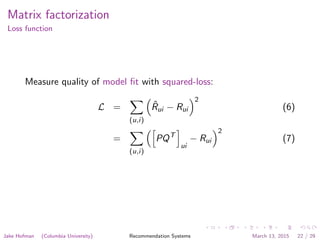
Measure quality of model fit with squared-loss:
L =
(u,i)
ˆRui − Rui
2
(6)
=
(u,i)
PQT
ui
− Rui
2
(7)
Jake Hofman (Columbia University) Recommendation Systems March 13, 2015 22 / 29
Matrix factorization
Optimization
The loss is non-convex in (P, Q), so no global minimum exists
Instead we can optimize L iteratively, e.g.:
• Alternating least squares: update each row of P, holding Q
fixed, and vice-versa
• Stochastic gradient descent: update individual rows pu and qi
for each observed Rui
Jake Hofman (Columbia University) Recommendation Systems March 13, 2015 23 / 29
Matrix factorization
Alternating least squares
L is convex in rows of P with Q fixed, and Q with P fixed, so
alternate solutions to the normal equations:
pu = Q(u)T
Q(u)
−1
Q(u)T
r(u) (8)
qi = P(i)T
P(i)
−1
P(i)T
r(i) (9)
where:
• Q(u) is the item association matrix restricted to items rated
by user u
• P(i) is the user preference matrix restricted to users that have
rated item i
• r(u) are ratings by user u and r(i) are ratings on item i
Jake Hofman (Columbia University) Recommendation Systems March 13, 2015 24 / 29
Matrix factorization
Stochastic gradient descent
Alternatively, we can avoid inverting matrices by taking steps in
the direction of the negative gradient for each observed rating:
pu ← pu − η
∂L
∂pu
= pu + Rui − ˆRui qi (10)
qi ← qi − η
∂L
∂qi
= qi + Rui − ˆRui pu (11)
for some step-size η
Jake Hofman (Columbia University) Recommendation Systems March 13, 2015 25 / 29
Matrix factorization
Practical notes
Several ways to scale:
• Distribute matrix operations with MapReduce [GHNS11]
• Parallelize stochastic gradient descent [ZWSL10]
• Expectation-maximization for pLSI with MapReduce
[DDGR07]
Jake Hofman (Columbia University) Recommendation Systems March 13, 2015 26 / 29
Datasets
• Movielens
http://www.grouplens.org/node/12
• Reddit
http://bit.ly/redditdata
• CU “million songs”
http://labrosa.ee.columbia.edu/millionsong/
• Yahoo Music KDDcup
http://kddcup.yahoo.com/
• AudioScrobbler
http://bit.ly/audioscrobblerdata
• Delicious
http://bit.ly/deliciousdata
• . . .
Jake Hofman (Columbia University) Recommendation Systems March 13, 2015 27 / 29
References I
AS Das, M Datar, A Garg, and S Rajaram.
Google news personalization: scalable online collaborative
filtering.
page 280, 2007.
R Gemulla, PJ Haas, E Nijkamp, and Y Sismanis.
Large-scale matrix factorization with distributed stochastic
gradient descent.
2011.
Yehuda Koren.
The bellkor solution to the netflix grand prize.
pages 1–10, Aug 2009.
G Linden, B Smith, and J York.
Amazon. com recommendations: Item-to-item collaborative
filtering.
IEEE Internet computing, 7(1):76–80, 2003.
Jake Hofman (Columbia University) Recommendation Systems March 13, 2015 28 / 29
References II
A Toscher, M Jahrer, and RM Bell.
The bigchaos solution to the netflix grand prize.
2009.
M. Zinkevich, M. Weimer, A. Smola, and L. Li.
Parallelized stochastic gradient descent.
In Neural Information Processing Systems (NIPS), 2010.
Jake Hofman (Columbia University) Recommendation Systems March 13, 2015 29 / 29

Modeling Social Data, Lecture 8: Recommendation Systems

  • 1.
    Recommendation Systems APAM E4990 ModelingSocial Data Jake Hofman Columbia University March 13, 2015 Jake Hofman (Columbia University) Recommendation Systems March 13, 2015 1 / 29
  • 2.
    Personalized recommendations Jake Hofman(Columbia University) Recommendation Systems March 13, 2015 2 / 29
  • 3.
    Personalized recommendations Jake Hofman(Columbia University) Recommendation Systems March 13, 2015 3 / 29
  • 4.
    http://netflixprize.com Jake Hofman (ColumbiaUniversity) Recommendation Systems March 13, 2015 4 / 29
  • 5.
    http://netflixprize.com/rules Jake Hofman (ColumbiaUniversity) Recommendation Systems March 13, 2015 5 / 29
  • 6.
    http://netflixprize.com/faq Jake Hofman (ColumbiaUniversity) Recommendation Systems March 13, 2015 6 / 29
  • 7.
    Netflix prize: results http://en.wikipedia.org/wiki/Netflix_Prize JakeHofman (Columbia University) Recommendation Systems March 13, 2015 7 / 29
  • 8.
    Netflix prize: results See[TJB09] and [Kor09] for more gory details. Jake Hofman (Columbia University) Recommendation Systems March 13, 2015 8 / 29
  • 9.
    http://bit.ly/beyond5stars Jake Hofman (ColumbiaUniversity) Recommendation Systems March 13, 2015 9 / 29
  • 10.
    Recommendation systems High-level approaches: •Content-based methods (e.g., wgenre: thrillers = +2.3, wdirector: coen brothers = +1.7) • Collaborative methods (e.g., “Users who liked this also liked”) Jake Hofman (Columbia University) Recommendation Systems March 13, 2015 10 / 29
  • 11.
    Netflix prize: data (userid,movieid, rating, date) Jake Hofman (Columbia University) Recommendation Systems March 13, 2015 11 / 29
  • 12.
    Netflix prize: data (movieid,year, title) Jake Hofman (Columbia University) Recommendation Systems March 13, 2015 11 / 29
  • 13.
    Recommendation systems High-level approaches: •Content-based methods (e.g., wgenre: thrillers = +2.3, wdirector: coen brothers = +1.7) • Collaborative methods (e.g., “Users who liked this also liked”) Jake Hofman (Columbia University) Recommendation Systems March 13, 2015 12 / 29
  • 14.
    Collaborative filtering Memory-based (e.g., k-nearestneighbors) Model-based (e.g., matrix factorization) http://research.yahoo.com/pub/2859 Jake Hofman (Columbia University) Recommendation Systems March 13, 2015 13 / 29
  • 15.
    Problem statement • Givena set of past ratings Rui that user u gave item i • Users may explicitly assign ratings, e.g., Rui ∈ [1, 5] is number of stars for movie rating • Or we may infer implicit ratings from user actions, e.g. Rui = 1 if u purchased i; otherwise Rui = ? Jake Hofman (Columbia University) Recommendation Systems March 13, 2015 14 / 29
  • 16.
    Problem statement • Givena set of past ratings Rui that user u gave item i • Users may explicitly assign ratings, e.g., Rui ∈ [1, 5] is number of stars for movie rating • Or we may infer implicit ratings from user actions, e.g. Rui = 1 if u purchased i; otherwise Rui = ? • Make recommendations of several forms • Predict unseen item ratings for a particular user • Suggest items for a particular user • Suggest items similar to a particular item • . . . Jake Hofman (Columbia University) Recommendation Systems March 13, 2015 14 / 29
  • 17.
    Problem statement • Givena set of past ratings Rui that user u gave item i • Users may explicitly assign ratings, e.g., Rui ∈ [1, 5] is number of stars for movie rating • Or we may infer implicit ratings from user actions, e.g. Rui = 1 if u purchased i; otherwise Rui = ? • Make recommendations of several forms • Predict unseen item ratings for a particular user • Suggest items for a particular user • Suggest items similar to a particular item • . . . • Compare to natural baselines • Guess global average for item ratings • Suggest globally popular items Jake Hofman (Columbia University) Recommendation Systems March 13, 2015 14 / 29
  • 18.
    k-nearest neighbors Key intuition: Takea local popularity vote amongst “similar” users Jake Hofman (Columbia University) Recommendation Systems March 13, 2015 15 / 29
  • 19.
    k-nearest neighbors User similarity Quantifysimilarity as a function of users’ past ratings, e.g. • Fraction of items u and v have in common Suv = |ru ∩ rv | |ru ∪ rv | = i Rui Rvi i (Rui + Rvi − Rui Rvi ) (1) Retain top-k most similar neighbors v for each user u Jake Hofman (Columbia University) Recommendation Systems March 13, 2015 16 / 29
  • 20.
    k-nearest neighbors User similarity Quantifysimilarity as a function of users’ past ratings, e.g. • Angle between rating vectors Suv = ru · rv |ru| |rv | = i Rui Rvi i R2 ui j R2 vj (1) Retain top-k most similar neighbors v for each user u Jake Hofman (Columbia University) Recommendation Systems March 13, 2015 16 / 29
  • 21.
    k-nearest neighbors Predicted ratings Predictunseen ratings ˆRui as a weighted vote over u’s neighbors’ ratings for item i ˆRui = v Rvi Suv v Suv (2) Jake Hofman (Columbia University) Recommendation Systems March 13, 2015 17 / 29
  • 22.
    k-nearest neighbors Practical notes Weexpect most users have nothing in common, so calculate similarities as: for each item i: for all pairs of users u, v that have rated i: calculate Suv (if not already calculated) Jake Hofman (Columbia University) Recommendation Systems March 13, 2015 18 / 29
  • 23.
    k-nearest neighbors Practical notes Alternatively,we can make recommendations using an item-based approach [LSY03]: • Compute similarities Sij between all pairs of items • Predict ratings with a weighted vote ˆRui = j Ruj Sij / j Sij Jake Hofman (Columbia University) Recommendation Systems March 13, 2015 18 / 29
  • 24.
    k-nearest neighbors Practical notes Several(relatively) simple ways to scale: • Sample a subset of ratings for each user (by, e.g., recency) • Use MinHash to cluster users [DDGR07] • Distribute calculations with MapReduce Jake Hofman (Columbia University) Recommendation Systems March 13, 2015 18 / 29
  • 25.
    Matrix factorization Key intuition: Modelitem attributes as belonging to a set of unobserved “topics and user preferences across these “topics” Jake Hofman (Columbia University) Recommendation Systems March 13, 2015 19 / 29
  • 26.
    Matrix factorization Linear model Startwith a simple linear model: ˆRui = b0 global average + bu user bias + bi item bias (3) Jake Hofman (Columbia University) Recommendation Systems March 13, 2015 20 / 29
  • 27.
    Matrix factorization Linear model Forexample, we might predict that a harsh critic would score a popular movie as ˆRui = 3.6 global average + −0.5 user bias + 0.8 item bias (3) = 3.9 (4) Jake Hofman (Columbia University) Recommendation Systems March 13, 2015 20 / 29
  • 28.
    Matrix factorization Low-rank approximation Addan interaction term: ˆRui = b0 global average + bu user bias + bi item bias + Wui user-item interaction (5) where Wui = pu · qi = k PukQik • Puk is user u’s preference for topic k • Qik is item i’s association with topic k Jake Hofman (Columbia University) Recommendation Systems March 13, 2015 21 / 29
  • 29.
    Matrix factorization Loss function Measurequality of model fit with squared-loss: L = (u,i) ˆRui − Rui 2 (6) = (u,i) PQT ui − Rui 2 (7) Jake Hofman (Columbia University) Recommendation Systems March 13, 2015 22 / 29
  • 30.
    Matrix factorization Optimization The lossis non-convex in (P, Q), so no global minimum exists Instead we can optimize L iteratively, e.g.: • Alternating least squares: update each row of P, holding Q fixed, and vice-versa • Stochastic gradient descent: update individual rows pu and qi for each observed Rui Jake Hofman (Columbia University) Recommendation Systems March 13, 2015 23 / 29
  • 31.
    Matrix factorization Alternating leastsquares L is convex in rows of P with Q fixed, and Q with P fixed, so alternate solutions to the normal equations: pu = Q(u)T Q(u) −1 Q(u)T r(u) (8) qi = P(i)T P(i) −1 P(i)T r(i) (9) where: • Q(u) is the item association matrix restricted to items rated by user u • P(i) is the user preference matrix restricted to users that have rated item i • r(u) are ratings by user u and r(i) are ratings on item i Jake Hofman (Columbia University) Recommendation Systems March 13, 2015 24 / 29
  • 32.
    Matrix factorization Stochastic gradientdescent Alternatively, we can avoid inverting matrices by taking steps in the direction of the negative gradient for each observed rating: pu ← pu − η ∂L ∂pu = pu + Rui − ˆRui qi (10) qi ← qi − η ∂L ∂qi = qi + Rui − ˆRui pu (11) for some step-size η Jake Hofman (Columbia University) Recommendation Systems March 13, 2015 25 / 29
  • 33.
    Matrix factorization Practical notes Severalways to scale: • Distribute matrix operations with MapReduce [GHNS11] • Parallelize stochastic gradient descent [ZWSL10] • Expectation-maximization for pLSI with MapReduce [DDGR07] Jake Hofman (Columbia University) Recommendation Systems March 13, 2015 26 / 29
  • 34.
    Datasets • Movielens http://www.grouplens.org/node/12 • Reddit http://bit.ly/redditdata •CU “million songs” http://labrosa.ee.columbia.edu/millionsong/ • Yahoo Music KDDcup http://kddcup.yahoo.com/ • AudioScrobbler http://bit.ly/audioscrobblerdata • Delicious http://bit.ly/deliciousdata • . . . Jake Hofman (Columbia University) Recommendation Systems March 13, 2015 27 / 29
  • 35.
    References I AS Das,M Datar, A Garg, and S Rajaram. Google news personalization: scalable online collaborative filtering. page 280, 2007. R Gemulla, PJ Haas, E Nijkamp, and Y Sismanis. Large-scale matrix factorization with distributed stochastic gradient descent. 2011. Yehuda Koren. The bellkor solution to the netflix grand prize. pages 1–10, Aug 2009. G Linden, B Smith, and J York. Amazon. com recommendations: Item-to-item collaborative filtering. IEEE Internet computing, 7(1):76–80, 2003. Jake Hofman (Columbia University) Recommendation Systems March 13, 2015 28 / 29
  • 36.
    References II A Toscher,M Jahrer, and RM Bell. The bigchaos solution to the netflix grand prize. 2009. M. Zinkevich, M. Weimer, A. Smola, and L. Li. Parallelized stochastic gradient descent. In Neural Information Processing Systems (NIPS), 2010. Jake Hofman (Columbia University) Recommendation Systems March 13, 2015 29 / 29