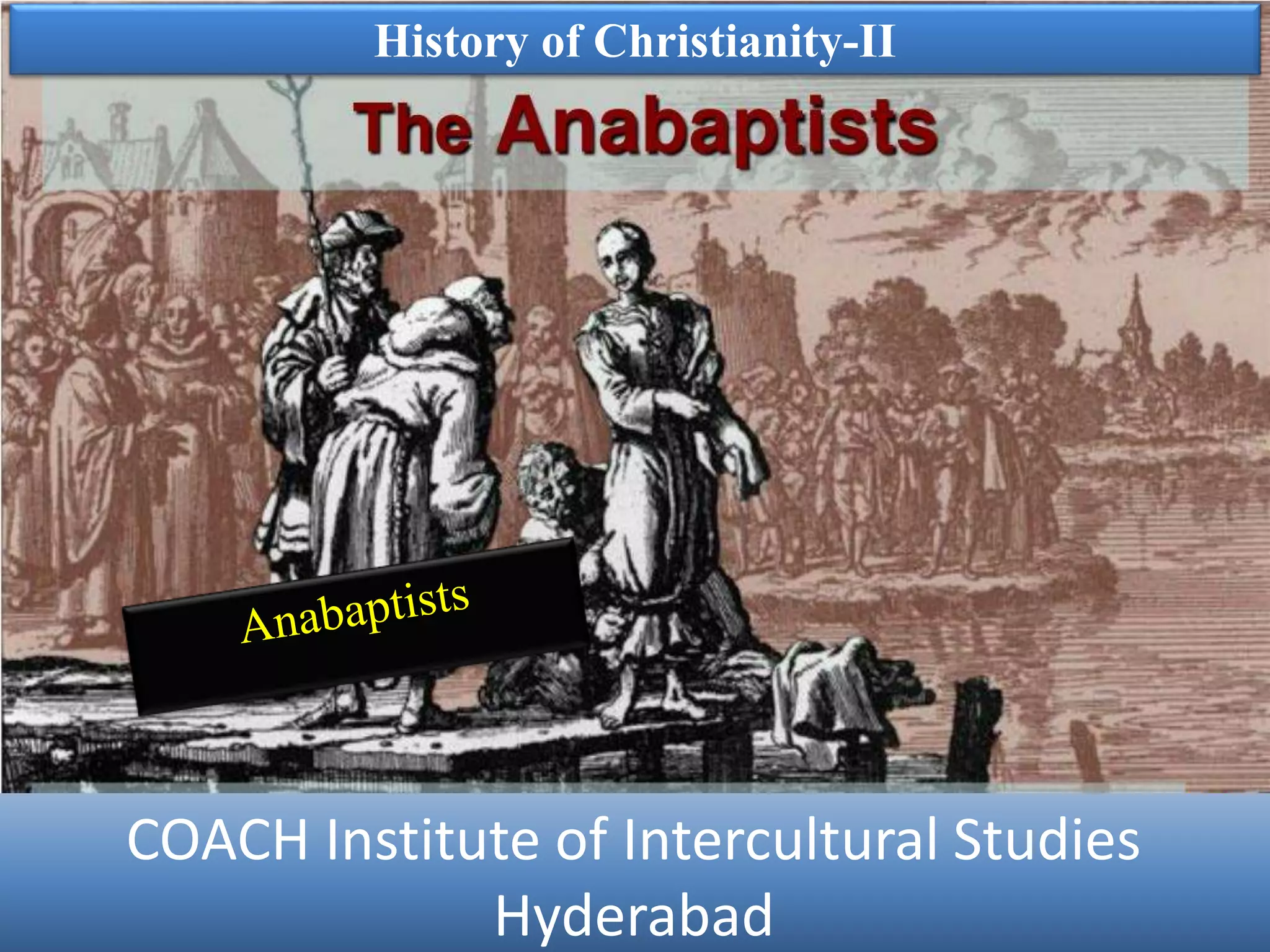
History of Christianity-II
COACH Institute of Intercultural Studies
Hyderabad
The Protestant Reformation
1300 – 1570 CE
Anabaptists are Christians of the
Reformation of 16th century Europe.
Although some consider the Anabaptist
movement to be an off shoot of
Protestantism, others see it as a distinct
movement. The Amish, Hutterites, and
Mennonites are direct descendants of the
movement. Brethren, Bruderhof, and the
Apostolic Christian Church are later
developments in Anabaptist groups
The name Anabaptist is derived from the
Greek term anabaptista, or “one who
baptizes over again.” This name was given
them by their persecutors in reference to the
practice of re-baptizing converts who already
had been baptized as infants.
Anabaptists required that baptismal
candidates be able to make their own
confessions of faith and so rejected baptism
of infants.
The early members of this movement did not
accept the name “Anabaptist”, claiming that
since infant baptism was unscriptural and
null and void, the baptizing of believers was
not a rebaptism but in fact their first real
baptism.
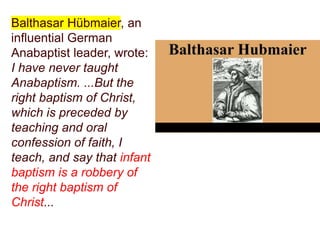
Balthasar Hübmaier, an
influential German
Anabaptist leader, wrote:
I have never taught
Anabaptism. ...But the
right baptism of Christ,
which is preceded by
teaching and oral
confession of faith, I
teach, and say that infant
baptism is a robbery of
the right baptism of
Christ...
As a result of their views on the nature of baptism and other
issues, Anabaptists were heavily persecuted during the 16th
century and into the 17th by both Magisterial Protestants
and Roman Catholics.
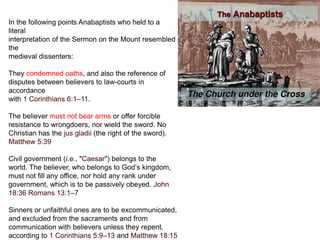
In the following points Anabaptists who held to a
literal
interpretation of the Sermon on the Mount resembled
the
medieval dissenters:
They condemned oaths, and also the reference of
disputes between believers to law-courts in
accordance
with 1 Corinthians 6:1–11.
The believer must not bear arms or offer forcible
resistance to wrongdoers, nor wield the sword. No
Christian has the jus gladii (the right of the sword).
Matthew 5:39
Civil government (i.e., "Caesar") belongs to the
world. The believer, who belongs to God’s kingdom,
must not fill any office, nor hold any rank under
government, which is to be passively obeyed. John
18:36 Romans 13:1–7
Sinners or unfaithful ones are to be excommunicated,
and excluded from the sacraments and from
communication with believers unless they repent,
according to 1 Corinthians 5:9–13 and Matthew 18:15
• Against violence, war, child baptism and
theocracy
• simple living—lived apart from
society in own communities.
• everyone has access to Bible
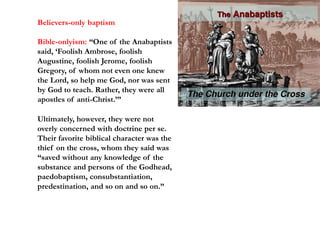
Believers-only baptism
Bible-onlyism: “One of the Anabaptists
said, ‘Foolish Ambrose, foolish
Augustine, foolish Jerome, foolish
Gregory, of whom not even one knew
the Lord, so help me God, nor was sent
by God to teach. Rather, they were all
apostles of anti-Christ.’”
Ultimately, however, they were not
overly concerned with doctrine per se.
Their favorite biblical character was the
thief on the cross, whom they said was
“saved without any knowledge of the
substance and persons of the Godhead,
paedobaptism, consubstantiation,
predestination, and so on and so on.”
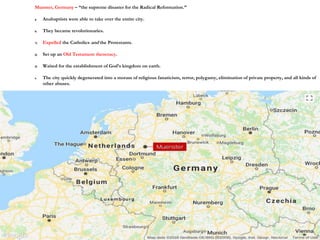
Munster, Germany – “the supreme disaster for the Radical Reformation.”
a. Anabaptists were able to take over the entire city.
b. They became revolutionaries.
1) Expelled the Catholics and the Protestants.
2) Set up an Old Testament theocracy.
3) Waited for the establishment of God’s kingdom on earth.
c. The city quickly degenerated into a morass of religious fanaticism, terror, polygamy, elimination of private property, and all kinds of
other abuses.
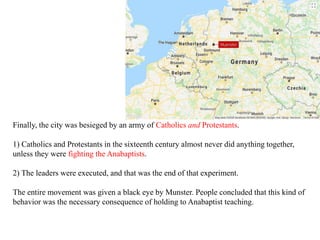
Finally, the city was besieged by an army of Catholics and Protestants.
1) Catholics and Protestants in the sixteenth century almost never did anything together,
unless they were fighting the Anabaptists.
2) The leaders were executed, and that was the end of that experiment.
The entire movement was given a black eye by Munster. People concluded that this kind of
behavior was the necessary consequence of holding to Anabaptist teaching.
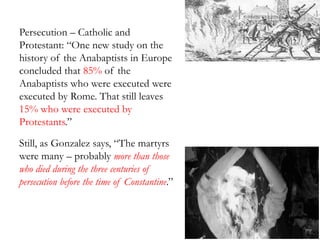
Persecution – Catholic and
Protestant: “One new study on the
history of the Anabaptists in Europe
concluded that 85% of the
Anabaptists who were executed were
executed by Rome. That still leaves
15% who were executed by
Protestants.”
Still, as Gonzalez says, “The martyrs
were many – probably more than those
who died during the three centuries of
persecution before the time of Constantine.”
CONTACT @ +91-8309511427
coachinterculturalstudies@gmail.com

Lecture 13; anabaptists

  • 1.
    History of Christianity-II COACHInstitute of Intercultural Studies Hyderabad
  • 2.
  • 3.
    Anabaptists are Christiansof the Reformation of 16th century Europe. Although some consider the Anabaptist movement to be an off shoot of Protestantism, others see it as a distinct movement. The Amish, Hutterites, and Mennonites are direct descendants of the movement. Brethren, Bruderhof, and the Apostolic Christian Church are later developments in Anabaptist groups
  • 4.
    The name Anabaptistis derived from the Greek term anabaptista, or “one who baptizes over again.” This name was given them by their persecutors in reference to the practice of re-baptizing converts who already had been baptized as infants. Anabaptists required that baptismal candidates be able to make their own confessions of faith and so rejected baptism of infants. The early members of this movement did not accept the name “Anabaptist”, claiming that since infant baptism was unscriptural and null and void, the baptizing of believers was not a rebaptism but in fact their first real baptism.
  • 5.
    Balthasar Hübmaier, an influentialGerman Anabaptist leader, wrote: I have never taught Anabaptism. ...But the right baptism of Christ, which is preceded by teaching and oral confession of faith, I teach, and say that infant baptism is a robbery of the right baptism of Christ...
  • 6.
    As a resultof their views on the nature of baptism and other issues, Anabaptists were heavily persecuted during the 16th century and into the 17th by both Magisterial Protestants and Roman Catholics.
  • 7.
    In the followingpoints Anabaptists who held to a literal interpretation of the Sermon on the Mount resembled the medieval dissenters: They condemned oaths, and also the reference of disputes between believers to law-courts in accordance with 1 Corinthians 6:1–11. The believer must not bear arms or offer forcible resistance to wrongdoers, nor wield the sword. No Christian has the jus gladii (the right of the sword). Matthew 5:39 Civil government (i.e., "Caesar") belongs to the world. The believer, who belongs to God’s kingdom, must not fill any office, nor hold any rank under government, which is to be passively obeyed. John 18:36 Romans 13:1–7 Sinners or unfaithful ones are to be excommunicated, and excluded from the sacraments and from communication with believers unless they repent, according to 1 Corinthians 5:9–13 and Matthew 18:15
  • 8.
    • Against violence,war, child baptism and theocracy • simple living—lived apart from society in own communities. • everyone has access to Bible
  • 9.
    Believers-only baptism Bible-onlyism: “Oneof the Anabaptists said, ‘Foolish Ambrose, foolish Augustine, foolish Jerome, foolish Gregory, of whom not even one knew the Lord, so help me God, nor was sent by God to teach. Rather, they were all apostles of anti-Christ.’” Ultimately, however, they were not overly concerned with doctrine per se. Their favorite biblical character was the thief on the cross, whom they said was “saved without any knowledge of the substance and persons of the Godhead, paedobaptism, consubstantiation, predestination, and so on and so on.”
  • 10.
    Munster, Germany –“the supreme disaster for the Radical Reformation.” a. Anabaptists were able to take over the entire city. b. They became revolutionaries. 1) Expelled the Catholics and the Protestants. 2) Set up an Old Testament theocracy. 3) Waited for the establishment of God’s kingdom on earth. c. The city quickly degenerated into a morass of religious fanaticism, terror, polygamy, elimination of private property, and all kinds of other abuses.
  • 11.
    Finally, the citywas besieged by an army of Catholics and Protestants. 1) Catholics and Protestants in the sixteenth century almost never did anything together, unless they were fighting the Anabaptists. 2) The leaders were executed, and that was the end of that experiment. The entire movement was given a black eye by Munster. People concluded that this kind of behavior was the necessary consequence of holding to Anabaptist teaching.
  • 12.
    Persecution – Catholicand Protestant: “One new study on the history of the Anabaptists in Europe concluded that 85% of the Anabaptists who were executed were executed by Rome. That still leaves 15% who were executed by Protestants.” Still, as Gonzalez says, “The martyrs were many – probably more than those who died during the three centuries of persecution before the time of Constantine.”
  • 13.