Read ‘building
background’ on
page 500- get
your vocab out
Bell Ringer
11/30/15
Vocab for today:
4. Medieval - pertaining to, characteristic of, or in the
style of the Middle Ages; another name for the Middle
Ages; 500 - 1500
12. Monastery- a house or place of residence occupied
by a community of monks, living in seclusion under
religious vows.
15. Monks- religious men who lived apart from society
in isolated communities
16. Benedict- Italian monk; created the Benedictine
Rule in the 500’s for monks to follow
17. Charlemagne- 700’s – a brilliant warrior and strong
king that led the Franks in building a huge empire
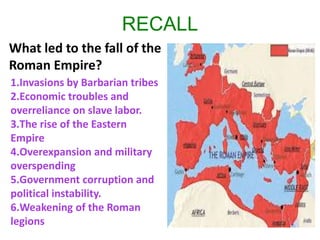
RECALL
What led to the fall of the
Roman Empire?
1.Invasions by Barbarian tribes
2.Economic troubles and
overreliance on slave labor.
3.The rise of the Eastern
Empire
4.Overexpansion and military
overspending
5.Government corruption and
political instability.
6.Weakening of the Roman
legions
objective
• I can understand and explain the conflict and
cooperation between the Papacy and
European monarchs, including Charlemagne,
Gregory VII, and Emperor Henry IV.
• 7.34 – Demonstrate understanding of the conflict and cooperation
between the Papacy and European monarchs, including Charlemagne,
Gregory VII, and Emperor Henry IV
Middle Ages
• With the fall of the Roman Empire; Europe split
into many kingdoms, beginning the time known as
the Middle Ages 500 – 1500
• Christianity begins to spread across Europe
because of missionaries (sent by the Pope) and
monks
– Monks served as scribes and helped people read and
write – monks lived in monasteries
• An Italian monk named Benedict created rules that
monks followed called the Benedictine rule- turn
your books to page 502 and let’s read them
From Gaul to France
• Christianity spreading farther north
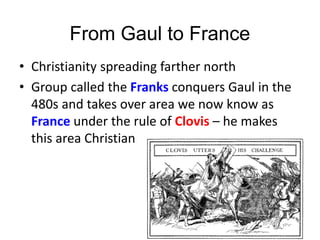
• Group called the Franks conquers Gaul in the
480s and takes over area we now know as
France under the rule of Clovis – he makes
this area Christian
Charlemagne comes to Power
• A leader named Charlemagne becomes leader of
the Franks in the late 700’s
– Brilliant warrior, strong king – creates huge empire
• Spends much of his time at war
By the time he was
finished he conquered
what is now France –
stretched into modern
Germany, Austria, Italy,
and northern Spain.
Emperor Charlemagne
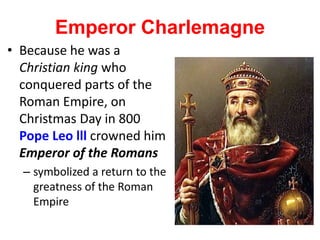
• Because he was a
Christian king who
conquered parts of the
Roman Empire, on
Christmas Day in 800
Pope Leo lll crowned him
Emperor of the Romans
– symbolized a return to the
greatness of the Roman
Empire
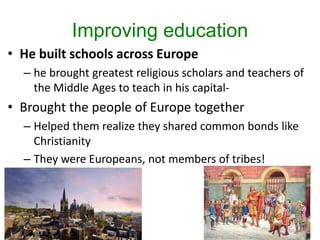
Improving education
• He built schools across Europe
– he brought greatest religious scholars and teachers of
the Middle Ages to teach in his capital-
• Brought the people of Europe together
– Helped them realize they shared common bonds like
Christianity
– They were Europeans, not members of tribes!
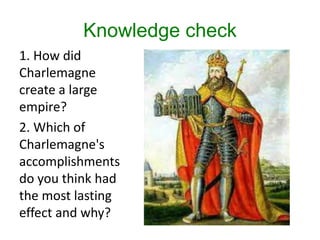
Knowledge check
1. How did
Charlemagne
create a large
empire?
2. Which of
Charlemagne's
accomplishments
do you think had
the most lasting
effect and why?
Annotating the text
• You will read the text about Charlemagne and
jot down your thoughts as you read.
• - for something you think was cool
• Circle anything you think is confusing
• Underline something you find significant
about Charlemagne
Written Response
• Create an 8-10 sentences paragraph on the
following prompt:
• Explain the significance and legacy of
Charlemagne during the Middle Ages

Charlemagne

  • 1.
    Read ‘building background’ on page500- get your vocab out Bell Ringer 11/30/15
  • 2.
    Vocab for today: 4.Medieval - pertaining to, characteristic of, or in the style of the Middle Ages; another name for the Middle Ages; 500 - 1500 12. Monastery- a house or place of residence occupied by a community of monks, living in seclusion under religious vows. 15. Monks- religious men who lived apart from society in isolated communities 16. Benedict- Italian monk; created the Benedictine Rule in the 500’s for monks to follow 17. Charlemagne- 700’s – a brilliant warrior and strong king that led the Franks in building a huge empire
  • 3.
    RECALL What led tothe fall of the Roman Empire? 1.Invasions by Barbarian tribes 2.Economic troubles and overreliance on slave labor. 3.The rise of the Eastern Empire 4.Overexpansion and military overspending 5.Government corruption and political instability. 6.Weakening of the Roman legions
  • 4.
    objective • I canunderstand and explain the conflict and cooperation between the Papacy and European monarchs, including Charlemagne, Gregory VII, and Emperor Henry IV. • 7.34 – Demonstrate understanding of the conflict and cooperation between the Papacy and European monarchs, including Charlemagne, Gregory VII, and Emperor Henry IV
  • 5.
    Middle Ages • Withthe fall of the Roman Empire; Europe split into many kingdoms, beginning the time known as the Middle Ages 500 – 1500 • Christianity begins to spread across Europe because of missionaries (sent by the Pope) and monks – Monks served as scribes and helped people read and write – monks lived in monasteries • An Italian monk named Benedict created rules that monks followed called the Benedictine rule- turn your books to page 502 and let’s read them
  • 6.
    From Gaul toFrance • Christianity spreading farther north • Group called the Franks conquers Gaul in the 480s and takes over area we now know as France under the rule of Clovis – he makes this area Christian
  • 7.
    Charlemagne comes toPower • A leader named Charlemagne becomes leader of the Franks in the late 700’s – Brilliant warrior, strong king – creates huge empire • Spends much of his time at war By the time he was finished he conquered what is now France – stretched into modern Germany, Austria, Italy, and northern Spain.
  • 8.
    Emperor Charlemagne • Becausehe was a Christian king who conquered parts of the Roman Empire, on Christmas Day in 800 Pope Leo lll crowned him Emperor of the Romans – symbolized a return to the greatness of the Roman Empire
  • 9.
    Improving education • Hebuilt schools across Europe – he brought greatest religious scholars and teachers of the Middle Ages to teach in his capital- • Brought the people of Europe together – Helped them realize they shared common bonds like Christianity – They were Europeans, not members of tribes!
  • 10.
    Knowledge check 1. Howdid Charlemagne create a large empire? 2. Which of Charlemagne's accomplishments do you think had the most lasting effect and why?
  • 11.
    Annotating the text •You will read the text about Charlemagne and jot down your thoughts as you read. • - for something you think was cool • Circle anything you think is confusing • Underline something you find significant about Charlemagne
  • 12.
    Written Response • Createan 8-10 sentences paragraph on the following prompt: • Explain the significance and legacy of Charlemagne during the Middle Ages