INFLUENCE OF THE SEA IN
THE PORTUGUESE CULTURE


      LIVING BY THE SEA
      2009/2011


                  Escola EBI/JI José Carlos da Maia
                  8º B – Área de Projecto
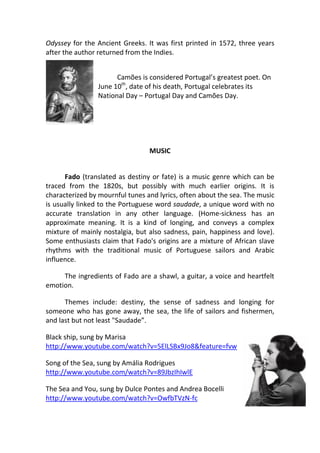
The Portuguese will remain in History for
the intensive maritime exploration undertaken
during the 15th and 16th centuries. Portuguese
sailors were at the vanguard of European overseas
exploration, discovering and mapping the coasts
of Africa, Asia and Brazil. Expeditions started in
1419 along West Africa's coast under the
sponsorship of prince Henry the Navigator,
reaching the Cape of Good Hope and entering the Indian Ocean in 1488.
Ten years later, Vasco da Gama led the first fleet around Africa to India,
arriving in Calicut and starting a maritime route from Portugal to India.
Soon, after reaching Brazil, explorations proceed to southeast Asia, having
reached Japan in 1542.

                              Mainly because of this, the sea has always
                        been a major influence in the Portuguese culture,
                        especially in literature, music and architecture.


                                LITERATURE

      Since the sixteenth century, the sea is largely sung by Portuguese
poets and historians. The theme of the Sea in Portuguese literature
becomes a historical constant, shaping many general characteristics of the
Portuguese identity. The Literature of Travel is one of the richest evidence
of Portugal's relations with the oceans.

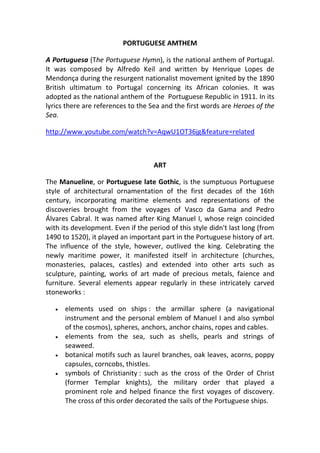
        Considered one of the greatest works of
Portuguese literature, The Lusiads date of 1572
and this epic by Luís de Camões is the glorification
of the Portuguese people.
Written in Homeric fashion, the poem focuses
mainly on a fantastical interpretation of the
Portuguese voyages of discovery during the 15th
and 16th centuries. The Lusiads is often regarded
as Portugal's national epic, much in the way as
Virgil's Aeneid was for the Ancient Romans, as well as Homer's Iliad and
Odyssey for the Ancient Greeks. It was first printed in 1572, three years
after the author returned from the Indies.


                      Camões is considered Portugal’s greatest poet. On
                June 10th, date of his death, Portugal celebrates its
                National Day – Portugal Day and Camões Day.


                                 MUSIC


      Fado (translated as destiny or fate) is a music genre which can be
traced from the 1820s, but possibly with much earlier origins. It is
characterized by mournful tunes and lyrics, often about the sea. The music
is usually linked to the Portuguese word saudade, a unique word with no
accurate translation in any other language. (Home-sickness has an
approximate meaning. It is a kind of longing, and conveys a complex
mixture of mainly nostalgia, but also sadness, pain, happiness and love).
Some enthusiasts claim that Fado's origins are a mixture of African slave
rhythms with the traditional music of Portuguese sailors and Arabic
influence.

     The ingredients of Fado are a shawl, a guitar, a voice and heartfelt
emotion.

      Themes include: destiny, the sense of sadness and longing for
someone who has gone away, the sea, the life of sailors and fishermen,
and last but not least "Saudade”.

Black ship, sung by Marisa
http://www.youtube.com/watch?v=5ElLSBx9Jo8&feature=fvw

Song of the Sea, sung by Amália Rodrigues
http://www.youtube.com/watch?v=89JbzIhIwlE

The Sea and You, sung by Dulce Pontes and Andrea Bocelli
http://www.youtube.com/watch?v=OwfbTVzN-fc
PORTUGUESE AMTHEM

A Portuguesa (The Portuguese Hymn), is the national anthem of Portugal.
It was composed by Alfredo Keil and written by Henrique Lopes de
Mendonça during the resurgent nationalist movement ignited by the 1890
British ultimatum to Portugal concerning its African colonies. It was
adopted as the national anthem of the Portuguese Republic in 1911. In its
lyrics there are references to the Sea and the first words are Heroes of the
Sea.

http://www.youtube.com/watch?v=AqwU1OT36jg&feature=related


                                    ART

The Manueline, or Portuguese late Gothic, is the sumptuous Portuguese
style of architectural ornamentation of the first decades of the 16th
century, incorporating maritime elements and representations of the
discoveries brought from the voyages of Vasco da Gama and Pedro
Álvares Cabral. It was named after King Manuel I, whose reign coincided
with its development. Even if the period of this style didn't last long (from
1490 to 1520), it played an important part in the Portuguese history of art.
The influence of the style, however, outlived the king. Celebrating the
newly maritime power, it manifested itself in architecture (churches,
monasteries, palaces, castles) and extended into other arts such as
sculpture, painting, works of art made of precious metals, faience and
furniture. Several elements appear regularly in these intricately carved
stoneworks :

      elements used on ships : the armillar sphere (a navigational
       instrument and the personal emblem of Manuel I and also symbol
       of the cosmos), spheres, anchors, anchor chains, ropes and cables.
      elements from the sea, such as shells, pearls and strings of
       seaweed.
      botanical motifs such as laurel branches, oak leaves, acorns, poppy
       capsules, corncobs, thistles.
      symbols of Christianity : such as the cross of the Order of Christ
       (former Templar knights), the military order that played a
       prominent role and helped finance the first voyages of discovery.
       The cross of this order decorated the sails of the Portuguese ships.
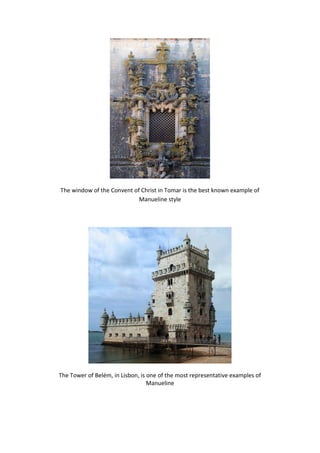
The window of the Convent of Christ in Tomar is the best known example of
                            Manueline style


The Tower of Belém, in Lisbon, is one of the most representative examples of
                                  Manueline
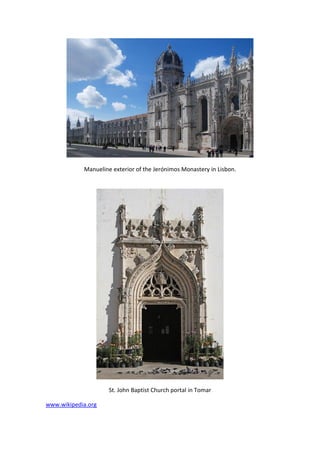
Manueline exterior of the Jerónimos Monastery in Lisbon.


                     St. John Baptist Church portal in Tomar

www.wikipedia.org

Portuguese culture

  • 1.
    INFLUENCE OF THESEA IN THE PORTUGUESE CULTURE LIVING BY THE SEA 2009/2011 Escola EBI/JI José Carlos da Maia 8º B – Área de Projecto
  • 2.
    The Portuguese willremain in History for the intensive maritime exploration undertaken during the 15th and 16th centuries. Portuguese sailors were at the vanguard of European overseas exploration, discovering and mapping the coasts of Africa, Asia and Brazil. Expeditions started in 1419 along West Africa's coast under the sponsorship of prince Henry the Navigator, reaching the Cape of Good Hope and entering the Indian Ocean in 1488. Ten years later, Vasco da Gama led the first fleet around Africa to India, arriving in Calicut and starting a maritime route from Portugal to India. Soon, after reaching Brazil, explorations proceed to southeast Asia, having reached Japan in 1542. Mainly because of this, the sea has always been a major influence in the Portuguese culture, especially in literature, music and architecture. LITERATURE Since the sixteenth century, the sea is largely sung by Portuguese poets and historians. The theme of the Sea in Portuguese literature becomes a historical constant, shaping many general characteristics of the Portuguese identity. The Literature of Travel is one of the richest evidence of Portugal's relations with the oceans. Considered one of the greatest works of Portuguese literature, The Lusiads date of 1572 and this epic by Luís de Camões is the glorification of the Portuguese people. Written in Homeric fashion, the poem focuses mainly on a fantastical interpretation of the Portuguese voyages of discovery during the 15th and 16th centuries. The Lusiads is often regarded as Portugal's national epic, much in the way as Virgil's Aeneid was for the Ancient Romans, as well as Homer's Iliad and
  • 3.
    Odyssey for theAncient Greeks. It was first printed in 1572, three years after the author returned from the Indies. Camões is considered Portugal’s greatest poet. On June 10th, date of his death, Portugal celebrates its National Day – Portugal Day and Camões Day. MUSIC Fado (translated as destiny or fate) is a music genre which can be traced from the 1820s, but possibly with much earlier origins. It is characterized by mournful tunes and lyrics, often about the sea. The music is usually linked to the Portuguese word saudade, a unique word with no accurate translation in any other language. (Home-sickness has an approximate meaning. It is a kind of longing, and conveys a complex mixture of mainly nostalgia, but also sadness, pain, happiness and love). Some enthusiasts claim that Fado's origins are a mixture of African slave rhythms with the traditional music of Portuguese sailors and Arabic influence. The ingredients of Fado are a shawl, a guitar, a voice and heartfelt emotion. Themes include: destiny, the sense of sadness and longing for someone who has gone away, the sea, the life of sailors and fishermen, and last but not least "Saudade”. Black ship, sung by Marisa http://www.youtube.com/watch?v=5ElLSBx9Jo8&feature=fvw Song of the Sea, sung by Amália Rodrigues http://www.youtube.com/watch?v=89JbzIhIwlE The Sea and You, sung by Dulce Pontes and Andrea Bocelli http://www.youtube.com/watch?v=OwfbTVzN-fc
  • 4.
    PORTUGUESE AMTHEM A Portuguesa(The Portuguese Hymn), is the national anthem of Portugal. It was composed by Alfredo Keil and written by Henrique Lopes de Mendonça during the resurgent nationalist movement ignited by the 1890 British ultimatum to Portugal concerning its African colonies. It was adopted as the national anthem of the Portuguese Republic in 1911. In its lyrics there are references to the Sea and the first words are Heroes of the Sea. http://www.youtube.com/watch?v=AqwU1OT36jg&feature=related ART The Manueline, or Portuguese late Gothic, is the sumptuous Portuguese style of architectural ornamentation of the first decades of the 16th century, incorporating maritime elements and representations of the discoveries brought from the voyages of Vasco da Gama and Pedro Álvares Cabral. It was named after King Manuel I, whose reign coincided with its development. Even if the period of this style didn't last long (from 1490 to 1520), it played an important part in the Portuguese history of art. The influence of the style, however, outlived the king. Celebrating the newly maritime power, it manifested itself in architecture (churches, monasteries, palaces, castles) and extended into other arts such as sculpture, painting, works of art made of precious metals, faience and furniture. Several elements appear regularly in these intricately carved stoneworks :  elements used on ships : the armillar sphere (a navigational instrument and the personal emblem of Manuel I and also symbol of the cosmos), spheres, anchors, anchor chains, ropes and cables.  elements from the sea, such as shells, pearls and strings of seaweed.  botanical motifs such as laurel branches, oak leaves, acorns, poppy capsules, corncobs, thistles.  symbols of Christianity : such as the cross of the Order of Christ (former Templar knights), the military order that played a prominent role and helped finance the first voyages of discovery. The cross of this order decorated the sails of the Portuguese ships.
  • 5.
    The window ofthe Convent of Christ in Tomar is the best known example of Manueline style The Tower of Belém, in Lisbon, is one of the most representative examples of Manueline
  • 6.
    Manueline exterior ofthe Jerónimos Monastery in Lisbon. St. John Baptist Church portal in Tomar www.wikipedia.org