The Power of God's Covenant:
Trusting in His Promises
Dr. Venkat Potana
Genesis 15:1-12, 17-18
The readings for this Second Sunday
of Lent—from Genesis, Philippians,
and Luke—all emphasize the power
of God's promises and the call to
trust in Him despite challenges.
 In Genesis 15:1-12, 17-18, God
makes a covenant with Abraham,
promising him descendants and
land, even though Abraham sees no
immediate fulfillment.
 In Philippians 3:17-4:1, Paul exhorts
believers to remain focused on their
heavenly citizenship, reminding
them that their ultimate
transformation is secured in Christ.
 In Luke 13:31-35, Jesus, despite
facing opposition, steadfastly moves
forward in fulfilling God’s
redemptive plan, lamenting over
Jerusalem’s rejection of God's
salvation.
These passages are intricately linked,
revealing three key truths:
1.God is always faithful to His
promises.
2.We are called to persevere in faith,
even in times of doubt.
3.God’s plan will be fulfilled in His
perfect time.
Due to the
limitation of
time, and since I
cannot do
justice to an
expository
preaching of all
three passages,
my focus this
morning will be
exclusively on
Genesis 15:1-
12, 17-18
After this, the word of the LORD came to Abram in a vision:
“Do not be afraid, Abram.
I am your shield,
your very great reward.”
2
But Abram said, “Sovereign LORD, what can you give me since I remain childless
and the one who will inherit my estate is Eliezer of Damascus?” And Abram said,
“You have given me no children; so a servant in my household will be my heir.”
4
Then the word of the LORD came to him: “This man will not be your heir, but a son
who is your own flesh and blood will be your heir.” 5
He took him outside and said,
“Look up at the sky and count the stars—if indeed you can count them.” Then he
said to him, “So shall your offspring be.”
6
Abram believed the LORD, and he credited it to him as righteousness.
7
He also said to him, “I am the LORD, who brought you out of Ur of the Chaldeans
to give you this land to take possession of it.”
8
But Abram said, “Sovereign LORD, how can I know that I will gain possession of
it?”
9
So the LORD said to him, “Bring me a heifer, a goat and a ram, each three years
old, along with a dove and a young pigeon.”
10
Abram brought all these to him, cut them in two and arranged the halves opposite
each other; the birds, however, he did not cut in half. 11
Then birds of prey came
down on the carcasses, but Abram drove them away.
12
As the sun was setting, Abram fell into a deep sleep, and a thick and dreadful
darkness came over him.
Genesis 15:1-12, 17-18
In this text God establishes His covenant
with Abraham. This passage serves as a
foundation for our faith, reminding us
that God alone guarantees His
promises, and our response must be
one of trust band obedience.
This passage is not merely a historical
record but a divine revelation of God’s
faithfulness, sovereignty, and
unwavering commitment to His
promises. Many of us wrestle with
doubts and uncertainties, wondering
when and how God’s promises will
come to fulfillment. Abraham, too,
faced such a moment when he
questioned how God’s covenant would
unfold.
I. God’s Promises Are Greater Than Our Fears (Genesis 15:1-5)
The passage begins with a divine vision: “After
these things the word of the Lord came to
Abram in a vision, saying, ‘Do not be afraid,
Abram, I am your shield, your exceedingly
great reward.’” (Genesis 15:1).
The Hebrew phrase ‫ָא‬
‫ר‬‫י‬‫ַאל־ִּת‬ (al-tira)—“Do not
fear”—is a powerful command that we see
throughout Scripture whenever God calls His
people to trust Him.
The phrase "Do not fear" (or similar
variations like "Fear not" and "Do not
be afraid") appears approximately
365 times in the Bible. This number is
often noted as a daily reminder from
God to trust in Him and not be afraid.
Why? Because fear paralyzes faith. Abram had just come
from a great victory (Genesis 14), but his heart was still
troubled. He had wealth, he had influence, but he had no
heir. He saw the circumstances, and they didn't align with
God’s promises.
How often do we, like Abram, focus on what we lack rather
than trusting in what God has promised? But God reassures
Abram, saying, “I am your shield, your exceedingly great
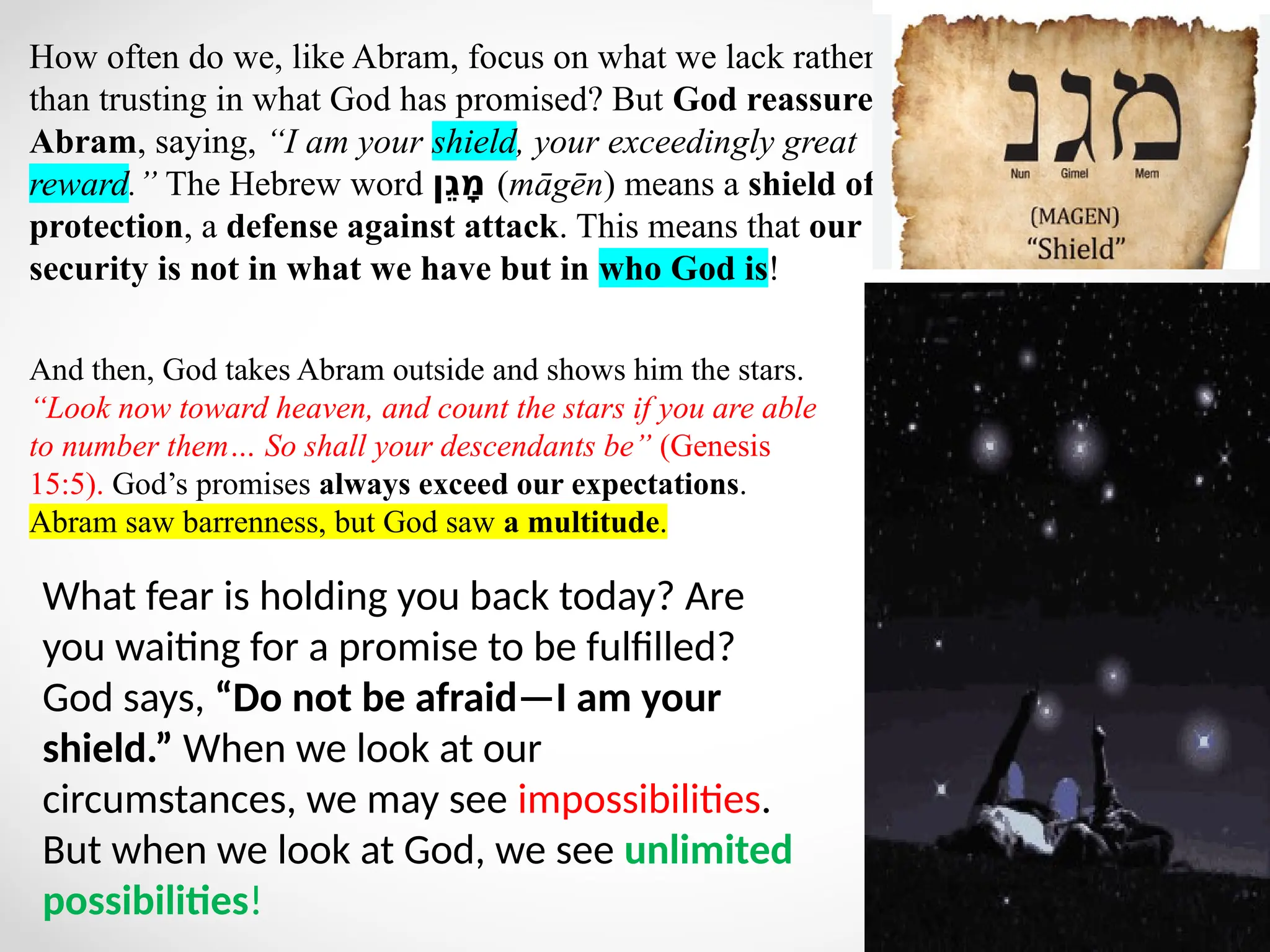
reward.” The Hebrew word ‫ֵן‬‫ָג‬‫מ‬ (māgēn) means a shield of
protection, a defense against attack. This means that our
security is not in what we have but in who God is!
And then, God takes Abram outside and shows him the stars.
“Look now toward heaven, and count the stars if you are able
to number them… So shall your descendants be” (Genesis
15:5). God’s promises always exceed our expectations.
Abram saw barrenness, but God saw a multitude.
What fear is holding you back today? Are
you waiting for a promise to be fulfilled?
God says, “Do not be afraid—I am your
shield.” When we look at our
circumstances, we may see impossibilities.
But when we look at God, we see unlimited
possibilities!
II. Faith Is the Foundation of Righteousness (Genesis 15:6)
I. God’s Promises Are Greater Than Our Fears (Genesis 15:1-5)
The turning point of this passage comes in
Genesis 15:6: “And he believed in the LORD,
and He accounted it to him for righteousness.”
The Hebrew verb ‫ִן‬‫מ‬ֱ‫א‬ֶ‫ה‬ְ ‫ו‬ "ve-he-e-MIN"
(veh-heh-eh-MEEN) means to trust
completely, to place full confidence in God.
Abram didn’t just believe in God’s existence—
he trusted in God’s character and His word.
This word comes from the root ‫ַן‬‫מ‬ָ‫א‬
(aman), meaning "to believe" or "to
trust."
Veh-heh-eh-MEEN
And because of this faith, God credited it to him as righteousness.
The word ‫ָה‬‫ק‬ָ‫ד‬ְ‫צ‬ (ṣ
ĕdāqāh) means righteousness, justification. This
verse is one of the most foundational verses in the Bible, later quoted
by Paul in Romans 4:3 and Galatians 3:6, teaching that salvation
has always been by faith, not by works.
The Hebrew word ‫ָה‬‫ק‬ָ‫ד‬ְ‫צ‬ (ṣĕdāqāh) is often translated as
righteousness, justice, or charity. It is a significant theological
term in both the Old Testament and Jewish tradition. Unlike
modern understandings of righteousness as merely moral
uprightness, ṣĕdāqāh carries a strong relational and covenantal
meaning—it reflects God’s justice, His faithful dealings with
humanity, and the ethical obligation of His people to live in
alignment with His will.
Ṣĕdāqāh as Divine Righteousness
In the Old Testament, ṣĕdāqāh is
often used to describe the
righteousness of God. It refers to His
faithfulness in upholding justice and
His covenant with His people.
Brothers and
sisters, Abram did
not yet see the
fulfillment of God’s
promise. But he
believed. Do you
believe today?
Faith is not about
seeing the evidence
before trusting—it
is about trusting
before seeing.
Are you waiting on God but struggling with doubt? Remember,
God calls us to walk by faith, not by sight (2 Corinthians 5:7). Like
Abram, we must choose to trust that God is faithful even when
we do not yet see the fulfillment.
A powerful illustration of this faith challenge comes from the life of Charles Blondin,
a famous French tightrope walker.
On June 30, 1859, Blondin became the first person to walk across a 1,100-foot (335-meter) tightrope
stretched 160 feet (50 meters) above Niagara Falls. Thousands gathered to watch this daring feat, and
as he reached the other side, the crowd cheered wildly.
But Blondin wasn’t done. Over the next few months, he performed increasingly daring variations,
such as:
✅ Walking blindfolded
✅ Crossing on stilts
✅ Carrying a small stove and cooking an omelet mid-air
✅ Walking backward
✅ Pushing a wheelbarrow
One day, Blondin pushed a wheelbarrow across the tightrope. The crowd roared with excitement.
Then he turned to them and asked, “Do you believe I can carry a person across?”
The crowd shouted in agreement, confident in his ability.
Then Blondin pointed to someone and said, “Get in the wheelbarrow.”
Silence fell. No one stepped forward. They had just seen him perform amazing feats, yet no one was willing to trust him with their life.
On August 17, 1859, the only person willing to trust Blondin was his manager, Harry Colcord. Instead of sitting in the wheelbarrow, Colcord
climbed onto Blondin’s back, and together they carefully made their way across the tightrope over the roaring waters of Niagara Falls.
Many people say they believe in God, but true faith is not just intellectual agreement—it is trusting Him enough to step out in obedience.
"For we walk by faith, not by sight." (2 Corinthians 5:7)
Just like the crowd at Niagara, we may claim to believe in God's promises, but when He calls us to trust Him fully, do we hesitate? Will you just
cheer from the sidelines, or will you step into the “wheelbarrow” of faith?
Let us choose to trust God completely, as Abram did, knowing that His promises will never fail.
II. Faith Is the Foundation of Righteousness (Genesis 15:6)
I. God’s Promises Are Greater Than Our Fears (Genesis 15:1-5)
Now, here is where the passage takes a
dramatic turn. In ancient times, when two
people made a covenant, they would cut
animals in half and walk between the pieces,
symbolizing that if either party broke the
covenant, they would face the same fate.
III. God Alone Guarantees His Covenant (Genesis 15:7-18)
But here’s what’s remarkable: In Genesis
15:17, “a smoking firepot and a flaming torch
passed between the pieces.” Who walked
between the pieces? Only God!
The Hebrew imagery here is profound:
• The smoking firepot (‫ן‬ ‫ָׁש‬ָ
‫ע‬ ‫ּנּור‬‫)ַּת‬ and the flaming torch
(‫ׁש‬ֵ
‫א‬ ‫יד‬‫ִַּפ‬
‫ל‬) represent God’s presence and holiness—similar to the
pillar of cloud and fire in Exodus.
• Abram never walked through the pieces. This means the
covenant depended entirely on God—not on Abram!
This is a unilateral covenant, meaning that its fulfillment is entirely
God’s responsibility. This points us directly to Jesus Christ, who took
our place on the cross. Just as God alone passed through the covenantal
pieces, Christ alone bore the penalty for our sins. This is the Gospel in
Genesis!
When we fail, when we struggle, when we doubt—God remains
faithful. The fulfillment of His promises does not depend on us, but
on Him. Jesus is the ultimate fulfillment of this covenant, securing
our salvation forever (Hebrews 9:15).
Conclusion: Living in the Assurance of God’s Covenant
Genesis 15 is not just Abram’s story—it is our story.
It teaches us:
1. God’s promises are greater than our fears—Do not be afraid; trust in God’s word.
2. Faith is the foundation of righteousness—We are justified by faith, not by works.
3. God alone guarantees His covenant—Our salvation is secured by Christ, not by our efforts.
As we reflect on this passage, let us respond in faith. Are you
willing to trust in God’s promises, even when they seem
delayed? Are you ready to place your confidence in Christ
alone?
Brothers and sisters, God’s covenant is eternal, and His
faithfulness is unshakable. May we walk in the assurance of His
promises, knowing that He is our shield and our exceedingly
great reward.
As we journey through Lent, let us deepen our faith in God’s
promises, remain steadfast in the face of trials, and trust that
God’s ultimate plan will be accomplished in His time.
Amen.

The Power of God's Covenant: Trusting in His Promises.pptx

  • 1.
    The Power ofGod's Covenant: Trusting in His Promises Dr. Venkat Potana Genesis 15:1-12, 17-18
  • 2.
    The readings forthis Second Sunday of Lent—from Genesis, Philippians, and Luke—all emphasize the power of God's promises and the call to trust in Him despite challenges.
  • 3.
     In Genesis15:1-12, 17-18, God makes a covenant with Abraham, promising him descendants and land, even though Abraham sees no immediate fulfillment.  In Philippians 3:17-4:1, Paul exhorts believers to remain focused on their heavenly citizenship, reminding them that their ultimate transformation is secured in Christ.  In Luke 13:31-35, Jesus, despite facing opposition, steadfastly moves forward in fulfilling God’s redemptive plan, lamenting over Jerusalem’s rejection of God's salvation.
  • 4.
    These passages areintricately linked, revealing three key truths: 1.God is always faithful to His promises. 2.We are called to persevere in faith, even in times of doubt. 3.God’s plan will be fulfilled in His perfect time.
  • 5.
    Due to the limitationof time, and since I cannot do justice to an expository preaching of all three passages, my focus this morning will be exclusively on Genesis 15:1- 12, 17-18
  • 6.
    After this, theword of the LORD came to Abram in a vision: “Do not be afraid, Abram. I am your shield, your very great reward.” 2 But Abram said, “Sovereign LORD, what can you give me since I remain childless and the one who will inherit my estate is Eliezer of Damascus?” And Abram said, “You have given me no children; so a servant in my household will be my heir.” 4 Then the word of the LORD came to him: “This man will not be your heir, but a son who is your own flesh and blood will be your heir.” 5 He took him outside and said, “Look up at the sky and count the stars—if indeed you can count them.” Then he said to him, “So shall your offspring be.” 6 Abram believed the LORD, and he credited it to him as righteousness. 7 He also said to him, “I am the LORD, who brought you out of Ur of the Chaldeans to give you this land to take possession of it.” 8 But Abram said, “Sovereign LORD, how can I know that I will gain possession of it?” 9 So the LORD said to him, “Bring me a heifer, a goat and a ram, each three years old, along with a dove and a young pigeon.” 10 Abram brought all these to him, cut them in two and arranged the halves opposite each other; the birds, however, he did not cut in half. 11 Then birds of prey came down on the carcasses, but Abram drove them away. 12 As the sun was setting, Abram fell into a deep sleep, and a thick and dreadful darkness came over him. Genesis 15:1-12, 17-18
  • 7.
    In this textGod establishes His covenant with Abraham. This passage serves as a foundation for our faith, reminding us that God alone guarantees His promises, and our response must be one of trust band obedience. This passage is not merely a historical record but a divine revelation of God’s faithfulness, sovereignty, and unwavering commitment to His promises. Many of us wrestle with doubts and uncertainties, wondering when and how God’s promises will come to fulfillment. Abraham, too, faced such a moment when he questioned how God’s covenant would unfold.
  • 8.
    I. God’s PromisesAre Greater Than Our Fears (Genesis 15:1-5) The passage begins with a divine vision: “After these things the word of the Lord came to Abram in a vision, saying, ‘Do not be afraid, Abram, I am your shield, your exceedingly great reward.’” (Genesis 15:1). The Hebrew phrase ‫ָא‬ ‫ר‬‫י‬‫ַאל־ִּת‬ (al-tira)—“Do not fear”—is a powerful command that we see throughout Scripture whenever God calls His people to trust Him. The phrase "Do not fear" (or similar variations like "Fear not" and "Do not be afraid") appears approximately 365 times in the Bible. This number is often noted as a daily reminder from God to trust in Him and not be afraid. Why? Because fear paralyzes faith. Abram had just come from a great victory (Genesis 14), but his heart was still troubled. He had wealth, he had influence, but he had no heir. He saw the circumstances, and they didn't align with God’s promises.
  • 9.
    How often dowe, like Abram, focus on what we lack rather than trusting in what God has promised? But God reassures Abram, saying, “I am your shield, your exceedingly great reward.” The Hebrew word ‫ֵן‬‫ָג‬‫מ‬ (māgēn) means a shield of protection, a defense against attack. This means that our security is not in what we have but in who God is! And then, God takes Abram outside and shows him the stars. “Look now toward heaven, and count the stars if you are able to number them… So shall your descendants be” (Genesis 15:5). God’s promises always exceed our expectations. Abram saw barrenness, but God saw a multitude. What fear is holding you back today? Are you waiting for a promise to be fulfilled? God says, “Do not be afraid—I am your shield.” When we look at our circumstances, we may see impossibilities. But when we look at God, we see unlimited possibilities!
  • 11.
    II. Faith Isthe Foundation of Righteousness (Genesis 15:6) I. God’s Promises Are Greater Than Our Fears (Genesis 15:1-5) The turning point of this passage comes in Genesis 15:6: “And he believed in the LORD, and He accounted it to him for righteousness.” The Hebrew verb ‫ִן‬‫מ‬ֱ‫א‬ֶ‫ה‬ְ ‫ו‬ "ve-he-e-MIN" (veh-heh-eh-MEEN) means to trust completely, to place full confidence in God. Abram didn’t just believe in God’s existence— he trusted in God’s character and His word. This word comes from the root ‫ַן‬‫מ‬ָ‫א‬ (aman), meaning "to believe" or "to trust." Veh-heh-eh-MEEN
  • 12.
    And because ofthis faith, God credited it to him as righteousness. The word ‫ָה‬‫ק‬ָ‫ד‬ְ‫צ‬ (ṣ ĕdāqāh) means righteousness, justification. This verse is one of the most foundational verses in the Bible, later quoted by Paul in Romans 4:3 and Galatians 3:6, teaching that salvation has always been by faith, not by works. The Hebrew word ‫ָה‬‫ק‬ָ‫ד‬ְ‫צ‬ (ṣĕdāqāh) is often translated as righteousness, justice, or charity. It is a significant theological term in both the Old Testament and Jewish tradition. Unlike modern understandings of righteousness as merely moral uprightness, ṣĕdāqāh carries a strong relational and covenantal meaning—it reflects God’s justice, His faithful dealings with humanity, and the ethical obligation of His people to live in alignment with His will. Ṣĕdāqāh as Divine Righteousness In the Old Testament, ṣĕdāqāh is often used to describe the righteousness of God. It refers to His faithfulness in upholding justice and His covenant with His people.
  • 13.
    Brothers and sisters, Abramdid not yet see the fulfillment of God’s promise. But he believed. Do you believe today? Faith is not about seeing the evidence before trusting—it is about trusting before seeing.
  • 14.
    Are you waitingon God but struggling with doubt? Remember, God calls us to walk by faith, not by sight (2 Corinthians 5:7). Like Abram, we must choose to trust that God is faithful even when we do not yet see the fulfillment. A powerful illustration of this faith challenge comes from the life of Charles Blondin, a famous French tightrope walker. On June 30, 1859, Blondin became the first person to walk across a 1,100-foot (335-meter) tightrope stretched 160 feet (50 meters) above Niagara Falls. Thousands gathered to watch this daring feat, and as he reached the other side, the crowd cheered wildly. But Blondin wasn’t done. Over the next few months, he performed increasingly daring variations, such as: ✅ Walking blindfolded ✅ Crossing on stilts ✅ Carrying a small stove and cooking an omelet mid-air ✅ Walking backward ✅ Pushing a wheelbarrow One day, Blondin pushed a wheelbarrow across the tightrope. The crowd roared with excitement. Then he turned to them and asked, “Do you believe I can carry a person across?” The crowd shouted in agreement, confident in his ability. Then Blondin pointed to someone and said, “Get in the wheelbarrow.” Silence fell. No one stepped forward. They had just seen him perform amazing feats, yet no one was willing to trust him with their life. On August 17, 1859, the only person willing to trust Blondin was his manager, Harry Colcord. Instead of sitting in the wheelbarrow, Colcord climbed onto Blondin’s back, and together they carefully made their way across the tightrope over the roaring waters of Niagara Falls. Many people say they believe in God, but true faith is not just intellectual agreement—it is trusting Him enough to step out in obedience. "For we walk by faith, not by sight." (2 Corinthians 5:7) Just like the crowd at Niagara, we may claim to believe in God's promises, but when He calls us to trust Him fully, do we hesitate? Will you just cheer from the sidelines, or will you step into the “wheelbarrow” of faith? Let us choose to trust God completely, as Abram did, knowing that His promises will never fail.
  • 15.
    II. Faith Isthe Foundation of Righteousness (Genesis 15:6) I. God’s Promises Are Greater Than Our Fears (Genesis 15:1-5) Now, here is where the passage takes a dramatic turn. In ancient times, when two people made a covenant, they would cut animals in half and walk between the pieces, symbolizing that if either party broke the covenant, they would face the same fate. III. God Alone Guarantees His Covenant (Genesis 15:7-18) But here’s what’s remarkable: In Genesis 15:17, “a smoking firepot and a flaming torch passed between the pieces.” Who walked between the pieces? Only God!
  • 16.
    The Hebrew imageryhere is profound: • The smoking firepot (‫ן‬ ‫ָׁש‬ָ ‫ע‬ ‫ּנּור‬‫)ַּת‬ and the flaming torch (‫ׁש‬ֵ ‫א‬ ‫יד‬‫ִַּפ‬ ‫ל‬) represent God’s presence and holiness—similar to the pillar of cloud and fire in Exodus. • Abram never walked through the pieces. This means the covenant depended entirely on God—not on Abram! This is a unilateral covenant, meaning that its fulfillment is entirely God’s responsibility. This points us directly to Jesus Christ, who took our place on the cross. Just as God alone passed through the covenantal pieces, Christ alone bore the penalty for our sins. This is the Gospel in Genesis! When we fail, when we struggle, when we doubt—God remains faithful. The fulfillment of His promises does not depend on us, but on Him. Jesus is the ultimate fulfillment of this covenant, securing our salvation forever (Hebrews 9:15).
  • 17.
    Conclusion: Living inthe Assurance of God’s Covenant Genesis 15 is not just Abram’s story—it is our story. It teaches us: 1. God’s promises are greater than our fears—Do not be afraid; trust in God’s word. 2. Faith is the foundation of righteousness—We are justified by faith, not by works. 3. God alone guarantees His covenant—Our salvation is secured by Christ, not by our efforts. As we reflect on this passage, let us respond in faith. Are you willing to trust in God’s promises, even when they seem delayed? Are you ready to place your confidence in Christ alone? Brothers and sisters, God’s covenant is eternal, and His faithfulness is unshakable. May we walk in the assurance of His promises, knowing that He is our shield and our exceedingly great reward. As we journey through Lent, let us deepen our faith in God’s promises, remain steadfast in the face of trials, and trust that God’s ultimate plan will be accomplished in His time. Amen.