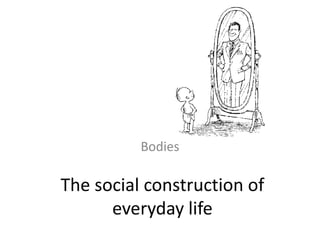
The social construction of
everyday life
Bodies
Ask your partner
• Using Goffman’s idea of performance, in which
ways can the body perform:
– Gender
– Class
– Ethnicity
• Using Hall’s circuit of culture (identity,
production, consumption, regulation,
representation), can you analyse how the body is
cultural?
• In what ways can we say that bodies are socially
constructed?
Today
• Identity and social construction
• The sociology of bodies
• The body project – Schilling
• Resources and the body project:
– An international perspective: the aryan model
• Male bodies – Bordo
Identity – relates very strongly to
social construction
• ‘Identity is about belonging, about what you have
in common with some people and what
differentiates you from others. At its most basic it
gives you a sense of personal location, the stable
core to your individuality. But it is also about your
social relationships, your complex involvement
with others’
• (Weeks, 1991:88)
• This leads us to bodies…
4
The sociology of bodies
• Bodies seem to be straightforward, natural
and given.
• ‘Body projects’ 'in the process of becoming; a
project which should be worked at and
accomplished as part of an individual's self-
identity'.
(Shilling, C., 2003, The Body and Social Theory,
London, Thousand Oaks, New Delhi, Sage
Publications. )
5
The Body Project
• ‘the process of becoming and transforming a biological entity
through social action’ (cited in Macionis and Plummer 2008:213).
– Clothing
– Washing and hygiene
– Medical and fitness regimes (p. 213)
– Tatoos piercings
• Individuals are expected to take more responsibility for their health
(not smoking, going to the gym…)
• A healthy body is a worthy body; an unhealthy body is a deviant
body
– Kilbourne’s work:
• Deviation is regulated through contempt, ‘humour’
Resources and the body project
• The relationships different classes have with the body,
and different access to resources will affect the body
project. The Aryan Model.
• http://www.youtube.com/watch?v=3yKqOSpDDp4&fea
ture=related
• Complexity:
– Access to material resources
– Presumed aryan normative
• Idealised female beauty has existed for hundreds of
years in the form of:
• Concubines
• Paintings
• stories
Stereotypes in the media
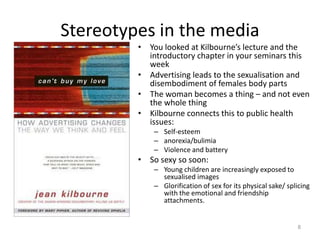
• You looked at Kilbourne’s lecture and the
introductory chapter in your seminars this
week
• Advertising leads to the sexualisation and
disembodiment of females body parts
• The woman becomes a thing – and not even
the whole thing
• Kilbourne connects this to public health
issues:
– Self-esteem
– anorexia/bulimia
– Violence and battery
• So sexy so soon:
– Young children are increasingly exposed to
sexualised images
– Glorification of sex for its physical sake/ splicing
with the emotional and friendship
attachments.
8
What about men’s bodies?
• We have so far been looking at the objectified
female form:
– Disembodied
– Sexualised
– Commoditised
• How are men’s bodies used in advertising and
the media, and is this changing?
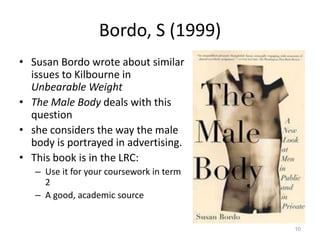
Bordo, S (1999)
• Susan Bordo wrote about similar
issues to Kilbourne in
Unbearable Weight
• The Male Body deals with this
question
• she considers the way the male
body is portrayed in advertising.
• This book is in the LRC:
– Use it for your coursework in term
2
– A good, academic source
10
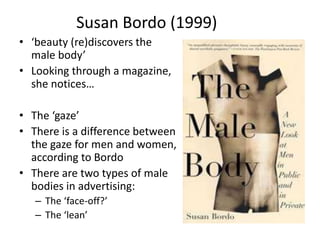
Susan Bordo (1999)
• ‘beauty (re)discovers the
male body’
• Looking through a magazine,
she notices…
• The ‘gaze’
• There is a difference between
the gaze for men and women,
according to Bordo
• There are two types of male
bodies in advertising:
– The ‘face-off?’
– The ‘lean’
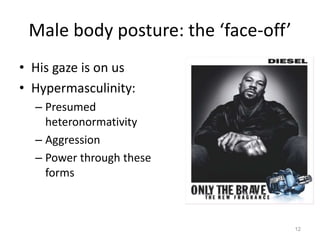
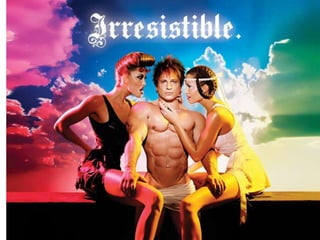
Male body posture: the ‘face-off’
• His gaze is on us
• Hypermasculinity:
– Presumed
heteronormativity
– Aggression
– Power through these
forms
12
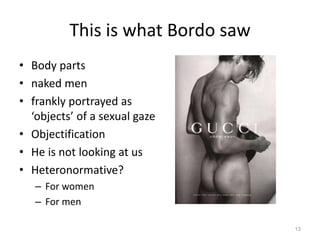
This is what Bordo saw
• Body parts
• naked men
• frankly portrayed as
‘objects’ of a sexual gaze
• Objectification
• He is not looking at us
• Heteronormative?
– For women
– For men
13
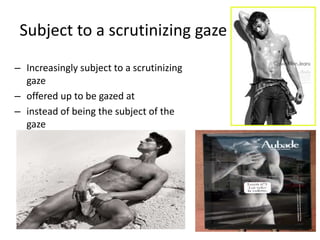
Subject to a scrutinizing gaze
– Increasingly subject to a scrutinizing
gaze
– offered up to be gazed at
– instead of being the subject of the
gaze
14
• David Barton gym: ‘No pecs, no sex.’
15
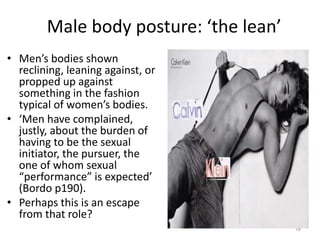
Male body posture: ‘the lean’
• Men’s bodies shown
reclining, leaning against, or
propped up against
something in the fashion
typical of women’s bodies.
• ‘Men have complained,
justly, about the burden of
having to be the sexual
initiator, the pursuer, the
one of whom sexual
“performance” is expected’
(Bordo p190).
• Perhaps this is an escape
from that role?
16
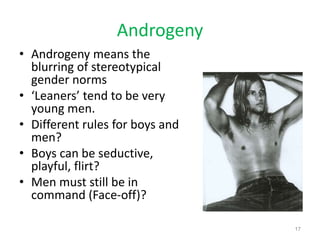
Androgeny
• Androgeny means the
blurring of stereotypical
gender norms
• ‘Leaners’ tend to be very
young men.
• Different rules for boys and
men?
• Boys can be seductive,
playful, flirt?
• Men must still be in
command (Face-off)?
17
‘No, I don’t think the business of beauty is without its
pleasures. It offers a daily ritual of transformation,
renewal. Of “putting oneself together” and walking
out into the world, more confident than you were . . .
. I love shopping for makeup with my friends. (Despite
what [many people believe], feminism—certainly not
feminism in the nineties—is not synonymous with
unshaven legs.) Women bond over shared make-up,
shared beauty tips. . . . Too often, though, our bond is
over shared pain. . . there’s always that constant
judgment and evaluation.’
(Bordo p217)
18
• Do you think the same is true of men?
In 1997 ‘men . . . comprised over a quarter of
cosmetic-surgery patients. . . As many as a million
men—and eight million women—have an eating
disorder. . . Men’s health magazines . . . dispense diet
and exercise advice (“A better Body in Half the Time,”
“50 Snacks That Won’t Make You Fat”)’ (Bordo p218).
19
20
• Stereotypes are damaging to both men and
women.
• The social construction of gender through
advertising is harmful in many ways, including
judging oneself according to impossible ideals.
21
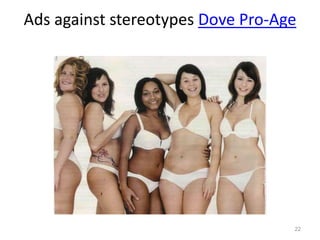
Ads against stereotypes Dove Pro-Age
22
How many adverts show men doing
housework?
23
Key theories and terms you need to
know
• Definitions of micro-sociology (x2)
• Agents of socialization ( x5)
• Psychodynamic socialization theories
• Behaviourism theories
• Social Constructionism/ interactionist theories
• Margaret Mead
• Susan Bordo
• Chris Shilling (the body project)
• Bandura (Bobo Doll)
• Irving Goffman
• Garfinkel
Today
• Identity and social construction
• The sociology of bodies
• The body project – Schilling
• Resources and the body project:
– An international perspective: the aryan model
• Now –
– The end of term test
Preparation for revision
27th November 2013
Aims
• Familiarise selves with structure of test (exam)
• Understand what is expected of you in test
• Be confident how much work you need to do
at home in order to succeed
Test Structure
• Two sections:
A: 10 short-answer questions (50 marks)
B: one essay (50 marks)
• 1.5 hours
• Marked out of 100
• Worth 10% of final grade
Test Structure
• Section A:
You should usually write four or five sentences for
each answer
DO NOT BULLET POINT/LIST YOUR ANSWERS –
MARKS WILL BE TAKEN OFF IF YOU DO: USE FULL
SENTENCES!!
The more the points, the more you write
Revision tips: flash cards, write your own
questions, then write your answers
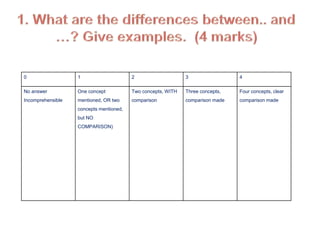
0 1 2 3 4
No answer
Incomprehensible
One concept
mentioned, OR two
concepts mentioned,
but NO
COMPARISON)
Two concepts, WITH
comparison
Three concepts,
comparison made
Four concepts, clear
comparison made
Test Structure
• Section B:
A typical question:
Compare and contrast Marx’s theory of ---- with
Durkheim’s theory of -----. With reference to theory,
which is more convincing?
You will write ONE essay from a choice of three
essay questions
You should usually write 1½ - 2 pages for the
essay.
Long answer questions
• Plan for at least five minutes.
– The best essays are planned.
– The plan will not be marked.
• The best essays make an argument.
– They use theory to answer and analyse
– They analyse examples from different perspectives
 Revision tips: write your own essay questions, use
your part A flash cards to plan the essay, think of
examples from the ‘real world’
34
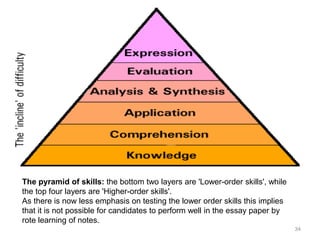
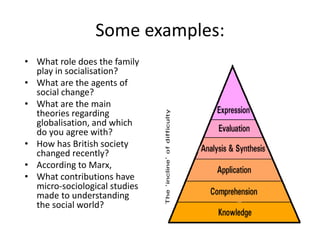
The pyramid of skills: the bottom two layers are 'Lower-order skills', while
the top four layers are 'Higher-order skills'.
As there is now less emphasis on testing the lower order skills this implies
that it is not possible for candidates to perform well in the essay paper by
rote learning of notes.
Some examples:
• What role does the family
play in socialisation?
• What are the agents of
social change?
• What are the main
theories regarding
globalisation, and which
do you agree with?
• How has British society
changed recently?
• According to Marx,
• What contributions have
micro-sociological studies
made to understanding
the social world?
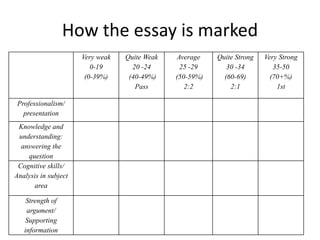
How the essay is marked
Very weak
0-19
(0-39%)
Quite Weak
20 -24
(40-49%)
Pass
Average
25 -29
(50-59%)
2:2
Quite Strong
30 -34
(60-69)
2:1
Very Strong
35-50
(70+%)
1st
Professionalism/
presentation
Knowledge and
understanding:
answering the
question
Cognitive skills/
Analysis in subject
area
Strength of
argument/
Supporting
information
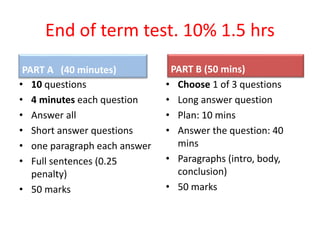
End of term test. 10% 1.5 hrs
PART A (40 minutes)
• 10 questions
• 4 minutes each question
• Answer all
• Short answer questions
• one paragraph each answer
• Full sentences (0.25
penalty)
• 50 marks
PART B (50 mins)
• Choose 1 of 3 questions
• Long answer question
• Plan: 10 mins
• Answer the question: 40
mins
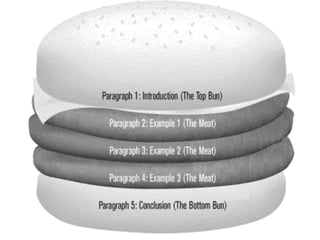
• Paragraphs (intro, body,
conclusion)
• 50 marks
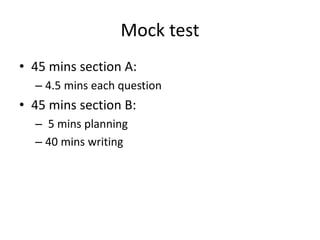
Mock test
• 45 mins section A:
– 4.5 mins each question
• 45 mins section B:
– 5 mins planning
– 40 mins writing
which student are you?
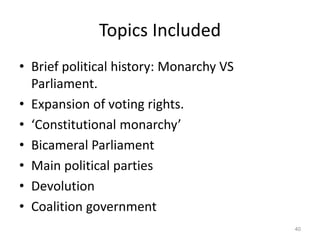
Topics Included
• Brief political history: Monarchy VS
Parliament.
• Expansion of voting rights.
• ‘Constitutional monarchy’
• Bicameral Parliament
• Main political parties
• Devolution
• Coalition government
40
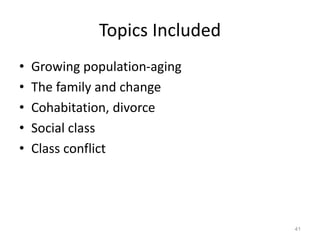
Topics Included
• Growing population-aging
• The family and change
• Cohabitation, divorce
• Social class
• Class conflict
41
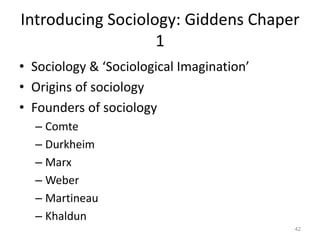
Introducing Sociology: Giddens Chaper
1
• Sociology & ‘Sociological Imagination’
• Origins of sociology
• Founders of sociology
– Comte
– Durkheim
– Marx
– Weber
– Martineau
– Khaldun
42
Introducing Sociology: Giddens Chaper
1
• Aims of early sociologists
• Modern theoretical approaches
– Functionalism
– Conflict theory
– Symbolic interactionism
• Micro/macro sociology
• Importance of sociology
43
Globalisation and the study of society:
Giddens Ch.4
What is it?
Is it really new?
• Pre-modern societies
• Pastoral and agrarian
• Non-industrial or traditional
• Industrial
• Post-industrial
Global development
Factors contributing to globalisation
Technology & compression of time and space
Impacts of globalisation, e.g. weakening of the nation state and national
identity
The ‘electric economy’
Global commodity chains
Globalisation debate
Americanisation?
• Social change
– Cultural factors
– Physical environment
– Political organisation
• Sociological approaches
– Marx
– Weber
– Durkheim
45
Culture, Norms and Values: Macionis
and Plummer Ch. 5
• Definitions of culture
• Five major components of culture:
Symbols
Language
Values
Norms
Material culture
Ethnocentrism
Cultural Relativism
Glocalisation
Postmodern culture
Social Construction of Everyday Life:
Macionis and Plummer Ch. 7
Nature versus nurture
Agencies of socialisation
Social construction
Gender stereotypes within the media
The sociology of bodies
How to revise
• Re-read the set reading, taking notes on these key topics.
• Meet with your friends and test each other.
• Use the online Moodle glossary
• The short answers are designed to test your knowledge
of all those little points from the reading: not just from
the lecture power points
• The essays are designed to test your in-depth critical
knowledge of the theories.
• You can’t answer the essay questions without doing a lot
of hard work.
• Make sure you can give examples from real life
• Think about some of the questions which have been
raised in the workshops
Seminar presentations
Pay attention to Moodle
• British Society
• What is sociology?
• Globalization
• Change
• Cultures, norms and values
• Social constructionism
• Marx
• Durkheim
• Weber
Pay attention to Moodle
• British Society
• What is sociology?
• Globalization
• Change
• Cultures, norms and values
• Social constructionism
• Marx
• Durkheim
• Weber
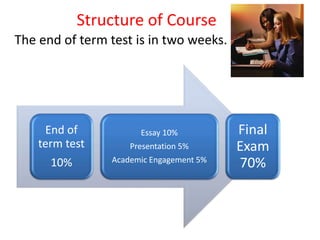
Structure of Course
The end of term test is in two weeks.
End of
term test
10%
Essay 10%
Presentation 5%
Academic Engagement 5%
Final
Exam
70%
Self-study activities
• Revision for end of term test.
• Create 8 mind maps on A3 paper using different
coloured pens to revise lectures 1-8.
• Bring to lectures and seminars
• Bring books to lectures and seminars
• Include: key terms, theorists, definitions. Detail!
• Go to Moodle Glossary and test a friend on the terms.
• Create flash cards that represent key terms.
• Go back and do ALL assignments on Moodle
• The next two weeks, you will be doing revision and
presentations.

Bodies and social constructionism

  • 1.
    The social constructionof everyday life Bodies
  • 2.
    Ask your partner •Using Goffman’s idea of performance, in which ways can the body perform: – Gender – Class – Ethnicity • Using Hall’s circuit of culture (identity, production, consumption, regulation, representation), can you analyse how the body is cultural? • In what ways can we say that bodies are socially constructed?
  • 3.
    Today • Identity andsocial construction • The sociology of bodies • The body project – Schilling • Resources and the body project: – An international perspective: the aryan model • Male bodies – Bordo
  • 4.
    Identity – relatesvery strongly to social construction • ‘Identity is about belonging, about what you have in common with some people and what differentiates you from others. At its most basic it gives you a sense of personal location, the stable core to your individuality. But it is also about your social relationships, your complex involvement with others’ • (Weeks, 1991:88) • This leads us to bodies… 4
  • 5.
    The sociology ofbodies • Bodies seem to be straightforward, natural and given. • ‘Body projects’ 'in the process of becoming; a project which should be worked at and accomplished as part of an individual's self- identity'. (Shilling, C., 2003, The Body and Social Theory, London, Thousand Oaks, New Delhi, Sage Publications. ) 5
  • 6.
    The Body Project •‘the process of becoming and transforming a biological entity through social action’ (cited in Macionis and Plummer 2008:213). – Clothing – Washing and hygiene – Medical and fitness regimes (p. 213) – Tatoos piercings • Individuals are expected to take more responsibility for their health (not smoking, going to the gym…) • A healthy body is a worthy body; an unhealthy body is a deviant body – Kilbourne’s work: • Deviation is regulated through contempt, ‘humour’
  • 7.
    Resources and thebody project • The relationships different classes have with the body, and different access to resources will affect the body project. The Aryan Model. • http://www.youtube.com/watch?v=3yKqOSpDDp4&fea ture=related • Complexity: – Access to material resources – Presumed aryan normative • Idealised female beauty has existed for hundreds of years in the form of: • Concubines • Paintings • stories
  • 8.
    Stereotypes in themedia • You looked at Kilbourne’s lecture and the introductory chapter in your seminars this week • Advertising leads to the sexualisation and disembodiment of females body parts • The woman becomes a thing – and not even the whole thing • Kilbourne connects this to public health issues: – Self-esteem – anorexia/bulimia – Violence and battery • So sexy so soon: – Young children are increasingly exposed to sexualised images – Glorification of sex for its physical sake/ splicing with the emotional and friendship attachments. 8
  • 9.
    What about men’sbodies? • We have so far been looking at the objectified female form: – Disembodied – Sexualised – Commoditised • How are men’s bodies used in advertising and the media, and is this changing?
  • 10.
    Bordo, S (1999) •Susan Bordo wrote about similar issues to Kilbourne in Unbearable Weight • The Male Body deals with this question • she considers the way the male body is portrayed in advertising. • This book is in the LRC: – Use it for your coursework in term 2 – A good, academic source 10
  • 11.
    Susan Bordo (1999) •‘beauty (re)discovers the male body’ • Looking through a magazine, she notices… • The ‘gaze’ • There is a difference between the gaze for men and women, according to Bordo • There are two types of male bodies in advertising: – The ‘face-off?’ – The ‘lean’
  • 12.
    Male body posture:the ‘face-off’ • His gaze is on us • Hypermasculinity: – Presumed heteronormativity – Aggression – Power through these forms 12
  • 13.
    This is whatBordo saw • Body parts • naked men • frankly portrayed as ‘objects’ of a sexual gaze • Objectification • He is not looking at us • Heteronormative? – For women – For men 13
  • 14.
    Subject to ascrutinizing gaze – Increasingly subject to a scrutinizing gaze – offered up to be gazed at – instead of being the subject of the gaze 14
  • 15.
    • David Bartongym: ‘No pecs, no sex.’ 15
  • 16.
    Male body posture:‘the lean’ • Men’s bodies shown reclining, leaning against, or propped up against something in the fashion typical of women’s bodies. • ‘Men have complained, justly, about the burden of having to be the sexual initiator, the pursuer, the one of whom sexual “performance” is expected’ (Bordo p190). • Perhaps this is an escape from that role? 16
  • 17.
    Androgeny • Androgeny meansthe blurring of stereotypical gender norms • ‘Leaners’ tend to be very young men. • Different rules for boys and men? • Boys can be seductive, playful, flirt? • Men must still be in command (Face-off)? 17
  • 18.
    ‘No, I don’tthink the business of beauty is without its pleasures. It offers a daily ritual of transformation, renewal. Of “putting oneself together” and walking out into the world, more confident than you were . . . . I love shopping for makeup with my friends. (Despite what [many people believe], feminism—certainly not feminism in the nineties—is not synonymous with unshaven legs.) Women bond over shared make-up, shared beauty tips. . . . Too often, though, our bond is over shared pain. . . there’s always that constant judgment and evaluation.’ (Bordo p217) 18
  • 19.
    • Do youthink the same is true of men? In 1997 ‘men . . . comprised over a quarter of cosmetic-surgery patients. . . As many as a million men—and eight million women—have an eating disorder. . . Men’s health magazines . . . dispense diet and exercise advice (“A better Body in Half the Time,” “50 Snacks That Won’t Make You Fat”)’ (Bordo p218). 19
  • 20.
  • 21.
    • Stereotypes aredamaging to both men and women. • The social construction of gender through advertising is harmful in many ways, including judging oneself according to impossible ideals. 21
  • 22.
    Ads against stereotypesDove Pro-Age 22
  • 23.
    How many advertsshow men doing housework? 23
  • 24.
    Key theories andterms you need to know • Definitions of micro-sociology (x2) • Agents of socialization ( x5) • Psychodynamic socialization theories • Behaviourism theories • Social Constructionism/ interactionist theories • Margaret Mead • Susan Bordo • Chris Shilling (the body project) • Bandura (Bobo Doll) • Irving Goffman • Garfinkel
  • 25.
    Today • Identity andsocial construction • The sociology of bodies • The body project – Schilling • Resources and the body project: – An international perspective: the aryan model • Now – – The end of term test
  • 26.
  • 27.
    Aims • Familiarise selveswith structure of test (exam) • Understand what is expected of you in test • Be confident how much work you need to do at home in order to succeed
  • 28.
    Test Structure • Twosections: A: 10 short-answer questions (50 marks) B: one essay (50 marks) • 1.5 hours • Marked out of 100 • Worth 10% of final grade
  • 29.
    Test Structure • SectionA: You should usually write four or five sentences for each answer DO NOT BULLET POINT/LIST YOUR ANSWERS – MARKS WILL BE TAKEN OFF IF YOU DO: USE FULL SENTENCES!! The more the points, the more you write Revision tips: flash cards, write your own questions, then write your answers
  • 30.
    0 1 23 4 No answer Incomprehensible One concept mentioned, OR two concepts mentioned, but NO COMPARISON) Two concepts, WITH comparison Three concepts, comparison made Four concepts, clear comparison made
  • 31.
    Test Structure • SectionB: A typical question: Compare and contrast Marx’s theory of ---- with Durkheim’s theory of -----. With reference to theory, which is more convincing? You will write ONE essay from a choice of three essay questions You should usually write 1½ - 2 pages for the essay.
  • 32.
    Long answer questions •Plan for at least five minutes. – The best essays are planned. – The plan will not be marked. • The best essays make an argument. – They use theory to answer and analyse – They analyse examples from different perspectives  Revision tips: write your own essay questions, use your part A flash cards to plan the essay, think of examples from the ‘real world’
  • 34.
    34 The pyramid ofskills: the bottom two layers are 'Lower-order skills', while the top four layers are 'Higher-order skills'. As there is now less emphasis on testing the lower order skills this implies that it is not possible for candidates to perform well in the essay paper by rote learning of notes.
  • 35.
    Some examples: • Whatrole does the family play in socialisation? • What are the agents of social change? • What are the main theories regarding globalisation, and which do you agree with? • How has British society changed recently? • According to Marx, • What contributions have micro-sociological studies made to understanding the social world?
  • 36.
    How the essayis marked Very weak 0-19 (0-39%) Quite Weak 20 -24 (40-49%) Pass Average 25 -29 (50-59%) 2:2 Quite Strong 30 -34 (60-69) 2:1 Very Strong 35-50 (70+%) 1st Professionalism/ presentation Knowledge and understanding: answering the question Cognitive skills/ Analysis in subject area Strength of argument/ Supporting information
  • 37.
    End of termtest. 10% 1.5 hrs PART A (40 minutes) • 10 questions • 4 minutes each question • Answer all • Short answer questions • one paragraph each answer • Full sentences (0.25 penalty) • 50 marks PART B (50 mins) • Choose 1 of 3 questions • Long answer question • Plan: 10 mins • Answer the question: 40 mins • Paragraphs (intro, body, conclusion) • 50 marks
  • 38.
    Mock test • 45mins section A: – 4.5 mins each question • 45 mins section B: – 5 mins planning – 40 mins writing
  • 39.
  • 40.
    Topics Included • Briefpolitical history: Monarchy VS Parliament. • Expansion of voting rights. • ‘Constitutional monarchy’ • Bicameral Parliament • Main political parties • Devolution • Coalition government 40
  • 41.
    Topics Included • Growingpopulation-aging • The family and change • Cohabitation, divorce • Social class • Class conflict 41
  • 42.
    Introducing Sociology: GiddensChaper 1 • Sociology & ‘Sociological Imagination’ • Origins of sociology • Founders of sociology – Comte – Durkheim – Marx – Weber – Martineau – Khaldun 42
  • 43.
    Introducing Sociology: GiddensChaper 1 • Aims of early sociologists • Modern theoretical approaches – Functionalism – Conflict theory – Symbolic interactionism • Micro/macro sociology • Importance of sociology 43
  • 44.
    Globalisation and thestudy of society: Giddens Ch.4 What is it? Is it really new? • Pre-modern societies • Pastoral and agrarian • Non-industrial or traditional • Industrial • Post-industrial Global development Factors contributing to globalisation Technology & compression of time and space Impacts of globalisation, e.g. weakening of the nation state and national identity The ‘electric economy’ Global commodity chains Globalisation debate Americanisation?
  • 45.
    • Social change –Cultural factors – Physical environment – Political organisation • Sociological approaches – Marx – Weber – Durkheim 45
  • 46.
    Culture, Norms andValues: Macionis and Plummer Ch. 5 • Definitions of culture • Five major components of culture: Symbols Language Values Norms Material culture Ethnocentrism Cultural Relativism Glocalisation Postmodern culture
  • 47.
    Social Construction ofEveryday Life: Macionis and Plummer Ch. 7 Nature versus nurture Agencies of socialisation Social construction Gender stereotypes within the media The sociology of bodies
  • 48.
    How to revise •Re-read the set reading, taking notes on these key topics. • Meet with your friends and test each other. • Use the online Moodle glossary • The short answers are designed to test your knowledge of all those little points from the reading: not just from the lecture power points • The essays are designed to test your in-depth critical knowledge of the theories. • You can’t answer the essay questions without doing a lot of hard work. • Make sure you can give examples from real life • Think about some of the questions which have been raised in the workshops
  • 49.
    Seminar presentations Pay attentionto Moodle • British Society • What is sociology? • Globalization • Change • Cultures, norms and values • Social constructionism • Marx • Durkheim • Weber Pay attention to Moodle • British Society • What is sociology? • Globalization • Change • Cultures, norms and values • Social constructionism • Marx • Durkheim • Weber
  • 50.
    Structure of Course Theend of term test is in two weeks. End of term test 10% Essay 10% Presentation 5% Academic Engagement 5% Final Exam 70%
  • 51.
    Self-study activities • Revisionfor end of term test. • Create 8 mind maps on A3 paper using different coloured pens to revise lectures 1-8. • Bring to lectures and seminars • Bring books to lectures and seminars • Include: key terms, theorists, definitions. Detail! • Go to Moodle Glossary and test a friend on the terms. • Create flash cards that represent key terms. • Go back and do ALL assignments on Moodle • The next two weeks, you will be doing revision and presentations.