Business Research Methods
Developing a Research Proposal
Learning objectives
 Understand the steps involved in preparing a research
proposal.
 Discuss the probable content of a research proposal.
 Outline a methodological framework for a research
proposal
 Developing research proposals (Guidellines)
Research Idea
 The first thing you need as a research is to generate ideas
for your research project.
 Your idea for you research project is properly expressed
in your very well conceptualized research statement or
question.
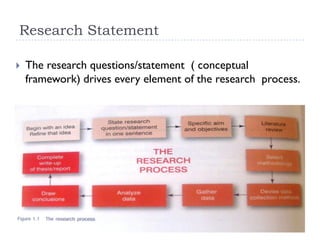
Research Statement
 The research questions/statement ( conceptual
framework) drives every element of the research process.
Generating ideas
 You can generate ideas for research projects
from:
 Everything you have studied so far
 Everything you have seen, watched and
experienced in your work
 Everything that interests or intrigues you
about the business world
 Every person that you have encountered in
the business world.
Problem? (Generating ideas for research
project?)
The problem should not be of having no ideas;
The problem should be in deciding on which idea
to focus for your research project.
•Think Critically about your ideas for research project.
•Think About problems you can encounter
•Some of the following critical questions need to be
asked in your research
Questions to the proposed research idea
 Are there any particular problems, sensitivities,
issues, about this research idea that stand out
from the start?
 Do you think that these problems, issues and
sensitivities would be substantial enough to
stop such a research project or to substantially
delay such a research project?
Questions in relation to the literature
 Is there anything written about this
topic?Too little or too much?
 Who has been writing on this topic?
When? Recently?
 Where is it written? Journals? Online?
 What is being written about the topic?
 What do the authors in the journals
recommend for further research?
Questions in relation to Methodology
 What methodologies did previous researchers in
the field used for their studies?
 What kind of data collection methods did they
use?
 Where would you conduct your research? Do you
have access to the site?
 What kind of data would you look for in order to
produce some new knowledge in this field?
 How would you gather it?Why would you gather
in this manner?Why is it the best way?
Dead End!
 It is important not to be attached to an idea
until you get indications of being viable
research project.
 There is no point in getting attached to an idea
of research project if it is not acceptable to
your potential examiner/ supervisor.
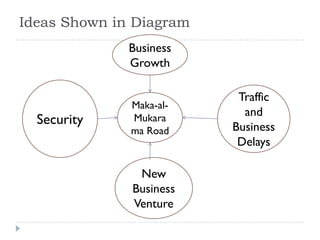
Maka-al-
Mukara
ma Road
Business
Growth
Traffic
and
Business
Delays
New
Business
Venture
Security
Ideas Shown in Diagram
Conceptual Framework- First Step
 This research project is a case study examining
the advertising campaigns undertaken in the year
2013 for the marketing of the telecomunication
companies in Mogadishu.
 The research project is a survey of the business
plans of 50 SMEs in the Bakara Market.
Refining Research Ideas
 Too big,Too broad or too ambitious research
projects.
 From research idea to a properly defined and
refined research project.
 Spend much time in conceptualizing your research
and it will save you time in the long run.
 It is essential to have the support of your
supervisor for your research idea, statement or
research project.
Limiting the scope
 The critical question is whether
the research is doable.
 Research project assignment (
Scope and size)
 Be very clear on the standards
expected, the magnitude or scope
expected and any expectations or
requirements
 Be very clear also what you want,
as a researcher to accomplish in
the research.
Aim and objectives
 Aim of your research:To keep things simple,
the aim of your research is your research
statement/question restated as an aim
 Objectives of the research:The steps the
researcher takes in order to accomplish the
aim of the research.
 (See Examples in the textbook)
Theoretical framework ( Chapter 6 In detail)
 A sample literature review is required to write
for research proposal.
 In general it would be 300-800 words.
 Have a look at Journal Articles if you wish to
see how literature review looks like.
 Remember that literature review is not list of
relevant literature; it is a review of relevant
literature (critically evaluating literature).
Methodological framework
 A synopsis of the methodological framework is presented
in the research proposal.
 Research methodology:The appropriate methodology is
indicated to the researcher by:
 the nature of the research,
 the kind of data required for the study,
 And the geographic spread of the population
Population and sample
 Population: Every person who, or every
entity which, could be included in the
research ( Chapter 8 in detail).
 Sample:A sample is a subset of a
population. If probability sampling is used
the sample said to be representative of
the population.
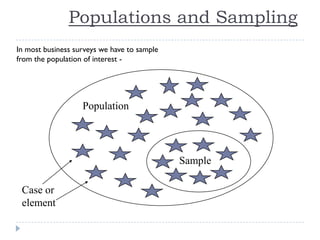
Populations and Sampling
Population
Sample
Case or
element
In most business surveys we have to sample
from the population of interest -
Cont…
 What is needed in the research
proposal:
 Statement of methodology,
 A description of the population of the
study and the size of the sample drawn
from the population.
 Data collection method details
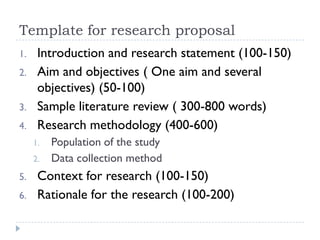
Template for research proposal
1. Introduction and research statement (100-150)
2. Aim and objectives ( One aim and several
objectives) (50-100)
3. Sample literature review ( 300-800 words)
4. Research methodology (400-600)
1. Population of the study
2. Data collection method
5. Context for research (100-150)
6. Rationale for the research (100-200)
Be prepared for
 To make mistakes and to learn.
 To write and rewrite many times.
 To spend many hours looking for
information.
 To have your writing criticized.
 To feel confuse and hopeless some
times.
Important information for writing
 Always structure your work in advance.
 Know that you want to say before writing.
 Every sentence must contain one idea only.
 Each sentence must follow logically from the before:
chain of ideas.
 Write in a way that is easy to read.
 Use simple language.
 Check spelling and grammar.
 Do not cut and paste from articles.
 Make it simple
 Avoid pretentious language, unnecessary jargon, and
double speak by cutting down every unnecessary
word.
 Read your work loud
 A sentence that is difficult to say will be difficult to
read.
 Revise , revise, revise.
 Put an end to it
 The faster you finish the proposal and submit it the
less time you have wasted thinking about writing it.
Tips for successful proposal writing
20130928_Developing a Research Proposal.pdf

20130928_Developing a Research Proposal.pdf

  • 1.
  • 2.
    Learning objectives  Understandthe steps involved in preparing a research proposal.  Discuss the probable content of a research proposal.  Outline a methodological framework for a research proposal  Developing research proposals (Guidellines)
  • 3.
    Research Idea  Thefirst thing you need as a research is to generate ideas for your research project.  Your idea for you research project is properly expressed in your very well conceptualized research statement or question.
  • 4.
    Research Statement  Theresearch questions/statement ( conceptual framework) drives every element of the research process.
  • 5.
    Generating ideas  Youcan generate ideas for research projects from:  Everything you have studied so far  Everything you have seen, watched and experienced in your work  Everything that interests or intrigues you about the business world  Every person that you have encountered in the business world.
  • 6.
    Problem? (Generating ideasfor research project?) The problem should not be of having no ideas; The problem should be in deciding on which idea to focus for your research project. •Think Critically about your ideas for research project. •Think About problems you can encounter •Some of the following critical questions need to be asked in your research
  • 7.
    Questions to theproposed research idea  Are there any particular problems, sensitivities, issues, about this research idea that stand out from the start?  Do you think that these problems, issues and sensitivities would be substantial enough to stop such a research project or to substantially delay such a research project?
  • 8.
    Questions in relationto the literature  Is there anything written about this topic?Too little or too much?  Who has been writing on this topic? When? Recently?  Where is it written? Journals? Online?  What is being written about the topic?  What do the authors in the journals recommend for further research?
  • 9.
    Questions in relationto Methodology  What methodologies did previous researchers in the field used for their studies?  What kind of data collection methods did they use?  Where would you conduct your research? Do you have access to the site?  What kind of data would you look for in order to produce some new knowledge in this field?  How would you gather it?Why would you gather in this manner?Why is it the best way?
  • 10.
    Dead End!  Itis important not to be attached to an idea until you get indications of being viable research project.  There is no point in getting attached to an idea of research project if it is not acceptable to your potential examiner/ supervisor.
  • 11.
  • 12.
    Conceptual Framework- FirstStep  This research project is a case study examining the advertising campaigns undertaken in the year 2013 for the marketing of the telecomunication companies in Mogadishu.  The research project is a survey of the business plans of 50 SMEs in the Bakara Market.
  • 13.
    Refining Research Ideas Too big,Too broad or too ambitious research projects.  From research idea to a properly defined and refined research project.  Spend much time in conceptualizing your research and it will save you time in the long run.  It is essential to have the support of your supervisor for your research idea, statement or research project.
  • 14.
    Limiting the scope The critical question is whether the research is doable.  Research project assignment ( Scope and size)  Be very clear on the standards expected, the magnitude or scope expected and any expectations or requirements  Be very clear also what you want, as a researcher to accomplish in the research.
  • 15.
    Aim and objectives Aim of your research:To keep things simple, the aim of your research is your research statement/question restated as an aim  Objectives of the research:The steps the researcher takes in order to accomplish the aim of the research.  (See Examples in the textbook)
  • 17.
    Theoretical framework (Chapter 6 In detail)  A sample literature review is required to write for research proposal.  In general it would be 300-800 words.  Have a look at Journal Articles if you wish to see how literature review looks like.  Remember that literature review is not list of relevant literature; it is a review of relevant literature (critically evaluating literature).
  • 18.
    Methodological framework  Asynopsis of the methodological framework is presented in the research proposal.  Research methodology:The appropriate methodology is indicated to the researcher by:  the nature of the research,  the kind of data required for the study,  And the geographic spread of the population
  • 19.
    Population and sample Population: Every person who, or every entity which, could be included in the research ( Chapter 8 in detail).  Sample:A sample is a subset of a population. If probability sampling is used the sample said to be representative of the population.
  • 20.
    Populations and Sampling Population Sample Caseor element In most business surveys we have to sample from the population of interest -
  • 21.
    Cont…  What isneeded in the research proposal:  Statement of methodology,  A description of the population of the study and the size of the sample drawn from the population.  Data collection method details
  • 22.
    Template for researchproposal 1. Introduction and research statement (100-150) 2. Aim and objectives ( One aim and several objectives) (50-100) 3. Sample literature review ( 300-800 words) 4. Research methodology (400-600) 1. Population of the study 2. Data collection method 5. Context for research (100-150) 6. Rationale for the research (100-200)
  • 23.
    Be prepared for To make mistakes and to learn.  To write and rewrite many times.  To spend many hours looking for information.  To have your writing criticized.  To feel confuse and hopeless some times.
  • 24.
    Important information forwriting  Always structure your work in advance.  Know that you want to say before writing.  Every sentence must contain one idea only.  Each sentence must follow logically from the before: chain of ideas.  Write in a way that is easy to read.  Use simple language.  Check spelling and grammar.  Do not cut and paste from articles.
  • 25.
     Make itsimple  Avoid pretentious language, unnecessary jargon, and double speak by cutting down every unnecessary word.  Read your work loud  A sentence that is difficult to say will be difficult to read.  Revise , revise, revise.  Put an end to it  The faster you finish the proposal and submit it the less time you have wasted thinking about writing it. Tips for successful proposal writing