Testing LectureC to C++
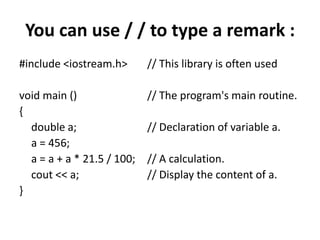
You can use / / to type a remark :#include <iostream.h> 	// This library is often usedvoid main () 			// The program's main routine.{	double a; 			// Declaration of variable a.	a = 456;	a = a + a * 21.5 / 100; 	// A calculation.cout << a; 			// Display the content of a.}
Input from keyboard and output to screen can be performed through cout << and cin >> :#include <iostream.h>void main(){int a; 			// a is an integer variable	char s [100]; 			// s points to a sring of 99 characterscout << "This is a sample program." << endl;cout << endl; 			// Line feed (end of line)cout << "Type your age : ";cin >> a;cout << "Type your name : ";cin >> s;cout << endl;cout << "Hello " << s << " you're " << a << " old." << endl;cout << endl << endl << "Bye !" << endl;}
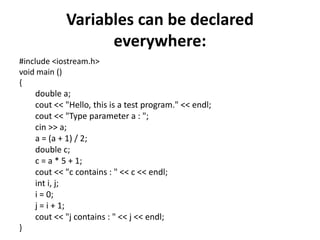
Variables can be declared everywhere:#include <iostream.h>void main (){double a;cout << "Hello, this is a test program." << endl;cout << "Type parameter a : ";cin >> a;a = (a + 1) / 2;double c;c = a * 5 + 1;cout << "c contains : " << c << endl;inti, j;i = 0;j = i + 1;cout << "j contains : " << j << endl;}
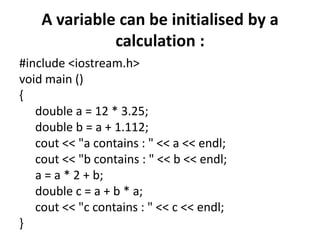
A variable can be initialised by a calculation :#include <iostream.h>void main (){double a = 12 * 3.25;double b = a + 1.112;cout << "a contains : " << a << endl;cout << "b contains : " << b << endl;a = a * 2 + b;double c = a + b * a;cout << "c contains : " << c << endl;}
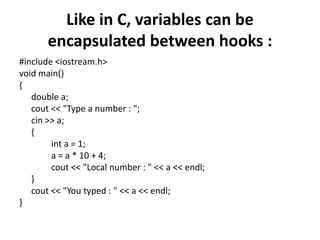
Like in C, variables can be encapsulated between hooks :#include <iostream.h>void main(){	double a;cout << "Type a number : ";cin >> a;	{int a = 1;		a = a * 10 + 4;cout << "Local number : " << a << endl;	}cout << "You typed : " << a << endl;}
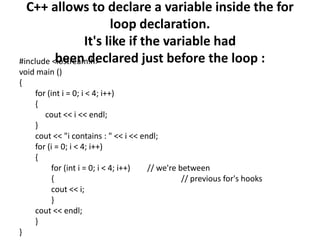
C++ allows to declare a variable inside the for loop declaration. It's like if the variable hadbeen declared just before the loop :#include <iostream.h>void main (){for (int i = 0; i < 4; i++){cout << i << endl;}cout << "i contains : " << i << endl;for (i = 0; i < 4; i++){for (inti = 0; i < 4; i++) 	// we're between{					 // previous for's hookscout << i;}cout << endl;}}
A global variable can be accessed even if another variable with the same name has beendeclared inside the function :#include <iostream.h>double a = 128;void main (){double a = 256;cout << "Local a : " << a << endl;cout << "Global a : " << ::a << endl;}
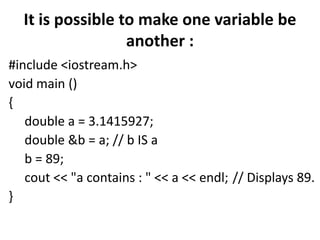
It is possible to make one variable be another :#include <iostream.h>void main (){double a = 3.1415927;double &b = a; // b IS ab = 89;cout << "a contains : " << a << endl; 	// Displays 89.}
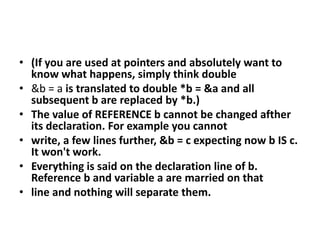
(If you are used at pointers and absolutely want to know what happens, simply think double&b = a is translated to double *b = &a and all subsequent b are replaced by *b.)The value of REFERENCE b cannot be changed afther its declaration. For example you cannotwrite, a few lines further, &b = c expecting now b IS c. It won't work.Everything is said on the declaration line of b. Reference b and variable a are married on thatline and nothing will separate them.
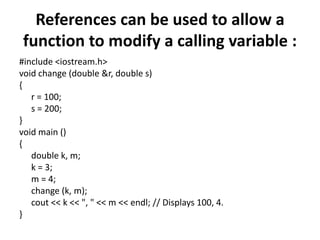
References can be used to allow a function to modify a calling variable :#include <iostream.h>void change (double &r, double s){	r = 100;	s = 200;}void main (){	double k, m;	k = 3;	m = 4;	change (k, m);cout << k << ", " << m << endl; // Displays 100, 4.}
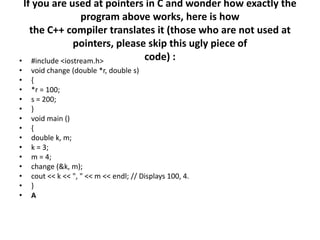
If you are used at pointers in C and wonder how exactly the program above works, here is howthe C++ compiler translates it (those who are not used at pointers, please skip this ugly piece ofcode) :#include <iostream.h>void change (double *r, double s){*r = 100;s = 200;}void main (){double k, m;k = 3;m = 4;change (&k, m);cout << k << ", " << m << endl; // Displays 100, 4.}A
Testing lecture after lec 4

Testing lecture after lec 4

  • 1.
  • 2.
    You can use/ / to type a remark :#include <iostream.h> // This library is often usedvoid main () // The program's main routine.{ double a; // Declaration of variable a. a = 456; a = a + a * 21.5 / 100; // A calculation.cout << a; // Display the content of a.}
  • 3.
    Input from keyboardand output to screen can be performed through cout << and cin >> :#include <iostream.h>void main(){int a; // a is an integer variable char s [100]; // s points to a sring of 99 characterscout << "This is a sample program." << endl;cout << endl; // Line feed (end of line)cout << "Type your age : ";cin >> a;cout << "Type your name : ";cin >> s;cout << endl;cout << "Hello " << s << " you're " << a << " old." << endl;cout << endl << endl << "Bye !" << endl;}
  • 4.
    Variables can bedeclared everywhere:#include <iostream.h>void main (){double a;cout << "Hello, this is a test program." << endl;cout << "Type parameter a : ";cin >> a;a = (a + 1) / 2;double c;c = a * 5 + 1;cout << "c contains : " << c << endl;inti, j;i = 0;j = i + 1;cout << "j contains : " << j << endl;}
  • 5.
    A variable canbe initialised by a calculation :#include <iostream.h>void main (){double a = 12 * 3.25;double b = a + 1.112;cout << "a contains : " << a << endl;cout << "b contains : " << b << endl;a = a * 2 + b;double c = a + b * a;cout << "c contains : " << c << endl;}
  • 6.
    Like in C,variables can be encapsulated between hooks :#include <iostream.h>void main(){ double a;cout << "Type a number : ";cin >> a; {int a = 1; a = a * 10 + 4;cout << "Local number : " << a << endl; }cout << "You typed : " << a << endl;}
  • 7.
    C++ allows todeclare a variable inside the for loop declaration. It's like if the variable hadbeen declared just before the loop :#include <iostream.h>void main (){for (int i = 0; i < 4; i++){cout << i << endl;}cout << "i contains : " << i << endl;for (i = 0; i < 4; i++){for (inti = 0; i < 4; i++) // we're between{ // previous for's hookscout << i;}cout << endl;}}
  • 8.
    A global variablecan be accessed even if another variable with the same name has beendeclared inside the function :#include <iostream.h>double a = 128;void main (){double a = 256;cout << "Local a : " << a << endl;cout << "Global a : " << ::a << endl;}
  • 9.
    It is possibleto make one variable be another :#include <iostream.h>void main (){double a = 3.1415927;double &b = a; // b IS ab = 89;cout << "a contains : " << a << endl; // Displays 89.}
  • 10.
    (If you areused at pointers and absolutely want to know what happens, simply think double&b = a is translated to double *b = &a and all subsequent b are replaced by *b.)The value of REFERENCE b cannot be changed afther its declaration. For example you cannotwrite, a few lines further, &b = c expecting now b IS c. It won't work.Everything is said on the declaration line of b. Reference b and variable a are married on thatline and nothing will separate them.
  • 11.
    References can beused to allow a function to modify a calling variable :#include <iostream.h>void change (double &r, double s){ r = 100; s = 200;}void main (){ double k, m; k = 3; m = 4; change (k, m);cout << k << ", " << m << endl; // Displays 100, 4.}
  • 12.
    If you areused at pointers in C and wonder how exactly the program above works, here is howthe C++ compiler translates it (those who are not used at pointers, please skip this ugly piece ofcode) :#include <iostream.h>void change (double *r, double s){*r = 100;s = 200;}void main (){double k, m;k = 3;m = 4;change (&k, m);cout << k << ", " << m << endl; // Displays 100, 4.}A