OOPs with C++ Lecture 4
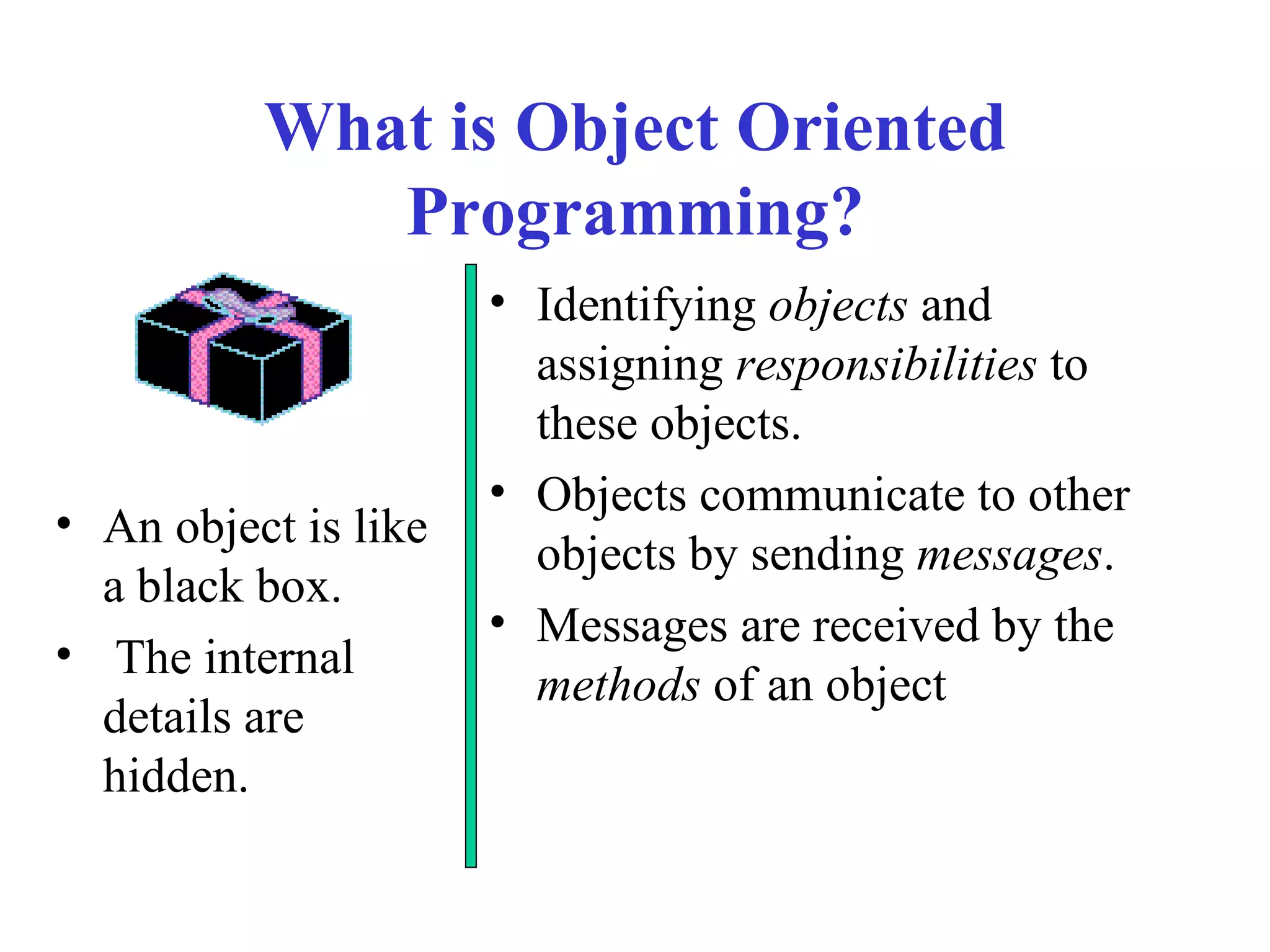
What is Object Oriented Programming? An object is like a black box. The internal details are hidden. Identifying  objects  and assigning  responsibilities  to these objects. Objects communicate to other objects by sending  messages . Messages are received by the  methods  of an object
The two steps of Object Oriented Programming Making Classes:   Creating, extending or reusing abstract data types. Making Objects interact:   Creating objects from abstract data types and defining their relationships.
Example: The Creature class class Creature {  private: int yearOfBirth; public:  void setYearOfBirth(year) { yearOfBirth = year; } int getYearOfBirth() {  return yearOfBirth; }  };
Example: The Creature class class Creature {  private: int yearOfBirth; public:  void setYearOfBirth(year); int getYearOfBirth(); }; void Creature::setYearOfBirth { yearOfBirth = year; } int Creature::getYearOfBirth() {  return yearOfBirth; }  Note that unless the methods are very short, declaration and implementation is usually separated. The declaration goes into a header file (.h), the implementation in a .cpp file.
Classes & Objects What may be different for all objects in a class, and what remains the same? All the objects in a class may have different attribute values (state data), but their allowed behaviours are all the same. So a class is a blueprint for objects
Objects & Classes A class is defined by: A Unique Name Attributes Methods An object is defined by: Identity State Behaviour
Instantiating Objects An object is instantiated just like any other data type: int x; char y; Creature z;   Declaring z of type ‘creature’  means we have generated an object with the attributes and methods of the class.
Multiple Objects Of course we can create many objects of the same class: Creature myDog; Creature theMilkman; Creature myBestFriend; Creates three objects.
Sending Messages /    Calling Methods. A message is send to an object by calling a method of this object. Use the . (dot) for calling a method of an object. int k;  k =  theMilkman.getYearOfBirth(); myDog.setYearOfBirth(1998); Messages are sent to my dog and the milkman.
Back to the Instantiation... An object is instantiated just like any other data type: int x; char y; Creature z;   Here the “default constructor” of the Creature class is automatically called. If we don’t like this we can specify constructors explicitly!
End

Lecture 4

  • 1.
    OOPs with C++Lecture 4
  • 2.
    What is ObjectOriented Programming? An object is like a black box. The internal details are hidden. Identifying objects and assigning responsibilities to these objects. Objects communicate to other objects by sending messages . Messages are received by the methods of an object
  • 3.
    The two stepsof Object Oriented Programming Making Classes: Creating, extending or reusing abstract data types. Making Objects interact: Creating objects from abstract data types and defining their relationships.
  • 4.
    Example: The Creatureclass class Creature { private: int yearOfBirth; public: void setYearOfBirth(year) { yearOfBirth = year; } int getYearOfBirth() { return yearOfBirth; } };
  • 5.
    Example: The Creatureclass class Creature { private: int yearOfBirth; public: void setYearOfBirth(year); int getYearOfBirth(); }; void Creature::setYearOfBirth { yearOfBirth = year; } int Creature::getYearOfBirth() { return yearOfBirth; } Note that unless the methods are very short, declaration and implementation is usually separated. The declaration goes into a header file (.h), the implementation in a .cpp file.
  • 6.
    Classes & ObjectsWhat may be different for all objects in a class, and what remains the same? All the objects in a class may have different attribute values (state data), but their allowed behaviours are all the same. So a class is a blueprint for objects
  • 7.
    Objects & ClassesA class is defined by: A Unique Name Attributes Methods An object is defined by: Identity State Behaviour
  • 8.
    Instantiating Objects Anobject is instantiated just like any other data type: int x; char y; Creature z; Declaring z of type ‘creature’ means we have generated an object with the attributes and methods of the class.
  • 9.
    Multiple Objects Ofcourse we can create many objects of the same class: Creature myDog; Creature theMilkman; Creature myBestFriend; Creates three objects.
  • 10.
    Sending Messages / Calling Methods. A message is send to an object by calling a method of this object. Use the . (dot) for calling a method of an object. int k; k = theMilkman.getYearOfBirth(); myDog.setYearOfBirth(1998); Messages are sent to my dog and the milkman.
  • 11.
    Back to theInstantiation... An object is instantiated just like any other data type: int x; char y; Creature z; Here the “default constructor” of the Creature class is automatically called. If we don’t like this we can specify constructors explicitly!
  • 12.