Business school
University of Saint Thomas Of Mozambique
Bachelors Honor In Computer Science
High Performance computing in Advanced Operating System
Eric Pascal Wasonga, Daniel Darsamo, Kainza Scovia, Marcos
Custanheira.
1
HIGH
PERFORMANACE
COMPUTING
Table Outline
1.introduction
2. components and
application of HPC
3. Parallel computing
3. distributed computing
4. super computing
5. quantam computing
6. conclussion
2
Introduction
This presentation aims to provide an in-depth exploration of three pivotal
topics in contemporary computer science: High-Performance Computing
(HPC), Computer Architecture, and Quantum Computing. Each section
will cover fundamental concepts, advanced techniques, and real-world
applications, equipping readers with a comprehensive understanding of
these domains for academic and practical purposes.
3
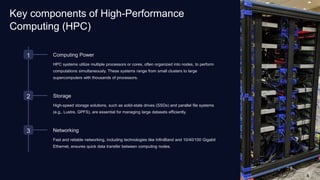
Key components of High-Performance
Computing (HPC)
1 Computing Power
HPC systems utilize multiple processors or cores, often organized into nodes, to perform
computations simultaneously. These systems range from small clusters to large
supercomputers with thousands of processors.
2 Storage
High-speed storage solutions, such as solid-state drives (SSDs) and parallel file systems
(e.g., Lustre, GPFS), are essential for managing large datasets efficiently.
3 Networking
Fast and reliable networking, including technologies like InfiniBand and 10/40/100 Gigabit
Ethernet, ensures quick data transfer between computing nodes.
4
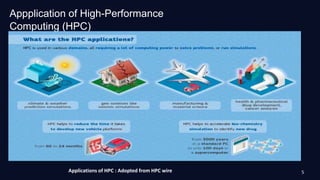
Appplication of High-Performance
Computing (HPC)
Applications of HPC : Adopted from HPC wire 5
Techniques in Parallel Computing
1. Data Parallelism
Distributing subsets of the
same dataset across
multiple computing nodes
and performing the same
operation on each subset.
2. Task Parallelism
Distributing different tasks
across multiple
processors, where each
processor performs a
different task on the same
or different data.
3. Pipeline Parallelism
Dividing tasks into a
series of subtasks, each
executed in a specific
order, analogous to an
assembly line.
Parallel Computing
Parallel computing is a computational paradigm that allows for the execution of multiple calculations or processes simultaneously.
6
Parallel Computing
1. Shared memory model, multiple processors
access a common memory space.
2. Distributed memory model, each processor
has its own private memory, and processors
communicate with each other through a network.
3.Hybrid model combines elements of both
shared and distributed memory models,
leveraging the advantages of each.
Programming models
1. Symmetric Multiprocessing (SMP) systems
utilize multiple identical processors that share a
single memory space and are connected via a
common bus.
2. Massively Parallel Processing (MPP) systems
consist of numerous independent processors,
each with its own private memory.
3. Cluster Computing involves connecting
multiple standalone computers (nodes) through
a network to function as a cohesive system.
Architecture
7
Distributed Computing
1 Scalability
Ability to handle increasing workloads
by adding more nodes.
2 Fault Tolerance
Capability to continue operation even if
some components fail.
3 Resource Sharing
Efficient utilization of resources across
multiple systems.
4 Concurrency
Multiple processes running simultaneously.
Distributed computing is integral to High-Performance Computing (HPC) as it
enables the use of networked computer resources to work collaboratively on
complex computations. By distributing tasks across multiple systems, HPC can
achieve;
8
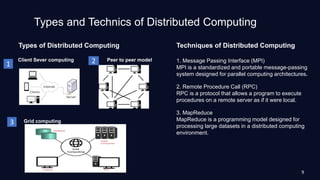
Types and Technics of Distributed Computing
Types of Distributed Computing Techniques of Distributed Computing
1. Message Passing Interface (MPI)
MPI is a standardized and portable message-passing
system designed for parallel computing architectures.
2. Remote Procedure Call (RPC)
RPC is a protocol that allows a program to execute
procedures on a remote server as if it were local.
3. MapReduce
MapReduce is a programming model designed for
processing large datasets in a distributed computing
environment.
Grid computing
Peer to peer model
1 2
3
Client Sever computing
9
Supercomputing
High Processing Speed
Measured in FLOPS (Floating Point
Operations Per Second).
Large Memory Capacity
Ability to handle extensive datasets.
High-Speed Interconnects
Fast communication between processors.
Specialized Software
Optimized for performance.
Major Characteristics
Supercomputing involves the use of supercomputers, which are the fastest and most powerful
computers available. Supercomputers are designed to perform highly complex computations
at extremely high speeds, often measured in FLOPS (Floating Point Operations Per Second)
10
Examples of Super Computers and their Applications
1. Summit, Developer: IBM
Usage: Summit is employed for a variety of scientific research
applications, including astrophysics, climate modeling, and genomics.
It boasts a peak performance of over 200 petaflops.
Fugaku ,Developer: RIKEN and Fujitsu
Usage: Fugaku is used for simulations in medicine,
material sciences, and climate research. It achieved the
top position in the TOP500 list of supercomputers with a
performance exceeding 442 petaflops.
3. Sierra ,Developer: IBM
Usage: Sierra is primarily used for nuclear weapons
simulations and stockpile management at the Lawrence
Livermore National Laboratory. It delivers a peak
performance of over 125 petaflops.
11
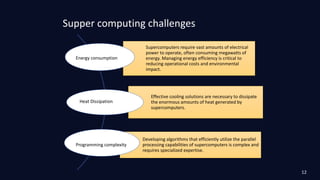
Supper computing challenges
Supercomputers require vast amounts of electrical
power to operate, often consuming megawatts of
energy. Managing energy efficiency is critical to
reducing operational costs and environmental
impact.
Effective cooling solutions are necessary to dissipate
the enormous amounts of heat generated by
supercomputers.
Developing algorithms that efficiently utilize the parallel
processing capabilities of supercomputers is complex and
requires specialized expertise.
Energy consumption
Heat Dissipation
Programming complexity
12
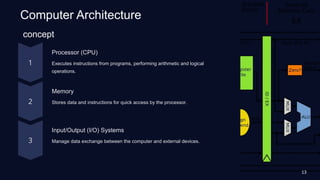
Computer Architecture
Processor (CPU)
Executes instructions from programs, performing arithmetic and logical
operations.
Memory
Stores data and instructions for quick access by the processor.
Input/Output (I/O) Systems
Manage data exchange between the computer and external devices.
concept
13
Processor Design
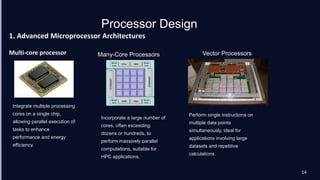
1. Advanced Microprocessor Architectures
Integrate multiple processing
cores on a single chip,
allowing parallel execution of
tasks to enhance
performance and energy
efficiency.
Many-Core Processors
Incorporate a large number of
cores, often exceeding
dozens or hundreds, to
perform massively parallel
computations, suitable for
HPC applications.
Vector Processors
Perform single instructions on
multiple data points
simultaneously, ideal for
applications involving large
datasets and repetitive
calculations.
Multi-core processor
14
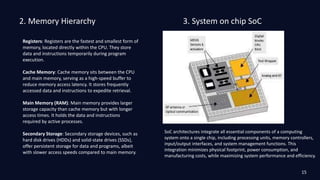
2. Memory Hierarchy
Registers: Registers are the fastest and smallest form of
memory, located directly within the CPU. They store
data and instructions temporarily during program
execution.
Cache Memory: Cache memory sits between the CPU
and main memory, serving as a high-speed buffer to
reduce memory access latency. It stores frequently
accessed data and instructions to expedite retrieval.
Main Memory (RAM): Main memory provides larger
storage capacity than cache memory but with longer
access times. It holds the data and instructions
required by active processes.
Secondary Storage: Secondary storage devices, such as
hard disk drives (HDDs) and solid-state drives (SSDs),
offer persistent storage for data and programs, albeit
with slower access speeds compared to main memory.
3. System on chip SoC
SoC architectures integrate all essential components of a computing
system onto a single chip, including processing units, memory controllers,
input/output interfaces, and system management functions. This
integration minimizes physical footprint, power consumption, and
manufacturing costs, while maximizing system performance and efficiency.
15
Concepts of Quantum Computing
Quantum Superposition
A qubit can exist in multiple
states simultaneously, enabling
parallelism in computations.
Qunatum Entanglement
Qubits can be entangled,
meaning the state of one qubit
can depend on the state of
another, even over long
distances, allowing for complex
correlations.
Quantum Interference
Quantum states can interfere
with each other, enhancing
correct solutions while
canceling out incorrect ones.
Quantum Bits
Quibits may exist in several states
simultaneously ,in contrast to
classical bits which only represent 0
or 1. Because of this quantum
computing can handle enormous
volumes of data simultaneously.
16
Quantum Algorithms
Shor's Algorithm
Shor's algorithm is used for integer
factorization, exponentially faster than
the best-known classical algorithms. It
has significant implications for
cryptography, particularly in breaking
widely used encryption schemes like
RSA.
Grover's Algorithm
Grover's algorithm provides a quadratic
speedup for unstructured search
problems, allowing a quantum computer
to search through unsorted databases
more efficiently than classical
counterparts.
Major Examples
Other Quantum Algorithm
Vairous other algorithims have
been developed for specific
computational tasks, including
simulations ,optimization
,cryptography ,and machine
learning.
17
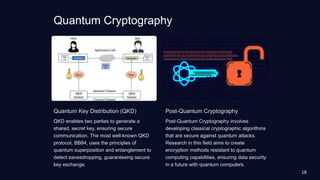
Quantum Cryptography
Quantum Key Distribution (QKD)
QKD enables two parties to generate a
shared, secret key, ensuring secure
communication. The most well-known QKD
protocol, BB84, uses the principles of
quantum superposition and entanglement to
detect eavesdropping, guaranteeing secure
key exchange.
Post-Quantum Cryptography
Post-Quantum Cryptography involves
developing classical cryptographic algorithms
that are secure against quantum attacks.
Research in this field aims to create
encryption methods resistant to quantum
computing capabilities, ensuring data security
in a future with quantum computers.
18
Conclusion
In conclusion, the convergence of High-Performance Computing, Computer Architecture,
and Quantum Computing underscores the inexorable march towards a future where
computational boundaries are continually pushed, enabling humanity to tackle grand
challenges, unlock new discoveries, and usher in a new era of innovation and progress.
As we navigate this ever-evolving landscape, it is imperative to embrace the opportunities
and challenges posed by these technologies, ensuring that we harness their full potential for
the betterment of society and the advancement of human knowledge.
19
References
References
High-Performance Computing (HPC):
1.Dongarra, J., Beckman, P., et al. (2020). The International Exascale Software Project: A Call to
Cooperative Action by the Global High-Performance Community. IEEE Computer, 53(3), 16-24
2.Wilkinson, B., & Allen, M. (2021). Parallel Programming: Techniques and Applications Using
Networked Workstations and Parallel Computers. Springer.
See more references on our report word documenet.
20

Assignment-1 Updated Version advanced comp.pptx

  • 1.
    Business school University ofSaint Thomas Of Mozambique Bachelors Honor In Computer Science High Performance computing in Advanced Operating System Eric Pascal Wasonga, Daniel Darsamo, Kainza Scovia, Marcos Custanheira. 1
  • 2.
    HIGH PERFORMANACE COMPUTING Table Outline 1.introduction 2. componentsand application of HPC 3. Parallel computing 3. distributed computing 4. super computing 5. quantam computing 6. conclussion 2
  • 3.
    Introduction This presentation aimsto provide an in-depth exploration of three pivotal topics in contemporary computer science: High-Performance Computing (HPC), Computer Architecture, and Quantum Computing. Each section will cover fundamental concepts, advanced techniques, and real-world applications, equipping readers with a comprehensive understanding of these domains for academic and practical purposes. 3
  • 4.
    Key components ofHigh-Performance Computing (HPC) 1 Computing Power HPC systems utilize multiple processors or cores, often organized into nodes, to perform computations simultaneously. These systems range from small clusters to large supercomputers with thousands of processors. 2 Storage High-speed storage solutions, such as solid-state drives (SSDs) and parallel file systems (e.g., Lustre, GPFS), are essential for managing large datasets efficiently. 3 Networking Fast and reliable networking, including technologies like InfiniBand and 10/40/100 Gigabit Ethernet, ensures quick data transfer between computing nodes. 4
  • 5.
    Appplication of High-Performance Computing(HPC) Applications of HPC : Adopted from HPC wire 5
  • 6.
    Techniques in ParallelComputing 1. Data Parallelism Distributing subsets of the same dataset across multiple computing nodes and performing the same operation on each subset. 2. Task Parallelism Distributing different tasks across multiple processors, where each processor performs a different task on the same or different data. 3. Pipeline Parallelism Dividing tasks into a series of subtasks, each executed in a specific order, analogous to an assembly line. Parallel Computing Parallel computing is a computational paradigm that allows for the execution of multiple calculations or processes simultaneously. 6
  • 7.
    Parallel Computing 1. Sharedmemory model, multiple processors access a common memory space. 2. Distributed memory model, each processor has its own private memory, and processors communicate with each other through a network. 3.Hybrid model combines elements of both shared and distributed memory models, leveraging the advantages of each. Programming models 1. Symmetric Multiprocessing (SMP) systems utilize multiple identical processors that share a single memory space and are connected via a common bus. 2. Massively Parallel Processing (MPP) systems consist of numerous independent processors, each with its own private memory. 3. Cluster Computing involves connecting multiple standalone computers (nodes) through a network to function as a cohesive system. Architecture 7
  • 8.
    Distributed Computing 1 Scalability Abilityto handle increasing workloads by adding more nodes. 2 Fault Tolerance Capability to continue operation even if some components fail. 3 Resource Sharing Efficient utilization of resources across multiple systems. 4 Concurrency Multiple processes running simultaneously. Distributed computing is integral to High-Performance Computing (HPC) as it enables the use of networked computer resources to work collaboratively on complex computations. By distributing tasks across multiple systems, HPC can achieve; 8
  • 9.
    Types and Technicsof Distributed Computing Types of Distributed Computing Techniques of Distributed Computing 1. Message Passing Interface (MPI) MPI is a standardized and portable message-passing system designed for parallel computing architectures. 2. Remote Procedure Call (RPC) RPC is a protocol that allows a program to execute procedures on a remote server as if it were local. 3. MapReduce MapReduce is a programming model designed for processing large datasets in a distributed computing environment. Grid computing Peer to peer model 1 2 3 Client Sever computing 9
  • 10.
    Supercomputing High Processing Speed Measuredin FLOPS (Floating Point Operations Per Second). Large Memory Capacity Ability to handle extensive datasets. High-Speed Interconnects Fast communication between processors. Specialized Software Optimized for performance. Major Characteristics Supercomputing involves the use of supercomputers, which are the fastest and most powerful computers available. Supercomputers are designed to perform highly complex computations at extremely high speeds, often measured in FLOPS (Floating Point Operations Per Second) 10
  • 11.
    Examples of SuperComputers and their Applications 1. Summit, Developer: IBM Usage: Summit is employed for a variety of scientific research applications, including astrophysics, climate modeling, and genomics. It boasts a peak performance of over 200 petaflops. Fugaku ,Developer: RIKEN and Fujitsu Usage: Fugaku is used for simulations in medicine, material sciences, and climate research. It achieved the top position in the TOP500 list of supercomputers with a performance exceeding 442 petaflops. 3. Sierra ,Developer: IBM Usage: Sierra is primarily used for nuclear weapons simulations and stockpile management at the Lawrence Livermore National Laboratory. It delivers a peak performance of over 125 petaflops. 11
  • 12.
    Supper computing challenges Supercomputersrequire vast amounts of electrical power to operate, often consuming megawatts of energy. Managing energy efficiency is critical to reducing operational costs and environmental impact. Effective cooling solutions are necessary to dissipate the enormous amounts of heat generated by supercomputers. Developing algorithms that efficiently utilize the parallel processing capabilities of supercomputers is complex and requires specialized expertise. Energy consumption Heat Dissipation Programming complexity 12
  • 13.
    Computer Architecture Processor (CPU) Executesinstructions from programs, performing arithmetic and logical operations. Memory Stores data and instructions for quick access by the processor. Input/Output (I/O) Systems Manage data exchange between the computer and external devices. concept 13
  • 14.
    Processor Design 1. AdvancedMicroprocessor Architectures Integrate multiple processing cores on a single chip, allowing parallel execution of tasks to enhance performance and energy efficiency. Many-Core Processors Incorporate a large number of cores, often exceeding dozens or hundreds, to perform massively parallel computations, suitable for HPC applications. Vector Processors Perform single instructions on multiple data points simultaneously, ideal for applications involving large datasets and repetitive calculations. Multi-core processor 14
  • 15.
    2. Memory Hierarchy Registers:Registers are the fastest and smallest form of memory, located directly within the CPU. They store data and instructions temporarily during program execution. Cache Memory: Cache memory sits between the CPU and main memory, serving as a high-speed buffer to reduce memory access latency. It stores frequently accessed data and instructions to expedite retrieval. Main Memory (RAM): Main memory provides larger storage capacity than cache memory but with longer access times. It holds the data and instructions required by active processes. Secondary Storage: Secondary storage devices, such as hard disk drives (HDDs) and solid-state drives (SSDs), offer persistent storage for data and programs, albeit with slower access speeds compared to main memory. 3. System on chip SoC SoC architectures integrate all essential components of a computing system onto a single chip, including processing units, memory controllers, input/output interfaces, and system management functions. This integration minimizes physical footprint, power consumption, and manufacturing costs, while maximizing system performance and efficiency. 15
  • 16.
    Concepts of QuantumComputing Quantum Superposition A qubit can exist in multiple states simultaneously, enabling parallelism in computations. Qunatum Entanglement Qubits can be entangled, meaning the state of one qubit can depend on the state of another, even over long distances, allowing for complex correlations. Quantum Interference Quantum states can interfere with each other, enhancing correct solutions while canceling out incorrect ones. Quantum Bits Quibits may exist in several states simultaneously ,in contrast to classical bits which only represent 0 or 1. Because of this quantum computing can handle enormous volumes of data simultaneously. 16
  • 17.
    Quantum Algorithms Shor's Algorithm Shor'salgorithm is used for integer factorization, exponentially faster than the best-known classical algorithms. It has significant implications for cryptography, particularly in breaking widely used encryption schemes like RSA. Grover's Algorithm Grover's algorithm provides a quadratic speedup for unstructured search problems, allowing a quantum computer to search through unsorted databases more efficiently than classical counterparts. Major Examples Other Quantum Algorithm Vairous other algorithims have been developed for specific computational tasks, including simulations ,optimization ,cryptography ,and machine learning. 17
  • 18.
    Quantum Cryptography Quantum KeyDistribution (QKD) QKD enables two parties to generate a shared, secret key, ensuring secure communication. The most well-known QKD protocol, BB84, uses the principles of quantum superposition and entanglement to detect eavesdropping, guaranteeing secure key exchange. Post-Quantum Cryptography Post-Quantum Cryptography involves developing classical cryptographic algorithms that are secure against quantum attacks. Research in this field aims to create encryption methods resistant to quantum computing capabilities, ensuring data security in a future with quantum computers. 18
  • 19.
    Conclusion In conclusion, theconvergence of High-Performance Computing, Computer Architecture, and Quantum Computing underscores the inexorable march towards a future where computational boundaries are continually pushed, enabling humanity to tackle grand challenges, unlock new discoveries, and usher in a new era of innovation and progress. As we navigate this ever-evolving landscape, it is imperative to embrace the opportunities and challenges posed by these technologies, ensuring that we harness their full potential for the betterment of society and the advancement of human knowledge. 19
  • 20.
    References References High-Performance Computing (HPC): 1.Dongarra,J., Beckman, P., et al. (2020). The International Exascale Software Project: A Call to Cooperative Action by the Global High-Performance Community. IEEE Computer, 53(3), 16-24 2.Wilkinson, B., & Allen, M. (2021). Parallel Programming: Techniques and Applications Using Networked Workstations and Parallel Computers. Springer. See more references on our report word documenet. 20