UNIT II
VON NEUMANN ARCHITECTURE VS
HARVARD ARCHITECTURE
ARM
History
• ARM was developed at Acron Computer Limited
of Cambridge, England between 1983 and 1985
• RISC concept introduced in 1980 at Stanford and
Berkley
• ARM Limited founded in 1990
• ARM Cores
– Licensed to partners to develop and fabricate new
micro-controllers
– Soft-core
ARM Architecture
• Based upon RISC Architecture with enhancements to
meet requirements of embedded applications
– A large uniform register file
– Load-store architecture, where data processing operations
operate on register contents only
– Uniform and fixed length instructions
– 32-bit processor
– Instructions are 32-bit long
– Von Neuman-type bus structure (ARM7), Harvard (ARM9)
– Good Speed/Power Consumption Ratio
– High Code Density
• Most ARM's implement two instruction sets
1. 32-bit ARM Instruction Set
2. 16-bit Thumb Instruction Set
• Data type can be
– 8 bit bytes
– 16 bit half-words
– 32 bit words
– may be seen as a byte line folded into 4-byte
words.
ARM Features
• Thumb Set designed for 16-bit word lengths and
instructions, which internally executes by same 32-
bit core.
• ARM views memory as a linear collection of bytes
numbered upwards from zero. it contains memory
management unit and memory protection unit.
• Most operations are executed over registers.
• All instructions can be conditional.
• it uses Big-endian and Little-endian method.
ARM Features
• The ARM processor supports 25 different instruction
• ARM provides no explicit return instruction.
• The Software Interrupt (SWI) instruction is the only
way an ARM processor can access resources controlled
by the operating system.
• Many Thumb data processing instructions use a 2-
address format.
• The ARM architecture has a large variety of addressing
modes
ARM Architecture
• The ARM cortex is a complicated microcontroller
within the ARM family that has ARMv7 design. There
are 3 subfamilies within the ARM cortex family:
a) ARM Cortex Ax-series
b) ARM Cortex Rx-series
c) ARM Cortex Mx-series
• • The ARM Architecture consists of following:
a) Arithmetic Logic Unit
b) Booth multiplier
c) Barrel shifter
d) Control unit
e) Register file
• Priority encoder
• Multiplexers
• Arithmetic Logic Unit (ALU)
• Booth multiplier factor
• Barrel Sifter
• Control unit
• Incrementer
• Address Register
• Instruction decoder
• Register file
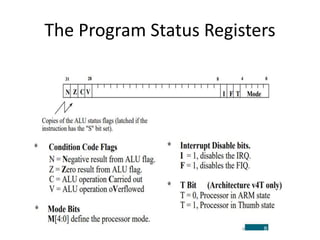
The Program Status Registers
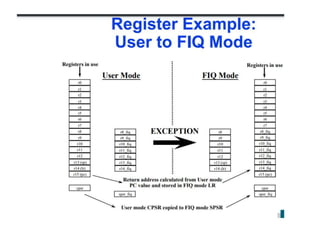
Processor Modes
Format summary
Conditional Execution
The Condition Field
Instruction Set
• The instruction set can be broadly classified as
follows:
i) Data processing instructions
ii) Load store instructions—single register, multiple
register
iii) Branch instructions
iv) Status register access instructions
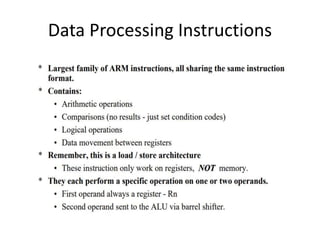
Data Processing Instructions
ARM data processing instructions
Data processing Instruction Format
Arithmetic Operations
Comparisons
Logical Operations
Data Movement
Multiplication Instructions
Shift Instructions
Load / Store Instructions
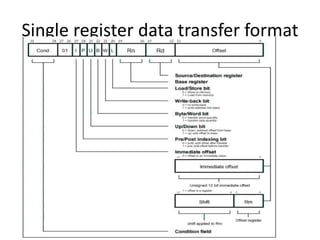
Single register data transfer
Single register data transfer format
Load and Store Word or Byte: Base
Register
• In register-indirect addressing, the value
stored in the register is used as the address to
be fetched from memory; the result of that
fetch is the desired operand value.
• LDR r0,[r1]
• LDR r0,[r1, -r2]
• LDR r0,[r1, #4]
Load and Store Word or Byte: Offsets
from the Base Register
Load and Store Word or Byte: Pre-
indexed Addressing
Load and Store Word or Byte: Post-
indexed Addressing
Load and Stores with User Mode
Privilege

Presentation1.pptx

  • 1.
  • 2.
    VON NEUMANN ARCHITECTUREVS HARVARD ARCHITECTURE
  • 5.
  • 6.
    History • ARM wasdeveloped at Acron Computer Limited of Cambridge, England between 1983 and 1985 • RISC concept introduced in 1980 at Stanford and Berkley • ARM Limited founded in 1990 • ARM Cores – Licensed to partners to develop and fabricate new micro-controllers – Soft-core
  • 7.
    ARM Architecture • Basedupon RISC Architecture with enhancements to meet requirements of embedded applications – A large uniform register file – Load-store architecture, where data processing operations operate on register contents only – Uniform and fixed length instructions – 32-bit processor – Instructions are 32-bit long – Von Neuman-type bus structure (ARM7), Harvard (ARM9) – Good Speed/Power Consumption Ratio – High Code Density
  • 8.
    • Most ARM'simplement two instruction sets 1. 32-bit ARM Instruction Set 2. 16-bit Thumb Instruction Set • Data type can be – 8 bit bytes – 16 bit half-words – 32 bit words – may be seen as a byte line folded into 4-byte words.
  • 10.
    ARM Features • ThumbSet designed for 16-bit word lengths and instructions, which internally executes by same 32- bit core. • ARM views memory as a linear collection of bytes numbered upwards from zero. it contains memory management unit and memory protection unit. • Most operations are executed over registers. • All instructions can be conditional. • it uses Big-endian and Little-endian method.
  • 11.
    ARM Features • TheARM processor supports 25 different instruction • ARM provides no explicit return instruction. • The Software Interrupt (SWI) instruction is the only way an ARM processor can access resources controlled by the operating system. • Many Thumb data processing instructions use a 2- address format. • The ARM architecture has a large variety of addressing modes
  • 12.
    ARM Architecture • TheARM cortex is a complicated microcontroller within the ARM family that has ARMv7 design. There are 3 subfamilies within the ARM cortex family: a) ARM Cortex Ax-series b) ARM Cortex Rx-series c) ARM Cortex Mx-series • • The ARM Architecture consists of following: a) Arithmetic Logic Unit b) Booth multiplier c) Barrel shifter d) Control unit e) Register file
  • 15.
    • Priority encoder •Multiplexers • Arithmetic Logic Unit (ALU) • Booth multiplier factor • Barrel Sifter • Control unit • Incrementer • Address Register • Instruction decoder • Register file
  • 17.
  • 18.
  • 22.
  • 25.
  • 26.
  • 27.
    Instruction Set • Theinstruction set can be broadly classified as follows: i) Data processing instructions ii) Load store instructions—single register, multiple register iii) Branch instructions iv) Status register access instructions
  • 28.
  • 29.
    ARM data processinginstructions
  • 30.
  • 31.
  • 32.
  • 33.
  • 34.
  • 35.
  • 36.
  • 37.
    Load / StoreInstructions
  • 38.
  • 39.
    Single register datatransfer format
  • 40.
    Load and StoreWord or Byte: Base Register
  • 41.
    • In register-indirectaddressing, the value stored in the register is used as the address to be fetched from memory; the result of that fetch is the desired operand value. • LDR r0,[r1] • LDR r0,[r1, -r2] • LDR r0,[r1, #4]
  • 42.
    Load and StoreWord or Byte: Offsets from the Base Register
  • 43.
    Load and StoreWord or Byte: Pre- indexed Addressing
  • 44.
    Load and StoreWord or Byte: Post- indexed Addressing
  • 45.
    Load and Storeswith User Mode Privilege