lecture 1
Assist. Lect. Hiba Abdul –Kareem
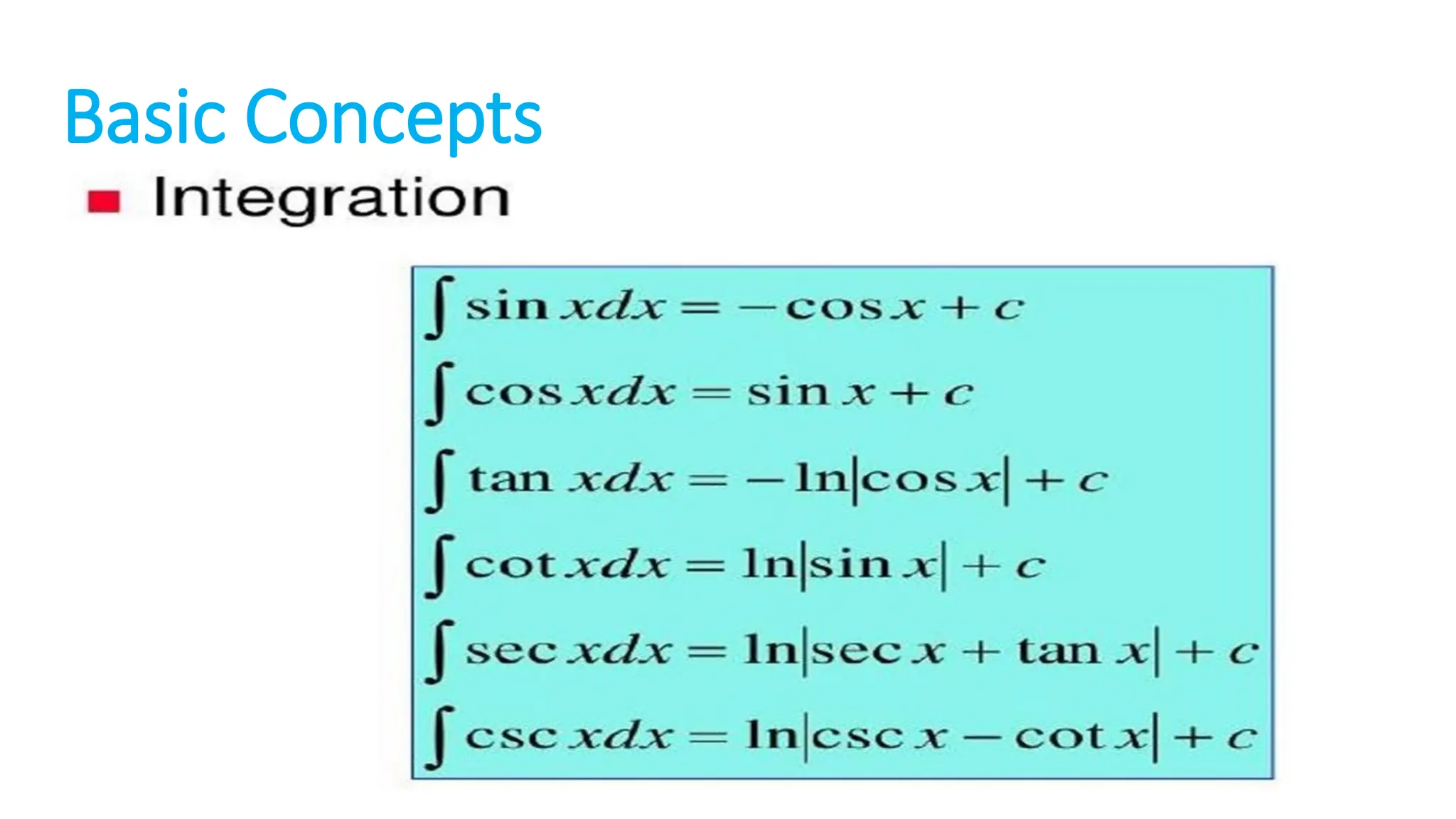
Basic Concepts
Basic Concepts
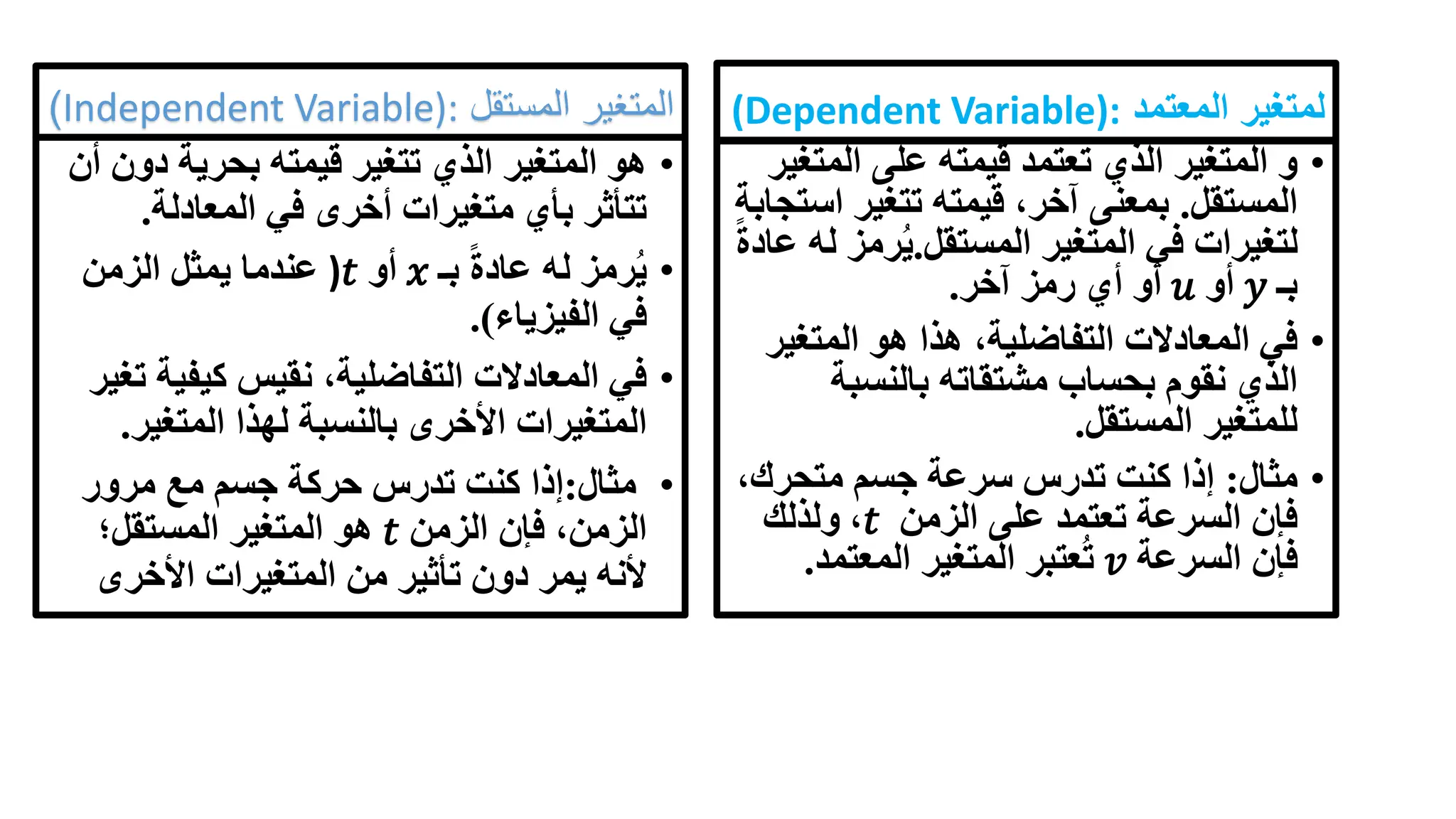
‫المستقل‬ ‫المتغير‬
Independent Variable):
)
•
‫دو‬ ‫بحرية‬ ‫قيمته‬ ‫تتغير‬ ‫الذي‬ ‫المتغير‬ ‫هو‬
‫أن‬ ‫ن‬
‫المعادلة‬ ‫في‬ ‫أخرى‬ ‫متغيرات‬ ‫بأي‬ ‫تتأثر‬
.
•
‫بـ‬ ً‫ة‬‫عاد‬ ‫له‬ ‫رمز‬ُ‫ي‬
𝑥
‫أو‬
𝑡
)
‫الزمن‬ ‫يمثل‬ ‫عندما‬
‫الفيزياء‬ ‫في‬
.)
•
‫كيفي‬ ‫نقيس‬ ،‫التفاضلية‬ ‫المعادالت‬ ‫في‬
‫تغير‬ ‫ة‬
‫المتغير‬ ‫لهذا‬ ‫بالنسبة‬ ‫األخرى‬ ‫المتغيرات‬
.
•
‫مثال‬
:
‫مرور‬ ‫مع‬ ‫جسم‬ ‫حركة‬ ‫تدرس‬ ‫كنت‬ ‫إذا‬
‫الزمن‬ ‫فإن‬ ،‫الزمن‬
𝑡
‫المستقل؛‬ ‫المتغير‬ ‫هو‬
‫األخرى‬ ‫المتغيرات‬ ‫من‬ ‫تأثير‬ ‫دون‬ ‫يمر‬ ‫ألنه‬
‫المعتمد‬ ‫لمتغير‬
(Dependent Variable):
•
‫المت‬ ‫على‬ ‫قيمته‬ ‫تعتمد‬ ‫الذي‬ ‫المتغير‬ ‫و‬
‫غير‬
‫المستقل‬
.
‫اس‬ ‫تتغير‬ ‫قيمته‬ ،‫آخر‬ ‫بمعنى‬
‫تجابة‬
‫المستقل‬ ‫المتغير‬ ‫في‬ ‫لتغيرات‬
.
‫رمز‬ُ‫ي‬
ً‫ة‬‫عاد‬ ‫له‬
‫بـ‬
𝑦
‫أو‬
𝑢
‫آخر‬ ‫رمز‬ ‫أي‬ ‫أو‬
.
•
‫المتغي‬ ‫هو‬ ‫هذا‬ ،‫التفاضلية‬ ‫المعادالت‬ ‫في‬
‫ر‬
‫بالنسبة‬ ‫مشتقاته‬ ‫بحساب‬ ‫نقوم‬ ‫الذي‬
‫المستقل‬ ‫للمتغير‬
.
•
‫مثال‬
:
،‫متحرك‬ ‫جسم‬ ‫سرعة‬ ‫تدرس‬ ‫كنت‬ ‫إذا‬
‫الزمن‬ ‫على‬ ‫تعتمد‬ ‫السرعة‬ ‫فإن‬
𝑡
،
‫ولذلك‬
‫السرعة‬ ‫فإن‬
𝑣
‫المعتمد‬ ‫المتغير‬ ‫عتبر‬ُ‫ت‬
.
•
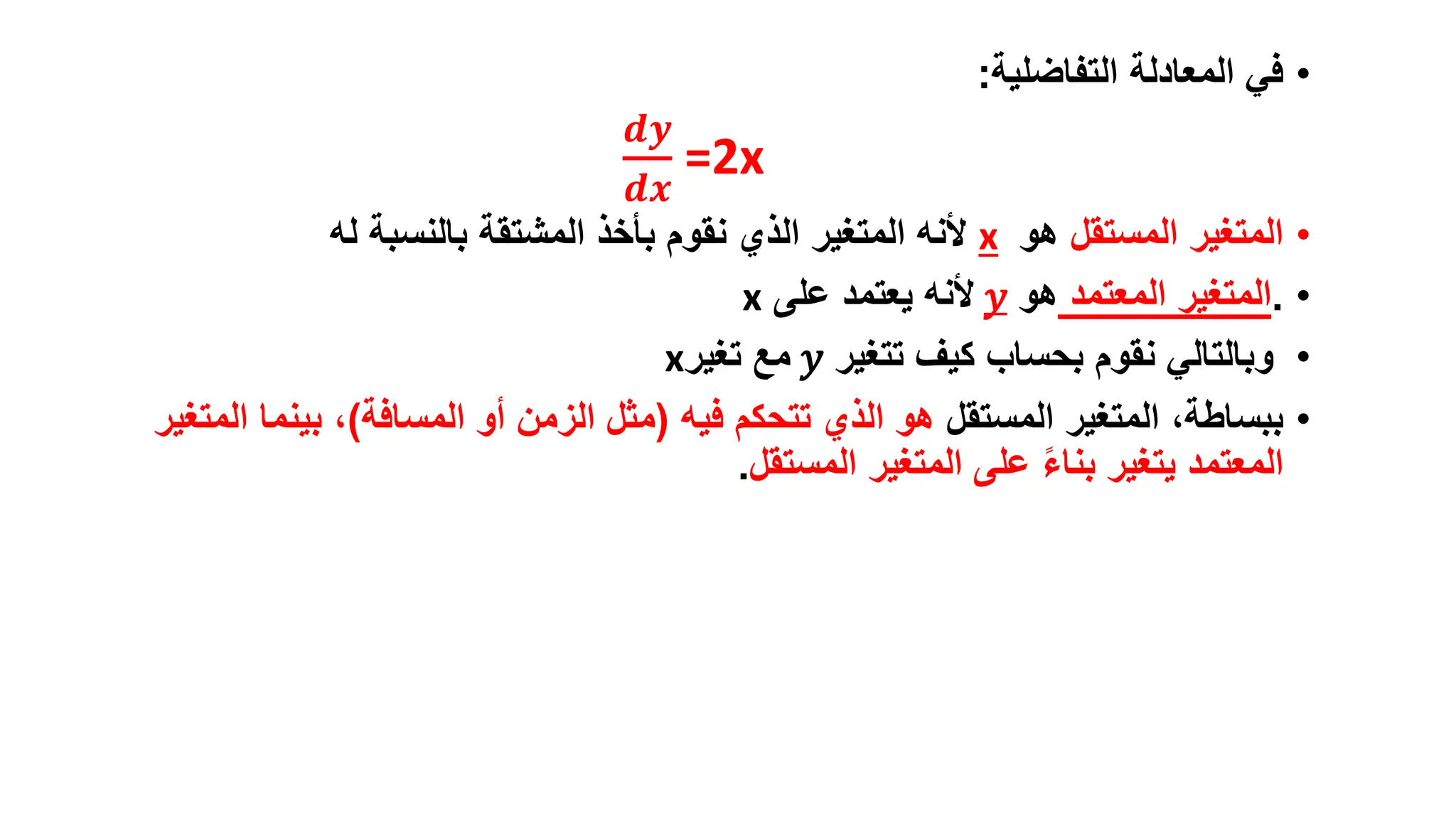
‫التفاضلية‬ ‫المعادلة‬ ‫في‬
:
𝒅𝒚
𝒅𝒙
=2x
•
‫المستقل‬ ‫المتغير‬
‫هو‬
x
‫له‬ ‫بالنسبة‬ ‫المشتقة‬ ‫بأخذ‬ ‫نقوم‬ ‫الذي‬ ‫المتغير‬ ‫ألنه‬
•
.
‫المعتمد‬ ‫المتغير‬
‫هو‬
𝑦
‫على‬ ‫يعتمد‬ ‫ألنه‬
x
•
‫تتغير‬ ‫كيف‬ ‫بحساب‬ ‫نقوم‬ ‫وبالتالي‬
𝑦
‫تغير‬ ‫مع‬
x
•
‫المستقل‬ ‫المتغير‬ ،‫ببساطة‬
‫فيه‬ ‫تتحكم‬ ‫الذي‬ ‫هو‬
(
‫المسافة‬ ‫أو‬ ‫الزمن‬ ‫مثل‬
)
‫ال‬ ‫بينما‬ ،
‫متغير‬
‫المستقل‬ ‫المتغير‬ ‫على‬ ً‫ء‬‫بنا‬ ‫يتغير‬ ‫المعتمد‬
.
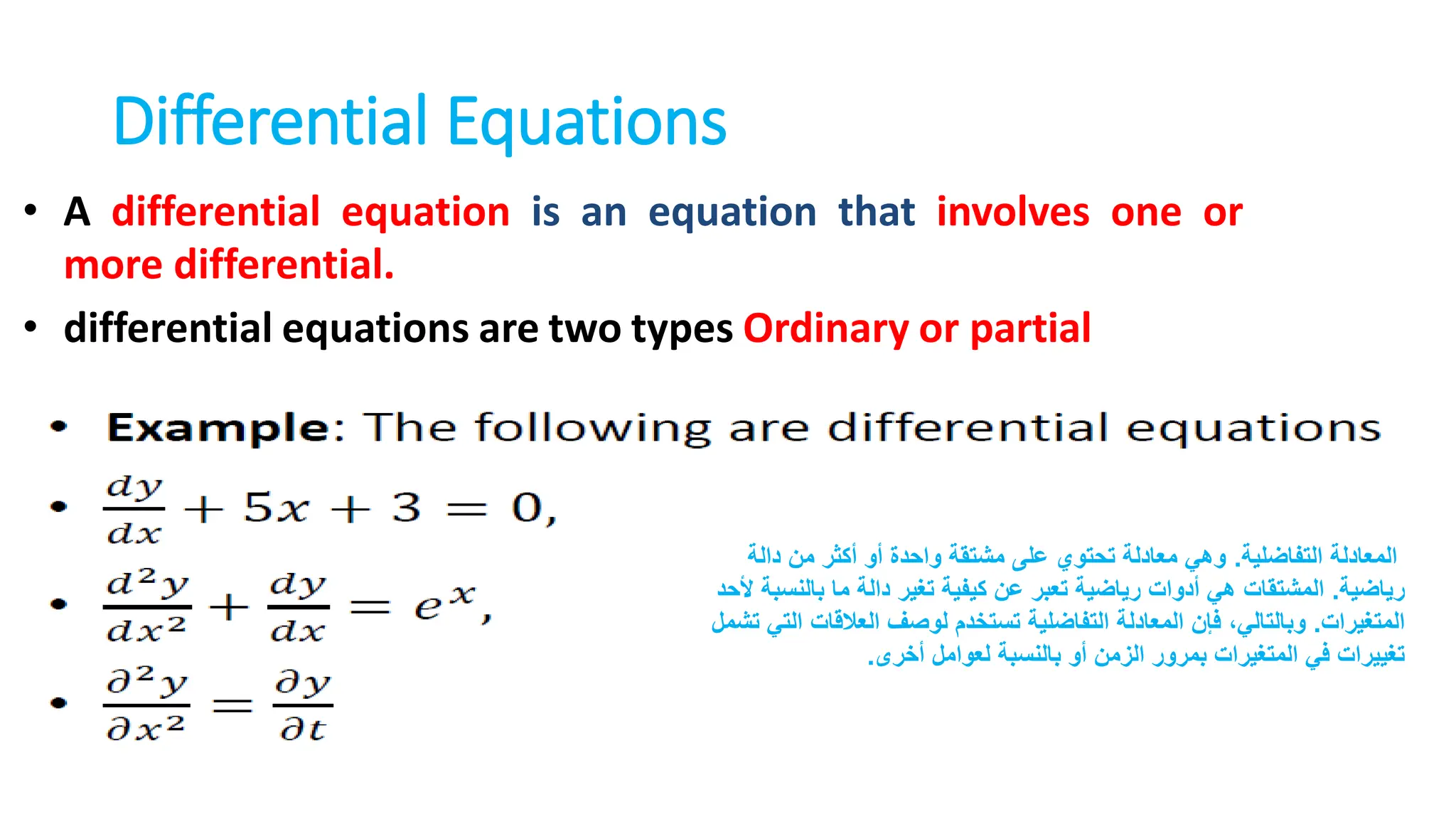
Differential Equations
• A differential equation is an equation that involves one or
more differential.
• differential equations are two types Ordinary or partial
‫التفاضلية‬ ‫المعادلة‬
.
‫دالة‬ ‫من‬ ‫أكثر‬ ‫أو‬ ‫واحدة‬ ‫مشتقة‬ ‫على‬ ‫تحتوي‬ ‫معادلة‬ ‫وهي‬
‫رياضية‬
.
‫بالن‬ ‫ما‬ ‫دالة‬ ‫تغير‬ ‫كيفية‬ ‫عن‬ ‫تعبر‬ ‫رياضية‬ ‫أدوات‬ ‫هي‬ ‫المشتقات‬
‫ألحد‬ ‫سبة‬
‫المتغيرات‬
.
‫العالقات‬ ‫لوصف‬ ‫تستخدم‬ ‫التفاضلية‬ ‫المعادلة‬ ‫فإن‬ ،‫وبالتالي‬
‫تشمل‬ ‫التي‬
‫أخرى‬ ‫لعوامل‬ ‫بالنسبة‬ ‫أو‬ ‫الزمن‬ ‫بمرور‬ ‫المتغيرات‬ ‫في‬ ‫تغييرات‬
.
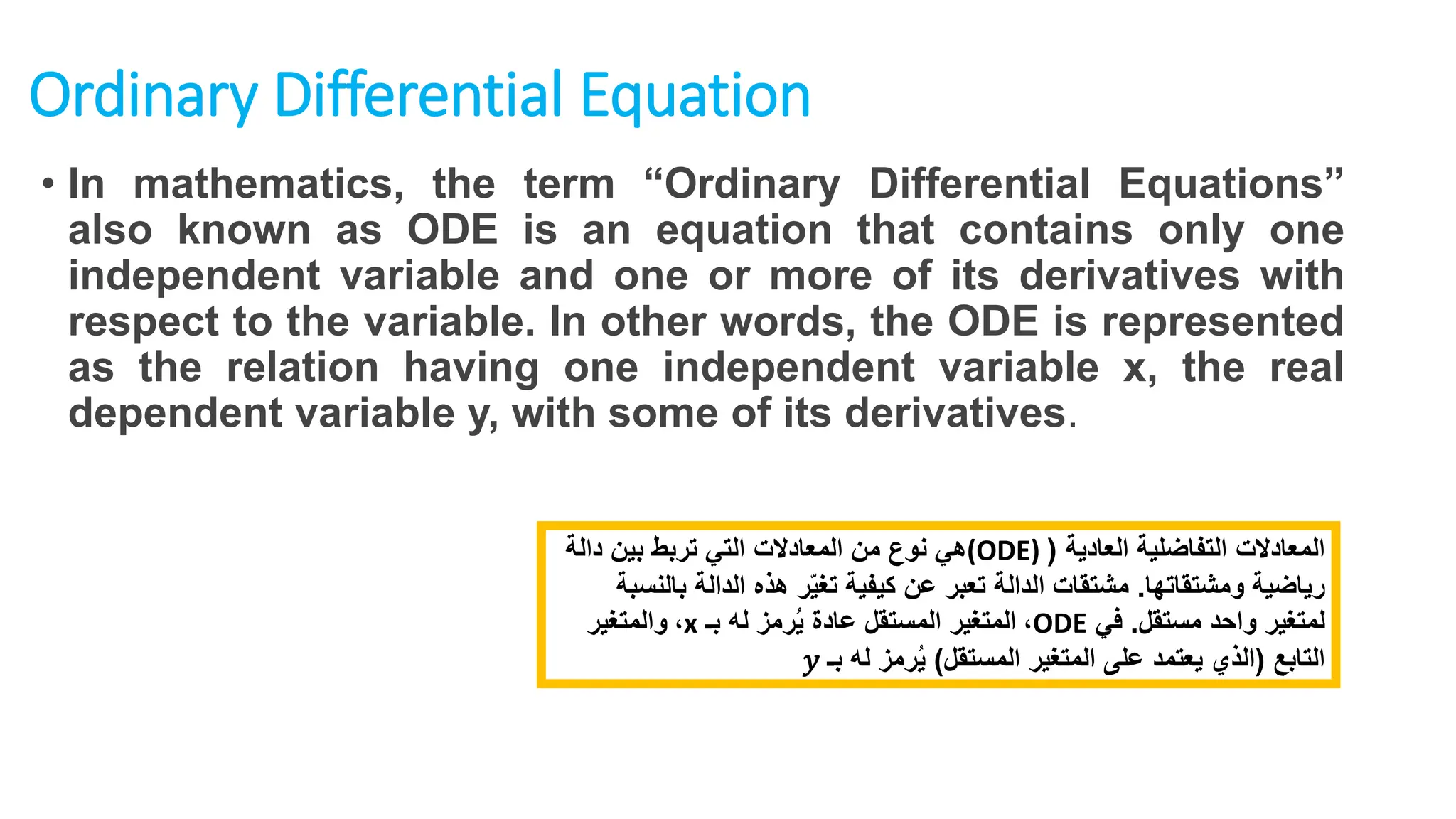
Ordinary Differential Equation
• In mathematics, the term “Ordinary Differential Equations”
also known as ODE is an equation that contains only one
independent variable and one or more of its derivatives with
respect to the variable. In other words, the ODE is represented
as the relation having one independent variable x, the real
dependent variable y, with some of its derivatives.
‫المعادالت‬
‫العادية‬ ‫التفاضلية‬
(
(ODE)
‫دالة‬ ‫بين‬ ‫تربط‬ ‫التي‬ ‫المعادالت‬ ‫من‬ ‫نوع‬ ‫هي‬
‫ومشتقاتها‬ ‫رياضية‬
.
‫ب‬ ‫الدالة‬ ‫هذه‬ ‫ر‬ّ‫ي‬‫تغ‬ ‫كيفية‬ ‫عن‬ ‫تعبر‬ ‫الدالة‬ ‫مشتقات‬
‫النسبة‬
‫مستقل‬ ‫واحد‬ ‫لمتغير‬
.
‫في‬
ODE
،
‫بـ‬ ‫له‬ ‫رمز‬ُ‫ي‬ ‫عادة‬ ‫المستقل‬ ‫المتغير‬
x
،
‫والمتغير‬
‫التابع‬
(
‫المستقل‬ ‫المتغير‬ ‫على‬ ‫يعتمد‬ ‫الذي‬
)
‫بـ‬ ‫له‬ ‫رمز‬ُ‫ي‬
𝑦
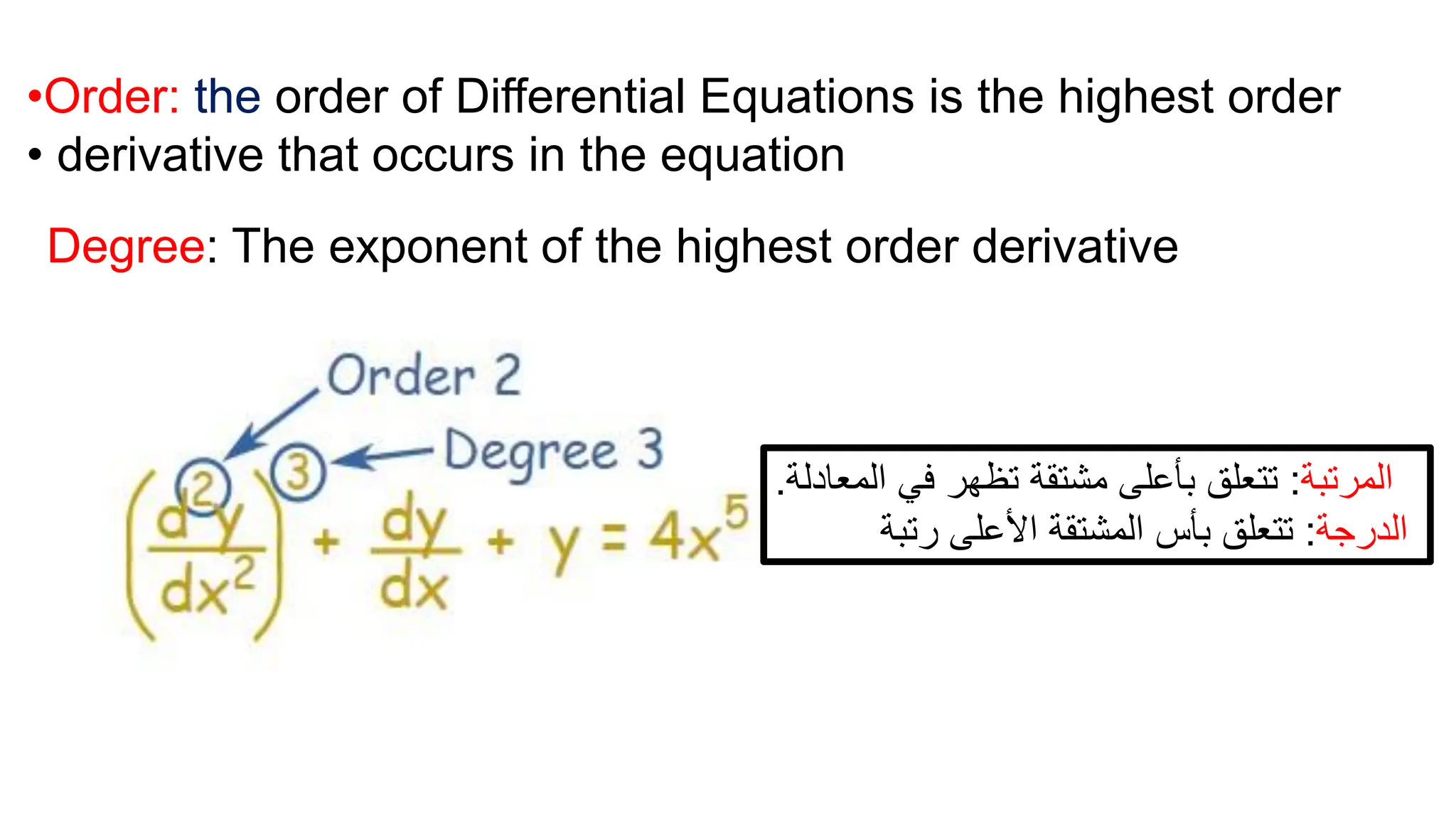
•Order: the order of Differential Equations is the highest order
• derivative that occurs in the equation
Degree: The exponent of the highest order derivative
‫المرتبة‬
:
‫المعادل‬ ‫في‬ ‫تظهر‬ ‫مشتقة‬ ‫بأعلى‬ ‫تتعلق‬
‫ة‬
.
‫الدرجة‬
:
‫األعلى‬ ‫المشتقة‬ ‫بأس‬ ‫تتعلق‬
‫رتبة‬
Classwork
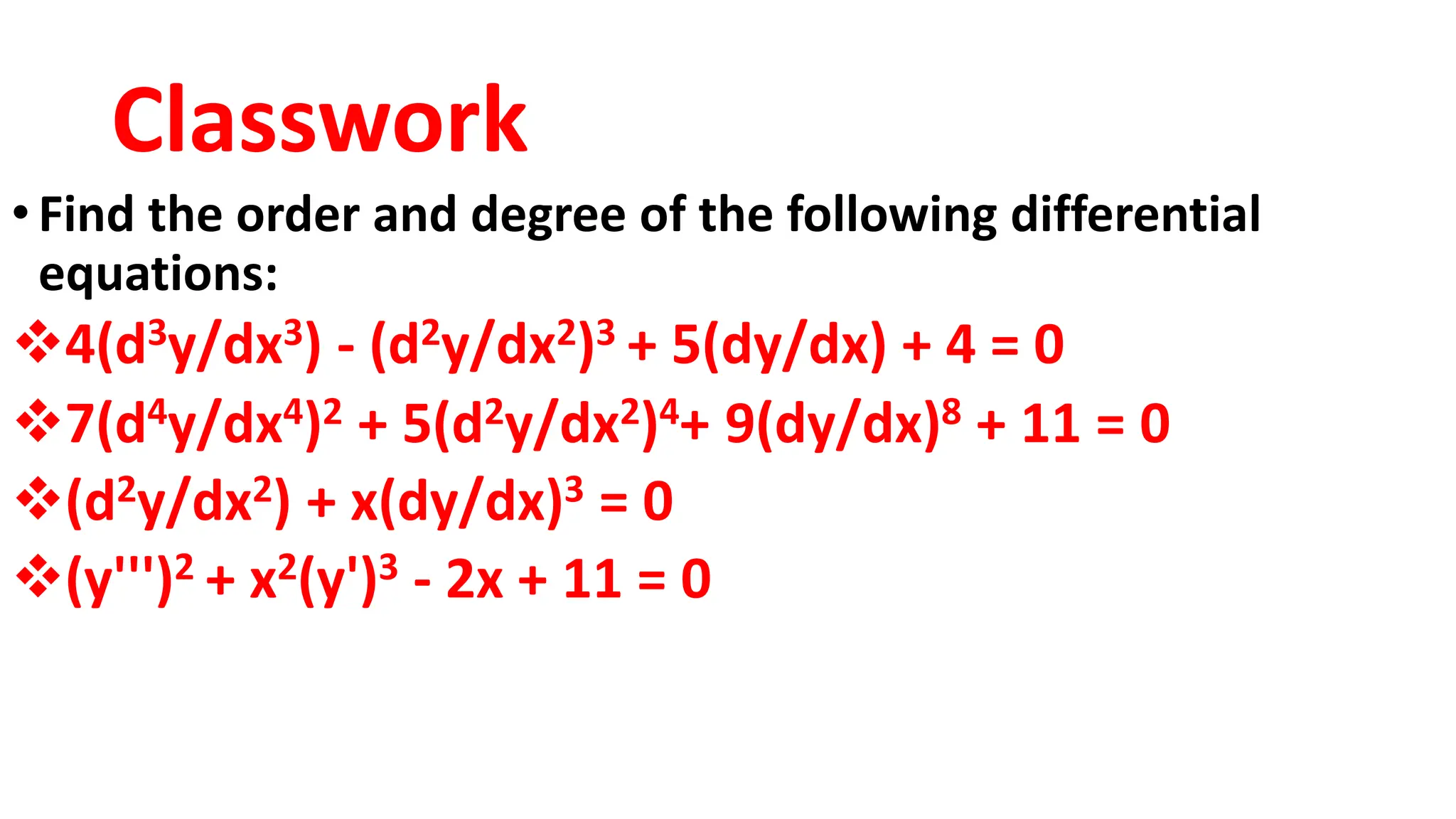
•Find the order and degree of the following differential
equations:
4(d3y/dx3) - (d2y/dx2)3 + 5(dy/dx) + 4 = 0
7(d4y/dx4)2 + 5(d2y/dx2)4+ 9(dy/dx)8 + 11 = 0
(d2y/dx2) + x(dy/dx)3 = 0
(y''')2 + x2(y')3 - 2x + 11 = 0
Classwork
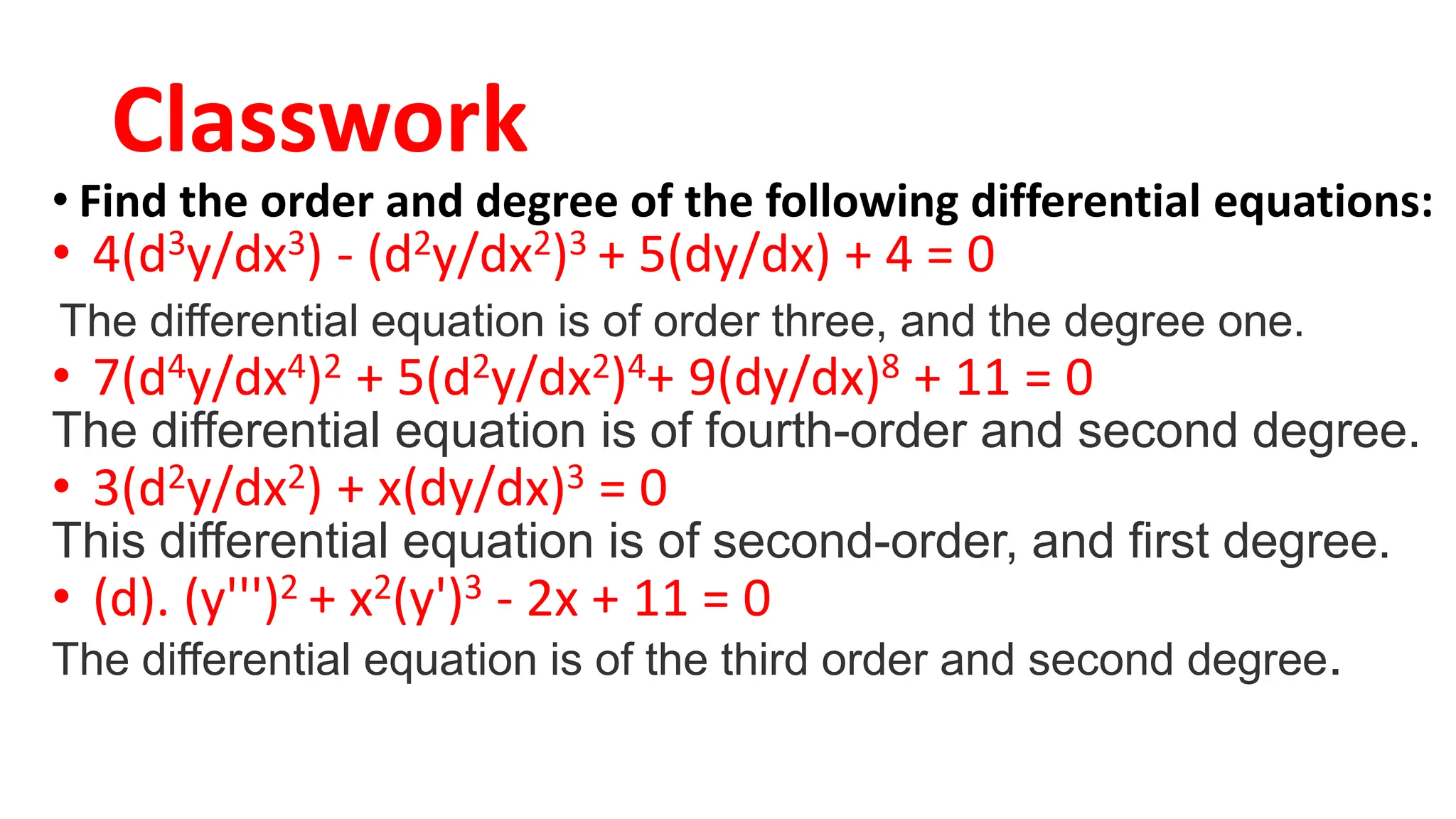
• Find the order and degree of the following differential equations:
• 4(d3y/dx3) - (d2y/dx2)3 + 5(dy/dx) + 4 = 0
The differential equation is of order three, and the degree one.
• 7(d4y/dx4)2 + 5(d2y/dx2)4+ 9(dy/dx)8 + 11 = 0
The differential equation is of fourth-order and second degree.
• 3(d2y/dx2) + x(dy/dx)3 = 0
This differential equation is of second-order, and first degree.
• (d). (y''')2 + x2(y')3 - 2x + 11 = 0
The differential equation is of the third order and second degree.
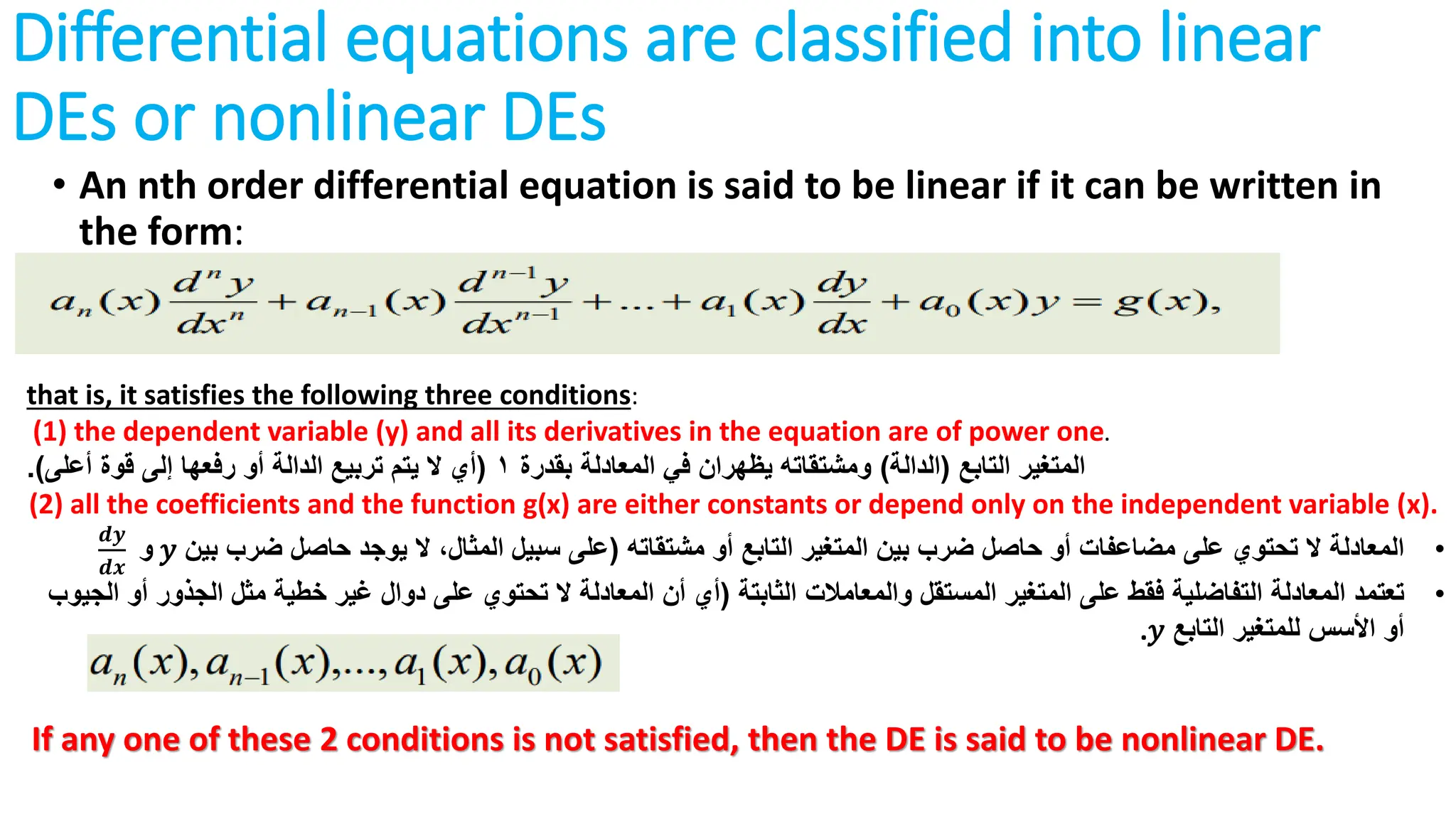
Differential equations are classified into linear
DEs or nonlinear DEs
• An nth order differential equation is said to be linear if it can be written in
the form:
that is, it satisfies the following three conditions:
(1) the dependent variable (y) and all its derivatives in the equation are of power one.
‫التابع‬ ‫المتغير‬
(
‫الدالة‬
)
‫بقدرة‬ ‫المعادلة‬ ‫في‬ ‫يظهران‬ ‫ومشتقاته‬
1
(
‫أعلى‬ ‫قوة‬ ‫إلى‬ ‫رفعها‬ ‫أو‬ ‫الدالة‬ ‫تربيع‬ ‫يتم‬ ‫ال‬ ‫أي‬
.)
(2) all the coefficients and the function g(x) are either constants or depend only on the independent variable (x).
•
‫المعادلة‬
‫مشتقاته‬ ‫أو‬ ‫التابع‬ ‫المتغير‬ ‫بين‬ ‫ضرب‬ ‫حاصل‬ ‫أو‬ ‫مضاعفات‬ ‫على‬ ‫تحتوي‬ ‫ال‬
(
‫بين‬ ‫ضرب‬ ‫حاصل‬ ‫يوجد‬ ‫ال‬ ،‫المثال‬ ‫سبيل‬ ‫على‬
𝑦
‫و‬
𝒅𝒚
𝒅𝒙
•
‫تعتمد‬
‫الثابتة‬ ‫والمعامالت‬ ‫المستقل‬ ‫المتغير‬ ‫على‬ ‫فقط‬ ‫التفاضلية‬ ‫المعادلة‬
(
‫الجذ‬ ‫مثل‬ ‫خطية‬ ‫غير‬ ‫دوال‬ ‫على‬ ‫تحتوي‬ ‫ال‬ ‫المعادلة‬ ‫أن‬ ‫أي‬
‫الجيوب‬ ‫أو‬ ‫ور‬
‫التابع‬ ‫للمتغير‬ ‫األسس‬ ‫أو‬
𝑦
.
If any one of these 2 conditions is not satisfied, then the DE is said to be nonlinear DE.
The following differential equations are linear
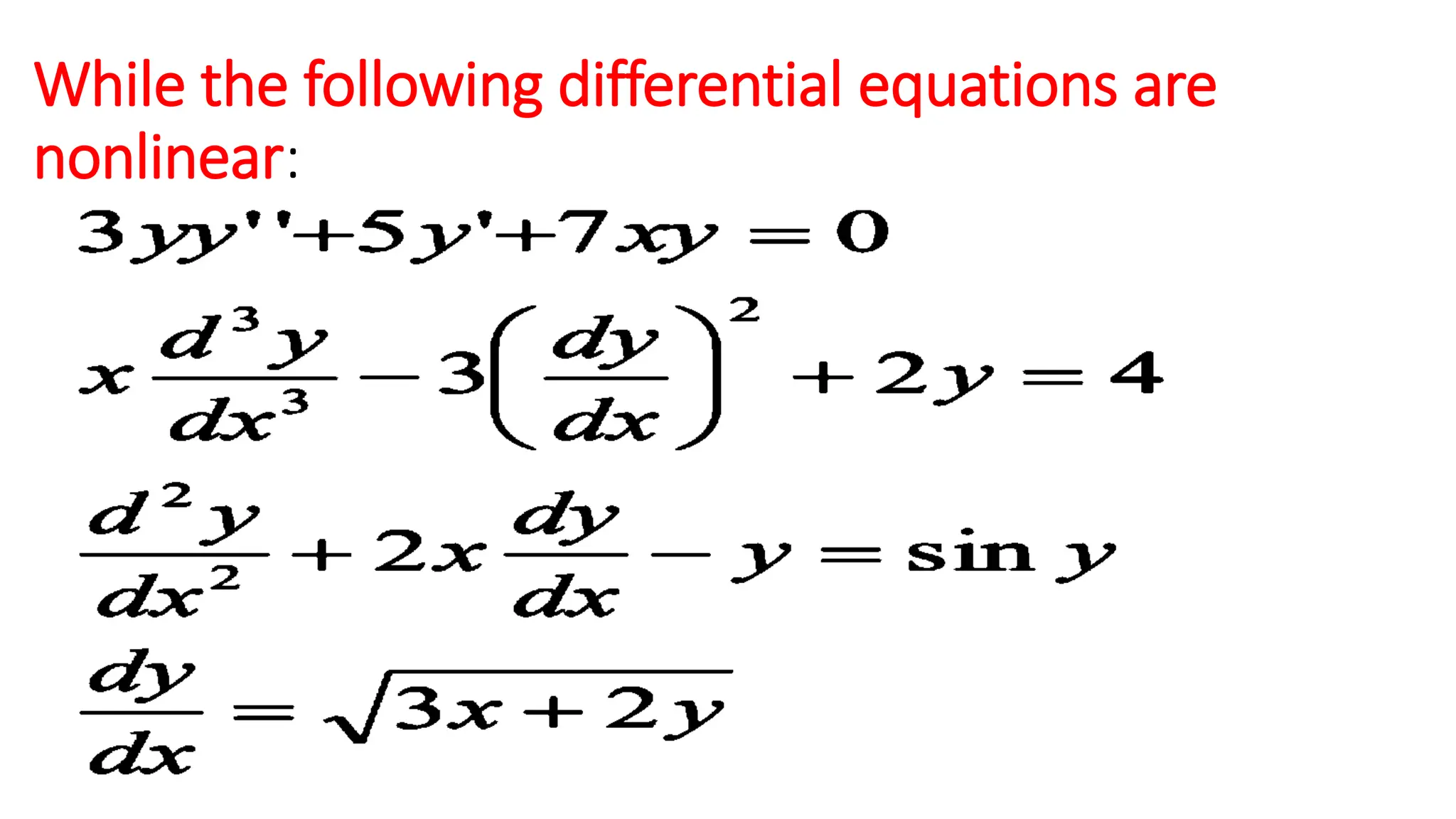
While the following differential equations are
nonlinear:
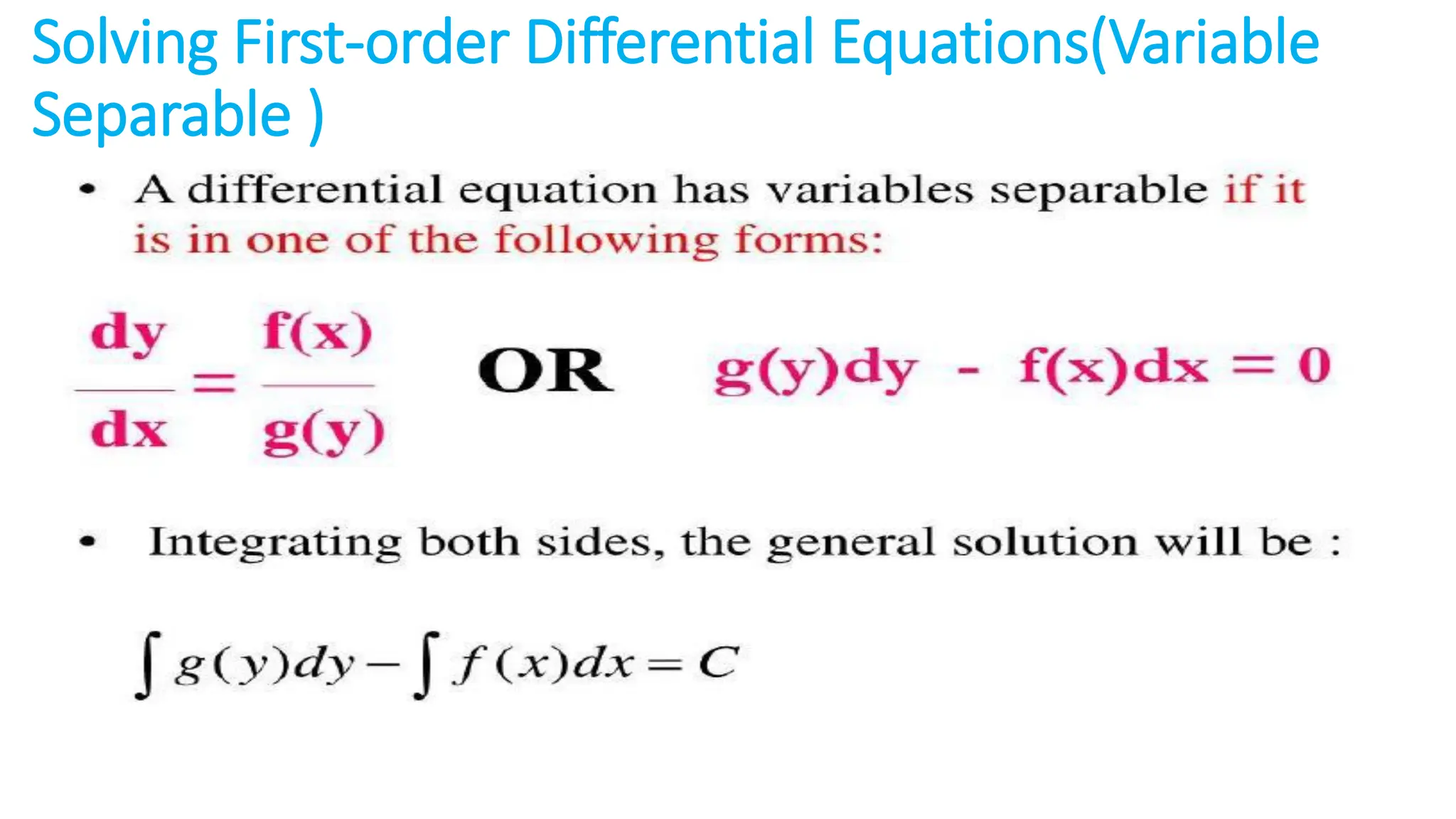
Solving First-order Differential Equations(Variable
Separable )
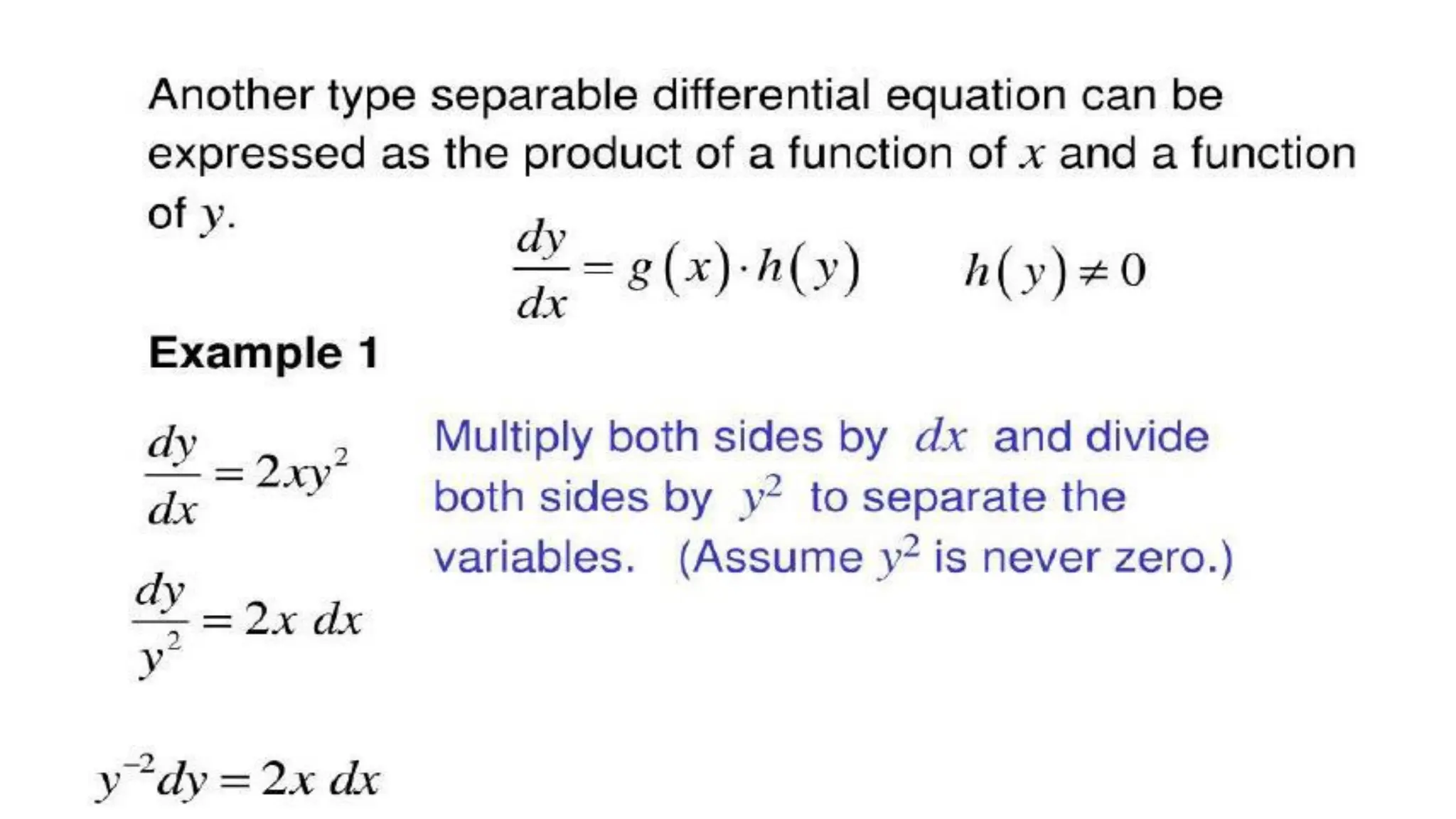
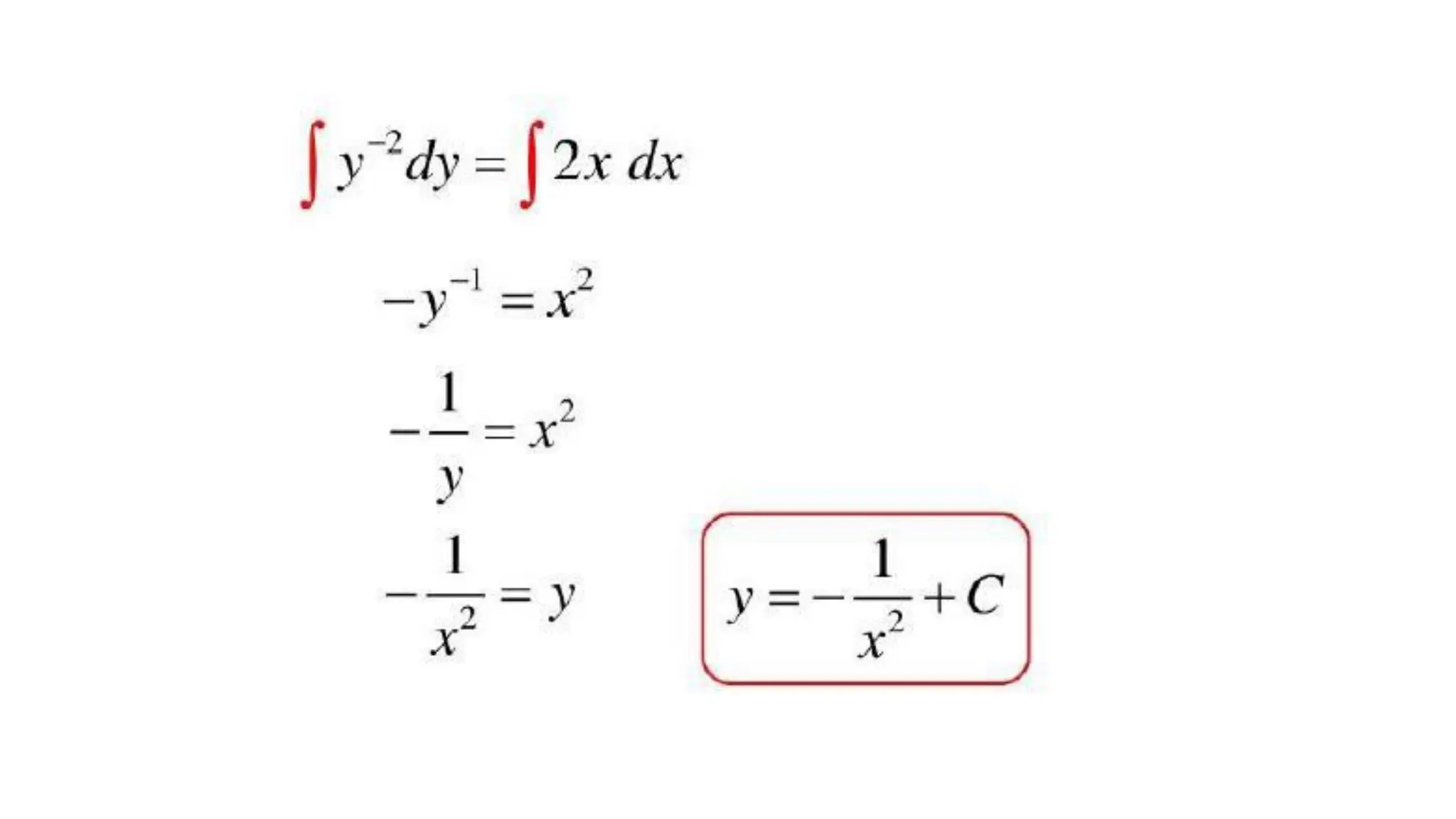
• A separable equation is solved by separating the variables, that is, rearranging
the equation so that everything involving y appears on one side of the
equation, and everything involving x appears on the other. The equation can
then be integrated directly.
‫معادلة‬
‫التفاضلية‬
‫القابلة‬
‫للفصل‬
‫هي‬
‫نوع‬
‫من‬
‫المعادالت‬
‫التفاضلية‬
‫التي‬
‫يمكن‬
‫حلها‬
‫بتقسيم‬
‫المتغ‬
‫يرات‬
.
‫بمعنى‬
،‫آخر‬
‫نقوم‬
‫بترتيب‬
‫المعادلة‬
‫بحيث‬
‫تظهر‬
‫جميع‬
‫التعبيرات‬
‫التي‬
‫تحتوي‬
‫على‬
‫المتغير‬
𝑦
‫على‬
‫جهة‬
‫واحدة‬
‫من‬
‫ا‬
،‫لمعادلة‬
‫وجميع‬
‫التعبيرات‬
‫التي‬
‫تحتوي‬
‫على‬
‫المتغير‬
𝑥
‫على‬
‫الجهة‬
‫األخرى‬
.
‫بعد‬
‫ذلك‬
‫يمكننا‬
‫تكامل‬
‫كال‬
‫الطرفين‬
‫بشكل‬
‫منفصل‬
‫لحل‬
‫المعادلة‬
.
Solving First-order Differential Equations(Variable
Separable )
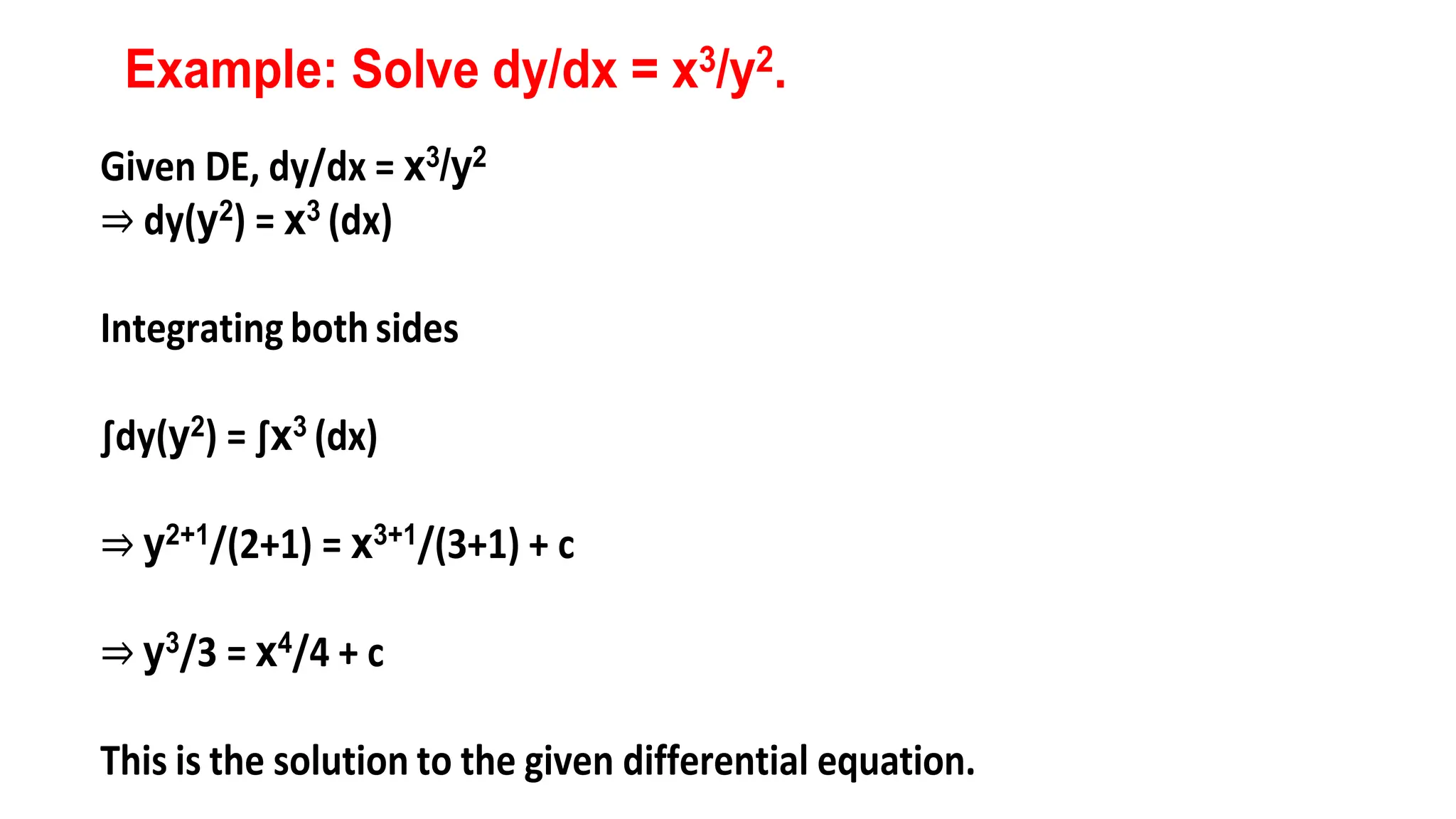
Example: Solve dy/dx = x3/y2.
Given DE, dy/dx = x3/y2
⇒ dy(y2) = x3 (dx)
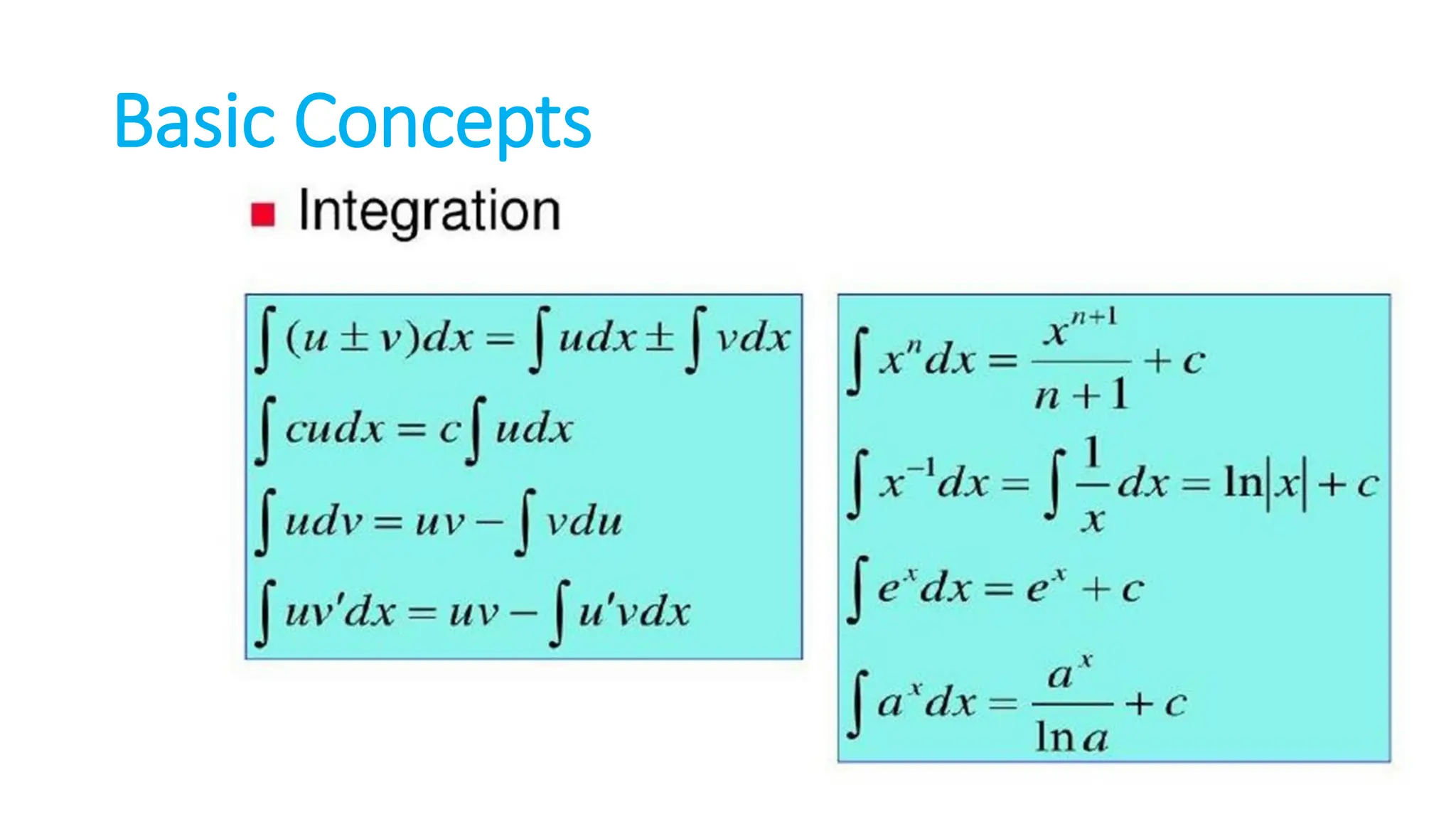
Integrating bothsides
∫dy(y2) = ∫x3 (dx)
⇒ y2+1/(2+1) = x3+1/(3+1) + c
⇒ y3/3 = x4/4 + c
This is the solution to the given differential equation.
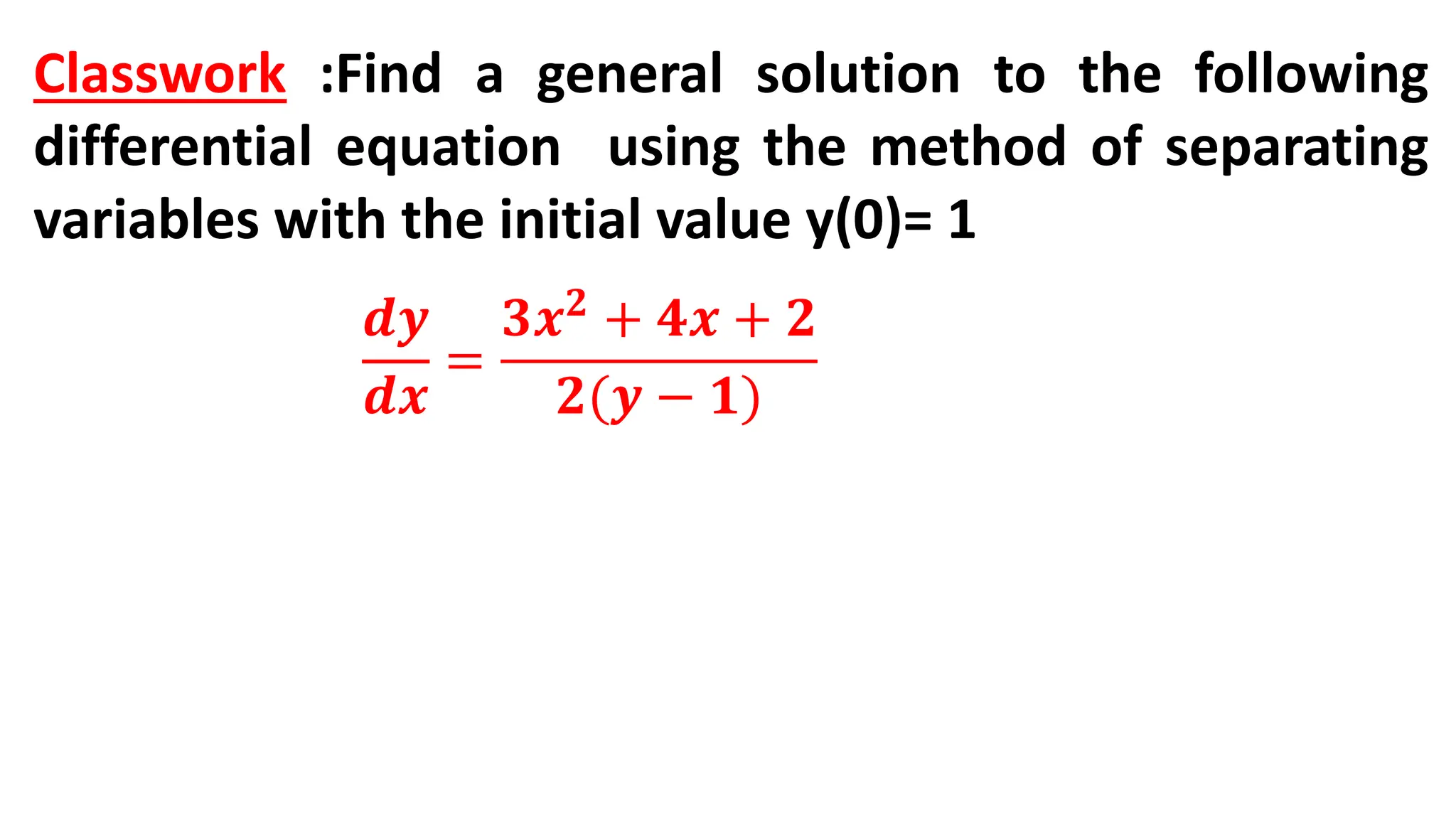
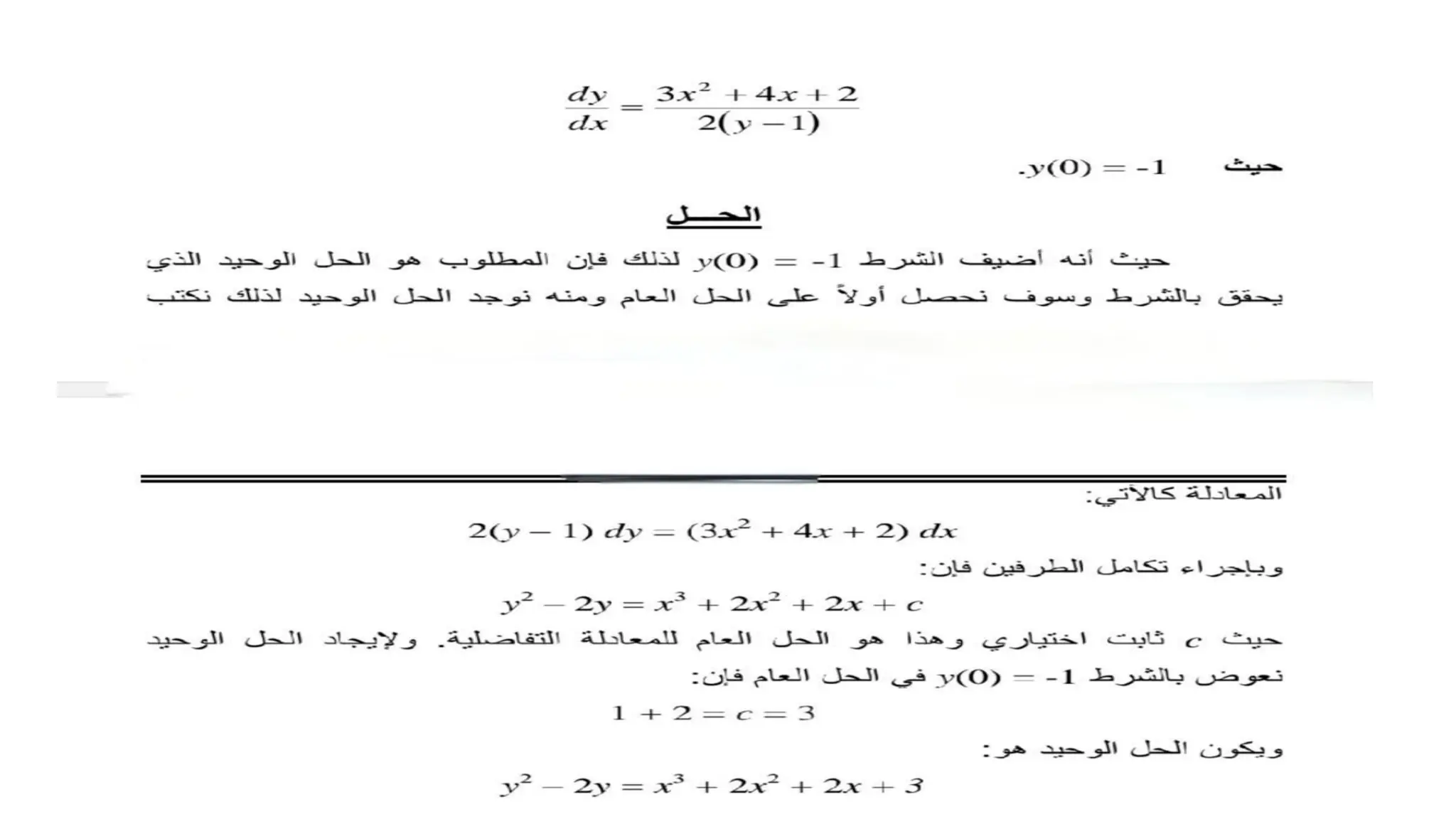
Classwork :Find a general solution to the following
differential equation using the method of separating
variables with the initial value y(0)= 1
𝒅𝒚
𝒅𝒙
=
𝟑𝒙𝟐
+ 𝟒𝒙 + 𝟐
𝟐(𝒚 − 𝟏)
Newton's Law of Cooling
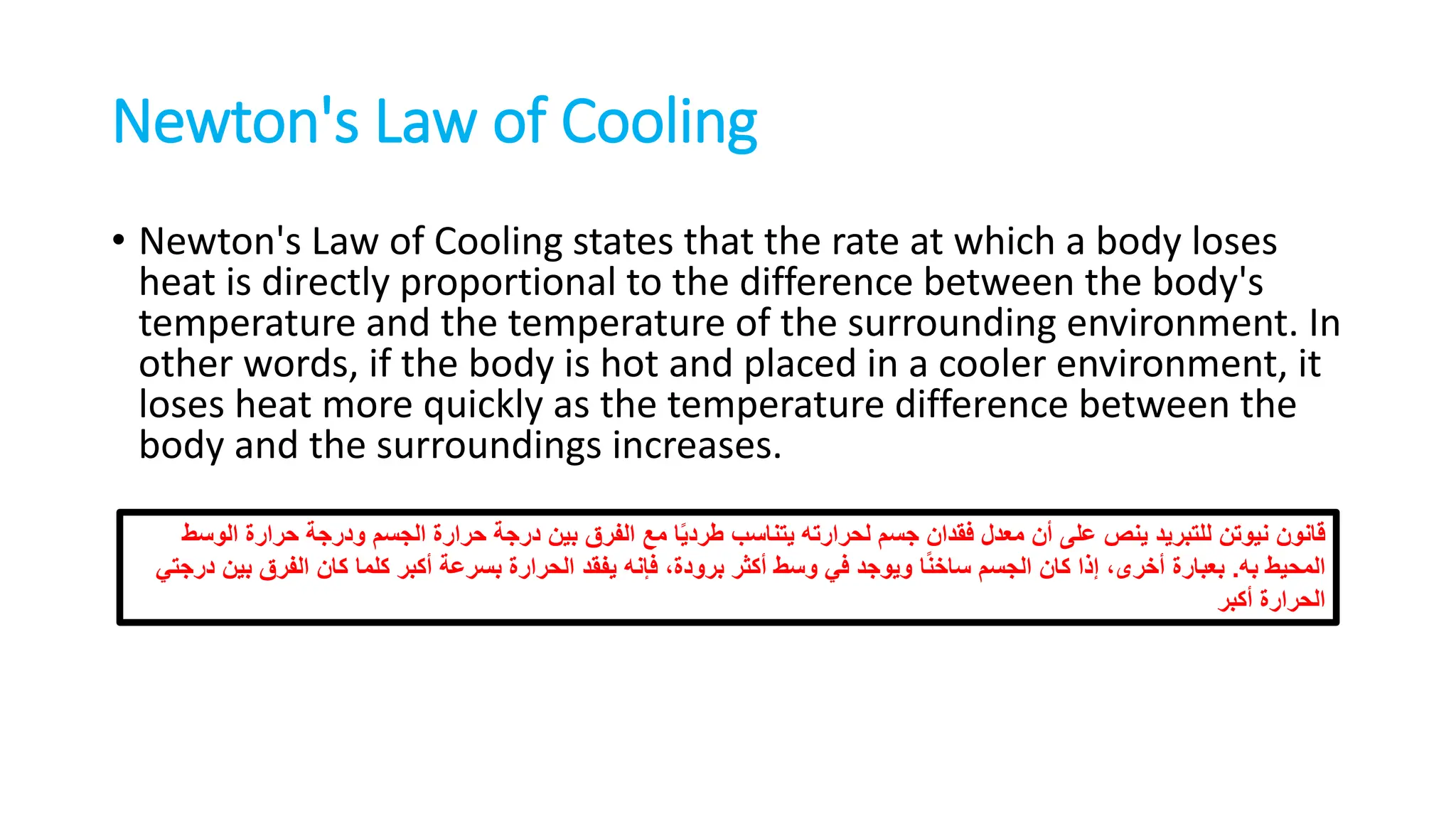
• Newton's Law of Cooling states that the rate at which a body loses
heat is directly proportional to the difference between the body's
temperature and the temperature of the surrounding environment. In
other words, if the body is hot and placed in a cooler environment, it
loses heat more quickly as the temperature difference between the
body and the surroundings increases.
‫قانون‬
‫الوسط‬ ‫حرارة‬ ‫ودرجة‬ ‫الجسم‬ ‫حرارة‬ ‫درجة‬ ‫بين‬ ‫الفرق‬ ‫مع‬ ‫ا‬ً‫ي‬‫طرد‬ ‫يتناسب‬ ‫لحرارته‬ ‫جسم‬ ‫فقدان‬ ‫معدل‬ ‫أن‬ ‫على‬ ‫ينص‬ ‫للتبريد‬ ‫نيوتن‬
‫به‬ ‫المحيط‬
.
‫درجتي‬ ‫بين‬ ‫الفرق‬ ‫كان‬ ‫كلما‬ ‫أكبر‬ ‫بسرعة‬ ‫الحرارة‬ ‫يفقد‬ ‫فإنه‬ ،‫برودة‬ ‫أكثر‬ ‫وسط‬ ‫في‬ ‫ويوجد‬ ‫ا‬ً‫ن‬‫ساخ‬ ‫الجسم‬ ‫كان‬ ‫إذا‬ ،‫أخرى‬ ‫بعبارة‬
‫أكبر‬ ‫الحرارة‬
Newton's Law of Cooling
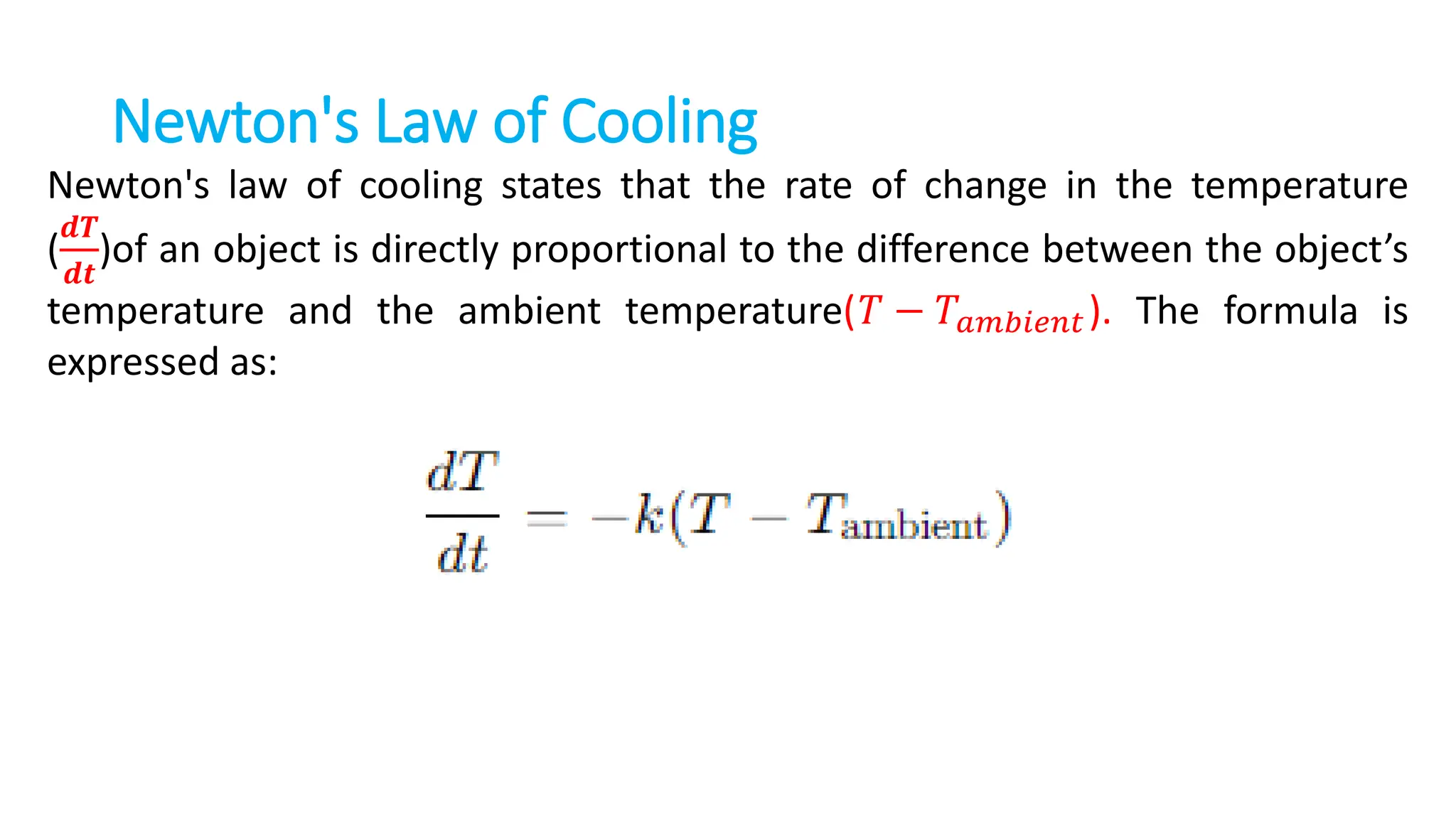
Newton's law of cooling states that the rate of change in the temperature
(
𝒅𝑻
𝒅𝒕
)of an object is directly proportional to the difference between the object’s
temperature and the ambient temperature(𝑇 − 𝑇𝑎𝑚𝑏𝑖𝑒𝑛𝑡 ). The formula is
expressed as:
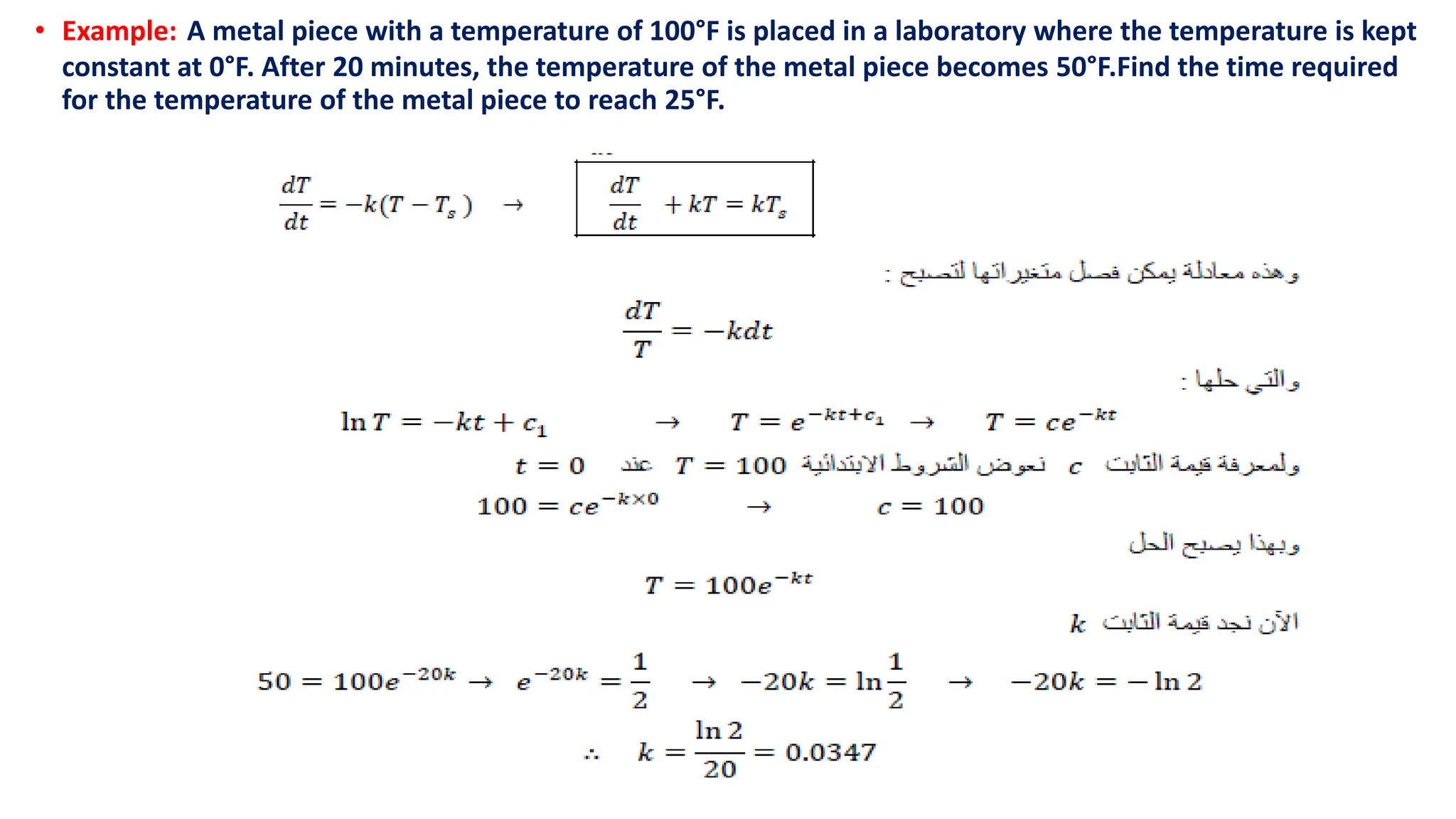
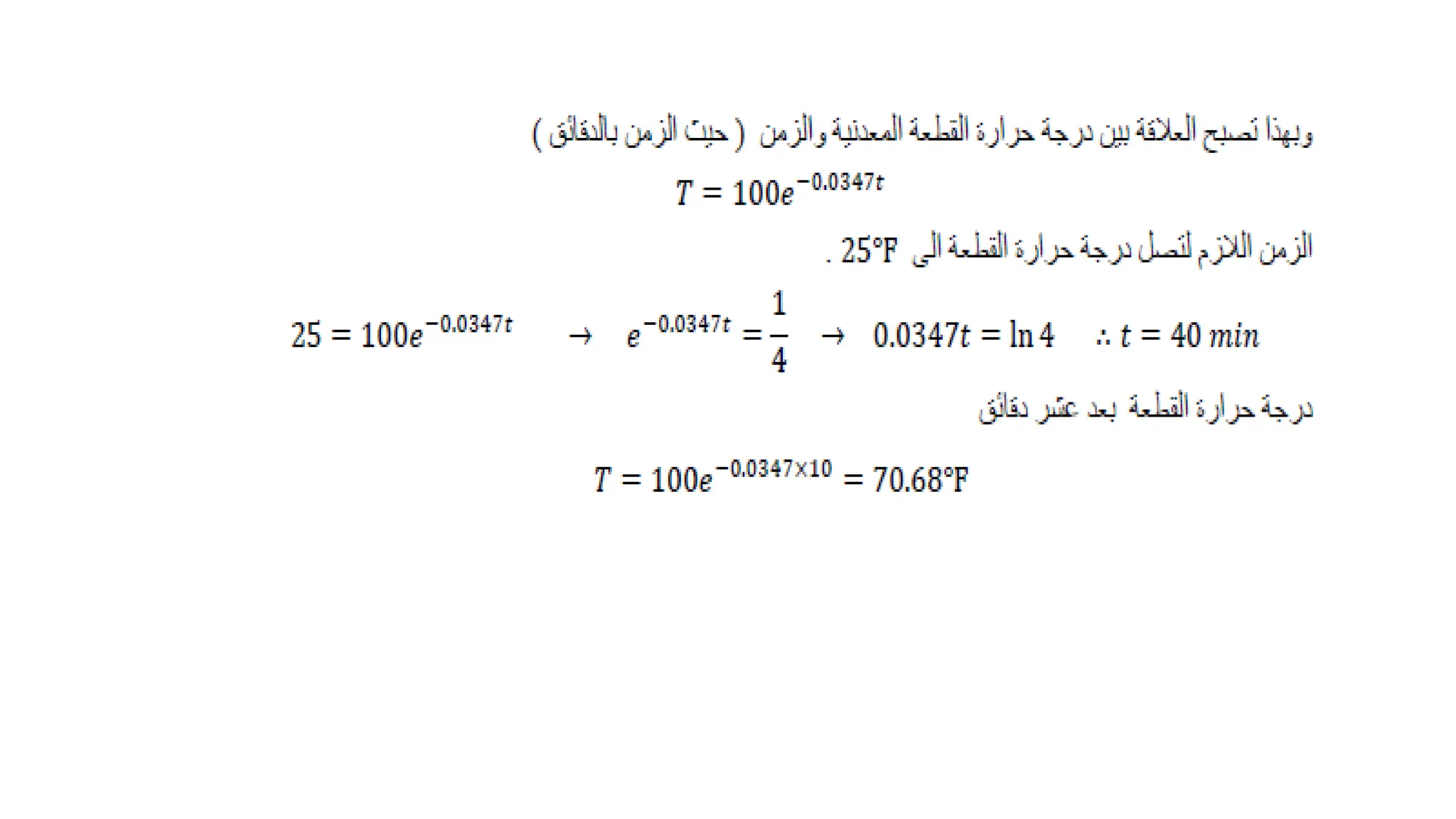
• Example: A metal piece with a temperature of 100°F is placed in a laboratory where the temperature is kept
constant at 0°F. After 20 minutes, the temperature of the metal piece becomes 50°F.Find the time required
for the temperature of the metal piece to reach 25°F.

Any
Questions

lectااتتتتاارررررررررررررررررررررررررررر1.pdf

  • 1.
    lecture 1 Assist. Lect.Hiba Abdul –Kareem
  • 2.
  • 3.
  • 4.
    ‫المستقل‬ ‫المتغير‬ Independent Variable): ) • ‫دو‬‫بحرية‬ ‫قيمته‬ ‫تتغير‬ ‫الذي‬ ‫المتغير‬ ‫هو‬ ‫أن‬ ‫ن‬ ‫المعادلة‬ ‫في‬ ‫أخرى‬ ‫متغيرات‬ ‫بأي‬ ‫تتأثر‬ . • ‫بـ‬ ً‫ة‬‫عاد‬ ‫له‬ ‫رمز‬ُ‫ي‬ 𝑥 ‫أو‬ 𝑡 ) ‫الزمن‬ ‫يمثل‬ ‫عندما‬ ‫الفيزياء‬ ‫في‬ .) • ‫كيفي‬ ‫نقيس‬ ،‫التفاضلية‬ ‫المعادالت‬ ‫في‬ ‫تغير‬ ‫ة‬ ‫المتغير‬ ‫لهذا‬ ‫بالنسبة‬ ‫األخرى‬ ‫المتغيرات‬ . • ‫مثال‬ : ‫مرور‬ ‫مع‬ ‫جسم‬ ‫حركة‬ ‫تدرس‬ ‫كنت‬ ‫إذا‬ ‫الزمن‬ ‫فإن‬ ،‫الزمن‬ 𝑡 ‫المستقل؛‬ ‫المتغير‬ ‫هو‬ ‫األخرى‬ ‫المتغيرات‬ ‫من‬ ‫تأثير‬ ‫دون‬ ‫يمر‬ ‫ألنه‬ ‫المعتمد‬ ‫لمتغير‬ (Dependent Variable): • ‫المت‬ ‫على‬ ‫قيمته‬ ‫تعتمد‬ ‫الذي‬ ‫المتغير‬ ‫و‬ ‫غير‬ ‫المستقل‬ . ‫اس‬ ‫تتغير‬ ‫قيمته‬ ،‫آخر‬ ‫بمعنى‬ ‫تجابة‬ ‫المستقل‬ ‫المتغير‬ ‫في‬ ‫لتغيرات‬ . ‫رمز‬ُ‫ي‬ ً‫ة‬‫عاد‬ ‫له‬ ‫بـ‬ 𝑦 ‫أو‬ 𝑢 ‫آخر‬ ‫رمز‬ ‫أي‬ ‫أو‬ . • ‫المتغي‬ ‫هو‬ ‫هذا‬ ،‫التفاضلية‬ ‫المعادالت‬ ‫في‬ ‫ر‬ ‫بالنسبة‬ ‫مشتقاته‬ ‫بحساب‬ ‫نقوم‬ ‫الذي‬ ‫المستقل‬ ‫للمتغير‬ . • ‫مثال‬ : ،‫متحرك‬ ‫جسم‬ ‫سرعة‬ ‫تدرس‬ ‫كنت‬ ‫إذا‬ ‫الزمن‬ ‫على‬ ‫تعتمد‬ ‫السرعة‬ ‫فإن‬ 𝑡 ، ‫ولذلك‬ ‫السرعة‬ ‫فإن‬ 𝑣 ‫المعتمد‬ ‫المتغير‬ ‫عتبر‬ُ‫ت‬ .
  • 5.
    • ‫التفاضلية‬ ‫المعادلة‬ ‫في‬ : 𝒅𝒚 𝒅𝒙 =2x • ‫المستقل‬‫المتغير‬ ‫هو‬ x ‫له‬ ‫بالنسبة‬ ‫المشتقة‬ ‫بأخذ‬ ‫نقوم‬ ‫الذي‬ ‫المتغير‬ ‫ألنه‬ • . ‫المعتمد‬ ‫المتغير‬ ‫هو‬ 𝑦 ‫على‬ ‫يعتمد‬ ‫ألنه‬ x • ‫تتغير‬ ‫كيف‬ ‫بحساب‬ ‫نقوم‬ ‫وبالتالي‬ 𝑦 ‫تغير‬ ‫مع‬ x • ‫المستقل‬ ‫المتغير‬ ،‫ببساطة‬ ‫فيه‬ ‫تتحكم‬ ‫الذي‬ ‫هو‬ ( ‫المسافة‬ ‫أو‬ ‫الزمن‬ ‫مثل‬ ) ‫ال‬ ‫بينما‬ ، ‫متغير‬ ‫المستقل‬ ‫المتغير‬ ‫على‬ ً‫ء‬‫بنا‬ ‫يتغير‬ ‫المعتمد‬ .
  • 6.
    Differential Equations • Adifferential equation is an equation that involves one or more differential. • differential equations are two types Ordinary or partial ‫التفاضلية‬ ‫المعادلة‬ . ‫دالة‬ ‫من‬ ‫أكثر‬ ‫أو‬ ‫واحدة‬ ‫مشتقة‬ ‫على‬ ‫تحتوي‬ ‫معادلة‬ ‫وهي‬ ‫رياضية‬ . ‫بالن‬ ‫ما‬ ‫دالة‬ ‫تغير‬ ‫كيفية‬ ‫عن‬ ‫تعبر‬ ‫رياضية‬ ‫أدوات‬ ‫هي‬ ‫المشتقات‬ ‫ألحد‬ ‫سبة‬ ‫المتغيرات‬ . ‫العالقات‬ ‫لوصف‬ ‫تستخدم‬ ‫التفاضلية‬ ‫المعادلة‬ ‫فإن‬ ،‫وبالتالي‬ ‫تشمل‬ ‫التي‬ ‫أخرى‬ ‫لعوامل‬ ‫بالنسبة‬ ‫أو‬ ‫الزمن‬ ‫بمرور‬ ‫المتغيرات‬ ‫في‬ ‫تغييرات‬ .
  • 7.
    Ordinary Differential Equation •In mathematics, the term “Ordinary Differential Equations” also known as ODE is an equation that contains only one independent variable and one or more of its derivatives with respect to the variable. In other words, the ODE is represented as the relation having one independent variable x, the real dependent variable y, with some of its derivatives. ‫المعادالت‬ ‫العادية‬ ‫التفاضلية‬ ( (ODE) ‫دالة‬ ‫بين‬ ‫تربط‬ ‫التي‬ ‫المعادالت‬ ‫من‬ ‫نوع‬ ‫هي‬ ‫ومشتقاتها‬ ‫رياضية‬ . ‫ب‬ ‫الدالة‬ ‫هذه‬ ‫ر‬ّ‫ي‬‫تغ‬ ‫كيفية‬ ‫عن‬ ‫تعبر‬ ‫الدالة‬ ‫مشتقات‬ ‫النسبة‬ ‫مستقل‬ ‫واحد‬ ‫لمتغير‬ . ‫في‬ ODE ، ‫بـ‬ ‫له‬ ‫رمز‬ُ‫ي‬ ‫عادة‬ ‫المستقل‬ ‫المتغير‬ x ، ‫والمتغير‬ ‫التابع‬ ( ‫المستقل‬ ‫المتغير‬ ‫على‬ ‫يعتمد‬ ‫الذي‬ ) ‫بـ‬ ‫له‬ ‫رمز‬ُ‫ي‬ 𝑦
  • 8.
    •Order: the orderof Differential Equations is the highest order • derivative that occurs in the equation Degree: The exponent of the highest order derivative ‫المرتبة‬ : ‫المعادل‬ ‫في‬ ‫تظهر‬ ‫مشتقة‬ ‫بأعلى‬ ‫تتعلق‬ ‫ة‬ . ‫الدرجة‬ : ‫األعلى‬ ‫المشتقة‬ ‫بأس‬ ‫تتعلق‬ ‫رتبة‬
  • 9.
    Classwork •Find the orderand degree of the following differential equations: 4(d3y/dx3) - (d2y/dx2)3 + 5(dy/dx) + 4 = 0 7(d4y/dx4)2 + 5(d2y/dx2)4+ 9(dy/dx)8 + 11 = 0 (d2y/dx2) + x(dy/dx)3 = 0 (y''')2 + x2(y')3 - 2x + 11 = 0
  • 10.
    Classwork • Find theorder and degree of the following differential equations: • 4(d3y/dx3) - (d2y/dx2)3 + 5(dy/dx) + 4 = 0 The differential equation is of order three, and the degree one. • 7(d4y/dx4)2 + 5(d2y/dx2)4+ 9(dy/dx)8 + 11 = 0 The differential equation is of fourth-order and second degree. • 3(d2y/dx2) + x(dy/dx)3 = 0 This differential equation is of second-order, and first degree. • (d). (y''')2 + x2(y')3 - 2x + 11 = 0 The differential equation is of the third order and second degree.
  • 11.
    Differential equations areclassified into linear DEs or nonlinear DEs • An nth order differential equation is said to be linear if it can be written in the form: that is, it satisfies the following three conditions: (1) the dependent variable (y) and all its derivatives in the equation are of power one. ‫التابع‬ ‫المتغير‬ ( ‫الدالة‬ ) ‫بقدرة‬ ‫المعادلة‬ ‫في‬ ‫يظهران‬ ‫ومشتقاته‬ 1 ( ‫أعلى‬ ‫قوة‬ ‫إلى‬ ‫رفعها‬ ‫أو‬ ‫الدالة‬ ‫تربيع‬ ‫يتم‬ ‫ال‬ ‫أي‬ .) (2) all the coefficients and the function g(x) are either constants or depend only on the independent variable (x). • ‫المعادلة‬ ‫مشتقاته‬ ‫أو‬ ‫التابع‬ ‫المتغير‬ ‫بين‬ ‫ضرب‬ ‫حاصل‬ ‫أو‬ ‫مضاعفات‬ ‫على‬ ‫تحتوي‬ ‫ال‬ ( ‫بين‬ ‫ضرب‬ ‫حاصل‬ ‫يوجد‬ ‫ال‬ ،‫المثال‬ ‫سبيل‬ ‫على‬ 𝑦 ‫و‬ 𝒅𝒚 𝒅𝒙 • ‫تعتمد‬ ‫الثابتة‬ ‫والمعامالت‬ ‫المستقل‬ ‫المتغير‬ ‫على‬ ‫فقط‬ ‫التفاضلية‬ ‫المعادلة‬ ( ‫الجذ‬ ‫مثل‬ ‫خطية‬ ‫غير‬ ‫دوال‬ ‫على‬ ‫تحتوي‬ ‫ال‬ ‫المعادلة‬ ‫أن‬ ‫أي‬ ‫الجيوب‬ ‫أو‬ ‫ور‬ ‫التابع‬ ‫للمتغير‬ ‫األسس‬ ‫أو‬ 𝑦 . If any one of these 2 conditions is not satisfied, then the DE is said to be nonlinear DE.
  • 12.
    The following differentialequations are linear
  • 13.
    While the followingdifferential equations are nonlinear:
  • 14.
    Solving First-order DifferentialEquations(Variable Separable ) • A separable equation is solved by separating the variables, that is, rearranging the equation so that everything involving y appears on one side of the equation, and everything involving x appears on the other. The equation can then be integrated directly. ‫معادلة‬ ‫التفاضلية‬ ‫القابلة‬ ‫للفصل‬ ‫هي‬ ‫نوع‬ ‫من‬ ‫المعادالت‬ ‫التفاضلية‬ ‫التي‬ ‫يمكن‬ ‫حلها‬ ‫بتقسيم‬ ‫المتغ‬ ‫يرات‬ . ‫بمعنى‬ ،‫آخر‬ ‫نقوم‬ ‫بترتيب‬ ‫المعادلة‬ ‫بحيث‬ ‫تظهر‬ ‫جميع‬ ‫التعبيرات‬ ‫التي‬ ‫تحتوي‬ ‫على‬ ‫المتغير‬ 𝑦 ‫على‬ ‫جهة‬ ‫واحدة‬ ‫من‬ ‫ا‬ ،‫لمعادلة‬ ‫وجميع‬ ‫التعبيرات‬ ‫التي‬ ‫تحتوي‬ ‫على‬ ‫المتغير‬ 𝑥 ‫على‬ ‫الجهة‬ ‫األخرى‬ . ‫بعد‬ ‫ذلك‬ ‫يمكننا‬ ‫تكامل‬ ‫كال‬ ‫الطرفين‬ ‫بشكل‬ ‫منفصل‬ ‫لحل‬ ‫المعادلة‬ .
  • 15.
    Solving First-order DifferentialEquations(Variable Separable )
  • 16.
    Example: Solve dy/dx= x3/y2. Given DE, dy/dx = x3/y2 ⇒ dy(y2) = x3 (dx) Integrating bothsides ∫dy(y2) = ∫x3 (dx) ⇒ y2+1/(2+1) = x3+1/(3+1) + c ⇒ y3/3 = x4/4 + c This is the solution to the given differential equation.
  • 19.
    Classwork :Find ageneral solution to the following differential equation using the method of separating variables with the initial value y(0)= 1 𝒅𝒚 𝒅𝒙 = 𝟑𝒙𝟐 + 𝟒𝒙 + 𝟐 𝟐(𝒚 − 𝟏)
  • 21.
    Newton's Law ofCooling • Newton's Law of Cooling states that the rate at which a body loses heat is directly proportional to the difference between the body's temperature and the temperature of the surrounding environment. In other words, if the body is hot and placed in a cooler environment, it loses heat more quickly as the temperature difference between the body and the surroundings increases. ‫قانون‬ ‫الوسط‬ ‫حرارة‬ ‫ودرجة‬ ‫الجسم‬ ‫حرارة‬ ‫درجة‬ ‫بين‬ ‫الفرق‬ ‫مع‬ ‫ا‬ً‫ي‬‫طرد‬ ‫يتناسب‬ ‫لحرارته‬ ‫جسم‬ ‫فقدان‬ ‫معدل‬ ‫أن‬ ‫على‬ ‫ينص‬ ‫للتبريد‬ ‫نيوتن‬ ‫به‬ ‫المحيط‬ . ‫درجتي‬ ‫بين‬ ‫الفرق‬ ‫كان‬ ‫كلما‬ ‫أكبر‬ ‫بسرعة‬ ‫الحرارة‬ ‫يفقد‬ ‫فإنه‬ ،‫برودة‬ ‫أكثر‬ ‫وسط‬ ‫في‬ ‫ويوجد‬ ‫ا‬ً‫ن‬‫ساخ‬ ‫الجسم‬ ‫كان‬ ‫إذا‬ ،‫أخرى‬ ‫بعبارة‬ ‫أكبر‬ ‫الحرارة‬
  • 22.
    Newton's Law ofCooling Newton's law of cooling states that the rate of change in the temperature ( 𝒅𝑻 𝒅𝒕 )of an object is directly proportional to the difference between the object’s temperature and the ambient temperature(𝑇 − 𝑇𝑎𝑚𝑏𝑖𝑒𝑛𝑡 ). The formula is expressed as:
  • 23.
    • Example: Ametal piece with a temperature of 100°F is placed in a laboratory where the temperature is kept constant at 0°F. After 20 minutes, the temperature of the metal piece becomes 50°F.Find the time required for the temperature of the metal piece to reach 25°F.
  • 25.