LECTURE 3
Prepared by:
Assist. Lect. Hiba Abdul –Kareem Assist. Lect. Azam Isam
Introduction to function
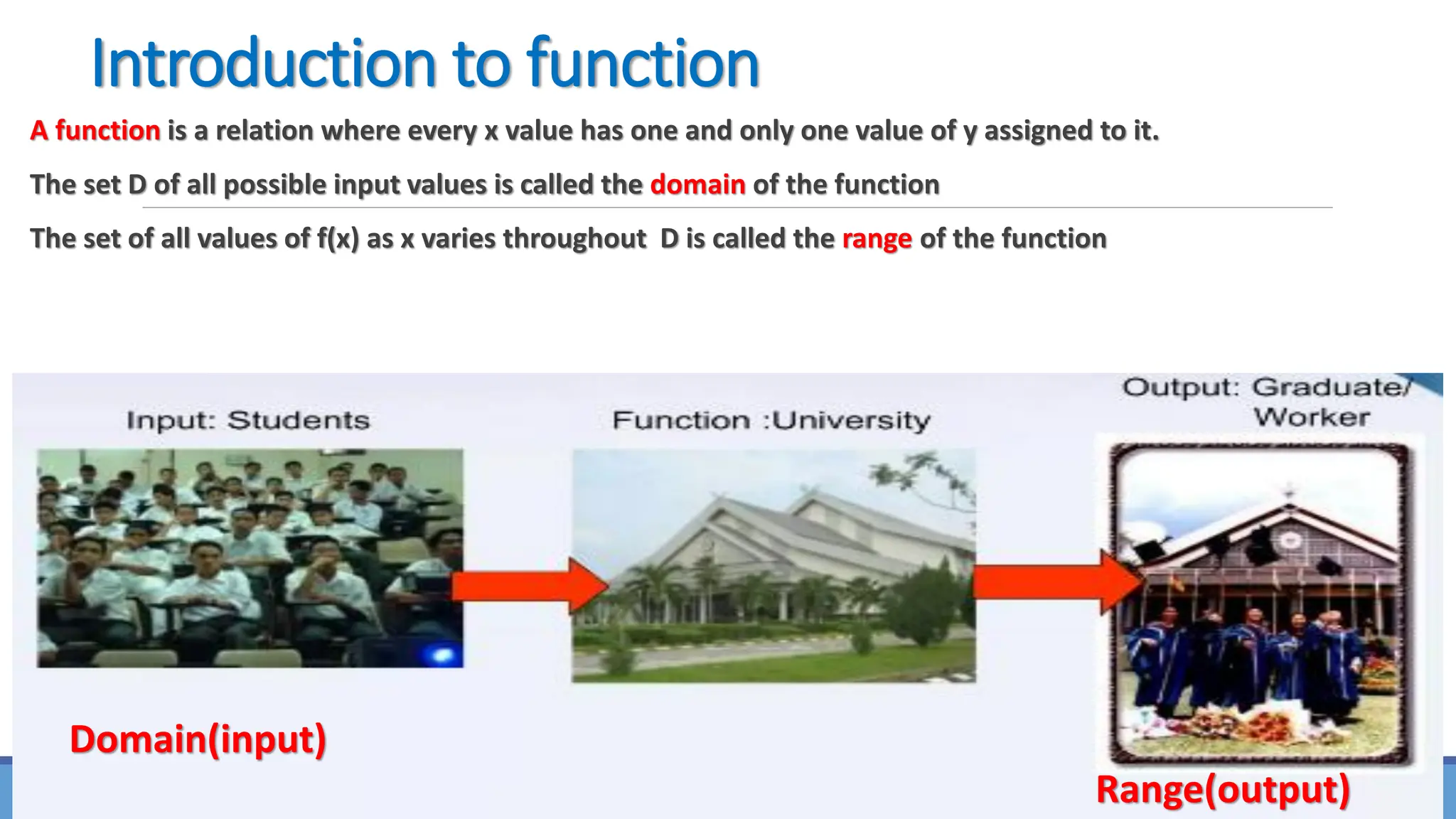
A function is a relation where every x value has one and only one value of y assigned to it.
The set D of all possible input values is called the domain of the function
The set of all values of f(x) as x varies throughout D is called the range of the function
Domain(input)
Range(output)
Domain &Range
For real-valued domains and ranges, the following points
should be satisfied :
1. we cannot divide by zero. The denominator cannot be zero
2. Any value under the square root cannot be negative
Domain
‫قيم‬
x
‫ان‬ ‫دون‬ ‫الدالة‬ ‫في‬ ‫تعويضها‬ ‫يمكن‬ ‫التي‬
‫سالب‬ ‫جذر‬ ‫او‬ ‫صفر‬ ‫مقام‬ ‫الناتج‬ ‫يكون‬
Range
‫قيم‬
y
‫ان‬ ‫دون‬ ‫الدالة‬ ‫في‬ ‫تعويضها‬ ‫يمكن‬ ‫التي‬
‫سالب‬ ‫جذر‬ ‫او‬ ‫صفر‬ ‫مقام‬ ‫الناتج‬ ‫يكون‬
Domain
The set D of all possible input values is called the domain of the function
Example: verify the domains and ranges of the following functions :
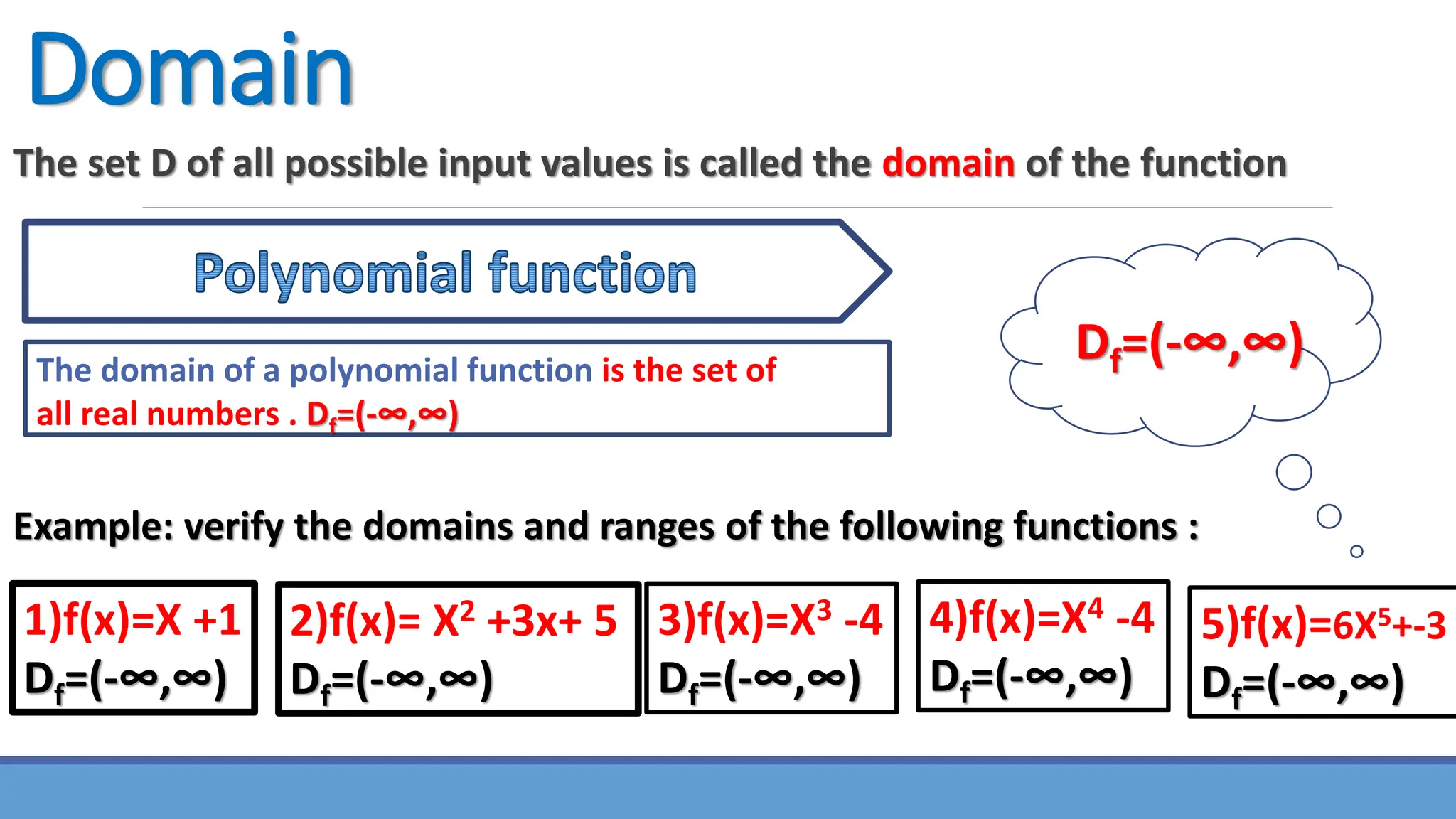
The domain of a polynomial function is the set of
all real numbers . Df=(-∞,∞)
Df=(-∞,∞)
3)f(x)=X3 -4
Df=(-∞,∞)
1)f(x)=X +1
Df=(-∞,∞)
2)f(x)= X2 +3x+ 5
Df=(-∞,∞)
4)f(x)=X4 -4
Df=(-∞,∞)
5)f(x)=6X5+-3
Df=(-∞,∞)
Domain
The set D of all possible input values is called the domain of the function
The domain of a rational function consists of all the real
numbers x, except those for which the denominator is 0
To find the domain for a given rational function
• Set the denominator equal to zero.
• Solve to find the x-values that cause the denominator to equal zero.
• The domain is all real numbers except those found in Step 2.
Domain
The set D of all possible input values is called the domain of the function
Example: find the domain for the following rational functions:
𝟏)𝒇 𝒙 =
𝟓𝒙𝟐
𝟑 − 𝒙
3-x=0
X=3
Df ={x∈ R: X≠3}
OR
Df =(-∞, 3 ∪
( (3 , ∞)
-∞ ∞
3
Domain
The set D of all possible input values is called the domain of the function
Example: find the domain for the following rational functions:
𝟐)𝒈 𝒙 =
𝒙 − 𝟏
𝒙𝟐 − 𝒙 − 𝟐
𝒙𝟐 − 𝒙 − 𝟐=0
(x-2)(x+1)=0
X=2,x=-1
Dg ={x∈ R: X≠2, : X≠-1}
OR
Dg =(-∞, -1 ∪
( (-1 , 2)∪ (2, ∞)
-∞ ∞
-1 2
c c c
Domain
The set D of all possible input values is called the domain of the function
Example: find the domain for the following rational functions:
𝟑)𝑯 𝒙 =
𝟏
𝟑𝑿+𝟐
-
𝟏
−𝟑𝑿−𝟓
3X+2=0
X=-
𝟐
𝟑
-3X-5=0
X=-
𝟓
𝟑
DH ={x∈ R: X≠-
𝟐
𝟑
, : X≠-
𝟓
𝟑
} OR DH =(-∞, -
𝟓
𝟑
∪
( (-
𝟓
𝟑
, -
𝟐
𝟑
)∪ (-
𝟐
𝟑
, ∞)
-∞ ∞
-
𝟓
𝟑
−
𝟐
𝟑
c c c
Domain
The set D of all possible input values is called the domain of the function
Example: find the domain for the following rational functions:
𝟒) y=
𝟏
𝒙
X=0
Dy ={x∈ R: X≠0 } OR Dy =(-∞, 0 ∪
( (0 , ∞)
-∞ ∞
𝟎
c c
Domain
The set D of all possible input values is called the domain of the function
The square root of a negative number is NOT a real number. i.e., the square
root function cannot accept negative numbers as inputs
Finding the Domain of a Square Root Function
Step 1: Set everything underneath the square root greater than or equal to 0.
Step 2: Solve the inequality from step 1.
Step 3: Write the result from step 2 in interval notation
Domain
Example: verify the domains and ranges of the following functions:
1)f(x)= 𝒙 − 𝟏𝟐
X-12≥0
x≥12
Df=[12, ∞)
2)f(x)=3 𝒙 − 𝟓
X-5≥0
x≥5
Df=[5, ∞)
The set D of all possible input values is called the domain of the function
Domain
3)f(x)= 𝟐𝒙 − 𝟕
2X-7≥0
2x≥7
x≥
𝟕
𝟐
Df=[
𝟕
𝟐
, ∞)
4)f(x)= −𝒙 − 𝟑
-X-3≥0
-x≥3
x≤-3
Df (-∞,-3]
Domain
5)f(x)=
𝟑
𝟐𝒙−𝟑
2X-3>0
2x>3
x>
𝟑
𝟐
Df=(
𝟑
𝟐
, ∞)
6)f(x)= 𝒙𝟐 − 𝟑
𝒙𝟐
-3≥0
𝒙𝟐
≥3
x ≥ ± 𝟑
Df =[- 𝟑, 𝟑]
Domain
5)f(x)=
𝒙−𝟏
𝒙+𝟐
X-1 ≥0
x ≥ 1
x+2>0
x>-2
Df = { x: x ≥ 1} ∩{ x: x x>-2}
Df=[𝟏, ∞)
𝟏
c
−𝟐
c
Range
The set of all values of f(x) as x varies throughout D is called the range of the function
‫اس‬ ‫اعلى‬
‫فردي‬
Rf=(-∞, ∞)
‫زوجي‬ ‫اس‬ ‫اعلى‬
Rf=[‫عدد‬, ∞)
‫او‬
Rf=(-∞, ‫]عدد‬
1)f(x)=X3 -8
Rf=(-∞, ∞)
2)f(x)=X2 +5
y= X2 +5
X2 =y-5
X= 𝒚 − 𝟓
y-5≥0
Y ≥5
Rf =[5, ∞)
3)f(x)=X -1
Rf=(-∞, ∞)
Range
The set of all values of f(x) as x varies throughout D is called the range of the function
‫اس‬ ‫اعلى‬
‫فردي‬
Rf=(-∞, ∞)
‫زوجي‬ ‫اس‬ ‫اعلى‬
Rf=[‫عدد‬, ∞)
‫او‬
Rf=(-∞, ‫]عدد‬
4)H(x)=X2
y=X2
X= 𝒚
y ≥0
RH =[0, ∞)
5)f(x)=4-X2
y= 4-X2
X2 =4-y
X=± 𝟒 − 𝒚
4-y≥0
-y ≥-4
y≤4 , Rf=(-∞,4]
Range
The set of all values of f(x) as x varies throughout D is called the range of the function
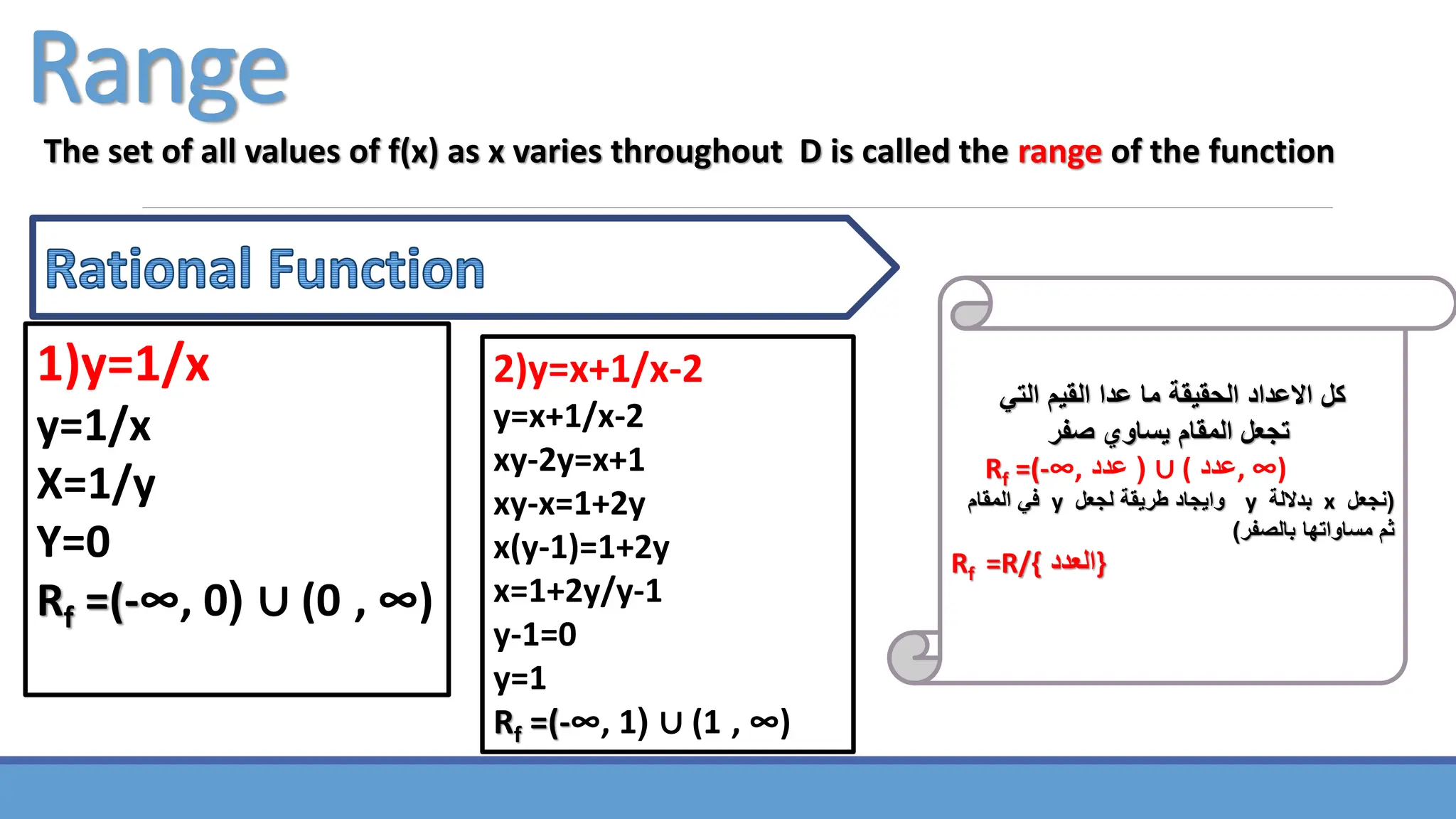
‫كل‬
‫القيم‬ ‫عدا‬ ‫ما‬ ‫الحقيقة‬ ‫االعداد‬
‫التي‬
‫صفر‬ ‫يساوي‬ ‫المقام‬ ‫تجعل‬
Rf =(-∞, ∪
(
‫عدد‬ ( ‫عدد‬, ∞)
(
‫نجعل‬
x
‫بداللة‬
y
‫لجعل‬ ‫طريقة‬ ‫وايجاد‬
y
‫المقام‬ ‫في‬
‫بالصفر‬ ‫مساواتها‬ ‫ثم‬
)
Rf =R/{ ‫}العدد‬
1)y=1/x
y=1/x
X=1/y
Y=0
Rf =(-∞, 0 ∪
( (0 , ∞)
2)y=x+1/x-2
y=x+1/x-2
xy-2y=x+1
xy-x=1+2y
x(y-1)=1+2y
x=1+2y/y-1
y-1=0
y=1
Rf =(-∞, 1 ∪
( (1 , ∞)
Range
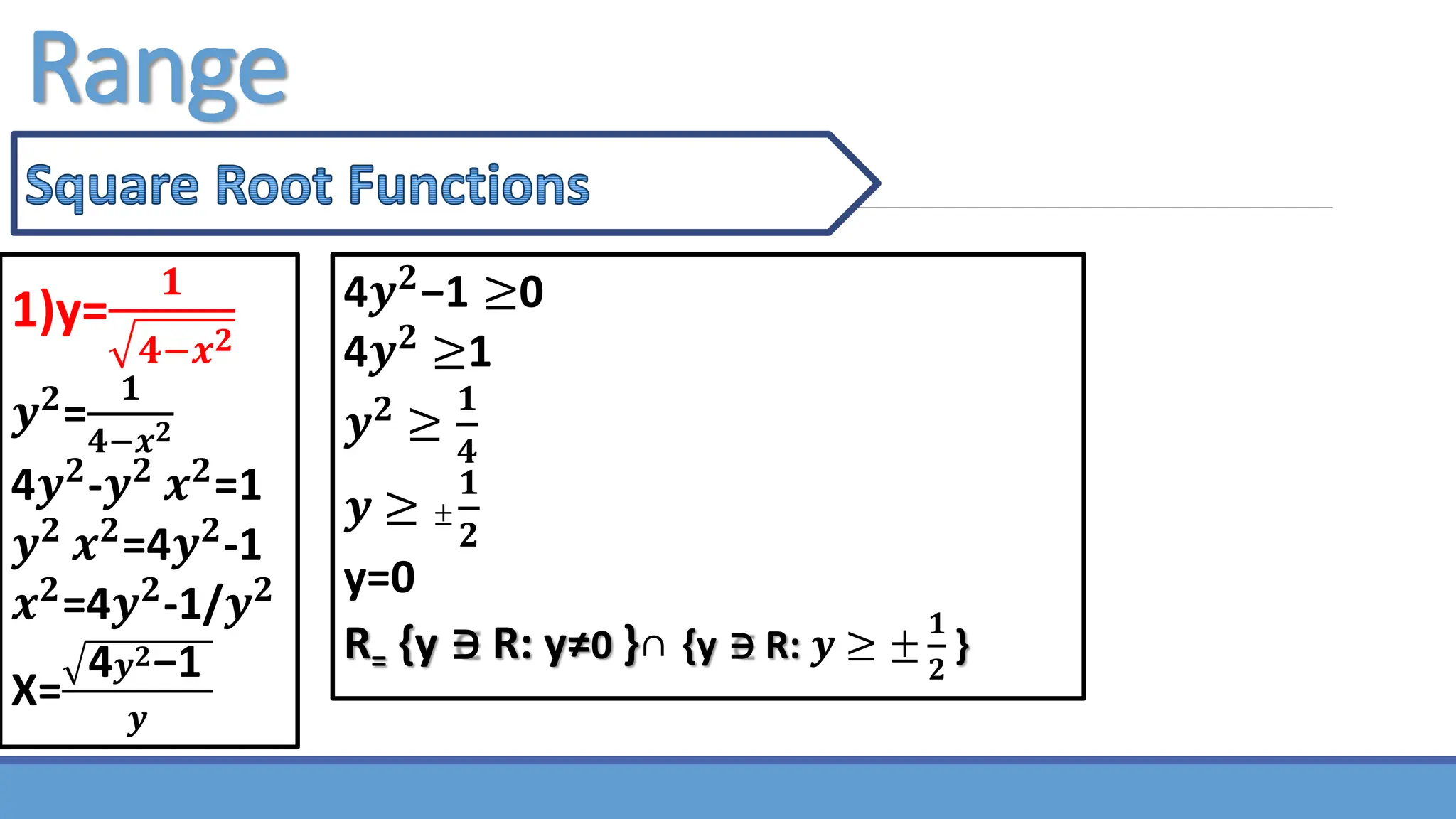
1)y=
𝟏
𝟒−𝒙𝟐
𝒚𝟐
=
𝟏
𝟒−𝒙𝟐
4𝒚𝟐
-𝒚𝟐
𝒙𝟐
=1
𝒚𝟐
𝒙𝟐
=4𝒚𝟐
-1
𝒙𝟐
=4𝒚𝟐
-1/𝒚𝟐
X=
4𝒚𝟐−1
𝒚
4𝒚𝟐
−1 ≥0
4𝒚𝟐
≥1
𝒚𝟐
≥
𝟏
𝟒
𝒚 ≥ ±
𝟏
𝟐
y=0
R= {y ∈ R: y≠0 }∩ {y ∈ R: 𝒚 ≥ ±
𝟏
𝟐
}
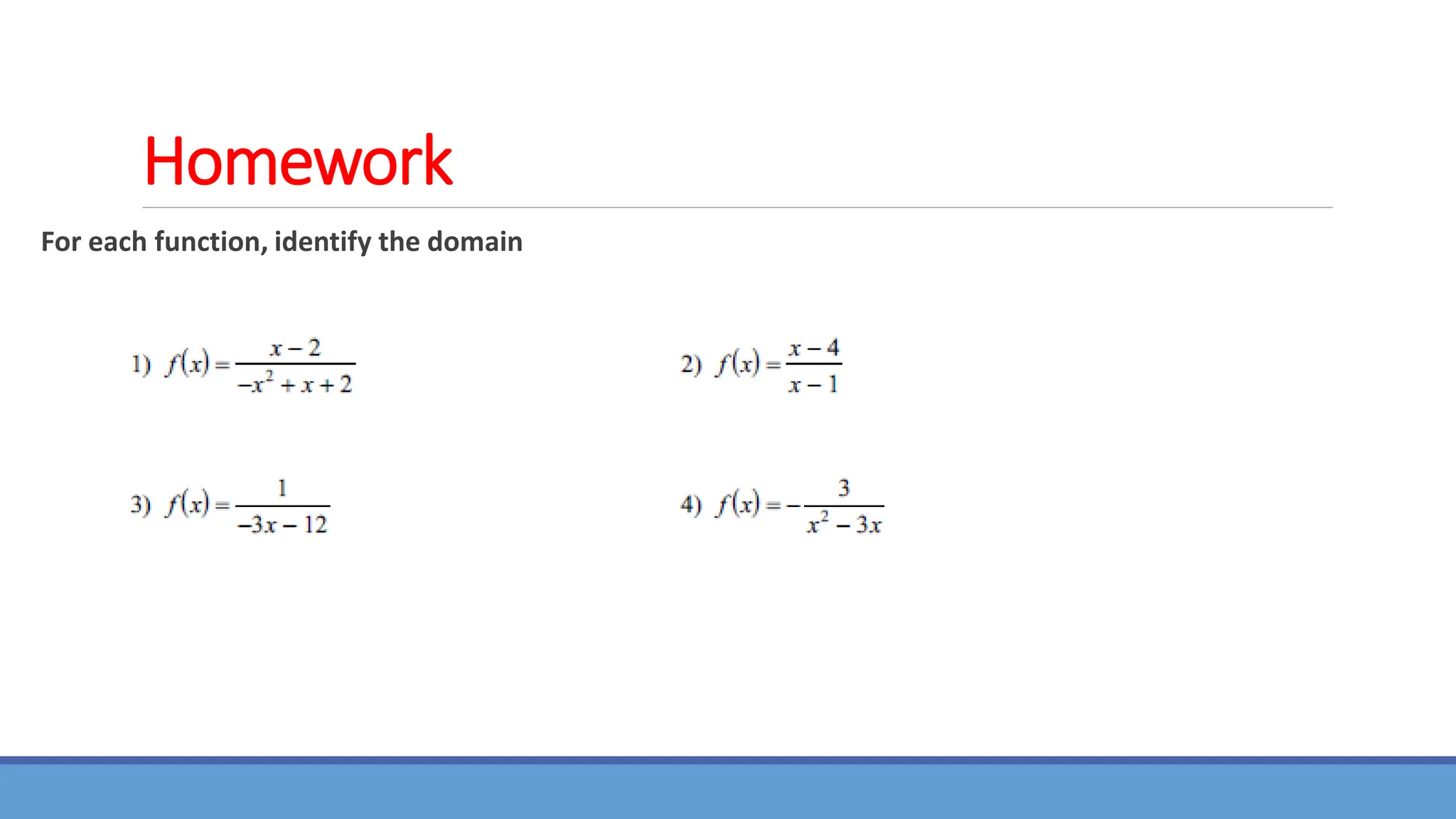
Homework
For each function, identify the domain
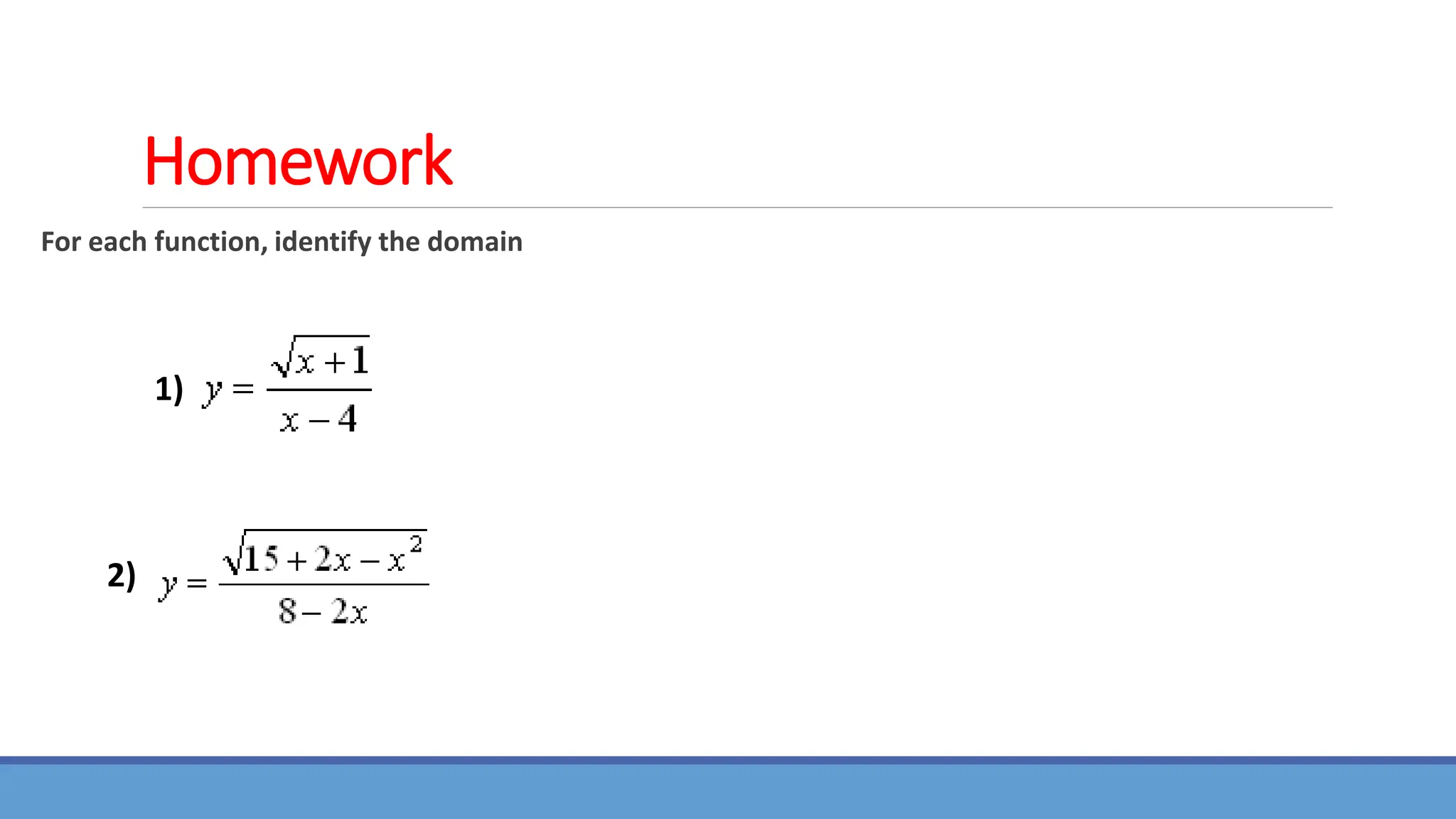
Homework
For each function, identify the domain
1)
2)
Identify the domain and range 𝒚 =
𝟏
𝒙+𝟏
-
𝟏
𝒙−𝟏
Homework
Homework

lecrfigfdtj x6 I f I ncccfyuggggrst3.pdf

  • 1.
    LECTURE 3 Prepared by: Assist.Lect. Hiba Abdul –Kareem Assist. Lect. Azam Isam
  • 2.
    Introduction to function Afunction is a relation where every x value has one and only one value of y assigned to it. The set D of all possible input values is called the domain of the function The set of all values of f(x) as x varies throughout D is called the range of the function Domain(input) Range(output)
  • 6.
    Domain &Range For real-valueddomains and ranges, the following points should be satisfied : 1. we cannot divide by zero. The denominator cannot be zero 2. Any value under the square root cannot be negative Domain ‫قيم‬ x ‫ان‬ ‫دون‬ ‫الدالة‬ ‫في‬ ‫تعويضها‬ ‫يمكن‬ ‫التي‬ ‫سالب‬ ‫جذر‬ ‫او‬ ‫صفر‬ ‫مقام‬ ‫الناتج‬ ‫يكون‬ Range ‫قيم‬ y ‫ان‬ ‫دون‬ ‫الدالة‬ ‫في‬ ‫تعويضها‬ ‫يمكن‬ ‫التي‬ ‫سالب‬ ‫جذر‬ ‫او‬ ‫صفر‬ ‫مقام‬ ‫الناتج‬ ‫يكون‬
  • 7.
    Domain The set Dof all possible input values is called the domain of the function Example: verify the domains and ranges of the following functions : The domain of a polynomial function is the set of all real numbers . Df=(-∞,∞) Df=(-∞,∞) 3)f(x)=X3 -4 Df=(-∞,∞) 1)f(x)=X +1 Df=(-∞,∞) 2)f(x)= X2 +3x+ 5 Df=(-∞,∞) 4)f(x)=X4 -4 Df=(-∞,∞) 5)f(x)=6X5+-3 Df=(-∞,∞)
  • 8.
    Domain The set Dof all possible input values is called the domain of the function The domain of a rational function consists of all the real numbers x, except those for which the denominator is 0 To find the domain for a given rational function • Set the denominator equal to zero. • Solve to find the x-values that cause the denominator to equal zero. • The domain is all real numbers except those found in Step 2.
  • 9.
    Domain The set Dof all possible input values is called the domain of the function Example: find the domain for the following rational functions: 𝟏)𝒇 𝒙 = 𝟓𝒙𝟐 𝟑 − 𝒙 3-x=0 X=3 Df ={x∈ R: X≠3} OR Df =(-∞, 3 ∪ ( (3 , ∞) -∞ ∞ 3
  • 10.
    Domain The set Dof all possible input values is called the domain of the function Example: find the domain for the following rational functions: 𝟐)𝒈 𝒙 = 𝒙 − 𝟏 𝒙𝟐 − 𝒙 − 𝟐 𝒙𝟐 − 𝒙 − 𝟐=0 (x-2)(x+1)=0 X=2,x=-1 Dg ={x∈ R: X≠2, : X≠-1} OR Dg =(-∞, -1 ∪ ( (-1 , 2)∪ (2, ∞) -∞ ∞ -1 2 c c c
  • 11.
    Domain The set Dof all possible input values is called the domain of the function Example: find the domain for the following rational functions: 𝟑)𝑯 𝒙 = 𝟏 𝟑𝑿+𝟐 - 𝟏 −𝟑𝑿−𝟓 3X+2=0 X=- 𝟐 𝟑 -3X-5=0 X=- 𝟓 𝟑 DH ={x∈ R: X≠- 𝟐 𝟑 , : X≠- 𝟓 𝟑 } OR DH =(-∞, - 𝟓 𝟑 ∪ ( (- 𝟓 𝟑 , - 𝟐 𝟑 )∪ (- 𝟐 𝟑 , ∞) -∞ ∞ - 𝟓 𝟑 − 𝟐 𝟑 c c c
  • 12.
    Domain The set Dof all possible input values is called the domain of the function Example: find the domain for the following rational functions: 𝟒) y= 𝟏 𝒙 X=0 Dy ={x∈ R: X≠0 } OR Dy =(-∞, 0 ∪ ( (0 , ∞) -∞ ∞ 𝟎 c c
  • 13.
    Domain The set Dof all possible input values is called the domain of the function The square root of a negative number is NOT a real number. i.e., the square root function cannot accept negative numbers as inputs Finding the Domain of a Square Root Function Step 1: Set everything underneath the square root greater than or equal to 0. Step 2: Solve the inequality from step 1. Step 3: Write the result from step 2 in interval notation
  • 14.
    Domain Example: verify thedomains and ranges of the following functions: 1)f(x)= 𝒙 − 𝟏𝟐 X-12≥0 x≥12 Df=[12, ∞) 2)f(x)=3 𝒙 − 𝟓 X-5≥0 x≥5 Df=[5, ∞) The set D of all possible input values is called the domain of the function
  • 15.
    Domain 3)f(x)= 𝟐𝒙 −𝟕 2X-7≥0 2x≥7 x≥ 𝟕 𝟐 Df=[ 𝟕 𝟐 , ∞) 4)f(x)= −𝒙 − 𝟑 -X-3≥0 -x≥3 x≤-3 Df (-∞,-3]
  • 16.
    Domain 5)f(x)= 𝟑 𝟐𝒙−𝟑 2X-3>0 2x>3 x> 𝟑 𝟐 Df=( 𝟑 𝟐 , ∞) 6)f(x)= 𝒙𝟐− 𝟑 𝒙𝟐 -3≥0 𝒙𝟐 ≥3 x ≥ ± 𝟑 Df =[- 𝟑, 𝟑]
  • 17.
    Domain 5)f(x)= 𝒙−𝟏 𝒙+𝟐 X-1 ≥0 x ≥1 x+2>0 x>-2 Df = { x: x ≥ 1} ∩{ x: x x>-2} Df=[𝟏, ∞) 𝟏 c −𝟐 c
  • 18.
    Range The set ofall values of f(x) as x varies throughout D is called the range of the function ‫اس‬ ‫اعلى‬ ‫فردي‬ Rf=(-∞, ∞) ‫زوجي‬ ‫اس‬ ‫اعلى‬ Rf=[‫عدد‬, ∞) ‫او‬ Rf=(-∞, ‫]عدد‬ 1)f(x)=X3 -8 Rf=(-∞, ∞) 2)f(x)=X2 +5 y= X2 +5 X2 =y-5 X= 𝒚 − 𝟓 y-5≥0 Y ≥5 Rf =[5, ∞) 3)f(x)=X -1 Rf=(-∞, ∞)
  • 19.
    Range The set ofall values of f(x) as x varies throughout D is called the range of the function ‫اس‬ ‫اعلى‬ ‫فردي‬ Rf=(-∞, ∞) ‫زوجي‬ ‫اس‬ ‫اعلى‬ Rf=[‫عدد‬, ∞) ‫او‬ Rf=(-∞, ‫]عدد‬ 4)H(x)=X2 y=X2 X= 𝒚 y ≥0 RH =[0, ∞) 5)f(x)=4-X2 y= 4-X2 X2 =4-y X=± 𝟒 − 𝒚 4-y≥0 -y ≥-4 y≤4 , Rf=(-∞,4]
  • 20.
    Range The set ofall values of f(x) as x varies throughout D is called the range of the function ‫كل‬ ‫القيم‬ ‫عدا‬ ‫ما‬ ‫الحقيقة‬ ‫االعداد‬ ‫التي‬ ‫صفر‬ ‫يساوي‬ ‫المقام‬ ‫تجعل‬ Rf =(-∞, ∪ ( ‫عدد‬ ( ‫عدد‬, ∞) ( ‫نجعل‬ x ‫بداللة‬ y ‫لجعل‬ ‫طريقة‬ ‫وايجاد‬ y ‫المقام‬ ‫في‬ ‫بالصفر‬ ‫مساواتها‬ ‫ثم‬ ) Rf =R/{ ‫}العدد‬ 1)y=1/x y=1/x X=1/y Y=0 Rf =(-∞, 0 ∪ ( (0 , ∞) 2)y=x+1/x-2 y=x+1/x-2 xy-2y=x+1 xy-x=1+2y x(y-1)=1+2y x=1+2y/y-1 y-1=0 y=1 Rf =(-∞, 1 ∪ ( (1 , ∞)
  • 21.
  • 22.
    Homework For each function,identify the domain
  • 23.
    Homework For each function,identify the domain 1) 2)
  • 24.
    Identify the domainand range 𝒚 = 𝟏 𝒙+𝟏 - 𝟏 𝒙−𝟏 Homework
  • 25.