MEDICAL IMAGE COMPUTING (CAP 5937)
LECTURE 6: Pre-Processing for
Nuclear Medicine Images
Dr. Ulas Bagci
HEC 221, Center for Research in Computer
Vision (CRCV), University of Central Florida
(UCF), Orlando, FL 32814.
bagci@ucf.edu or bagci@crcv.ucf.edu
1SPRING 2017
Outline
1. The use of PET/SPECT, PET/CT and MRI/PET Images
2. What to measure from Nuclear Medicine Images?
3. Denoising Nuclear Medicine Images
4. Partial Volume Correction
2
I. the use of PET/SPECT, PET/CT and MRI/PET
Images
3
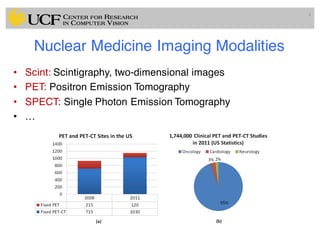
Nuclear Medicine Imaging Modalities
• Scint: Scintigraphy, two-dimensional images
• PET: Positron Emission Tomography
• SPECT: Single Photon Emission Tomography
• …
4
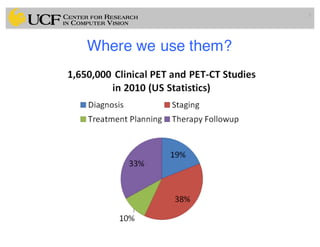
Where we use them?
5
Basics of PET/SPECT Imaging
• Uses short-lived positron emitting isotopes (produced by
collimators)
• Two gamma rays are produced from the annihilation of
each positron and can be detected by specialized gamma
cameras
• Resulting image show the distribution of isotopes
• An agent is used to bind into isotopes (glucose, …)
6
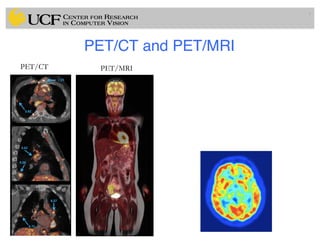
PET/CT and PET/MRI
7
PET/CT PET/MRI
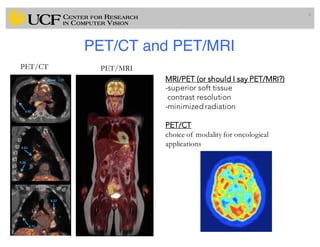
PET/CT and PET/MRI
8
PET/CT PET/MRI
MRI/PET (or should I say PET/MRI?)
-superior soft tissue
contrast resolution
-minimized radiation
PET/CT
choice of modality for oncological
applications
SPECT Imaging
• PET and SPECT are distinguished by the type of radioisotope
incorporated in the tracer.
9
SPECT Imaging
• PET and SPECT are distinguished by the type of radioisotope
incorporated in the tracer.
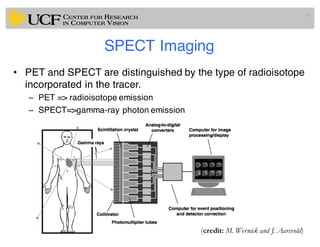
– PET => radioisotope emission
– SPECT=>gamma-ray photon emission
10
SPECT Imaging
• PET and SPECT are distinguished by the type of radioisotope
incorporated in the tracer.
– PET => radioisotope emission
– SPECT=>gamma-ray photon emission
11
(credit: M. Wernick and J. Aarsvold)
SPECT Imaging
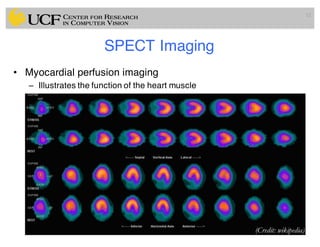
• Myocardial perfusion imaging
– Illustrates the function of the heart muscle
12
(Credit: wikipedia)
SPECT Imaging
• Myocardial perfusion imaging
• Functional brain imaging
• Bone diseases
• Neuroendocrine or neurological tumors
• White cell scan
• …
13
14
II. What to Measure?
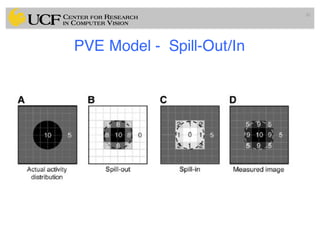
What to Measure in PET/SPECT/.. Images?
• SUV (standardized uptake value: voxel-wise or region-wise)
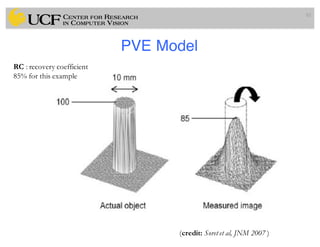
(SUVpeak, SUVmax, SUVlbm)
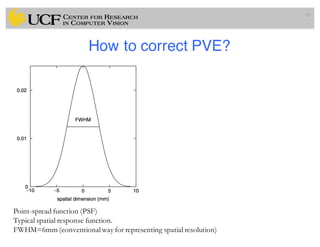
15
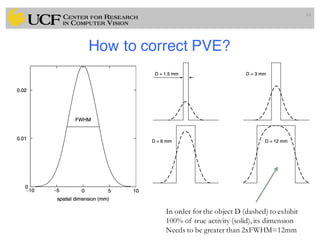
What to Measure in PET/SPECT/.. Images?
• SUV (standardized uptake value: voxel-wise or region-wise)
(SUVpeak, SUVmax, SUVlbm)
– FDG is widely used radiotracer in PET, and glucose analog.
– It accumulates in (preferentially) malignant cells due to higher glucose
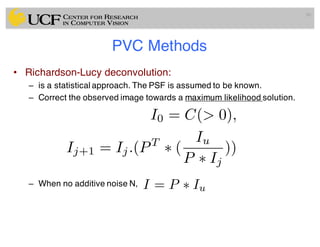
metabolism.
16
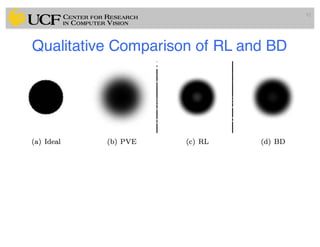
What to Measure in PET/SPECT/.. Images?
• SUV (standardized uptake value: voxel-wise or region-wise)
(SUVpeak, SUVmax, SUVlbm)
– FDG is widely used radiotracer in PET, and glucose analog.
– It accumulates in (preferentially) malignant cells due to higher glucose
metabolism.
– The most common parameter used to measure tracer accumulation in
PET studies is the standardized uptake value (SUV).
17
What to Measure in PET/SPECT/.. Images?
• SUV (standardized uptake value: voxel-wise or region-wise)
(SUVpeak, SUVmax, SUVlbm)
– FDG is widely used radiotracer in PET, and glucose analog.
– It accumulates in (preferentially) malignant cells due to higher glucose
metabolism.
– The most common parameter used to measure tracer accumulation in
PET studies is the standardized uptake value (SUV).
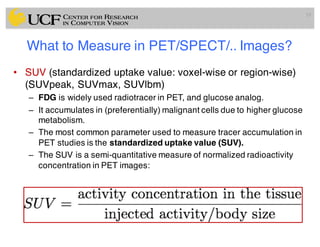
– The SUV is a semi-quantitative measure of normalized radioactivity
concentration in PET images:
18
What to Measure in PET/SPECT/.. Images?
• SUV (standardized uptake value: voxel-wise or region-wise)
(SUVpeak, SUVmax, SUVlbm)
– FDG is widely used radiotracer in PET, and glucose analog.
– It accumulates in (preferentially) malignant cells due to higher glucose
metabolism.
– The most common parameter used to measure tracer accumulation in
PET studies is the standardized uptake value (SUV).
– The SUV is a semi-quantitative measure of normalized radioactivity
concentration in PET images:
19
What to Measure in PET/SPECT/.. Images?
20
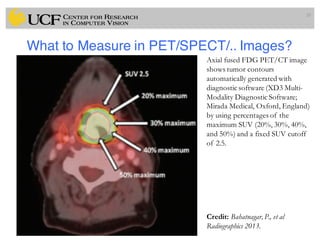
Axial fused FDG PET/CT image
shows tumor contours
automatically generated with
diagnostic software (XD3 Multi-
Modality Diagnostic Software;
Mirada Medical, Oxford, England)
by using percentages of the
maximum SUV (20%, 30%, 40%,
and 50%) and a fixed SUV cutoff
of 2.5.
Credit: Bahatnagar,P., et al
Radiographics 2013.
21
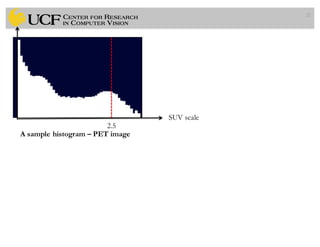
SUV scale
2.5
A sample histogram – PET image
22
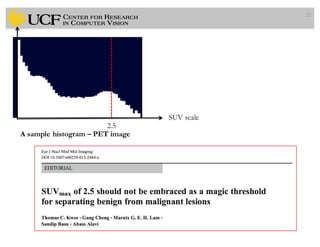
2.5
SUV scale
A sample histogram – PET image
What to Measure in PET/SPECT/.. Images?
• Metabolic lesion/tumor volume (MTV)
23
What to Measure in PET/SPECT/.. Images?
• Metabolic lesion/tumor volume (MTV)
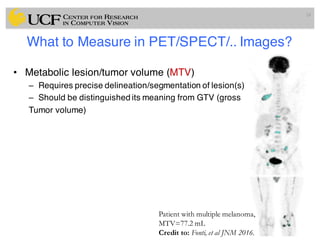
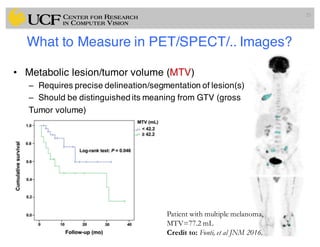
– Requires precise delineation/segmentation of lesion(s)
– Should be distinguished its meaning from GTV (gross
Tumor volume)
24
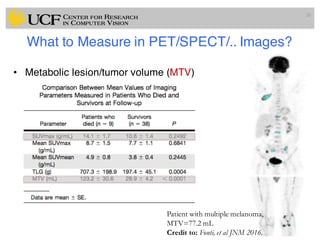
Patient with multiple melanoma,
MTV=77.2 mL
Credit to: Fonti, et al JNM 2016.
What to Measure in PET/SPECT/.. Images?
• Metabolic lesion/tumor volume (MTV)
– Requires precise delineation/segmentation of lesion(s)
– Should be distinguished its meaning from GTV (gross
Tumor volume)
25
Patient with multiple melanoma,
MTV=77.2 mL
Credit to: Fonti, et al JNM 2016.
What to Measure in PET/SPECT/.. Images?
• Metabolic lesion/tumor volume (MTV)
26
Patient with multiple melanoma,
MTV=77.2 mL
Credit to: Fonti, et al JNM 2016.
What to Measure in PET/SPECT/.. Images?
• Shape information of (functional) lesion (spiculated vs focal)
27
What to Measure in PET/SPECT/.. Images?
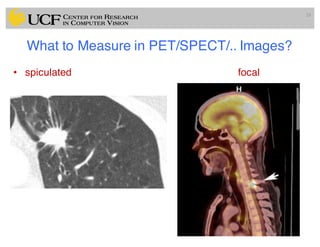
• spiculated focal
28
What to Measure in PET/SPECT/.. Images?
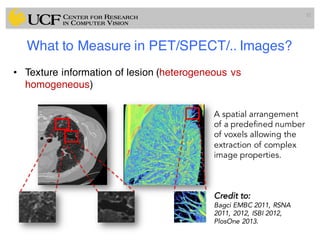
• Texture information of lesion (heterogeneous vs
homogeneous)
29
What to Measure in PET/SPECT/.. Images?
• Texture information of lesion (heterogeneous vs
homogeneous)
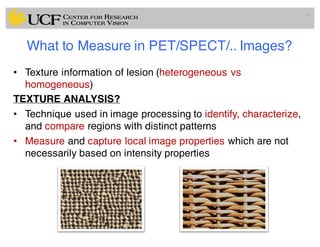
TEXTURE ANALYSIS?
• Technique used in image processing to identify, characterize,
and compare regions with distinct patterns
• Measure and capture local image properties which are not
necessarily based on intensity properties
30
What to Measure in PET/SPECT/.. Images?
• Texture information of lesion (heterogeneous vs
homogeneous)
TEXTURE ANALYSIS?
• Technique used in image processing to identify, characterize,
and compare regions with distinct patterns
• Measure and capture local image properties which are not
necessarily based on intensity properties
31
What to Measure in PET/SPECT/.. Images?
• Texture information of lesion (heterogeneous vs
homogeneous)
32
A spatial arrangement
of a predefined number
of voxels allowing the
extraction of complex
image properties.
Credit to:
Bagci EMBC 2011, RSNA
2011, 2012, ISBI 2012,
PlosOne 2013.
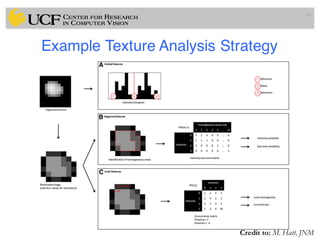
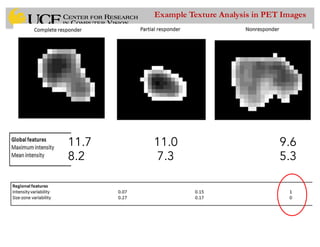
Example Texture Analysis Strategy
33
Credit to: M. Hatt, JNM
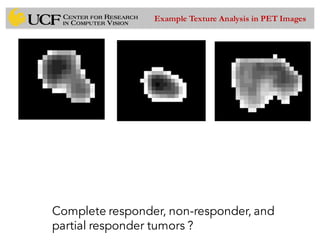
Complete responder, non-responder, and
partial responder tumors ?
Example Texture Analysis in PET Images
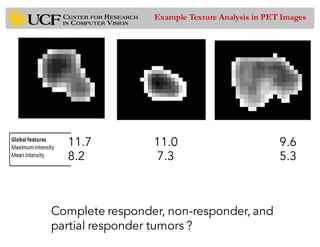
11.7 11.0 9.6
8.2 7.3 5.3
Complete responder, non-responder, and
partial responder tumors ?
Example Texture Analysis in PET Images
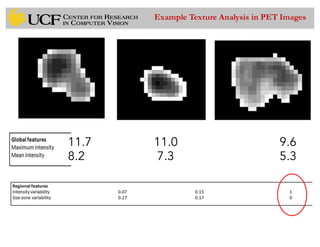
11.7 11.0 9.6
8.2 7.3 5.3
11.7 11.0 9.6
8.2 7.3 5.3
Example Texture Analysis in PET Images
11.7 11.0 9.6
8.2 7.3 5.3
What to Measure in PET/SPECT/.. Images?
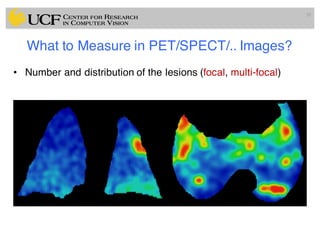
• Number and distribution of the lesions (focal, multi-focal)
Ex. Infections diseases such as in TB (tuberculosis), we often
see multi-focal uptake
38
What to Measure in PET/SPECT/.. Images?
• Number and distribution of the lesions (focal, multi-focal)
39
40
III. Denoising Nuclear Medicine Images
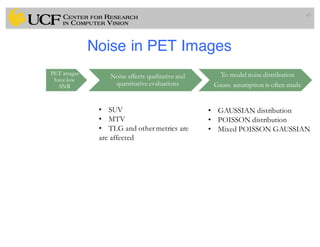
Noise in PET Images
41
PET images
have low
SNR
Noise in PET Images
42
PET images
have low
SNR
Noise affects qualitative and
quantitative evaluations
Noise in PET Images
43
PET images
have low
SNR
Noise affects qualitative and
quantitative evaluations
To model noise distribution
Gauss. assumption is often made
Noise in PET Images
44
PET images
have low
SNR
Noise affects qualitative and
quantitative evaluations
To model noise distribution
Gauss. assumption is often made
• GAUSSIAN distribution
• POISSON distribution
• Mixed POISSON GAUSSIAN
Noise in PET Images
45
PET images
have low
SNR
Noise affects qualitative and
quantitative evaluations
To model noise distribution
Gauss. assumption is often made
• GAUSSIAN distribution
• POISSON distribution
• Mixed POISSON GAUSSIAN
• SUV
• MTV
• TLG and othermetrics are
are affected
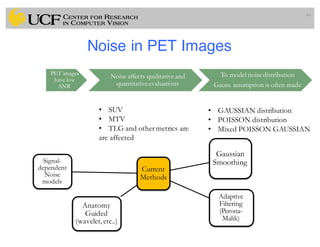
Noise in PET Images
46
PET images
have low
SNR
Noise affects qualitative and
quantitative evaluations
To model noise distribution
Gauss. assumption is often made
• GAUSSIAN distribution
• POISSON distribution
• Mixed POISSON GAUSSIAN
• SUV
• MTV
• TLG and othermetrics are
are affected
Current
Methods
Gaussian
Smoothing
Adaptive
Filtering
(Perona-
Malik)
Anatomy
Guided
(wavelet,etc..)
Signal-
dependent
Noise
models
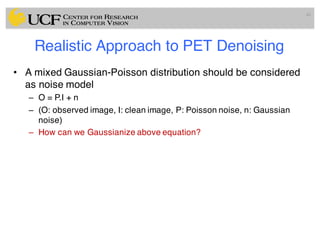
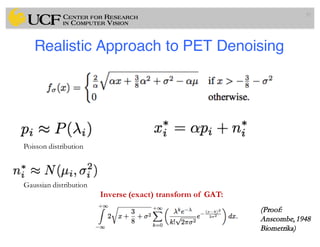
Realistic Approach to PET Denoising
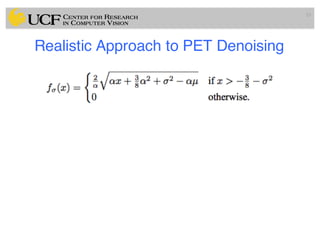
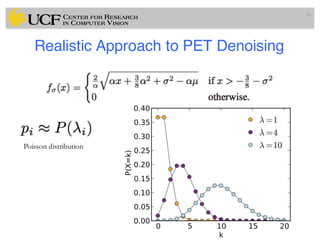
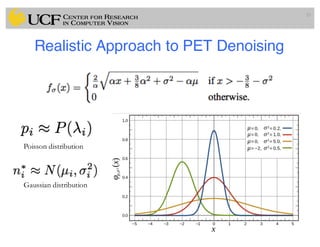
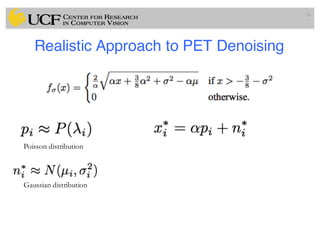
• A mixed Gaussian-Poisson distribution should be considered
as noise model
47
Realistic Approach to PET Denoising
• A mixed Gaussian-Poisson distribution should be considered
as noise model
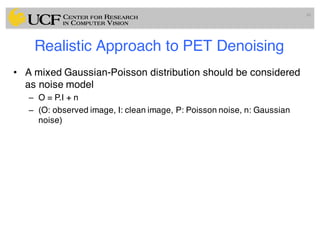
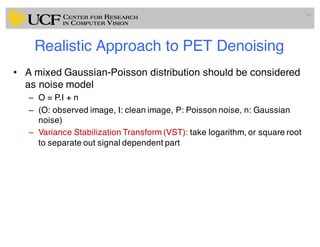
– O = P.I + n
– (O: observed image, I: clean image, P: Poisson noise, n: Gaussian
noise)
48
Realistic Approach to PET Denoising
• A mixed Gaussian-Poisson distribution should be considered
as noise model
– O = P.I + n
– (O: observed image, I: clean image, P: Poisson noise, n: Gaussian
noise)
– How can we Gaussianize above equation?
49
Realistic Approach to PET Denoising
• A mixed Gaussian-Poisson distribution should be considered
as noise model
– O = P.I + n
– (O: observed image, I: clean image, P: Poisson noise, n: Gaussian
noise)
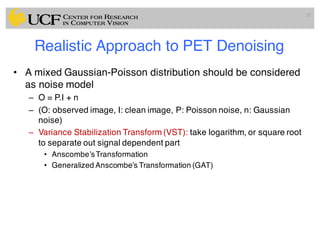
– Variance Stabilization Transform (VST): take logarithm, or square root
to separate out signal dependent part
50
Realistic Approach to PET Denoising
• A mixed Gaussian-Poisson distribution should be considered
as noise model
– O = P.I + n
– (O: observed image, I: clean image, P: Poisson noise, n: Gaussian
noise)
– Variance Stabilization Transform (VST): take logarithm, or square root
to separate out signal dependent part
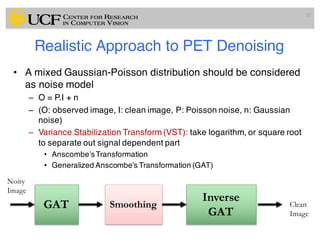
• Anscombe’sTransformation
• Generalized Anscombe’s Transformation (GAT)
51
Realistic Approach to PET Denoising
• A mixed Gaussian-Poisson distribution should be considered
as noise model
– O = P.I + n
– (O: observed image, I: clean image, P: Poisson noise, n: Gaussian
noise)
– Variance Stabilization Transform (VST): take logarithm, or square root
to separate out signal dependent part
• Anscombe’sTransformation
• Generalized Anscombe’s Transformation (GAT)
52
GAT
Inverse
GAT
Smoothing Clean
Image
Noisy
Image
Realistic Approach to PET Denoising
53
Realistic Approach to PET Denoising
54
Poisson distribution
Realistic Approach to PET Denoising
55
Poisson distribution
Gaussian distribution
Realistic Approach to PET Denoising
56
Poisson distribution
Gaussian distribution
Realistic Approach to PET Denoising
57
Poisson distribution
Gaussian distribution
Inverse (exact) transform of GAT:
(Proof:
Anscombe,1948
Biometrika)
Example Results
• After Gaussianization, proper smoothing methods can be
used, followed by inverse GAT!
58
Example Results
• After Gaussianization, proper smoothing methods can be
used, followed by inverse GAT!
• Following results show Gaussian, Perona-Malik (anisotropic),
Bilateral/Trilateral Filtering,
59
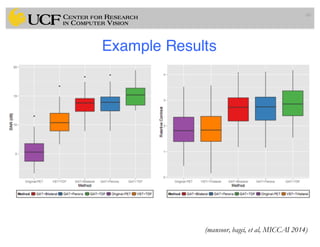
Example Results
• After Gaussianization, proper smoothing methods can be
used, followed by inverse GAT!
• Following results show Gaussian, Perona-Malik (anisotropic),
Bilateral/Trilateral Filtering,
60
(mansoor, bagci, et al, MICCAI 2014)
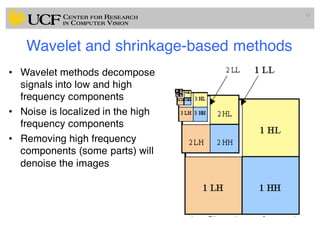
Wavelet and shrinkage-based methods
• Wavelet methods decompose
signals into low and high
frequency components
• Noise is localized in the high
frequency components
• Removing high frequency
components (some parts) will
denoise the images
61
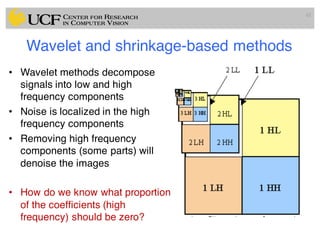
Wavelet and shrinkage-based methods
• Wavelet methods decompose
signals into low and high
frequency components
• Noise is localized in the high
frequency components
• Removing high frequency
components (some parts) will
denoise the images
• How do we know what proportion
of the coefficients (high
frequency) should be zero?
62
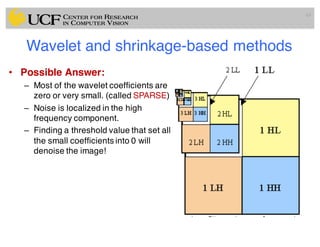
Wavelet and shrinkage-based methods
• Possible Answer:
– Most of the wavelet coefficients are
zero or very small. (called SPARSE)
– Noise is localized in the high
frequency component.
– Finding a threshold value that set all
the small coefficients into 0 will
denoise the image!
63
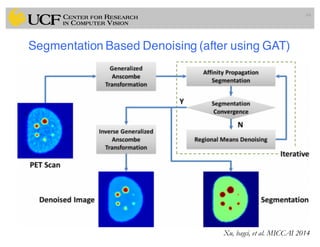
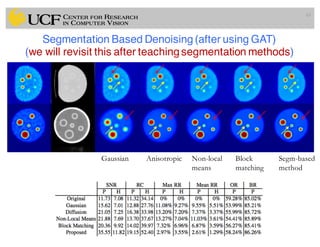
Segmentation Based Denoising (after using GAT)
64
Xu, bagci, et al. MICCAI 2014
Segmentation Based Denoising(after using GAT)
(we will revisit this after teachingsegmentation methods)
65
Gaussian Segm-based
method
Anisotropic Non-local
means
Block
matching
66
IV. Partial Volume Correction (PVC)
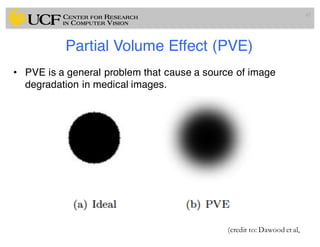
Partial Volume Effect (PVE)
• PVE is a general problem that cause a source of image
degradation in medical images.
67
(credit to: Dawood et al,
Partial Volume Effect (PVE)
• PVE is a general problem that cause a source of image
degradation in medical images.
• The causes of PVE lie in the limited resolution of the
respective imaging devices.
68
Partial Volume Effect (PVE)
• PVE is a general problem that cause a source of image
degradation in medical images.
• The causes of PVE lie in the limited resolution of the
respective imaging devices.
• Structures smaller than the system's resolution cannot be
resolved which results in blurred boundaries for example.
69
Partial Volume Effect (PVE)
• PVE is a general problem that cause a source of image
degradation in medical images.
• The causes of PVE lie in the limited resolution of the
respective imaging devices.
• Structures smaller than the system's resolution cannot be
resolved which results in blurred boundaries for example.
– If the size of the structures to be examined is close to the imaging
system's resolution, e.g., in imaging of small tumors, the impact of the
PVE cannot be neglected.
70
Partial Volume Effect (PVE)
• PVE is a general problem that cause a source of image
degradation in medical images.
• The causes of PVE lie in the limited resolution of the
respective imaging devices.
• Structures smaller than the system's resolution cannot be
resolved which results in blurred boundaries for example.
– If the size of the structures to be examined is close to the imaging
system's resolution, e.g., in imaging of small tumors, the impact of the
PVE cannot be neglected.
71
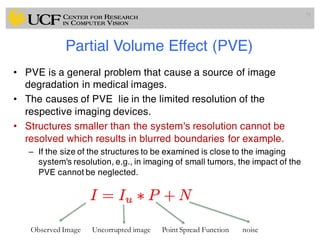
Observed Image Uncorrupted image Point Spread Function noise
PVE Model
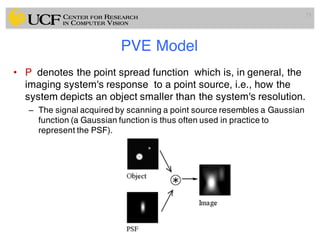
• P denotes the point spread function which is, in general, the
imaging system's response to a point source, i.e., how the
system depicts an object smaller than the system's resolution.
72
PVE Model
• P denotes the point spread function which is, in general, the
imaging system's response to a point source, i.e., how the
system depicts an object smaller than the system's resolution.
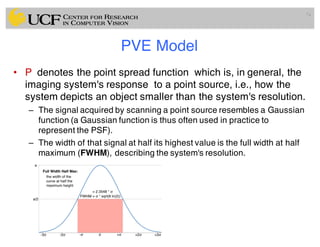
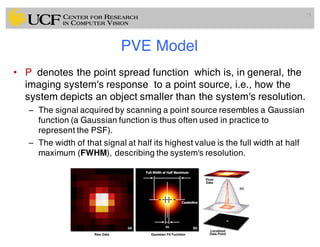
– The signal acquired by scanning a point source resembles a Gaussian
function (a Gaussian function is thus often used in practice to
represent the PSF).
73
PVE Model
• P denotes the point spread function which is, in general, the
imaging system's response to a point source, i.e., how the
system depicts an object smaller than the system's resolution.
– The signal acquired by scanning a point source resembles a Gaussian
function (a Gaussian function is thus often used in practice to
represent the PSF).
– The width of that signal at half its highest value is the full width at half
maximum (FWHM), describing the system's resolution.
74
PVE Model
• P denotes the point spread function which is, in general, the
imaging system's response to a point source, i.e., how the
system depicts an object smaller than the system's resolution.
– The signal acquired by scanning a point source resembles a Gaussian
function (a Gaussian function is thus often used in practice to
represent the PSF).
– The width of that signal at half its highest value is the full width at half
maximum (FWHM), describing the system's resolution.
75
PVE Model
• P denotes the point spread function which is, in general, the
imaging system's response to a point source, i.e., how the
system depicts an object smaller than the system's resolution.
– The signal acquired by scanning a point source resembles a Gaussian
function (a Gaussian function is thus often used in practice to
represent the PSF).
– The width of that signal at half its highest value is the full width at half
maximum (FWHM), describing the system's resolution.
– PVE has two reasons
• TF: Tissue Fraction
• Spill-over
76
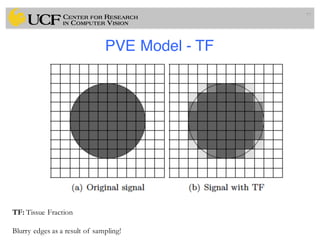
PVE Model - TF
77
TF: Tissue Fraction
Blurry edges as a result of sampling!
PVE Model - Spill-Over
• The largest contribution to PVE is caused by the spill-over
effect.
78
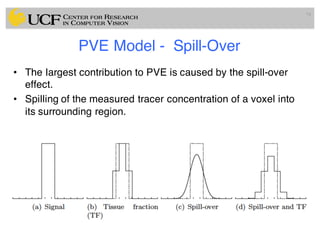
PVE Model - Spill-Over
• The largest contribution to PVE is caused by the spill-over
effect.
• Spilling of the measured tracer concentration of a voxel into
its surrounding region.
79
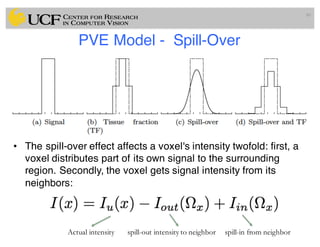
PVE Model - Spill-Over
• The spill-over effect affects a voxel's intensity twofold: first, a
voxel distributes part of its own signal to the surrounding
region. Secondly, the voxel gets signal intensity from its
neighbors:
80
Actual intensity spill-out intensity to neighbor spill-in from neighbor
PVE Model - Spill-Out/In
81
PVE Model
82
(credit: Soret et al, JNM 2007 )
RC : recovery coefficient
85% for this example
How to correct PVE?
83
Point-spread function (PSF)
Typical spatial response function.
FWHM=6mm (conventionalway for representing spatial resolution)
How to correct PVE?
84
In order for the object D (dashed) to exhibit
100% of true activity (solid),its dimension
Needs to be greater than 2xFWHM=12mm
PVC Methods
• Deconvolution: tries to reverse the convolution of a clean
image with the PSF.
– In practice, noise is amplified with this operation and PSF may not be
known exactly.
85
PVC Methods
• Deconvolution: tries to reverse the convolution of a clean
image with the PSF.
– In practice, noise is amplified with this operation and PSF may not be
known exactly.
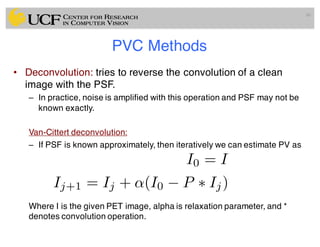
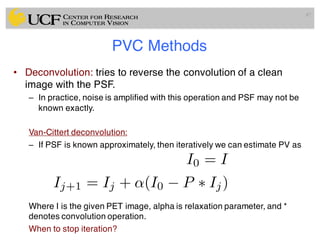
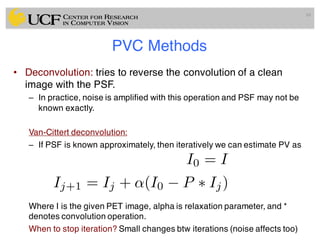
Van-Cittert deconvolution:
– If PSF is known approximately, then iteratively we can estimate PV as
Where I is the given PET image, alpha is relaxation parameter, and *
denotes convolution operation.
86
I0 = I
Ij+1 = Ij + ↵(I0 P ⇤ Ij)
PVC Methods
• Deconvolution: tries to reverse the convolution of a clean
image with the PSF.
– In practice, noise is amplified with this operation and PSF may not be
known exactly.
Van-Cittert deconvolution:
– If PSF is known approximately, then iteratively we can estimate PV as
Where I is the given PET image, alpha is relaxation parameter, and *
denotes convolution operation.
When to stop iteration?
87
I0 = I
Ij+1 = Ij + ↵(I0 P ⇤ Ij)
PVC Methods
• Deconvolution: tries to reverse the convolution of a clean
image with the PSF.
– In practice, noise is amplified with this operation and PSF may not be
known exactly.
Van-Cittert deconvolution:
– If PSF is known approximately, then iteratively we can estimate PV as
Where I is the given PET image, alpha is relaxation parameter, and *
denotes convolution operation.
When to stop iteration? Small changes btw iterations (noise affects too)
88
I0 = I
Ij+1 = Ij + ↵(I0 P ⇤ Ij)
PVC Methods
• Richardson-Lucy deconvolution:
– is a statistical approach. The PSF is assumed to be known.
– Correct the observed image towards a maximum likelihood solution.
89
PVC Methods
• Richardson-Lucy deconvolution:
– is a statistical approach. The PSF is assumed to be known.
– Correct the observed image towards a maximum likelihood solution.
– When no additive noise N,
90
I0 = C(> 0),
Ij+1 = Ij.(PT
⇤ (
Iu
P ⇤ Ij
))
I = P ⇤ Iu
PVC Methods
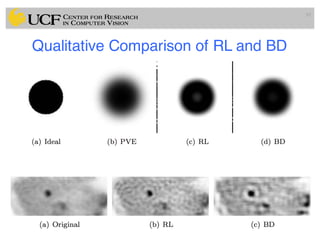
• Blind deconvolution:
– For an unknown PSF, estimate PSF iteratively (or use additional
knowledge such as anatomy information).
– Then use one of the existing algorithm such as RL or Wiener filtering.
91
Qualitative Comparison of RL and BD
92
Qualitative Comparison of RL and BD
93
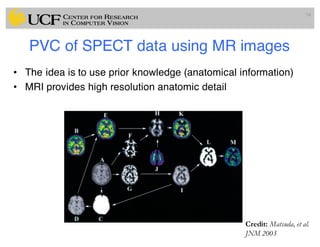
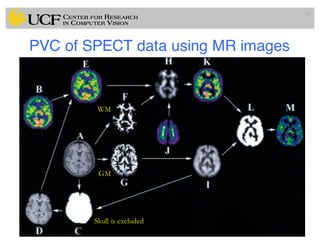
PVC of SPECT data using MR images
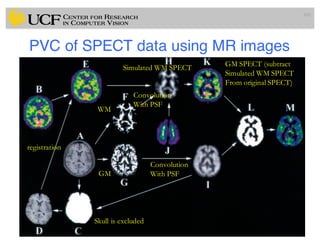
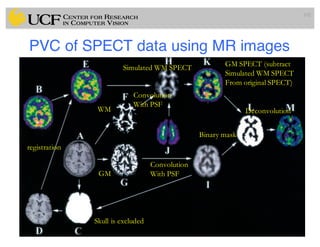
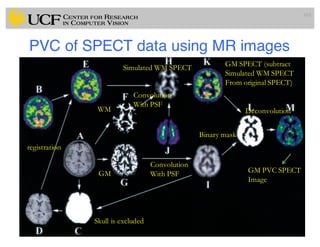
• The idea is to use prior knowledge (anatomical information)
• MRI provides high resolution anatomic detail
94
Credit: Matsuda, et al.
JNM 2003
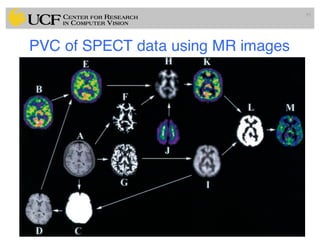
PVC of SPECT data using MR images
95
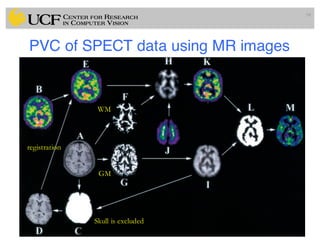
PVC of SPECT data using MR images
96
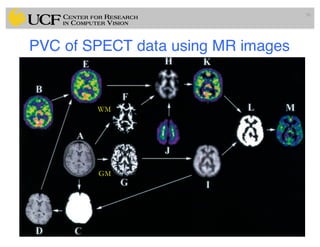
WM
GM
PVC of SPECT data using MR images
97
WM
GM
Skull is excluded
PVC of SPECT data using MR images
98
WM
GM
Skull is excluded
registration
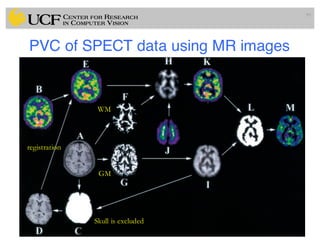
PVC of SPECT data using MR images
99
WM
GM
Skull is excluded
registration
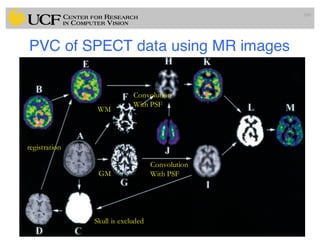
PVC of SPECT data using MR images
100
WM
GM
Skull is excluded
registration
Convolution
With PSF
Convolution
With PSF
PVC of SPECT data using MR images
101
WM
GM
Skull is excluded
registration
Convolution
With PSF
Convolution
With PSF
Simulated WM SPECT GM SPECT (subtract
Simulated WM SPECT
From original SPECT)
PVC of SPECT data using MR images
102
WM
GM
Skull is excluded
registration
Convolution
With PSF
Convolution
With PSF
Simulated WM SPECT GM SPECT (subtract
Simulated WM SPECT
From original SPECT)
Deconvolution
Binary mask
PVC of SPECT data using MR images
103
WM
GM
Skull is excluded
registration
Convolution
With PSF
Convolution
With PSF
Simulated WM SPECT GM SPECT (subtract
Simulated WM SPECT
From original SPECT)
Deconvolution
GM PVC SPECT
Image
Binary mask
More methods (assumptions)
• Partition based methods. The true activity distribution can be
segmented into a series of n non-overlapping compartments
with a known uniform uptake.
104
More methods (assumptions)
• Partition based methods. The true activity distribution can be
segmented into a series of n non-overlapping compartments
with a known uniform uptake.
• Multi-resolution approach. Gray level of high resolution image
(CT or MRI) should be positively correlated with those of the
functional image to be corrected.
105
More methods (assumptions)
• Partition based methods. The true activity distribution can be
segmented into a series of n non-overlapping compartments
with a known uniform uptake.
• Multi-resolution approach. Gray level of high resolution image
(CT or MRI) should be positively correlated with those of the
functional image to be corrected.
• Fitting method. Tumor can be considered as a sphere with an
unknown diameter and with uniform uptake and that the
background level is uniform.
106
Summary
• Nuclear medicine imaging modalities (PET & SPECT) are
useful in many diagnostic and therapeutic tasks
• Smoothing is required to clean images, improve both
visualization and interpretations
• Quantitative markers are needed to evaluate nuclear
medicine imaging modalities
• PVE is a major confounding factor in PET/SPECT imaging
that cannot be ignored.
107

Lec6: Pre-Processing for Nuclear Medicine Images

  • 1.
    MEDICAL IMAGE COMPUTING(CAP 5937) LECTURE 6: Pre-Processing for Nuclear Medicine Images Dr. Ulas Bagci HEC 221, Center for Research in Computer Vision (CRCV), University of Central Florida (UCF), Orlando, FL 32814. bagci@ucf.edu or bagci@crcv.ucf.edu 1SPRING 2017
  • 2.
    Outline 1. The useof PET/SPECT, PET/CT and MRI/PET Images 2. What to measure from Nuclear Medicine Images? 3. Denoising Nuclear Medicine Images 4. Partial Volume Correction 2
  • 3.
    I. the useof PET/SPECT, PET/CT and MRI/PET Images 3
  • 4.
    Nuclear Medicine ImagingModalities • Scint: Scintigraphy, two-dimensional images • PET: Positron Emission Tomography • SPECT: Single Photon Emission Tomography • … 4
  • 5.
    Where we usethem? 5
  • 6.
    Basics of PET/SPECTImaging • Uses short-lived positron emitting isotopes (produced by collimators) • Two gamma rays are produced from the annihilation of each positron and can be detected by specialized gamma cameras • Resulting image show the distribution of isotopes • An agent is used to bind into isotopes (glucose, …) 6
  • 7.
  • 8.
    PET/CT and PET/MRI 8 PET/CTPET/MRI MRI/PET (or should I say PET/MRI?) -superior soft tissue contrast resolution -minimized radiation PET/CT choice of modality for oncological applications
  • 9.
    SPECT Imaging • PETand SPECT are distinguished by the type of radioisotope incorporated in the tracer. 9
  • 10.
    SPECT Imaging • PETand SPECT are distinguished by the type of radioisotope incorporated in the tracer. – PET => radioisotope emission – SPECT=>gamma-ray photon emission 10
  • 11.
    SPECT Imaging • PETand SPECT are distinguished by the type of radioisotope incorporated in the tracer. – PET => radioisotope emission – SPECT=>gamma-ray photon emission 11 (credit: M. Wernick and J. Aarsvold)
  • 12.
    SPECT Imaging • Myocardialperfusion imaging – Illustrates the function of the heart muscle 12 (Credit: wikipedia)
  • 13.
    SPECT Imaging • Myocardialperfusion imaging • Functional brain imaging • Bone diseases • Neuroendocrine or neurological tumors • White cell scan • … 13
  • 14.
  • 15.
    What to Measurein PET/SPECT/.. Images? • SUV (standardized uptake value: voxel-wise or region-wise) (SUVpeak, SUVmax, SUVlbm) 15
  • 16.
    What to Measurein PET/SPECT/.. Images? • SUV (standardized uptake value: voxel-wise or region-wise) (SUVpeak, SUVmax, SUVlbm) – FDG is widely used radiotracer in PET, and glucose analog. – It accumulates in (preferentially) malignant cells due to higher glucose metabolism. 16
  • 17.
    What to Measurein PET/SPECT/.. Images? • SUV (standardized uptake value: voxel-wise or region-wise) (SUVpeak, SUVmax, SUVlbm) – FDG is widely used radiotracer in PET, and glucose analog. – It accumulates in (preferentially) malignant cells due to higher glucose metabolism. – The most common parameter used to measure tracer accumulation in PET studies is the standardized uptake value (SUV). 17
  • 18.
    What to Measurein PET/SPECT/.. Images? • SUV (standardized uptake value: voxel-wise or region-wise) (SUVpeak, SUVmax, SUVlbm) – FDG is widely used radiotracer in PET, and glucose analog. – It accumulates in (preferentially) malignant cells due to higher glucose metabolism. – The most common parameter used to measure tracer accumulation in PET studies is the standardized uptake value (SUV). – The SUV is a semi-quantitative measure of normalized radioactivity concentration in PET images: 18
  • 19.
    What to Measurein PET/SPECT/.. Images? • SUV (standardized uptake value: voxel-wise or region-wise) (SUVpeak, SUVmax, SUVlbm) – FDG is widely used radiotracer in PET, and glucose analog. – It accumulates in (preferentially) malignant cells due to higher glucose metabolism. – The most common parameter used to measure tracer accumulation in PET studies is the standardized uptake value (SUV). – The SUV is a semi-quantitative measure of normalized radioactivity concentration in PET images: 19
  • 20.
    What to Measurein PET/SPECT/.. Images? 20 Axial fused FDG PET/CT image shows tumor contours automatically generated with diagnostic software (XD3 Multi- Modality Diagnostic Software; Mirada Medical, Oxford, England) by using percentages of the maximum SUV (20%, 30%, 40%, and 50%) and a fixed SUV cutoff of 2.5. Credit: Bahatnagar,P., et al Radiographics 2013.
  • 21.
    21 SUV scale 2.5 A samplehistogram – PET image
  • 22.
    22 2.5 SUV scale A samplehistogram – PET image
  • 23.
    What to Measurein PET/SPECT/.. Images? • Metabolic lesion/tumor volume (MTV) 23
  • 24.
    What to Measurein PET/SPECT/.. Images? • Metabolic lesion/tumor volume (MTV) – Requires precise delineation/segmentation of lesion(s) – Should be distinguished its meaning from GTV (gross Tumor volume) 24 Patient with multiple melanoma, MTV=77.2 mL Credit to: Fonti, et al JNM 2016.
  • 25.
    What to Measurein PET/SPECT/.. Images? • Metabolic lesion/tumor volume (MTV) – Requires precise delineation/segmentation of lesion(s) – Should be distinguished its meaning from GTV (gross Tumor volume) 25 Patient with multiple melanoma, MTV=77.2 mL Credit to: Fonti, et al JNM 2016.
  • 26.
    What to Measurein PET/SPECT/.. Images? • Metabolic lesion/tumor volume (MTV) 26 Patient with multiple melanoma, MTV=77.2 mL Credit to: Fonti, et al JNM 2016.
  • 27.
    What to Measurein PET/SPECT/.. Images? • Shape information of (functional) lesion (spiculated vs focal) 27
  • 28.
    What to Measurein PET/SPECT/.. Images? • spiculated focal 28
  • 29.
    What to Measurein PET/SPECT/.. Images? • Texture information of lesion (heterogeneous vs homogeneous) 29
  • 30.
    What to Measurein PET/SPECT/.. Images? • Texture information of lesion (heterogeneous vs homogeneous) TEXTURE ANALYSIS? • Technique used in image processing to identify, characterize, and compare regions with distinct patterns • Measure and capture local image properties which are not necessarily based on intensity properties 30
  • 31.
    What to Measurein PET/SPECT/.. Images? • Texture information of lesion (heterogeneous vs homogeneous) TEXTURE ANALYSIS? • Technique used in image processing to identify, characterize, and compare regions with distinct patterns • Measure and capture local image properties which are not necessarily based on intensity properties 31
  • 32.
    What to Measurein PET/SPECT/.. Images? • Texture information of lesion (heterogeneous vs homogeneous) 32 A spatial arrangement of a predefined number of voxels allowing the extraction of complex image properties. Credit to: Bagci EMBC 2011, RSNA 2011, 2012, ISBI 2012, PlosOne 2013.
  • 33.
    Example Texture AnalysisStrategy 33 Credit to: M. Hatt, JNM
  • 34.
    Complete responder, non-responder,and partial responder tumors ? Example Texture Analysis in PET Images
  • 35.
    11.7 11.0 9.6 8.27.3 5.3 Complete responder, non-responder, and partial responder tumors ? Example Texture Analysis in PET Images
  • 36.
    Example Texture Analysisin PET Images 11.7 11.0 9.6 8.2 7.3 5.3
  • 37.
    11.7 11.0 9.6 8.27.3 5.3 Example Texture Analysis in PET Images 11.7 11.0 9.6 8.2 7.3 5.3
  • 38.
    What to Measurein PET/SPECT/.. Images? • Number and distribution of the lesions (focal, multi-focal) Ex. Infections diseases such as in TB (tuberculosis), we often see multi-focal uptake 38
  • 39.
    What to Measurein PET/SPECT/.. Images? • Number and distribution of the lesions (focal, multi-focal) 39
  • 40.
  • 41.
    Noise in PETImages 41 PET images have low SNR
  • 42.
    Noise in PETImages 42 PET images have low SNR Noise affects qualitative and quantitative evaluations
  • 43.
    Noise in PETImages 43 PET images have low SNR Noise affects qualitative and quantitative evaluations To model noise distribution Gauss. assumption is often made
  • 44.
    Noise in PETImages 44 PET images have low SNR Noise affects qualitative and quantitative evaluations To model noise distribution Gauss. assumption is often made • GAUSSIAN distribution • POISSON distribution • Mixed POISSON GAUSSIAN
  • 45.
    Noise in PETImages 45 PET images have low SNR Noise affects qualitative and quantitative evaluations To model noise distribution Gauss. assumption is often made • GAUSSIAN distribution • POISSON distribution • Mixed POISSON GAUSSIAN • SUV • MTV • TLG and othermetrics are are affected
  • 46.
    Noise in PETImages 46 PET images have low SNR Noise affects qualitative and quantitative evaluations To model noise distribution Gauss. assumption is often made • GAUSSIAN distribution • POISSON distribution • Mixed POISSON GAUSSIAN • SUV • MTV • TLG and othermetrics are are affected Current Methods Gaussian Smoothing Adaptive Filtering (Perona- Malik) Anatomy Guided (wavelet,etc..) Signal- dependent Noise models
  • 47.
    Realistic Approach toPET Denoising • A mixed Gaussian-Poisson distribution should be considered as noise model 47
  • 48.
    Realistic Approach toPET Denoising • A mixed Gaussian-Poisson distribution should be considered as noise model – O = P.I + n – (O: observed image, I: clean image, P: Poisson noise, n: Gaussian noise) 48
  • 49.
    Realistic Approach toPET Denoising • A mixed Gaussian-Poisson distribution should be considered as noise model – O = P.I + n – (O: observed image, I: clean image, P: Poisson noise, n: Gaussian noise) – How can we Gaussianize above equation? 49
  • 50.
    Realistic Approach toPET Denoising • A mixed Gaussian-Poisson distribution should be considered as noise model – O = P.I + n – (O: observed image, I: clean image, P: Poisson noise, n: Gaussian noise) – Variance Stabilization Transform (VST): take logarithm, or square root to separate out signal dependent part 50
  • 51.
    Realistic Approach toPET Denoising • A mixed Gaussian-Poisson distribution should be considered as noise model – O = P.I + n – (O: observed image, I: clean image, P: Poisson noise, n: Gaussian noise) – Variance Stabilization Transform (VST): take logarithm, or square root to separate out signal dependent part • Anscombe’sTransformation • Generalized Anscombe’s Transformation (GAT) 51
  • 52.
    Realistic Approach toPET Denoising • A mixed Gaussian-Poisson distribution should be considered as noise model – O = P.I + n – (O: observed image, I: clean image, P: Poisson noise, n: Gaussian noise) – Variance Stabilization Transform (VST): take logarithm, or square root to separate out signal dependent part • Anscombe’sTransformation • Generalized Anscombe’s Transformation (GAT) 52 GAT Inverse GAT Smoothing Clean Image Noisy Image
  • 53.
    Realistic Approach toPET Denoising 53
  • 54.
    Realistic Approach toPET Denoising 54 Poisson distribution
  • 55.
    Realistic Approach toPET Denoising 55 Poisson distribution Gaussian distribution
  • 56.
    Realistic Approach toPET Denoising 56 Poisson distribution Gaussian distribution
  • 57.
    Realistic Approach toPET Denoising 57 Poisson distribution Gaussian distribution Inverse (exact) transform of GAT: (Proof: Anscombe,1948 Biometrika)
  • 58.
    Example Results • AfterGaussianization, proper smoothing methods can be used, followed by inverse GAT! 58
  • 59.
    Example Results • AfterGaussianization, proper smoothing methods can be used, followed by inverse GAT! • Following results show Gaussian, Perona-Malik (anisotropic), Bilateral/Trilateral Filtering, 59
  • 60.
    Example Results • AfterGaussianization, proper smoothing methods can be used, followed by inverse GAT! • Following results show Gaussian, Perona-Malik (anisotropic), Bilateral/Trilateral Filtering, 60 (mansoor, bagci, et al, MICCAI 2014)
  • 61.
    Wavelet and shrinkage-basedmethods • Wavelet methods decompose signals into low and high frequency components • Noise is localized in the high frequency components • Removing high frequency components (some parts) will denoise the images 61
  • 62.
    Wavelet and shrinkage-basedmethods • Wavelet methods decompose signals into low and high frequency components • Noise is localized in the high frequency components • Removing high frequency components (some parts) will denoise the images • How do we know what proportion of the coefficients (high frequency) should be zero? 62
  • 63.
    Wavelet and shrinkage-basedmethods • Possible Answer: – Most of the wavelet coefficients are zero or very small. (called SPARSE) – Noise is localized in the high frequency component. – Finding a threshold value that set all the small coefficients into 0 will denoise the image! 63
  • 64.
    Segmentation Based Denoising(after using GAT) 64 Xu, bagci, et al. MICCAI 2014
  • 65.
    Segmentation Based Denoising(afterusing GAT) (we will revisit this after teachingsegmentation methods) 65 Gaussian Segm-based method Anisotropic Non-local means Block matching
  • 66.
    66 IV. Partial VolumeCorrection (PVC)
  • 67.
    Partial Volume Effect(PVE) • PVE is a general problem that cause a source of image degradation in medical images. 67 (credit to: Dawood et al,
  • 68.
    Partial Volume Effect(PVE) • PVE is a general problem that cause a source of image degradation in medical images. • The causes of PVE lie in the limited resolution of the respective imaging devices. 68
  • 69.
    Partial Volume Effect(PVE) • PVE is a general problem that cause a source of image degradation in medical images. • The causes of PVE lie in the limited resolution of the respective imaging devices. • Structures smaller than the system's resolution cannot be resolved which results in blurred boundaries for example. 69
  • 70.
    Partial Volume Effect(PVE) • PVE is a general problem that cause a source of image degradation in medical images. • The causes of PVE lie in the limited resolution of the respective imaging devices. • Structures smaller than the system's resolution cannot be resolved which results in blurred boundaries for example. – If the size of the structures to be examined is close to the imaging system's resolution, e.g., in imaging of small tumors, the impact of the PVE cannot be neglected. 70
  • 71.
    Partial Volume Effect(PVE) • PVE is a general problem that cause a source of image degradation in medical images. • The causes of PVE lie in the limited resolution of the respective imaging devices. • Structures smaller than the system's resolution cannot be resolved which results in blurred boundaries for example. – If the size of the structures to be examined is close to the imaging system's resolution, e.g., in imaging of small tumors, the impact of the PVE cannot be neglected. 71 Observed Image Uncorrupted image Point Spread Function noise
  • 72.
    PVE Model • Pdenotes the point spread function which is, in general, the imaging system's response to a point source, i.e., how the system depicts an object smaller than the system's resolution. 72
  • 73.
    PVE Model • Pdenotes the point spread function which is, in general, the imaging system's response to a point source, i.e., how the system depicts an object smaller than the system's resolution. – The signal acquired by scanning a point source resembles a Gaussian function (a Gaussian function is thus often used in practice to represent the PSF). 73
  • 74.
    PVE Model • Pdenotes the point spread function which is, in general, the imaging system's response to a point source, i.e., how the system depicts an object smaller than the system's resolution. – The signal acquired by scanning a point source resembles a Gaussian function (a Gaussian function is thus often used in practice to represent the PSF). – The width of that signal at half its highest value is the full width at half maximum (FWHM), describing the system's resolution. 74
  • 75.
    PVE Model • Pdenotes the point spread function which is, in general, the imaging system's response to a point source, i.e., how the system depicts an object smaller than the system's resolution. – The signal acquired by scanning a point source resembles a Gaussian function (a Gaussian function is thus often used in practice to represent the PSF). – The width of that signal at half its highest value is the full width at half maximum (FWHM), describing the system's resolution. 75
  • 76.
    PVE Model • Pdenotes the point spread function which is, in general, the imaging system's response to a point source, i.e., how the system depicts an object smaller than the system's resolution. – The signal acquired by scanning a point source resembles a Gaussian function (a Gaussian function is thus often used in practice to represent the PSF). – The width of that signal at half its highest value is the full width at half maximum (FWHM), describing the system's resolution. – PVE has two reasons • TF: Tissue Fraction • Spill-over 76
  • 77.
    PVE Model -TF 77 TF: Tissue Fraction Blurry edges as a result of sampling!
  • 78.
    PVE Model -Spill-Over • The largest contribution to PVE is caused by the spill-over effect. 78
  • 79.
    PVE Model -Spill-Over • The largest contribution to PVE is caused by the spill-over effect. • Spilling of the measured tracer concentration of a voxel into its surrounding region. 79
  • 80.
    PVE Model -Spill-Over • The spill-over effect affects a voxel's intensity twofold: first, a voxel distributes part of its own signal to the surrounding region. Secondly, the voxel gets signal intensity from its neighbors: 80 Actual intensity spill-out intensity to neighbor spill-in from neighbor
  • 81.
    PVE Model -Spill-Out/In 81
  • 82.
    PVE Model 82 (credit: Soretet al, JNM 2007 ) RC : recovery coefficient 85% for this example
  • 83.
    How to correctPVE? 83 Point-spread function (PSF) Typical spatial response function. FWHM=6mm (conventionalway for representing spatial resolution)
  • 84.
    How to correctPVE? 84 In order for the object D (dashed) to exhibit 100% of true activity (solid),its dimension Needs to be greater than 2xFWHM=12mm
  • 85.
    PVC Methods • Deconvolution:tries to reverse the convolution of a clean image with the PSF. – In practice, noise is amplified with this operation and PSF may not be known exactly. 85
  • 86.
    PVC Methods • Deconvolution:tries to reverse the convolution of a clean image with the PSF. – In practice, noise is amplified with this operation and PSF may not be known exactly. Van-Cittert deconvolution: – If PSF is known approximately, then iteratively we can estimate PV as Where I is the given PET image, alpha is relaxation parameter, and * denotes convolution operation. 86 I0 = I Ij+1 = Ij + ↵(I0 P ⇤ Ij)
  • 87.
    PVC Methods • Deconvolution:tries to reverse the convolution of a clean image with the PSF. – In practice, noise is amplified with this operation and PSF may not be known exactly. Van-Cittert deconvolution: – If PSF is known approximately, then iteratively we can estimate PV as Where I is the given PET image, alpha is relaxation parameter, and * denotes convolution operation. When to stop iteration? 87 I0 = I Ij+1 = Ij + ↵(I0 P ⇤ Ij)
  • 88.
    PVC Methods • Deconvolution:tries to reverse the convolution of a clean image with the PSF. – In practice, noise is amplified with this operation and PSF may not be known exactly. Van-Cittert deconvolution: – If PSF is known approximately, then iteratively we can estimate PV as Where I is the given PET image, alpha is relaxation parameter, and * denotes convolution operation. When to stop iteration? Small changes btw iterations (noise affects too) 88 I0 = I Ij+1 = Ij + ↵(I0 P ⇤ Ij)
  • 89.
    PVC Methods • Richardson-Lucydeconvolution: – is a statistical approach. The PSF is assumed to be known. – Correct the observed image towards a maximum likelihood solution. 89
  • 90.
    PVC Methods • Richardson-Lucydeconvolution: – is a statistical approach. The PSF is assumed to be known. – Correct the observed image towards a maximum likelihood solution. – When no additive noise N, 90 I0 = C(> 0), Ij+1 = Ij.(PT ⇤ ( Iu P ⇤ Ij )) I = P ⇤ Iu
  • 91.
    PVC Methods • Blinddeconvolution: – For an unknown PSF, estimate PSF iteratively (or use additional knowledge such as anatomy information). – Then use one of the existing algorithm such as RL or Wiener filtering. 91
  • 92.
  • 93.
  • 94.
    PVC of SPECTdata using MR images • The idea is to use prior knowledge (anatomical information) • MRI provides high resolution anatomic detail 94 Credit: Matsuda, et al. JNM 2003
  • 95.
    PVC of SPECTdata using MR images 95
  • 96.
    PVC of SPECTdata using MR images 96 WM GM
  • 97.
    PVC of SPECTdata using MR images 97 WM GM Skull is excluded
  • 98.
    PVC of SPECTdata using MR images 98 WM GM Skull is excluded registration
  • 99.
    PVC of SPECTdata using MR images 99 WM GM Skull is excluded registration
  • 100.
    PVC of SPECTdata using MR images 100 WM GM Skull is excluded registration Convolution With PSF Convolution With PSF
  • 101.
    PVC of SPECTdata using MR images 101 WM GM Skull is excluded registration Convolution With PSF Convolution With PSF Simulated WM SPECT GM SPECT (subtract Simulated WM SPECT From original SPECT)
  • 102.
    PVC of SPECTdata using MR images 102 WM GM Skull is excluded registration Convolution With PSF Convolution With PSF Simulated WM SPECT GM SPECT (subtract Simulated WM SPECT From original SPECT) Deconvolution Binary mask
  • 103.
    PVC of SPECTdata using MR images 103 WM GM Skull is excluded registration Convolution With PSF Convolution With PSF Simulated WM SPECT GM SPECT (subtract Simulated WM SPECT From original SPECT) Deconvolution GM PVC SPECT Image Binary mask
  • 104.
    More methods (assumptions) •Partition based methods. The true activity distribution can be segmented into a series of n non-overlapping compartments with a known uniform uptake. 104
  • 105.
    More methods (assumptions) •Partition based methods. The true activity distribution can be segmented into a series of n non-overlapping compartments with a known uniform uptake. • Multi-resolution approach. Gray level of high resolution image (CT or MRI) should be positively correlated with those of the functional image to be corrected. 105
  • 106.
    More methods (assumptions) •Partition based methods. The true activity distribution can be segmented into a series of n non-overlapping compartments with a known uniform uptake. • Multi-resolution approach. Gray level of high resolution image (CT or MRI) should be positively correlated with those of the functional image to be corrected. • Fitting method. Tumor can be considered as a sphere with an unknown diameter and with uniform uptake and that the background level is uniform. 106
  • 107.
    Summary • Nuclear medicineimaging modalities (PET & SPECT) are useful in many diagnostic and therapeutic tasks • Smoothing is required to clean images, improve both visualization and interpretations • Quantitative markers are needed to evaluate nuclear medicine imaging modalities • PVE is a major confounding factor in PET/SPECT imaging that cannot be ignored. 107