STEM Powers JETS New Prospect Elementary School 2010-2011
STEM Science—Discover and describe A better understanding of life (WHAT is…?) Technology—Invent and innovate Improving the natural world Engineering—Control, modify, or design materials, processes, and systems What could be…? Mathematics—Symbolic language for representing reality
Why STEM? The U.S. needs 400,000 new graduates in STEM fields by 2015. Careers traditionally American-led industries outside of science and technology, such as farming, health care, and finance also require a strong knowledge of STEM. We need to cultivate the next generation of innovators and big thinkers.
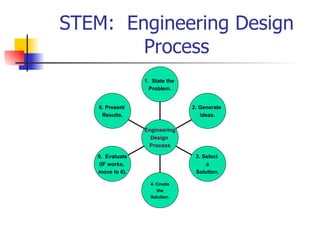
STEM:  Engineering Design Process 6. Present  Results. 5.  Evaluate  (IF works,  move to 6). 4. Create the  Solution. 3. Select  a Solution. 2. Generate  Ideas. 1.  State the  Problem. Engineering  Design  Process
National Science Standards (NSA) K-8 Science as Inquiry Physical Science Life Science Earth and Space Science Science in Personal and Social Perspective History and Nature of Science
National Technology Standards (ISTE) K-12 Creativity and Innovation:  Use of Technology Research and Information Fluency:  Use of Digital Tools Digital Citizenship:  Use of Technology
National Engineering Standards (ASEE) K-12 Engineering Design Communication and Teamwork
National Math Standards (NCTM)  K-12 Numbers and Operations Algebra Measurement Data Analysis and Probability Problem Solving Connections Representation
What is children’s engineering? Children’s engineering provides students the opportunity to solve real-life problems by researching, designing, building and testing solutions.  Projects can vary from something simple as creating a flower for a nursery rhyme to something as complex as designing a race car with safety features that protect a raw egg from breaking in a crash test.  Just as real engineers work with specific criteria, materials and time limits, so must student engineers.
What does STEM mean for New Prospect Elementary students? Students will continue to study and learn through the district’s Approved Curriculum, which focuses on all state and national standards. STEM lessons will be layered with the current curriculum for our district. Students from across the district may choose to attend New Prospect STEM Academy when it becomes a magnet school.
3 rd  -5 th  Design Challenges Students will show the parents or other classes how they used the Engineering Design Process. 3 rd  Grade:  Famous Historical Figures 4 th  Grade:  Build a Trunk 5 th  Grade:  Build a Bridge
STEM…The NEXT Steps For the 2011-2012 school year, New Prospect Elementary students, families, community, faculty, and staff will be engaged in utilizing the Engineering Design Process. For the 2012-2013 school year, New Prospect Elementary is scheduled to open as a fully-implemented STEM Theme School.

STEM Powers Jets

  • 1.
    STEM Powers JETSNew Prospect Elementary School 2010-2011
  • 2.
    STEM Science—Discover anddescribe A better understanding of life (WHAT is…?) Technology—Invent and innovate Improving the natural world Engineering—Control, modify, or design materials, processes, and systems What could be…? Mathematics—Symbolic language for representing reality
  • 3.
    Why STEM? TheU.S. needs 400,000 new graduates in STEM fields by 2015. Careers traditionally American-led industries outside of science and technology, such as farming, health care, and finance also require a strong knowledge of STEM. We need to cultivate the next generation of innovators and big thinkers.
  • 4.
    STEM: EngineeringDesign Process 6. Present Results. 5. Evaluate (IF works, move to 6). 4. Create the Solution. 3. Select a Solution. 2. Generate Ideas. 1. State the Problem. Engineering Design Process
  • 5.
    National Science Standards(NSA) K-8 Science as Inquiry Physical Science Life Science Earth and Space Science Science in Personal and Social Perspective History and Nature of Science
  • 6.
    National Technology Standards(ISTE) K-12 Creativity and Innovation: Use of Technology Research and Information Fluency: Use of Digital Tools Digital Citizenship: Use of Technology
  • 7.
    National Engineering Standards(ASEE) K-12 Engineering Design Communication and Teamwork
  • 8.
    National Math Standards(NCTM) K-12 Numbers and Operations Algebra Measurement Data Analysis and Probability Problem Solving Connections Representation
  • 9.
    What is children’sengineering? Children’s engineering provides students the opportunity to solve real-life problems by researching, designing, building and testing solutions. Projects can vary from something simple as creating a flower for a nursery rhyme to something as complex as designing a race car with safety features that protect a raw egg from breaking in a crash test. Just as real engineers work with specific criteria, materials and time limits, so must student engineers.
  • 10.
    What does STEMmean for New Prospect Elementary students? Students will continue to study and learn through the district’s Approved Curriculum, which focuses on all state and national standards. STEM lessons will be layered with the current curriculum for our district. Students from across the district may choose to attend New Prospect STEM Academy when it becomes a magnet school.
  • 11.
    3 rd -5 th Design Challenges Students will show the parents or other classes how they used the Engineering Design Process. 3 rd Grade: Famous Historical Figures 4 th Grade: Build a Trunk 5 th Grade: Build a Bridge
  • 12.
    STEM…The NEXT StepsFor the 2011-2012 school year, New Prospect Elementary students, families, community, faculty, and staff will be engaged in utilizing the Engineering Design Process. For the 2012-2013 school year, New Prospect Elementary is scheduled to open as a fully-implemented STEM Theme School.