Four-component Scattering Power Decomposition
       with Rotation of Coherency Matrix

           Yoshio Yamaguchi, Niigata University, Japan
                        Akinobu Sato
                         Ryoichi Sato
                      Hiroyoshi Yamada
                Wolfgang -M. Boerner, UIC, USA


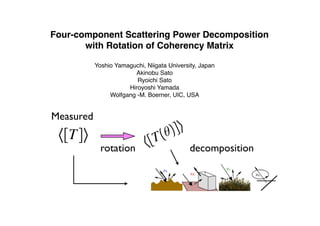
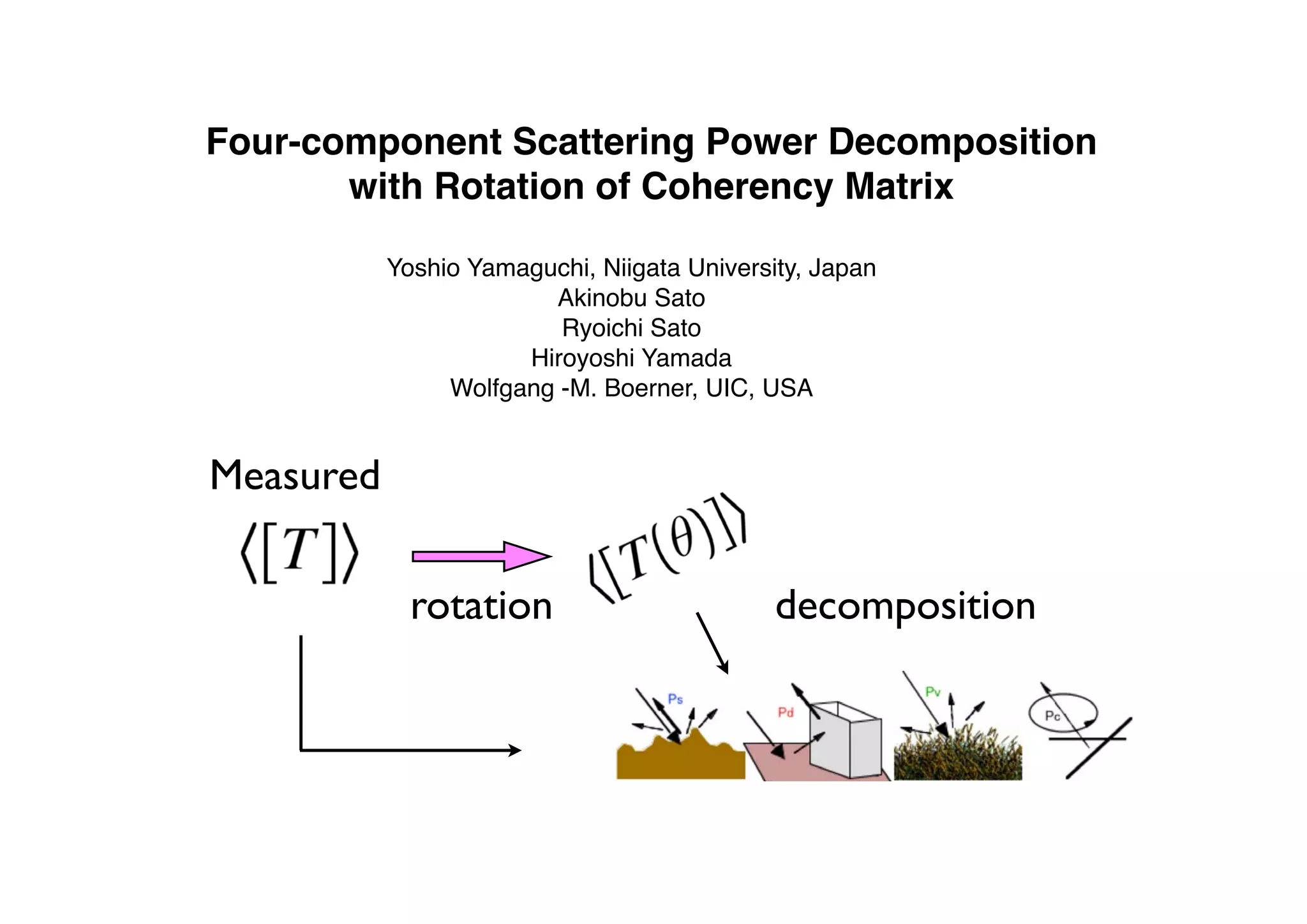
Measured

             rotation                        decomposition
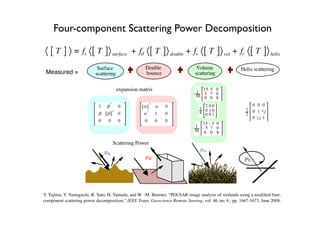
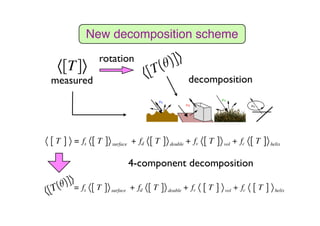
Four-component Scattering Power Decomposition


                            Surface                    Double                   Volume                 Helix scattering
 Measured =                scattering                  bounce                  scattering


                                           expansion matrix                       15 5 0
                                                                               1 5 7 0
                                                                               30 0 0 8
                                   *                        2
                            1              0                        0              2 00                    0 0 0
                                       2
                                                                                 1 0 10                  1 0 1 +j
                                           0            *
                                                                1   0            4 0 01                  2
                                                                                                           0 +j 1
                            0     0        0           0        0   0
                                                                                 15 - 5 0
                                                                              1 -5 7 0
                                                                              30 0 0 8

                                       Scattering Power


Y. Yajima, Y. Yamaguchi, R. Sato, H. Yamada, and W. -M. Boerner, “POLSAR image analysis of wetlands using a modified four-
component scattering power decomposition,” IEEE Trans. Geoscience Remote Sensing, vol. 46, no. 6 , pp. 1667-1673, June 2008.
N
    -Kyoto-
     Japan

   34.800N
   135.781E
    2009/4/22


ALPSRP172780690-P1.1__A     Google earth optical image
  © METI, JAXA


Scattering power
 Decomposition
         Pd

    Ps          Pv

                          Decomposed image (Ps, Pd, Pv)
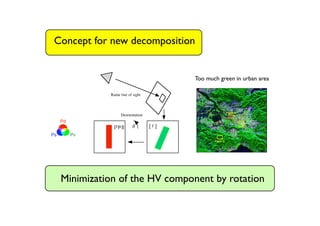
Concept for new decomposition


                                         Too much green in urban area

               Radar line of sight


                     Deorientation

                            S
     Pd
                 T                   T

Ps        Pv


     Minimization of the HV component by rotation
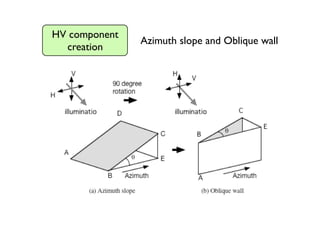
HV component
               Azimuth slope and Oblique wall
  creation
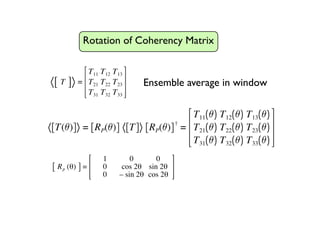
Rotation of Coherency Matrix


                         Ensemble average in window


           1       0         0
Rp ( ) =   0    cos 2     sin 2
           0   – sin 2    cos 2
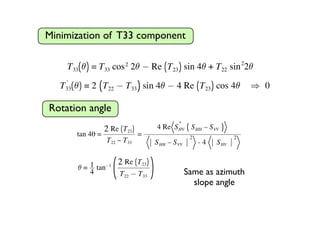
Minimization of T33 component

    T 33      = T 33 cos 2 2           Re T 23 sin 4 + T 22 sin 22


Rotation angle


                         2 Re T23
           = 1 tan - 1
             4           T 22   T 33            Same as azimuth
                                                  slope angle
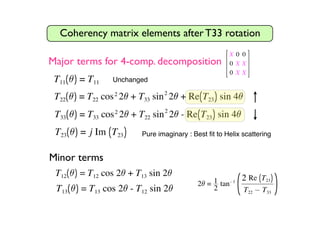
Coherency matrix elements after T33 rotation

Major terms for 4-comp. decomposition
              Unchanged


                     Pure imaginary : Best fit to Helix scattering


Minor terms

                                       2 = 1 tan - 1 2 Re T23
                                           2         T22 T33
New decomposition scheme
           rotation

measured                     decomposition


                 4-component decomposition
T11 T12 T 13             n
                                                                                                  T = T21 T22 T 23 = 1
                                                                                                                                           †


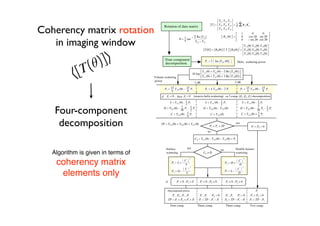
Coherency matrix rotation
                                                                                                                     n             kp kp
                                               Rotation of data matrix
                                                                                                      T31 T32 T 33
                                                                                                                                   1           0               0
                                                                          - 1 2 Re T 23                      Rp ( ) =              0        cos 2           sin 2

   in imaging window
                                                                  = 1 tan                                                          0       – sin 2          cos 2
                                                                    4          T 22 T 33
                                                                                                                             T 11               T 12        T 13
                                                                                                                           †
                                                                                         T        = R P( )    T      RP( ) = T 21               T 22        T 23
                                                                                                                             T 31               T 32        T 33

                                                Four-component                            Pc = 2 Im T 23 ( )
                                                decomposition                                                             Helix scattering power


                                                                                       T 11 ( ) + T 22 ( ) – 2 Re T12( )
                                                                             10 log
                                    Volume scattering                                  T11 ( ) + T 22 ( ) + 2 Re T 12( )
                                    power                                                                                2 dB
                                                                             - 2 dB

                                               Pv = 15 T 33 ( ) – 15 Pc                   Pv = 4 T 33 ( ) – 2 Pc               Pv = 15 T 33 ( ) – 15 Pc
                                                     4            8                                                                  4            8
                                          if     Pv < 0 , then Pc = 0         (remove helix scattering)            3 comp. (Ps, Pd, Pv ) decomposition

                                                      S = T 11 ( ) - 1 Pv                 S = T 11 ( ) - 1 Pv                      S = T 11 ( ) - 1 Pv
                                                                     2                                   2                                        2

    Four-component                             D = T 22 ( ) - 7 Pv - 1 Pc
                                                              30     2
                                                    C = T 12 ( ) - 1 Pv
                                                                   6
                                                                                         D = T 22 ( ) - T 33 ( )

                                                                                               C = T 12 ( )
                                                                                                                               D = T 22 ( ) - 7 Pv - 1 Pc
                                                                                                                                              30
                                                                                                                               C = T 12 ( ) + 1 Pv
                                                                                                                                               6
                                                                                                                                                     2


     decomposition                       TP = T 11 ( ) + T 22 ( ) + T 33 ( )
                                                                                              Pv + Pc > TP
                                                                                                                         yes
                                                                                                                                                Ps = Pd = 0
                                                                                             no

                                                                              C 0 = T 11 ( ) – T 22 ( ) – T33 ( ) + Pc


                                                Surface               yes                                                Double bounce
                                                                                                         no
   Algorithm is given in terms of               scattering                               C0 > 0                          scattering


    coherency matrix
                                                                        2                                                              2
                                                                C                                                          C
                                                       Ps = S +                                               Pd = D +
                                                                 S                                                         D
                                                                         2                                                   2
                                                                C                                                         C
     elements only                                     Pd = D –
                                                                 S
                                                                                                              Ps = S –
                                                                                                                          D

                                                if          Ps > 0 , Pd > 0           Ps > 0 , Pd < 0         Ps < 0 , Pd > 0

                                                     Decomposed power                                                                                  Pc
                                                        Ps , Pd , Pv , Pc          Pv , Pc Pd = 0              Pv , Pc Ps = 0                   Ps = Pd = 0
                                                     TP = Ps + Pd + Pv + Pc       Ps = TP – Pv – Pc           Pd = TP – Pv – Pc                Pv = TP – Pc
                                                      Four comp.                 Three comp.                  Three comp.                      Two comp.
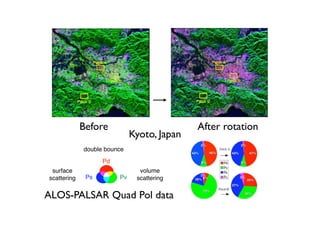
Before                         After rotation
                             Kyoto, Japan
             double bounce
                   Pd
 surface                       volume
scattering    Ps        Pv    scattering


ALOS-PALSAR Quad Pol data
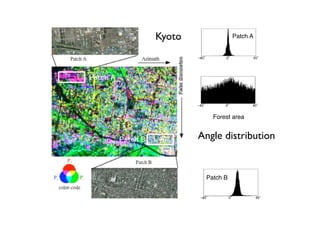
Kyoto              Patch A


           Forest area


        Angle distribution


         Patch B
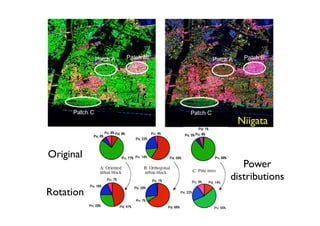
Niigata


Original
              Power
           distributions
Rotation
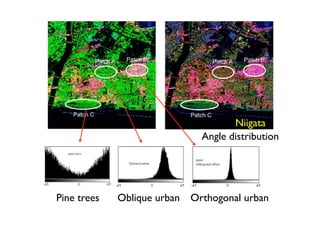
Niigata
                               Angle distribution


Pine trees   Oblique urban   Orthogonal urban
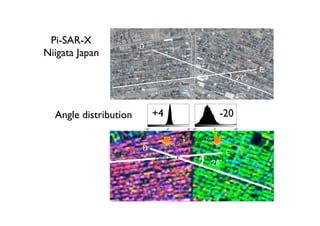
Pi-SAR-X
Niigata Japan


  Angle distribution   +4                 -20


                       Patch E   °   Patch D -20°
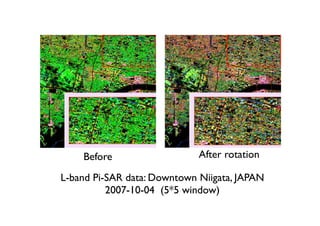
Before                   After rotation

L-band Pi-SAR data: Downtown Niigata, JAPAN
          2007-10-04 (5*5 window)
Before                    After T33 rotation
         Beijing, China
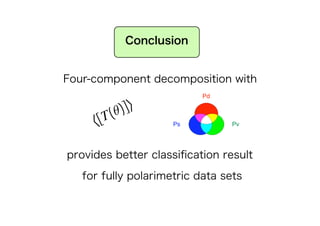
Conclusion


Four-component decomposition with
                           Pd


                     Ps         Pv


provides better classification result
   for fully polarimetric data sets

TU4.L09 - FOUR-COMPONENT SCATTERING POWER DECOMPOSITION WITH ROTATION OF COHERENCY MATRIX

  • 1.
    Four-component Scattering PowerDecomposition with Rotation of Coherency Matrix Yoshio Yamaguchi, Niigata University, Japan Akinobu Sato Ryoichi Sato Hiroyoshi Yamada Wolfgang -M. Boerner, UIC, USA Measured rotation decomposition
  • 2.
    Four-component Scattering PowerDecomposition Surface Double Volume Helix scattering Measured = scattering bounce scattering expansion matrix 15 5 0 1 5 7 0 30 0 0 8 * 2 1 0 0 2 00 0 0 0 2 1 0 10 1 0 1 +j 0 * 1 0 4 0 01 2 0 +j 1 0 0 0 0 0 0 15 - 5 0 1 -5 7 0 30 0 0 8 Scattering Power Y. Yajima, Y. Yamaguchi, R. Sato, H. Yamada, and W. -M. Boerner, “POLSAR image analysis of wetlands using a modified four- component scattering power decomposition,” IEEE Trans. Geoscience Remote Sensing, vol. 46, no. 6 , pp. 1667-1673, June 2008.
  • 3.
    N -Kyoto- Japan 34.800N 135.781E 2009/4/22 ALPSRP172780690-P1.1__A Google earth optical image © METI, JAXA Scattering power Decomposition Pd Ps Pv Decomposed image (Ps, Pd, Pv)
  • 4.
    Concept for newdecomposition Too much green in urban area Radar line of sight Deorientation S Pd T T Ps Pv Minimization of the HV component by rotation
  • 5.
    HV component Azimuth slope and Oblique wall creation
  • 6.
    Rotation of CoherencyMatrix Ensemble average in window 1 0 0 Rp ( ) = 0 cos 2 sin 2 0 – sin 2 cos 2
  • 7.
    Minimization of T33component T 33 = T 33 cos 2 2 Re T 23 sin 4 + T 22 sin 22 Rotation angle 2 Re T23 = 1 tan - 1 4 T 22 T 33 Same as azimuth slope angle
  • 8.
    Coherency matrix elementsafter T33 rotation Major terms for 4-comp. decomposition Unchanged Pure imaginary : Best fit to Helix scattering Minor terms 2 = 1 tan - 1 2 Re T23 2 T22 T33
  • 9.
    New decomposition scheme rotation measured decomposition 4-component decomposition
  • 10.
    T11 T12 T13 n T = T21 T22 T 23 = 1 † Coherency matrix rotation n kp kp Rotation of data matrix T31 T32 T 33 1 0 0 - 1 2 Re T 23 Rp ( ) = 0 cos 2 sin 2 in imaging window = 1 tan 0 – sin 2 cos 2 4 T 22 T 33 T 11 T 12 T 13 † T = R P( ) T RP( ) = T 21 T 22 T 23 T 31 T 32 T 33 Four-component Pc = 2 Im T 23 ( ) decomposition Helix scattering power T 11 ( ) + T 22 ( ) – 2 Re T12( ) 10 log Volume scattering T11 ( ) + T 22 ( ) + 2 Re T 12( ) power 2 dB - 2 dB Pv = 15 T 33 ( ) – 15 Pc Pv = 4 T 33 ( ) – 2 Pc Pv = 15 T 33 ( ) – 15 Pc 4 8 4 8 if Pv < 0 , then Pc = 0 (remove helix scattering) 3 comp. (Ps, Pd, Pv ) decomposition S = T 11 ( ) - 1 Pv S = T 11 ( ) - 1 Pv S = T 11 ( ) - 1 Pv 2 2 2 Four-component D = T 22 ( ) - 7 Pv - 1 Pc 30 2 C = T 12 ( ) - 1 Pv 6 D = T 22 ( ) - T 33 ( ) C = T 12 ( ) D = T 22 ( ) - 7 Pv - 1 Pc 30 C = T 12 ( ) + 1 Pv 6 2 decomposition TP = T 11 ( ) + T 22 ( ) + T 33 ( ) Pv + Pc > TP yes Ps = Pd = 0 no C 0 = T 11 ( ) – T 22 ( ) – T33 ( ) + Pc Surface yes Double bounce no Algorithm is given in terms of scattering C0 > 0 scattering coherency matrix 2 2 C C Ps = S + Pd = D + S D 2 2 C C elements only Pd = D – S Ps = S – D if Ps > 0 , Pd > 0 Ps > 0 , Pd < 0 Ps < 0 , Pd > 0 Decomposed power Pc Ps , Pd , Pv , Pc Pv , Pc Pd = 0 Pv , Pc Ps = 0 Ps = Pd = 0 TP = Ps + Pd + Pv + Pc Ps = TP – Pv – Pc Pd = TP – Pv – Pc Pv = TP – Pc Four comp. Three comp. Three comp. Two comp.
  • 11.
    Before After rotation Kyoto, Japan double bounce Pd surface volume scattering Ps Pv scattering ALOS-PALSAR Quad Pol data
  • 12.
    Kyoto Patch A Forest area Angle distribution Patch B
  • 13.
    Niigata Original Power distributions Rotation
  • 14.
    Niigata Angle distribution Pine trees Oblique urban Orthogonal urban
  • 15.
    Pi-SAR-X Niigata Japan Angle distribution +4 -20 Patch E ° Patch D -20°
  • 16.
    Before After rotation L-band Pi-SAR data: Downtown Niigata, JAPAN 2007-10-04 (5*5 window)
  • 17.
    Before After T33 rotation Beijing, China
  • 18.
    Conclusion Four-component decomposition with Pd Ps Pv provides better classification result for fully polarimetric data sets