Growth driven dynamics in mean-field
models of interacting spins
Richard G. Morris* and Tim Rogers†
* Theoretical Physics, The University of Warwick, Coventry, UK
†

Mathematics, The University of Bath, Bath, UK
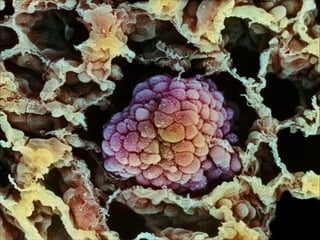
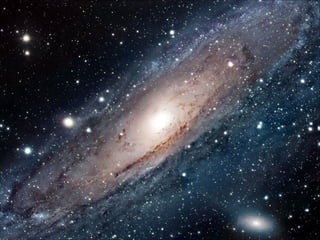
Growth
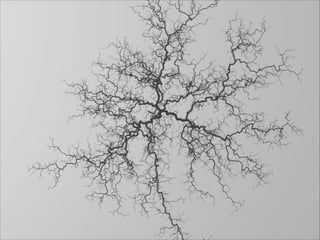
How do physicists model growth?
Downloaded by [University of Warwick] at 04:32 20 Feb

phenomenon that has been studied for many decades, however, by metallurgists, is

Figure 2. Monte Carlo simulation of domain growth in the d ˆ 2 Ising model at T ˆ 0
(taken from Kissner [8]). The system size is 256 £ 256, and the snapshots correspond
to 5, 15, 60 and 200 Monte Carlo steps per spin after a quench from T ˆ 1.

Kissner J. G., Ph. D., The University of Manchester (1992)
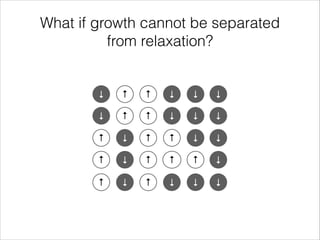
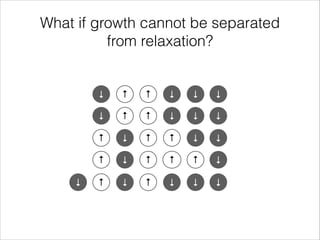
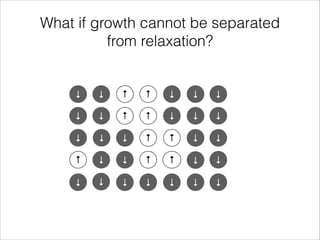
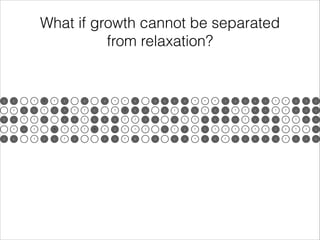
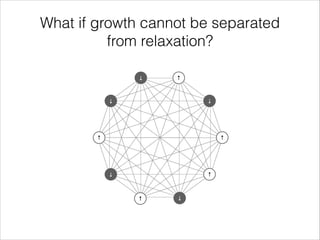
What if growth cannot be separated
from relaxation?
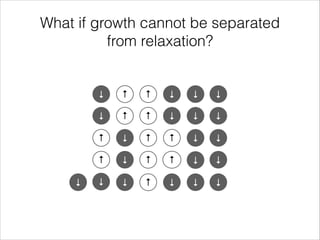
What if growth cannot be separated
from relaxation?

↓

↑

↑

↓

↓

↓

↓

↑

↑

↓

↓

↓

↑

↓

↑

↑

↓

↓

↑

↓

↑

↑

↑

↓

↑

↓

↑

↓

↓

↓
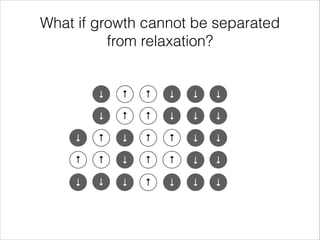
What if growth cannot be separated
from relaxation?

↓

↑

↓

↓

↓

↓

↑

↑

↓

↓

↓

↑

↓

↑

↑

↓

↓

↑
↓

↑

↓

↑

↑

↑

↓

↑

↓

↑

↓

↓

↓
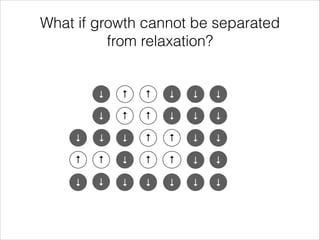
What if growth cannot be separated
from relaxation?

↓

↑

↓

↓

↓

↓

↑

↑

↓

↓

↓

↑

↓

↑

↑

↓

↓

↑
↓

↑

↓

↑

↑

↓

↓

↓

↓

↑

↓

↓

↓
What if growth cannot be separated
from relaxation?

↓

↑

↑

↓

↓

↓

↓

↑

↑

↓

↓

↓

↓

↑

↓

↑

↑

↓

↓

↑

↑

↓

↑

↑

↓

↓

↓

↓

↓

↑

↓

↓

↓
What if growth cannot be separated
from relaxation?

↓

↑

↑

↓

↓

↓

↓

↑

↑

↓

↓

↓

↓

↓

↓

↑

↑

↓

↓

↑

↑

↓

↑

↑

↓

↓

↓

↓

↓

↓

↓

↓

↓
What if growth cannot be separated
from relaxation?

↓

↓

↑

↑

↓

↓

↓

↓

↓

↑

↑

↓

↓

↓

↓

↓

↓

↑

↑

↓

↓

↑

↓

↓

↑

↑

↓

↓

↓

↓

↓

↓

↓

↓

↓
What if growth cannot be separated
from relaxation?

↓

↓

↓

↑

↑

↑

↓

↓

↓

↓

↓

↑

↑

↓

↓

↓

↓

↓

↓

↑

↑

↑

↓

↓

↓

↓

↓

↑

↑

↓

↓

↓

↓

↑

↓

↓

↑

↓

↓

↑

↑

↓

↓

↑

↑

↓

↓

↓

↓

↑

↓

↓

↑

↓

↓

↑

↑

↓

↓

↑

↑

↓

↓

↓

↓

↓

↑

↑

↓

↓

↓

↓

↑

↓

↓

↓

↑

↑

↓

↓

↓

↓

↑

↑

↓

↓

↓

↓

↑

↓

↓

↓

↑

↑

↓

↓

↓

↑

↓

↑

↓

↑

↑

↑

↑

↑

↑

↓

↑

↑

↑

↓

↓

↑

↓

↑

↓

↑

↑

↑

↑

↑

↑

↓

↑

↑

↑

↓

↓

↓

↓

↑

↓

↓

↑

↓

↓

↓

↓

↓

↑

↓

↓

↓

↓

↓

↓

↑

↓

↓

↑

↓

↓

↓

↓

↓

↑

↓

↓

↓
What if growth cannot be separated
from relaxation?
↓

↑

↓

↓

↑

↑

↓

↑

↑

↓
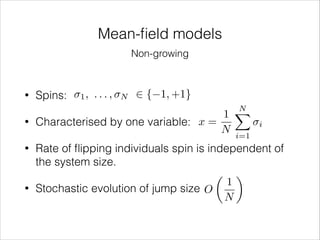
Mean-field models
Mean-field models
Non-growing
Mean-field models
Non-growing

•

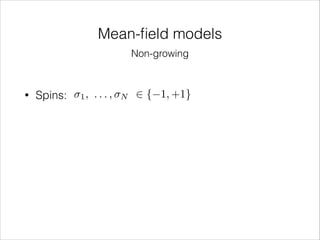
Spins:

1,

...,

N

2 { 1, +1}
Mean-field models
Non-growing

•
•

Spins:

1,

...,

N

2 { 1, +1}

N
X
1
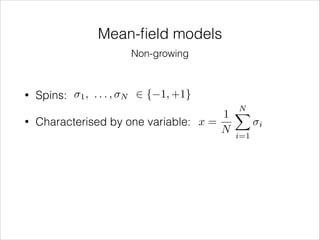
Characterised by one variable: x =
N i=1

i
Mean-field models
Non-growing

•
•
•

Spins:

1,

...,

N

2 { 1, +1}

N
X
1
Characterised by one variable: x =
N i=1

i

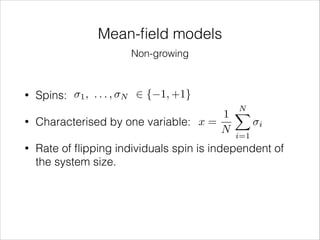
Rate of flipping individuals spin is independent of
the system size.
Mean-field models
Non-growing

•
•
•

•

Spins:

1,

...,

N

2 { 1, +1}

N
X
1
Characterised by one variable: x =
N i=1

i

Rate of flipping individuals spin is independent of
the system size.
✓ ◆
1
Stochastic evolution of jump size O
N
Mean-field models
Growing
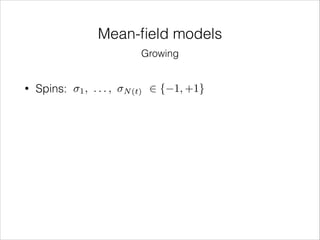
Mean-field models
Growing

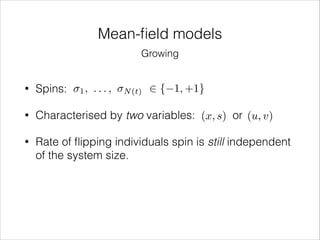
•

Spins:

1,

...,

N (t)

2 { 1, +1}
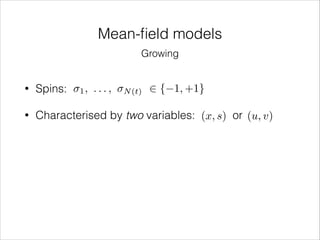
Mean-field models
Growing
1,

...,

2 { 1, +1}

•

Spins:

•

Characterised by two variables: (x, s) or (u, v)

N (t)
Mean-field models
Growing
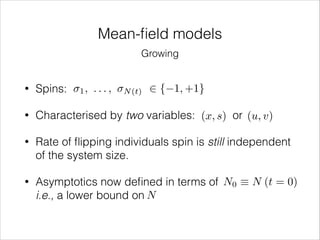
1,

...,

2 { 1, +1}

•

Spins:

•

Characterised by two variables: (x, s) or (u, v)

•

Rate of flipping individuals spin is still independent
of the system size.

N (t)
Mean-field models
Growing
1,

...,

2 { 1, +1}

•

Spins:

•

Characterised by two variables: (x, s) or (u, v)

•

Rate of flipping individuals spin is still independent
of the system size.

•

Asymptotics now defined in terms of N0 ⌘ N (t = 0)
i.e., a lower bound on N

N (t)
Mean-field models
Growth mechanism
Mean-field models
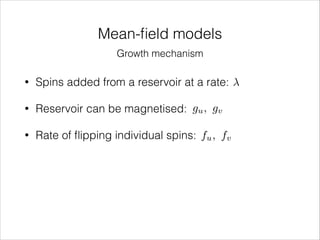
Growth mechanism
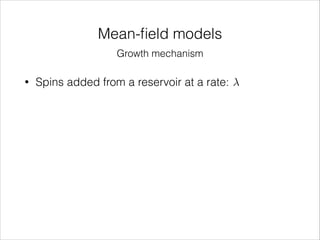
•

Spins added from a reservoir at a rate:
Mean-field models
Growth mechanism
•

Spins added from a reservoir at a rate:

•

Reservoir can be magnetised: gu , gv
Mean-field models
Growth mechanism
•

Spins added from a reservoir at a rate:

•

Reservoir can be magnetised: gu , gv

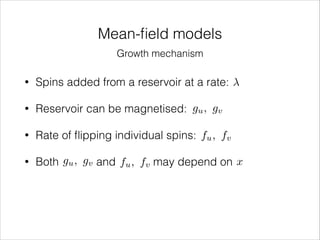
•

Rate of flipping individual spins: fu , fv
Mean-field models
Growth mechanism
•

Spins added from a reservoir at a rate:

•

Reservoir can be magnetised: gu , gv

•

Rate of flipping individual spins: fu , fv

•

Both gu , gv and fu , fv may depend on x
Mean-field models
Growth mechanism
•

Spins added from a reservoir at a rate:

•

Reservoir can be magnetised: gu , gv

•

Rate of flipping individual spins: fu , fv

•

Both gu , gv and fu , fv may depend on x

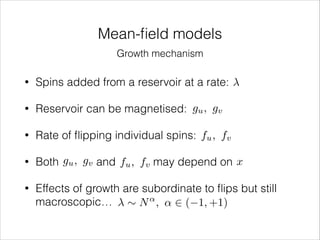
•

Effects of growth are subordinate to flips but still
macroscopic… ⇠ N ↵ , ↵ 2 ( 1, +1)
Mean-field models
Formal description
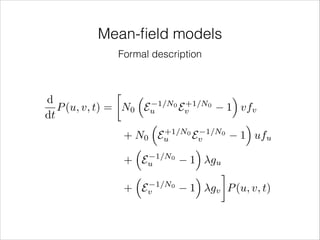
Mean-field models
Formal description



⇣

⌘

d
1/N0 +1/N0
P (u, v, t) = N0 Eu
Ev
1 vfv
dt
⇣
⌘
+1/N0
+ N0 E u
Ev 1/N0 1 ufu
⇣
⌘
1/N0
+ Eu
1 gu
⇣
⌘
1/N0
+ Ev
1 gv P (u, v, t)
Mean-field models
Formal description

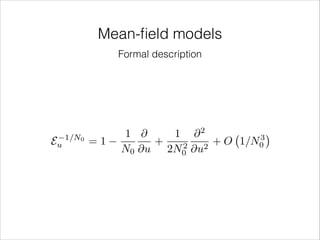
Eu

1/N0

=1

1 @
1 @2
3
+
2 @u2 + O 1/N0
N0 @u 2N0
Mean-field models
Formal description

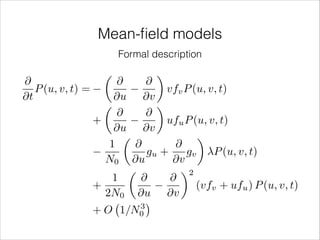
@
P (u, v, t) =
@t

✓

◆

@
@
vfv P (u, v, t)
@u @v
✓
◆
@
@
+
ufu P (u, v, t)
@u @v
✓
◆
1
@
@
gu +
gv
P (u, v, t)
N0 @u
@v
✓
◆2
1
@
@
(vfv + ufu ) P (u, v, t)
+
2N0 @u @v
+O

3
1/N0
Mean-field models
Formal description

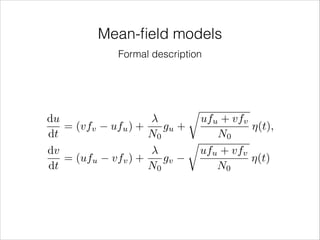
du
= (vfv
dt
dv
= (ufu
dt

r

ufu + vfv
ufu ) +
gu +
⌘(t),
N0
N0
r
ufu + vfv
vfv ) +
gv
⌘(t)
N0
N0
Mean-field models
Formal description

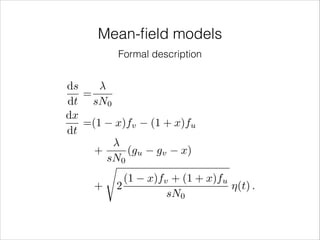
ds
=
dt sN0
dx
=(1 x)fv
dt
+

(gu

sN0
s
(1
+ 2

(1 + x)fu
gv

x)

x)fv + (1 + x)fu
⌘(t) .
sN0
The Voter model
The Voter model
Non-growing
The Voter model
Non-growing
•

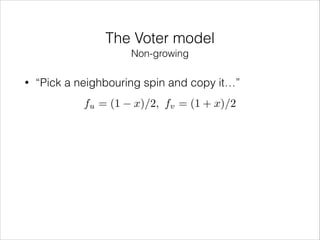
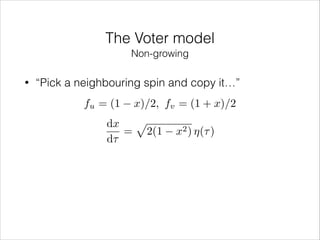
“Pick a neighbouring spin and copy it…”
The Voter model
Non-growing
•

“Pick a neighbouring spin and copy it…”
fu = (1

x)/2, fv = (1 + x)/2
The Voter model
Non-growing
•

“Pick a neighbouring spin and copy it…”
fu = (1

x)/2, fv = (1 + x)/2

dx p
= 2(1
d⌧

x2 ) ⌘(⌧ )
The Voter model

0.2

Non-growing

x

0
−0.2
0

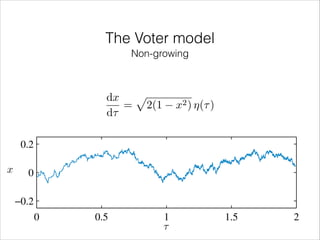
dx p
= 2(1 x2 ) ⌘(⌧ )
50d⌧
100
150

200

t

0.2
x

0
−0.2
0

0.5

1
τ

1.5

2
The Voter model

0.2

Non-growing

x

dx p
= 2(1
d⌧

0
−0.2
0

x2 ) ⌘(⌧ )

=) P1 (x) = [ (x1001) + (x +150 /2
1)]
50

200

t

0.2
x

0
−0.2
0

0.5

1
τ

1.5

2
The Voter model
Constant growth
The Voter model
Constant growth
•

Choose

=1
The Voter model
Constant growth
•

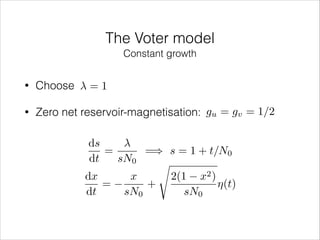
Choose

•

Zero net reservoir-magnetisation: gu = gv = 1/2

=1
The Voter model
Constant growth
•

Choose

•

Zero net reservoir-magnetisation: gu = gv = 1/2

=1

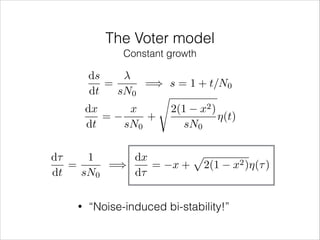
ds
=
=) s = 1 + t/N0
dt
sN0
s
dx
x
2(1 x2 )
=
+
⌘(t)
dt
sN0
sN0
The Voter model
Constant growth

ds
=
=) s = 1 + t/N0
dt
sN0
s
dx
x
2(1 x2 )
=
+
⌘(t)
dt
sN0
sN0
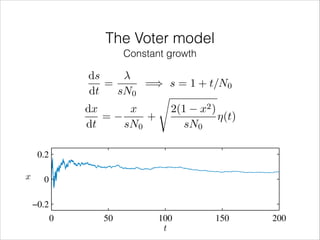
0.2
x

0
−0.2
0

50

100
t

150

200
The Voter model
Constant growth

ds
=
=) s = 1 + t/N0
dt
sN0
s
dx
x
2(1 x2 )
=
+
⌘(t)
dt
sN0
sN0
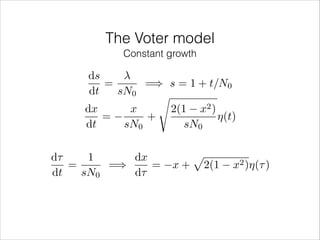
d⌧
1
dx
=
=)
=
dt
sN0
d⌧

p
x + 2(1

x2 )⌘(⌧ )
The Voter model
Constant growth

ds
=
=) s = 1 + t/N0
dt
sN0
s
dx
x
2(1 x2 )
=
+
⌘(t)
dt
sN0
sN0
d⌧
1
dx
=
=)
=
dt
sN0
d⌧
•

p
x + 2(1

“Noise-induced bi-stability!”

x2 )⌘(⌧ )
The Voter model
Constant growth cont’d
The Voter model
Constant growth cont’d
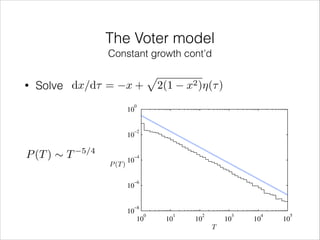
•

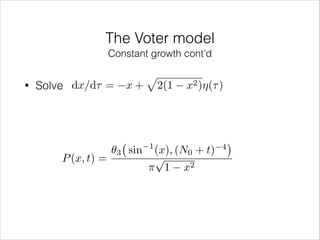
Solve dx/d⌧ =

x+

p

2(1

x2 )⌘(⌧ )
The Voter model
Constant growth cont’d
•

Solve dx/d⌧ =

x+

p

2(1

x2 )⌘(⌧ )
The Voter model
Constant growth cont’d
•

Solve dx/d⌧ =

P (x, t) =

x+

✓3 sin

p

1

2(1

x2 )⌘(⌧ )

(x), (N0 + t)
p
⇡ 1 x2

4
The Voter model
Constant growth cont’d
•

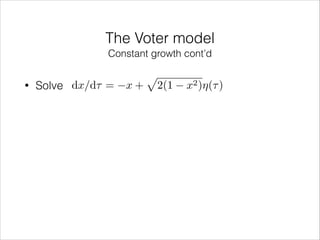
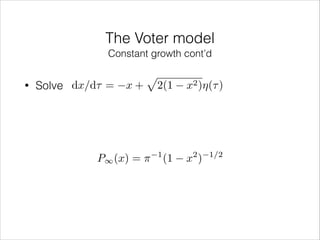
Solve dx/d⌧ =

x+

p

P1 (x) = ⇡

2(1

1

(1

x2 )⌘(⌧ )

2

x )

1/2
The Voter model
Constant growth cont’d
•

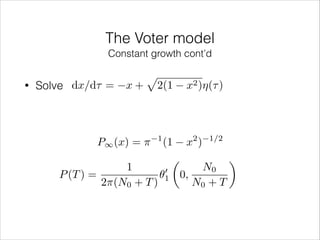
Solve dx/d⌧ =

x+

p

P1 (x) = ⇡

2(1

1

x2 )⌘(⌧ )

2

1/2

(1 x )
✓
◆
1
N0
0
P (T ) =
✓1 0,
2⇡(N0 + T )
N0 + T
The Voter model
Constant growth cont’d
•

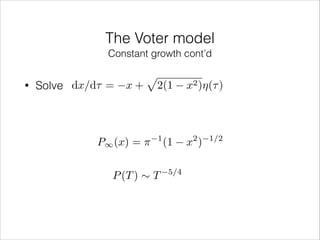
Solve dx/d⌧ =

x+

p

P1 (x) = ⇡

2(1

1

P (T ) ⇠ T

(1
5/4

x2 )⌘(⌧ )

2

x )

1/2
The Voter model
Constant growth cont’d
•

Solve dx/d⌧ =

x+
0

10

p

2(1

x2 )⌘(⌧ )

−2

10

P (T ) ⇠ T

5/4

−4

P (T )

10

−6

10

−8

10

0

10

1

10

2

3

10

10
T

4

10

10

5
The Glauber-Ising model
Non-growing
The Glauber-Ising model
Non-growing

P ({ }) = e

H[{ }]

/Z
The Glauber-Ising model
Non-growing

P ({ }) = e
Z=

X
x

e

H[{ }]

/Z

H[{ }]
The Glauber-Ising model
Non-growing

P ({ }) = e
Z=
H [{ }] =

X

e

H[{ }]

/Z

H[{ }]

x

N
X
J
N

hi,ji

i j

h

N
X
i=1

i
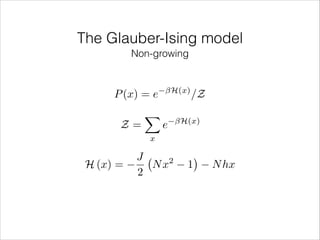
The Glauber-Ising model
Non-growing

H(x)

P (x) = e
Z=
H (x) =

X

e

/Z

H(x)

x

J
2
Nx
2

1

N hx
The Glauber-Ising model
Non-growing

H(x)

P (x) = e
Z=
H (x) =
fu/d

X

e

/Z

H(x)

x

J
2
Nx
2

1

N hx

1
= [1 ⌥ tanh (Jx + h)]
2
The Glauber-Ising model
Non-growing
The Glauber-Ising model
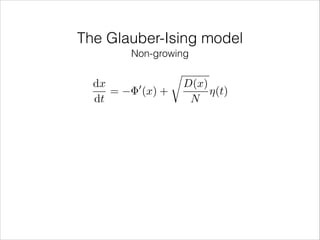
Non-growing

dx
=
dt

0

(x) +

r

D(x)
⌘(t)
N
The Glauber-Ising model
Non-growing

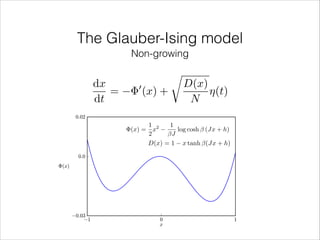
dx
=
dt

0

(x) +

r

D(x)
⌘(t)
N

1 2
1
(x) = x
log cosh (Jx + h)
2
J
D(x) = 1 x tanh (Jx + h)
The Glauber-Ising model
Growing
The Glauber-Ising model
Growing
•

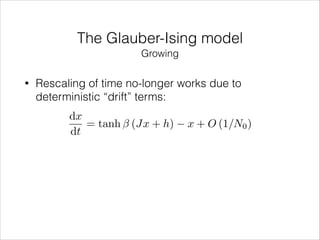
Rescaling of time no-longer works due to
deterministic “drift” terms:
The Glauber-Ising model
Growing
•

Rescaling of time no-longer works due to
deterministic “drift” terms:
dx
= tanh (Jx + h)
dt

x + O (1/N0 )
The Glauber-Ising model
Growing
•

Rescaling of time no-longer works due to
deterministic “drift” terms:
dx
= tanh (Jx + h)
dt

•

x + O (1/N0 )

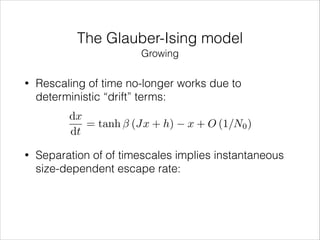
Separation of of timescales implies instantaneous
size-dependent escape rate:
The Glauber-Ising model
Growing
•

Rescaling of time no-longer works due to
deterministic “drift” terms:
dx
= tanh (Jx + h)
dt

x + O (1/N0 )

Separation of of timescales implies instantaneous
size-dependent escape rate:
s
⇢ Z x1 0
00 (x )| 00 (x )|D(x )
(⇠)
0
1
0
(s) =
exp
s
d⇠
2 D(x )
4⇡
1
x0 D(⇠)

•
The Glauber-Ising model
Growing cont’d
The Glauber-Ising model
Growing cont’d

•

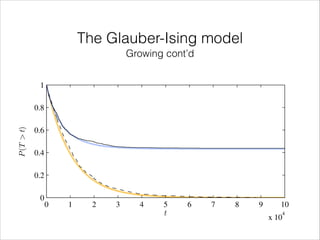
Survivor function:
The Glauber-Ising model
Growing cont’d

•

Survivor function:
P (T

t) = exp

⇢ Z

t

0

[s(t )] dt
0

0
The Glauber-Ising model
Growing cont’d

•

Survivor function:
P (T

•

t) = exp

Constant growth:

⇢ Z

t

0

[s(t )] dt
0

0
The Glauber-Ising model
Growing cont’d

•

Survivor function:
P (T

•

t) = exp

⇢ Z

t

0

[s(t )] dt

0

0

Constant growth:
P (T

t) = exp

⇢

AN0 B ⇣
e 1
B

e

B t/N0

⌘

A = (0), B = 0 (0)/(0) < 0
The Glauber-Ising model
Growing cont’d

•

Survivor function:
P (T

•

t) = exp

⇢ Z

t

0

[s(t )] dt

0

0

Constant growth:
P (T

1) > 0
A = (0), B = 0 (0)/(0) < 0
The Glauber-Ising model
Growing cont’d
1

P (T > t)

0.8
0.6
0.4
0.2
0
0

1

2

3

4

5
t

6

7

8

9

10
4

x 10
…back to the voter model
•

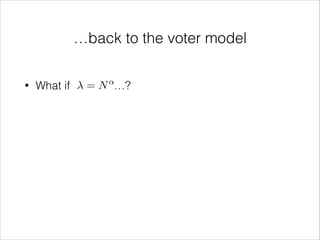
What if

↵

= N …?
…back to the voter model
↵

= N …?

•

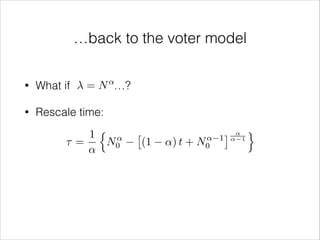
What if

•

Rescale time:
n
1
↵
⌧=
N0
↵

⇥

(1

↵) t +

↵
N0

⇤ ↵↵ 1 o
1
…back to the voter model
↵

= N …?

•

What if

•

Rescale time:
n
1
↵
⌧=
N0
↵

⇥

(1

↵) t +

↵
N0

↵
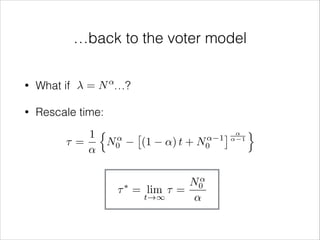
N0
⇤
⌧ = lim ⌧ =
t!1
↵

⇤ ↵↵ 1 o
1
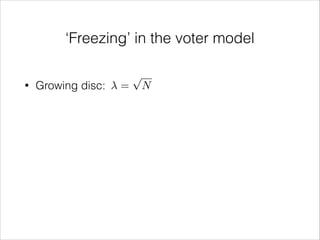
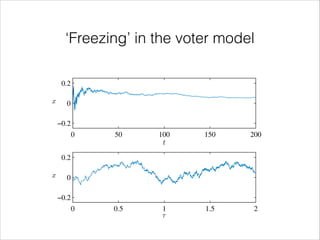
‘Freezing’ in the voter model
•

Growing disc:

=

p

N
‘Freezing’ in the voter model
•

Growing disc:

•

=

p

N

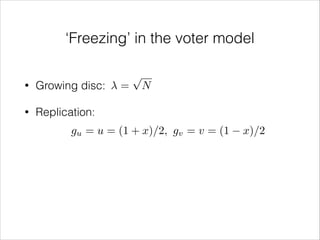
Replication:
gu = u = (1 + x)/2, gv = v = (1

x)/2
‘Freezing’ in the voter model
•

Growing disc:

•

=

p

N

Replication:
gu = u = (1 + x)/2, gv = v = (1
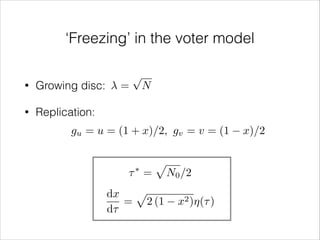
⌧⇤ =

p

dx p
= 2 (1
d⌧

N0 /2
x2 )⌘(⌧ )

x)/2
‘Freezing’ in the voter model
0.2
x

0
−0.2
0

50

100
t

150

200

0

0.5

1
τ

1.5

2

0.2
x

0
−0.2
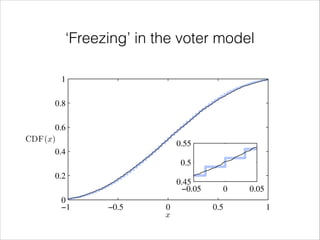
‘Freezing’ in the voter model
1
0.8
0.6
CDF(x)

0.55

0.4
0.5
0.2
0.45
−0.05
0
−1

−0.5

0
x

0
0.5

0.05
1
Wrap-up
Wrap-up
Wrap-up
•

Growth affects the dynamics of even the simplest
spin-models.
Wrap-up
•

Growth affects the dynamics of even the simplest
spin-models.

•

Seems pretty cool… absorbing/meta-stable
‘switch’.
Wrap-up
•

Growth affects the dynamics of even the simplest
spin-models.

•

Seems pretty cool… absorbing/meta-stable
‘switch’.

•

Going forward: what can we say about spatial
models?
Wrap-up
•

Growth affects the dynamics of even the simplest
spin-models.

•

Seems pretty cool… absorbing/meta-stable
‘switch’.

•

Going forward: what can we say about spatial
models?

•

What do you think / can you help?

Growth driven dynamics in mean-field models of interacting spins