Quantum Tunneling PUFs
and PUF-based Applications .
Dr. Kent Chuang
2022 September
Outline .
1. Recap
2. Design and implementation of quantum tunneling PUF
3. Experiment results of quantum tunneling PUF
4. PUF-based security applications
5. Conclusion and Outlook
Outline .
2. Design and implementation of quantum tunneling PUF
3. Experiment results of quantum tunneling PUF
4. PUF-based security applications
5. Conclusion and Outlook
page 5
Recap .
In the previous lectures, we have introduced
▪ The importance of hardware security & root of trust
▪ What is a PUF?
▪ What are the important PUF properties?
▪ The importance of reliability
▪ How to improve reliability?
▪ Intrinsically reliable PUFs based on quantum tunneling
page 6
Key Generation Using PUF .
KDF
Device
Secret
Auxiliary Input
(Optional)
Secret
Key
PUF Array
0 1
0 1
0
1
0
0
0
Readout
Interface
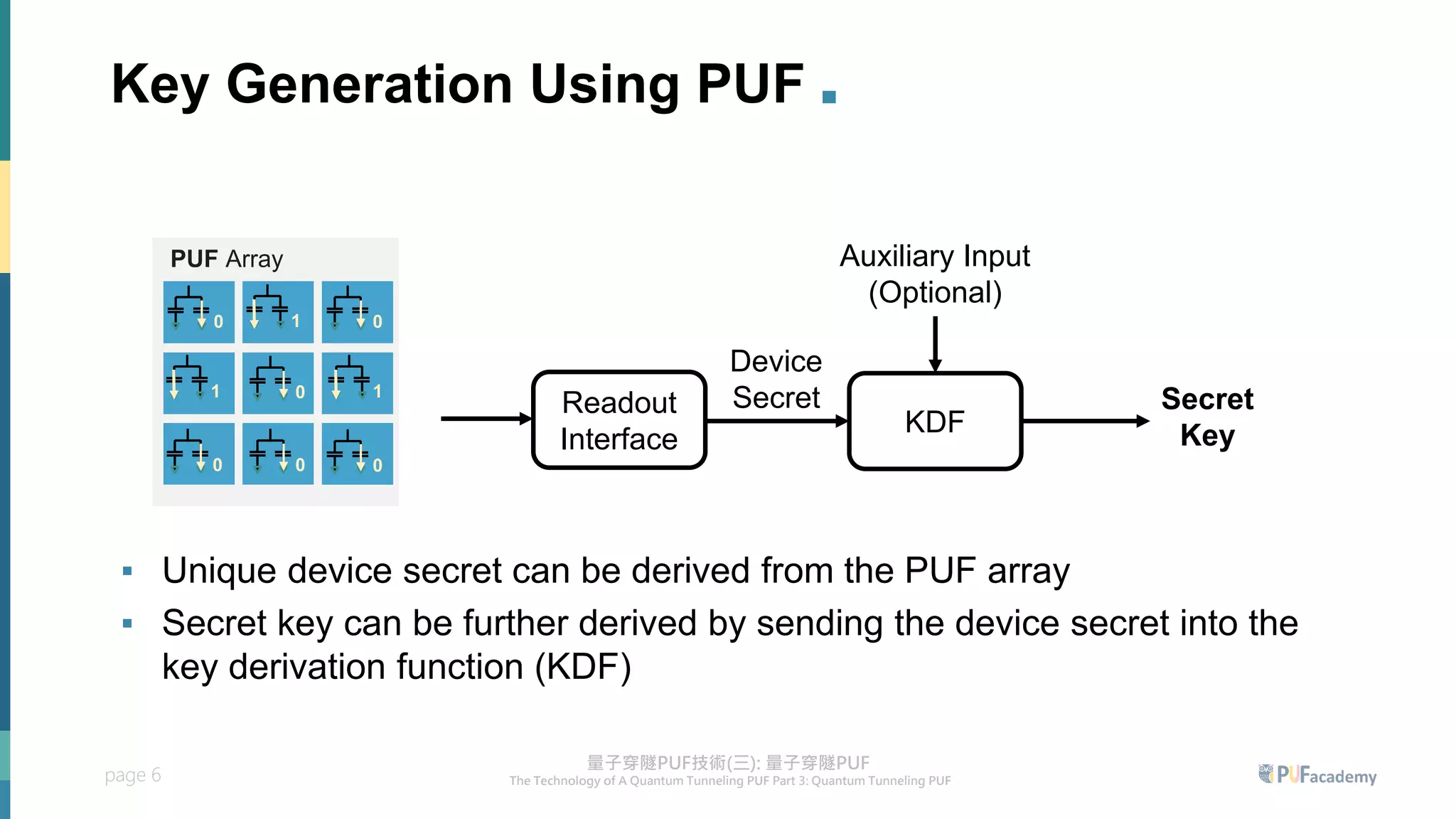
▪ Unique device secret can be derived from the PUF array
▪ Secret key can be further derived by sending the device secret into the
key derivation function (KDF)
page 7
PUFs need to be intrinsically reliable .
Readout
Interface
Post-
processing
n-bit k-bit
Stabilization
m-bit
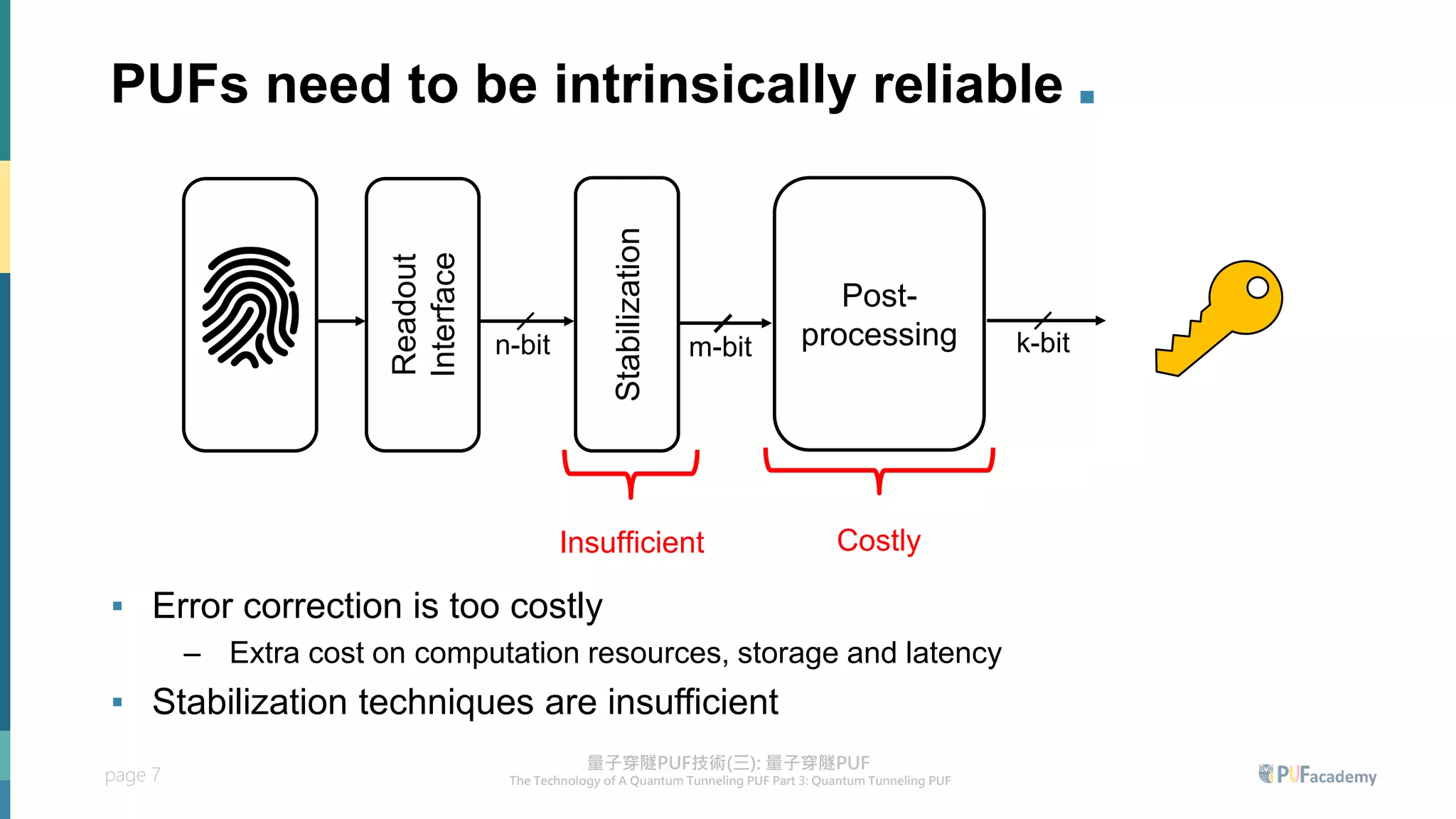
▪ Error correction is too costly
– Extra cost on computation resources, storage and latency
▪ Stabilization techniques are insufficient
Costly
Insufficient
page 8
Increase mismatches through burn-in .
VT
Percentage
Burn-in
VT
Percentage
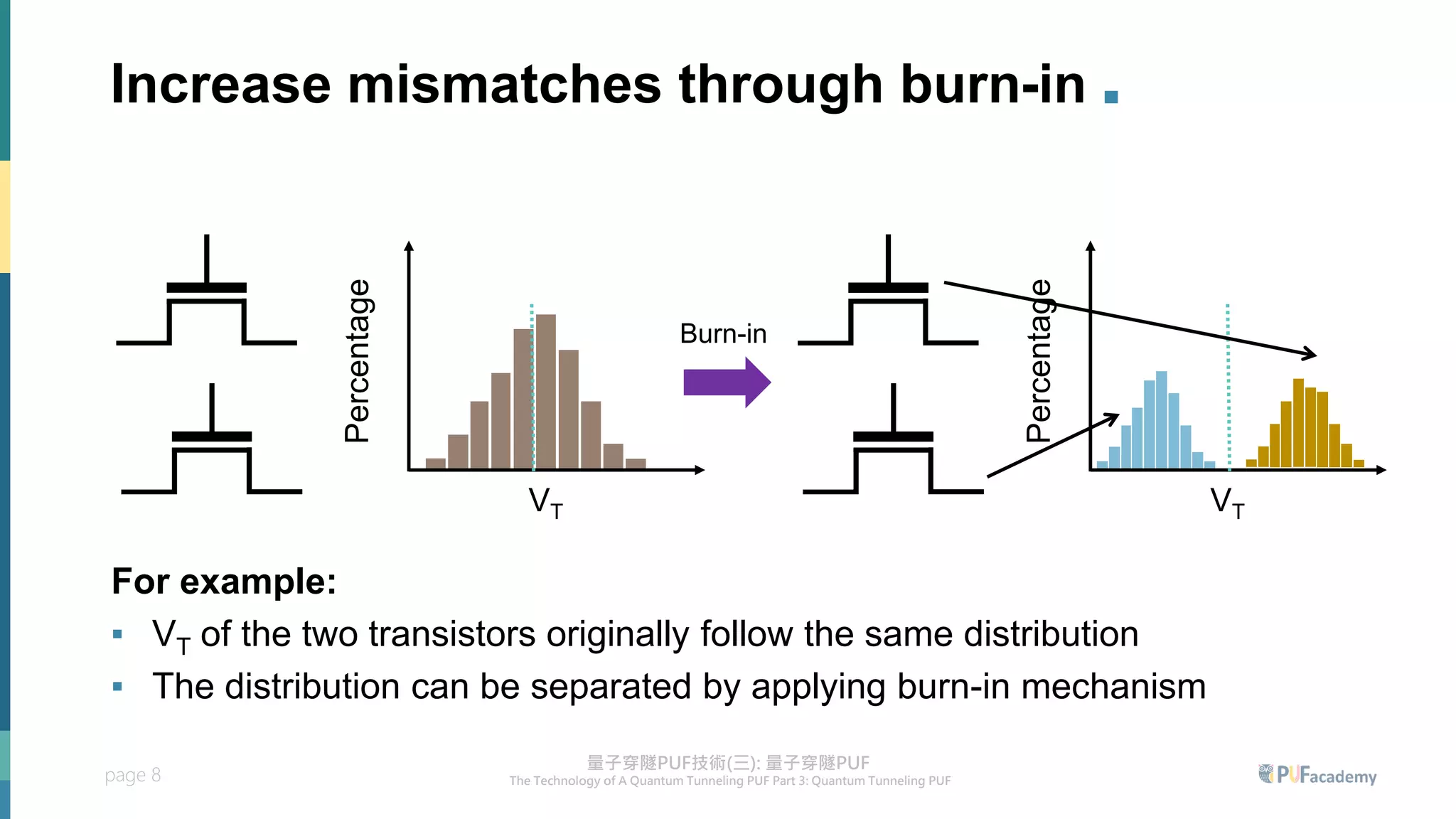
For example:
▪ VT of the two transistors originally follow the same distribution
▪ The distribution can be separated by applying burn-in mechanism
page 9
Quantum Tunneling PUFs .
“0” “1”
50% 50%
[Chuang, JSSC 2019]
[Wu, ISSCC 2018]
50% 50%
“0” “1”
▪ Only one tunneling path will be generated in two of the NMOS transistors
▪ Reading out the tunneling current of PUF cells → deriving PUF bits
Outline .
1. Recap
3. Experiment results of quantum tunneling PUF
4. PUF-based security applications
5. Conclusion and Outlook
page 11
Plenary Speech 2
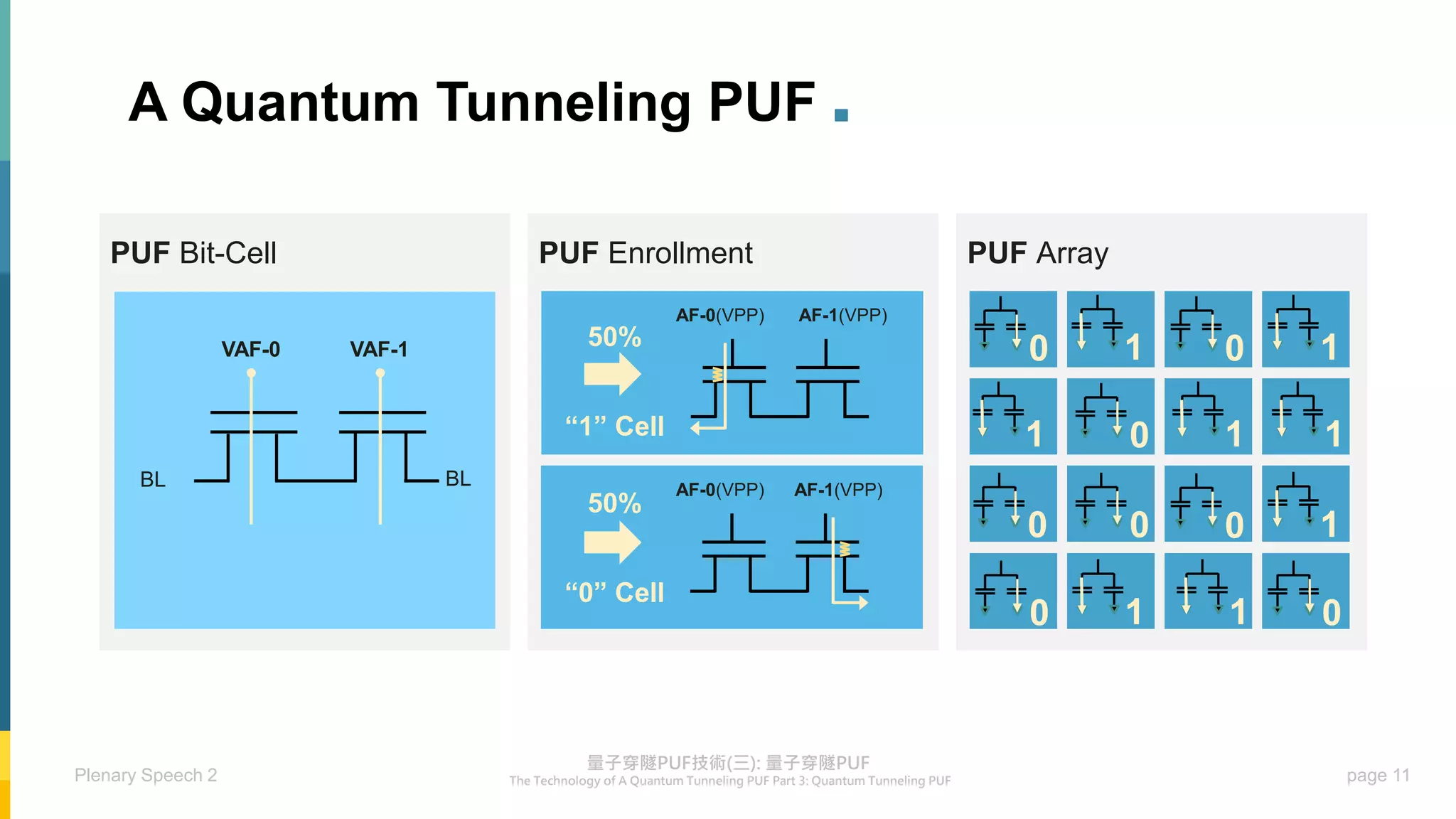
PUF Array
PUF Bit-Cell PUF Enrollment
BL
BL
VAF-0 VAF-1
AF-0(VPP) AF-1(VPP)
AF-0(VPP) AF-1(VPP)
50%
50%
“1” Cell
“0” Cell
0 1
0 1
0 1
0 1
1 1
0 1
0
0
1 0
A Quantum Tunneling PUF .
page 12
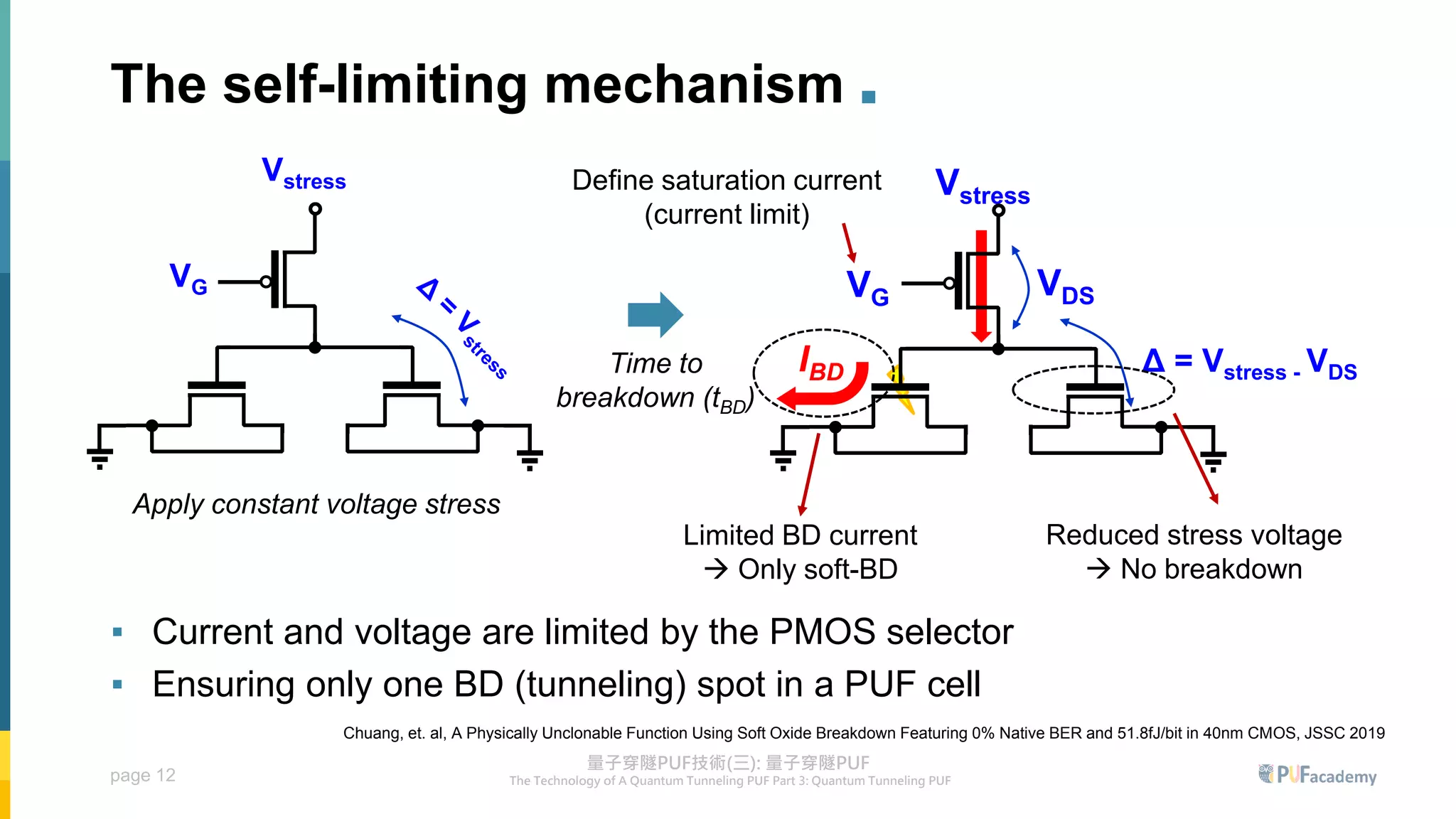
The self-limiting mechanism .
▪ Current and voltage are limited by the PMOS selector
▪ Ensuring only one BD (tunneling) spot in a PUF cell
Δ = Vstress - VDS
Vstress
VG VDS
IBD
Reduced stress voltage
→ No breakdown
Limited BD current
→ Only soft-BD
Define saturation current
(current limit)
Vstress
VG
Apply constant voltage stress
Time to
breakdown (tBD)
Chuang, et. al, A Physically Unclonable Function Using Soft Oxide Breakdown Featuring 0% Native BER and 51.8fJ/bit in 40nm CMOS, JSSC 2019
page 13
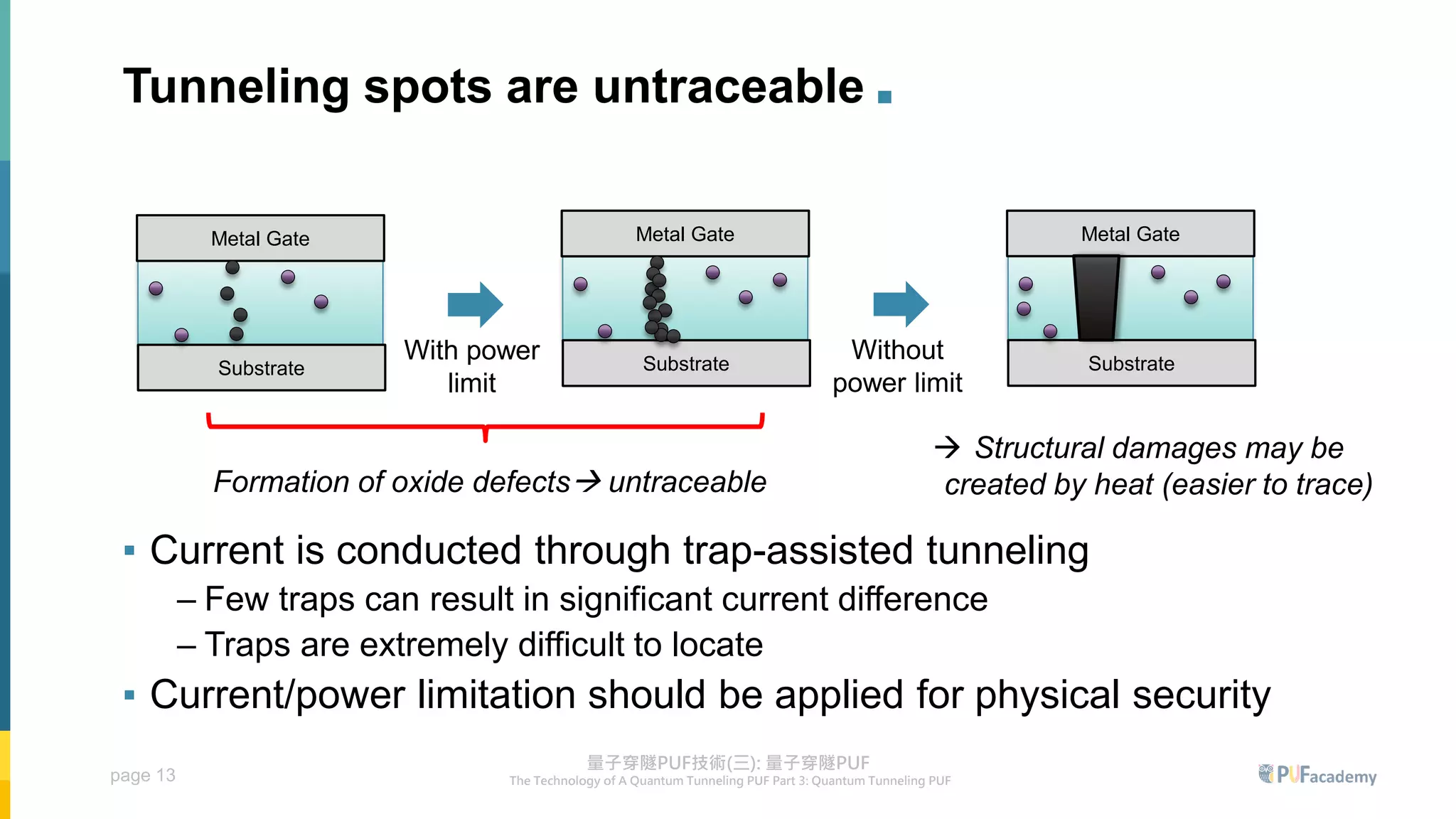
Tunneling spots are untraceable .
▪ Current is conducted through trap-assisted tunneling
‒ Few traps can result in significant current difference
‒ Traps are extremely difficult to locate
▪ Current/power limitation should be applied for physical security
Formation of oxide defects→ untraceable
Metal Gate
Substrate Substrate
Metal Gate
With power
limit
Without
power limit
Substrate
Metal Gate
→ Structural damages may be
created by heat (easier to trace)
page 14
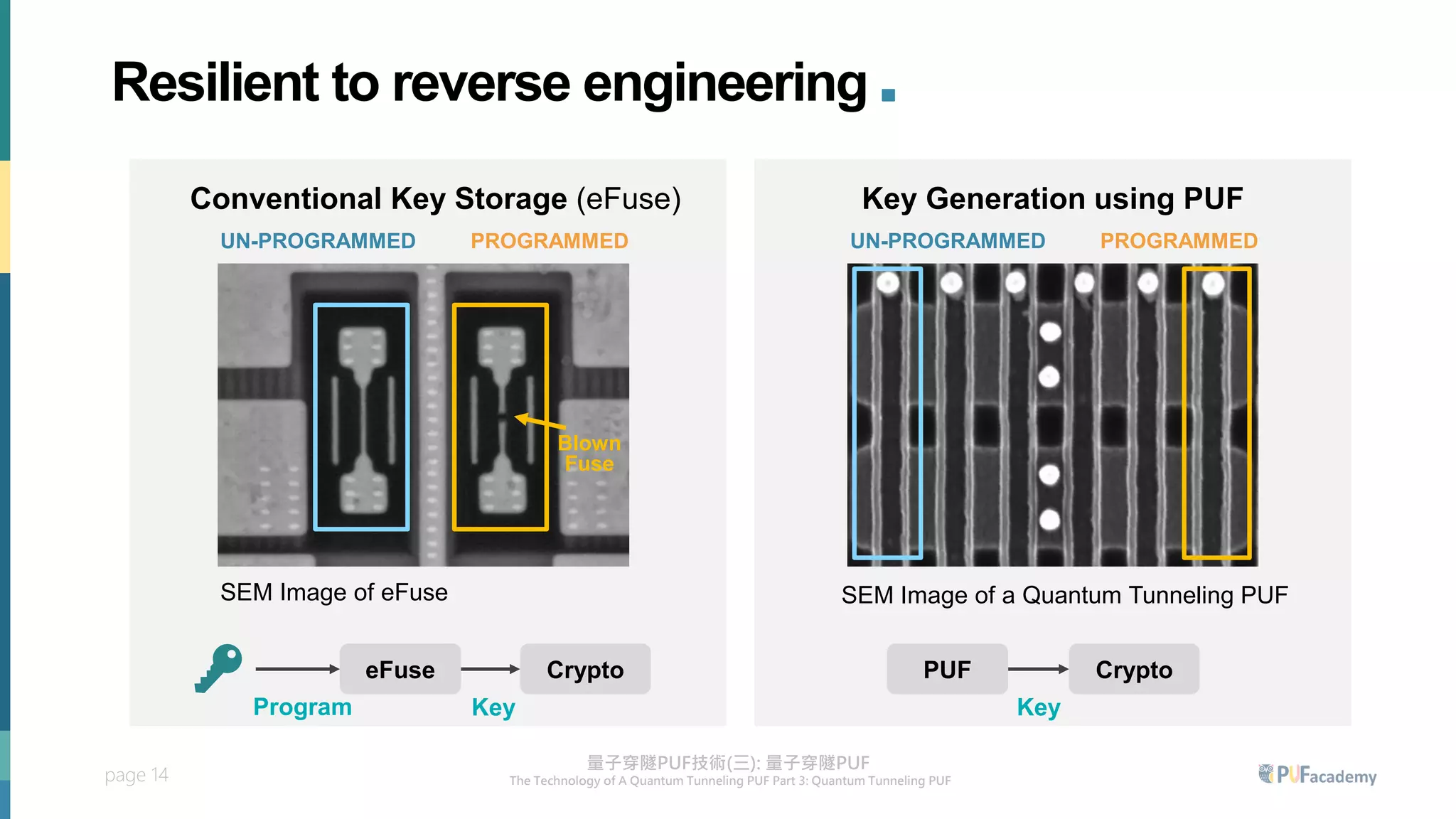
UN-PROGRAMMED
Blown
Fuse
PROGRAMMED UN-PROGRAMMED PROGRAMMED
SEM Image of eFuse SEM Image of a Quantum Tunneling PUF
PUF Crypto
Key
eFuse
Program
Crypto
Key
Conventional Key Storage (eFuse) Key Generation using PUF
Resilient to reverse engineering .
page 15
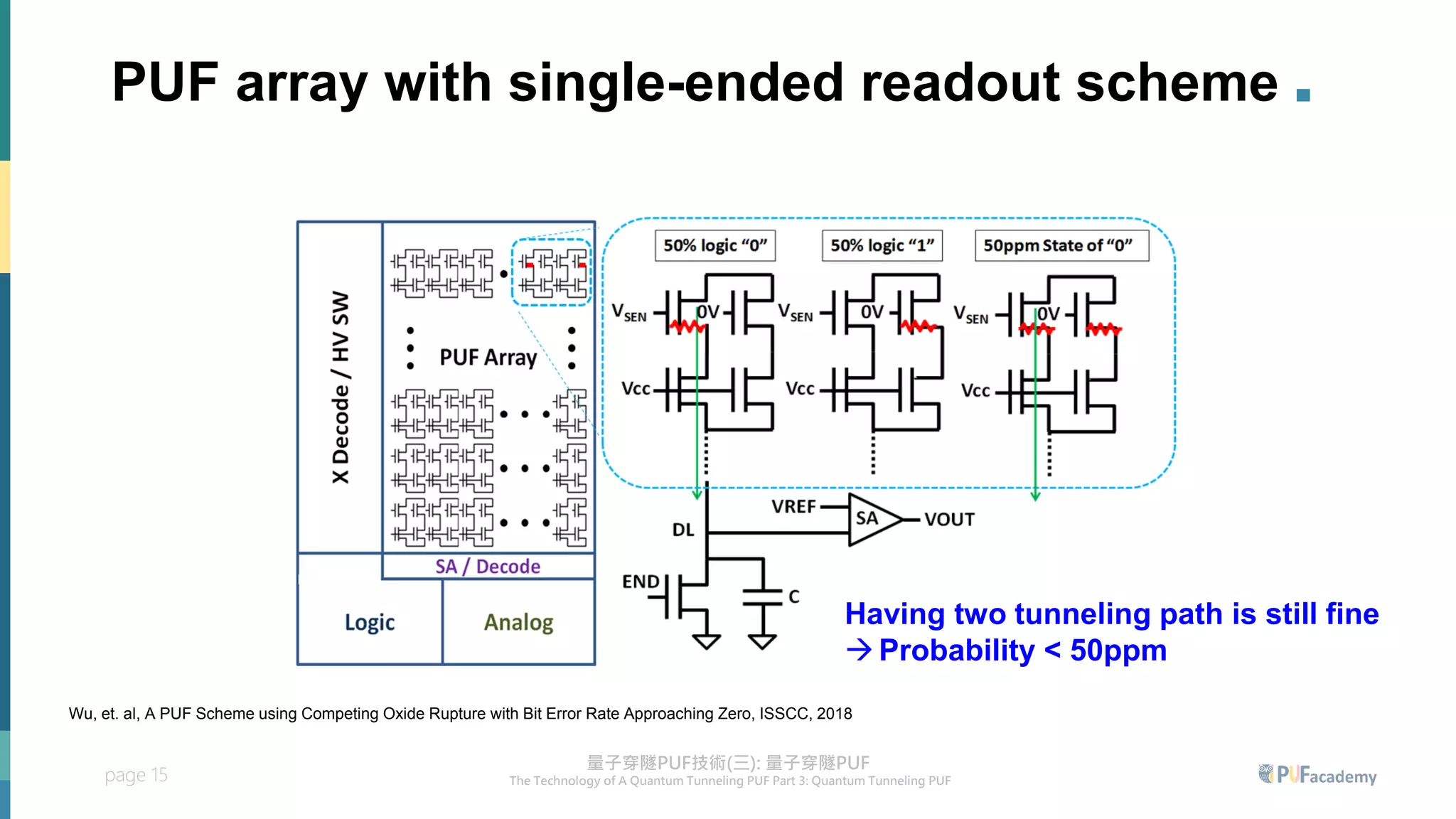
PUF array with single-ended readout scheme .
Having two tunneling path is still fine
→Probability < 50ppm
Wu, et. al, A PUF Scheme using Competing Oxide Rupture with Bit Error Rate Approaching Zero, ISSCC, 2018
page 16
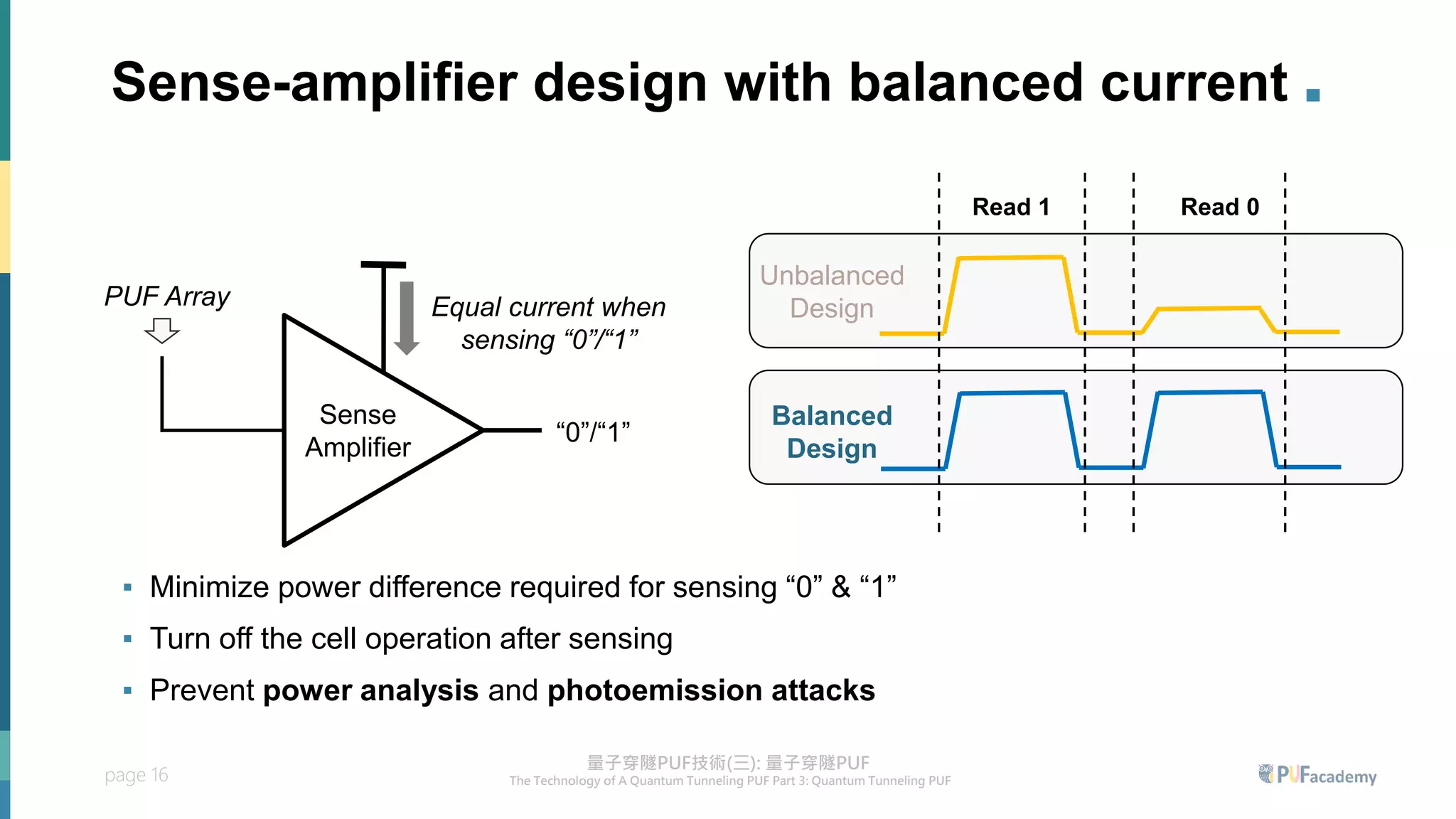
Sense-amplifier design with balanced current .
Sense
Amplifier
Equal current when
sensing “0”/“1”
“0”/“1”
PUF Array
▪ Minimize power difference required for sensing “0” & “1”
▪ Turn off the cell operation after sensing
▪ Prevent power analysis and photoemission attacks
Read 1 Read 0
Unbalanced
Design
Balanced
Design
Outline .
1. Recap
2. Design and implementation of quantum tunneling PUF
4. PUF-based security applications
5. Conclusion and Outlook
page 18
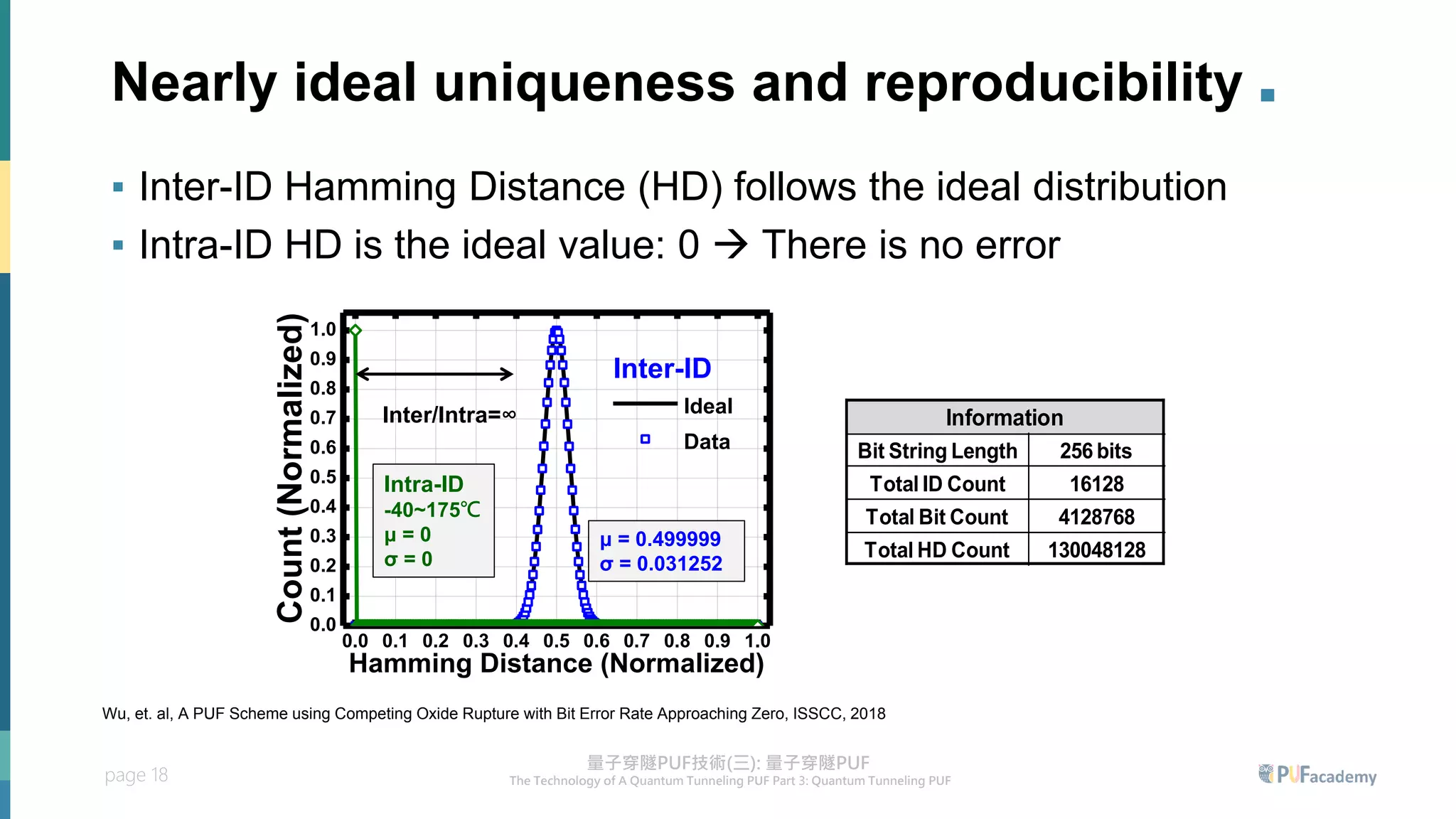
Nearly ideal uniqueness and reproducibility .
▪ Inter-ID Hamming Distance (HD) follows the ideal distribution
▪ Intra-ID HD is the ideal value: 0 → There is no error
0.0 0.1 0.2 0.3 0.4 0.5 0.6 0.7 0.8 0.9 1.0
0.0
0.1
0.2
0.3
0.4
0.5
0.6
0.7
0.8
0.9
1.0
Count
(Normalized)
Hamming Distance (Normalized)
Inter-ID
Ideal
Data
Inter/Intra=∞
μ = 0.499999
σ = 0.031252
Intra-ID
-40~175℃
μ = 0
σ = 0
Information
Bit String Length 256 bits
Total ID Count 16128
Total Bit Count 4128768
Total HD Count 130048128
Wu, et. al, A PUF Scheme using Competing Oxide Rupture with Bit Error Rate Approaching Zero, ISSCC, 2018
page 19
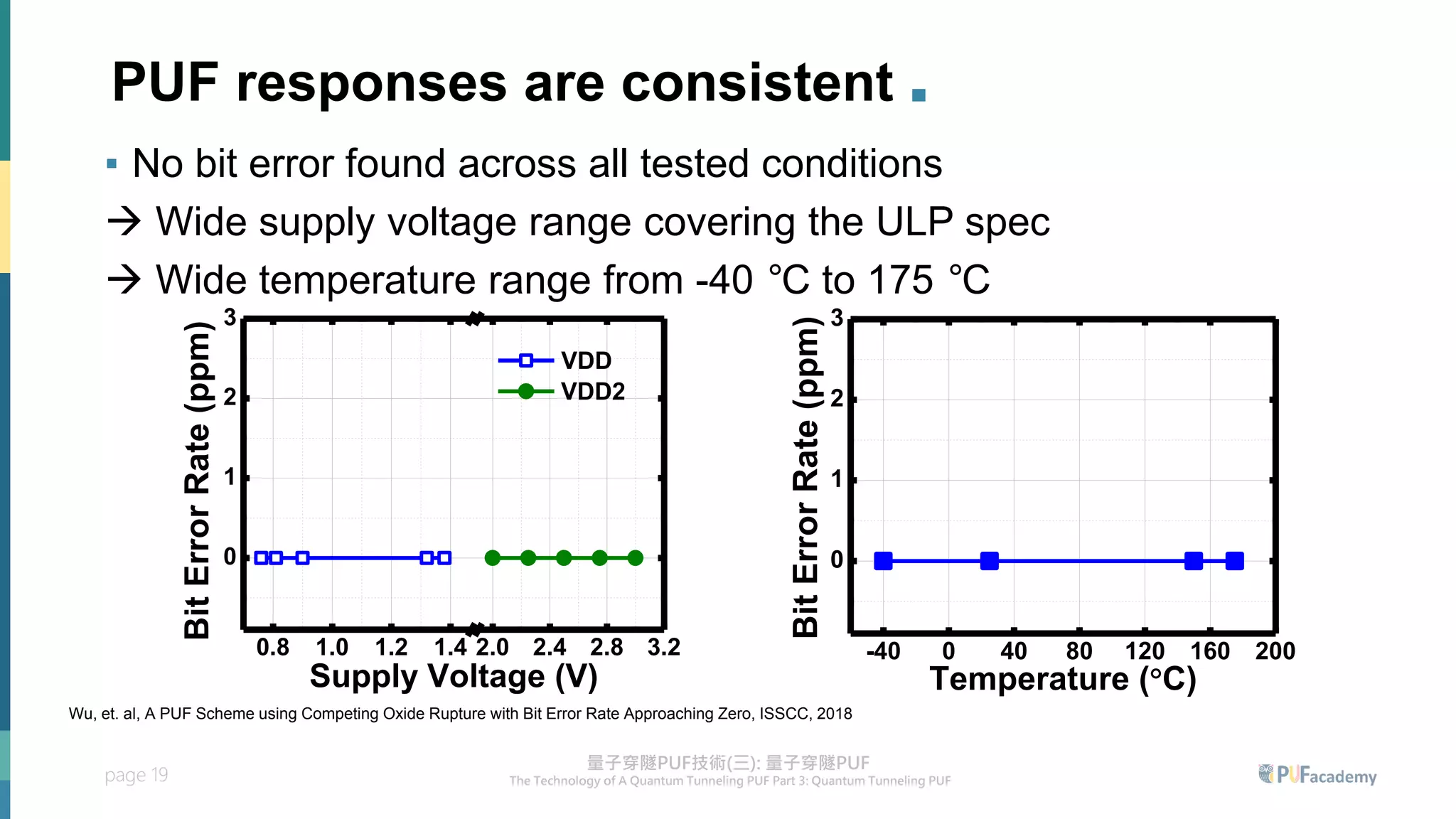
PUF responses are consistent .
▪ No bit error found across all tested conditions
→ Wide supply voltage range covering the ULP spec
→ Wide temperature range from -40 °C to 175 °C
0.8 1.0 1.2 1.4 2.0 2.4 2.8 3.2
0
1
2
3
Bit
Error
Rate
(ppm)
Supply Voltage (V)
VDD
VDD2
-40 0 40 80 120 160 200
0
1
2
3
Bit
Error
Rate
(ppm)
Temperature (C)
Wu, et. al, A PUF Scheme using Competing Oxide Rupture with Bit Error Rate Approaching Zero, ISSCC, 2018
page 20
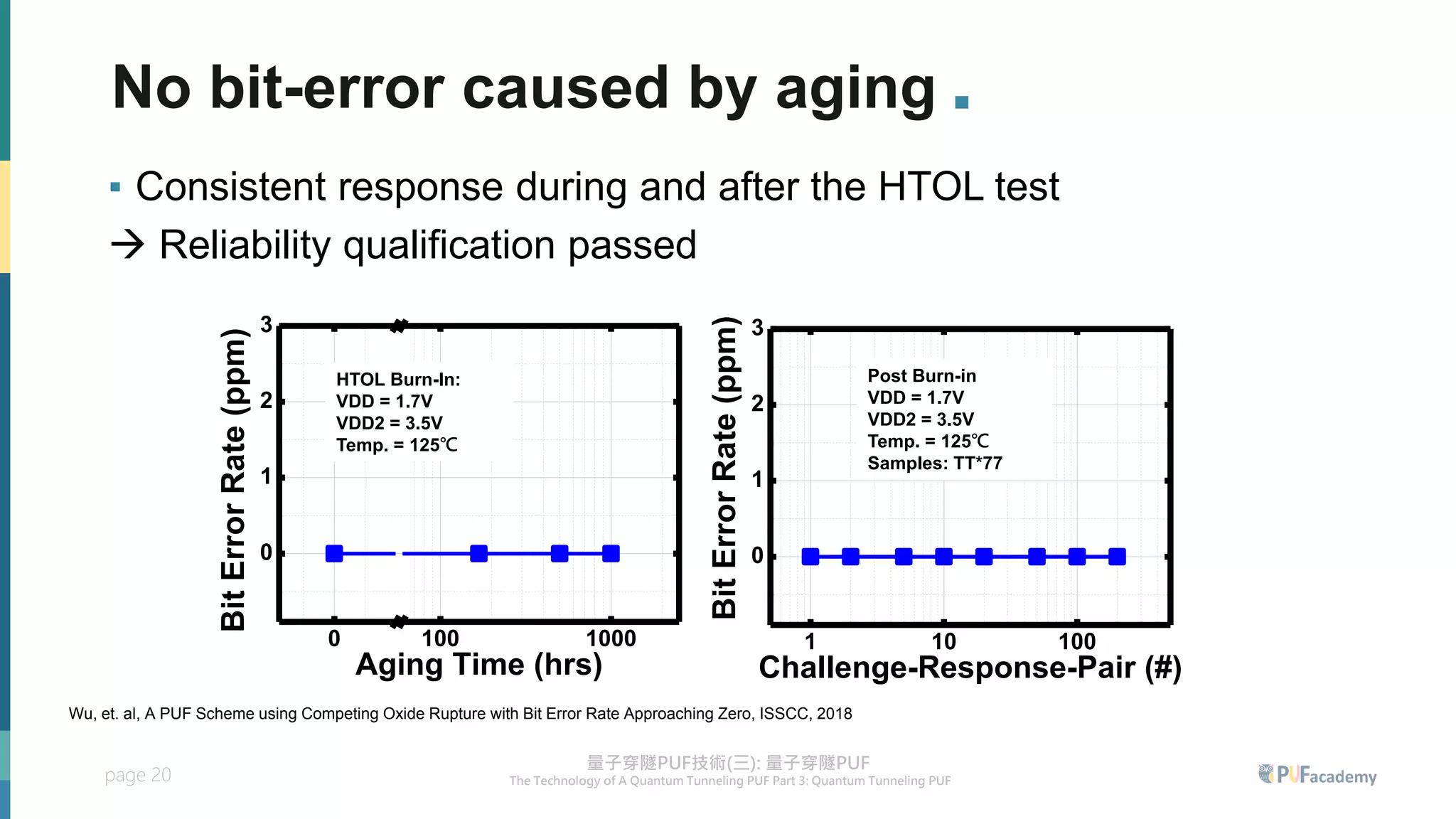
No bit-error caused by aging .
▪ Consistent response during and after the HTOL test
→ Reliability qualification passed
1 10 100
0
1
2
3
Bit
Error
Rate
(ppm)
Challenge-Response-Pair (#)
0 100 1000
0
1
2
3
Bit
Error
Rate
(ppm)
Aging Time (hrs)
HTOL Burn-In:
VDD = 1.7V
VDD2 = 3.5V
Temp. = 125℃
Post Burn-in
VDD = 1.7V
VDD2 = 3.5V
Temp. = 125℃
Samples: TT*77
Wu, et. al, A PUF Scheme using Competing Oxide Rupture with Bit Error Rate Approaching Zero, ISSCC, 2018
page 21
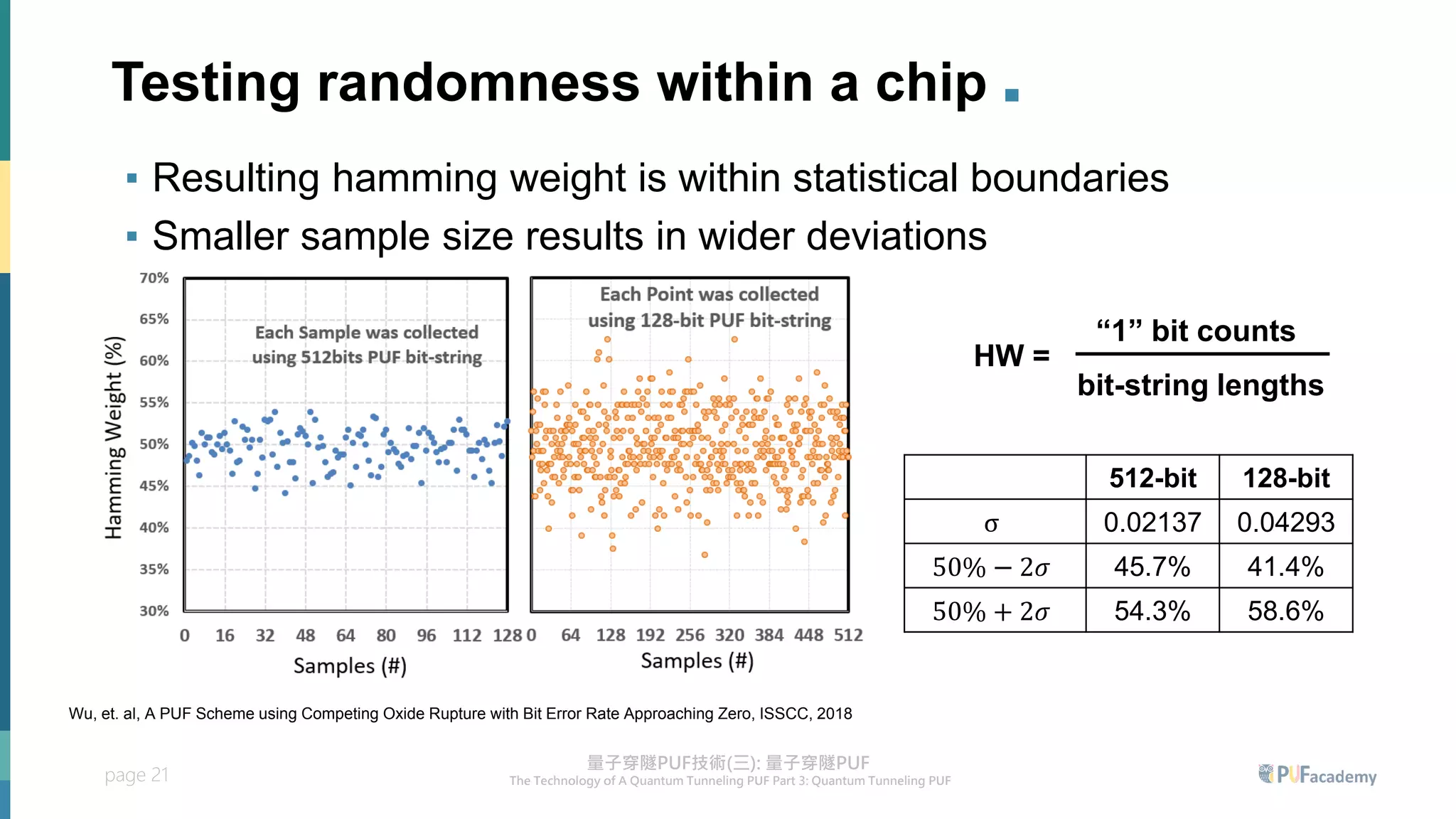
Testing randomness within a chip .
▪ Resulting hamming weight is within statistical boundaries
▪ Smaller sample size results in wider deviations
“1” bit counts
bit-string lengths
HW =
512-bit 128-bit
σ 0.02137 0.04293
50% − 2𝜎 45.7% 41.4%
50% + 2𝜎 54.3% 58.6%
Wu, et. al, A PUF Scheme using Competing Oxide Rupture with Bit Error Rate Approaching Zero, ISSCC, 2018
page 22
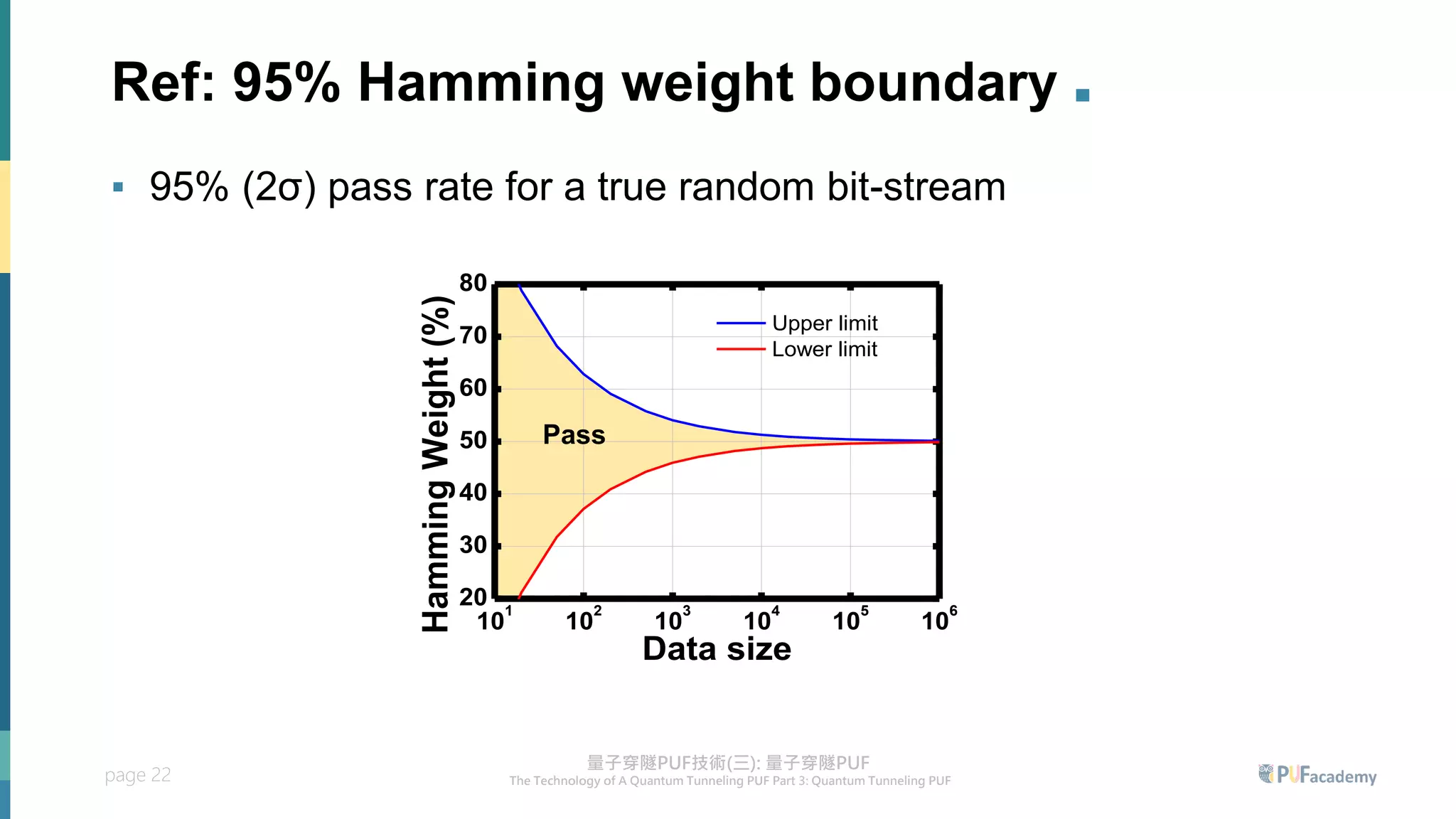
Ref: 95% Hamming weight boundary .
▪ 95% (2σ) pass rate for a true random bit-stream
10
1
10
2
10
3
10
4
10
5
10
6
20
30
40
50
60
70
80
Upper limit
Lower limit
Hamming
Weight
(%)
Data size
Pass
page 23
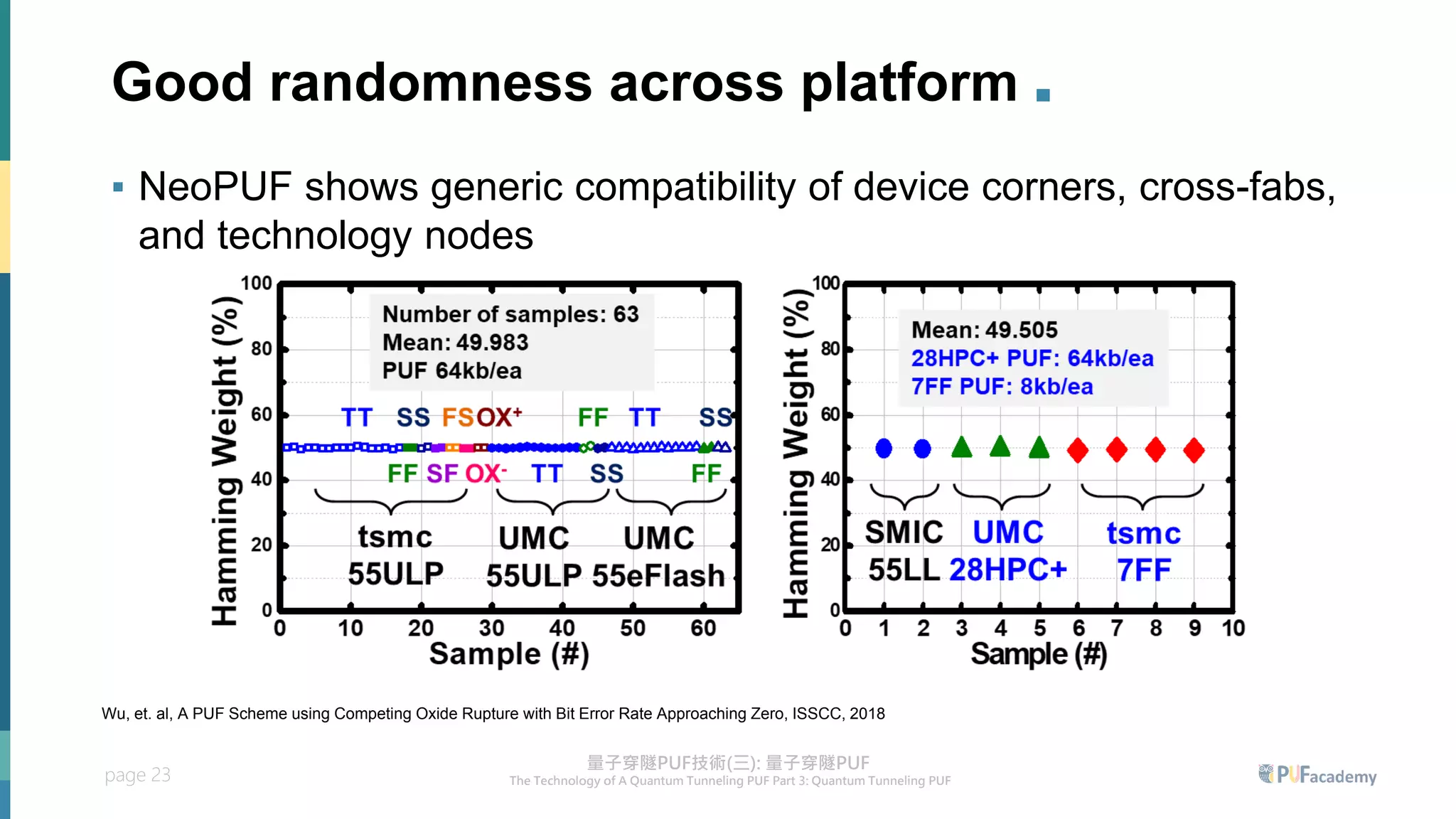
Good randomness across platform .
▪ NeoPUF shows generic compatibility of device corners, cross-fabs,
and technology nodes
Wu, et. al, A PUF Scheme using Competing Oxide Rupture with Bit Error Rate Approaching Zero, ISSCC, 2018
page 24
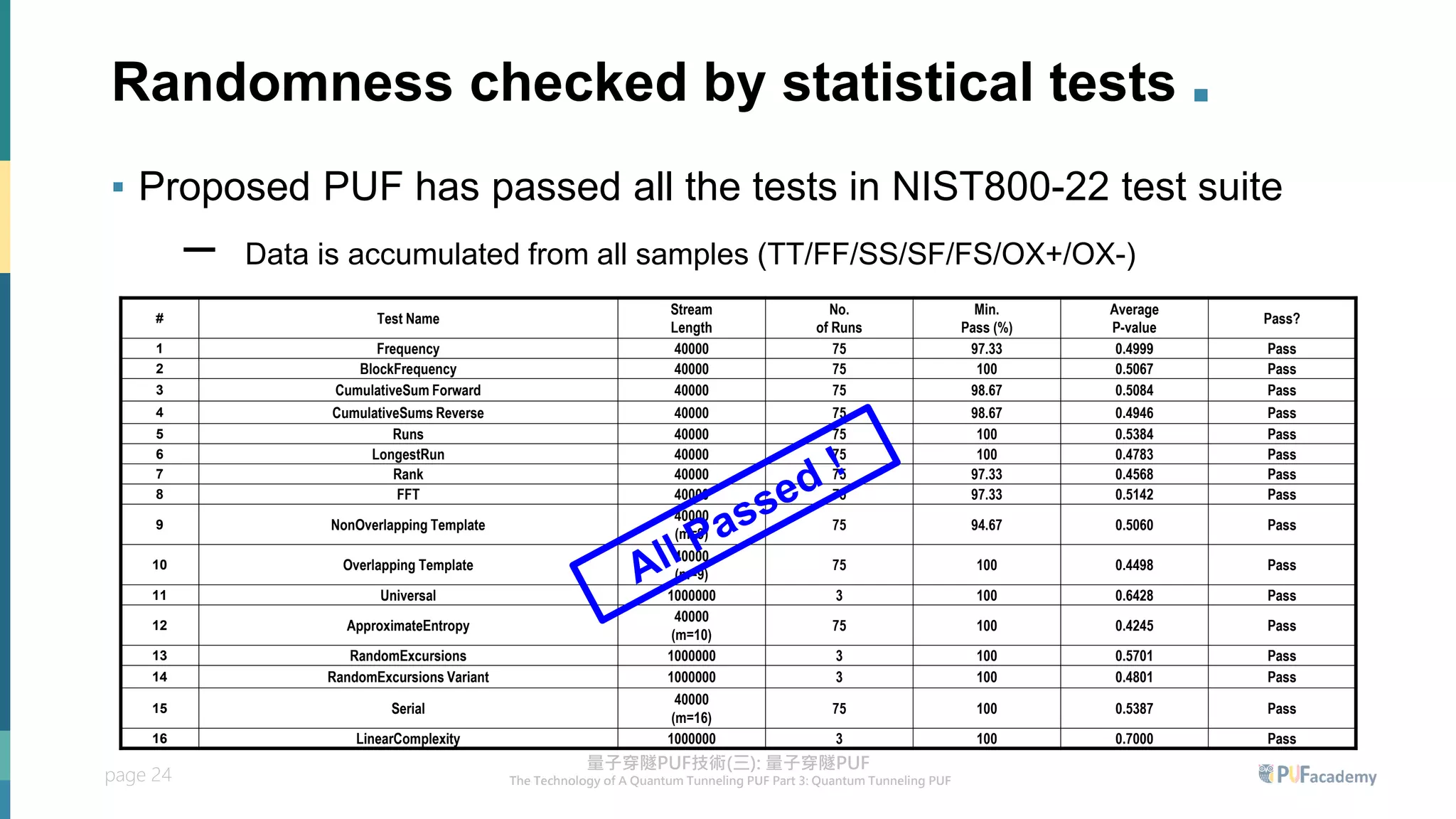
Randomness checked by statistical tests .
▪ Proposed PUF has passed all the tests in NIST800-22 test suite
– Data is accumulated from all samples (TT/FF/SS/SF/FS/OX+/OX-)
# Test Name
Stream
Length
No.
of Runs
Min.
Pass (%)
Average
P-value
Pass?
1 Frequency 40000 75 97.33 0.4999 Pass
2 BlockFrequency 40000 75 100 0.5067 Pass
3 CumulativeSum Forward 40000 75 98.67 0.5084 Pass
4 CumulativeSums Reverse 40000 75 98.67 0.4946 Pass
5 Runs 40000 75 100 0.5384 Pass
6 LongestRun 40000 75 100 0.4783 Pass
7 Rank 40000 75 97.33 0.4568 Pass
8 FFT 40000 75 97.33 0.5142 Pass
9 NonOverlapping Template
40000
(m=9)
75 94.67 0.5060 Pass
10 Overlapping Template
40000
(m=9)
75 100 0.4498 Pass
11 Universal 1000000 3 100 0.6428 Pass
12 ApproximateEntropy
40000
(m=10)
75 100 0.4245 Pass
13 RandomExcursions 1000000 3 100 0.5701 Pass
14 RandomExcursions Variant 1000000 3 100 0.4801 Pass
15 Serial
40000
(m=16)
75 100 0.5387 Pass
16 LinearComplexity 1000000 3 100 0.7000 Pass
page 25
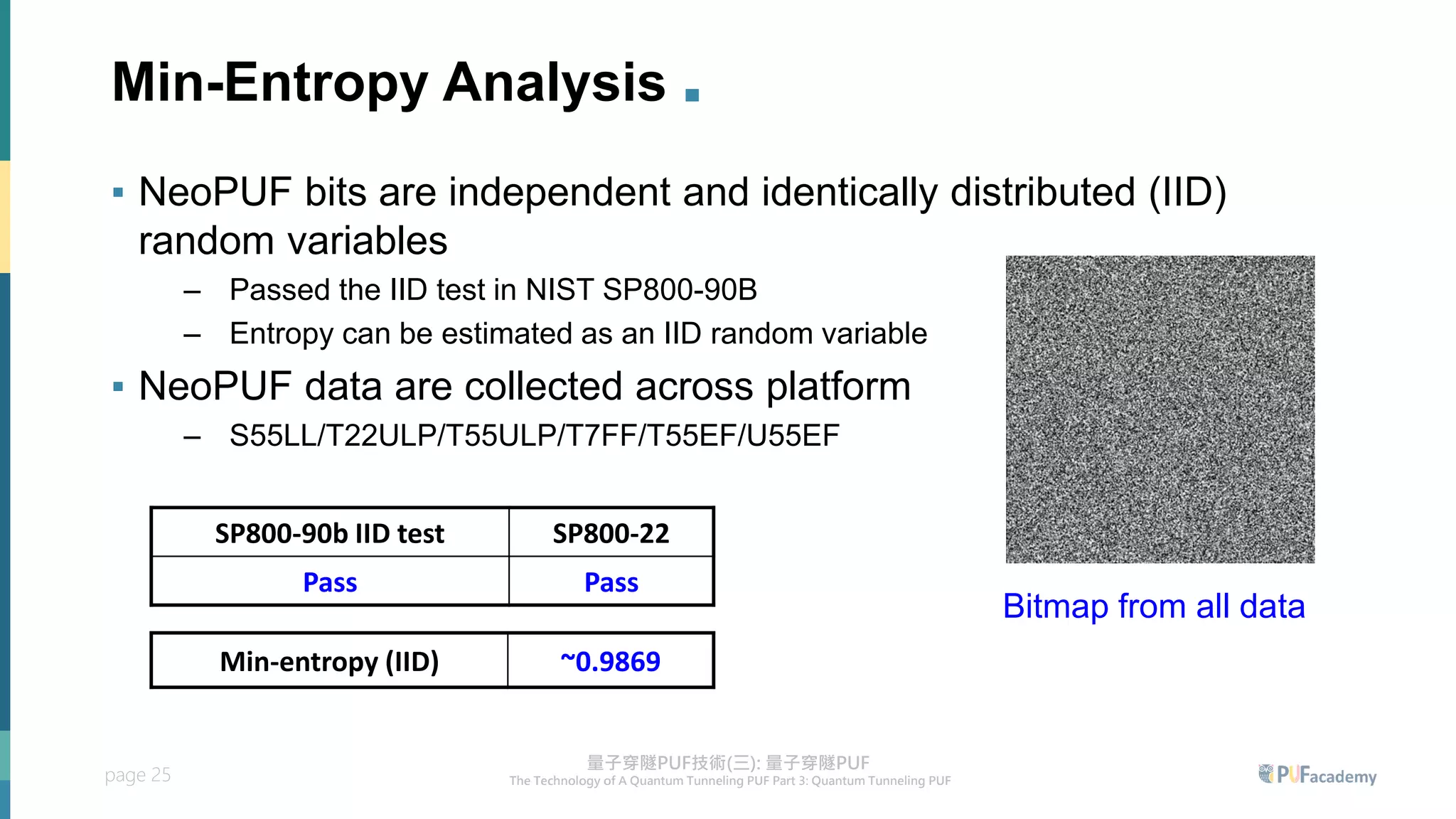
Min-Entropy Analysis .
▪ NeoPUF bits are independent and identically distributed (IID)
random variables
– Passed the IID test in NIST SP800-90B
– Entropy can be estimated as an IID random variable
▪ NeoPUF data are collected across platform
– S55LL/T22ULP/T55ULP/T7FF/T55EF/U55EF
SP800-90b IID test SP800-22
Pass Pass
Min-entropy (IID) ~0.9869
Bitmap from all data
Outline .
1. Recap
2. Design and implementation of quantum tunneling PUF
3. Experiment results of quantum tunneling PUF
5. Conclusion and Outlook
page 27
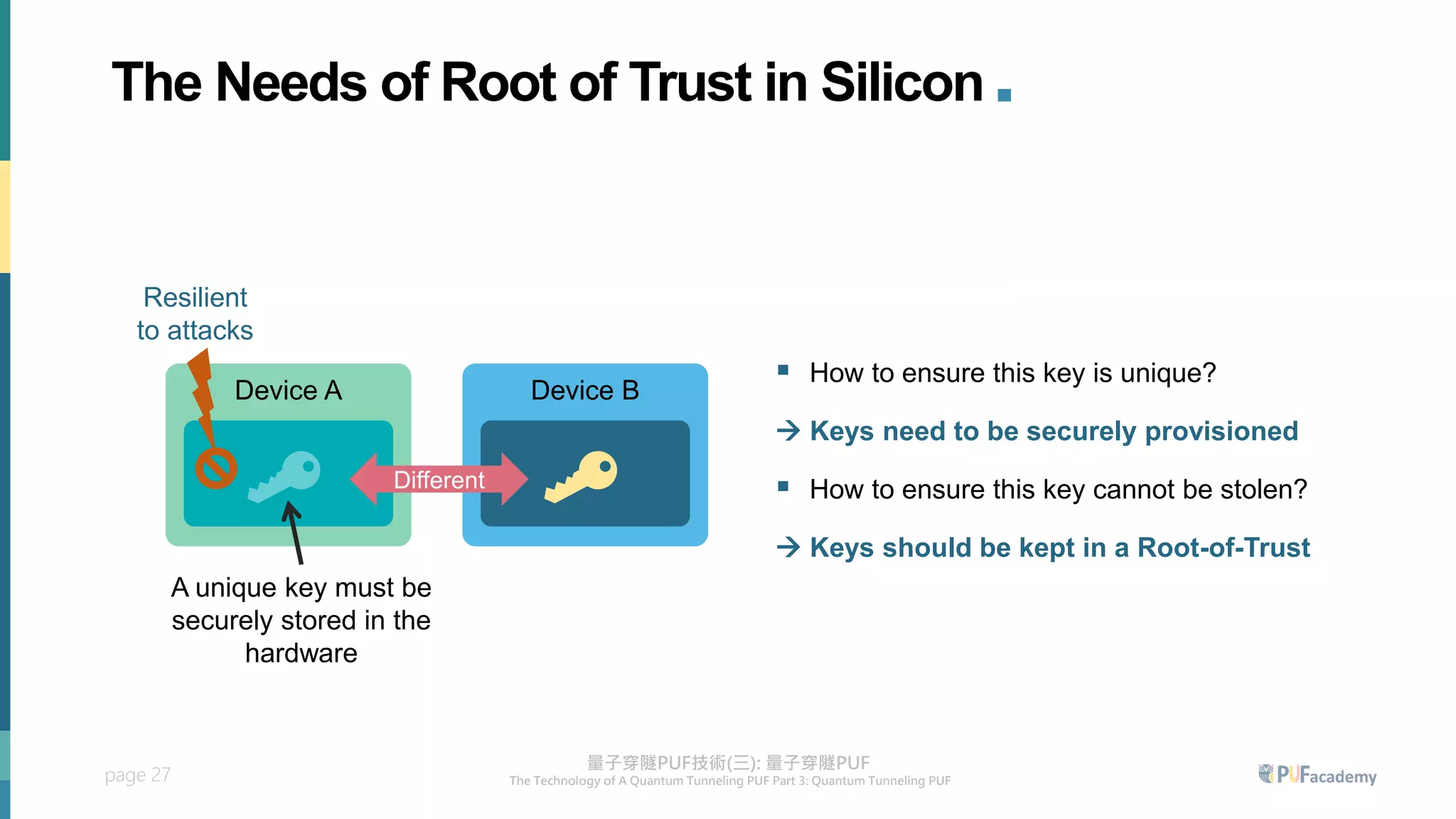
Device A
▪ How to ensure this key is unique?
→ Keys need to be securely provisioned
▪ How to ensure this key cannot be stolen?
→ Keys should be kept in a Root-of-Trust
A unique key must be
securely stored in the
hardware
Resilient
to attacks
Device B
Different
The Needs of Root of Trust in Silicon .
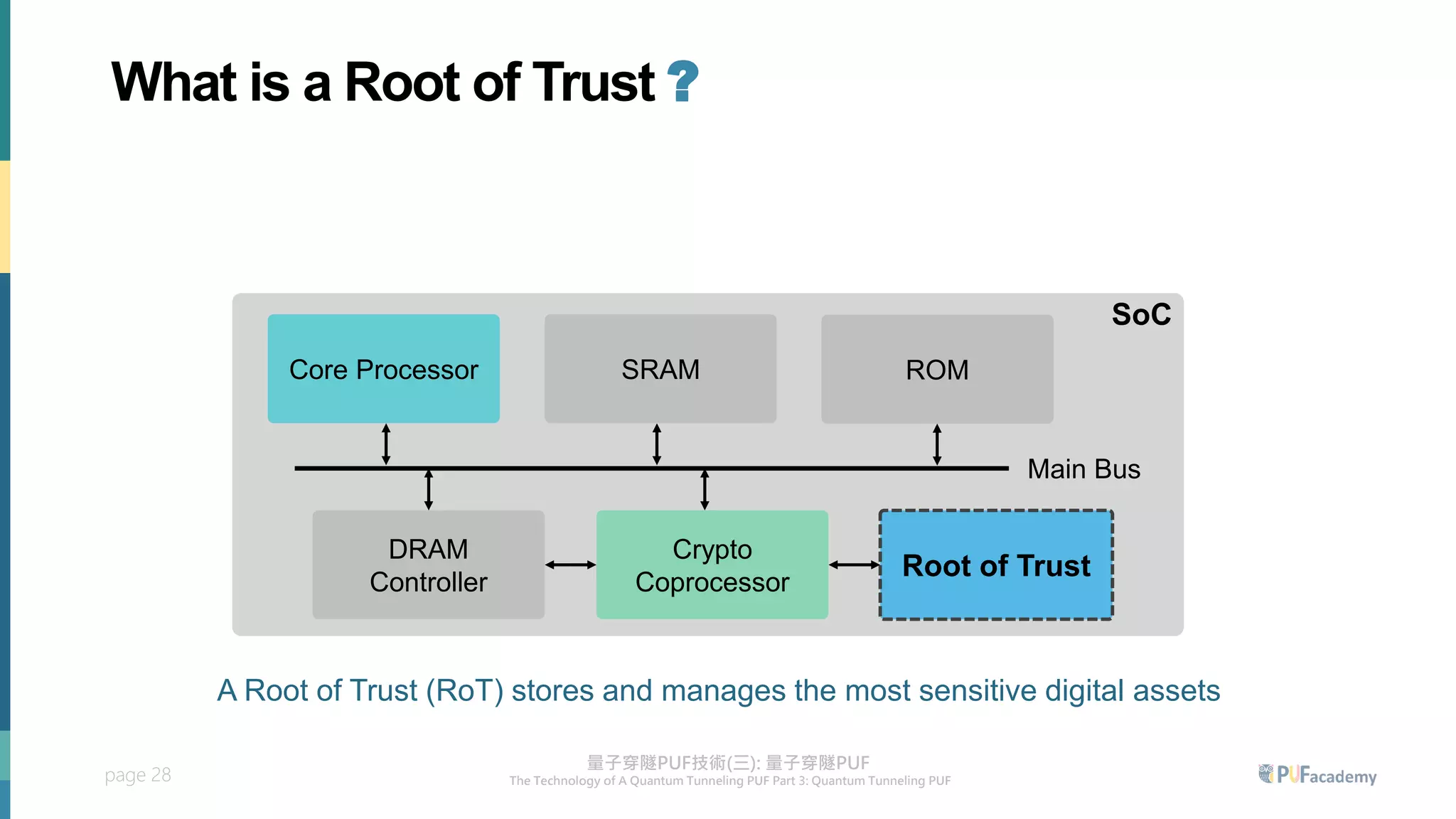
page 28
Root of Trust
Core Processor
Crypto
Coprocessor
DRAM
Controller
SRAM ROM
Main Bus
SoC
A Root of Trust (RoT) stores and manages the most sensitive digital assets
What is a Root of Trust ?
page 29
▪ Support comprehensive crypto
algorithms with high-speed extension
PUF-based Crypto Coprocessor (PUFcc)
CPU Core
APB AXI / AHB
PUFcc TRNG / UID / HUK
Anti-Tamper
Anti-fuse OTP + PUF
Crypto
DMA
SQC
▪ Unique key generated by PUF
▪ Secure key storage protected by PUF
PUF-based Root of Trust (PUFrt)
APB1
APB2
CPU Core
Secure
Sub-system
(Cryptos)
PUFrt HUK
TRNG
OTP
PUF-based Security IPs .
page 30
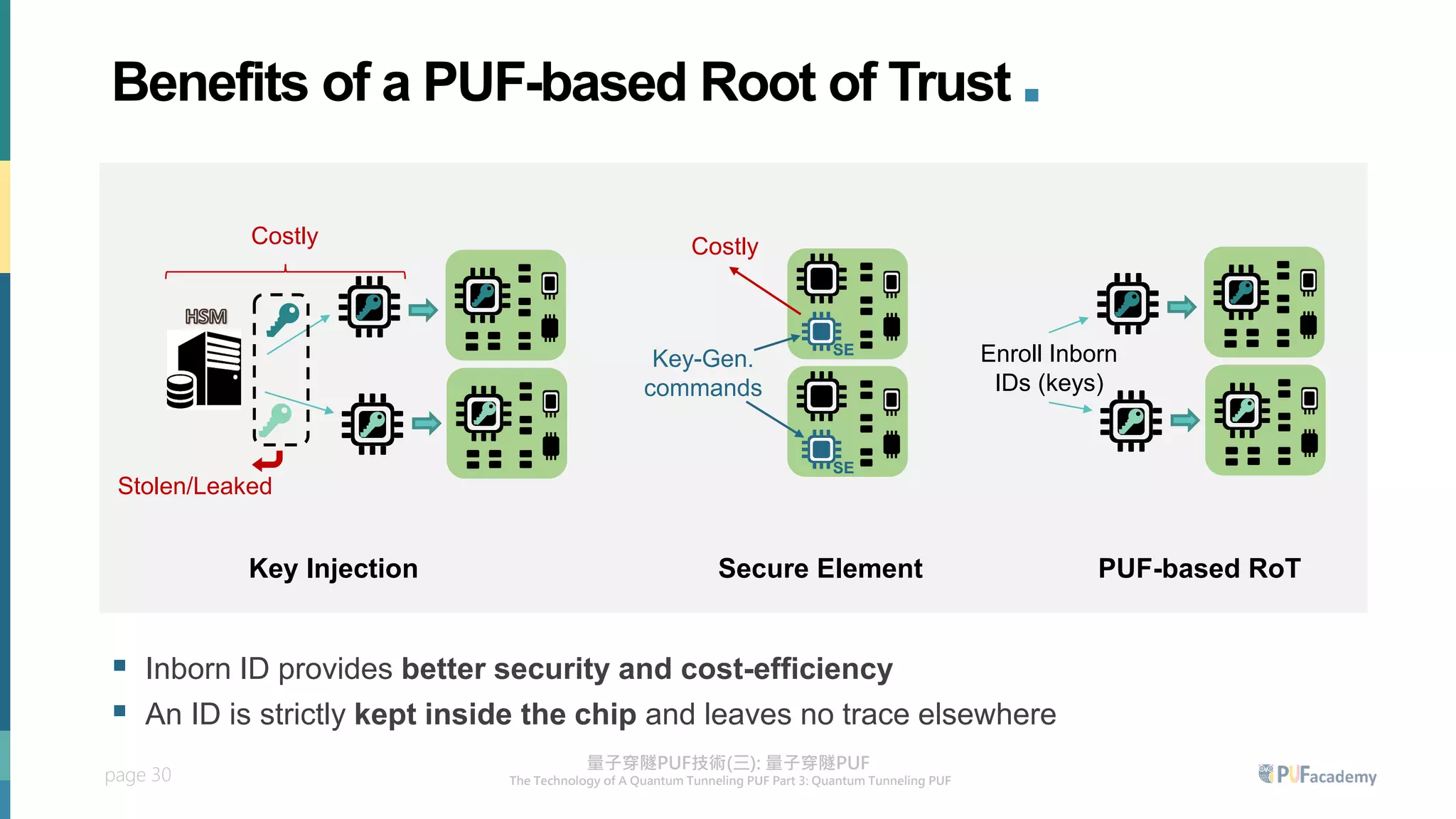
▪ Inborn ID provides better security and cost-efficiency
▪ An ID is strictly kept inside the chip and leaves no trace elsewhere
Key Injection Secure Element PUF-based RoT
Costly
Stolen/Leaked
Enroll Inborn
IDs (keys)
Key-Gen.
commands
Costly
SE
SE
Benefits of a PUF-based Root of Trust .
page 31
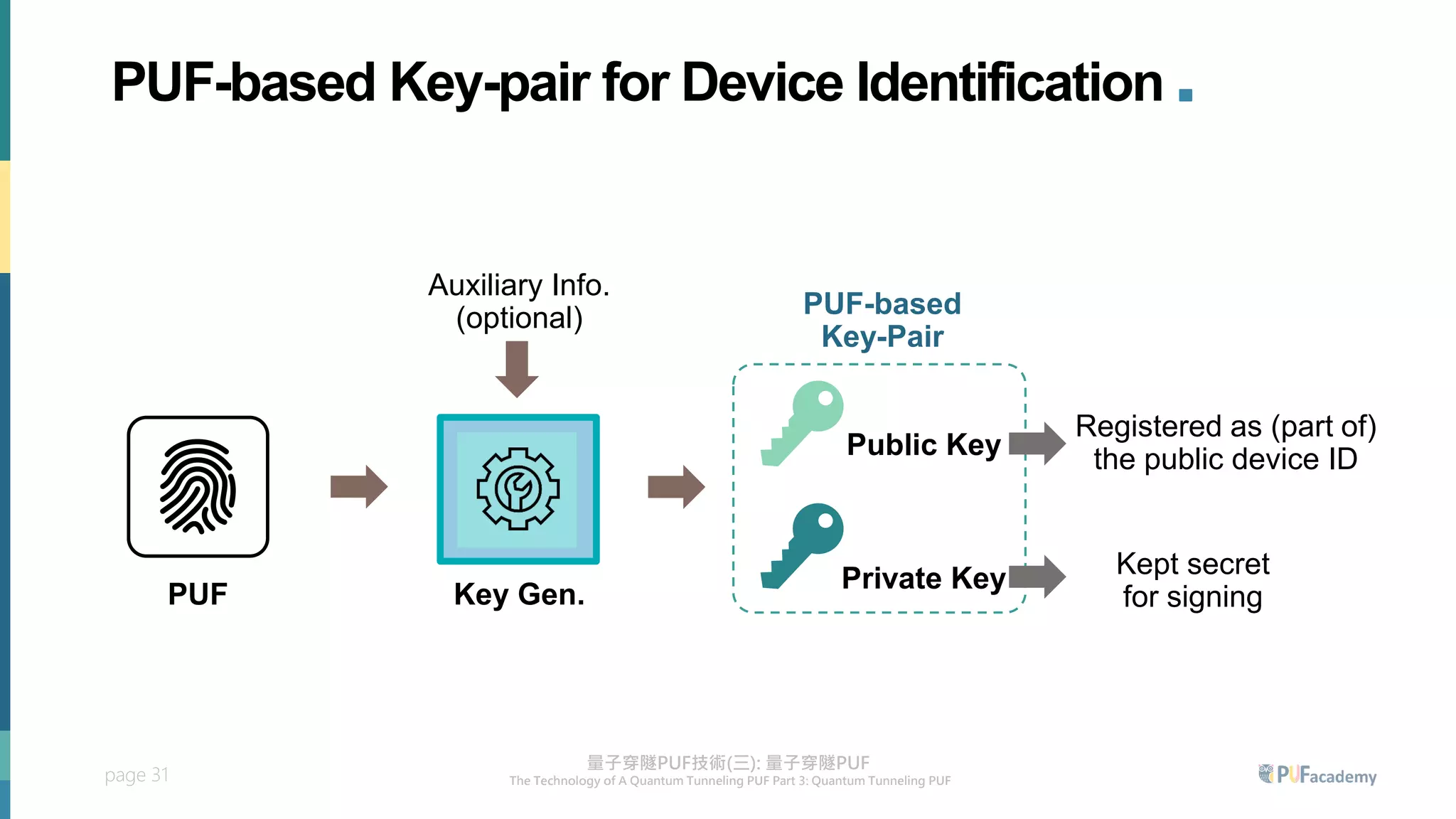
Key Gen.
PUF
Auxiliary Info.
(optional)
Public Key
Private Key
PUF-based
Key-Pair
Registered as (part of)
the public device ID
Kept secret
for signing
PUF-based Key-pair for Device Identification .
page 32
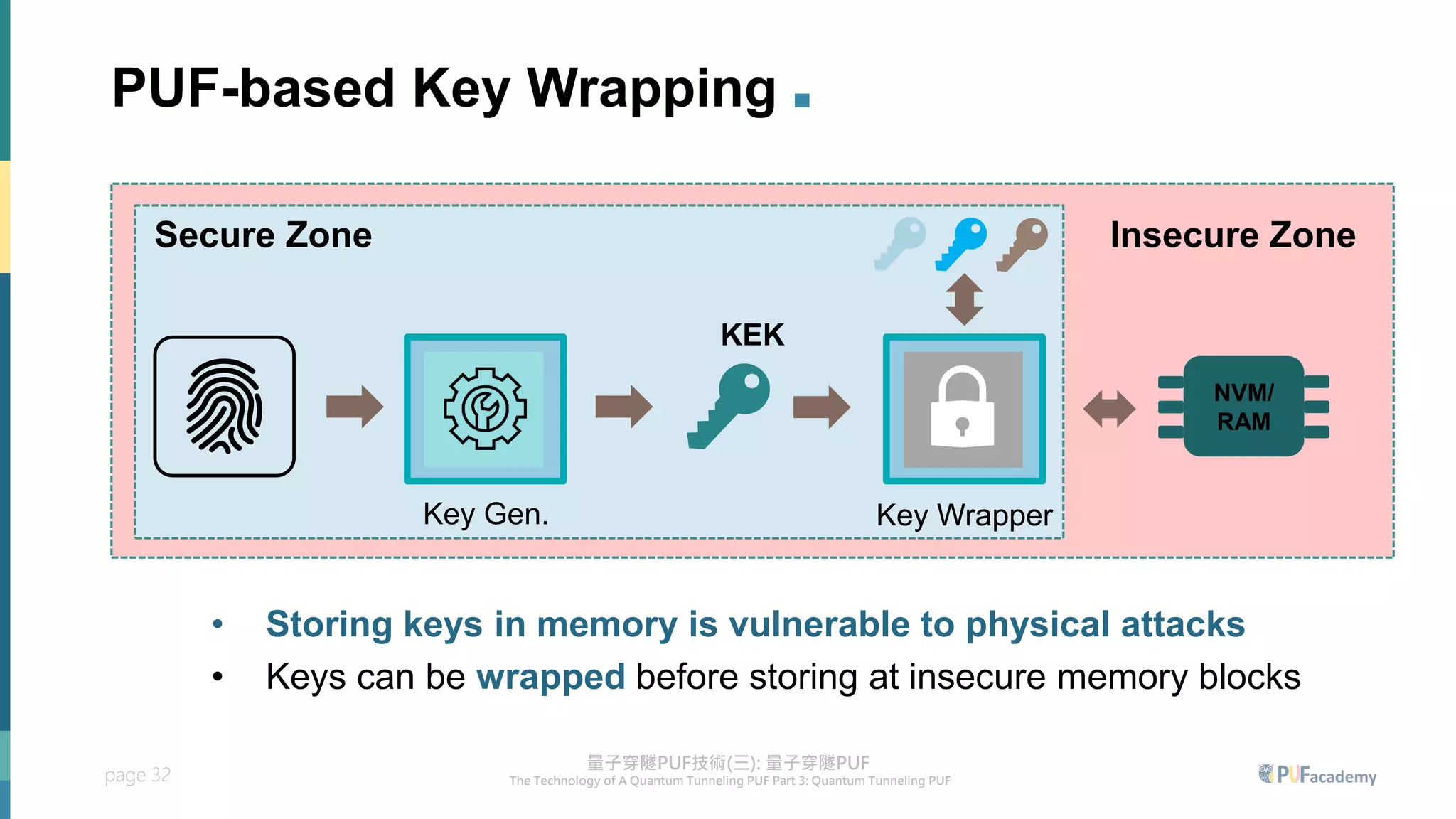
PUF-based Key Wrapping .
• Storing keys in memory is vulnerable to physical attacks
• Keys can be wrapped before storing at insecure memory blocks
Key Gen. Key Wrapper
NVM/
RAM
Insecure Zone
Secure Zone
KEK
page 33
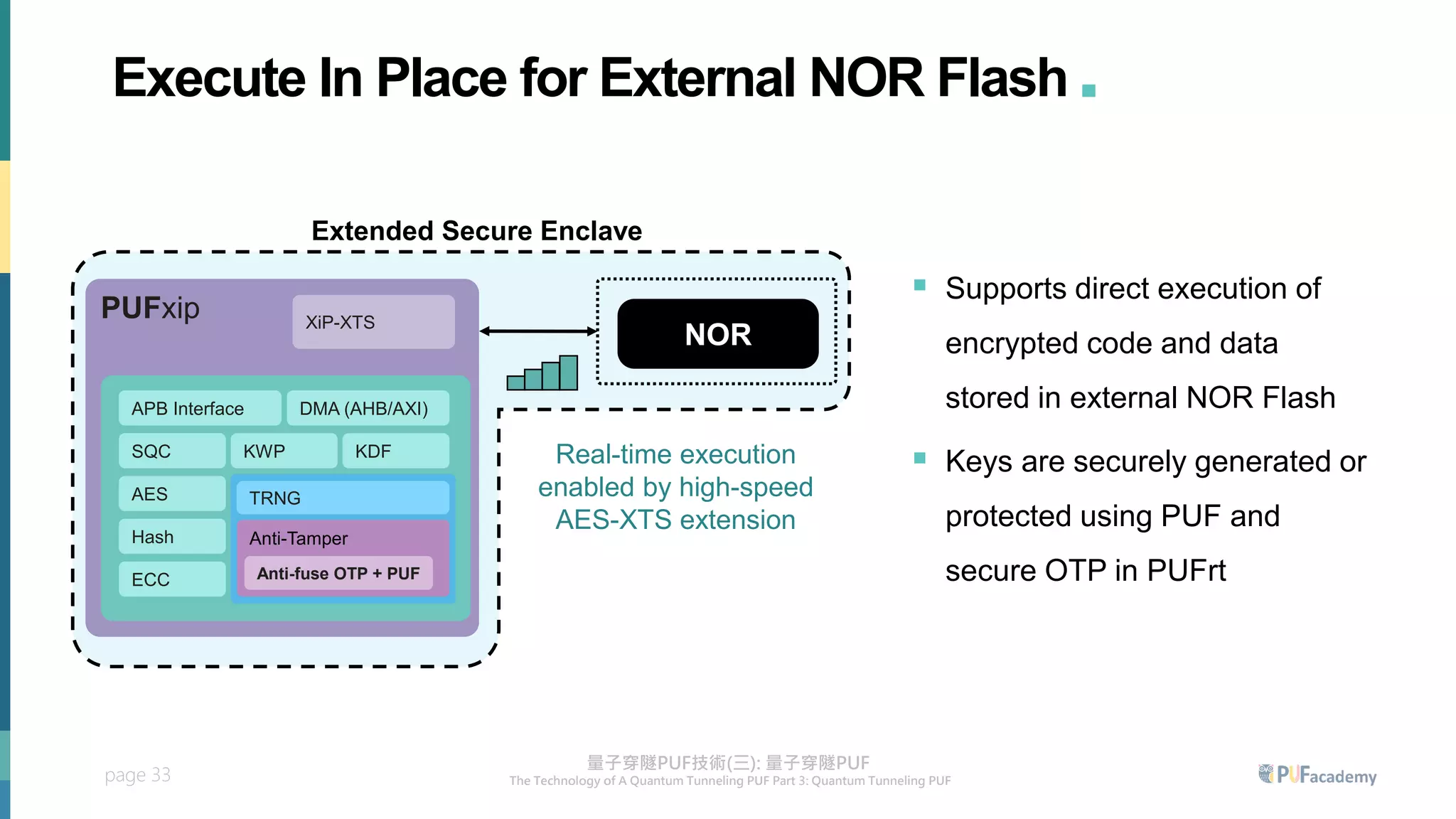
NOR
Real-time execution
enabled by high-speed
AES-XTS extension
Extended Secure Enclave
▪ Supports direct execution of
encrypted code and data
stored in external NOR Flash
▪ Keys are securely generated or
protected using PUF and
secure OTP in PUFrt
PUFxip XiP-XTS
TRNG
Anti-Tamper
Anti-fuse OTP + PUF
Hash
AES
ECC
DMA (AHB/AXI)
APB Interface
SQC KWP KDF
Execute In Place for External NOR Flash .
page 34
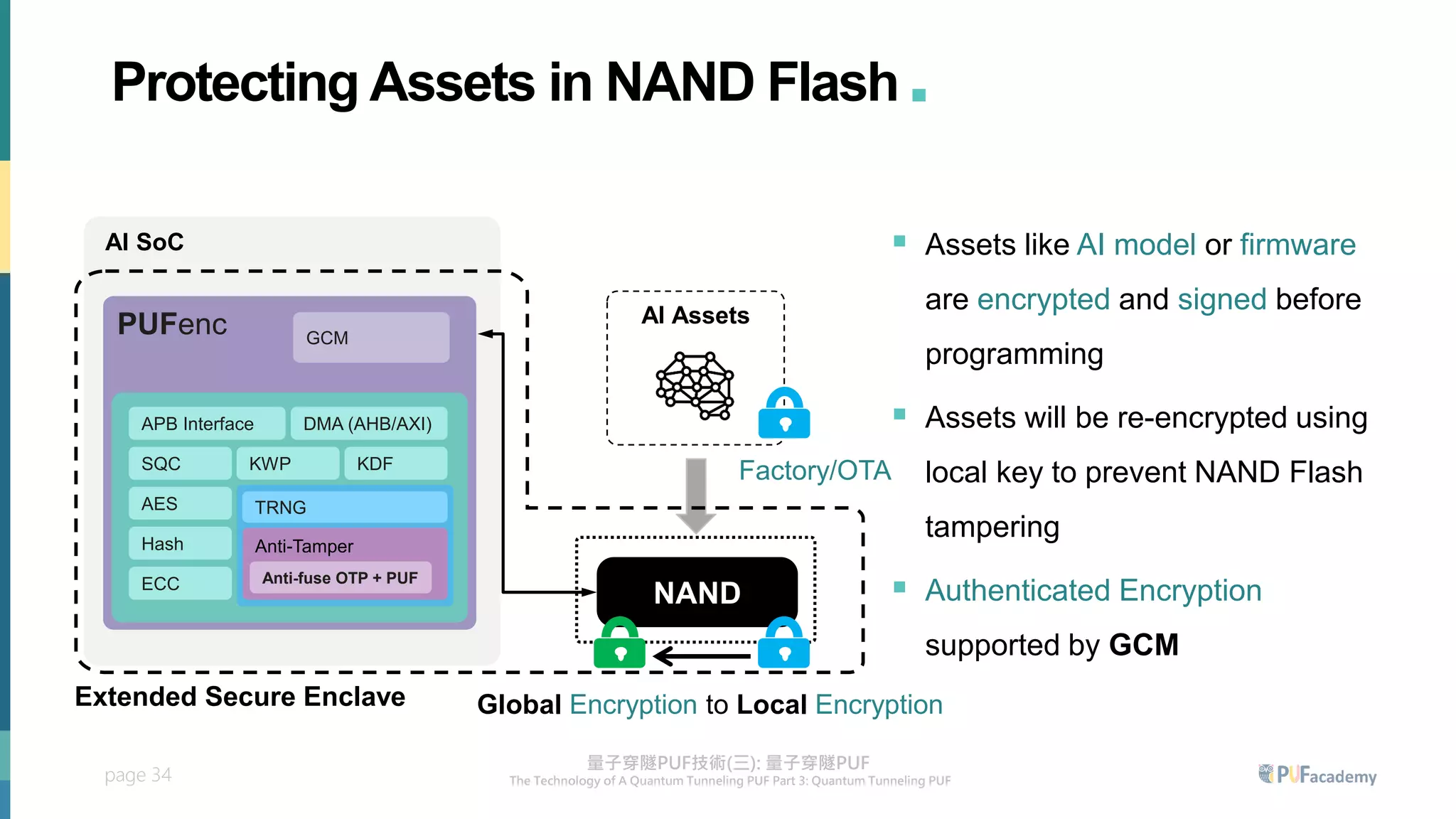
AI SoC
NAND
AI Assets
Global Encryption to Local Encryption
▪ Assets like AI model or firmware
are encrypted and signed before
programming
▪ Assets will be re-encrypted using
local key to prevent NAND Flash
tampering
▪ Authenticated Encryption
supported by GCM
Factory/OTA
PUFenc GCM
TRNG
Anti-Tamper
Anti-fuse OTP + PUF
Hash
AES
ECC
DMA (AHB/AXI)
APB Interface
SQC KWP KDF
Extended Secure Enclave
Protecting Assets in NAND Flash .
page 35
Secure IoT Network
Zero-Touch Device Onboard
Supply Chain End-of-Life
Kpri
Kpub
Registration
Kpri
Kpub
Onboard
Credentials
Assign
Kpri
Kpub
Owner
Credentials
Cloud
Service
Network
Management
DeID zeroization
Kpub
ODM
CA
Kpub
Assembly
Inborn
Cert.
Distribution Channel
Onboard
Service Disassembly
Decommission
Credential Update
Onboard Protocols
Establishing a Secure IoT Ecosystem .
page 36
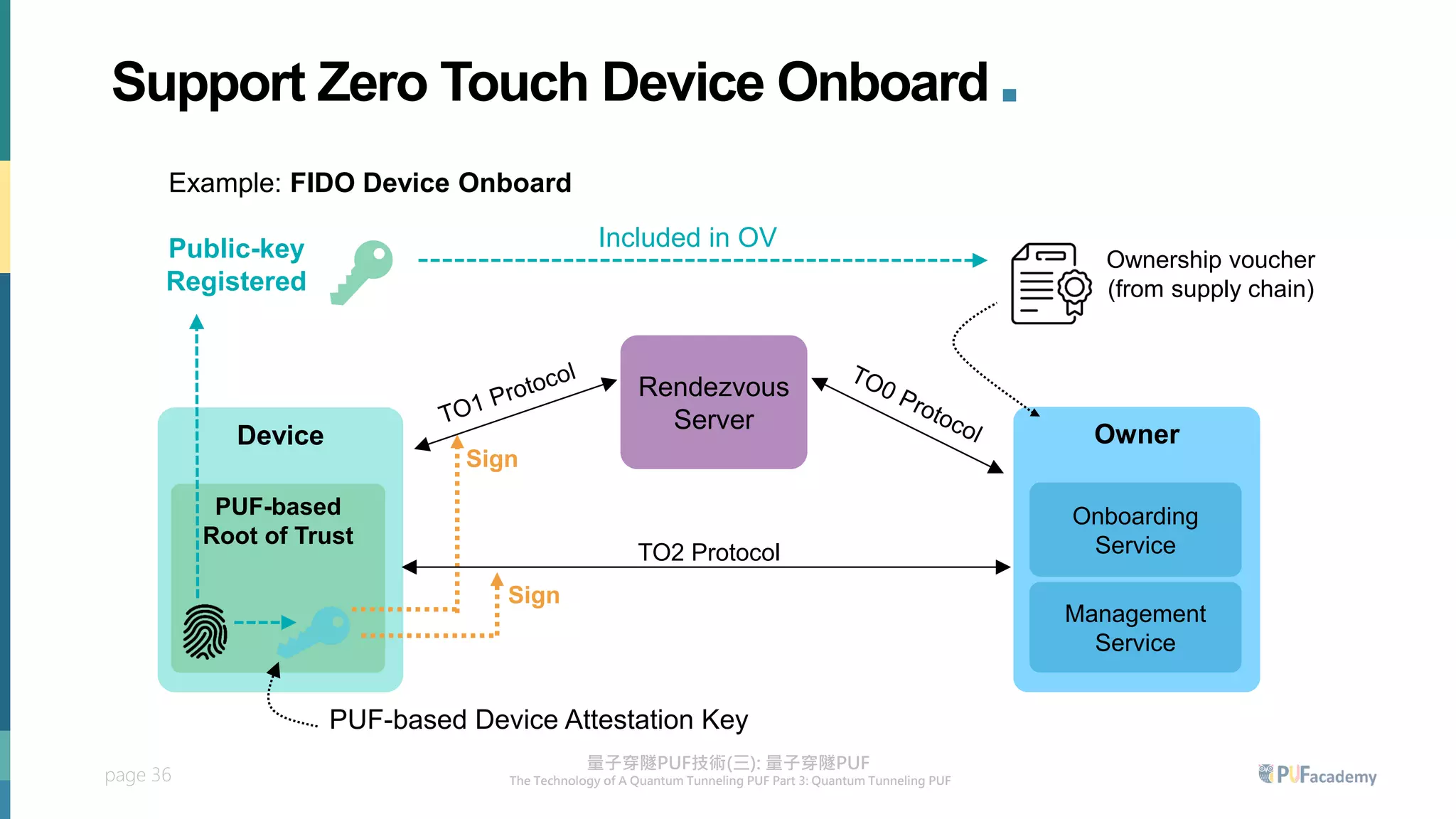
Device
PUF-based
Root of Trust
Owner
Onboarding
Service
Management
Service
Sign
Sign
Ownership voucher
(from supply chain)
Rendezvous
Server
TO2 Protocol
z
PUF-based Device Attestation Key
Public-key
Registered
Included in OV
Example: FIDO Device Onboard
Support Zero Touch Device Onboard .
page 37
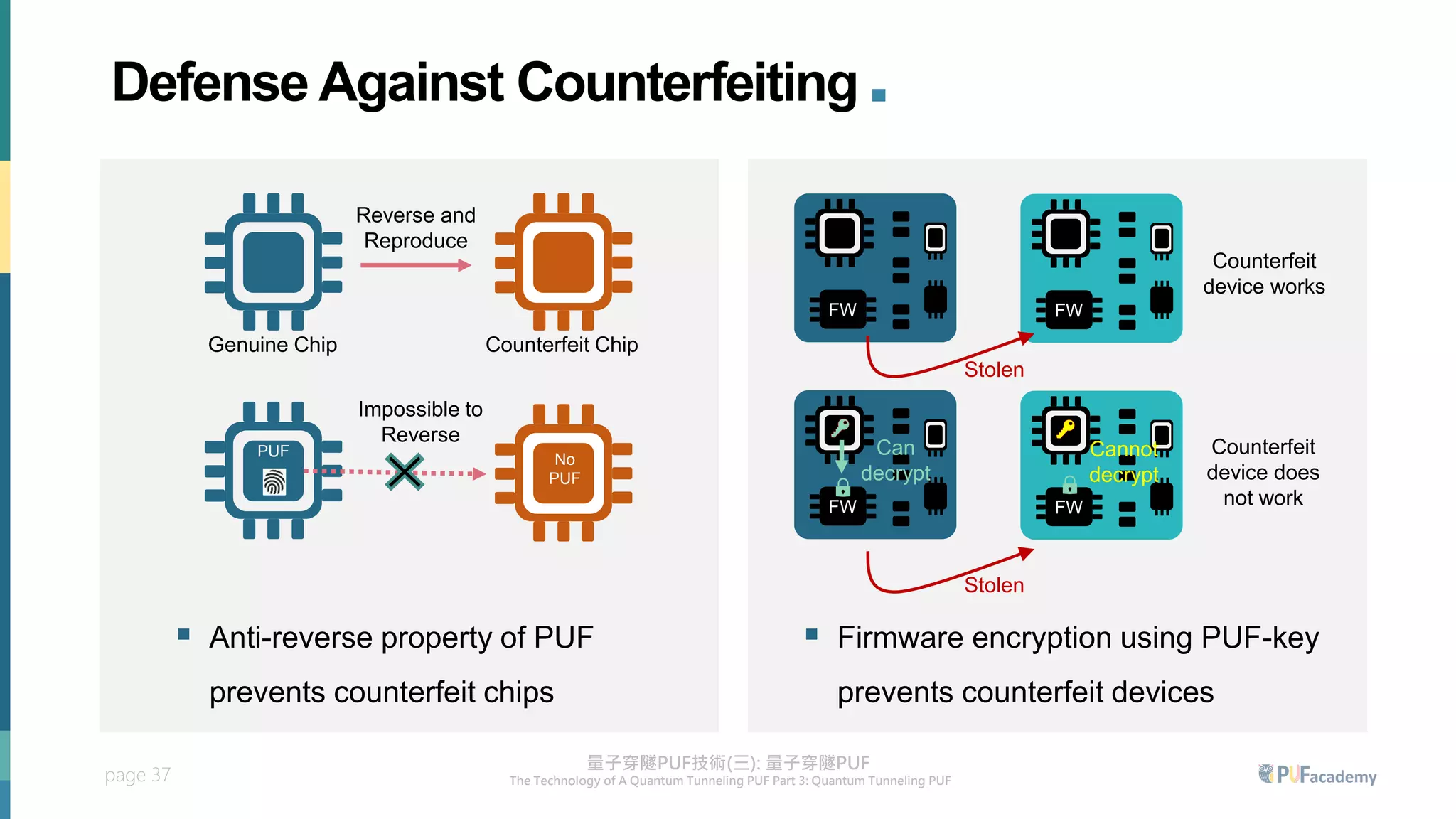
FW
Counterfeit
device works
FW
Stolen
FW FW
Can
decrypt
Cannot
decrypt
Counterfeit
device does
not work
PUF
Reverse and
Reproduce
Genuine Chip Counterfeit Chip
Impossible to
Reverse
No
PUF
▪ Anti-reverse property of PUF
prevents counterfeit chips
▪ Firmware encryption using PUF-key
prevents counterfeit devices
Stolen
Defense Against Counterfeiting .
page 38
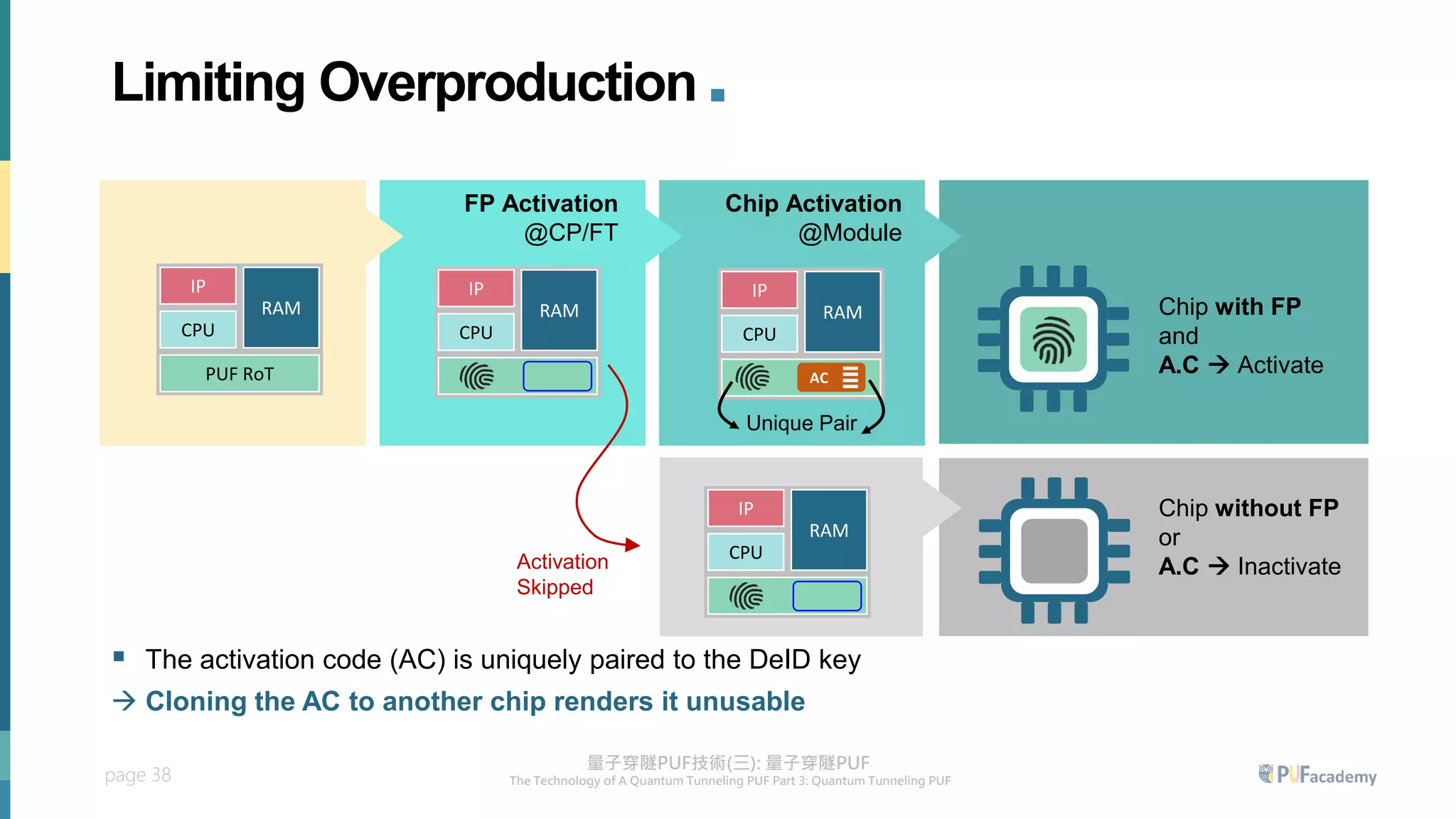
▪ The activation code (AC) is uniquely paired to the DeID key
→ Cloning the AC to another chip renders it unusable
FP Activation
@CP/FT
Chip Activation
@Module
Activation
Skipped
IP
CPU
RAM
PUF RoT
IP
CPU
RAM
IP
CPU
RAM
AC
Unique Pair
IP
CPU
RAM
Chip with FP
and
A.C → Activate
Chip without FP
or
A.C → Inactivate
Limiting Overproduction .
Outline .
1. Recap
2. Design and implementation of quantum tunneling PUF
3. Experiment results of quantum tunneling PUF
4. PUF-based security applications
PUFsecurity
page 40
page 40
Conclusion .
Quantum tunneling PUF has been introduced:
▪ It provides good randomness, reliability and physical security
▪ Root of trust and security IPs can be built upon it
▪ It enables a wide range of security applications
… helps building a more secure connected world
PUFsecurity
page 41
page 41
Outlook .
Coming up:
▪ PUF implementations in literature
▪ Performance comparison of different PUFs
▪ Analysis on yield, reliability, and physical attack vulnerability
Thank you!
More educational materials? Feel free to follow us!

PUF_lecture3.pdf

  • 2.
    Quantum Tunneling PUFs andPUF-based Applications . Dr. Kent Chuang 2022 September
  • 3.
    Outline . 1. Recap 2.Design and implementation of quantum tunneling PUF 3. Experiment results of quantum tunneling PUF 4. PUF-based security applications 5. Conclusion and Outlook
  • 4.
    Outline . 2. Designand implementation of quantum tunneling PUF 3. Experiment results of quantum tunneling PUF 4. PUF-based security applications 5. Conclusion and Outlook
  • 5.
    page 5 Recap . Inthe previous lectures, we have introduced ▪ The importance of hardware security & root of trust ▪ What is a PUF? ▪ What are the important PUF properties? ▪ The importance of reliability ▪ How to improve reliability? ▪ Intrinsically reliable PUFs based on quantum tunneling
  • 6.
    page 6 Key GenerationUsing PUF . KDF Device Secret Auxiliary Input (Optional) Secret Key PUF Array 0 1 0 1 0 1 0 0 0 Readout Interface ▪ Unique device secret can be derived from the PUF array ▪ Secret key can be further derived by sending the device secret into the key derivation function (KDF)
  • 7.
    page 7 PUFs needto be intrinsically reliable . Readout Interface Post- processing n-bit k-bit Stabilization m-bit ▪ Error correction is too costly – Extra cost on computation resources, storage and latency ▪ Stabilization techniques are insufficient Costly Insufficient
  • 8.
    page 8 Increase mismatchesthrough burn-in . VT Percentage Burn-in VT Percentage For example: ▪ VT of the two transistors originally follow the same distribution ▪ The distribution can be separated by applying burn-in mechanism
  • 9.
    page 9 Quantum TunnelingPUFs . “0” “1” 50% 50% [Chuang, JSSC 2019] [Wu, ISSCC 2018] 50% 50% “0” “1” ▪ Only one tunneling path will be generated in two of the NMOS transistors ▪ Reading out the tunneling current of PUF cells → deriving PUF bits
  • 10.
    Outline . 1. Recap 3.Experiment results of quantum tunneling PUF 4. PUF-based security applications 5. Conclusion and Outlook
  • 11.
    page 11 Plenary Speech2 PUF Array PUF Bit-Cell PUF Enrollment BL BL VAF-0 VAF-1 AF-0(VPP) AF-1(VPP) AF-0(VPP) AF-1(VPP) 50% 50% “1” Cell “0” Cell 0 1 0 1 0 1 0 1 1 1 0 1 0 0 1 0 A Quantum Tunneling PUF .
  • 12.
    page 12 The self-limitingmechanism . ▪ Current and voltage are limited by the PMOS selector ▪ Ensuring only one BD (tunneling) spot in a PUF cell Δ = Vstress - VDS Vstress VG VDS IBD Reduced stress voltage → No breakdown Limited BD current → Only soft-BD Define saturation current (current limit) Vstress VG Apply constant voltage stress Time to breakdown (tBD) Chuang, et. al, A Physically Unclonable Function Using Soft Oxide Breakdown Featuring 0% Native BER and 51.8fJ/bit in 40nm CMOS, JSSC 2019
  • 13.
    page 13 Tunneling spotsare untraceable . ▪ Current is conducted through trap-assisted tunneling ‒ Few traps can result in significant current difference ‒ Traps are extremely difficult to locate ▪ Current/power limitation should be applied for physical security Formation of oxide defects→ untraceable Metal Gate Substrate Substrate Metal Gate With power limit Without power limit Substrate Metal Gate → Structural damages may be created by heat (easier to trace)
  • 14.
    page 14 UN-PROGRAMMED Blown Fuse PROGRAMMED UN-PROGRAMMEDPROGRAMMED SEM Image of eFuse SEM Image of a Quantum Tunneling PUF PUF Crypto Key eFuse Program Crypto Key Conventional Key Storage (eFuse) Key Generation using PUF Resilient to reverse engineering .
  • 15.
    page 15 PUF arraywith single-ended readout scheme . Having two tunneling path is still fine →Probability < 50ppm Wu, et. al, A PUF Scheme using Competing Oxide Rupture with Bit Error Rate Approaching Zero, ISSCC, 2018
  • 16.
    page 16 Sense-amplifier designwith balanced current . Sense Amplifier Equal current when sensing “0”/“1” “0”/“1” PUF Array ▪ Minimize power difference required for sensing “0” & “1” ▪ Turn off the cell operation after sensing ▪ Prevent power analysis and photoemission attacks Read 1 Read 0 Unbalanced Design Balanced Design
  • 17.
    Outline . 1. Recap 2.Design and implementation of quantum tunneling PUF 4. PUF-based security applications 5. Conclusion and Outlook
  • 18.
    page 18 Nearly idealuniqueness and reproducibility . ▪ Inter-ID Hamming Distance (HD) follows the ideal distribution ▪ Intra-ID HD is the ideal value: 0 → There is no error 0.0 0.1 0.2 0.3 0.4 0.5 0.6 0.7 0.8 0.9 1.0 0.0 0.1 0.2 0.3 0.4 0.5 0.6 0.7 0.8 0.9 1.0 Count (Normalized) Hamming Distance (Normalized) Inter-ID Ideal Data Inter/Intra=∞ μ = 0.499999 σ = 0.031252 Intra-ID -40~175℃ μ = 0 σ = 0 Information Bit String Length 256 bits Total ID Count 16128 Total Bit Count 4128768 Total HD Count 130048128 Wu, et. al, A PUF Scheme using Competing Oxide Rupture with Bit Error Rate Approaching Zero, ISSCC, 2018
  • 19.
    page 19 PUF responsesare consistent . ▪ No bit error found across all tested conditions → Wide supply voltage range covering the ULP spec → Wide temperature range from -40 °C to 175 °C 0.8 1.0 1.2 1.4 2.0 2.4 2.8 3.2 0 1 2 3 Bit Error Rate (ppm) Supply Voltage (V) VDD VDD2 -40 0 40 80 120 160 200 0 1 2 3 Bit Error Rate (ppm) Temperature (C) Wu, et. al, A PUF Scheme using Competing Oxide Rupture with Bit Error Rate Approaching Zero, ISSCC, 2018
  • 20.
    page 20 No bit-errorcaused by aging . ▪ Consistent response during and after the HTOL test → Reliability qualification passed 1 10 100 0 1 2 3 Bit Error Rate (ppm) Challenge-Response-Pair (#) 0 100 1000 0 1 2 3 Bit Error Rate (ppm) Aging Time (hrs) HTOL Burn-In: VDD = 1.7V VDD2 = 3.5V Temp. = 125℃ Post Burn-in VDD = 1.7V VDD2 = 3.5V Temp. = 125℃ Samples: TT*77 Wu, et. al, A PUF Scheme using Competing Oxide Rupture with Bit Error Rate Approaching Zero, ISSCC, 2018
  • 21.
    page 21 Testing randomnesswithin a chip . ▪ Resulting hamming weight is within statistical boundaries ▪ Smaller sample size results in wider deviations “1” bit counts bit-string lengths HW = 512-bit 128-bit σ 0.02137 0.04293 50% − 2𝜎 45.7% 41.4% 50% + 2𝜎 54.3% 58.6% Wu, et. al, A PUF Scheme using Competing Oxide Rupture with Bit Error Rate Approaching Zero, ISSCC, 2018
  • 22.
    page 22 Ref: 95%Hamming weight boundary . ▪ 95% (2σ) pass rate for a true random bit-stream 10 1 10 2 10 3 10 4 10 5 10 6 20 30 40 50 60 70 80 Upper limit Lower limit Hamming Weight (%) Data size Pass
  • 23.
    page 23 Good randomnessacross platform . ▪ NeoPUF shows generic compatibility of device corners, cross-fabs, and technology nodes Wu, et. al, A PUF Scheme using Competing Oxide Rupture with Bit Error Rate Approaching Zero, ISSCC, 2018
  • 24.
    page 24 Randomness checkedby statistical tests . ▪ Proposed PUF has passed all the tests in NIST800-22 test suite – Data is accumulated from all samples (TT/FF/SS/SF/FS/OX+/OX-) # Test Name Stream Length No. of Runs Min. Pass (%) Average P-value Pass? 1 Frequency 40000 75 97.33 0.4999 Pass 2 BlockFrequency 40000 75 100 0.5067 Pass 3 CumulativeSum Forward 40000 75 98.67 0.5084 Pass 4 CumulativeSums Reverse 40000 75 98.67 0.4946 Pass 5 Runs 40000 75 100 0.5384 Pass 6 LongestRun 40000 75 100 0.4783 Pass 7 Rank 40000 75 97.33 0.4568 Pass 8 FFT 40000 75 97.33 0.5142 Pass 9 NonOverlapping Template 40000 (m=9) 75 94.67 0.5060 Pass 10 Overlapping Template 40000 (m=9) 75 100 0.4498 Pass 11 Universal 1000000 3 100 0.6428 Pass 12 ApproximateEntropy 40000 (m=10) 75 100 0.4245 Pass 13 RandomExcursions 1000000 3 100 0.5701 Pass 14 RandomExcursions Variant 1000000 3 100 0.4801 Pass 15 Serial 40000 (m=16) 75 100 0.5387 Pass 16 LinearComplexity 1000000 3 100 0.7000 Pass
  • 25.
    page 25 Min-Entropy Analysis. ▪ NeoPUF bits are independent and identically distributed (IID) random variables – Passed the IID test in NIST SP800-90B – Entropy can be estimated as an IID random variable ▪ NeoPUF data are collected across platform – S55LL/T22ULP/T55ULP/T7FF/T55EF/U55EF SP800-90b IID test SP800-22 Pass Pass Min-entropy (IID) ~0.9869 Bitmap from all data
  • 26.
    Outline . 1. Recap 2.Design and implementation of quantum tunneling PUF 3. Experiment results of quantum tunneling PUF 5. Conclusion and Outlook
  • 27.
    page 27 Device A ▪How to ensure this key is unique? → Keys need to be securely provisioned ▪ How to ensure this key cannot be stolen? → Keys should be kept in a Root-of-Trust A unique key must be securely stored in the hardware Resilient to attacks Device B Different The Needs of Root of Trust in Silicon .
  • 28.
    page 28 Root ofTrust Core Processor Crypto Coprocessor DRAM Controller SRAM ROM Main Bus SoC A Root of Trust (RoT) stores and manages the most sensitive digital assets What is a Root of Trust ?
  • 29.
    page 29 ▪ Supportcomprehensive crypto algorithms with high-speed extension PUF-based Crypto Coprocessor (PUFcc) CPU Core APB AXI / AHB PUFcc TRNG / UID / HUK Anti-Tamper Anti-fuse OTP + PUF Crypto DMA SQC ▪ Unique key generated by PUF ▪ Secure key storage protected by PUF PUF-based Root of Trust (PUFrt) APB1 APB2 CPU Core Secure Sub-system (Cryptos) PUFrt HUK TRNG OTP PUF-based Security IPs .
  • 30.
    page 30 ▪ InbornID provides better security and cost-efficiency ▪ An ID is strictly kept inside the chip and leaves no trace elsewhere Key Injection Secure Element PUF-based RoT Costly Stolen/Leaked Enroll Inborn IDs (keys) Key-Gen. commands Costly SE SE Benefits of a PUF-based Root of Trust .
  • 31.
    page 31 Key Gen. PUF AuxiliaryInfo. (optional) Public Key Private Key PUF-based Key-Pair Registered as (part of) the public device ID Kept secret for signing PUF-based Key-pair for Device Identification .
  • 32.
    page 32 PUF-based KeyWrapping . • Storing keys in memory is vulnerable to physical attacks • Keys can be wrapped before storing at insecure memory blocks Key Gen. Key Wrapper NVM/ RAM Insecure Zone Secure Zone KEK
  • 33.
    page 33 NOR Real-time execution enabledby high-speed AES-XTS extension Extended Secure Enclave ▪ Supports direct execution of encrypted code and data stored in external NOR Flash ▪ Keys are securely generated or protected using PUF and secure OTP in PUFrt PUFxip XiP-XTS TRNG Anti-Tamper Anti-fuse OTP + PUF Hash AES ECC DMA (AHB/AXI) APB Interface SQC KWP KDF Execute In Place for External NOR Flash .
  • 34.
    page 34 AI SoC NAND AIAssets Global Encryption to Local Encryption ▪ Assets like AI model or firmware are encrypted and signed before programming ▪ Assets will be re-encrypted using local key to prevent NAND Flash tampering ▪ Authenticated Encryption supported by GCM Factory/OTA PUFenc GCM TRNG Anti-Tamper Anti-fuse OTP + PUF Hash AES ECC DMA (AHB/AXI) APB Interface SQC KWP KDF Extended Secure Enclave Protecting Assets in NAND Flash .
  • 35.
    page 35 Secure IoTNetwork Zero-Touch Device Onboard Supply Chain End-of-Life Kpri Kpub Registration Kpri Kpub Onboard Credentials Assign Kpri Kpub Owner Credentials Cloud Service Network Management DeID zeroization Kpub ODM CA Kpub Assembly Inborn Cert. Distribution Channel Onboard Service Disassembly Decommission Credential Update Onboard Protocols Establishing a Secure IoT Ecosystem .
  • 36.
    page 36 Device PUF-based Root ofTrust Owner Onboarding Service Management Service Sign Sign Ownership voucher (from supply chain) Rendezvous Server TO2 Protocol z PUF-based Device Attestation Key Public-key Registered Included in OV Example: FIDO Device Onboard Support Zero Touch Device Onboard .
  • 37.
    page 37 FW Counterfeit device works FW Stolen FWFW Can decrypt Cannot decrypt Counterfeit device does not work PUF Reverse and Reproduce Genuine Chip Counterfeit Chip Impossible to Reverse No PUF ▪ Anti-reverse property of PUF prevents counterfeit chips ▪ Firmware encryption using PUF-key prevents counterfeit devices Stolen Defense Against Counterfeiting .
  • 38.
    page 38 ▪ Theactivation code (AC) is uniquely paired to the DeID key → Cloning the AC to another chip renders it unusable FP Activation @CP/FT Chip Activation @Module Activation Skipped IP CPU RAM PUF RoT IP CPU RAM IP CPU RAM AC Unique Pair IP CPU RAM Chip with FP and A.C → Activate Chip without FP or A.C → Inactivate Limiting Overproduction .
  • 39.
    Outline . 1. Recap 2.Design and implementation of quantum tunneling PUF 3. Experiment results of quantum tunneling PUF 4. PUF-based security applications
  • 40.
    PUFsecurity page 40 page 40 Conclusion. Quantum tunneling PUF has been introduced: ▪ It provides good randomness, reliability and physical security ▪ Root of trust and security IPs can be built upon it ▪ It enables a wide range of security applications … helps building a more secure connected world
  • 41.
    PUFsecurity page 41 page 41 Outlook. Coming up: ▪ PUF implementations in literature ▪ Performance comparison of different PUFs ▪ Analysis on yield, reliability, and physical attack vulnerability
  • 42.
    Thank you! More educationalmaterials? Feel free to follow us!