DECISION-MAKING TOOLS FOR
MANAGING IAS IN AGRICULTURE
Presented at:
International Congress on Biological Invasions
(Fuzhou, China, 2-6 November, 2009)
Outline
• Introduction: new invaders and lessons
– Tomato leaf miner
– Date palm red weevil
• Steps and tools for IAS in agriculture
– General scheme
– Prevention
• Description
• Key tools and resources
– Eradication
• Description
• Key tools and resources
• Conclusion
Tuta absoluta
A new invader for the Mediterranean region
High economic impact
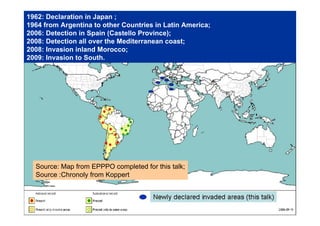
1962: Declaration in Japan ;
1964 from Argentina to other Countries in Latin America;
2006: Detection in Spain (Castello Province);
2008: Detection all over the Mediterranean coast;
2008: Invasion inland Morocco;
2009: Invasion to South.
Source: Map from EPPPO completed for this talk;
Source :Chronoly from Koppert
A single female can lay about 260 eggs during its lifetime;
10–12 generations per year;
The biological cycle is completed in 29–38 days.
Females lay eggs on aerial parts of their host plants;
Pupation in the soil, on the leaf surface or within mines;
Can be carried by plants for planting and fruits of tomato;
Larvae do not enter diapause as long as food is available;
Adult has nocturnal activity and hide at day time;
Seems to reproduce on all wild and cultivated Solaneceous plants.
Key biological traits for successful invasion
High reproductive potential.
Biology and behavior
The red palm weevil: Rhyncophorus ferrogineus
OLIVIER
Agricultural and environmental threat
Costly efforts and resources for eradication
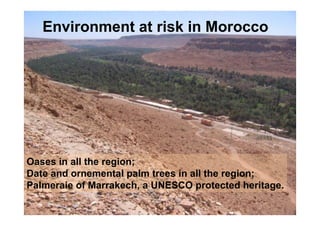
Environment at risk in Morocco
Oases in all the region;
Date and ornemental palm trees in all the region;
Palmeraie of Marrakech, a UNESCO protected heritage.
Lessons from these two pests
coming from far away
Increased movement of people and
increased trade in agricultural and
ornemental plants are source of
increased introduction of alien pests;
Global warming may favor
establishment in previously unsuitable
environment;
Prevention and collaboration are
essential for an effective management.
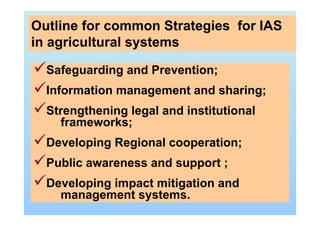
Safeguarding and Prevention;
Information management and sharing;
Strengthening legal and institutional
frameworks;
Developing Regional cooperation;
Public awareness and support ;
Developing impact mitigation and
management systems.
Outline for common Strategies for IAS
in agricultural systems
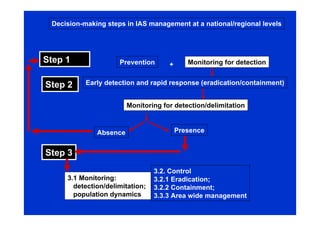
Decision-making steps in IAS management at a national/regional levels
Prevention
Presence
Early detection and rapid response (eradication/containment)
Absence
+ Monitoring for detection
Monitoring for detection/delimitation
3.1 Monitoring:
detection/delimitation;
population dynamics
Step 1
Step 2
Step 3
3.2. Control
3.2.1 Eradication;
3.2.2 Containment;
3.3.3 Area wide management
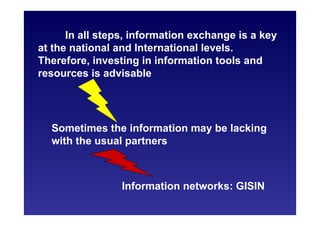
In all steps, information exchange is a key
at the national and International levels.
Therefore, investing in information tools and
resources is advisable
Information networks: GISIN
Sometimes the information may be lacking
with the usual partners
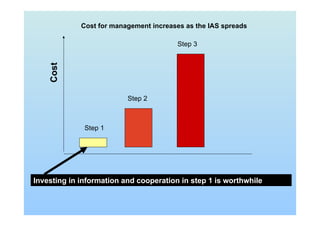
Cost
Step 1
Step 2
Step 3
Investing in information and cooperation in step 1 is worthwhile
Cost for management increases as the IAS spreads
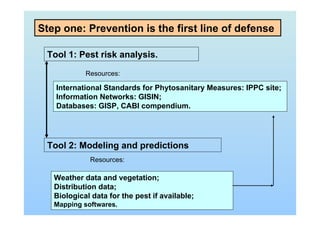
Step one: Prevention is the first line of defense
Tool 1: Pest risk analysis.
Resources:
International Standards for Phytosanitary Measures: IPPC site;
Information Networks: GISIN;
Databases: GISP, CABI compendium.
Tool 2: Modeling and predictions
Resources:
Weather data and vegetation;
Distribution data;
Biological data for the pest if available;
Mapping softwares.
14
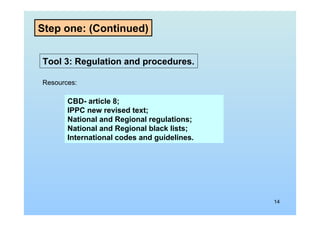
Tool 3: Regulation and procedures.
Resources:
CBD- article 8;
IPPC new revised text;
National and Regional regulations;
National and Regional black lists;
International codes and guidelines.
Step one: (Continued)
15
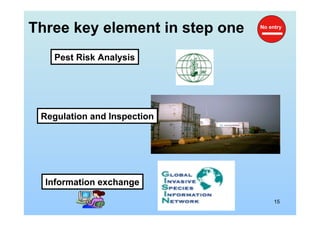
Three key element in step one
Regulation and Inspection
Pest Risk Analysis
No entry
Information exchange
16
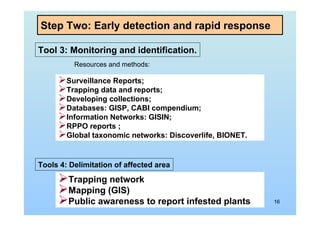
Step Two: Early detection and rapid response
Tool 3: Monitoring and identification.
Resources and methods:
Surveillance Reports;
Trapping data and reports;
Developing collections;
Databases: GISP, CABI compendium;
Information Networks: GISIN;
RPPO reports ;
Global taxonomic networks: Discoverlife, BIONET.
Tools 4: Delimitation of affected area
Trapping network
Mapping (GIS)
Public awareness to report infested plants
17
Tool 5: Eradication/containment
Ressources:
CBD- article 8;
IPPC new revised text;
National regulation and procedures;
Control.
Methods
Chemical and Biological methods;
Sterile Insect Technique
Raising public awareness to limit spread.
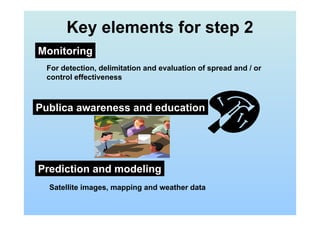
Key elements for step 2
Monitoring
For detection, delimitation and evaluation of spread and / or
control effectiveness
Prediction and modeling
Satellite images, mapping and weather data
Publica awareness and education
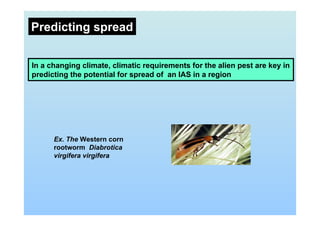
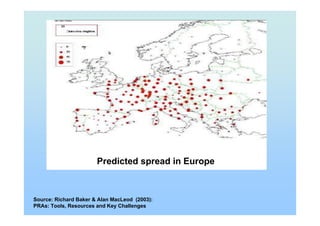
Predicting spread
Ex. The Western corn
rootworm Diabrotica
virgifera virgifera
In a changing climate, climatic requirements for the alien pest are key in
predicting the potential for spread of an IAS in a region
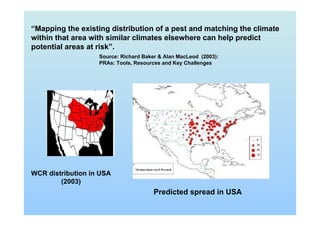
“Mapping the existing distribution of a pest and matching the climate
within that area with similar climates elsewhere can help predict
potential areas at risk”.
Source: Richard Baker & Alan MacLeod (2003):
PRAs: Tools, Resources and Key Challenges
WCR distribution in USA
(2003)
Predicted spread in USA
Source: Richard Baker & Alan MacLeod (2003):
PRAs: Tools, Resources and Key Challenges
Predicted spread in Europe
Summary and conclusion
Human accelerated degradation processes before
mastering the dynamics within the processes;
Pest Risk Analysis, modeling and information
exchange as well as international cooperation are the
only way to mitigate impact of IAS at a global level
Introduced agricultural pests are part of environmental
degradation processes;
Tools are available to reduce IAS impact in agriculture;

Tools for invasive species 2

  • 1.
    DECISION-MAKING TOOLS FOR MANAGINGIAS IN AGRICULTURE Presented at: International Congress on Biological Invasions (Fuzhou, China, 2-6 November, 2009)
  • 2.
    Outline • Introduction: newinvaders and lessons – Tomato leaf miner – Date palm red weevil • Steps and tools for IAS in agriculture – General scheme – Prevention • Description • Key tools and resources – Eradication • Description • Key tools and resources • Conclusion
  • 3.
    Tuta absoluta A newinvader for the Mediterranean region High economic impact
  • 4.
    1962: Declaration inJapan ; 1964 from Argentina to other Countries in Latin America; 2006: Detection in Spain (Castello Province); 2008: Detection all over the Mediterranean coast; 2008: Invasion inland Morocco; 2009: Invasion to South. Source: Map from EPPPO completed for this talk; Source :Chronoly from Koppert
  • 5.
    A single femalecan lay about 260 eggs during its lifetime; 10–12 generations per year; The biological cycle is completed in 29–38 days. Females lay eggs on aerial parts of their host plants; Pupation in the soil, on the leaf surface or within mines; Can be carried by plants for planting and fruits of tomato; Larvae do not enter diapause as long as food is available; Adult has nocturnal activity and hide at day time; Seems to reproduce on all wild and cultivated Solaneceous plants. Key biological traits for successful invasion High reproductive potential. Biology and behavior
  • 6.
    The red palmweevil: Rhyncophorus ferrogineus OLIVIER Agricultural and environmental threat Costly efforts and resources for eradication
  • 7.
    Environment at riskin Morocco Oases in all the region; Date and ornemental palm trees in all the region; Palmeraie of Marrakech, a UNESCO protected heritage.
  • 8.
    Lessons from thesetwo pests coming from far away Increased movement of people and increased trade in agricultural and ornemental plants are source of increased introduction of alien pests; Global warming may favor establishment in previously unsuitable environment; Prevention and collaboration are essential for an effective management.
  • 9.
    Safeguarding and Prevention; Informationmanagement and sharing; Strengthening legal and institutional frameworks; Developing Regional cooperation; Public awareness and support ; Developing impact mitigation and management systems. Outline for common Strategies for IAS in agricultural systems
  • 10.
    Decision-making steps inIAS management at a national/regional levels Prevention Presence Early detection and rapid response (eradication/containment) Absence + Monitoring for detection Monitoring for detection/delimitation 3.1 Monitoring: detection/delimitation; population dynamics Step 1 Step 2 Step 3 3.2. Control 3.2.1 Eradication; 3.2.2 Containment; 3.3.3 Area wide management
  • 11.
    In all steps,information exchange is a key at the national and International levels. Therefore, investing in information tools and resources is advisable Information networks: GISIN Sometimes the information may be lacking with the usual partners
  • 12.
    Cost Step 1 Step 2 Step3 Investing in information and cooperation in step 1 is worthwhile Cost for management increases as the IAS spreads
  • 13.
    Step one: Preventionis the first line of defense Tool 1: Pest risk analysis. Resources: International Standards for Phytosanitary Measures: IPPC site; Information Networks: GISIN; Databases: GISP, CABI compendium. Tool 2: Modeling and predictions Resources: Weather data and vegetation; Distribution data; Biological data for the pest if available; Mapping softwares.
  • 14.
    14 Tool 3: Regulationand procedures. Resources: CBD- article 8; IPPC new revised text; National and Regional regulations; National and Regional black lists; International codes and guidelines. Step one: (Continued)
  • 15.
    15 Three key elementin step one Regulation and Inspection Pest Risk Analysis No entry Information exchange
  • 16.
    16 Step Two: Earlydetection and rapid response Tool 3: Monitoring and identification. Resources and methods: Surveillance Reports; Trapping data and reports; Developing collections; Databases: GISP, CABI compendium; Information Networks: GISIN; RPPO reports ; Global taxonomic networks: Discoverlife, BIONET. Tools 4: Delimitation of affected area Trapping network Mapping (GIS) Public awareness to report infested plants
  • 17.
    17 Tool 5: Eradication/containment Ressources: CBD-article 8; IPPC new revised text; National regulation and procedures; Control. Methods Chemical and Biological methods; Sterile Insect Technique Raising public awareness to limit spread.
  • 18.
    Key elements forstep 2 Monitoring For detection, delimitation and evaluation of spread and / or control effectiveness Prediction and modeling Satellite images, mapping and weather data Publica awareness and education
  • 19.
    Predicting spread Ex. TheWestern corn rootworm Diabrotica virgifera virgifera In a changing climate, climatic requirements for the alien pest are key in predicting the potential for spread of an IAS in a region
  • 20.
    “Mapping the existingdistribution of a pest and matching the climate within that area with similar climates elsewhere can help predict potential areas at risk”. Source: Richard Baker & Alan MacLeod (2003): PRAs: Tools, Resources and Key Challenges WCR distribution in USA (2003) Predicted spread in USA
  • 21.
    Source: Richard Baker& Alan MacLeod (2003): PRAs: Tools, Resources and Key Challenges Predicted spread in Europe
  • 22.
    Summary and conclusion Humanaccelerated degradation processes before mastering the dynamics within the processes; Pest Risk Analysis, modeling and information exchange as well as international cooperation are the only way to mitigate impact of IAS at a global level Introduced agricultural pests are part of environmental degradation processes; Tools are available to reduce IAS impact in agriculture;