LECTURE 5,6
Community dentistry
Dental indices
Dr. noorah murad DDS
Introduction
• Prevention of dental disease is based on the
knowledge of the disease epidemiology.
• So to study these problems we need to develop
a suitable, practical method for recording and
classifying the occurrence and severity of the
disease.
• Dental index can be consider as the main tool
to find out the incidence, prevalence, and
severity of disease
• Dental indices provide quantitative method to
measure, score, and analyze dental condition in
individual and group
Home work
• The measurement of dental disease is easier
than the measurement of any other forms of
disease?
• Why we measure diseases in a quantitative
terms, why?
index
• A numerical value of a clinical disease or condition
based on determined criteria, under specified
conditions, with definite upper and lower limits,
designed to facilitate compression among population
examined by the same criteria and method.
• An index is an indicator or measure of something.
Uses of dental index
1. Assess prevalence and incidence of oral
disease.
2. Provide baseline data for comparison in
epidemiological studies.
3. Study oral health status of individual and
population for planning DHC.
4. In clinical trials to define specific problem.
5. Evaluation of oral health services and
preventive programs.
Properties of an ideal index
Clarity, simplicity and objectivity
• The examiner should be able to carry the rules
of the index in his mind.
• Easy to apply with no loss of time.
• Criteria should be clear and unambiguous.
Properties of an ideal index
Validity
• Must measure what is intended to measure.
• Accurately reflects the extent to which the disease
present, for example:
The higher the score the more severe the disease.
Properties of an ideal index
Reliability and reproducibility
• The index most give the same results each time
it is applied.
Means : if the same or different researchers
examined the same patient with the same
condition multiple times, each time results
would be the same.
Properties of an ideal index
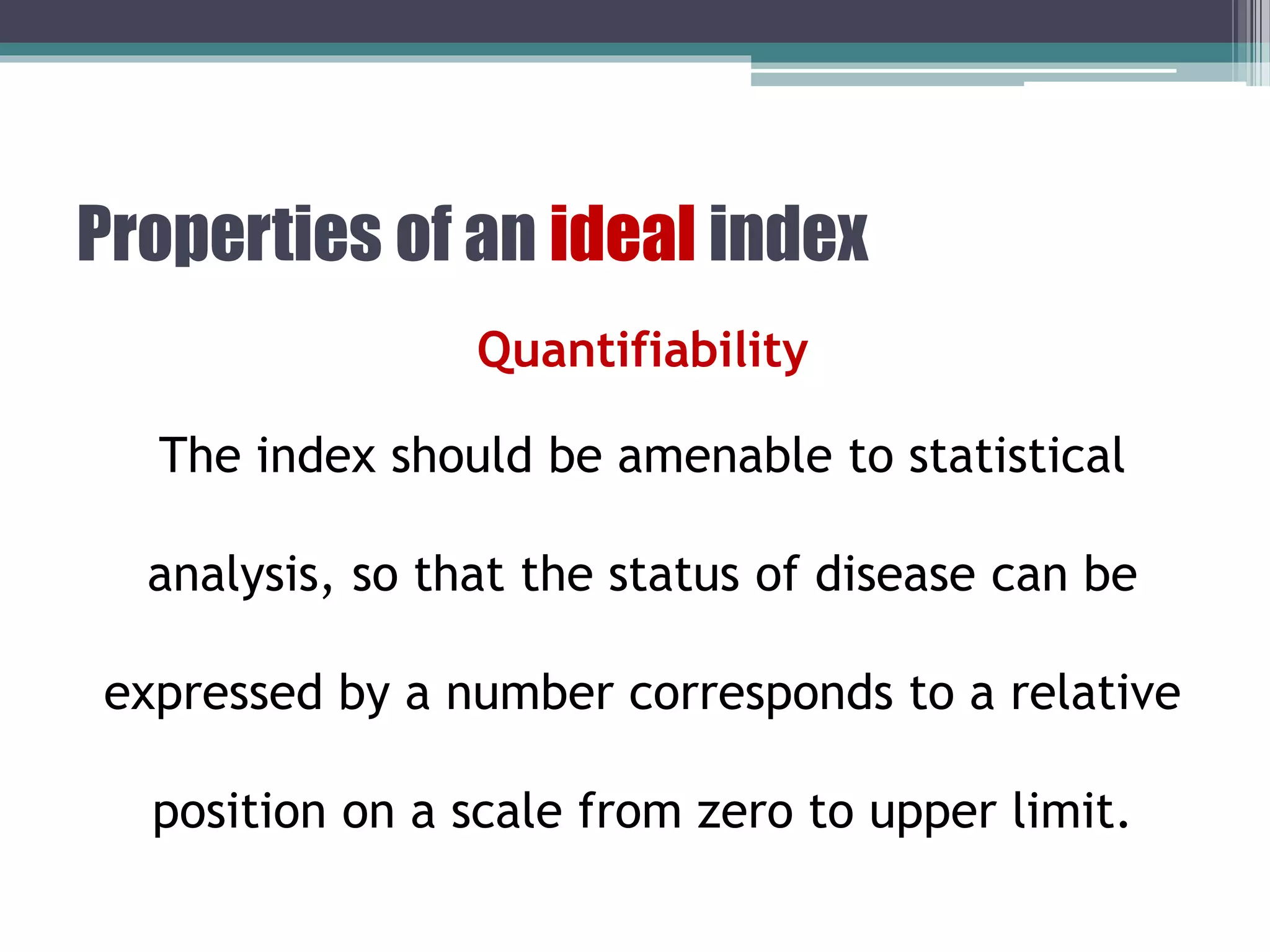
Quantifiability
The index should be amenable to statistical
analysis, so that the status of disease can be
expressed by a number corresponds to a relative
position on a scale from zero to upper limit.
Properties of an ideal index
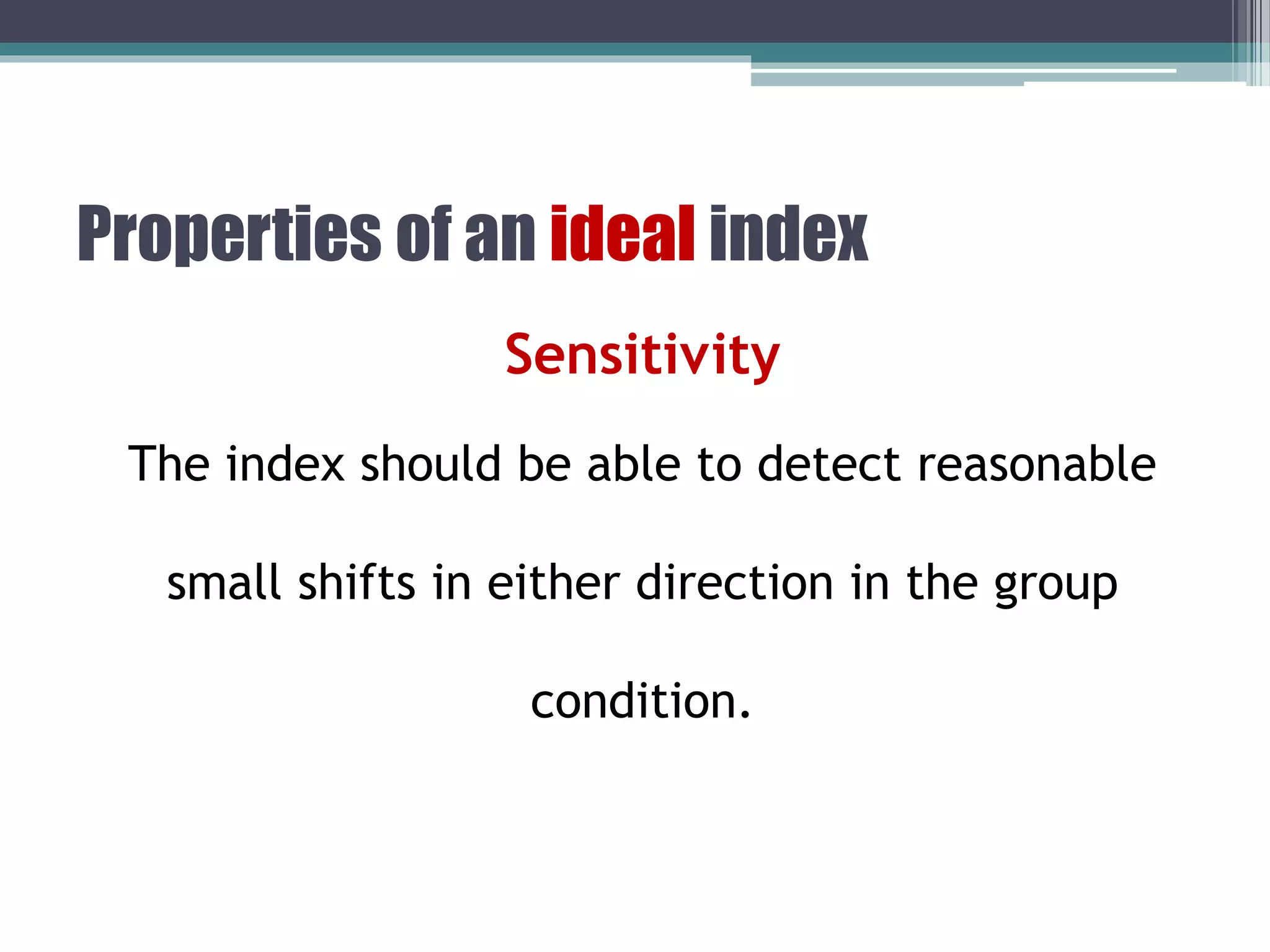
Sensitivity
The index should be able to detect reasonable
small shifts in either direction in the group
condition.
Properties of an ideal index
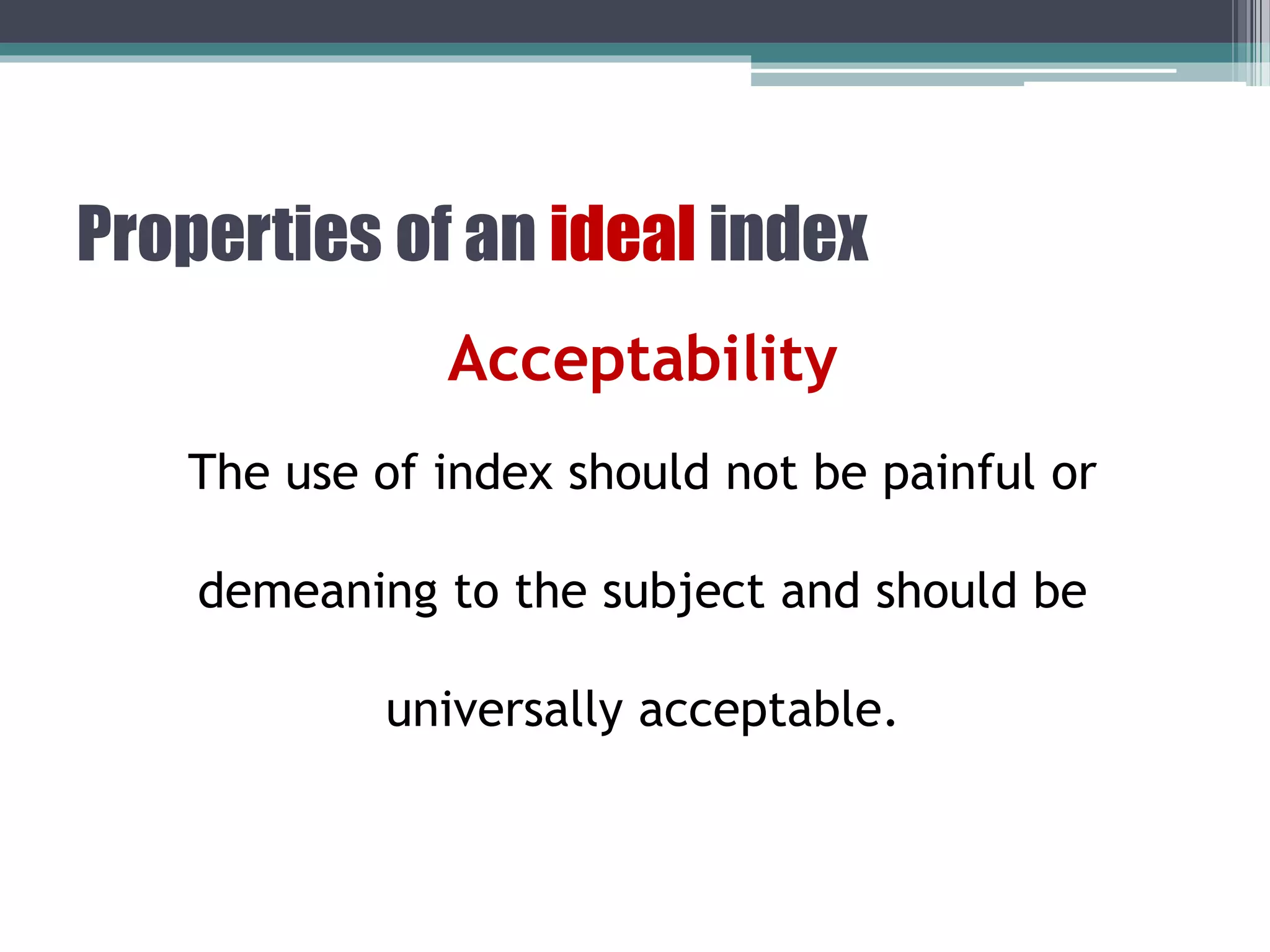
Acceptability
The use of index should not be painful or
demeaning to the subject and should be
universally acceptable.
Properties of an ideal index
Cost and material
Require minimal equipment and
expenditure.
Classification of indices
Based on:
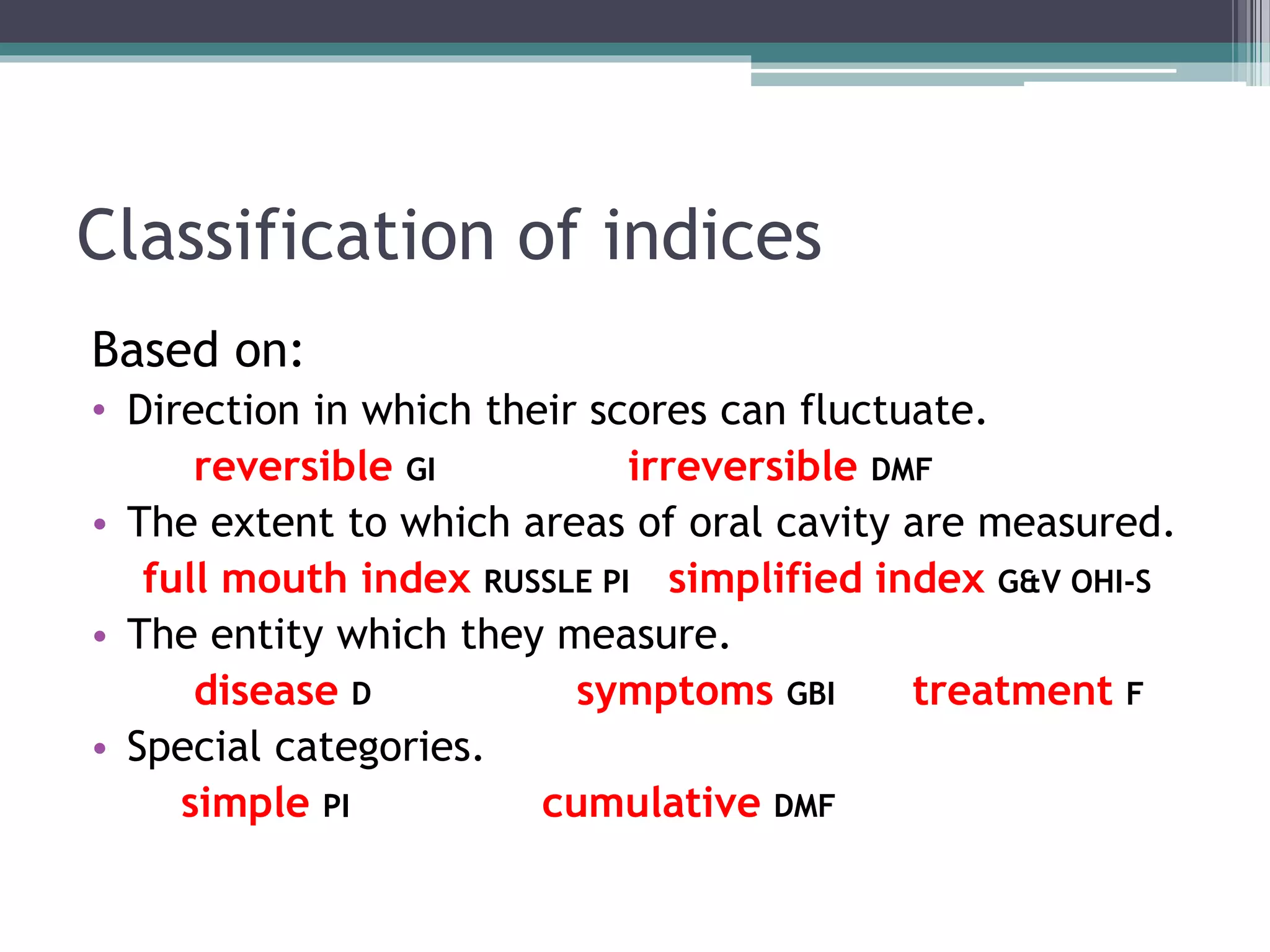
• Direction in which their scores can fluctuate.
reversible GI irreversible DMF
• The extent to which areas of oral cavity are measured.
full mouth index RUSSLE PI simplified index G&V OHI-S
• The entity which they measure.
disease D symptoms GBI treatment F
• Special categories.
simple PI cumulative DMF
Examples of dental indices:
DMFT - Caries activity
RCI - Root caries
GBI - Gingival bleeding
CPITN - Community periodontal index of
treatment needs
DFI - Dental fluorosis.
Indices used for assessment of
dental caries
Decayed-Missing-
Filled index (DMF)
DECAYED-MISSING-FILLED INDEX
• D component describe decay.
• M component describe missing due to caries.
• F component describe filling due to caries.
This index developed by klein et al (1938 ) and modified by
WHO.
Coronal caries of permanent teeth only.
Gives the sum of an individual’s decayed, missing, filled
permanent teeth or surface.
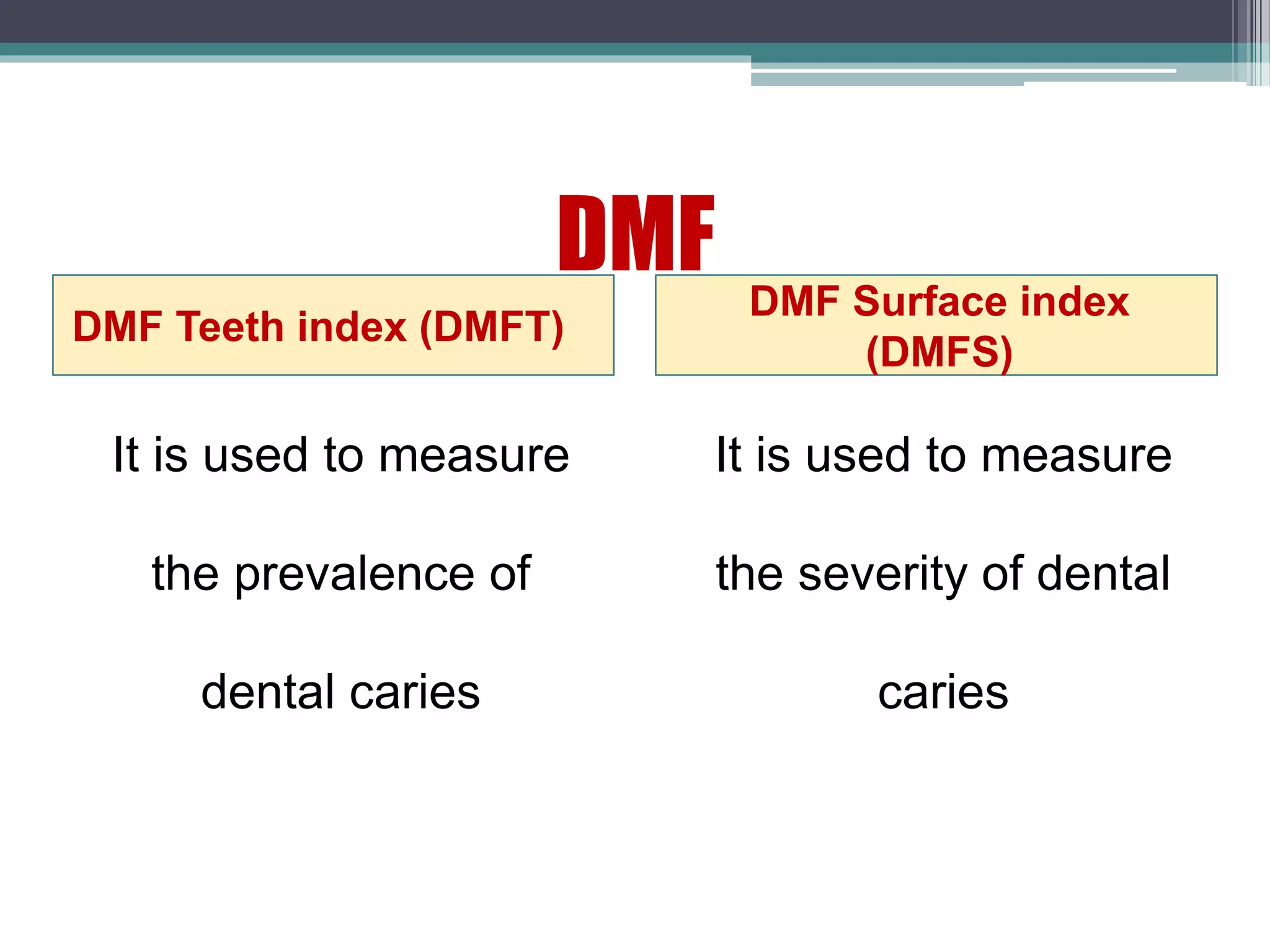
DMF
DMF Teeth index (DMFT)
DMF Surface index
(DMFS)
It is used to measure
the prevalence of
dental caries
It is used to measure
the severity of dental
caries
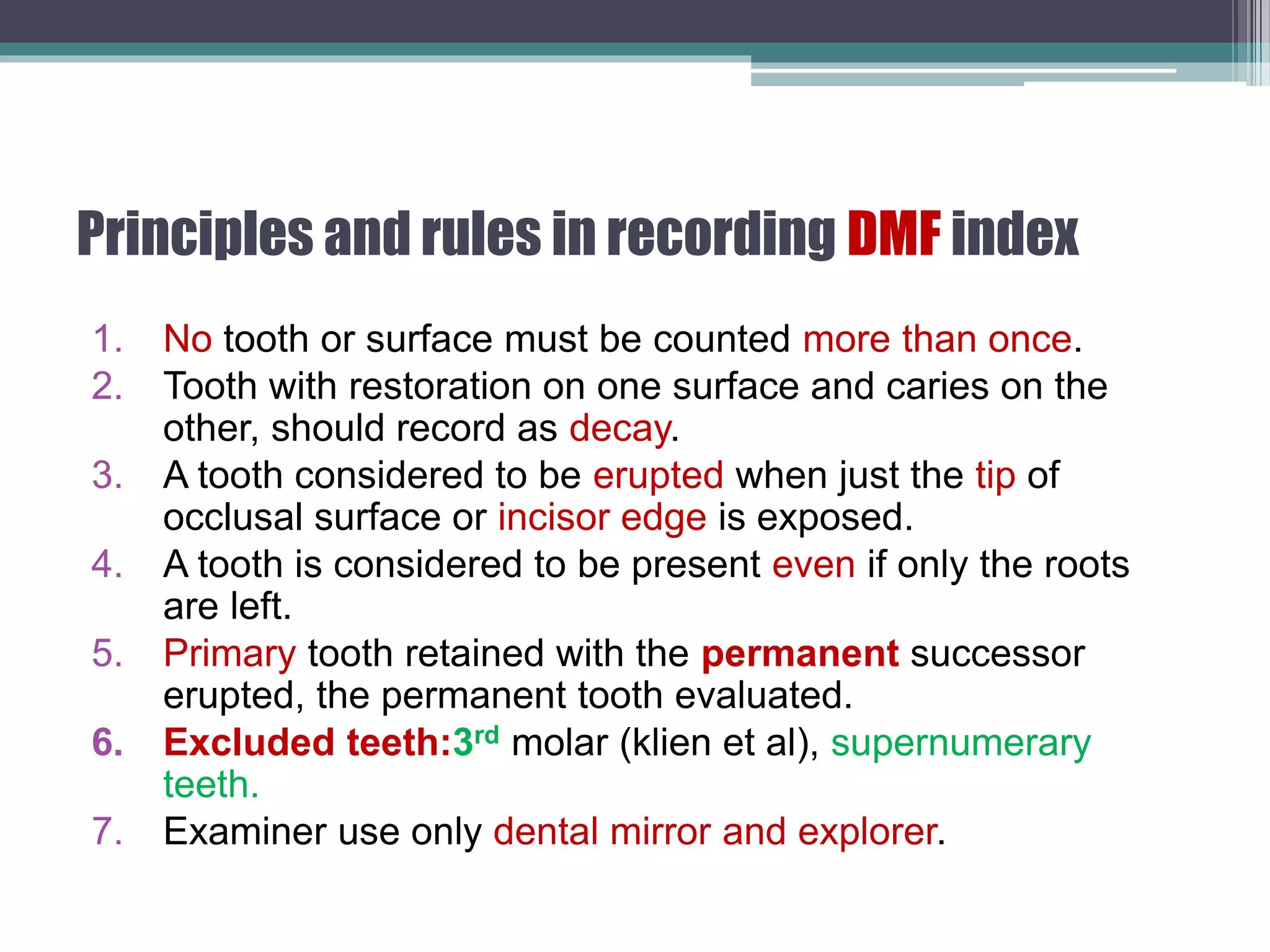
Principles and rules in recording DMF index
1. No tooth or surface must be counted more than once.
2. Tooth with restoration on one surface and caries on the
other, should record as decay.
3. A tooth considered to be erupted when just the tip of
occlusal surface or incisor edge is exposed.
4. A tooth is considered to be present even if only the roots
are left.
5. Primary tooth retained with the permanent successor
erupted, the permanent tooth evaluated.
6. Excluded teeth:3rd molar (klien et al), supernumerary
teeth.
7. Examiner use only dental mirror and explorer.
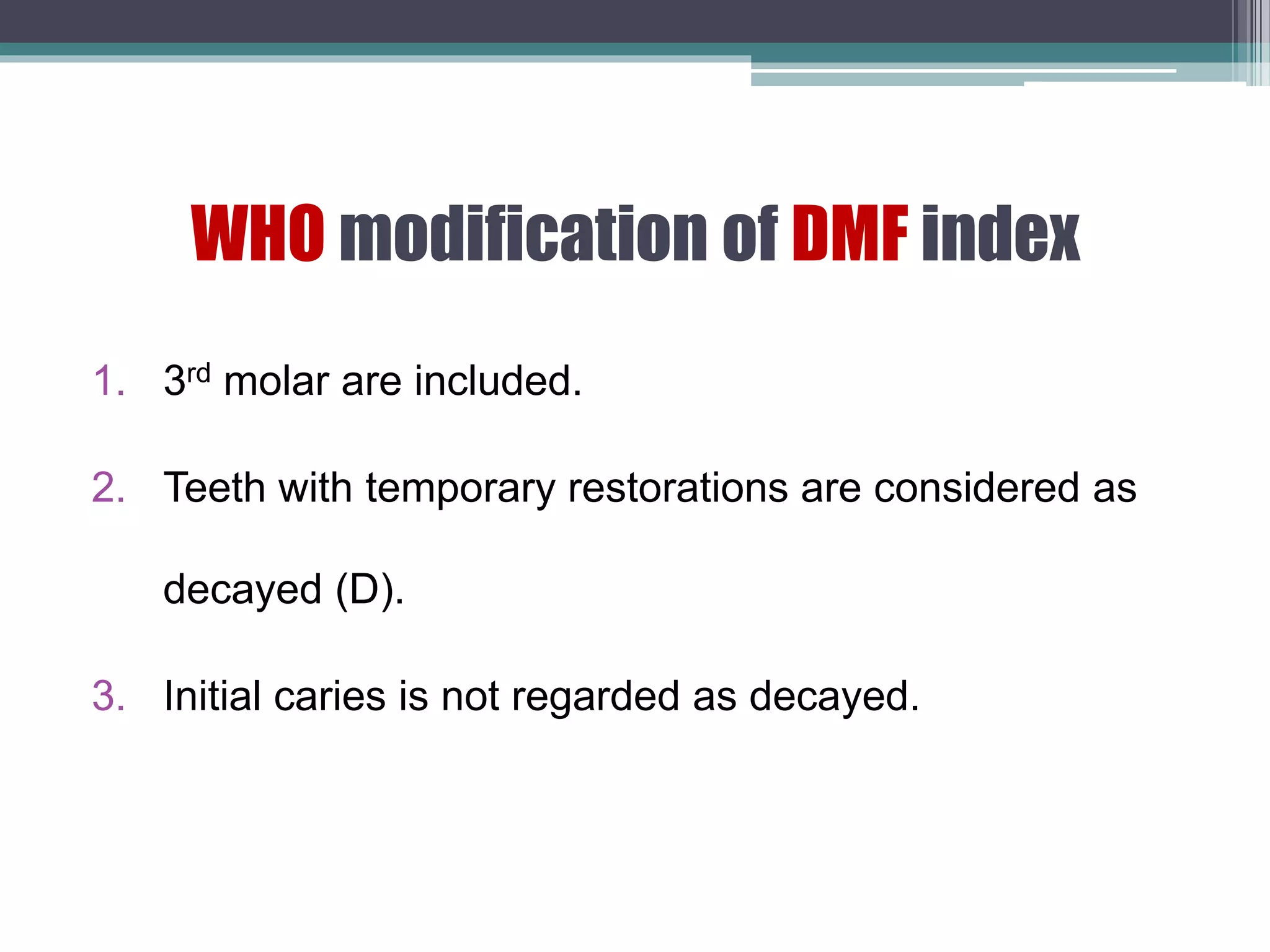
WHO modification of DMF index
1. 3rd molar are included.
2. Teeth with temporary restorations are considered as
decayed (D).
3. Initial caries is not regarded as decayed.
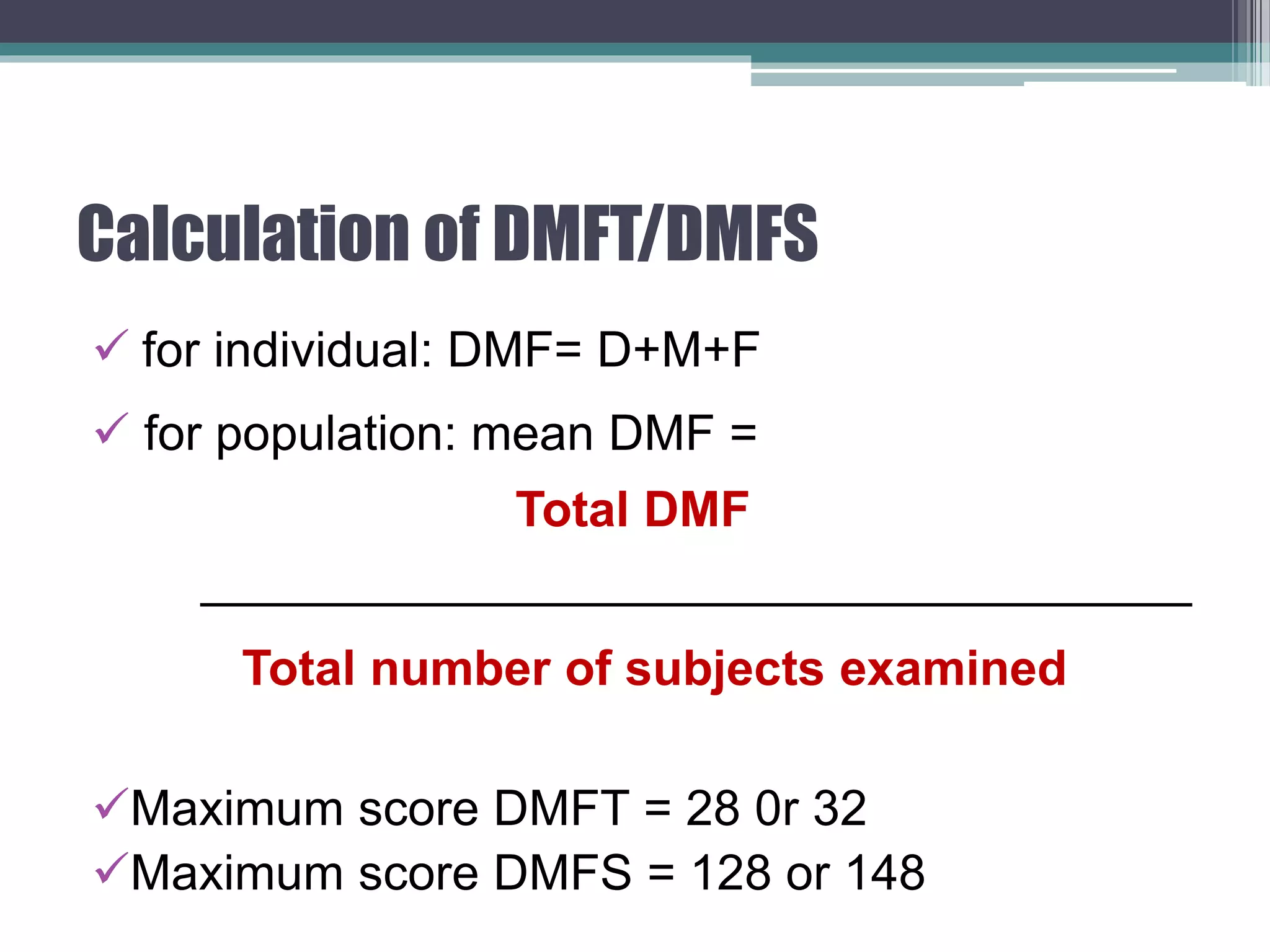
Calculation of DMFT/DMFS
 for individual: DMF= D+M+F
 for population: mean DMF =
Total DMF
____________________________________
Total number of subjects examined
Maximum score DMFT = 28 0r 32
Maximum score DMFS = 128 or 148
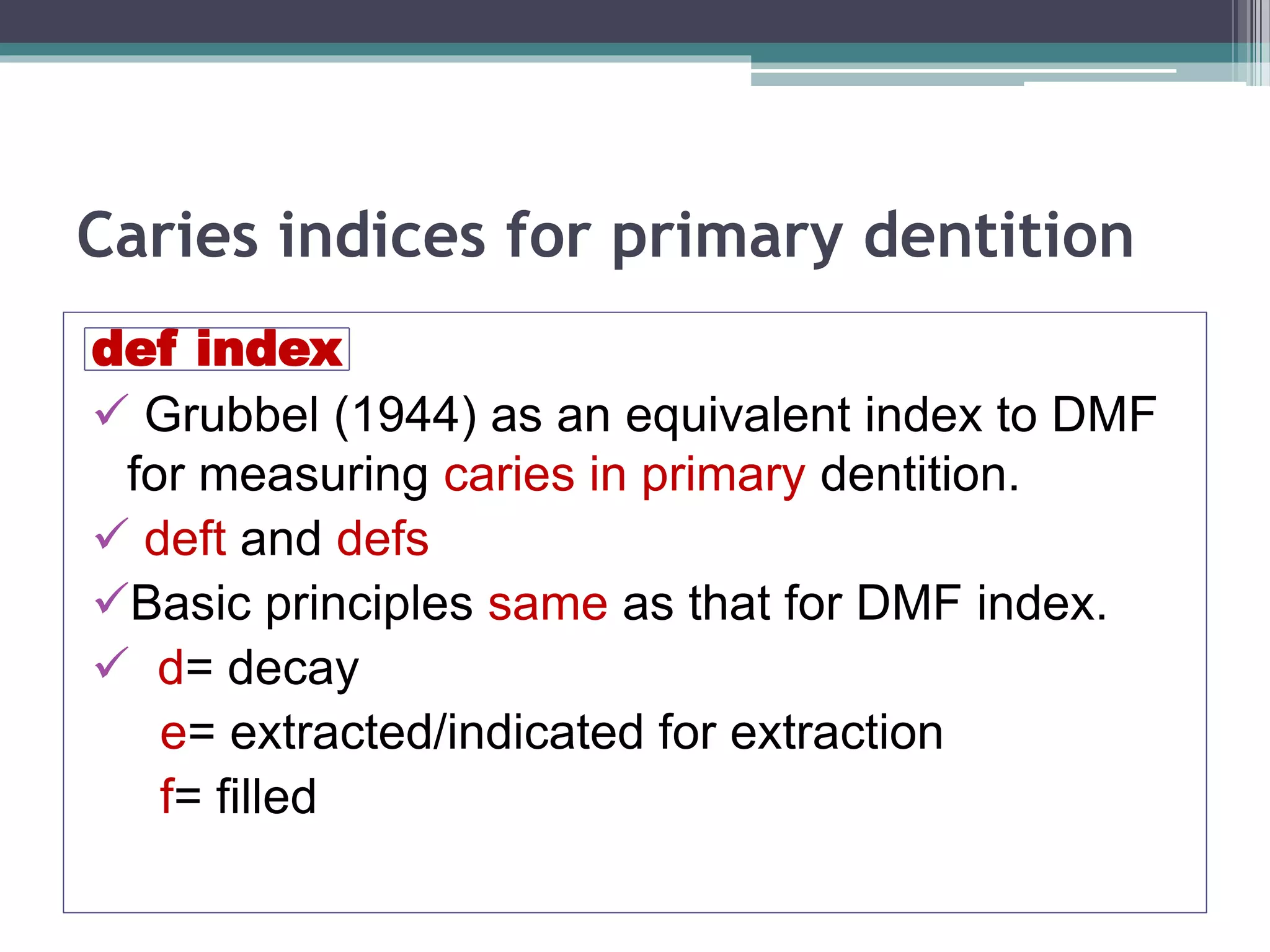
Caries indices for primary dentition
def index
 Grubbel (1944) as an equivalent index to DMF
for measuring caries in primary dentition.
 deft and defs
Basic principles same as that for DMF index.
 d= decay
e= extracted/indicated for extraction
f= filled
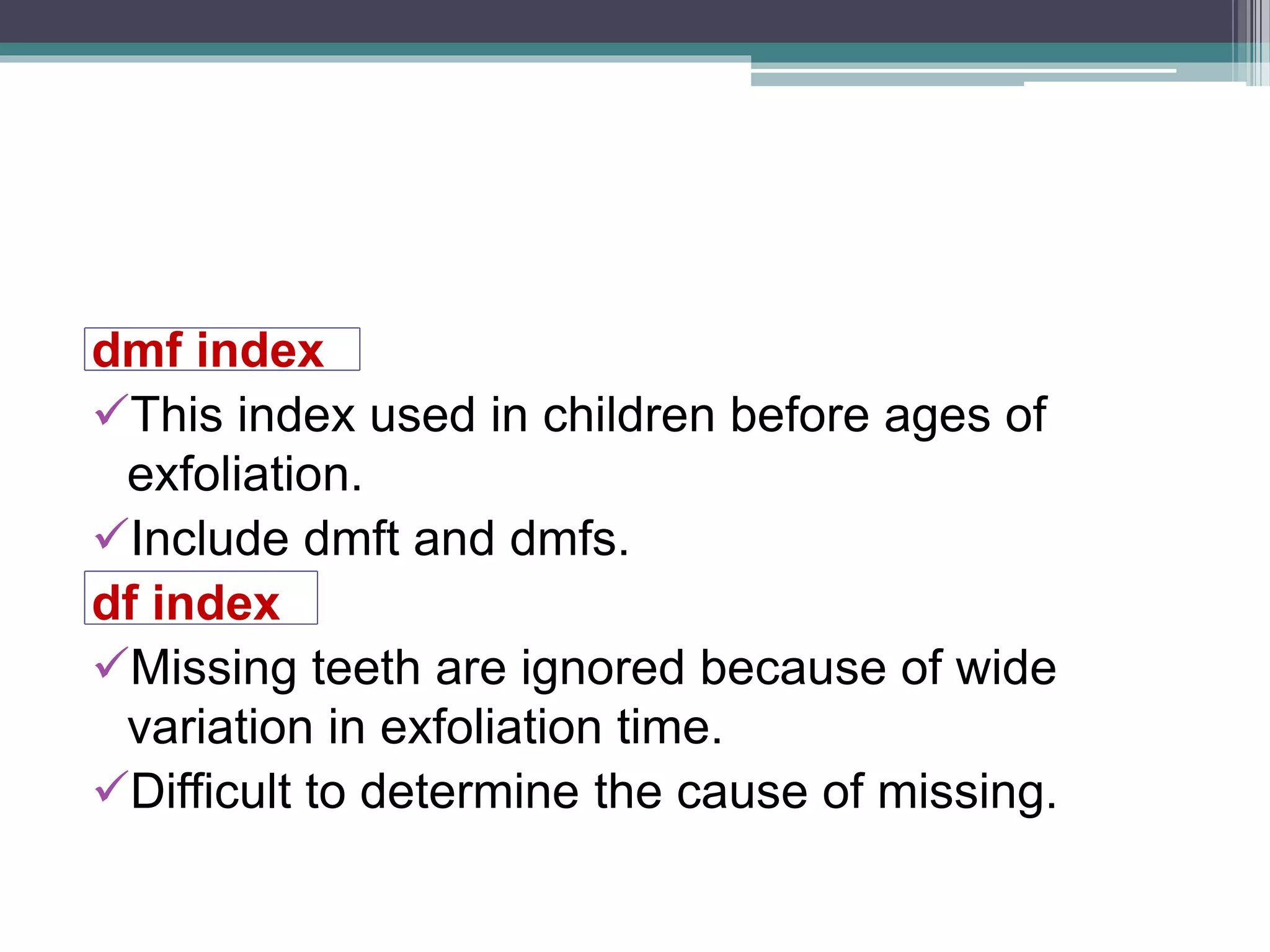
dmf index
This index used in children before ages of
exfoliation.
Include dmft and dmfs.
df index
Missing teeth are ignored because of wide
variation in exfoliation time.
Difficult to determine the cause of missing.
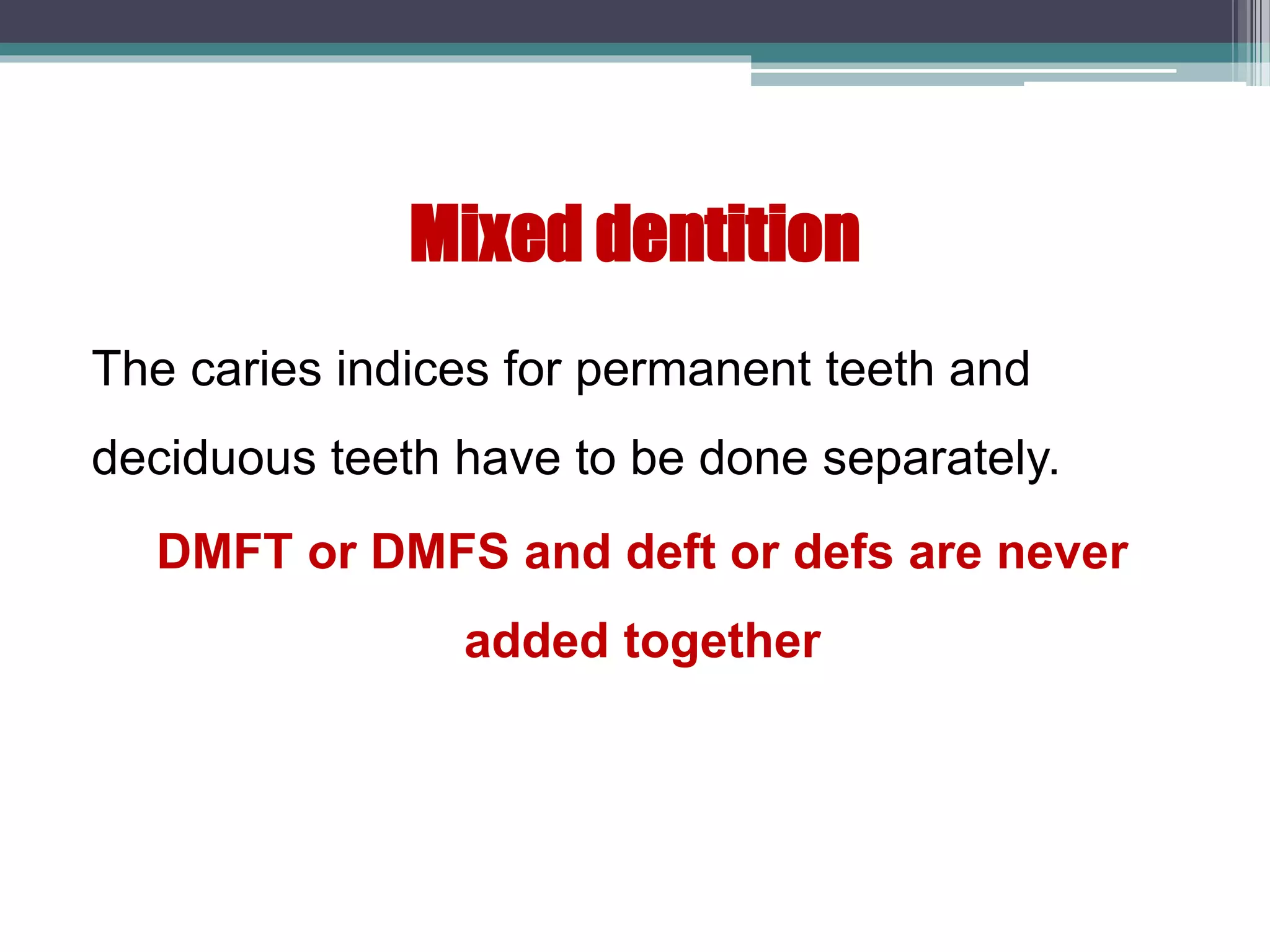
Mixed dentition
The caries indices for permanent teeth and
deciduous teeth have to be done separately.
DMFT or DMFS and deft or defs are never
added together
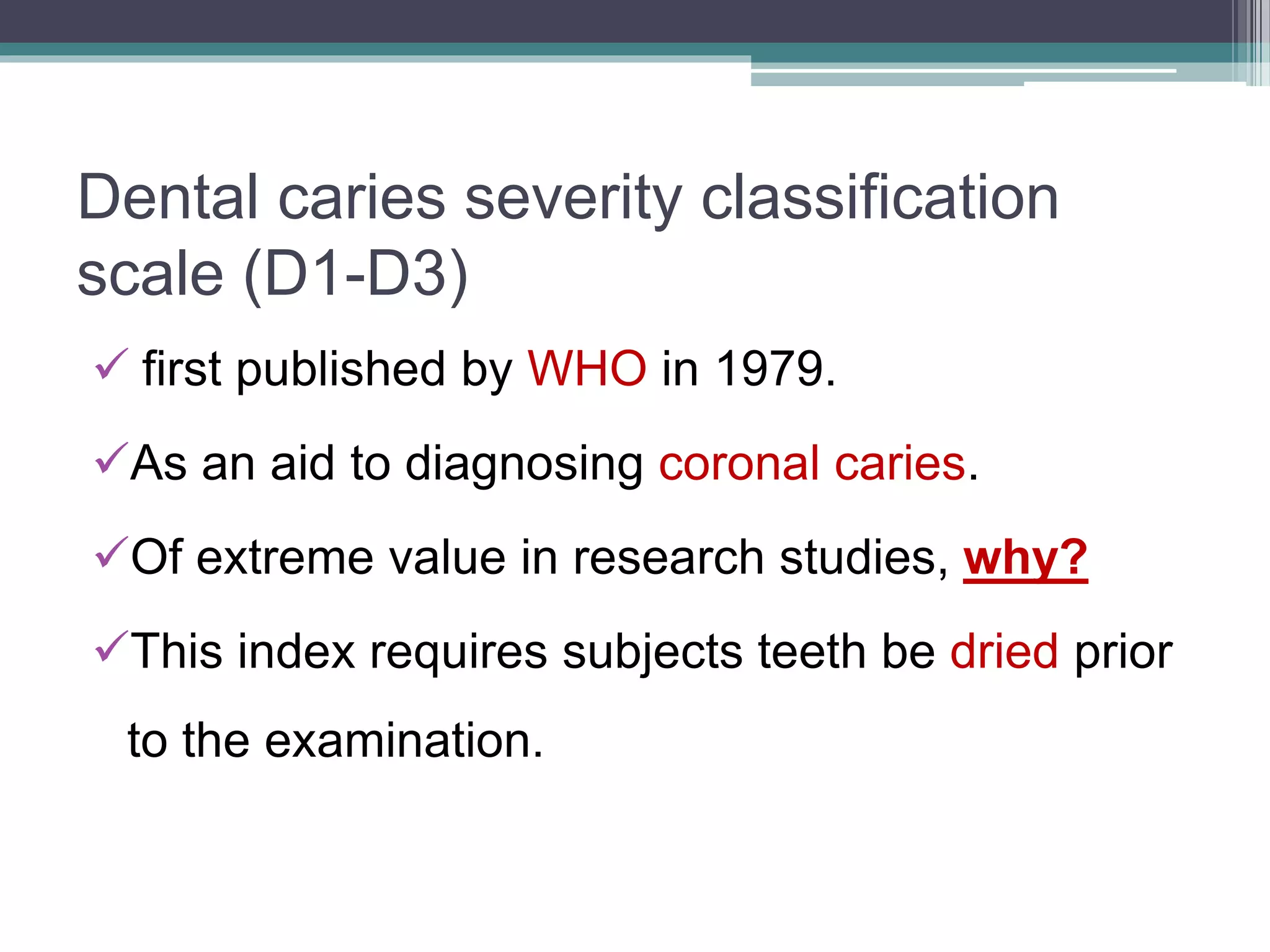
Dental caries severity classification
scale (D1-D3)
 first published by WHO in 1979.
As an aid to diagnosing coronal caries.
Of extreme value in research studies, why?
This index requires subjects teeth be dried prior
to the examination.
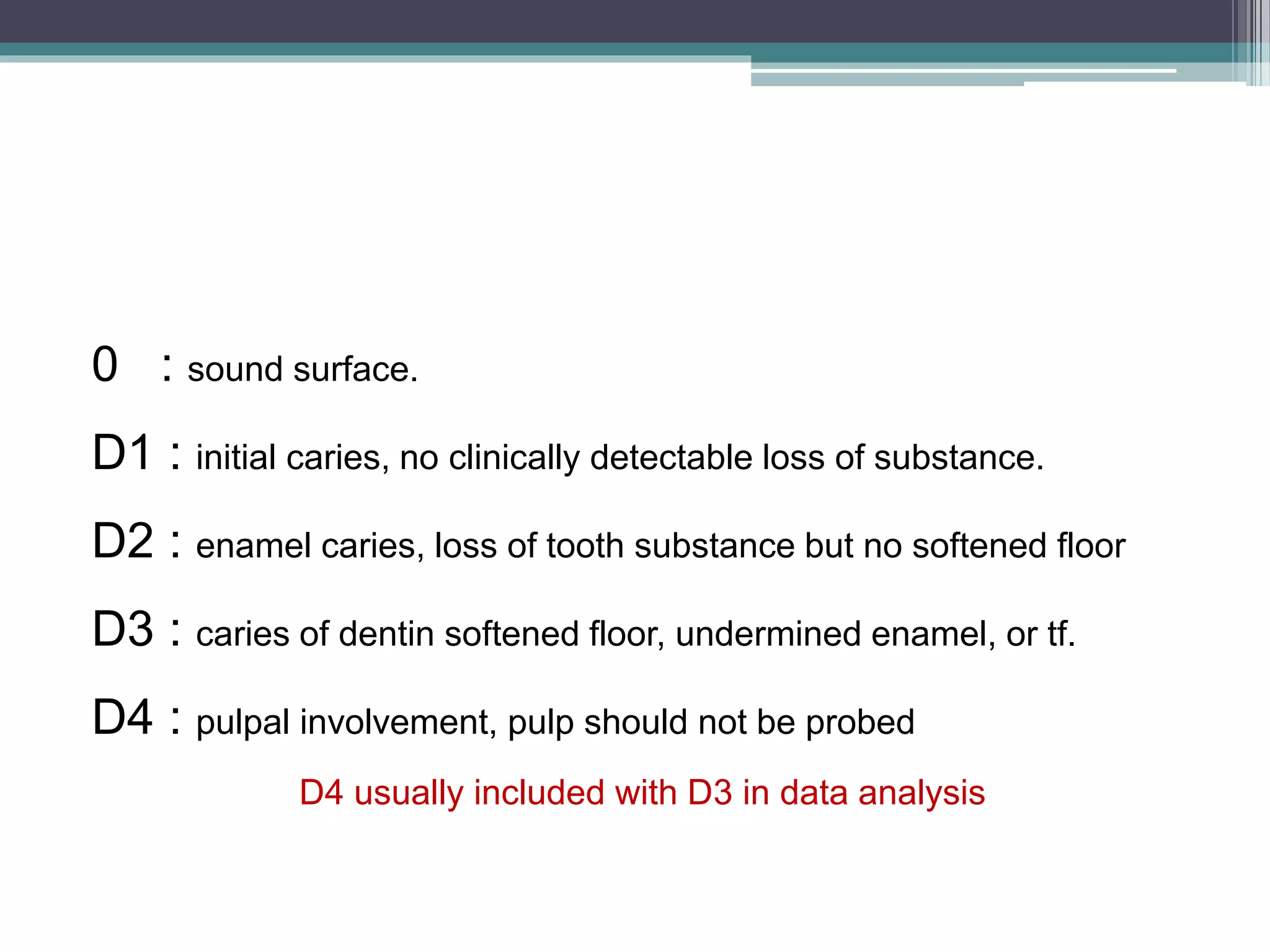
0 : sound surface.
D1 : initial caries, no clinically detectable loss of substance.
D2 : enamel caries, loss of tooth substance but no softened floor
D3 : caries of dentin softened floor, undermined enamel, or tf.
D4 : pulpal involvement, pulp should not be probed
D4 usually included with D3 in data analysis
Root caries index (RCI)
Introduced by Katz in 1979.
Only teeth with gingival recession are examined,
because only the root surface that exposed to
the oral environment are at risk to develop root
caries.
RCI records as follow:
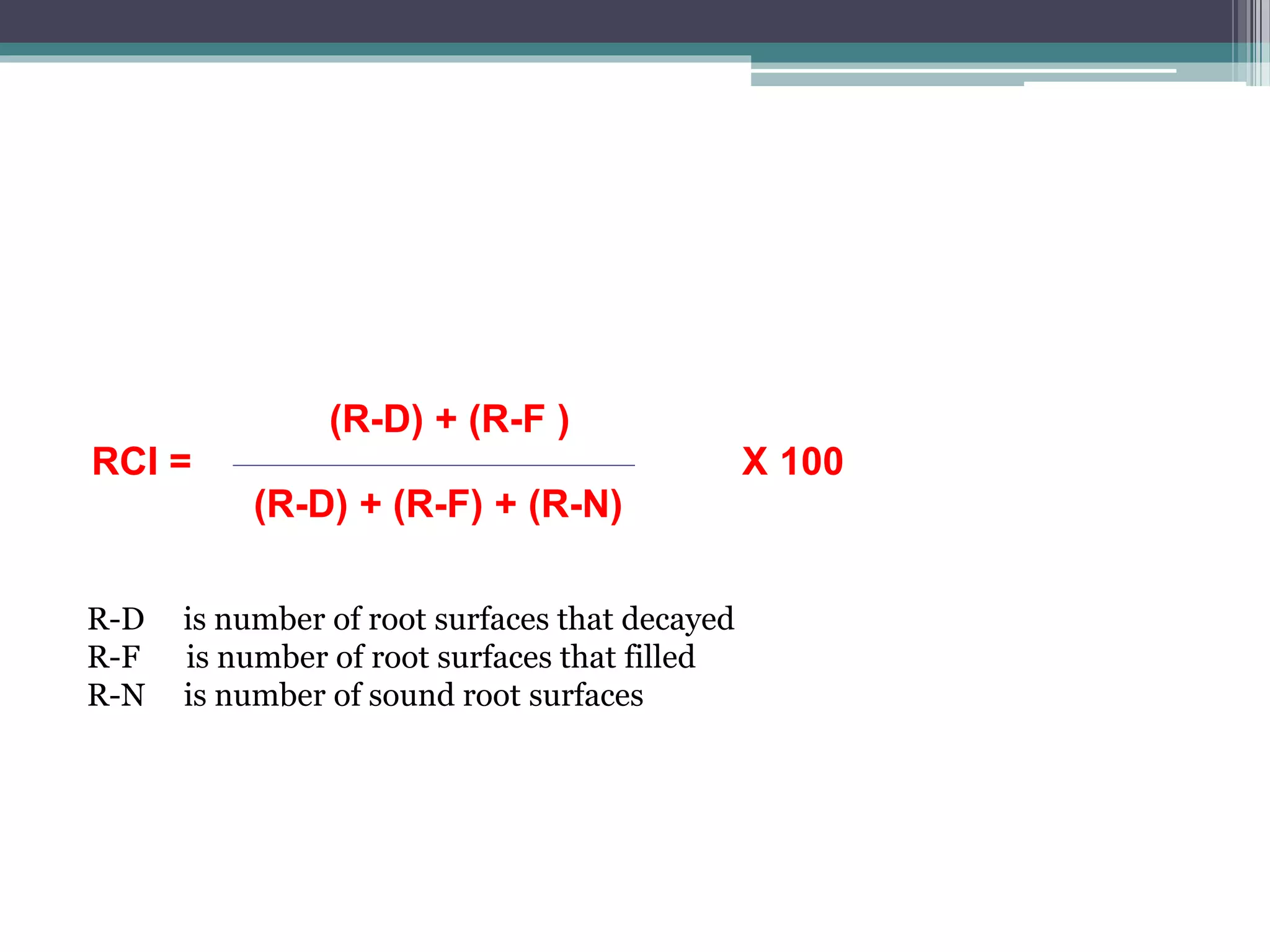
(R-D) + (R-F )
RCI = X 100
(R-D) + (R-F) + (R-N)
R-D is number of root surfaces that decayed
R-F is number of root surfaces that filled
R-N is number of sound root surfaces
Lecture 5,6

Lecture 5,6

  • 1.
    LECTURE 5,6 Community dentistry Dentalindices Dr. noorah murad DDS
  • 2.
    Introduction • Prevention ofdental disease is based on the knowledge of the disease epidemiology. • So to study these problems we need to develop a suitable, practical method for recording and classifying the occurrence and severity of the disease. • Dental index can be consider as the main tool to find out the incidence, prevalence, and severity of disease • Dental indices provide quantitative method to measure, score, and analyze dental condition in individual and group
  • 3.
    Home work • Themeasurement of dental disease is easier than the measurement of any other forms of disease? • Why we measure diseases in a quantitative terms, why?
  • 4.
    index • A numericalvalue of a clinical disease or condition based on determined criteria, under specified conditions, with definite upper and lower limits, designed to facilitate compression among population examined by the same criteria and method. • An index is an indicator or measure of something.
  • 5.
    Uses of dentalindex 1. Assess prevalence and incidence of oral disease. 2. Provide baseline data for comparison in epidemiological studies. 3. Study oral health status of individual and population for planning DHC. 4. In clinical trials to define specific problem. 5. Evaluation of oral health services and preventive programs.
  • 6.
    Properties of anideal index Clarity, simplicity and objectivity • The examiner should be able to carry the rules of the index in his mind. • Easy to apply with no loss of time. • Criteria should be clear and unambiguous.
  • 7.
    Properties of anideal index Validity • Must measure what is intended to measure. • Accurately reflects the extent to which the disease present, for example: The higher the score the more severe the disease.
  • 8.
    Properties of anideal index Reliability and reproducibility • The index most give the same results each time it is applied. Means : if the same or different researchers examined the same patient with the same condition multiple times, each time results would be the same.
  • 9.
    Properties of anideal index Quantifiability The index should be amenable to statistical analysis, so that the status of disease can be expressed by a number corresponds to a relative position on a scale from zero to upper limit.
  • 10.
    Properties of anideal index Sensitivity The index should be able to detect reasonable small shifts in either direction in the group condition.
  • 11.
    Properties of anideal index Acceptability The use of index should not be painful or demeaning to the subject and should be universally acceptable.
  • 12.
    Properties of anideal index Cost and material Require minimal equipment and expenditure.
  • 13.
    Classification of indices Basedon: • Direction in which their scores can fluctuate. reversible GI irreversible DMF • The extent to which areas of oral cavity are measured. full mouth index RUSSLE PI simplified index G&V OHI-S • The entity which they measure. disease D symptoms GBI treatment F • Special categories. simple PI cumulative DMF
  • 14.
    Examples of dentalindices: DMFT - Caries activity RCI - Root caries GBI - Gingival bleeding CPITN - Community periodontal index of treatment needs DFI - Dental fluorosis.
  • 15.
    Indices used forassessment of dental caries Decayed-Missing- Filled index (DMF)
  • 16.
    DECAYED-MISSING-FILLED INDEX • Dcomponent describe decay. • M component describe missing due to caries. • F component describe filling due to caries. This index developed by klein et al (1938 ) and modified by WHO. Coronal caries of permanent teeth only. Gives the sum of an individual’s decayed, missing, filled permanent teeth or surface.
  • 17.
    DMF DMF Teeth index(DMFT) DMF Surface index (DMFS) It is used to measure the prevalence of dental caries It is used to measure the severity of dental caries
  • 18.
    Principles and rulesin recording DMF index 1. No tooth or surface must be counted more than once. 2. Tooth with restoration on one surface and caries on the other, should record as decay. 3. A tooth considered to be erupted when just the tip of occlusal surface or incisor edge is exposed. 4. A tooth is considered to be present even if only the roots are left. 5. Primary tooth retained with the permanent successor erupted, the permanent tooth evaluated. 6. Excluded teeth:3rd molar (klien et al), supernumerary teeth. 7. Examiner use only dental mirror and explorer.
  • 19.
    WHO modification ofDMF index 1. 3rd molar are included. 2. Teeth with temporary restorations are considered as decayed (D). 3. Initial caries is not regarded as decayed.
  • 20.
    Calculation of DMFT/DMFS for individual: DMF= D+M+F  for population: mean DMF = Total DMF ____________________________________ Total number of subjects examined Maximum score DMFT = 28 0r 32 Maximum score DMFS = 128 or 148
  • 21.
    Caries indices forprimary dentition def index  Grubbel (1944) as an equivalent index to DMF for measuring caries in primary dentition.  deft and defs Basic principles same as that for DMF index.  d= decay e= extracted/indicated for extraction f= filled
  • 22.
    dmf index This indexused in children before ages of exfoliation. Include dmft and dmfs. df index Missing teeth are ignored because of wide variation in exfoliation time. Difficult to determine the cause of missing.
  • 23.
    Mixed dentition The cariesindices for permanent teeth and deciduous teeth have to be done separately. DMFT or DMFS and deft or defs are never added together
  • 24.
    Dental caries severityclassification scale (D1-D3)  first published by WHO in 1979. As an aid to diagnosing coronal caries. Of extreme value in research studies, why? This index requires subjects teeth be dried prior to the examination.
  • 25.
    0 : soundsurface. D1 : initial caries, no clinically detectable loss of substance. D2 : enamel caries, loss of tooth substance but no softened floor D3 : caries of dentin softened floor, undermined enamel, or tf. D4 : pulpal involvement, pulp should not be probed D4 usually included with D3 in data analysis
  • 26.
    Root caries index(RCI) Introduced by Katz in 1979. Only teeth with gingival recession are examined, because only the root surface that exposed to the oral environment are at risk to develop root caries. RCI records as follow:
  • 27.
    (R-D) + (R-F) RCI = X 100 (R-D) + (R-F) + (R-N) R-D is number of root surfaces that decayed R-F is number of root surfaces that filled R-N is number of sound root surfaces