SURVEY  PROCEDURESBY :-   DR. NAVAL KANT JOGI               BDS (GDC RAIPUR)
WHAT  IS  SURVEY ?Is an investigation in which information is systematically collected ,but in which experimental method is not used.
ADVANTAGES OF SURVEY METHODProvides information on some aspects of oral health status about which information may not be available from any source.
Information pertaining to numerator as well as denominator becomes available which enables us to calculate various indices & rates.
Various associations & correlations b/w different variables can be identified & studied.
Reasons for utilization as well as non utilization of oral healthcare services & facilities can be identified & studied.
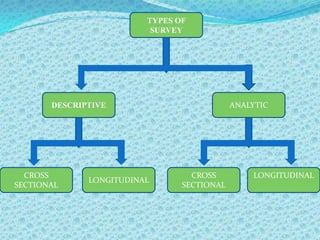
Information from a well planned systematic survey is more reliable, complete & accurate compared to information collected routinely.TYPES OF SURVEYDESCRIPTIVEANALYTICLONGITUDINALCROSS SECTIONALLONGITUDINALCROSS SECTIONAL
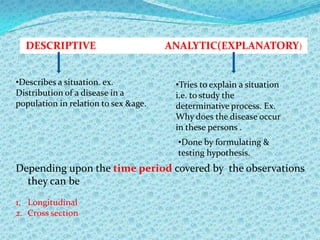
DESCRIPTIVEANALYTIC(EXPLANATORY)Describes a situation. ex.    Distribution of a disease in a population in relation to sex &age.
Tries to explain a situation i.e. to study the determinative process. Ex. Why does the disease occur in these persons .
Done by formulating & testing hypothesis.Depending upon the time period covered by  the observations they can beLongitudinalCross section
BASIC ORAL HEALTH SURVEYS:-Are defined as survey to collect the basic information about oral disease status & treatment needs that is needed for planning or monitoring oral health care programmes.noteSurveys are not designed to collect information about clinical effectiveness of different preventive or care procedures or etiological factors affecting disease distribution or severity.
However the information obtained can be used for monitoring the effectiveness of oral care services.OBJECTIVES OF ORAL HEALTH SURVEYS:-Initially to provide a full picture of the oral health status & needs of a population.Subsequently to monitor changes in disease levels or  patterns.
PATHFINDER SURVEY:-Special factors associated with the most common oral diseases & the extensive experience gained in oral epidemiology over the past 25 years have enabled a practical, economic survey sampling methodology to be defined – “PATHFINDER” method.Method used is “stratified cluster sampling technique” which aims to include the most important population subgroups likely to have different disease levels. It also proposes appropriate number of subjects in specific index age groups in any one location.
In this way reliable & clinically relevant information for planning is obtained at minimum expense.It is suitable  for obtaining the following information:-The overall prevalence of the common oral diseases & conditions affecting the population.Variations in disease in the population enable case needs for different age groups to be determined, to provide information about severity & progression of disease & to give an indication as to whether the levels are  increasing or decreasing.PREVALENCERefers to all current cases(old & new) existing at a given point in time or over a period of time in a given population.
PATHFINDER SURVEYS CAN BE EITHER PILOT SURVEYNATIONAL PATHFINDER SURVEYPILOT SURVEY:-Is one that includes only the most important subgroups in the population &only 1 or 2 index ages usually 12 yrs or one another age gr.This survey provide minimum amount of data needed to commence planning . Additional data has to be collected in order to provide a baseline for the implementation & monitoring of services.NATIONAL PATHFINDER SURVEY:-Incorporates sufficient examination sets to cover all important subgroups of the population that may have differing disease levels or treatment needs & at least 3 of the age groups or index ages.This type of survey is suitable for the collection of data for the planning & monitoring of services.
INDEX AGE & AGE GROUPS:-Recommended ages are-                                5 year  for  primary dentition                             12,15 ,35-44 & 65-74 for  permanent dentition5th year- in relation  to levels of caries in the primary dentition which may exhibit                       over a shorter  time span.12th year–age at which children leave primary school therefore it is last age at which reliable sample may be obtained easily through the school system.All perm. Teeth have erupted except 3rd molars- for this reason it has been chosen as “Global Monitoring Age” for caries for international comparisons & monitoring of disease trends.
15th year-at this age the permanent teeth have been exposed to the oral environment for 3-9 years.35-44 years-standard monitoring group for health conditions of adults. Full effect of caries , periodontal disease involvement & general effects of the care provided can be monitored using data for this age group.65-74 years-data for this group is necessary for planning  appropriate care for the alderly & for monitoring the overall effects of oral care services in a population.
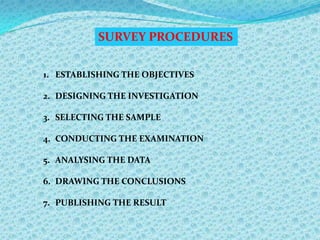
SURVEY PROCEDURESESTABLISHING THE OBJECTIVESDESIGNING THE INVESTIGATIONSELECTING THE SAMPLECONDUCTING THE EXAMINATIONANALYSING THE DATADRAWING THE CONCLUSIONSPUBLISHING THE RESULT
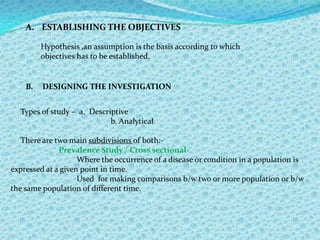
ESTABLISHING THE OBJECTIVESHypothesis ,an assumption is the basis according to which objectives has to be established.B.     DESIGNING THE INVESTIGATION     Types of study –  a.  Descriptive                                                   b. Analytical      There are two main subdivisions of both:-Prevalence Study / Cross sectional-                                 Where the occurrence of a disease or condition in a population is                 expressed at a given point in time.                                 Used  for making comparisons b/w two or more population or b/w the same population of different time.
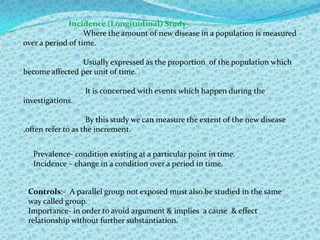
                        Incidence (Longitudinal) Study-                               Where the amount of new disease in a population is measured over a period of time.                              Usually expressed as the proportion  of the population which become affected per unit of time.                               It is concerned with events which happen during the investigations.                               By this study we can measure the extent of the new disease ,often refer to as the increment. Prevalence- condition existing at a particular point in time.Incidence – change in a condition over a period in time.Controls:-  A parallel group not exposed must also be studied in the same way called group.Importance- in order to avoid argument & implies  a cause  & effect relationship without further substantiation.
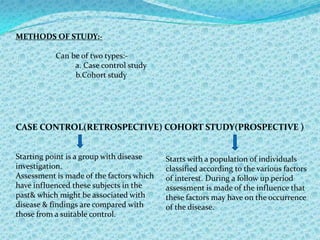
METHODS OF STUDY:-                    Can be of two types:-                              a. Case control studyb.Cohort studyCASE CONTROL(RETROSPECTIVE) COHORT STUDY(PROSPECTIVE )Starting point is a group with disease investigation.Assessment is made of the factors which have influenced these subjects in the past& which might be associated with disease & findings are compared with those from a suitable control.Starts with a population of individuals classified according to the various factors of interest. During a follow up period assessment is made of the influence that these factors may have on the occurrence of the disease.
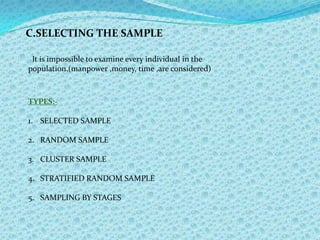
C.SELECTING THE SAMPLE   It is impossible to examine every individual in the                  population.(manpower ,money, time ,are considered)TYPES:-SELECTED SAMPLERANDOM SAMPLE CLUSTER SAMPLESTRATIFIED RANDOM SAMPLESAMPLING BY STAGES
SELECTED SAMPLEA criteria is set if a person fulfills the criteria he is selected for the sample                   Selection may be done either by                             Self selected- which is haphazard or systematic                             Research workersRANDOM SAMPLEWhere each individual have  an equal chance of being included in the sample. CLUSTER SAMPLEDone for administrative & economic reasonsClusters may be villages , buildings ,classes of schoolchildren or family.
STRATIFIED RANDOM SAMPLEIf the conditions under investigation is known to be related to various factors such as age sex or area of residence the population is first divided into these groups or strata & a random sample taken within each stration.SAMPLING BY STAGESEx:- in the two stage sampling the population is divided into a set of 1 st stage sampling units(Primary Sampling Units) & a sample of these units is selected by  simple ,random, stratified or systematic sampling.Individuals are then chosen from each of these primary units any method of samplings.Size of sample is dependent on the statistical characteristics of the data to be collected.Larger the sample less the sampling variation i.e. less chance of misleading result.
D.CODUCTING EXAMINATIONSObtaining approval from the authoritiesBudgeting SchedulingEmergency cases & referrals\Validity & reliability of data Personnel & organizationInstruments & supplies Examination areaMethod of examination, criteria for diagnosis ,indices.Type I-complete examination using mouth mirror & explorer, illumination ,full mouth radiographs & additional diagnostic method such as  study model pulp testing , transillumination,lab investigation.
Type II- mouth mirror, explorer , illumination, bitewing radiographs & periapical radiographs.Type III- only mouth mirror  explorer , illuminationType IV- this is a screening procedure only using a tongue depressor & available illumination.Note – Type II is used in clinical trials                 Type III is used in epidemiological surveys                    Type IV in inspection of school children & to discover the    children who need treatment.
E.ANALYSING THE DATA F.DRAWING THE CONCLUSIONG.PUBLISHING THE REPORTS                   should include following information                           Statements & purposes of the survey
                           Material & methods
                           Discussion & conclusionsTHANK     YOU
Presentation1
Presentation1

Presentation1

  • 1.
    SURVEY PROCEDURESBY:- DR. NAVAL KANT JOGI BDS (GDC RAIPUR)
  • 2.
    WHAT IS SURVEY ?Is an investigation in which information is systematically collected ,but in which experimental method is not used.
  • 3.
    ADVANTAGES OF SURVEYMETHODProvides information on some aspects of oral health status about which information may not be available from any source.
  • 4.
    Information pertaining tonumerator as well as denominator becomes available which enables us to calculate various indices & rates.
  • 5.
    Various associations &correlations b/w different variables can be identified & studied.
  • 6.
    Reasons for utilizationas well as non utilization of oral healthcare services & facilities can be identified & studied.
  • 7.
    Information from awell planned systematic survey is more reliable, complete & accurate compared to information collected routinely.TYPES OF SURVEYDESCRIPTIVEANALYTICLONGITUDINALCROSS SECTIONALLONGITUDINALCROSS SECTIONAL
  • 8.
    DESCRIPTIVEANALYTIC(EXPLANATORY)Describes a situation.ex. Distribution of a disease in a population in relation to sex &age.
  • 9.
    Tries to explaina situation i.e. to study the determinative process. Ex. Why does the disease occur in these persons .
  • 10.
    Done by formulating& testing hypothesis.Depending upon the time period covered by the observations they can beLongitudinalCross section
  • 11.
    BASIC ORAL HEALTHSURVEYS:-Are defined as survey to collect the basic information about oral disease status & treatment needs that is needed for planning or monitoring oral health care programmes.noteSurveys are not designed to collect information about clinical effectiveness of different preventive or care procedures or etiological factors affecting disease distribution or severity.
  • 12.
    However the informationobtained can be used for monitoring the effectiveness of oral care services.OBJECTIVES OF ORAL HEALTH SURVEYS:-Initially to provide a full picture of the oral health status & needs of a population.Subsequently to monitor changes in disease levels or patterns.
  • 13.
    PATHFINDER SURVEY:-Special factorsassociated with the most common oral diseases & the extensive experience gained in oral epidemiology over the past 25 years have enabled a practical, economic survey sampling methodology to be defined – “PATHFINDER” method.Method used is “stratified cluster sampling technique” which aims to include the most important population subgroups likely to have different disease levels. It also proposes appropriate number of subjects in specific index age groups in any one location.
  • 14.
    In this wayreliable & clinically relevant information for planning is obtained at minimum expense.It is suitable for obtaining the following information:-The overall prevalence of the common oral diseases & conditions affecting the population.Variations in disease in the population enable case needs for different age groups to be determined, to provide information about severity & progression of disease & to give an indication as to whether the levels are increasing or decreasing.PREVALENCERefers to all current cases(old & new) existing at a given point in time or over a period of time in a given population.
  • 15.
    PATHFINDER SURVEYS CANBE EITHER PILOT SURVEYNATIONAL PATHFINDER SURVEYPILOT SURVEY:-Is one that includes only the most important subgroups in the population &only 1 or 2 index ages usually 12 yrs or one another age gr.This survey provide minimum amount of data needed to commence planning . Additional data has to be collected in order to provide a baseline for the implementation & monitoring of services.NATIONAL PATHFINDER SURVEY:-Incorporates sufficient examination sets to cover all important subgroups of the population that may have differing disease levels or treatment needs & at least 3 of the age groups or index ages.This type of survey is suitable for the collection of data for the planning & monitoring of services.
  • 16.
    INDEX AGE &AGE GROUPS:-Recommended ages are- 5 year for primary dentition 12,15 ,35-44 & 65-74 for permanent dentition5th year- in relation to levels of caries in the primary dentition which may exhibit over a shorter time span.12th year–age at which children leave primary school therefore it is last age at which reliable sample may be obtained easily through the school system.All perm. Teeth have erupted except 3rd molars- for this reason it has been chosen as “Global Monitoring Age” for caries for international comparisons & monitoring of disease trends.
  • 17.
    15th year-at thisage the permanent teeth have been exposed to the oral environment for 3-9 years.35-44 years-standard monitoring group for health conditions of adults. Full effect of caries , periodontal disease involvement & general effects of the care provided can be monitored using data for this age group.65-74 years-data for this group is necessary for planning appropriate care for the alderly & for monitoring the overall effects of oral care services in a population.
  • 18.
    SURVEY PROCEDURESESTABLISHING THEOBJECTIVESDESIGNING THE INVESTIGATIONSELECTING THE SAMPLECONDUCTING THE EXAMINATIONANALYSING THE DATADRAWING THE CONCLUSIONSPUBLISHING THE RESULT
  • 19.
    ESTABLISHING THE OBJECTIVESHypothesis,an assumption is the basis according to which objectives has to be established.B. DESIGNING THE INVESTIGATION Types of study – a. Descriptive b. Analytical There are two main subdivisions of both:-Prevalence Study / Cross sectional- Where the occurrence of a disease or condition in a population is expressed at a given point in time. Used for making comparisons b/w two or more population or b/w the same population of different time.
  • 20.
    Incidence (Longitudinal) Study- Where the amount of new disease in a population is measured over a period of time. Usually expressed as the proportion of the population which become affected per unit of time. It is concerned with events which happen during the investigations. By this study we can measure the extent of the new disease ,often refer to as the increment. Prevalence- condition existing at a particular point in time.Incidence – change in a condition over a period in time.Controls:- A parallel group not exposed must also be studied in the same way called group.Importance- in order to avoid argument & implies a cause & effect relationship without further substantiation.
  • 21.
    METHODS OF STUDY:- Can be of two types:- a. Case control studyb.Cohort studyCASE CONTROL(RETROSPECTIVE) COHORT STUDY(PROSPECTIVE )Starting point is a group with disease investigation.Assessment is made of the factors which have influenced these subjects in the past& which might be associated with disease & findings are compared with those from a suitable control.Starts with a population of individuals classified according to the various factors of interest. During a follow up period assessment is made of the influence that these factors may have on the occurrence of the disease.
  • 22.
    C.SELECTING THE SAMPLE It is impossible to examine every individual in the population.(manpower ,money, time ,are considered)TYPES:-SELECTED SAMPLERANDOM SAMPLE CLUSTER SAMPLESTRATIFIED RANDOM SAMPLESAMPLING BY STAGES
  • 23.
    SELECTED SAMPLEA criteriais set if a person fulfills the criteria he is selected for the sample Selection may be done either by Self selected- which is haphazard or systematic Research workersRANDOM SAMPLEWhere each individual have an equal chance of being included in the sample. CLUSTER SAMPLEDone for administrative & economic reasonsClusters may be villages , buildings ,classes of schoolchildren or family.
  • 24.
    STRATIFIED RANDOM SAMPLEIfthe conditions under investigation is known to be related to various factors such as age sex or area of residence the population is first divided into these groups or strata & a random sample taken within each stration.SAMPLING BY STAGESEx:- in the two stage sampling the population is divided into a set of 1 st stage sampling units(Primary Sampling Units) & a sample of these units is selected by simple ,random, stratified or systematic sampling.Individuals are then chosen from each of these primary units any method of samplings.Size of sample is dependent on the statistical characteristics of the data to be collected.Larger the sample less the sampling variation i.e. less chance of misleading result.
  • 25.
    D.CODUCTING EXAMINATIONSObtaining approvalfrom the authoritiesBudgeting SchedulingEmergency cases & referrals\Validity & reliability of data Personnel & organizationInstruments & supplies Examination areaMethod of examination, criteria for diagnosis ,indices.Type I-complete examination using mouth mirror & explorer, illumination ,full mouth radiographs & additional diagnostic method such as study model pulp testing , transillumination,lab investigation.
  • 26.
    Type II- mouthmirror, explorer , illumination, bitewing radiographs & periapical radiographs.Type III- only mouth mirror explorer , illuminationType IV- this is a screening procedure only using a tongue depressor & available illumination.Note – Type II is used in clinical trials Type III is used in epidemiological surveys Type IV in inspection of school children & to discover the children who need treatment.
  • 27.
    E.ANALYSING THE DATAF.DRAWING THE CONCLUSIONG.PUBLISHING THE REPORTS should include following information Statements & purposes of the survey
  • 28.
    Material & methods
  • 29.
    Discussion & conclusionsTHANK YOU