Computational Linguistics              1


Lecture 2: Acoustic Phonetics and PRAAT
  o   Some Readings on acoustics and PRAAT
  o   Waves, sound waves, and spectra
  o   Speech waveforms
  o   Deriving schwa
  o   Formants
  o   Spectrograms
  o   Reading spectrograms

                            Dr. Saeed Rahati
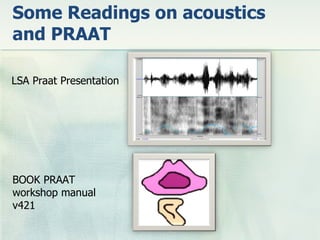
Some Readings on acoustics
and PRAAT

LSA Praat Presentation


BOOK PRAAT
workshop manual
v421
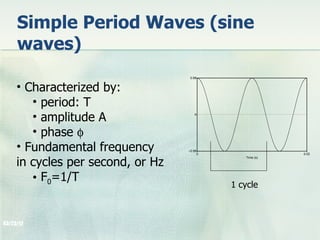
Simple Period Waves (sine
     waves)
                                    0.99


     • Characterized by:
        • period: T
        • amplitude A                 0


        • phase φ
     • Fundamental frequency       –0.99
                                        0                 0.02


     in cycles per second, or Hz
                                               Time (s)


        • F0=1/T
                                            1 cycle


03/23/12
Simple periodic waves of
         sound                                         4
 0.99


   0


–0.99
     0                   0.02


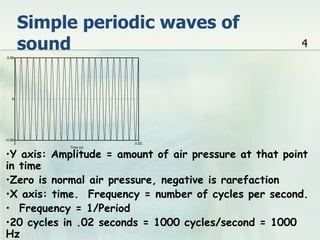
•Y axis: Amplitude = amount of air pressure at that point
              Time (s)


in time
•Zero is normal air pressure, negative is rarefaction
•X axis: time. Frequency = number of cycles per second.
• Frequency = 1/Period
•20 cycles in .02 seconds = 1000 cycles/second = 1000
Hz
Waves have different
frequencies                                             5
              0.99


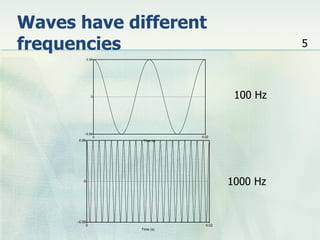
                  0                            100 Hz


          –0.99
                     0               0.02
       0.99               Time (s)


         0
                                              1000 Hz


      –0.99
              0                        0.02
                         Time (s)
Complex waves: Adding a 100
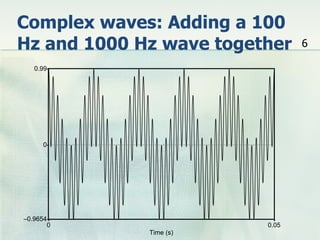
Hz and 1000 Hz wave together    6

   0.99


     0


–0.9654
       0                 0.05
             Time (s)
Spectrum                                               7

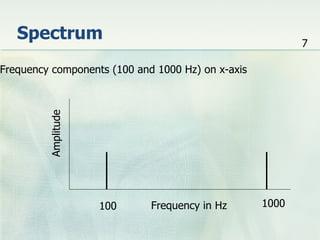
Frequency components (100 and 1000 Hz) on x-axis
         Amplitude


                     100     Frequency in Hz       1000
Spectra continued                      8

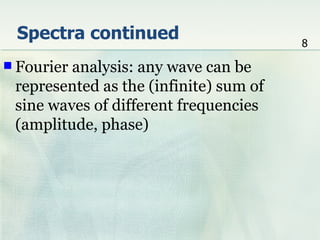
 Fourieranalysis: any wave can be
 represented as the (infinite) sum of
 sine waves of different frequencies
 (amplitude, phase)
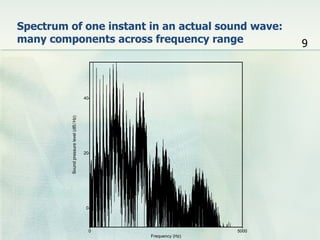
Spectrum of one instant in an actual sound wave:
many components across frequency range             9


            40


            20


             0


             0                           5000
                        Frequency (Hz)
Waveforms for speech                                         10
   Waveform of the vowel [iy]


   Frequency: repetitions/second of a wave
   Above vowel has 28 reps in .11 secs
   So freq is 28/.11 = 255 Hz
   This is speed that vocal folds move, hence voicing
   Amplitude: y axis: amount of air pressure at that point in time
   Zero is normal air pressure, negative is rarefaction
She just had a baby                                                               11


   What can we learn from a wavefile?
          Vowels are voiced, long, loud
          Length in time = length in space in waveform picture
          Voicing: regular peaks in amplitude
          When stops closed: no peaks: silence.
          Peaks = voicing: .46 to .58 (vowel [iy], from second .65 to .74 (vowel
           [ax]) and so on
          Silence of stop closure (1.06 to 1.08 for first [b], or 1.26 to 1.28 for
           second [b])
          Fricatives like [sh] intense irregular pattern; see .33 to .46
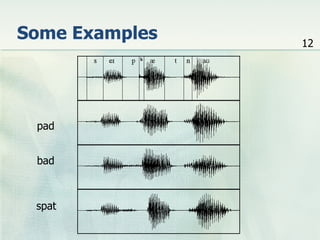
Some Examples   12


 pad


 bad


 spat
Part of [ae] waveform from
“had”                                                 13


   Note complex wave repeating nine times in figure
   Plus smaller waves which repeats 4 times for every
    large pattern
   Large wave has frequency of 250 Hz (9 times in .036
    seconds)
   Small wave roughly 4 times this, or roughly 1000 Hz
   Two little tiny waves on top of peak of 1000 Hz waves
Back to spectrum                                 14
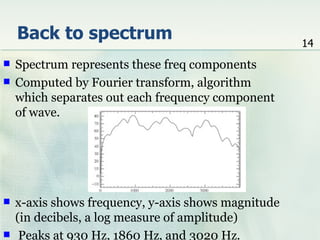
   Spectrum represents these freq components
   Computed by Fourier transform, algorithm
    which separates out each frequency component
    of wave.


   x-axis shows frequency, y-axis shows magnitude
    (in decibels, a log measure of amplitude)
    Peaks at 930 Hz, 1860 Hz, and 3020 Hz.
Why is a speech sound wave
 composed of these peaks?                        15


 Articulatory   facts:
   The vocal cord vibrations create harmonics
   The mouth is an amplifier
   Depending on shape of mouth, some
    harmonics are amplified more than others
16
Deriving schwa: how shape of mouth
    (filter function) creates peaks!         17
 Reminder of basic facts about sound waves
 f = c/λ
 c = speed of sound (approx 35,000 cm/sec)
 A sound with λ=10 meters has low frequency f
  = 35 Hz (35,000/1000)
 A sound with λ=2 centimeters has high
  frequency f = 17,500 Hz (35,000/2)
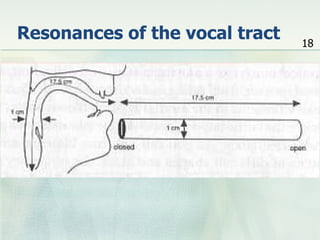
Resonances of the vocal tract                   18

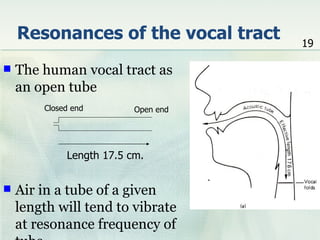
     The human vocal tract as an open tube
  Closed end        Open end


          Length 17.5
     Airin a tube of
          cm.         a given length will tend to
      vibrate at resonance frequency of tube.
Resonances of the vocal tract    19

   The human vocal tract as
    an open tube
        Closed end        Open end


             Length 17.5 cm.


   Air in a tube of a given
    length will tend to vibrate
    at resonance frequency of
Resonances of the vocal tract                  20
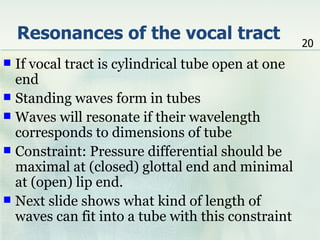
 If vocal tract is cylindrical tube open at one
  end
 Standing waves form in tubes
 Waves will resonate if their wavelength
  corresponds to dimensions of tube
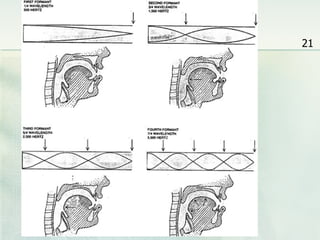
 Constraint: Pressure differential should be
  maximal at (closed) glottal end and minimal
  at (open) lip end.
 Next slide shows what kind of length of
  waves can fit into a tube with this constraint
21
Computing the 3 formants of
    schwa                                      22
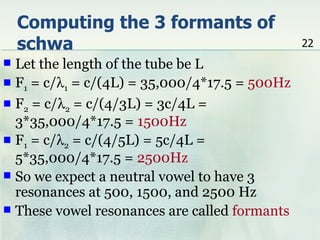
 Let the length of the tube be L
 F1 = c/λ1 = c/(4L) = 35,000/4*17.5 = 500Hz
 F2 = c/λ2 = c/(4/3L) = 3c/4L =
  3*35,000/4*17.5 = 1500Hz
 F1 = c/λ2 = c/(4/5L) = 5c/4L =
  5*35,000/4*17.5 = 2500Hz
 So we expect a neutral vowel to have 3
  resonances at 500, 1500, and 2500 Hz
 These vowel resonances are called formants
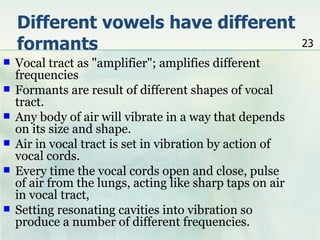
Different vowels have different
    formants                                               23
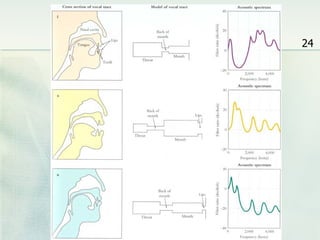
   Vocal tract as "amplifier"; amplifies different
    frequencies
   Formants are result of different shapes of vocal
    tract.
   Any body of air will vibrate in a way that depends
    on its size and shape.
   Air in vocal tract is set in vibration by action of
    vocal cords.
   Every time the vocal cords open and close, pulse
    of air from the lungs, acting like sharp taps on air
    in vocal tract,
   Setting resonating cavities into vibration so
    produce a number of different frequencies.
24
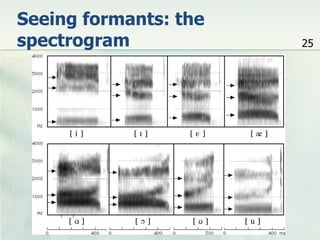
Seeing formants: the
spectrogram            25
Formants                                       26
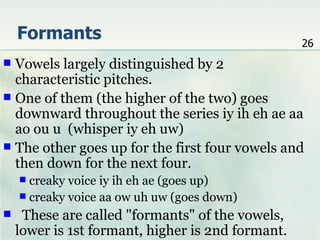
 Vowels largely distinguished by 2
  characteristic pitches.
 One of them (the higher of the two) goes
  downward throughout the series iy ih eh ae aa
  ao ou u (whisper iy eh uw)
 The other goes up for the first four vowels and
  then down for the next four.
     creaky voice iy ih eh ae (goes up)
     creaky voice aa ow uh uw (goes down)
    These are called "formants" of the vowels,
    lower is 1st formant, higher is 2nd formant.
How formants are produced               27
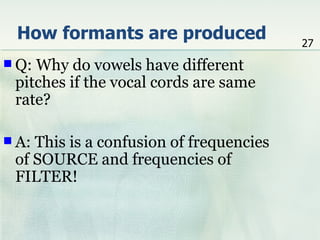
 Q:Why do vowels have different
 pitches if the vocal cords are same
 rate?

 A:This is a confusion of frequencies
 of SOURCE and frequencies of
 FILTER!
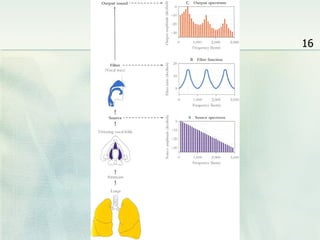
Remember source-filter model
 of speech production                                  28

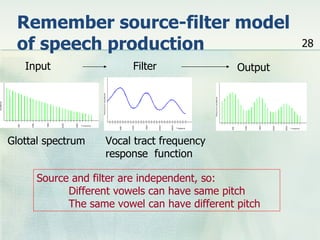
   Input                 Filter               Output


Glottal spectrum   Vocal tract frequency
                   response function

      Source and filter are independent, so:
            Different vowels can have same pitch
            The same vowel can have different pitch
Vowel [i] sung at successively higher
pitch.                                  29


     1                 2          3


     4             5               6


          7
How to read spectrograms                                      30


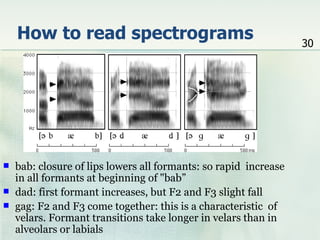
   bab: closure of lips lowers all formants: so rapid increase
    in all formants at beginning of "bab”
   dad: first formant increases, but F2 and F3 slight fall
   gag: F2 and F3 come together: this is a characteristic of
    velars. Formant transitions take longer in velars than in
    alveolars or labials
She came back and started
again                                                                31


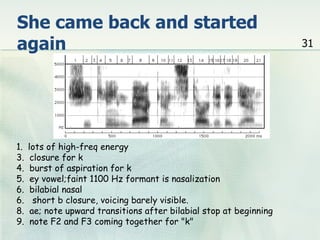
1.   lots of high-freq energy
3.    closure for k
4.    burst of aspiration for k
5.    ey vowel;faint 1100 Hz formant is nasalization
6.    bilabial nasal
6.     short b closure, voicing barely visible.
8.    ae; note upward transitions after bilabial stop at beginning
9.    note F2 and F3 coming together for "k"
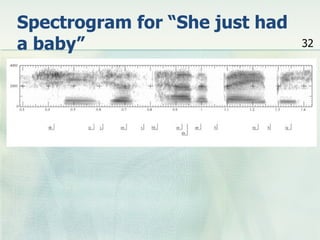
Spectrogram for “She just had
a baby”                         32

Lec 2

  • 1.
    Computational Linguistics 1 Lecture 2: Acoustic Phonetics and PRAAT o Some Readings on acoustics and PRAAT o Waves, sound waves, and spectra o Speech waveforms o Deriving schwa o Formants o Spectrograms o Reading spectrograms Dr. Saeed Rahati
  • 2.
    Some Readings onacoustics and PRAAT LSA Praat Presentation BOOK PRAAT workshop manual v421
  • 3.
    Simple Period Waves(sine waves) 0.99 • Characterized by: • period: T • amplitude A 0 • phase φ • Fundamental frequency –0.99 0 0.02 in cycles per second, or Hz Time (s) • F0=1/T 1 cycle 03/23/12
  • 4.
    Simple periodic wavesof sound 4 0.99 0 –0.99 0 0.02 •Y axis: Amplitude = amount of air pressure at that point Time (s) in time •Zero is normal air pressure, negative is rarefaction •X axis: time. Frequency = number of cycles per second. • Frequency = 1/Period •20 cycles in .02 seconds = 1000 cycles/second = 1000 Hz
  • 5.
    Waves have different frequencies 5 0.99 0 100 Hz –0.99 0 0.02 0.99 Time (s) 0 1000 Hz –0.99 0 0.02 Time (s)
  • 6.
    Complex waves: Addinga 100 Hz and 1000 Hz wave together 6 0.99 0 –0.9654 0 0.05 Time (s)
  • 7.
    Spectrum 7 Frequency components (100 and 1000 Hz) on x-axis Amplitude 100 Frequency in Hz 1000
  • 8.
    Spectra continued 8  Fourieranalysis: any wave can be represented as the (infinite) sum of sine waves of different frequencies (amplitude, phase)
  • 9.
    Spectrum of oneinstant in an actual sound wave: many components across frequency range 9 40 20 0 0 5000 Frequency (Hz)
  • 10.
    Waveforms for speech 10  Waveform of the vowel [iy]  Frequency: repetitions/second of a wave  Above vowel has 28 reps in .11 secs  So freq is 28/.11 = 255 Hz  This is speed that vocal folds move, hence voicing  Amplitude: y axis: amount of air pressure at that point in time  Zero is normal air pressure, negative is rarefaction
  • 11.
    She just hada baby 11  What can we learn from a wavefile?  Vowels are voiced, long, loud  Length in time = length in space in waveform picture  Voicing: regular peaks in amplitude  When stops closed: no peaks: silence.  Peaks = voicing: .46 to .58 (vowel [iy], from second .65 to .74 (vowel [ax]) and so on  Silence of stop closure (1.06 to 1.08 for first [b], or 1.26 to 1.28 for second [b])  Fricatives like [sh] intense irregular pattern; see .33 to .46
  • 12.
    Some Examples 12 pad bad spat
  • 13.
    Part of [ae]waveform from “had” 13  Note complex wave repeating nine times in figure  Plus smaller waves which repeats 4 times for every large pattern  Large wave has frequency of 250 Hz (9 times in .036 seconds)  Small wave roughly 4 times this, or roughly 1000 Hz  Two little tiny waves on top of peak of 1000 Hz waves
  • 14.
    Back to spectrum 14  Spectrum represents these freq components  Computed by Fourier transform, algorithm which separates out each frequency component of wave.  x-axis shows frequency, y-axis shows magnitude (in decibels, a log measure of amplitude)  Peaks at 930 Hz, 1860 Hz, and 3020 Hz.
  • 15.
    Why is aspeech sound wave composed of these peaks? 15  Articulatory facts:  The vocal cord vibrations create harmonics  The mouth is an amplifier  Depending on shape of mouth, some harmonics are amplified more than others
  • 16.
  • 17.
    Deriving schwa: howshape of mouth (filter function) creates peaks! 17  Reminder of basic facts about sound waves  f = c/λ  c = speed of sound (approx 35,000 cm/sec)  A sound with λ=10 meters has low frequency f = 35 Hz (35,000/1000)  A sound with λ=2 centimeters has high frequency f = 17,500 Hz (35,000/2)
  • 18.
    Resonances of thevocal tract 18  The human vocal tract as an open tube Closed end Open end Length 17.5  Airin a tube of cm. a given length will tend to vibrate at resonance frequency of tube.
  • 19.
    Resonances of thevocal tract 19  The human vocal tract as an open tube Closed end Open end Length 17.5 cm.  Air in a tube of a given length will tend to vibrate at resonance frequency of
  • 20.
    Resonances of thevocal tract 20  If vocal tract is cylindrical tube open at one end  Standing waves form in tubes  Waves will resonate if their wavelength corresponds to dimensions of tube  Constraint: Pressure differential should be maximal at (closed) glottal end and minimal at (open) lip end.  Next slide shows what kind of length of waves can fit into a tube with this constraint
  • 21.
  • 22.
    Computing the 3formants of schwa 22  Let the length of the tube be L  F1 = c/λ1 = c/(4L) = 35,000/4*17.5 = 500Hz  F2 = c/λ2 = c/(4/3L) = 3c/4L = 3*35,000/4*17.5 = 1500Hz  F1 = c/λ2 = c/(4/5L) = 5c/4L = 5*35,000/4*17.5 = 2500Hz  So we expect a neutral vowel to have 3 resonances at 500, 1500, and 2500 Hz  These vowel resonances are called formants
  • 23.
    Different vowels havedifferent formants 23  Vocal tract as "amplifier"; amplifies different frequencies  Formants are result of different shapes of vocal tract.  Any body of air will vibrate in a way that depends on its size and shape.  Air in vocal tract is set in vibration by action of vocal cords.  Every time the vocal cords open and close, pulse of air from the lungs, acting like sharp taps on air in vocal tract,  Setting resonating cavities into vibration so produce a number of different frequencies.
  • 24.
  • 25.
  • 26.
    Formants 26  Vowels largely distinguished by 2 characteristic pitches.  One of them (the higher of the two) goes downward throughout the series iy ih eh ae aa ao ou u (whisper iy eh uw)  The other goes up for the first four vowels and then down for the next four.  creaky voice iy ih eh ae (goes up)  creaky voice aa ow uh uw (goes down)  These are called "formants" of the vowels, lower is 1st formant, higher is 2nd formant.
  • 27.
    How formants areproduced 27  Q:Why do vowels have different pitches if the vocal cords are same rate?  A:This is a confusion of frequencies of SOURCE and frequencies of FILTER!
  • 28.
    Remember source-filter model of speech production 28 Input Filter Output Glottal spectrum Vocal tract frequency response function Source and filter are independent, so: Different vowels can have same pitch The same vowel can have different pitch
  • 29.
    Vowel [i] sungat successively higher pitch. 29 1 2 3 4 5 6 7
  • 30.
    How to readspectrograms 30  bab: closure of lips lowers all formants: so rapid increase in all formants at beginning of "bab”  dad: first formant increases, but F2 and F3 slight fall  gag: F2 and F3 come together: this is a characteristic of velars. Formant transitions take longer in velars than in alveolars or labials
  • 31.
    She came backand started again 31 1. lots of high-freq energy 3. closure for k 4. burst of aspiration for k 5. ey vowel;faint 1100 Hz formant is nasalization 6. bilabial nasal 6. short b closure, voicing barely visible. 8. ae; note upward transitions after bilabial stop at beginning 9. note F2 and F3 coming together for "k"
  • 32.
    Spectrogram for “Shejust had a baby” 32