Computer Networks – CSE331
Lecture 12
1 Hr
 understand principles behind
transport layer services:
 multiplexing, demultiplexing
 reliable data transfer
 flow control
 congestion control
 learn about Internet
transport layer protocols:
 UDP: connectionless
transport
 TCP: connection-oriented
reliable transport
 TCP congestion control
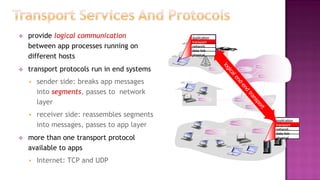
 provide logical communication
between app processes running on
different hosts
 transport protocols run in end systems
 sender side: breaks app messages
into segments, passes to network
layer
 receiver side: reassembles segments
into messages, passes to app layer
 more than one transport protocol
available to apps
 Internet: TCP and UDP
application
transport
network
data link
physical
application
transport
network
data link
physical
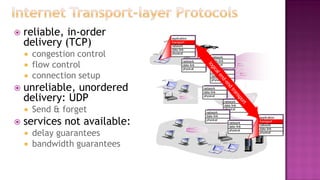
 reliable, in-order
delivery (TCP)
 congestion control
 flow control
 connection setup
 unreliable, unordered
delivery: UDP
 Send & forget
 services not available:
 delay guarantees
 bandwidth guarantees
application
transport
network
data link
physical
application
transport
network
data link
physical
network
data link
physical
network
data link
physical
network
data link
physical
network
data link
physical
network
data link
physical
network
data link
physical
network
data link
physical
process
socket
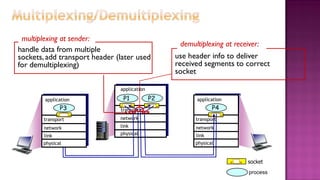
use header info to deliver
received segments to correct
socket
demultiplexing at receiver:
handle data from multiple
sockets, add transport header (later used
for demultiplexing)
multiplexing at sender:
transport
application
physical
link
network
P2P1
transport
application
physical
link
network
P4
transport
application
physical
link
network
P3
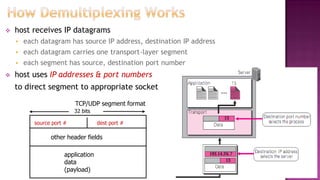
 host receives IP datagrams
 each datagram has source IP address, destination IP address
 each datagram carries one transport-layer segment
 each segment has source, destination port number
 host uses IP addresses & port numbers
to direct segment to appropriate socket
source port # dest port #
32 bits
application
data
(payload)
other header fields
TCP/UDP segment format
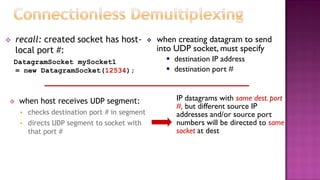
 recall: created socket has host-
local port #:
DatagramSocket mySocket1
= new DatagramSocket(12534);
 when host receives UDP segment:
 checks destination port # in segment
 directs UDP segment to socket with
that port #
 when creating datagram to send
into UDP socket, must specify
 destination IP address
 destination port #
IP datagrams with same dest. port
#, but different source IP
addresses and/or source port
numbers will be directed to same
socket at dest
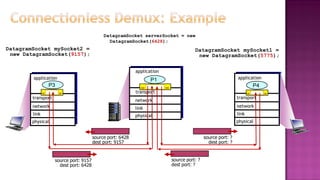
DatagramSocket serverSocket = new
DatagramSocket(6428);
transport
application
physical
link
network
P3
transport
application
physical
link
network
P1
transport
application
physical
link
network
P4
DatagramSocket mySocket1 =
new DatagramSocket(5775);
DatagramSocket mySocket2 =
new DatagramSocket(9157);
source port: 9157
dest port: 6428
source port: 6428
dest port: 9157
source port: ?
dest port: ?
source port: ?
dest port: ?
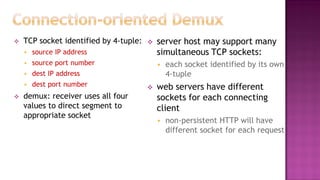
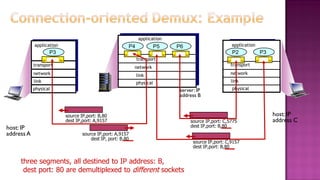
 TCP socket identified by 4-tuple:
 source IP address
 source port number
 dest IP address
 dest port number
 demux: receiver uses all four
values to direct segment to
appropriate socket
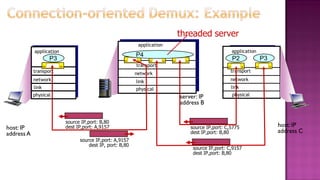
 server host may support many
simultaneous TCP sockets:
 each socket identified by its own
4-tuple
 web servers have different
sockets for each connecting
client
 non-persistent HTTP will have
different socket for each request
transport
application
physical
link
network
P3
transport
application
physical
link
P4
transport
application
physical
link
network
P2
source IP,port: A,9157
dest IP, port: B,80
source IP,port: B,80
dest IP,port: A,9157
host: IP
address A
host: IP
address C
network
P6P5
P3
source IP,port: C,5775
dest IP,port: B,80
source IP,port: C,9157
dest IP,port: B,80
three segments, all destined to IP address: B,
dest port: 80 are demultiplexed to different sockets
server: IP
address B
transport
application
physical
link
network
P3
transport
application
physical
link
transport
application
physical
link
network
P2
source IP,port: A,9157
dest IP, port: B,80
source IP,port: B,80
dest IP,port: A,9157host: IP
address A
host: IP
address C
server: IP
address B
network
P3
source IP,port: C,5775
dest IP,port: B,80
source IP,port: C,9157
dest IP,port: B,80
P4
threaded server
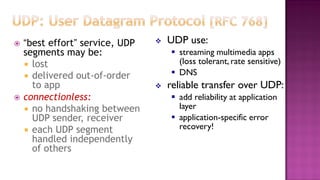
 “best effort” service, UDP
segments may be:
 lost
 delivered out-of-order
to app
 connectionless:
 no handshaking between
UDP sender, receiver
 each UDP segment
handled independently
of others
 UDP use:
 streaming multimedia apps
(loss tolerant, rate sensitive)
 DNS
 reliable transfer over UDP:
 add reliability at application
layer
 application-specific error
recovery!
source port # dest port #
32 bits
application
data
(payload)
UDP segment format
length checksum
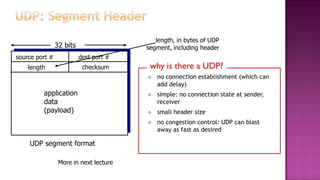
length, in bytes of UDP
segment, including header
 no connection establishment (which can
add delay)
 simple: no connection state at sender,
receiver
 small header size
 no congestion control: UDP can blast
away as fast as desired
why is there a UDP?
More in next lecture
 Ross book 3.1 to 3.2
 Forouzan 13.1

Lec 12(Transport Layer)

  • 1.
    Computer Networks –CSE331 Lecture 12 1 Hr
  • 2.
     understand principlesbehind transport layer services:  multiplexing, demultiplexing  reliable data transfer  flow control  congestion control  learn about Internet transport layer protocols:  UDP: connectionless transport  TCP: connection-oriented reliable transport  TCP congestion control
  • 3.
     provide logicalcommunication between app processes running on different hosts  transport protocols run in end systems  sender side: breaks app messages into segments, passes to network layer  receiver side: reassembles segments into messages, passes to app layer  more than one transport protocol available to apps  Internet: TCP and UDP application transport network data link physical application transport network data link physical
  • 4.
     reliable, in-order delivery(TCP)  congestion control  flow control  connection setup  unreliable, unordered delivery: UDP  Send & forget  services not available:  delay guarantees  bandwidth guarantees application transport network data link physical application transport network data link physical network data link physical network data link physical network data link physical network data link physical network data link physical network data link physical network data link physical
  • 5.
    process socket use header infoto deliver received segments to correct socket demultiplexing at receiver: handle data from multiple sockets, add transport header (later used for demultiplexing) multiplexing at sender: transport application physical link network P2P1 transport application physical link network P4 transport application physical link network P3
  • 6.
     host receivesIP datagrams  each datagram has source IP address, destination IP address  each datagram carries one transport-layer segment  each segment has source, destination port number  host uses IP addresses & port numbers to direct segment to appropriate socket source port # dest port # 32 bits application data (payload) other header fields TCP/UDP segment format
  • 7.
     recall: createdsocket has host- local port #: DatagramSocket mySocket1 = new DatagramSocket(12534);  when host receives UDP segment:  checks destination port # in segment  directs UDP segment to socket with that port #  when creating datagram to send into UDP socket, must specify  destination IP address  destination port # IP datagrams with same dest. port #, but different source IP addresses and/or source port numbers will be directed to same socket at dest
  • 8.
    DatagramSocket serverSocket =new DatagramSocket(6428); transport application physical link network P3 transport application physical link network P1 transport application physical link network P4 DatagramSocket mySocket1 = new DatagramSocket(5775); DatagramSocket mySocket2 = new DatagramSocket(9157); source port: 9157 dest port: 6428 source port: 6428 dest port: 9157 source port: ? dest port: ? source port: ? dest port: ?
  • 9.
     TCP socketidentified by 4-tuple:  source IP address  source port number  dest IP address  dest port number  demux: receiver uses all four values to direct segment to appropriate socket  server host may support many simultaneous TCP sockets:  each socket identified by its own 4-tuple  web servers have different sockets for each connecting client  non-persistent HTTP will have different socket for each request
  • 10.
    transport application physical link network P3 transport application physical link P4 transport application physical link network P2 source IP,port: A,9157 destIP, port: B,80 source IP,port: B,80 dest IP,port: A,9157 host: IP address A host: IP address C network P6P5 P3 source IP,port: C,5775 dest IP,port: B,80 source IP,port: C,9157 dest IP,port: B,80 three segments, all destined to IP address: B, dest port: 80 are demultiplexed to different sockets server: IP address B
  • 11.
    transport application physical link network P3 transport application physical link transport application physical link network P2 source IP,port: A,9157 destIP, port: B,80 source IP,port: B,80 dest IP,port: A,9157host: IP address A host: IP address C server: IP address B network P3 source IP,port: C,5775 dest IP,port: B,80 source IP,port: C,9157 dest IP,port: B,80 P4 threaded server
  • 12.
     “best effort”service, UDP segments may be:  lost  delivered out-of-order to app  connectionless:  no handshaking between UDP sender, receiver  each UDP segment handled independently of others  UDP use:  streaming multimedia apps (loss tolerant, rate sensitive)  DNS  reliable transfer over UDP:  add reliability at application layer  application-specific error recovery!
  • 13.
    source port #dest port # 32 bits application data (payload) UDP segment format length checksum length, in bytes of UDP segment, including header  no connection establishment (which can add delay)  simple: no connection state at sender, receiver  small header size  no congestion control: UDP can blast away as fast as desired why is there a UDP? More in next lecture
  • 14.
     Ross book3.1 to 3.2  Forouzan 13.1