6

Tutun Juhana
Telecommunication Engineering

Transport Layer

School of Electrical Engineering & Informatics
Institut Teknologi Bandung

Computer Networks
TRANSPORT LAYER SERVICES
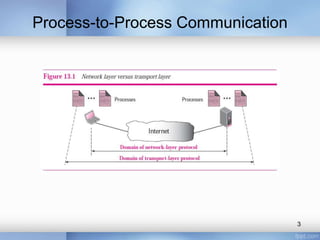
Process-to-Process Communication

3
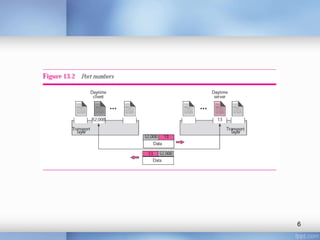
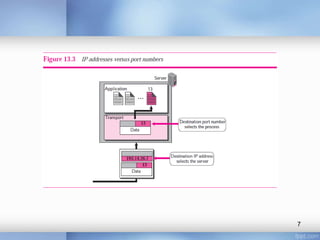
Addressing: Port Numbers
• To define the processes, we need
identifiers called port numbers
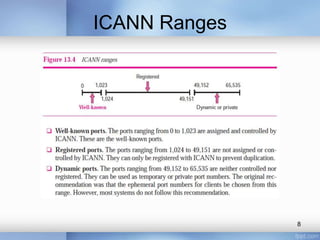
• In the TCP/IP protocol suite, the port
numbers are integers between 0 and
65,535

4
• In client-server paradigm:
– Client program defines itself ephemeral port
number  Short lived  recommended to be
greater than 1,023
– Server process must use well-known port
numbers

5
6
7
ICANN Ranges

8
Socket Addresses
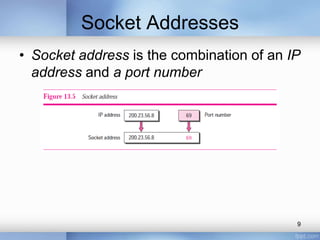
• Socket address is the combination of an IP
address and a port number

9
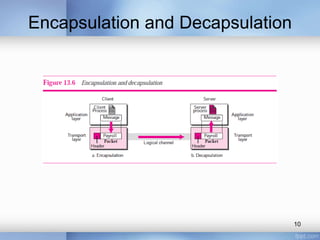
Encapsulation and Decapsulation

10
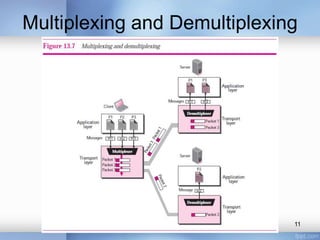
Multiplexing and Demultiplexing

11
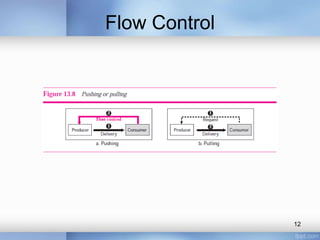
Flow Control

12
13
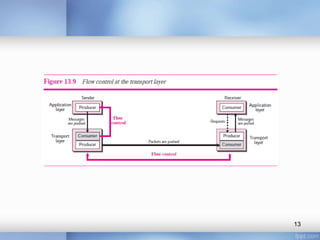
Although flow control can be implemented in
several ways, one of the solutions is
normally to use two buffers. One at the
sending transport layer and the other at the
receiving transport layer

14
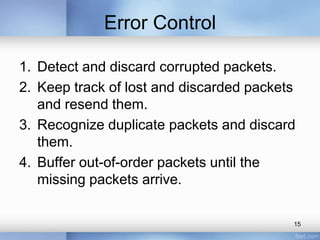
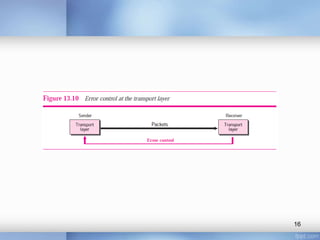
Error Control
1. Detect and discard corrupted packets.
2. Keep track of lost and discarded packets
and resend them.
3. Recognize duplicate packets and discard
them.
4. Buffer out-of-order packets until the
missing packets arrive.
15
16
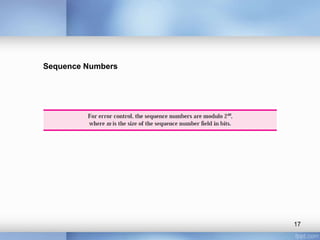
Sequence Numbers

17
Acknowledgment
• We can use both positive and negative signals as error
control
• The receiver side
– can send an acknowledgement (ACK) for each or a collection of
packets that have arrived safe and sound
– can simply discard the corrupted packets

• The sender can detect lost packets if it uses a timer
– When a packet is sent, the sender starts a timer; when the timer
expires, if an ACK does not arrive before the timer expires, the
sender resends the packet.
– Duplicate packets can be silently discarded by the receiver. Outof order packets can be either discarded (to be treated as lost
packets by the sender), or stored until the missing ones arrives.18
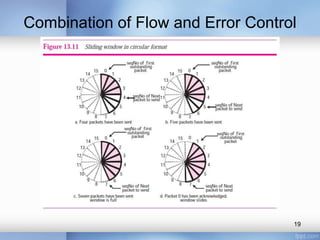
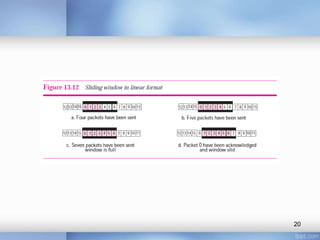
Combination of Flow and Error Control

19
20
Congestion Control
• Congestion control refers to the
mechanisms and techniques to control the
congestion and keep the load below the
capacity

21
Open-Loop Congestion Control
• Retransmission Policy
• Window Policy
• Acknowledgment Policy

22
Closed-Loop Congestion Control
• Closed-loop congestion control
mechanisms try to alleviate congestion
after it happens

23
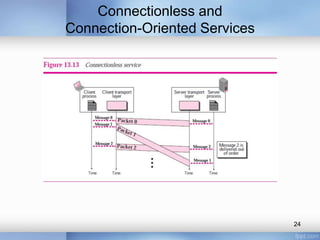
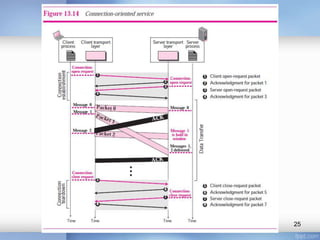
Connectionless and
Connection-Oriented Services

24
25
TRANSPORT-LAYER PROTOCOLS

26
Simple Protocol

27
Stop-and-Wait Protocol

28
29
Efficiency
• The Stop-and-Wait protocol is very inefficient if our
channel is thick and long
– By thick, we mean that our channel has a large bandwidth (high
data rate)
– by long, we mean the round-trip delay is long
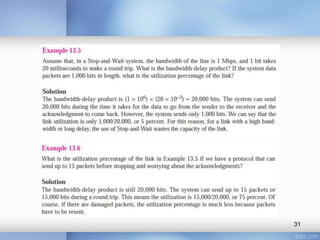
– The product of the above two is called the bandwidth-delay
product
– We can think of the channel as a pipe. The bandwidth-delay
product then is the volume of the pipe in bits
– The pipe is always there. If we do not use it, we are inefficient.
– The bandwidth-delay product is a measure of the number of bits
a sender can transmit through the system while waiting for an
acknowledgment from the receiver.
30
31
Pipelining
• In networking and in other areas, a task is
often begun before the previous task has
ended  This is known as pipelining
• There is no pipelining in the Stop-and-Wait
protocol because a sender must wait for a
packet to reach the destination and be
acknowledged before the next packet can
be sent
32
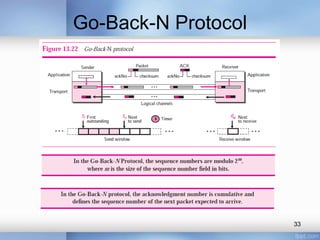
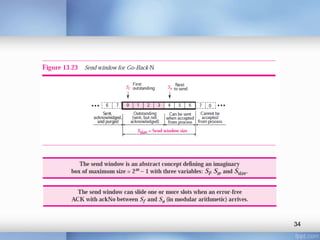
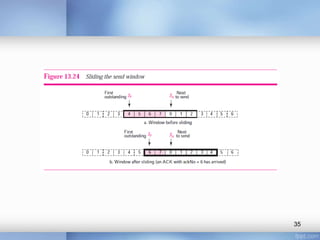
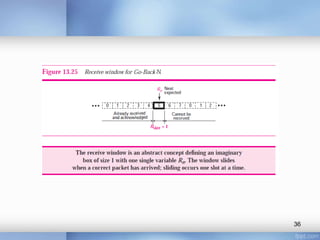
Go-Back-N Protocol

33
34
35
36
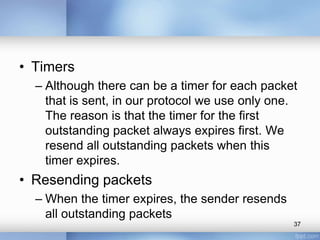
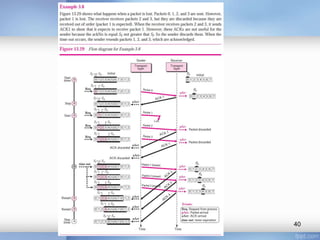
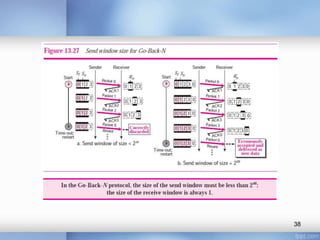
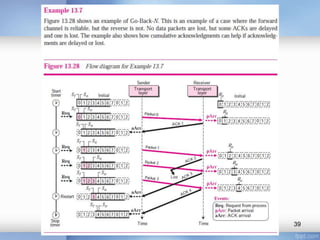
• Timers
– Although there can be a timer for each packet
that is sent, in our protocol we use only one.
The reason is that the timer for the first
outstanding packet always expires first. We
resend all outstanding packets when this
timer expires.

• Resending packets
– When the timer expires, the sender resends
all outstanding packets
37
38
39
40
41
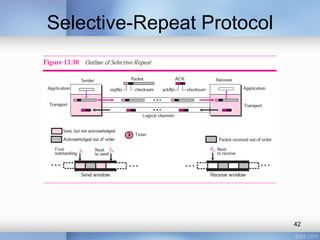
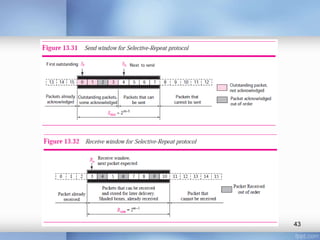
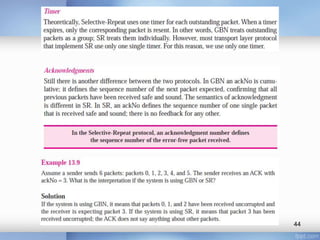
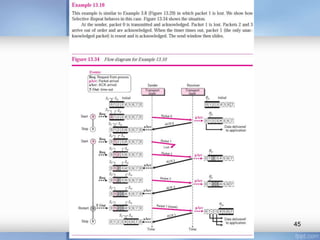
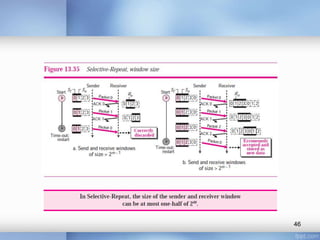
Selective-Repeat Protocol

42
43
44
45
46
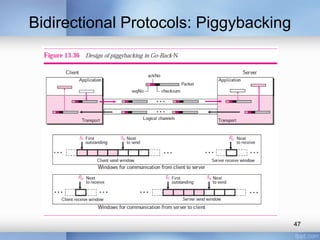
Bidirectional Protocols: Piggybacking

47

Transport Layer Part 1