
TCP vs UDP - Difference and Comparison | Diffen http://www.diffen.com/difference/TCP_vs_UDP 
Compare Anything ›› vs. GO » 
TCP vs. UDP 
Diffen › Technology › Computers › Computer Networking 
There are two types of Internet Protocol (IP) traffic. They are TCP or 
Transmission Control Protocol and UDP or User Datagram 
Protocol. TCP is connection oriented – once a connection is established, 
data can be sent bidirectional. UDP is a simpler, connectionless Internet 
protocol. Multiple messages are sent as packets in chunks using UDP. 
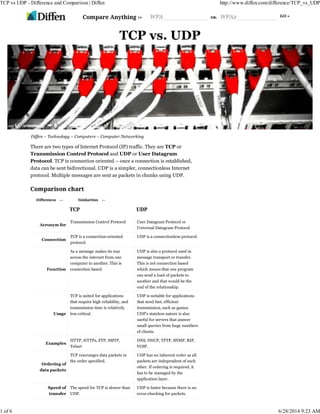
Comparison chart 
Differences — Similarities — 
TCP UDP 
Acronym for 
Transmission Control Protocol User Datagram Protocol or 
Universal Datagram Protocol 
Connection 
TCP is a connection-oriented 
protocol. 
UDP is a connectionless protocol. 
Function 
As a message makes its way 
across the internet from one 
computer to another. This is 
connection based. 
UDP is also a protocol used in 
message transport or transfer. 
This is not connection based 
which means that one program 
can send a load of packets to 
another and that would be the 
end of the relationship. 
Usage 
TCP is suited for applications 
that require high reliability, and 
transmission time is relatively 
less critical. 
UDP is suitable for applications 
that need fast, efficient 
transmission, such as games. 
UDP's stateless nature is also 
useful for servers that answer 
small queries from huge numbers 
of clients. 
Examples 
HTTP, HTTPs, FTP, SMTP, 
Telnet 
DNS, DHCP, TFTP, SNMP, RIP, 
VOIP. 
Ordering of 
data packets 
TCP rearranges data packets in 
the order specified. 
UDP has no inherent order as all 
packets are independent of each 
other. If ordering is required, it 
has to be managed by the 
application layer. 
Speed of 
transfer 
The speed for TCP is slower than 
UDP. 
UDP is faster because there is no 
error-checking for packets. 
1 of 6 6/28/2014 9:23 AM
TCP vs UDP - Difference and Comparison | Diffen http://www.diffen.com/difference/TCP_vs_UDP 
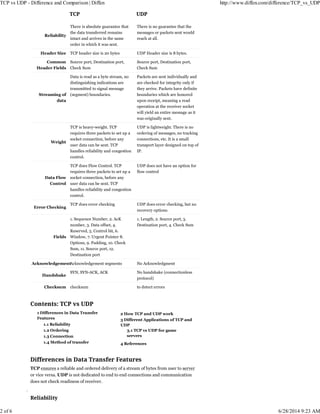
TCP UDP 
Reliability 
There is absolute guarantee that 
the data transferred remains 
intact and arrives in the same 
order in which it was sent. 
There is no guarantee that the 
messages or packets sent would 
reach at all. 
Header Size TCP header size is 20 bytes UDP Header size is 8 bytes. 
Common 
Header Fields 
Source port, Destination port, 
Check Sum 
Source port, Destination port, 
Check Sum 
Streaming of 
data 
Data is read as a byte stream, no 
distinguishing indications are 
transmitted to signal message 
(segment) boundaries. 
Packets are sent individually and 
are checked for integrity only if 
they arrive. Packets have definite 
boundaries which are honored 
upon receipt, meaning a read 
operation at the receiver socket 
will yield an entire message as it 
was originally sent. 
Weight 
TCP is heavy-weight. TCP 
requires three packets to set up a 
socket connection, before any 
user data can be sent. TCP 
handles reliability and congestion 
control. 
UDP is lightweight. There is no 
ordering of messages, no tracking 
connections, etc. It is a small 
transport layer designed on top of 
IP. 
Data Flow 
Control 
TCP does Flow Control. TCP 
requires three packets to set up a 
socket connection, before any 
user data can be sent. TCP 
handles reliability and congestion 
control. 
UDP does not have an option for 
flow control 
Error Checking 
TCP does error checking UDP does error checking, but no 
recovery options. 
Fields 
1. Sequence Number, 2. AcK 
number, 3. Data offset, 4. 
Reserved, 5. Control bit, 6. 
Window, 7. Urgent Pointer 8. 
Options, 9. Padding, 10. Check 
Sum, 11. Source port, 12. 
Destination port 
1. Length, 2. Source port, 3. 
Destination port, 4. Check Sum 
AcknowledgementAcknowledgement segments No Acknowledgment 
Handshake 
SYN, SYN-ACK, ACK No handshake (connectionless 
protocol) 
Checksum checksum to detect errors 
Contents: TCP vs UDP 
1 Differences in Data Transfer 
Features 
1.1 Reliability 
1.2 Ordering 
1.3 Connection 
1.4 Method of transfer 
2 How TCP and UDP work 
3 Different Applications of TCP and 
UDP 
3.1 TCP vs UDP for game 
servers 
4 References 
Differences in Data Transfer Features 
TCP ensures a reliable and ordered delivery of a stream of bytes from user to server 
or vice versa. UDP is not dedicated to end to end connections and communication 
does not check readiness of receiver. 
. 
Reliability 
2 of 6 6/28/2014 9:23 AM
TCP vs UDP - Difference and Comparison | Diffen http://www.diffen.com/difference/TCP_vs_UDP 
TCP is more reliable since it manages message 
acknowledgment and retransmissions in case of lost 
parts. Thus there is absolutely no missing data. 
UDP does not ensure that communication has 
reached receiver since concepts of acknowledgment, 
time out and retransmission are not present. 
Ordering 
TCP transmissions are sent in a sequence and they 
are received in the same sequence. In the event of 
data segments arriving in wrong order, TCP 
reorders and delivers application. In the case of 
UDP, sent message sequence may not be 
maintained when it reaches receiving application. 
There is absolutely no way of predicting the order in 
which message will be received. 
A light-hearted look at the 
Connection 
philosophical difference 
TCP is a heavy weight connection requiring three 
between UDP and TCP 
packets for a socket connection and handles 
congestion control and reliability. UDP is a lightweight transport layer designed 
atop an IP. There are no tracking connections or ordering of messages. 
Method of transfer 
TCP reads data as a byte stream and message is transmitted to segment boundaries. 
UDP messages are packets which are sent individually and on arrival are checked for 
their integrity. Packets have defined boundaries while data stream has none. 
How TCP and UDP work 
A TCP connection is established via a three way handshake, which is a process of 
initiating and acknowledging a connection. Once the connection is established data 
transfer can begin. After transmission, the connection is terminated by closing of all 
established virtual circuits. 
UDP uses a simple transmission model without implicit hand-shaking dialogues for 
guaranteeing reliability, ordering, or data integrity. Thus, UDP provides an 
unreliable service and datagrams may arrive out of order, appear duplicated, or go 
missing without notice. UDP assumes that error checking and correction is either 
not necessary or performed in the application, avoiding the overhead of such 
processing at the network interface level. Unlike TCP, UDP is compatible with packet 
broadcasts (sending to all on local network) and multicasting (send to all 
subscribers). 
Different Applications of TCP and UDP 
Web browsing, email and file transfer are common applications that make use of 
TCP. TCP is used to control segment size, rate of data exchange, flow control and 
network congestion. TCP is preferred where error correction facilities are required 
at network interface level. UDP is largely used by time sensitive applications as well 
as by servers that answer small queries from huge number of clients. UDP is 
3 of 6 6/28/2014 9:23 AM
TCP vs UDP - Difference and Comparison | Diffen http://www.diffen.com/difference/TCP_vs_UDP 
compatible with packet broadcast - sending to all on a network and multicasting – 
sending to all subscribers. UDP is commonly used in Domain Name System, Voice 
over IP, Trivial File Transfer Protocol and online games. 
TCP vs UDP for game servers 
For massively multiplayer online (MMO) games, developers often have to make an 
architectural choice between using UDP or TCP persistent connections. The 
advantages of TCP are persistent connections, reliability, and being able to use 
packets of arbitrary sizes. The biggest problem with TCP in this scenario is its 
congestion control algorithm, which treats packet loss as a sign of bandwidth 
limitations and automatically throttles the sending of packets. On 3G or Wi-Fi 
networks, this can cause a significant latency. 
Experienced developer Christoffer Lernö weighed the pros and cons and 
recommends the following criteria to choose whether to use TCP or UDP for your 
game: 
Use HTTP over TCP for making occasional, client-initiated stateless queries 
when it's OK to have an occasional delay. 
Use persistent plain TCP sockets if both client and server independently send 
packets but an occasional delay is OK (e.g. Online Poker, many MMOs). 
Use UDP if both client and server may independently send packets and 
occasional lag is not OK (e.g. Most multiplayer action games, some MMOs). 
References 
Wikipedia: Transmission Control Protocol 
Wikipedia: User Datagram Protocol 
UDP vs TCP for game servers 
Related Comparisons 
WPA vs WPA2 Hub vs Switch Cat5 vs Cat5e 
Internet vs World 
Wide Web 
Router vs Switch Modem vs Router 
See What's New In Sports & Entertainment 
Watch here for the latest news on celebrities, 
sports & more. See what everyone's talking 
about! 
UVidi.com 
Follow Share Cite Authors 
Ads with NTENT 
4 of 6 6/28/2014 9:23 AM
TCP vs UDP - Difference and Comparison | Diffen http://www.diffen.com/difference/TCP_vs_UDP 
If you read this far, you should follow us on: 
Comments via Facebook 
January 30, 2014, 7:53am 
very helpful, tnxs 
— 213.✗.✗.158 
February 28, 2013, 9:27am 
Really helpful and made me understand it for a basic university 
assignment I'm doing 
— 217.✗.✗.254 
April 29, 2014, 6:19am 
very well compared, thanks. 
— 115.✗.✗.156 
March 9, 2014, 8:27pm 
Very helpful. Thanks 
— 173.✗.✗.30 
March 6, 2014, 3:45pm 
Very helpful 
— 37.✗.✗.113 
December 23, 2013, 4:39pm 
thank you its very useful :-) 
— 117.✗.✗.195 
October 7, 2013, 3:50pm 
Very useful. thanks for sharing 
— 196.✗.✗.180 
July 4, 2013, 7:17am 
Just found your web site, definitely a keeper. 
— 184.✗.✗.157 
Anonymous comments (8) 
Comments: TCP vs UDP 
Add a comment... 
Also post on Facebook Posting as Harikiran Raju (Change) 
Vighnesh Kambli — System Administrator at IBM 
DHCP is not type of UDP protocol. So, pl do correction. 
Reply — Like — — Follow Post 2 — June 7 at 10:52am 
Aletha Michelle Naobes — — The Polytechnic of Namibia 
Thanx this very Help/Use full! 
Reply — Like — — Follow Post — May 10 at 4:39pm 
View 98 more 
121 comments 
Facebook social plugin 
Follow 
2 
Hitesh S. Khasiya — Server Administrator at B.H.Gardi College of 
Engineering and Technology 
This is very useful...keep it up bro/sis...thanks. 
Reply — Like — 2 — Follow Post — May 7 at 12:53pm 
Asif Ahmed Shaikh — Sterling college nerul 
Thanks...... 
Reply — Like — Follow Post — June 10 at 7:47pm 
Rashed Rahee — 
Follow 
match useful thanks for shared. 
Reply — Like — — Follow Post — April 4 at 4:02pm 
1 
Usman Ali Butt — 
Follow 
Very helpful thanks. 
Reply — Like — — Follow Post — August 27, 2013 at 4:09pm 
5 
Fresnel Erlang — 
Follow 
thanks... very useful... 
Reply — Like — — Follow Post — November 1, 2013 at 11:18am 
1 
Yogesh Mhoprekar — 
Follow 
very helpful thanksss 
Reply — Like — Follow Post — January 21 at 11:56am 
JP Shepherd — Follow 
— Student at ChristLife Ministry 
cool. I get the meaning now. thanks 
Reply — Like — — Follow Post — July 11, 2013 at 6:04am 
1 
Waqeeh Ul Hasan — Karachi, Pakistan 
very useful ) : 
Reply — Like — 1 — Follow Post — June 29, 2013 at 12:13pm 
Jeremiah Seni — Follow 
— Mzumbe University 
thank you 
Reply — Like — — Follow Post — April 22, 2013 at 2:14am 
2 
Temesgen Addiszemen — Follow 
— Works at Student 
thank you 
Reply — Like — — Follow Post — May 21, 2013 at 1:43am 
1 
Krishna Singh — Asst. Professor at Rgukt 
Good works, thanx. 
Reply — Like — 1 — Follow Post — May 12, 2013 at 1:30pm 
Jenny Parton — Follow 
— Works at MidWest Express Inc 
Thank you! 
Reply — Like — — Follow Post — March 8, 2013 at 2:43am 
2 
Ahmed ElGhobashy — Follow 
— MSP at Microsoft Egypt 
Good Work :D 
Reply — Like — Follow Post — May 8, 2013 at 4:32pm 
5 of 6 6/28/2014 9:23 AM
TCP vs UDP - Difference and Comparison | Diffen http://www.diffen.com/difference/TCP_vs_UDP 
About Diffen 
Sign up 
User Requests 
Feedback 
Stay connected 
Comparison Categories 
Bands 
Baseball Players 
Countries 
Credit Cards 
Music Genres 
Roller Coasters 
Stadiums 
© All rights reserved. 
Terms of use | Privacy policy 
6 of 6 6/28/2014 9:23 AM

Tcp vs udp difference and comparison diffen

  • 1.
    TCP vs UDP- Difference and Comparison | Diffen http://www.diffen.com/difference/TCP_vs_UDP Compare Anything ›› vs. GO » TCP vs. UDP Diffen › Technology › Computers › Computer Networking There are two types of Internet Protocol (IP) traffic. They are TCP or Transmission Control Protocol and UDP or User Datagram Protocol. TCP is connection oriented – once a connection is established, data can be sent bidirectional. UDP is a simpler, connectionless Internet protocol. Multiple messages are sent as packets in chunks using UDP. Comparison chart Differences — Similarities — TCP UDP Acronym for Transmission Control Protocol User Datagram Protocol or Universal Datagram Protocol Connection TCP is a connection-oriented protocol. UDP is a connectionless protocol. Function As a message makes its way across the internet from one computer to another. This is connection based. UDP is also a protocol used in message transport or transfer. This is not connection based which means that one program can send a load of packets to another and that would be the end of the relationship. Usage TCP is suited for applications that require high reliability, and transmission time is relatively less critical. UDP is suitable for applications that need fast, efficient transmission, such as games. UDP's stateless nature is also useful for servers that answer small queries from huge numbers of clients. Examples HTTP, HTTPs, FTP, SMTP, Telnet DNS, DHCP, TFTP, SNMP, RIP, VOIP. Ordering of data packets TCP rearranges data packets in the order specified. UDP has no inherent order as all packets are independent of each other. If ordering is required, it has to be managed by the application layer. Speed of transfer The speed for TCP is slower than UDP. UDP is faster because there is no error-checking for packets. 1 of 6 6/28/2014 9:23 AM
  • 2.
    TCP vs UDP- Difference and Comparison | Diffen http://www.diffen.com/difference/TCP_vs_UDP TCP UDP Reliability There is absolute guarantee that the data transferred remains intact and arrives in the same order in which it was sent. There is no guarantee that the messages or packets sent would reach at all. Header Size TCP header size is 20 bytes UDP Header size is 8 bytes. Common Header Fields Source port, Destination port, Check Sum Source port, Destination port, Check Sum Streaming of data Data is read as a byte stream, no distinguishing indications are transmitted to signal message (segment) boundaries. Packets are sent individually and are checked for integrity only if they arrive. Packets have definite boundaries which are honored upon receipt, meaning a read operation at the receiver socket will yield an entire message as it was originally sent. Weight TCP is heavy-weight. TCP requires three packets to set up a socket connection, before any user data can be sent. TCP handles reliability and congestion control. UDP is lightweight. There is no ordering of messages, no tracking connections, etc. It is a small transport layer designed on top of IP. Data Flow Control TCP does Flow Control. TCP requires three packets to set up a socket connection, before any user data can be sent. TCP handles reliability and congestion control. UDP does not have an option for flow control Error Checking TCP does error checking UDP does error checking, but no recovery options. Fields 1. Sequence Number, 2. AcK number, 3. Data offset, 4. Reserved, 5. Control bit, 6. Window, 7. Urgent Pointer 8. Options, 9. Padding, 10. Check Sum, 11. Source port, 12. Destination port 1. Length, 2. Source port, 3. Destination port, 4. Check Sum AcknowledgementAcknowledgement segments No Acknowledgment Handshake SYN, SYN-ACK, ACK No handshake (connectionless protocol) Checksum checksum to detect errors Contents: TCP vs UDP 1 Differences in Data Transfer Features 1.1 Reliability 1.2 Ordering 1.3 Connection 1.4 Method of transfer 2 How TCP and UDP work 3 Different Applications of TCP and UDP 3.1 TCP vs UDP for game servers 4 References Differences in Data Transfer Features TCP ensures a reliable and ordered delivery of a stream of bytes from user to server or vice versa. UDP is not dedicated to end to end connections and communication does not check readiness of receiver. . Reliability 2 of 6 6/28/2014 9:23 AM
  • 3.
    TCP vs UDP- Difference and Comparison | Diffen http://www.diffen.com/difference/TCP_vs_UDP TCP is more reliable since it manages message acknowledgment and retransmissions in case of lost parts. Thus there is absolutely no missing data. UDP does not ensure that communication has reached receiver since concepts of acknowledgment, time out and retransmission are not present. Ordering TCP transmissions are sent in a sequence and they are received in the same sequence. In the event of data segments arriving in wrong order, TCP reorders and delivers application. In the case of UDP, sent message sequence may not be maintained when it reaches receiving application. There is absolutely no way of predicting the order in which message will be received. A light-hearted look at the Connection philosophical difference TCP is a heavy weight connection requiring three between UDP and TCP packets for a socket connection and handles congestion control and reliability. UDP is a lightweight transport layer designed atop an IP. There are no tracking connections or ordering of messages. Method of transfer TCP reads data as a byte stream and message is transmitted to segment boundaries. UDP messages are packets which are sent individually and on arrival are checked for their integrity. Packets have defined boundaries while data stream has none. How TCP and UDP work A TCP connection is established via a three way handshake, which is a process of initiating and acknowledging a connection. Once the connection is established data transfer can begin. After transmission, the connection is terminated by closing of all established virtual circuits. UDP uses a simple transmission model without implicit hand-shaking dialogues for guaranteeing reliability, ordering, or data integrity. Thus, UDP provides an unreliable service and datagrams may arrive out of order, appear duplicated, or go missing without notice. UDP assumes that error checking and correction is either not necessary or performed in the application, avoiding the overhead of such processing at the network interface level. Unlike TCP, UDP is compatible with packet broadcasts (sending to all on local network) and multicasting (send to all subscribers). Different Applications of TCP and UDP Web browsing, email and file transfer are common applications that make use of TCP. TCP is used to control segment size, rate of data exchange, flow control and network congestion. TCP is preferred where error correction facilities are required at network interface level. UDP is largely used by time sensitive applications as well as by servers that answer small queries from huge number of clients. UDP is 3 of 6 6/28/2014 9:23 AM
  • 4.
    TCP vs UDP- Difference and Comparison | Diffen http://www.diffen.com/difference/TCP_vs_UDP compatible with packet broadcast - sending to all on a network and multicasting – sending to all subscribers. UDP is commonly used in Domain Name System, Voice over IP, Trivial File Transfer Protocol and online games. TCP vs UDP for game servers For massively multiplayer online (MMO) games, developers often have to make an architectural choice between using UDP or TCP persistent connections. The advantages of TCP are persistent connections, reliability, and being able to use packets of arbitrary sizes. The biggest problem with TCP in this scenario is its congestion control algorithm, which treats packet loss as a sign of bandwidth limitations and automatically throttles the sending of packets. On 3G or Wi-Fi networks, this can cause a significant latency. Experienced developer Christoffer Lernö weighed the pros and cons and recommends the following criteria to choose whether to use TCP or UDP for your game: Use HTTP over TCP for making occasional, client-initiated stateless queries when it's OK to have an occasional delay. Use persistent plain TCP sockets if both client and server independently send packets but an occasional delay is OK (e.g. Online Poker, many MMOs). Use UDP if both client and server may independently send packets and occasional lag is not OK (e.g. Most multiplayer action games, some MMOs). References Wikipedia: Transmission Control Protocol Wikipedia: User Datagram Protocol UDP vs TCP for game servers Related Comparisons WPA vs WPA2 Hub vs Switch Cat5 vs Cat5e Internet vs World Wide Web Router vs Switch Modem vs Router See What's New In Sports & Entertainment Watch here for the latest news on celebrities, sports & more. See what everyone's talking about! UVidi.com Follow Share Cite Authors Ads with NTENT 4 of 6 6/28/2014 9:23 AM
  • 5.
    TCP vs UDP- Difference and Comparison | Diffen http://www.diffen.com/difference/TCP_vs_UDP If you read this far, you should follow us on: Comments via Facebook January 30, 2014, 7:53am very helpful, tnxs — 213.✗.✗.158 February 28, 2013, 9:27am Really helpful and made me understand it for a basic university assignment I'm doing — 217.✗.✗.254 April 29, 2014, 6:19am very well compared, thanks. — 115.✗.✗.156 March 9, 2014, 8:27pm Very helpful. Thanks — 173.✗.✗.30 March 6, 2014, 3:45pm Very helpful — 37.✗.✗.113 December 23, 2013, 4:39pm thank you its very useful :-) — 117.✗.✗.195 October 7, 2013, 3:50pm Very useful. thanks for sharing — 196.✗.✗.180 July 4, 2013, 7:17am Just found your web site, definitely a keeper. — 184.✗.✗.157 Anonymous comments (8) Comments: TCP vs UDP Add a comment... Also post on Facebook Posting as Harikiran Raju (Change) Vighnesh Kambli — System Administrator at IBM DHCP is not type of UDP protocol. So, pl do correction. Reply — Like — — Follow Post 2 — June 7 at 10:52am Aletha Michelle Naobes — — The Polytechnic of Namibia Thanx this very Help/Use full! Reply — Like — — Follow Post — May 10 at 4:39pm View 98 more 121 comments Facebook social plugin Follow 2 Hitesh S. Khasiya — Server Administrator at B.H.Gardi College of Engineering and Technology This is very useful...keep it up bro/sis...thanks. Reply — Like — 2 — Follow Post — May 7 at 12:53pm Asif Ahmed Shaikh — Sterling college nerul Thanks...... Reply — Like — Follow Post — June 10 at 7:47pm Rashed Rahee — Follow match useful thanks for shared. Reply — Like — — Follow Post — April 4 at 4:02pm 1 Usman Ali Butt — Follow Very helpful thanks. Reply — Like — — Follow Post — August 27, 2013 at 4:09pm 5 Fresnel Erlang — Follow thanks... very useful... Reply — Like — — Follow Post — November 1, 2013 at 11:18am 1 Yogesh Mhoprekar — Follow very helpful thanksss Reply — Like — Follow Post — January 21 at 11:56am JP Shepherd — Follow — Student at ChristLife Ministry cool. I get the meaning now. thanks Reply — Like — — Follow Post — July 11, 2013 at 6:04am 1 Waqeeh Ul Hasan — Karachi, Pakistan very useful ) : Reply — Like — 1 — Follow Post — June 29, 2013 at 12:13pm Jeremiah Seni — Follow — Mzumbe University thank you Reply — Like — — Follow Post — April 22, 2013 at 2:14am 2 Temesgen Addiszemen — Follow — Works at Student thank you Reply — Like — — Follow Post — May 21, 2013 at 1:43am 1 Krishna Singh — Asst. Professor at Rgukt Good works, thanx. Reply — Like — 1 — Follow Post — May 12, 2013 at 1:30pm Jenny Parton — Follow — Works at MidWest Express Inc Thank you! Reply — Like — — Follow Post — March 8, 2013 at 2:43am 2 Ahmed ElGhobashy — Follow — MSP at Microsoft Egypt Good Work :D Reply — Like — Follow Post — May 8, 2013 at 4:32pm 5 of 6 6/28/2014 9:23 AM
  • 6.
    TCP vs UDP- Difference and Comparison | Diffen http://www.diffen.com/difference/TCP_vs_UDP About Diffen Sign up User Requests Feedback Stay connected Comparison Categories Bands Baseball Players Countries Credit Cards Music Genres Roller Coasters Stadiums © All rights reserved. Terms of use | Privacy policy 6 of 6 6/28/2014 9:23 AM