International Journal of Agriculture and Food Science Technology. 
ISSN 2249-3050, Volume 4, Number 4 (2013), pp. 317-324 
© Research India Publications 
http://www.ripublication.com/ ijafst.htm 
Moringa Oleifera Leaf as Functional Food Powder: 
Characterization and Uses 
Y. Singh and K. Prasad* 
Department of Food Engineering and Technology, Sant Longowal Institute of 
Engineering and Technology, Longowal – 148106, Punjab, India. 
Abstract 
Moringa oleifera commonly known as drumstick, horse radish, 
shobhanjana, murungai, soanjna, shajna, sainjna is often referred as 
“mother’s best friend” is a plant found wide applications in food and 
allied fields due to rich source of diverse range of nutrients and 
bioactive materials. Moringa is considered as one of the world’s most 
useful plant per available literature and thus all the plant parts is widely 
used in curing various ailments like antibiotic, anti-hypertensive, anti-spasmodic, 
antiulcer, anti-inflammatory, anti-asthmatic, 
hypocholesterolemic and hypoglycemic. Moreover, leaves of this plant 
being rich in protein may serve in combating the protein energy 
malnutrition for the undernourished population of world. Our studies 
have confirmed some useful importance of Moringa in context of its 
nutritional as well as its medicinal properties. Addition of small 
amount of leaf powder was not reflected any significant and 
disagreeable effects on the taste of a foods but improved the nutritional 
aspects on its incorporation. Reduction in water activity by decreasing 
the moisture content through the process of dehydration is followed in 
order to improve the shelf life and availability of this underutilized 
plant. Efforts are in way to develop the process and products to make 
available in the form of more acceptable and at the reach to the 
consumer at least to the under developed and developing countries for 
the inherent cited purposes. Under present investigation, we are 
representing the successful trials provided to the fresh leaves. The 
characteristics of the blanched leaves have been compared with the 
product of untreated samples in isothermal dehydration conditions (50 
- 80°C, with an equal temperature interval of 10°C). This developed 
shelf-stable leaf powders were characterized and possible uses on the
Y. Singh & K. Prasad 
318 
basis of nutritional aspects in various foods like soup, sauces and other 
culinary have been cited. 
Keywords: Moringa; drumstick; dehydration; powder; 
characterization. 
1. Introduction 
Moringa oleifera is a perennial tree, still considered as among underutilized plant and 
falls under Moringaceae family. The plant is also known as drumstick, sahjan or 
sohanjana in India. All plant parts are having remarkable range of some functional and 
nutraceutical properties (Singh et al, 2012) make this plant a diverse biomaterials for 
food and allied uses. The leaves, flowers and fruits of this plant are used in the 
preparation of several delicacies in Indian sub continent. Associated with high 
nutritional value of its edible portions pave a way in making this plant more popular as 
an important food source in order to combat protein energy malnutrition problem 
prevailed in most of the under developed and developing countries of the world. 
Presence of various types of antioxidant compounds make this plant leaves a valuable 
source of natural antioxidants (Anwar et al., 2007) and a good source of nutraceuticals 
and functional components as well (Makkar and Becker, 1996). 
The effect of environmental variables on quality and storability after harvesting are 
of more concern to food products especially of high concern with reference to leafy 
vegetables due to more area to thickness ratio. This leads to quality deterioration in 
very short duration of storage. This concept has been utilized under present 
investigation to get accelerated process of moisture reduction during the dehydration 
process in order to reduce the water activities with ceasing the enzymatic activity. The 
quality of dehydrated vegetables is affected by responsible physico-chemical 
constitutes, environmental conditions and pre processing methods applied (Singh et al, 
2013). Thus, it is important to determine the properties of different biomaterials for the 
design and develop the food processing equipment (Sahin and Sumnu, 2006). 
Considering these aspects, the objective of this investigation was critically planned to 
assess the characteristics of Moringa oleifera leaf powder in order to further use as 
functional food ingredient in the food and pharmaceutical products of concern also 
basically to enhance this important less explored readily available in certain parts of 
the country in a shelf stable easily usable form to the masses for the purpose. 
2. Materials and Methods 
2.1 Sample Preparation 
Fresh Moringa oleifera leaves were harvested during early morning from the available 
plant present in the residential area of Sant Longowal Institute of Engineering and 
Technology, Longowal, Punjab, India. The harvested leaves were thoroughly washed 
in running tap water twice to remove the presence of dirt or surface impurities if any.
Moringa Oleifera Leaf as Functional Food Powder: Characterization 319 
The average initial moisture content of the harvested leaves was found to be 79.28 ± 
0.83% (wwb) as determined using hot air oven method (AOAC, 2000). Steam 
blanching as pretreatment was given to the moringa leaves for 2 minutes in a 
developed steam blancher consisted of two chambers, one as steam generation 
chamber and other as steam generation cum blanching chamber. The combined 
pressure vessels with control units served effective process of blanching and given the 
name for this blancher as Precision steam blancher. Similarly, the developed precision 
dehydration chamber with developed precision control unit was used to study the 
effect of isothermal dehydration temperatures 50, 60, 70 and 80°C with an average 
temperature fluctuation of ±1°C on product characteristics. The leaf sample, 
approximately 100g, was uniformly spread in a square flat perforated non corrosive 
metal basket in a single layer on attaining the desired drying temperature condition. 
The dehydrated leaves obtained after the completion of previous process, the product 
was removed from the dryer and cooled in a controlled environmental chamber and 
further kept in air tight opaque glass jars and stored at 4±2°C for further use. The 
dehydrated leaves were crushed to powder using dry mixer grinder. Subsequently, the 
dehydration characteristics for dehydration ratio, rehydration ratio and coefficient of 
rehydration were assessed (Ranganna, 1997). 
2.2 Characterization 
The particle size analysis of separated fractions, over and under size particles of 150 
BSS sieve of Moringa leaf powder were determined through the developed image 
analysis technique (Prasad et al, 2012). The procedure for the determination of other 
physical properties, the gravimetric properties (Bulk density, BD; True density, TD), 
the frictional properties (Angle of repose, AOR; Coefficient of friction on glass 
surface, COFG; Coefficient of friction on galvanized iron surface, COFGI; Coefficient 
of friction on plywood surface, COFP) and optical properties (L; a; b and colour 
difference, ΔE) was adopted as described elsewhere (Singh and Prasad, 2013). The 
chemical analysis as moisture content, crude protein, crude fiber, crude fat, 
carbohydrate and ash was carried out by standard method (Ranganna, 1997). The total 
antioxidant capacity (TAC) and hydroxyl ion scavenging (HIS) of Moringa leaf 
powder was evaluated by measuring 1,1-diphenyl-2-picrylhydrazyl (DPPH) radical 
scavenging activity. Total phenol content (TPC) was determined 
spectrophotometrically at 750 nm by adding Folin-Ciocalteu reagent to the extract and 
expressing the results in gallic acid equivalents. The Water absorption index (WAI) 
was evaluated as the weight of sample obtained after removal of the supernatant per 
unit weight of original dry solids. The Water solubility index (WSI) was determined as 
the weight of dry solids in the supernatant expressed as a percentage of the original 
weight of sample. 
The statistical analysis for the data of obtained in triplicate were evaluated with 
mean separation to determine any statistically significant effects prevailed among them 
(Singh and Prasad, 2013).
Y. Singh & K. Prasad 
320 
3. Results and Discussion 
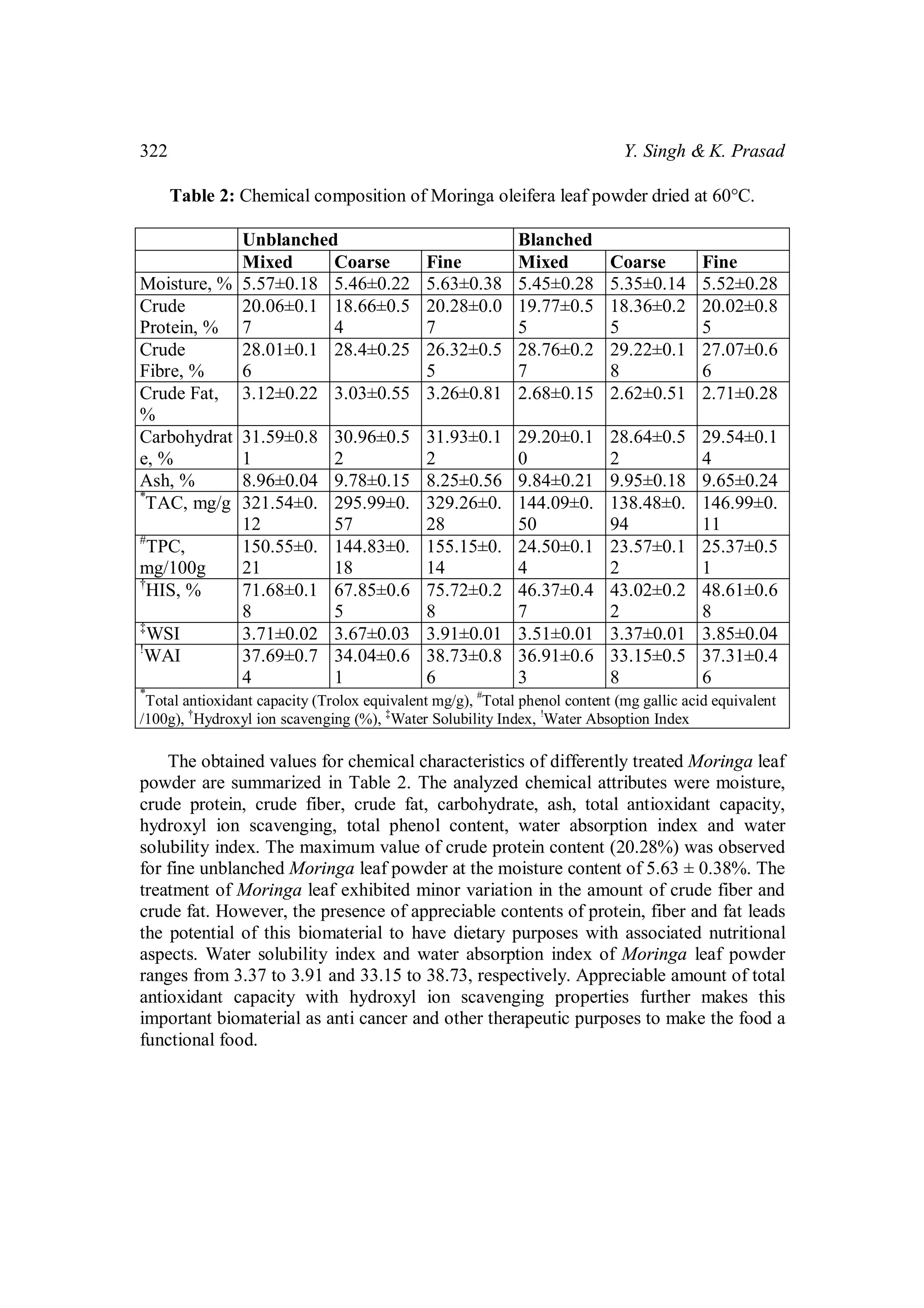
The effect of blanching and dehydration temperature on the drying characteristics of 
Moringa oleifera leaves are shown in Table 1. The quality of dehydrated Moringa 
oleifera leaves was found to be treatment and temperature dependent as per the 
variations in the colour parameters. The intense and appropriate greenness values was 
found to be associated with the untreated and dehydrated leaf at 50 and 60OC. 
Considering the benefits of dehydration rate with the optical parameter the powder 
prepared out of dehydrated leaves at 60OC was optimum. The dimensional 
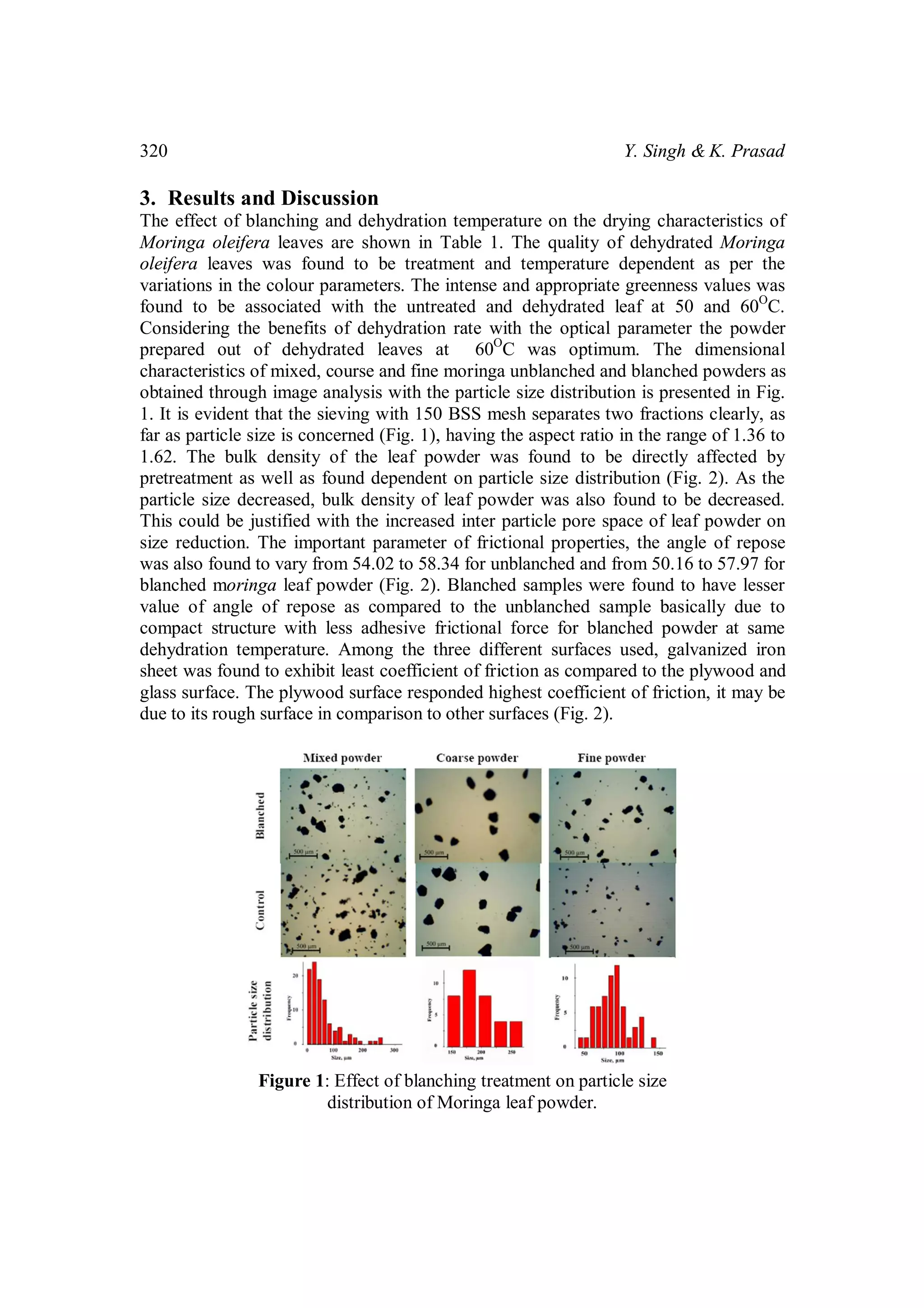
characteristics of mixed, course and fine moringa unblanched and blanched powders as 
obtained through image analysis with the particle size distribution is presented in Fig. 
1. It is evident that the sieving with 150 BSS mesh separates two fractions clearly, as 
far as particle size is concerned (Fig. 1), having the aspect ratio in the range of 1.36 to 
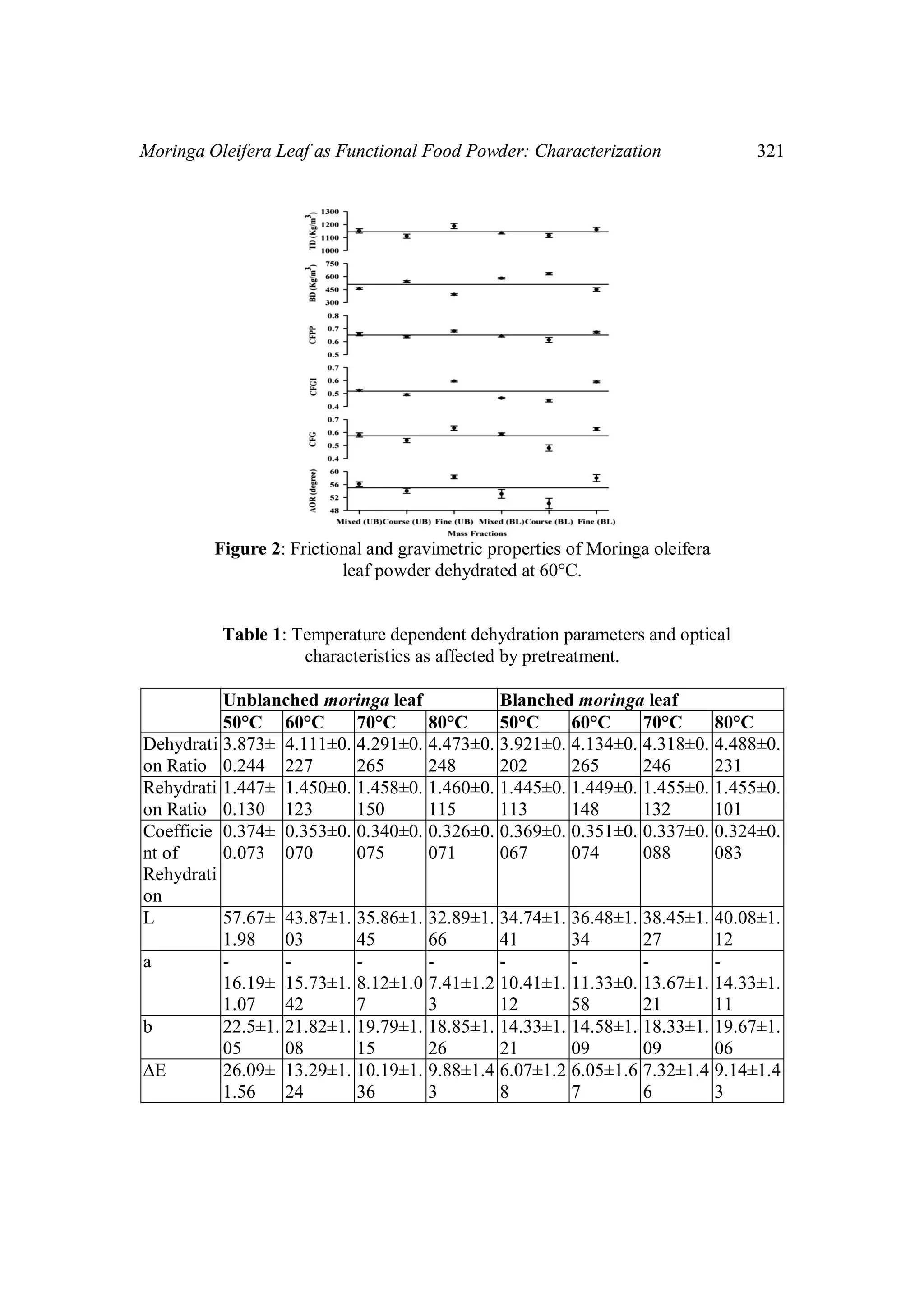
1.62. The bulk density of the leaf powder was found to be directly affected by 
pretreatment as well as found dependent on particle size distribution (Fig. 2). As the 
particle size decreased, bulk density of leaf powder was also found to be decreased. 
This could be justified with the increased inter particle pore space of leaf powder on 
size reduction. The important parameter of frictional properties, the angle of repose 
was also found to vary from 54.02 to 58.34 for unblanched and from 50.16 to 57.97 for 
blanched moringa leaf powder (Fig. 2). Blanched samples were found to have lesser 
value of angle of repose as compared to the unblanched sample basically due to 
compact structure with less adhesive frictional force for blanched powder at same 
dehydration temperature. Among the three different surfaces used, galvanized iron 
sheet was found to exhibit least coefficient of friction as compared to the plywood and 
glass surface. The plywood surface responded highest coefficient of friction, it may be 
due to its rough surface in comparison to other surfaces (Fig. 2). 
Figure 1: Effect of blanching treatment on particle size 
distribution of Moringa leaf powder.
Moringa Oleifera Leaf as Functional Food Powder: Characterization 321 
Figure 2: Frictional and gravimetric properties of Moringa oleifera 
leaf powder dehydrated at 60°C. 
Table 1: Temperature dependent dehydration parameters and optical 
characteristics as affected by pretreatment. 
Unblanched moringa leaf Blanched moringa leaf 
50°C 60°C 70°C 80°C 50°C 60°C 70°C 80°C 
Dehydrati 
on Ratio 
3.873± 
0.244 
4.111±0. 
227 
4.291±0. 
265 
4.473±0. 
248 
3.921±0. 
202 
4.134±0. 
265 
4.318±0. 
246 
4.488±0. 
231 
Rehydrati 
on Ratio 
1.447± 
0.130 
1.450±0. 
123 
1.458±0. 
150 
1.460±0. 
115 
1.445±0. 
113 
1.449±0. 
148 
1.455±0. 
132 
1.455±0. 
101 
Coefficie 
nt of 
Rehydrati 
on 
0.374± 
0.073 
0.353±0. 
070 
0.340±0. 
075 
0.326±0. 
071 
0.369±0. 
067 
0.351±0. 
074 
0.337±0. 
088 
0.324±0. 
083 
L 57.67± 
1.98 
43.87±1. 
03 
35.86±1. 
45 
32.89±1. 
66 
34.74±1. 
41 
36.48±1. 
34 
38.45±1. 
27 
40.08±1. 
12 
a - 
16.19± 
1.07 
- 
15.73±1. 
42 
- 
8.12±1.0 
7 
- 
7.41±1.2 
3 
- 
10.41±1. 
12 
- 
11.33±0. 
58 
- 
13.67±1. 
21 
- 
14.33±1. 
11 
b 22.5±1. 
05 
21.82±1. 
08 
19.79±1. 
15 
18.85±1. 
26 
14.33±1. 
21 
14.58±1. 
09 
18.33±1. 
09 
19.67±1. 
06 
ΔE 26.09± 
1.56 
13.29±1. 
24 
10.19±1. 
36 
9.88±1.4 
3 
6.07±1.2 
8 
6.05±1.6 
7 
7.32±1.4 
6 
9.14±1.4 
3
Y. Singh & K. Prasad 
322 
Table 2: Chemical composition of Moringa oleifera leaf powder dried at 60°C. 
Unblanched Blanched 
Mixed Coarse Fine Mixed Coarse Fine 
Moisture, % 5.57±0.18 5.46±0.22 5.63±0.38 5.45±0.28 5.35±0.14 5.52±0.28 
Crude 
20.06±0.1 
18.66±0.5 
20.28±0.0 
19.77±0.5 
18.36±0.2 
20.02±0.8 
Protein, % 
7 
4 
7 
5 
5 
5 
Crude 
Fibre, % 
28.01±0.1 
6 
28.4±0.25 26.32±0.5 
5 
28.76±0.2 
7 
29.22±0.1 
8 
27.07±0.6 
6 
Crude Fat, 
% 
3.12±0.22 3.03±0.55 3.26±0.81 2.68±0.15 2.62±0.51 2.71±0.28 
Carbohydrat 
e, % 
31.59±0.8 
1 
30.96±0.5 
2 
31.93±0.1 
2 
29.20±0.1 
0 
28.64±0.5 
2 
29.54±0.1 
4 
Ash, % 8.96±0.04 9.78±0.15 8.25±0.56 9.84±0.21 9.95±0.18 9.65±0.24 
*TAC, mg/g 321.54±0. 
12 
295.99±0. 
57 
329.26±0. 
28 
144.09±0. 
50 
138.48±0. 
94 
146.99±0. 
11 
#TPC, 
mg/100g 
150.55±0. 
21 
144.83±0. 
18 
155.15±0. 
14 
24.50±0.1 
4 
23.57±0.1 
2 
25.37±0.5 
1 
†HIS, % 71.68±0.1 
8 
67.85±0.6 
5 
75.72±0.2 
8 
46.37±0.4 
7 
43.02±0.2 
2 
48.61±0.6 
8 
‡WSI 3.71±0.02 3.67±0.03 3.91±0.01 3.51±0.01 3.37±0.01 3.85±0.04 
!WAI 37.69±0.7 
4 
34.04±0.6 
1 
38.73±0.8 
6 
36.91±0.6 
3 
33.15±0.5 
8 
37.31±0.4 
6 
*Total antioxidant capacity (Trolox equivalent mg/g), #Total phenol content (mg gallic acid equivalent 
/100g), †Hydroxyl ion scavenging (%), ‡Water Solubility Index, !Water Absoption Index 
The obtained values for chemical characteristics of differently treated Moringa leaf 
powder are summarized in Table 2. The analyzed chemical attributes were moisture, 
crude protein, crude fiber, crude fat, carbohydrate, ash, total antioxidant capacity, 
hydroxyl ion scavenging, total phenol content, water absorption index and water 
solubility index. The maximum value of crude protein content (20.28%) was observed 
for fine unblanched Moringa leaf powder at the moisture content of 5.63 ± 0.38%. The 
treatment of Moringa leaf exhibited minor variation in the amount of crude fiber and 
crude fat. However, the presence of appreciable contents of protein, fiber and fat leads 
the potential of this biomaterial to have dietary purposes with associated nutritional 
aspects. Water solubility index and water absorption index of Moringa leaf powder 
ranges from 3.37 to 3.91 and 33.15 to 38.73, respectively. Appreciable amount of total 
antioxidant capacity with hydroxyl ion scavenging properties further makes this 
important biomaterial as anti cancer and other therapeutic purposes to make the food a 
functional food.
Moringa Oleifera Leaf as Functional Food Powder: Characterization 323 
4. Conclusion 
Moringa oleifera leaf powder as obtained at a dehydration temperature of 60°C 
without any treatment further improves on fractionation and the fine fraction could be 
considered as an important functional and optimal biomaterial to be used to make the 
food rich with therapeutic values. Thus, this underutilized plant could further be 
justified as mother’s best friend plant to combat the associated problems of under 
developed and developing countries. 
References 
[1] AOAC (2000), Approved methods of analysis, The Association of Official 
Analytical Chemists, Washington DC. 
[2] F Anwar, S Latif, M Ashraf, and A H Gilani (2007), Moringa oleifera: A food 
plant with multiple medicinal uses, Phytotherapy Research, 21, pp. 17-25. 
[3] H P S Makkar and K Becker (1996), Nutritional value and antinutritional 
components of whole and ethanol extracted Moringa oleifera leaves, Animal 
Feed Science Tech., 63, pp. 211-228. 
[4] K Prasad, Y Singh, and A Anil (2012), Effects of grinding methods on the 
characteristics of Pusa 1121 rice flour, Journal of Tropical Agriculture and 
Food Science, 40, 2, pp. 193-201. 
[5] S Ranganna (1997), Handbook of Analysis of Quality Control of Fruit and 
Vegetable Product, 2nd edition Tata McGraw-Hill, New Delhi, India. 
[6] S Sahin and S G Sumnu (2006), Physical Properties of Foods, Springer 
Science & Business Media, LLC, New York, USA. 
[7] Y Singh and K Prasad (2013), Physical characteristics of some of the paddy 
varieties as affected by shelling and milling, Oryza (In Press). 
[8] Y Singh, P Yadav, D Kumar, Y K Yadav and K Prasad (2013), Drying: an 
approach to food preservation. In: Emerging Science and Technology for 
Food, Agriculture and Environment, S Kumar et al, (eds). Agrobios 
(International) Publishers, Jodhpur, India, pp. 423-434. 
[9] Y Singh, R Jale, K K Prasad, R K Sharma and K Prasad (2012), Moringa 
Oleifera: A Miracle Tree, Proceedings, International Seminar on Renewable 
Energy for Institutions and Communities in Urban and Rural Settings, Manav 
Institute, Jevra, India, pp. 73-81.
Y. Singh & K. Prasad 
324

Leaves as-functional-food-powder

  • 1.
    International Journal ofAgriculture and Food Science Technology. ISSN 2249-3050, Volume 4, Number 4 (2013), pp. 317-324 © Research India Publications http://www.ripublication.com/ ijafst.htm Moringa Oleifera Leaf as Functional Food Powder: Characterization and Uses Y. Singh and K. Prasad* Department of Food Engineering and Technology, Sant Longowal Institute of Engineering and Technology, Longowal – 148106, Punjab, India. Abstract Moringa oleifera commonly known as drumstick, horse radish, shobhanjana, murungai, soanjna, shajna, sainjna is often referred as “mother’s best friend” is a plant found wide applications in food and allied fields due to rich source of diverse range of nutrients and bioactive materials. Moringa is considered as one of the world’s most useful plant per available literature and thus all the plant parts is widely used in curing various ailments like antibiotic, anti-hypertensive, anti-spasmodic, antiulcer, anti-inflammatory, anti-asthmatic, hypocholesterolemic and hypoglycemic. Moreover, leaves of this plant being rich in protein may serve in combating the protein energy malnutrition for the undernourished population of world. Our studies have confirmed some useful importance of Moringa in context of its nutritional as well as its medicinal properties. Addition of small amount of leaf powder was not reflected any significant and disagreeable effects on the taste of a foods but improved the nutritional aspects on its incorporation. Reduction in water activity by decreasing the moisture content through the process of dehydration is followed in order to improve the shelf life and availability of this underutilized plant. Efforts are in way to develop the process and products to make available in the form of more acceptable and at the reach to the consumer at least to the under developed and developing countries for the inherent cited purposes. Under present investigation, we are representing the successful trials provided to the fresh leaves. The characteristics of the blanched leaves have been compared with the product of untreated samples in isothermal dehydration conditions (50 - 80°C, with an equal temperature interval of 10°C). This developed shelf-stable leaf powders were characterized and possible uses on the
  • 2.
    Y. Singh &K. Prasad 318 basis of nutritional aspects in various foods like soup, sauces and other culinary have been cited. Keywords: Moringa; drumstick; dehydration; powder; characterization. 1. Introduction Moringa oleifera is a perennial tree, still considered as among underutilized plant and falls under Moringaceae family. The plant is also known as drumstick, sahjan or sohanjana in India. All plant parts are having remarkable range of some functional and nutraceutical properties (Singh et al, 2012) make this plant a diverse biomaterials for food and allied uses. The leaves, flowers and fruits of this plant are used in the preparation of several delicacies in Indian sub continent. Associated with high nutritional value of its edible portions pave a way in making this plant more popular as an important food source in order to combat protein energy malnutrition problem prevailed in most of the under developed and developing countries of the world. Presence of various types of antioxidant compounds make this plant leaves a valuable source of natural antioxidants (Anwar et al., 2007) and a good source of nutraceuticals and functional components as well (Makkar and Becker, 1996). The effect of environmental variables on quality and storability after harvesting are of more concern to food products especially of high concern with reference to leafy vegetables due to more area to thickness ratio. This leads to quality deterioration in very short duration of storage. This concept has been utilized under present investigation to get accelerated process of moisture reduction during the dehydration process in order to reduce the water activities with ceasing the enzymatic activity. The quality of dehydrated vegetables is affected by responsible physico-chemical constitutes, environmental conditions and pre processing methods applied (Singh et al, 2013). Thus, it is important to determine the properties of different biomaterials for the design and develop the food processing equipment (Sahin and Sumnu, 2006). Considering these aspects, the objective of this investigation was critically planned to assess the characteristics of Moringa oleifera leaf powder in order to further use as functional food ingredient in the food and pharmaceutical products of concern also basically to enhance this important less explored readily available in certain parts of the country in a shelf stable easily usable form to the masses for the purpose. 2. Materials and Methods 2.1 Sample Preparation Fresh Moringa oleifera leaves were harvested during early morning from the available plant present in the residential area of Sant Longowal Institute of Engineering and Technology, Longowal, Punjab, India. The harvested leaves were thoroughly washed in running tap water twice to remove the presence of dirt or surface impurities if any.
  • 3.
    Moringa Oleifera Leafas Functional Food Powder: Characterization 319 The average initial moisture content of the harvested leaves was found to be 79.28 ± 0.83% (wwb) as determined using hot air oven method (AOAC, 2000). Steam blanching as pretreatment was given to the moringa leaves for 2 minutes in a developed steam blancher consisted of two chambers, one as steam generation chamber and other as steam generation cum blanching chamber. The combined pressure vessels with control units served effective process of blanching and given the name for this blancher as Precision steam blancher. Similarly, the developed precision dehydration chamber with developed precision control unit was used to study the effect of isothermal dehydration temperatures 50, 60, 70 and 80°C with an average temperature fluctuation of ±1°C on product characteristics. The leaf sample, approximately 100g, was uniformly spread in a square flat perforated non corrosive metal basket in a single layer on attaining the desired drying temperature condition. The dehydrated leaves obtained after the completion of previous process, the product was removed from the dryer and cooled in a controlled environmental chamber and further kept in air tight opaque glass jars and stored at 4±2°C for further use. The dehydrated leaves were crushed to powder using dry mixer grinder. Subsequently, the dehydration characteristics for dehydration ratio, rehydration ratio and coefficient of rehydration were assessed (Ranganna, 1997). 2.2 Characterization The particle size analysis of separated fractions, over and under size particles of 150 BSS sieve of Moringa leaf powder were determined through the developed image analysis technique (Prasad et al, 2012). The procedure for the determination of other physical properties, the gravimetric properties (Bulk density, BD; True density, TD), the frictional properties (Angle of repose, AOR; Coefficient of friction on glass surface, COFG; Coefficient of friction on galvanized iron surface, COFGI; Coefficient of friction on plywood surface, COFP) and optical properties (L; a; b and colour difference, ΔE) was adopted as described elsewhere (Singh and Prasad, 2013). The chemical analysis as moisture content, crude protein, crude fiber, crude fat, carbohydrate and ash was carried out by standard method (Ranganna, 1997). The total antioxidant capacity (TAC) and hydroxyl ion scavenging (HIS) of Moringa leaf powder was evaluated by measuring 1,1-diphenyl-2-picrylhydrazyl (DPPH) radical scavenging activity. Total phenol content (TPC) was determined spectrophotometrically at 750 nm by adding Folin-Ciocalteu reagent to the extract and expressing the results in gallic acid equivalents. The Water absorption index (WAI) was evaluated as the weight of sample obtained after removal of the supernatant per unit weight of original dry solids. The Water solubility index (WSI) was determined as the weight of dry solids in the supernatant expressed as a percentage of the original weight of sample. The statistical analysis for the data of obtained in triplicate were evaluated with mean separation to determine any statistically significant effects prevailed among them (Singh and Prasad, 2013).
  • 4.
    Y. Singh &K. Prasad 320 3. Results and Discussion The effect of blanching and dehydration temperature on the drying characteristics of Moringa oleifera leaves are shown in Table 1. The quality of dehydrated Moringa oleifera leaves was found to be treatment and temperature dependent as per the variations in the colour parameters. The intense and appropriate greenness values was found to be associated with the untreated and dehydrated leaf at 50 and 60OC. Considering the benefits of dehydration rate with the optical parameter the powder prepared out of dehydrated leaves at 60OC was optimum. The dimensional characteristics of mixed, course and fine moringa unblanched and blanched powders as obtained through image analysis with the particle size distribution is presented in Fig. 1. It is evident that the sieving with 150 BSS mesh separates two fractions clearly, as far as particle size is concerned (Fig. 1), having the aspect ratio in the range of 1.36 to 1.62. The bulk density of the leaf powder was found to be directly affected by pretreatment as well as found dependent on particle size distribution (Fig. 2). As the particle size decreased, bulk density of leaf powder was also found to be decreased. This could be justified with the increased inter particle pore space of leaf powder on size reduction. The important parameter of frictional properties, the angle of repose was also found to vary from 54.02 to 58.34 for unblanched and from 50.16 to 57.97 for blanched moringa leaf powder (Fig. 2). Blanched samples were found to have lesser value of angle of repose as compared to the unblanched sample basically due to compact structure with less adhesive frictional force for blanched powder at same dehydration temperature. Among the three different surfaces used, galvanized iron sheet was found to exhibit least coefficient of friction as compared to the plywood and glass surface. The plywood surface responded highest coefficient of friction, it may be due to its rough surface in comparison to other surfaces (Fig. 2). Figure 1: Effect of blanching treatment on particle size distribution of Moringa leaf powder.
  • 5.
    Moringa Oleifera Leafas Functional Food Powder: Characterization 321 Figure 2: Frictional and gravimetric properties of Moringa oleifera leaf powder dehydrated at 60°C. Table 1: Temperature dependent dehydration parameters and optical characteristics as affected by pretreatment. Unblanched moringa leaf Blanched moringa leaf 50°C 60°C 70°C 80°C 50°C 60°C 70°C 80°C Dehydrati on Ratio 3.873± 0.244 4.111±0. 227 4.291±0. 265 4.473±0. 248 3.921±0. 202 4.134±0. 265 4.318±0. 246 4.488±0. 231 Rehydrati on Ratio 1.447± 0.130 1.450±0. 123 1.458±0. 150 1.460±0. 115 1.445±0. 113 1.449±0. 148 1.455±0. 132 1.455±0. 101 Coefficie nt of Rehydrati on 0.374± 0.073 0.353±0. 070 0.340±0. 075 0.326±0. 071 0.369±0. 067 0.351±0. 074 0.337±0. 088 0.324±0. 083 L 57.67± 1.98 43.87±1. 03 35.86±1. 45 32.89±1. 66 34.74±1. 41 36.48±1. 34 38.45±1. 27 40.08±1. 12 a - 16.19± 1.07 - 15.73±1. 42 - 8.12±1.0 7 - 7.41±1.2 3 - 10.41±1. 12 - 11.33±0. 58 - 13.67±1. 21 - 14.33±1. 11 b 22.5±1. 05 21.82±1. 08 19.79±1. 15 18.85±1. 26 14.33±1. 21 14.58±1. 09 18.33±1. 09 19.67±1. 06 ΔE 26.09± 1.56 13.29±1. 24 10.19±1. 36 9.88±1.4 3 6.07±1.2 8 6.05±1.6 7 7.32±1.4 6 9.14±1.4 3
  • 6.
    Y. Singh &K. Prasad 322 Table 2: Chemical composition of Moringa oleifera leaf powder dried at 60°C. Unblanched Blanched Mixed Coarse Fine Mixed Coarse Fine Moisture, % 5.57±0.18 5.46±0.22 5.63±0.38 5.45±0.28 5.35±0.14 5.52±0.28 Crude 20.06±0.1 18.66±0.5 20.28±0.0 19.77±0.5 18.36±0.2 20.02±0.8 Protein, % 7 4 7 5 5 5 Crude Fibre, % 28.01±0.1 6 28.4±0.25 26.32±0.5 5 28.76±0.2 7 29.22±0.1 8 27.07±0.6 6 Crude Fat, % 3.12±0.22 3.03±0.55 3.26±0.81 2.68±0.15 2.62±0.51 2.71±0.28 Carbohydrat e, % 31.59±0.8 1 30.96±0.5 2 31.93±0.1 2 29.20±0.1 0 28.64±0.5 2 29.54±0.1 4 Ash, % 8.96±0.04 9.78±0.15 8.25±0.56 9.84±0.21 9.95±0.18 9.65±0.24 *TAC, mg/g 321.54±0. 12 295.99±0. 57 329.26±0. 28 144.09±0. 50 138.48±0. 94 146.99±0. 11 #TPC, mg/100g 150.55±0. 21 144.83±0. 18 155.15±0. 14 24.50±0.1 4 23.57±0.1 2 25.37±0.5 1 †HIS, % 71.68±0.1 8 67.85±0.6 5 75.72±0.2 8 46.37±0.4 7 43.02±0.2 2 48.61±0.6 8 ‡WSI 3.71±0.02 3.67±0.03 3.91±0.01 3.51±0.01 3.37±0.01 3.85±0.04 !WAI 37.69±0.7 4 34.04±0.6 1 38.73±0.8 6 36.91±0.6 3 33.15±0.5 8 37.31±0.4 6 *Total antioxidant capacity (Trolox equivalent mg/g), #Total phenol content (mg gallic acid equivalent /100g), †Hydroxyl ion scavenging (%), ‡Water Solubility Index, !Water Absoption Index The obtained values for chemical characteristics of differently treated Moringa leaf powder are summarized in Table 2. The analyzed chemical attributes were moisture, crude protein, crude fiber, crude fat, carbohydrate, ash, total antioxidant capacity, hydroxyl ion scavenging, total phenol content, water absorption index and water solubility index. The maximum value of crude protein content (20.28%) was observed for fine unblanched Moringa leaf powder at the moisture content of 5.63 ± 0.38%. The treatment of Moringa leaf exhibited minor variation in the amount of crude fiber and crude fat. However, the presence of appreciable contents of protein, fiber and fat leads the potential of this biomaterial to have dietary purposes with associated nutritional aspects. Water solubility index and water absorption index of Moringa leaf powder ranges from 3.37 to 3.91 and 33.15 to 38.73, respectively. Appreciable amount of total antioxidant capacity with hydroxyl ion scavenging properties further makes this important biomaterial as anti cancer and other therapeutic purposes to make the food a functional food.
  • 7.
    Moringa Oleifera Leafas Functional Food Powder: Characterization 323 4. Conclusion Moringa oleifera leaf powder as obtained at a dehydration temperature of 60°C without any treatment further improves on fractionation and the fine fraction could be considered as an important functional and optimal biomaterial to be used to make the food rich with therapeutic values. Thus, this underutilized plant could further be justified as mother’s best friend plant to combat the associated problems of under developed and developing countries. References [1] AOAC (2000), Approved methods of analysis, The Association of Official Analytical Chemists, Washington DC. [2] F Anwar, S Latif, M Ashraf, and A H Gilani (2007), Moringa oleifera: A food plant with multiple medicinal uses, Phytotherapy Research, 21, pp. 17-25. [3] H P S Makkar and K Becker (1996), Nutritional value and antinutritional components of whole and ethanol extracted Moringa oleifera leaves, Animal Feed Science Tech., 63, pp. 211-228. [4] K Prasad, Y Singh, and A Anil (2012), Effects of grinding methods on the characteristics of Pusa 1121 rice flour, Journal of Tropical Agriculture and Food Science, 40, 2, pp. 193-201. [5] S Ranganna (1997), Handbook of Analysis of Quality Control of Fruit and Vegetable Product, 2nd edition Tata McGraw-Hill, New Delhi, India. [6] S Sahin and S G Sumnu (2006), Physical Properties of Foods, Springer Science & Business Media, LLC, New York, USA. [7] Y Singh and K Prasad (2013), Physical characteristics of some of the paddy varieties as affected by shelling and milling, Oryza (In Press). [8] Y Singh, P Yadav, D Kumar, Y K Yadav and K Prasad (2013), Drying: an approach to food preservation. In: Emerging Science and Technology for Food, Agriculture and Environment, S Kumar et al, (eds). Agrobios (International) Publishers, Jodhpur, India, pp. 423-434. [9] Y Singh, R Jale, K K Prasad, R K Sharma and K Prasad (2012), Moringa Oleifera: A Miracle Tree, Proceedings, International Seminar on Renewable Energy for Institutions and Communities in Urban and Rural Settings, Manav Institute, Jevra, India, pp. 73-81.
  • 8.
    Y. Singh &K. Prasad 324