BUSINESS PLAN 
Moringa Oleifera Nutritional Supplement 
August 18, 2008 
John Aoko Odeyo 
Twenyo Building 
Near Rabuor Market 
P.O.BOX 3917 
Kisumu 
Kenya 
Phone : +254.738.652716 
Mobile : +254.722.731453 
E-mail : kodeyo2000@yahoo.com 
DAGO NETWORK YOUTH GROUP
CONTENTS 
0. EXECUTIVE SUMMARY 3 
1. THE BUSINESS 3 
2. THE ENTERPRENEUR 10 
3. THE FINANCIAL PLAN 12 
4. THE DEVELOPMENT IMPACT 14
Executive Summary 
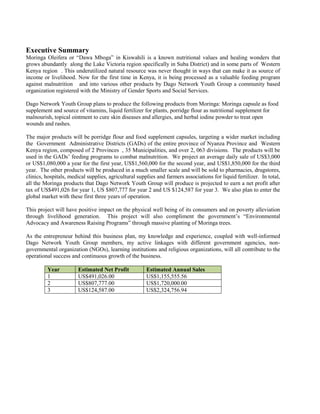
Moringa Oleifera or “Dawa Mboga” in Kiswahili is a known nutritional values and healing wonders that grows abundantly along the Lake Victoria region specifically in Suba District) and in some parts of Western Kenya region . This underutilized natural resource was never thought in ways that can make it as source of income or livelihood. Now for the first time in Kenya, it is being processed as a valuable feeding program against malnutrition and into various other products by Dago Network Youth Group a community based organization registered with the Ministry of Gender Sports and Social Services. 
Dago Network Youth Group plans to produce the following products from Moringa: Moringa capsule as food supplement and source of vitamins, liquid fertilizer for plants, porridge flour as nutritional supplement for malnourish, topical ointment to cure skin diseases and allergies, and herbal iodine powder to treat open wounds and rashes. 
The major products will be porridge flour and food supplement capsules, targeting a wider market including the Government Administrative Districts (GADs) of the entire province of Nyanza Province and Western Kenya region, composed of 2 Provinces , 35 Municipalities, and over 2, 063 divisions. The products will be used in the GADs’ feeding programs to combat malnutrition. We project an average daily sale of US$3,000 or US$1,080,000 a year for the first year, US$1,560,000 for the second year, and US$1,850,000 for the third year. The other products will be produced in a much smaller scale and will be sold to pharmacies, drugstores, clinics, hospitals, medical supplies, agricultural supplies and farmers associations for liquid fertilizer. In total, all the Moringa products that Dago Network Youth Group will produce is projected to earn a net profit after tax of US$491,026 for year 1, US $807,777 for year 2 and US $124,587 for year 3. We also plan to enter the global market with these first three years of operation. 
This project will have positive impact on the physical well being of its consumers and on poverty alleviation through livelihood generation. This project will also compliment the government’s “Environmental Advocacy and Awareness Raising Programs” through massive planting of Moringa trees. 
As the entrepreneur behind this business plan, my knowledge and experience, coupled with well-informed Dago Network Youth Group members, my active linkages with different government agencies, non- governmental organization (NGOs), learning institutions and religious organizations, will all contribute to the operational success and continuous growth of the business. 
Year Estimated Net Profit Estimated Annual Sales 
1 
US$491,026.00 
US$1,155,555.56 
2 
US$807,777.00 
US$1,720,000.00 
3 
US$124,587.00 
US$2,324,756.94
1. THE BUSINESS 
1.1 Business Proposition 
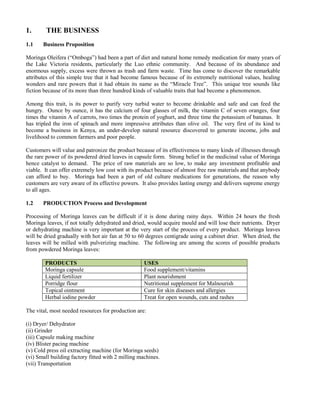
Moringa Oleifera (“Omboga”) had been a part of diet and natural home remedy medication for many years of the Lake Victoria residents, particularly the Luo ethnic community. And because of its abundance and enormous supply, excess were thrown as trash and farm waste. Time has come to discover the remarkable attributes of this simple tree that it had become famous because of its extremely nutritional values, healing wonders and rare powers that it had obtain its name as the “Miracle Tree”. This unique tree sounds like fiction because of its more than three hundred kinds of valuable traits that had become a phenomenon. 
Among this trait, is its power to purify very turbid water to become drinkable and safe and can feed the hungry. Ounce by ounce, it has the calcium of four glasses of milk, the vitamin C of seven oranges, four times the vitamin A of carrots, two times the protein of yoghurt, and three time the potassium of bananas. It has tripled the iron of spinach and more impressive attributes than olive oil. The very first of its kind to become a business in Kenya, an under-develop natural resource discovered to generate income, jobs and livelihood to common farmers and poor people. 
Customers will value and patronize the product because of its effectiveness to many kinds of illnesses through the rare power of its powdered dried leaves in capsule form. Strong belief in the medicinal value of Moringa hence catalyst to demand. The price of raw materials are so low, to make any investment profitable and viable. It can offer extremely low cost with its product because of almost free raw materials and that anybody can afford to buy. Moringa had been a part of old culture medications for generations, the reason why customers are very aware of its effective powers. It also provides lasting energy and delivers supreme energy to all ages. 
1.2 PRODUCTION Process and Development 
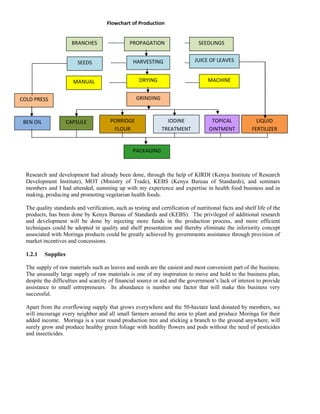
Processing of Moringa leaves can be difficult if it is done during rainy days. Within 24 hours the fresh Moringa leaves, if not totally dehydrated and dried, would acquire mould and will lose their nutrients. Dryer or dehydrating machine is very important at the very start of the process of every product. Moringa leaves will be dried gradually with hot air fan at 50 to 60 degrees centigrade using a cabinet drier. When dried, the leaves will be milled with pulverizing machine. The following are among the scores of possible products from powdered Moringa leaves: 
PRODUCTS USES 
Moringa capsule 
Food supplement/vitamins 
Liquid fertilizer 
Plant nourishment 
Porridge flour 
Nutritional supplement for Malnourish 
Topical ointment 
Cure for skin diseases and allergies 
Herbal iodine powder 
Treat for open wounds, cuts and rashes 
The vital, most needed resources for production are: 
(i) Dryer/ Dehydrator 
(ii) Grinder 
(iii) Capsule making machine 
(iv) Blister pacing machine 
(v) Cold press oil extracting machine (for Moringa seeds) 
(vi) Small building factory fitted with 2 milling machines. 
(vii) Transportation
------------- ---------- 
------------- ---------- 
-------------- ---------------- 
Research and development had already been done, through the help of KIRDI (Kenya Institute of Research Development Institute), MOT (Ministry of Trade), KEBS (Kenya Bureau of Standards), and seminars members and I had attended, summing up with my experience and expertise in health food business and in making, producing and promoting vegetarian health foods. 
The quality standards and verification, such as testing and certification of nutritional facts and shelf life of the products, has been done by Kenya Bureau of Standards and (KEBS). The privileged of additional research and development will be done by injecting more funds in the production process, and more efficient techniques could be adopted in quality and shelf presentation and thereby eliminate the inferiority concept associated with Moringa products could be greatly achieved by governments assistance through provision of market incentives and concessions. 
1.2.1 Supplies 
The supply of raw materials such as leaves and seeds are the easiest and most convenient part of the business. The unusually large supply of raw materials is one of my inspiration to move and hold to the business plan, despite the difficulties and scarcity of financial source or aid and the government’s lack of interest to provide assistance to small entrepreneurs. Its abundance is number one factor that will make this business very successful. 
Apart from the overflowing supply that grows everywhere and the 50-hectare land donated by members, we will encourage every neighbor and all small farmers around the area to plant and produce Moringa for their added income. Moringa is a year round production tree and sticking a branch to the ground anywhere, will surely grow and produce healthy green foliage with healthy flowers and pods without the need of pesticides and insecticides. 
BRANCHES 
PROPAGATION 
SEEDLINGS 
SEEDS 
HARVESTING 
JUICE OF LEAVES 
MANUAL 
DRYING 
MACHINE 
GRINDING 
COLD PRESS 
BEN OIL 
CAPSULE 
PORRIDGE FLOUR 
IODINE TREATMENT 
TOPICAL OINTMENT 
LIQUID FERTILIZER 
PACKAGING 
Flowchart of Production
1.3 Market Structure and Analysis 
1.3.1 Target Market and Customer Base 
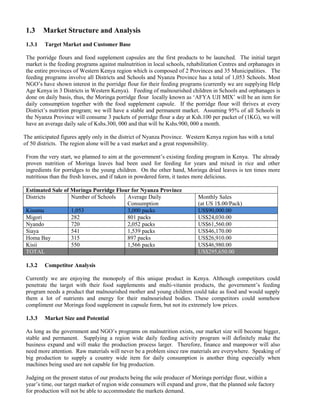
The porridge flours and food supplement capsules are the first products to be launched. The initial target market is the feeding programs against malnutrition in local schools, rehabilitation Centres and orphanages in the entire provinces of Western Kenya region which is composed of 2 Provinces and 35 Municipalities. The feeding programs involve all Districts and Schools and Nyanza Province has a total of 1,053 Schools. Most NGO’s have shown interest in the porridge flour for their feeding programs (currently we are supplying Help Age Kenya in 3 Districts in Western Kenya). Feeding of malnourished children in Schools and orphanages is done on daily basis, thus, the Moringa porridge flour locally known as ‘AFYA UJI MIX’ will be an item for daily consumption together with the food supplement capsule. If the porridge flour will thrives at every District’s nutrition program; we will have a stable and permanent market. Assuming 95% of all Schools in the Nyanza Province will consume 3 packets of porridge flour a day at Ksh.100 per packet of (1KG), we will have an average daily sale of Kshs.300, 000 and that will be Kshs.900, 000 a month. 
The anticipated figures apply only in the district of Nyanza Province. Western Kenya region has with a total of 50 districts. The region alone will be a vast market and a great responsibility. 
From the very start, we planned to aim at the government’s existing feeding program in Kenya. The already proven nutrition of Moringa leaves had been used for feeding for years and mixed in rice and other ingredients for porridges to the young children. On the other hand, Moringa dried leaves is ten times more nutritious than the fresh leaves, and if taken in powdered form, it tastes more delicious. 
Estimated Sale of Moringa Porridge Flour for Nyanza Province 
Districts 
Number of Schools 
Average Daily Consumption 
Monthly Sales 
(at US 1$.00/Pack) Kisumu 1,053 3,000 packs US$90,000.00 
Migori 
282 
801 packs 
US$24,030.00 
Nyando 
720 
2,052 packs 
US$61,560.00 
Siaya 
541 
1,539 packs 
US$46,170.00 
Homa Bay 
315 
897 packs 
US$26,910.00 
Kisii 
550 
1,566 packs 
US$46,980.00 TOTAL US$295,650.00 
1.3.2 Competitor Analysis 
Currently we are enjoying the monopoly of this unique product in Kenya. Although competitors could penetrate the target with their food supplements and multi-vitamin products, the government’s feeding program needs a product that malnourished mother and young children could take as food and would supply them a lot of nutrients and energy for their malnourished bodies. These competitors could somehow compliment our Moringa food supplement in capsule form, but not its extremely low prices. 
1.3.3 Market Size and Potential 
As long as the government and NGO’s programs on malnutrition exists, our market size will become bigger, stable and permanent. Supplying a region wide daily feeding activity program will definitely make the business expand and will make the production process larger. Therefore, finance and manpower will also need more attention. Raw materials will never be a problem since raw materials are everywhere. Speaking of big production to supply a country wide item for daily consumption is another thing especially when machines being used are not capable for big production. 
Judging on the present status of our products being the sole producer of Moringa porridge flour, within a year’s time, our target market of region wide consumers will expand and grow, that the planned sole factory for production will not be able to accommodate the markets demand.
1.3.4 Competitive Advantage 
The number one of selling advantage of our Moringa flour and our food supplement capsule is its uniqueness. The very first of its kind ever introduced for business in the Kenyan market. Number two selling point is it is already proven of its well known multi-nutrients that no other fruits or vegetables can ever have. Its rare powers of medicinal properties and enormous vitamins will not be compared to any nutritious fruit or vegetable that one needs to combine all their nutrients, to equal wonders and energy giving properties. It is like growing vitamins at your doorstep. 
1.4 Marketing and Sales 
1.4.1 Sales 
Our plan to push our sales in its first year of operation to be able to compensate the full initial capital of US$250,000 should be ploughed back and would materialize through commitment, determination and hard work. Through close supervision in our target market, cooperation and proper contact on the targeted market groups by each member of the company, voluntary labour and support and the rich supply of raw materials will definitely make our goals come true. This low initial investment due to premium pricing boost high profit margin and will help a lot to compensate the US$250,000 initial capital. 
1.4.2 Marketing and Communication 
Our privilege to push our products to market is through close communication and direct contact with different government agencies and their programs; participation in trade fairs through the help of the department of Trade and Industry (DTI); seminars and demonstrations in different communities; Association, Trade Shows conferences; meetings of Parents-Teachers Associations (PTA); advertisements both in print media and over the radio and television; and through the Internet could all be possible ways to market our new products. 
1.4.3 Distribution 
Distribution will be done on weekly basis. These distributions of supply for feeding activities will be delivered at schools, county council or city halls. Supply for two weeks will be delivered and distributed in advance for feeding activities. Cheque payments on delivered Moringa flour will be picked up from the contracted institutions one three days after delivery of the product.Currently and in a small scale, we are supplying Help Age Kenya with 2,400kg per week and 4,800kg to the local supermarkets (Yatin and Ukwala) respectively on a weekly basis. Coupled with school feeding programs in Rabuor Primary School, KOWIO Nursery School etc
1.5 Company Structure 
1.5.1 Management 
The management team is consisting of five: 
John Aoko Odeyo -The company CEO and in charge of product development, advertisement and marketing through performing seminars with the NGOs and PTAs in the region. 
Betty Tom -Head of production and in charge of the factory and product development. 
Bernard Ochieng -in charge in office management and team cooperation. 
Violet Awuonda - IT; in charge of product label and designs. 
Martin Awuor -Sales and delivery; farm management; in charge of equipment/ machines repairs. 
Three manual laborer s and one messenger. 
1.52 Legal Status 
The name of the organization is Dago Network Youth Group, it was registered with the Ministry of Gender Sports and Social Services in 2005. The Moringa project is a masterpiece of the organization. 
1.5.3 Partners and Sponsors 
Our financial partners come from the able membership of the organization. Each member has his/her own personal funds used in the development of the products. The members are already determined to have their roles, ties and commitment with the business. 
We have received support from the Ministry of Trade, Ministry of Youth Affairs, Kenya Agricultural Finance Cooperation, Kenya Industrial Estate (KIE), OGRA Foundation, Help Age Kenya, HOVIC (Hope for Victoria Kenya) etc. 
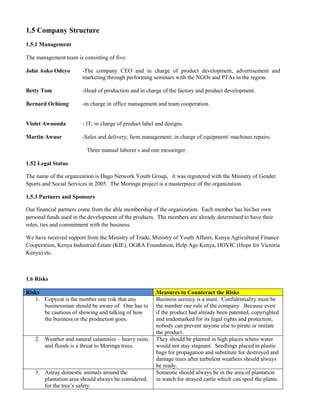
1.6 Risks 
Risks Measures to Counteract the Risks 
1. Copycat is the number one risk that any businessman should be aware of. One has to be cautious of showing and talking of how the business or the production goes. 
Business secrecy is a must. Confidentiality must be the number one rule of the company. Because even if the product had already been patented, copyrighted and trademarked for its legal rights and protection, nobody can prevent anyone else to pirate or imitate the product. 
2. Weather and natural calamities – heavy rains and floods is a threat to Moringa trees. 
They should be planted in high places where water would not stay stagnant. Seedlings placed in plastic bags for propagation and substitute for destroyed and damage trees after turbulent weathers should always be ready. 
3. Astray domestic animals around the plantation area should always be considered for the tree’s safety. 
Someone should always be in the area of plantation in watch for strayed cattle which can spoil the plants.
1.7 SWOT Analysis 
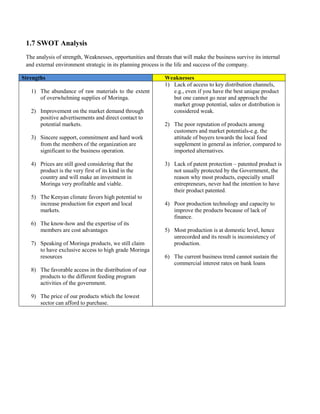
The analysis of strength, Weaknesses, opportunities and threats that will make the business survive its internal and external environment strategic in its planning process is the life and success of the company. Strengths Weaknesses 
1) The abundance of raw materials to the extent of overwhelming supplies of Moringa. 
2) Improvement on the market demand through positive advertisements and direct contact to potential markets. 
3) Sincere support, commitment and hard work from the members of the organization are significant to the business operation. 
4) Prices are still good considering that the product is the very first of its kind in the country and will make an investment in Moringa very profitable and viable. 
5) The Kenyan climate favors high potential to increase production for export and local markets. 
6) The know-how and the expertise of its members are cost advantages 
7) Speaking of Moringa products, we still claim to have exclusive access to high grade Moringa resources 
8) The favorable access in the distribution of our products to the different feeding program activities of the government. 
9) The price of our products which the lowest sector can afford to purchase. 
1) Lack of access to key distribution channels, e.g., even if you have the best unique product but one cannot go near and approach the market group potential, sales or distribution is considered weak. 
2) The poor reputation of products among customers and market potentials-e.g. the attitude of buyers towards the local food supplement in general as inferior, compared to imported alternatives. 
3) Lack of patent protection – patented product is not usually protected by the Government, the reason why most products, especially small entrepreneurs, never had the intention to have their product patented. 
4) Poor production technology and capacity to improve the products because of lack of finance. 
5) Most production is at domestic level, hence unrecorded and its result is inconsistency of production. 
6) The current business trend cannot sustain the commercial interest rates on bank loans
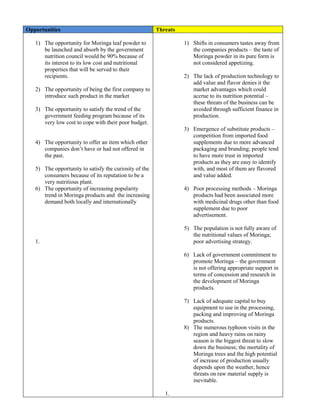
Opportunities Threats 
1) The opportunity for Moringa leaf powder to be launched and absorb by the government nutrition council would be 90% because of its interest to its low cost and nutritional properties that will be served to their recipients. 
2) The opportunity of being the first company to introduce such product in the market 
3) The opportunity to satisfy the trend of the government feeding program because of its very low cost to cope with their poor budget. 
4) The opportunity to offer an item which other companies don’t have or had not offered in the past. 
5) The opportunity to satisfy the curiosity of the consumers because of its reputation to be a very nutritious plant. 
6) The opportunity of increasing popularity trend in Moringa products and the increasing demand both locally and internationally 
1. 
1) Shifts in consumers tastes away from the companies products – the taste of Moringa powder in its pure form is not considered appetizing. 
2) The lack of production technology to add value and flavor denies it the market advantages which could accrue to its nutrition potential – these threats of the business can be avoided through sufficient finance in production. 
3) Emergence of substitute products – competition from imported food supplements due to more advanced packaging and branding; people tend to have more trust in imported products as they are easy to identify with, and most of them are flavored and value added. 
4) Poor processing methods – Moringa products had been associated more with medicinal drugs other than food supplement due to poor advertisement. 
5) The population is not fully aware of the nutritional values of Moringa; poor advertising strategy. 
6) Lack of government commitment to promote Moringa – the government is not offering appropriate support in terms of concession and research in the development of Moringa products. 
7) Lack of adequate capital to buy equipment to use in the processing, packing and improving of Moringa products. 
8) The numerous typhoon visits in the region and heavy rains on rainy season is the biggest threat to slow down the business; the mortality of Moringa trees and the high potential of increase of production usually depends upon the weather, hence threats on raw material supply is inevitable. 
1.
2.0THE ENTERPRENEUR 
2.1 Personal Motivation and Individual Qualities 
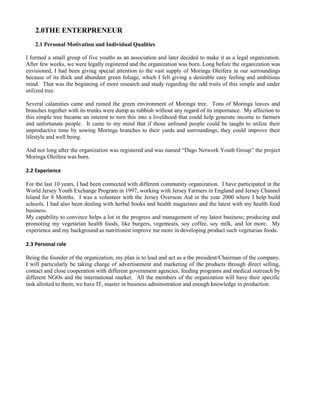
I formed a small group of five youths as an association and later decided to make it as a legal organization. After few weeks, we were legally registered and the organization was born. Long before the organization was envisioned, I had been giving special attention to the vast supply of Moringa Oleifera in our surroundings because of its thick and abundant green foliage, which I felt giving a desirable easy feeling and ambitious mind. That was the beginning of more research and study regarding the odd traits of this simple and under utilized tree. 
Several calamities came and ruined the green environment of Moringa tree. Tons of Moringa leaves and branches together with its trunks were dump as rubbish without any regard of its importance. My affection to this simple tree became an interest to turn this into a livelihood that could help generate income to farmers and unfortunate people. It came to my mind that if those unfound people could be taught to utilize their unproductive time by sowing Moringa branches to their yards and surroundings, they could improve their lifestyle and well being. 
And not long after the organization was registered and was named “Dago Network Youth Group” the project Moringa Oleifera was born. 
2.2 Experience 
For the last 10 years, I had been connected with different community organization. I have participated in the World Jersey Youth Exchange Program in 1997, working with Jersey Farmers in England and Jersey Channel Island for 8 Months. I was a volunteer with the Jersey Overseas Aid in the year 2000 where I help build schools. I had also been dealing with herbal books and health magazines and the latest with my health food business. 
My capability to convince helps a lot in the progress and management of my latest business; producing and promoting my vegetarian health foods, like burgers, vegemeats, soy coffee, soy milk, and lot more. My experience and my background as nutritionist improve me more in developing product such vegetarian foods. 
2.3 Personal role 
Being the founder of the organization, my plan is to lead and act as a the president/Chairman of the company. I will particularly be taking charge of advertisement and marketing of the products through direct selling, contact and close cooperation with different government agencies, feeding programs and medical outreach by different NGOs and the international market. All the members of the organization will have their specific task allotted to them; we have IT, master in business administration and enough knowledge in production.
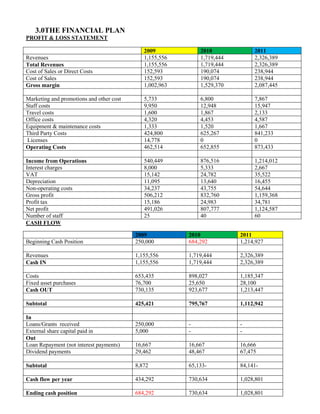
3.0THE FINANCIAL PLAN 
PROFIT & LOSS STATEMENT 
2009 2010 2011 
Revenues 
1,155,556 
1,719,444 
2,326,389 
Total Revenues 
1,155,556 
1,719,444 
2,326,389 
Cost of Sales or Direct Costs 
152,593 
190,074 
238,944 
Cost of Sales 
152,593 
190,074 
238,944 
Gross margin 
1,002,963 
1,529,370 
2,087,445 
Marketing and promotions and other cost 
5,733 
6,800 
7,867 
Staff costs 
9,950 
12,948 
15,947 
Travel costs 
1,600 
1,867 
2,133 
Office costs 
4,320 
4,453 
4,587 
Equipment & maintenance costs 
1,333 
1,520 
1,667 
Third Party Costs 
424,800 
625,267 
841,233 
Licenses 
14,778 
0 
0 
Operating Costs 
462,514 
652,855 
873,433 
Income from Operations 
540,449 
876,516 
1,214,012 
Interest charges 
8,000 
5,333 
2,667 
VAT 
15,142 
24,782 
35,522 
Depreciation 
11,095 
13,640 
16,455 
Non-operating costs 
34,237 
43,755 
54,644 
Gross profit 
506,212 
832,760 
1,159,368 
Profit tax 
15,186 
24,983 
34,781 
Net profit 
491,026 
807,777 
1,124,587 
Number of staff 
25 
40 
60 
CASH FLOW 
2009 2010 2011 
Beginning Cash Position 
250,000 
684,292 
1,214,927 
Revenues 
1,155,556 
1,719,444 
2,326,389 
Cash IN 
1,155,556 
1,719,444 
2,326,389 
Costs 
653,435 
898,027 
1,185,347 
Fixed asset purchases 
76,700 
25,650 
28,100 
Cash OUT 
730,135 
923,677 
1,213,447 
Subtotal 
425,421 
795,767 
1,112,942 
In 
Loans/Grants received 
250,000 
- 
- 
External share capital paid in 
5,000 
- 
- 
Out 
Loan Repayment (not interest payments) 
16,667 
16,667 
16,666 
Dividend payments 
29,462 
48,467 
67,475 
Subtotal 
8,872 
65,133- 
84,141- 
Cash flow per year 
434,292 
730,634 
1,028,801 
Ending cash position 
684,292 
730,634 
1,028,801
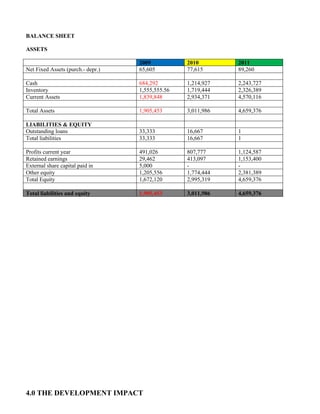
BALANCE SHEET 
ASSETS 
2009 2010 2011 
Net Fixed Assets (purch.- depr.) 
65,605 
77,615 
89,260 
Cash 
684,292 
1,214,927 
2,243,727 
Inventory 
1,555,555.56 
1,719,444 
2,326,389 
Current Assets 
1,839,848 
2,934,371 
4,570,116 
Total Assets 
1,905,453 
3,011,986 
4,659,376 
LIABILITIES & EQUITY 
Outstanding loans 
33,333 
16,667 
1 
Total liabilities 
33,333 
16,667 
1 
Profits current year 
491,026 
807,777 
1,124,587 
Retained earnings 
29,462 
413,097 
1,153,400 
External share capital paid in 
5,000 
- 
- 
Other equity 
1,205,556 
1,774,444 
2,381,389 
Total Equity 
1,672,120 
2,995,319 
4,659,376 
Total liabilities and equity 1,905,453 3,011,986 4,659,376 
4.0 THE DEVELOPMENT IMPACT
4.1The Development Impact of the Business 
While economic development had taken off little by little and had some gradual improvements in some urban areas and big cities in the Kenya, development in the provinces like Nyanza has remained at subsistence level because of poor market access and limited government attention. However, there is an abundance of natural resources and skills, the reason why one of these natural resources, such as Moringa Oleifera, that thrives abundantly everywhere in the region will soon be one of natural resources under developed productive assets. 
The development impact of our project will be measured on: 
1. Poverty alleviation 
2. Positive lifestyle development 
3. Promote social reforms 
4. Participation to help improve the quality life of others 
5. Development of well being of fellow citizen 
4.2 Local Employment and / or Income 
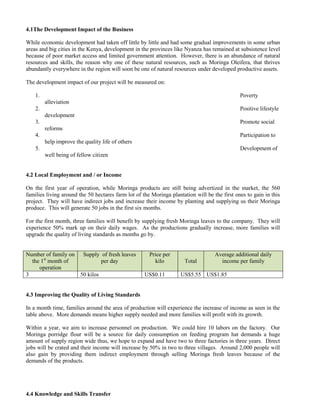
On the first year of operation, while Moringa products are still being advertized in the market, the 560 families living around the 50 hectares farm lot of the Moringa plantation will be the first ones to gain in this project. They will have indirect jobs and increase their income by planting and supplying us their Moringa produce. This will generate 50 jobs in the first six months. 
For the first month, three families will benefit by supplying fresh Moringa leaves to the company. They will experience 50% mark up on their daily wages. As the productions gradually increase, more families will upgrade the quality of living standards as months go by. 
Number of family on the 1st month of operation Supply of fresh leaves per day Price per kilo Total Average additional daily income per family 
3 
50 kilos 
US$0.11 
US$5.55 
US$1.85 
4.3 Improving the Quality of Living Standards 
In a month time, families around the area of production will experience the increase of income as seen in the table above. More demands means higher supply needed and more families will profit with its growth. 
Within a year, we aim to increase personnel on production. We could hire 10 labors on the factory. Our Moringa porridge flour will be a source for daily consumption on feeding program hat demands a huge amount of supply region wide thus, we hope to expand and have two to three factories in three years. Direct jobs will be crated and their income will increase by 50% in two to three villages. Around 2,000 people will also gain by providing them indirect employment through selling Moringa fresh leaves because of the demands of the products. 
4.4 Knowledge and Skills Transfer
Development of living standards will steadily be seen as they gain knowledge and skills by teaching them to plant and grow for a productive harvest. Educating and informing them about the advantages and profit that they will gain by planting Moringa in their surroundings will inspire and give them hope to look forward to in the future because they will learn the value of their labor and would realize to utilize their idle time in order to have more income. 
4.5 The Environmental Impacts and Improvements 
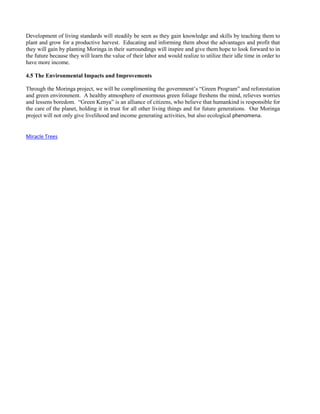
Through the Moringa project, we will be complimenting the government’s “Green Program” and reforestation and green environment. A healthy atmosphere of enormous green foliage freshens the mind, relieves worries and lessens boredom. “Green Kenya” is an alliance of citizens, who believe that humankind is responsible for the care of the planet, holding it in trust for all other living things and for future generations. Our Moringa project will not only give livelihood and income generating activities, but also ecological phenomena. 
Miracle Trees

Moringa business-plan

  • 1.
    BUSINESS PLAN MoringaOleifera Nutritional Supplement August 18, 2008 John Aoko Odeyo Twenyo Building Near Rabuor Market P.O.BOX 3917 Kisumu Kenya Phone : +254.738.652716 Mobile : +254.722.731453 E-mail : kodeyo2000@yahoo.com DAGO NETWORK YOUTH GROUP
  • 2.
    CONTENTS 0. EXECUTIVESUMMARY 3 1. THE BUSINESS 3 2. THE ENTERPRENEUR 10 3. THE FINANCIAL PLAN 12 4. THE DEVELOPMENT IMPACT 14
  • 3.
    Executive Summary MoringaOleifera or “Dawa Mboga” in Kiswahili is a known nutritional values and healing wonders that grows abundantly along the Lake Victoria region specifically in Suba District) and in some parts of Western Kenya region . This underutilized natural resource was never thought in ways that can make it as source of income or livelihood. Now for the first time in Kenya, it is being processed as a valuable feeding program against malnutrition and into various other products by Dago Network Youth Group a community based organization registered with the Ministry of Gender Sports and Social Services. Dago Network Youth Group plans to produce the following products from Moringa: Moringa capsule as food supplement and source of vitamins, liquid fertilizer for plants, porridge flour as nutritional supplement for malnourish, topical ointment to cure skin diseases and allergies, and herbal iodine powder to treat open wounds and rashes. The major products will be porridge flour and food supplement capsules, targeting a wider market including the Government Administrative Districts (GADs) of the entire province of Nyanza Province and Western Kenya region, composed of 2 Provinces , 35 Municipalities, and over 2, 063 divisions. The products will be used in the GADs’ feeding programs to combat malnutrition. We project an average daily sale of US$3,000 or US$1,080,000 a year for the first year, US$1,560,000 for the second year, and US$1,850,000 for the third year. The other products will be produced in a much smaller scale and will be sold to pharmacies, drugstores, clinics, hospitals, medical supplies, agricultural supplies and farmers associations for liquid fertilizer. In total, all the Moringa products that Dago Network Youth Group will produce is projected to earn a net profit after tax of US$491,026 for year 1, US $807,777 for year 2 and US $124,587 for year 3. We also plan to enter the global market with these first three years of operation. This project will have positive impact on the physical well being of its consumers and on poverty alleviation through livelihood generation. This project will also compliment the government’s “Environmental Advocacy and Awareness Raising Programs” through massive planting of Moringa trees. As the entrepreneur behind this business plan, my knowledge and experience, coupled with well-informed Dago Network Youth Group members, my active linkages with different government agencies, non- governmental organization (NGOs), learning institutions and religious organizations, will all contribute to the operational success and continuous growth of the business. Year Estimated Net Profit Estimated Annual Sales 1 US$491,026.00 US$1,155,555.56 2 US$807,777.00 US$1,720,000.00 3 US$124,587.00 US$2,324,756.94
  • 4.
    1. THE BUSINESS 1.1 Business Proposition Moringa Oleifera (“Omboga”) had been a part of diet and natural home remedy medication for many years of the Lake Victoria residents, particularly the Luo ethnic community. And because of its abundance and enormous supply, excess were thrown as trash and farm waste. Time has come to discover the remarkable attributes of this simple tree that it had become famous because of its extremely nutritional values, healing wonders and rare powers that it had obtain its name as the “Miracle Tree”. This unique tree sounds like fiction because of its more than three hundred kinds of valuable traits that had become a phenomenon. Among this trait, is its power to purify very turbid water to become drinkable and safe and can feed the hungry. Ounce by ounce, it has the calcium of four glasses of milk, the vitamin C of seven oranges, four times the vitamin A of carrots, two times the protein of yoghurt, and three time the potassium of bananas. It has tripled the iron of spinach and more impressive attributes than olive oil. The very first of its kind to become a business in Kenya, an under-develop natural resource discovered to generate income, jobs and livelihood to common farmers and poor people. Customers will value and patronize the product because of its effectiveness to many kinds of illnesses through the rare power of its powdered dried leaves in capsule form. Strong belief in the medicinal value of Moringa hence catalyst to demand. The price of raw materials are so low, to make any investment profitable and viable. It can offer extremely low cost with its product because of almost free raw materials and that anybody can afford to buy. Moringa had been a part of old culture medications for generations, the reason why customers are very aware of its effective powers. It also provides lasting energy and delivers supreme energy to all ages. 1.2 PRODUCTION Process and Development Processing of Moringa leaves can be difficult if it is done during rainy days. Within 24 hours the fresh Moringa leaves, if not totally dehydrated and dried, would acquire mould and will lose their nutrients. Dryer or dehydrating machine is very important at the very start of the process of every product. Moringa leaves will be dried gradually with hot air fan at 50 to 60 degrees centigrade using a cabinet drier. When dried, the leaves will be milled with pulverizing machine. The following are among the scores of possible products from powdered Moringa leaves: PRODUCTS USES Moringa capsule Food supplement/vitamins Liquid fertilizer Plant nourishment Porridge flour Nutritional supplement for Malnourish Topical ointment Cure for skin diseases and allergies Herbal iodine powder Treat for open wounds, cuts and rashes The vital, most needed resources for production are: (i) Dryer/ Dehydrator (ii) Grinder (iii) Capsule making machine (iv) Blister pacing machine (v) Cold press oil extracting machine (for Moringa seeds) (vi) Small building factory fitted with 2 milling machines. (vii) Transportation
  • 5.
    ------------- ---------- ----------------------- -------------- ---------------- Research and development had already been done, through the help of KIRDI (Kenya Institute of Research Development Institute), MOT (Ministry of Trade), KEBS (Kenya Bureau of Standards), and seminars members and I had attended, summing up with my experience and expertise in health food business and in making, producing and promoting vegetarian health foods. The quality standards and verification, such as testing and certification of nutritional facts and shelf life of the products, has been done by Kenya Bureau of Standards and (KEBS). The privileged of additional research and development will be done by injecting more funds in the production process, and more efficient techniques could be adopted in quality and shelf presentation and thereby eliminate the inferiority concept associated with Moringa products could be greatly achieved by governments assistance through provision of market incentives and concessions. 1.2.1 Supplies The supply of raw materials such as leaves and seeds are the easiest and most convenient part of the business. The unusually large supply of raw materials is one of my inspiration to move and hold to the business plan, despite the difficulties and scarcity of financial source or aid and the government’s lack of interest to provide assistance to small entrepreneurs. Its abundance is number one factor that will make this business very successful. Apart from the overflowing supply that grows everywhere and the 50-hectare land donated by members, we will encourage every neighbor and all small farmers around the area to plant and produce Moringa for their added income. Moringa is a year round production tree and sticking a branch to the ground anywhere, will surely grow and produce healthy green foliage with healthy flowers and pods without the need of pesticides and insecticides. BRANCHES PROPAGATION SEEDLINGS SEEDS HARVESTING JUICE OF LEAVES MANUAL DRYING MACHINE GRINDING COLD PRESS BEN OIL CAPSULE PORRIDGE FLOUR IODINE TREATMENT TOPICAL OINTMENT LIQUID FERTILIZER PACKAGING Flowchart of Production
  • 6.
    1.3 Market Structureand Analysis 1.3.1 Target Market and Customer Base The porridge flours and food supplement capsules are the first products to be launched. The initial target market is the feeding programs against malnutrition in local schools, rehabilitation Centres and orphanages in the entire provinces of Western Kenya region which is composed of 2 Provinces and 35 Municipalities. The feeding programs involve all Districts and Schools and Nyanza Province has a total of 1,053 Schools. Most NGO’s have shown interest in the porridge flour for their feeding programs (currently we are supplying Help Age Kenya in 3 Districts in Western Kenya). Feeding of malnourished children in Schools and orphanages is done on daily basis, thus, the Moringa porridge flour locally known as ‘AFYA UJI MIX’ will be an item for daily consumption together with the food supplement capsule. If the porridge flour will thrives at every District’s nutrition program; we will have a stable and permanent market. Assuming 95% of all Schools in the Nyanza Province will consume 3 packets of porridge flour a day at Ksh.100 per packet of (1KG), we will have an average daily sale of Kshs.300, 000 and that will be Kshs.900, 000 a month. The anticipated figures apply only in the district of Nyanza Province. Western Kenya region has with a total of 50 districts. The region alone will be a vast market and a great responsibility. From the very start, we planned to aim at the government’s existing feeding program in Kenya. The already proven nutrition of Moringa leaves had been used for feeding for years and mixed in rice and other ingredients for porridges to the young children. On the other hand, Moringa dried leaves is ten times more nutritious than the fresh leaves, and if taken in powdered form, it tastes more delicious. Estimated Sale of Moringa Porridge Flour for Nyanza Province Districts Number of Schools Average Daily Consumption Monthly Sales (at US 1$.00/Pack) Kisumu 1,053 3,000 packs US$90,000.00 Migori 282 801 packs US$24,030.00 Nyando 720 2,052 packs US$61,560.00 Siaya 541 1,539 packs US$46,170.00 Homa Bay 315 897 packs US$26,910.00 Kisii 550 1,566 packs US$46,980.00 TOTAL US$295,650.00 1.3.2 Competitor Analysis Currently we are enjoying the monopoly of this unique product in Kenya. Although competitors could penetrate the target with their food supplements and multi-vitamin products, the government’s feeding program needs a product that malnourished mother and young children could take as food and would supply them a lot of nutrients and energy for their malnourished bodies. These competitors could somehow compliment our Moringa food supplement in capsule form, but not its extremely low prices. 1.3.3 Market Size and Potential As long as the government and NGO’s programs on malnutrition exists, our market size will become bigger, stable and permanent. Supplying a region wide daily feeding activity program will definitely make the business expand and will make the production process larger. Therefore, finance and manpower will also need more attention. Raw materials will never be a problem since raw materials are everywhere. Speaking of big production to supply a country wide item for daily consumption is another thing especially when machines being used are not capable for big production. Judging on the present status of our products being the sole producer of Moringa porridge flour, within a year’s time, our target market of region wide consumers will expand and grow, that the planned sole factory for production will not be able to accommodate the markets demand.
  • 7.
    1.3.4 Competitive Advantage The number one of selling advantage of our Moringa flour and our food supplement capsule is its uniqueness. The very first of its kind ever introduced for business in the Kenyan market. Number two selling point is it is already proven of its well known multi-nutrients that no other fruits or vegetables can ever have. Its rare powers of medicinal properties and enormous vitamins will not be compared to any nutritious fruit or vegetable that one needs to combine all their nutrients, to equal wonders and energy giving properties. It is like growing vitamins at your doorstep. 1.4 Marketing and Sales 1.4.1 Sales Our plan to push our sales in its first year of operation to be able to compensate the full initial capital of US$250,000 should be ploughed back and would materialize through commitment, determination and hard work. Through close supervision in our target market, cooperation and proper contact on the targeted market groups by each member of the company, voluntary labour and support and the rich supply of raw materials will definitely make our goals come true. This low initial investment due to premium pricing boost high profit margin and will help a lot to compensate the US$250,000 initial capital. 1.4.2 Marketing and Communication Our privilege to push our products to market is through close communication and direct contact with different government agencies and their programs; participation in trade fairs through the help of the department of Trade and Industry (DTI); seminars and demonstrations in different communities; Association, Trade Shows conferences; meetings of Parents-Teachers Associations (PTA); advertisements both in print media and over the radio and television; and through the Internet could all be possible ways to market our new products. 1.4.3 Distribution Distribution will be done on weekly basis. These distributions of supply for feeding activities will be delivered at schools, county council or city halls. Supply for two weeks will be delivered and distributed in advance for feeding activities. Cheque payments on delivered Moringa flour will be picked up from the contracted institutions one three days after delivery of the product.Currently and in a small scale, we are supplying Help Age Kenya with 2,400kg per week and 4,800kg to the local supermarkets (Yatin and Ukwala) respectively on a weekly basis. Coupled with school feeding programs in Rabuor Primary School, KOWIO Nursery School etc
  • 8.
    1.5 Company Structure 1.5.1 Management The management team is consisting of five: John Aoko Odeyo -The company CEO and in charge of product development, advertisement and marketing through performing seminars with the NGOs and PTAs in the region. Betty Tom -Head of production and in charge of the factory and product development. Bernard Ochieng -in charge in office management and team cooperation. Violet Awuonda - IT; in charge of product label and designs. Martin Awuor -Sales and delivery; farm management; in charge of equipment/ machines repairs. Three manual laborer s and one messenger. 1.52 Legal Status The name of the organization is Dago Network Youth Group, it was registered with the Ministry of Gender Sports and Social Services in 2005. The Moringa project is a masterpiece of the organization. 1.5.3 Partners and Sponsors Our financial partners come from the able membership of the organization. Each member has his/her own personal funds used in the development of the products. The members are already determined to have their roles, ties and commitment with the business. We have received support from the Ministry of Trade, Ministry of Youth Affairs, Kenya Agricultural Finance Cooperation, Kenya Industrial Estate (KIE), OGRA Foundation, Help Age Kenya, HOVIC (Hope for Victoria Kenya) etc. 1.6 Risks Risks Measures to Counteract the Risks 1. Copycat is the number one risk that any businessman should be aware of. One has to be cautious of showing and talking of how the business or the production goes. Business secrecy is a must. Confidentiality must be the number one rule of the company. Because even if the product had already been patented, copyrighted and trademarked for its legal rights and protection, nobody can prevent anyone else to pirate or imitate the product. 2. Weather and natural calamities – heavy rains and floods is a threat to Moringa trees. They should be planted in high places where water would not stay stagnant. Seedlings placed in plastic bags for propagation and substitute for destroyed and damage trees after turbulent weathers should always be ready. 3. Astray domestic animals around the plantation area should always be considered for the tree’s safety. Someone should always be in the area of plantation in watch for strayed cattle which can spoil the plants.
  • 9.
    1.7 SWOT Analysis The analysis of strength, Weaknesses, opportunities and threats that will make the business survive its internal and external environment strategic in its planning process is the life and success of the company. Strengths Weaknesses 1) The abundance of raw materials to the extent of overwhelming supplies of Moringa. 2) Improvement on the market demand through positive advertisements and direct contact to potential markets. 3) Sincere support, commitment and hard work from the members of the organization are significant to the business operation. 4) Prices are still good considering that the product is the very first of its kind in the country and will make an investment in Moringa very profitable and viable. 5) The Kenyan climate favors high potential to increase production for export and local markets. 6) The know-how and the expertise of its members are cost advantages 7) Speaking of Moringa products, we still claim to have exclusive access to high grade Moringa resources 8) The favorable access in the distribution of our products to the different feeding program activities of the government. 9) The price of our products which the lowest sector can afford to purchase. 1) Lack of access to key distribution channels, e.g., even if you have the best unique product but one cannot go near and approach the market group potential, sales or distribution is considered weak. 2) The poor reputation of products among customers and market potentials-e.g. the attitude of buyers towards the local food supplement in general as inferior, compared to imported alternatives. 3) Lack of patent protection – patented product is not usually protected by the Government, the reason why most products, especially small entrepreneurs, never had the intention to have their product patented. 4) Poor production technology and capacity to improve the products because of lack of finance. 5) Most production is at domestic level, hence unrecorded and its result is inconsistency of production. 6) The current business trend cannot sustain the commercial interest rates on bank loans
  • 10.
    Opportunities Threats 1)The opportunity for Moringa leaf powder to be launched and absorb by the government nutrition council would be 90% because of its interest to its low cost and nutritional properties that will be served to their recipients. 2) The opportunity of being the first company to introduce such product in the market 3) The opportunity to satisfy the trend of the government feeding program because of its very low cost to cope with their poor budget. 4) The opportunity to offer an item which other companies don’t have or had not offered in the past. 5) The opportunity to satisfy the curiosity of the consumers because of its reputation to be a very nutritious plant. 6) The opportunity of increasing popularity trend in Moringa products and the increasing demand both locally and internationally 1. 1) Shifts in consumers tastes away from the companies products – the taste of Moringa powder in its pure form is not considered appetizing. 2) The lack of production technology to add value and flavor denies it the market advantages which could accrue to its nutrition potential – these threats of the business can be avoided through sufficient finance in production. 3) Emergence of substitute products – competition from imported food supplements due to more advanced packaging and branding; people tend to have more trust in imported products as they are easy to identify with, and most of them are flavored and value added. 4) Poor processing methods – Moringa products had been associated more with medicinal drugs other than food supplement due to poor advertisement. 5) The population is not fully aware of the nutritional values of Moringa; poor advertising strategy. 6) Lack of government commitment to promote Moringa – the government is not offering appropriate support in terms of concession and research in the development of Moringa products. 7) Lack of adequate capital to buy equipment to use in the processing, packing and improving of Moringa products. 8) The numerous typhoon visits in the region and heavy rains on rainy season is the biggest threat to slow down the business; the mortality of Moringa trees and the high potential of increase of production usually depends upon the weather, hence threats on raw material supply is inevitable. 1.
  • 11.
    2.0THE ENTERPRENEUR 2.1Personal Motivation and Individual Qualities I formed a small group of five youths as an association and later decided to make it as a legal organization. After few weeks, we were legally registered and the organization was born. Long before the organization was envisioned, I had been giving special attention to the vast supply of Moringa Oleifera in our surroundings because of its thick and abundant green foliage, which I felt giving a desirable easy feeling and ambitious mind. That was the beginning of more research and study regarding the odd traits of this simple and under utilized tree. Several calamities came and ruined the green environment of Moringa tree. Tons of Moringa leaves and branches together with its trunks were dump as rubbish without any regard of its importance. My affection to this simple tree became an interest to turn this into a livelihood that could help generate income to farmers and unfortunate people. It came to my mind that if those unfound people could be taught to utilize their unproductive time by sowing Moringa branches to their yards and surroundings, they could improve their lifestyle and well being. And not long after the organization was registered and was named “Dago Network Youth Group” the project Moringa Oleifera was born. 2.2 Experience For the last 10 years, I had been connected with different community organization. I have participated in the World Jersey Youth Exchange Program in 1997, working with Jersey Farmers in England and Jersey Channel Island for 8 Months. I was a volunteer with the Jersey Overseas Aid in the year 2000 where I help build schools. I had also been dealing with herbal books and health magazines and the latest with my health food business. My capability to convince helps a lot in the progress and management of my latest business; producing and promoting my vegetarian health foods, like burgers, vegemeats, soy coffee, soy milk, and lot more. My experience and my background as nutritionist improve me more in developing product such vegetarian foods. 2.3 Personal role Being the founder of the organization, my plan is to lead and act as a the president/Chairman of the company. I will particularly be taking charge of advertisement and marketing of the products through direct selling, contact and close cooperation with different government agencies, feeding programs and medical outreach by different NGOs and the international market. All the members of the organization will have their specific task allotted to them; we have IT, master in business administration and enough knowledge in production.
  • 12.
    3.0THE FINANCIAL PLAN PROFIT & LOSS STATEMENT 2009 2010 2011 Revenues 1,155,556 1,719,444 2,326,389 Total Revenues 1,155,556 1,719,444 2,326,389 Cost of Sales or Direct Costs 152,593 190,074 238,944 Cost of Sales 152,593 190,074 238,944 Gross margin 1,002,963 1,529,370 2,087,445 Marketing and promotions and other cost 5,733 6,800 7,867 Staff costs 9,950 12,948 15,947 Travel costs 1,600 1,867 2,133 Office costs 4,320 4,453 4,587 Equipment & maintenance costs 1,333 1,520 1,667 Third Party Costs 424,800 625,267 841,233 Licenses 14,778 0 0 Operating Costs 462,514 652,855 873,433 Income from Operations 540,449 876,516 1,214,012 Interest charges 8,000 5,333 2,667 VAT 15,142 24,782 35,522 Depreciation 11,095 13,640 16,455 Non-operating costs 34,237 43,755 54,644 Gross profit 506,212 832,760 1,159,368 Profit tax 15,186 24,983 34,781 Net profit 491,026 807,777 1,124,587 Number of staff 25 40 60 CASH FLOW 2009 2010 2011 Beginning Cash Position 250,000 684,292 1,214,927 Revenues 1,155,556 1,719,444 2,326,389 Cash IN 1,155,556 1,719,444 2,326,389 Costs 653,435 898,027 1,185,347 Fixed asset purchases 76,700 25,650 28,100 Cash OUT 730,135 923,677 1,213,447 Subtotal 425,421 795,767 1,112,942 In Loans/Grants received 250,000 - - External share capital paid in 5,000 - - Out Loan Repayment (not interest payments) 16,667 16,667 16,666 Dividend payments 29,462 48,467 67,475 Subtotal 8,872 65,133- 84,141- Cash flow per year 434,292 730,634 1,028,801 Ending cash position 684,292 730,634 1,028,801
  • 13.
    BALANCE SHEET ASSETS 2009 2010 2011 Net Fixed Assets (purch.- depr.) 65,605 77,615 89,260 Cash 684,292 1,214,927 2,243,727 Inventory 1,555,555.56 1,719,444 2,326,389 Current Assets 1,839,848 2,934,371 4,570,116 Total Assets 1,905,453 3,011,986 4,659,376 LIABILITIES & EQUITY Outstanding loans 33,333 16,667 1 Total liabilities 33,333 16,667 1 Profits current year 491,026 807,777 1,124,587 Retained earnings 29,462 413,097 1,153,400 External share capital paid in 5,000 - - Other equity 1,205,556 1,774,444 2,381,389 Total Equity 1,672,120 2,995,319 4,659,376 Total liabilities and equity 1,905,453 3,011,986 4,659,376 4.0 THE DEVELOPMENT IMPACT
  • 14.
    4.1The Development Impactof the Business While economic development had taken off little by little and had some gradual improvements in some urban areas and big cities in the Kenya, development in the provinces like Nyanza has remained at subsistence level because of poor market access and limited government attention. However, there is an abundance of natural resources and skills, the reason why one of these natural resources, such as Moringa Oleifera, that thrives abundantly everywhere in the region will soon be one of natural resources under developed productive assets. The development impact of our project will be measured on: 1. Poverty alleviation 2. Positive lifestyle development 3. Promote social reforms 4. Participation to help improve the quality life of others 5. Development of well being of fellow citizen 4.2 Local Employment and / or Income On the first year of operation, while Moringa products are still being advertized in the market, the 560 families living around the 50 hectares farm lot of the Moringa plantation will be the first ones to gain in this project. They will have indirect jobs and increase their income by planting and supplying us their Moringa produce. This will generate 50 jobs in the first six months. For the first month, three families will benefit by supplying fresh Moringa leaves to the company. They will experience 50% mark up on their daily wages. As the productions gradually increase, more families will upgrade the quality of living standards as months go by. Number of family on the 1st month of operation Supply of fresh leaves per day Price per kilo Total Average additional daily income per family 3 50 kilos US$0.11 US$5.55 US$1.85 4.3 Improving the Quality of Living Standards In a month time, families around the area of production will experience the increase of income as seen in the table above. More demands means higher supply needed and more families will profit with its growth. Within a year, we aim to increase personnel on production. We could hire 10 labors on the factory. Our Moringa porridge flour will be a source for daily consumption on feeding program hat demands a huge amount of supply region wide thus, we hope to expand and have two to three factories in three years. Direct jobs will be crated and their income will increase by 50% in two to three villages. Around 2,000 people will also gain by providing them indirect employment through selling Moringa fresh leaves because of the demands of the products. 4.4 Knowledge and Skills Transfer
  • 15.
    Development of livingstandards will steadily be seen as they gain knowledge and skills by teaching them to plant and grow for a productive harvest. Educating and informing them about the advantages and profit that they will gain by planting Moringa in their surroundings will inspire and give them hope to look forward to in the future because they will learn the value of their labor and would realize to utilize their idle time in order to have more income. 4.5 The Environmental Impacts and Improvements Through the Moringa project, we will be complimenting the government’s “Green Program” and reforestation and green environment. A healthy atmosphere of enormous green foliage freshens the mind, relieves worries and lessens boredom. “Green Kenya” is an alliance of citizens, who believe that humankind is responsible for the care of the planet, holding it in trust for all other living things and for future generations. Our Moringa project will not only give livelihood and income generating activities, but also ecological phenomena. Miracle Trees