1 
Moringa and other highly nutritious plant resources: Strategies, standards and markets for a better 
impact on nutrition in Africa. Accra, Ghana, November 16-18, 2006 
Leaf yield and Nutritive 
value of Moringa 
stenopetala 
and Moringa oleifera 
Accessions 
By 
Dechasa Jiru Kai sonder 
Lalisa Alemayehu,Yalemtshay Mekonen 
and Agena Anjulo
2 
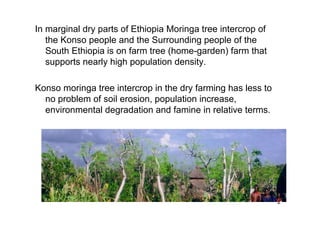
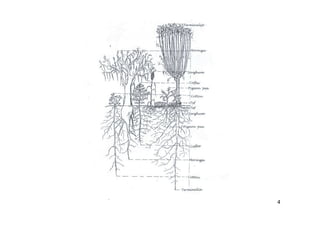
In marginal dry parts of Ethiopia Moringa tree intercrop of 
the Konso people and the Surrounding people of the 
South Ethiopia is on farm tree (home-garden) farm that 
supports nearly high population density. 
Konso moringa tree intercrop in the dry farming has less to 
no problem of soil erosion, population increase, 
environmental degradation and famine in relative terms.
3 
Participatory farmers interview 
Three important tree intercrops were 
identified in Ethiopia 
In Ox-culture 
Acaia albida( Faidherrdia albida) (N) 
Croton macrstachyus (P) 
Hoe-culture 
Moringa stenopetala
4
5 
• Honey production (Apiculture) 
• Ethiopia has three to five million bee colonies, 
which makes the country with the highest bee 
density in Africa. It is the fourth largest wax 
producing country after China, Mexico and 
Turkey. The total estimate is about two 
thousand one hundred tones per year, it is one 
of the largest honey producing country in Africa. 
World wide it stands in tenth place in honey 
production. In area where cattle production is 
limited apiculture plays a significant role. 
Perennial plant provides sustainable bee forage 
Since land is currentely converted to annual 
crop and grass cover bees are indanger.
6 
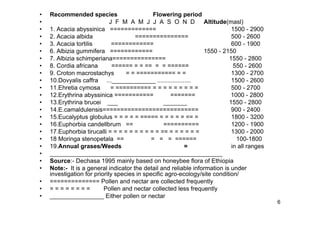
• Recommended species Flowering period 
• J F M A M J J A S O N D Altitude(masl) 
• 1. Acacia abyssinica ============= 1500 - 2900 
• 2. Acacia albida =============== 500 - 2600 
• 3. Acacia tortilis ============ 600 - 1900 
• 6. Albizia gummifera ============ 1550 - 2150 
• 7. Albizia schimperiana=============== 1550 - 2800 
• 8. Cordia africana ====== = = == = = ====== 550 - 2600 
• 9. Croton macrostachys = = =========== = = 1300 - 2700 
• 10.Dovyalis caffra ..._____________ .................... 1500 - 2600 
• 11.Ehretia cymosa = ========== = = = = = = = = = 500 - 2700 
• 12.Erythrina abyssinica =========== ======= 1000 - 2800 
• 13.Erythrina brucei ___ _______ 1550 - 2800 
• 14.E.camaldulensis=========================== 900 - 2400 
• 15.Eucalyptus globulus = = = = = ===== = = = = = == = 1800 - 3200 
• 16.Euphorbia candellbrum == ========== 1200 - 1900 
• 17.Euphorbia tirucalli = = = = = = = = = = == = = = = = = 1300 - 2000 
• 18 Moringa stenopetala == = = = ====== 100-1800 
• 19.Annual grases/Weeds = in all ranges 
• ___________________________________________________ 
• Source:- Dechasa 1995 mainly based on honeybee flora of Ethiopia 
• Note:- It is a general indicator the detail and reliable information is under 
investigation for priority species in specific agro-ecology/site condition/ 
• ============== Pollen and nectar are collected frequently 
• = = = = = = = = Pollen and nectar collected less frequently 
• ________________ Either pollen or nectar
7 
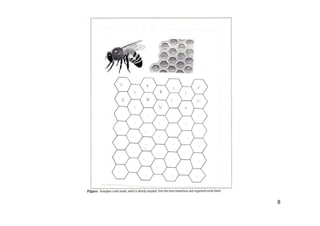
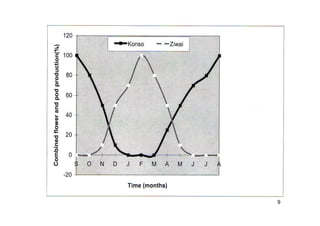
On farm tree planting 
Staggered spacing is adopted 
From Engineer Bee 
It is also a breeder
8
9
10
11 
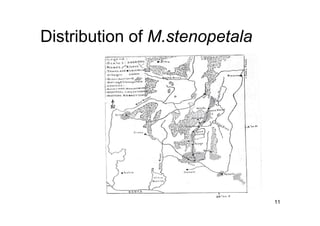
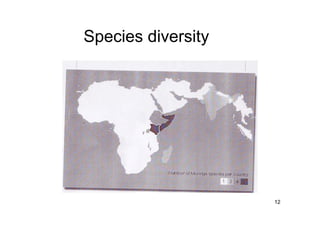
Distribution of M.stenopetala
12 
Species diversity
13 
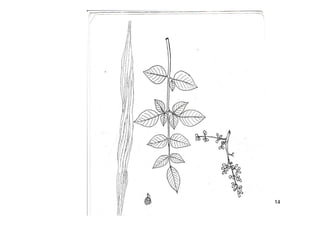
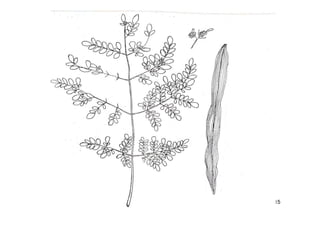
Leaf assessment 
• M.stenopetala 
• M.oleifera 
Leaflets
14
15
16 
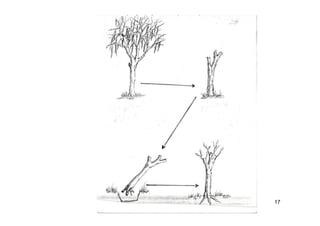
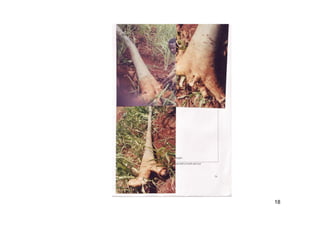
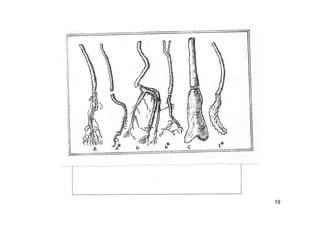
• Local Konso planting method
17
18
19
20
21
22
23
24
25
26
27
28 
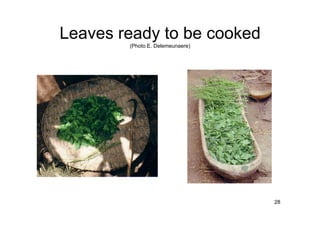
Leaves ready to be cooked 
(Photo E. Delemeunaere)
29 
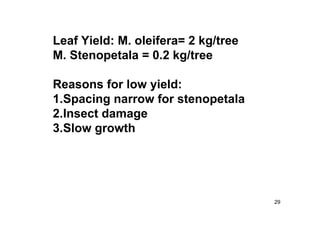
Leaf Yield: M. oleifera= 2 kg/tree 
M. Stenopetala = 0.2 kg/tree 
Reasons for low yield: 
1.Spacing narrow for stenopetala 
2.Insect damage 
3.Slow growth
30 
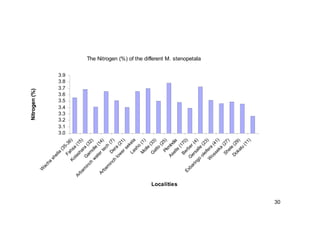
The Nitrogen (%) of the different M. stenopetala 
3.9 
3.8 
3.7 
3.6 
3.5 
3.4 
3.3 
3.2 
3.1 
3.0 
Wacha shella (35-36) 
Fahsa (15) 
Kolashara (32) 
Dera (21) 
Arbaminch lower sekela 
Gamolle (14) 
Arbaminch water tech (7) 
Gatto (25) 
Lasho (1) 
Molle (33) 
Berber (4) 
Gersalle (23) 
Exbaringo oleifera (41) 
PkmIndia 
Aselle (170) 
Shele (29) 
Dokatu (11) 
Wosseka (27) 
Localities 
Nitrogen (%)
31 
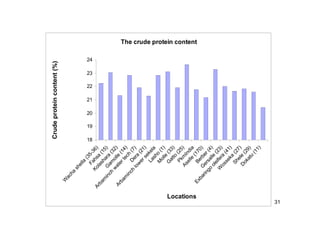
The crude protein content 
24 
23 
22 
21 
20 
19 
18 
Fahsa (15) 
Kolashara (32) 
Gamolle (14) 
Arbaminch water tech (7) 
Wacha shella (35-36) 
Dera (21) 
Arbaminch lower sekela 
Lasho (1) 
Molle (33) 
PkmIndia 
Aselle (170) 
Gatto (25) 
Shele (29) 
Dokatu (11) 
Berber (4) 
Gersalle (23) 
Exbaringo oleifera (41) 
Wosseka (27) 
Locations 
Crude protein content (%)
32 
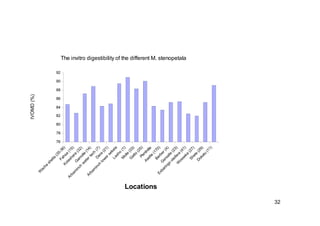
The invitro digestibility of the different M. stenopetala 
92 
90 
88 
86 
84 
82 
80 
78 
76 
Wacha shella (35-36) 
Fahsa (15) 
Kolashara (32) 
Dera (21) 
Arbaminch lower sekela 
Gamolle (14) 
Arbaminch water tech (7) 
Gatto (25) 
Lasho (1) 
Molle (33) 
Berber (4) 
Gersalle (23) 
Exbaringo oleifera (41) 
PkmIndia 
Aselle (170) 
Shele (29) 
Dokatu (11) 
Wosseka (27) 
Locations 
IVOMD (%)
33 
THANK 
YOU 
Photo E. Demeuleunaere

Nutritive value-of-moringa-stenopetala-and-moringa-oleifera

  • 1.
    1 Moringa andother highly nutritious plant resources: Strategies, standards and markets for a better impact on nutrition in Africa. Accra, Ghana, November 16-18, 2006 Leaf yield and Nutritive value of Moringa stenopetala and Moringa oleifera Accessions By Dechasa Jiru Kai sonder Lalisa Alemayehu,Yalemtshay Mekonen and Agena Anjulo
  • 2.
    2 In marginaldry parts of Ethiopia Moringa tree intercrop of the Konso people and the Surrounding people of the South Ethiopia is on farm tree (home-garden) farm that supports nearly high population density. Konso moringa tree intercrop in the dry farming has less to no problem of soil erosion, population increase, environmental degradation and famine in relative terms.
  • 3.
    3 Participatory farmersinterview Three important tree intercrops were identified in Ethiopia In Ox-culture Acaia albida( Faidherrdia albida) (N) Croton macrstachyus (P) Hoe-culture Moringa stenopetala
  • 4.
  • 5.
    5 • Honeyproduction (Apiculture) • Ethiopia has three to five million bee colonies, which makes the country with the highest bee density in Africa. It is the fourth largest wax producing country after China, Mexico and Turkey. The total estimate is about two thousand one hundred tones per year, it is one of the largest honey producing country in Africa. World wide it stands in tenth place in honey production. In area where cattle production is limited apiculture plays a significant role. Perennial plant provides sustainable bee forage Since land is currentely converted to annual crop and grass cover bees are indanger.
  • 6.
    6 • Recommendedspecies Flowering period • J F M A M J J A S O N D Altitude(masl) • 1. Acacia abyssinica ============= 1500 - 2900 • 2. Acacia albida =============== 500 - 2600 • 3. Acacia tortilis ============ 600 - 1900 • 6. Albizia gummifera ============ 1550 - 2150 • 7. Albizia schimperiana=============== 1550 - 2800 • 8. Cordia africana ====== = = == = = ====== 550 - 2600 • 9. Croton macrostachys = = =========== = = 1300 - 2700 • 10.Dovyalis caffra ..._____________ .................... 1500 - 2600 • 11.Ehretia cymosa = ========== = = = = = = = = = 500 - 2700 • 12.Erythrina abyssinica =========== ======= 1000 - 2800 • 13.Erythrina brucei ___ _______ 1550 - 2800 • 14.E.camaldulensis=========================== 900 - 2400 • 15.Eucalyptus globulus = = = = = ===== = = = = = == = 1800 - 3200 • 16.Euphorbia candellbrum == ========== 1200 - 1900 • 17.Euphorbia tirucalli = = = = = = = = = = == = = = = = = 1300 - 2000 • 18 Moringa stenopetala == = = = ====== 100-1800 • 19.Annual grases/Weeds = in all ranges • ___________________________________________________ • Source:- Dechasa 1995 mainly based on honeybee flora of Ethiopia • Note:- It is a general indicator the detail and reliable information is under investigation for priority species in specific agro-ecology/site condition/ • ============== Pollen and nectar are collected frequently • = = = = = = = = Pollen and nectar collected less frequently • ________________ Either pollen or nectar
  • 7.
    7 On farmtree planting Staggered spacing is adopted From Engineer Bee It is also a breeder
  • 8.
  • 9.
  • 10.
  • 11.
    11 Distribution ofM.stenopetala
  • 12.
  • 13.
    13 Leaf assessment • M.stenopetala • M.oleifera Leaflets
  • 14.
  • 15.
  • 16.
    16 • LocalKonso planting method
  • 17.
  • 18.
  • 19.
  • 20.
  • 21.
  • 22.
  • 23.
  • 24.
  • 25.
  • 26.
  • 27.
  • 28.
    28 Leaves readyto be cooked (Photo E. Delemeunaere)
  • 29.
    29 Leaf Yield:M. oleifera= 2 kg/tree M. Stenopetala = 0.2 kg/tree Reasons for low yield: 1.Spacing narrow for stenopetala 2.Insect damage 3.Slow growth
  • 30.
    30 The Nitrogen(%) of the different M. stenopetala 3.9 3.8 3.7 3.6 3.5 3.4 3.3 3.2 3.1 3.0 Wacha shella (35-36) Fahsa (15) Kolashara (32) Dera (21) Arbaminch lower sekela Gamolle (14) Arbaminch water tech (7) Gatto (25) Lasho (1) Molle (33) Berber (4) Gersalle (23) Exbaringo oleifera (41) PkmIndia Aselle (170) Shele (29) Dokatu (11) Wosseka (27) Localities Nitrogen (%)
  • 31.
    31 The crudeprotein content 24 23 22 21 20 19 18 Fahsa (15) Kolashara (32) Gamolle (14) Arbaminch water tech (7) Wacha shella (35-36) Dera (21) Arbaminch lower sekela Lasho (1) Molle (33) PkmIndia Aselle (170) Gatto (25) Shele (29) Dokatu (11) Berber (4) Gersalle (23) Exbaringo oleifera (41) Wosseka (27) Locations Crude protein content (%)
  • 32.
    32 The invitrodigestibility of the different M. stenopetala 92 90 88 86 84 82 80 78 76 Wacha shella (35-36) Fahsa (15) Kolashara (32) Dera (21) Arbaminch lower sekela Gamolle (14) Arbaminch water tech (7) Gatto (25) Lasho (1) Molle (33) Berber (4) Gersalle (23) Exbaringo oleifera (41) PkmIndia Aselle (170) Shele (29) Dokatu (11) Wosseka (27) Locations IVOMD (%)
  • 33.
    33 THANK YOU Photo E. Demeuleunaere