Learning Unit #1
Overview of Money and Banking
Objectives of Learning Unit
• Importance of Financial System
• Three Financial Markets
• Financial Institutions
• Money in Economy
• Economic Data of the U.S. Economy
• Review of Macroeconomics
Financial System
• Some people do not have a productive use of
funds, while others have a productive use of funds.
• Financial system channels funds from savers
(people who have an excess funds) to investors
(people who have a shortage of funds).
• Financial system promotes economic efficiency by
allocating limited resources efficiently in
economy.
Financial System and Economy
Well-functioning financial system promotes
• Economic growth
• Stable prices
• High employment
• Accumulation of wealth
Financial Instruments
• In financial system, when lenders provide funds to
borrowers, borrowers provide financial
instruments to lenders.
• Financial Instrument (a.k.a. Security, IOU): A
claim on the issuer’s (borrower’s) future income
or assets.
• Value of financial instruments is determined by
borrowers and lenders in financial markets.
Three Financial Markets
• Bond Market
• Stock Market
• Foreign Exchange Market
Bond Market
• Bond: A debt instrument that promises to make
payments periodically for a specified period of time.
– Ex. U.S. Treasury Bonds
• Governments issue bonds to finance budget deficits,
while large corporations issue bonds to finance
large investment projects.
• Bond market determines interest rates.
Interest Rates
• Interest rate: Cost of borrowing funds.
• Interest rates affect economic activities by
affecting individual’s willingness to spend.
– High interest rates encourage savers to save more (lend
more) and spend less.
– High interest rates discourage borrowers to borrow
more and spend more.
– High interest rates means high costs for corporations to
undertake investment projects.
Interest Rates in Action
• There are many different interest rates.
– Different financial instruments have different interest
rates.
– Each interest rate is determined in each bond market.
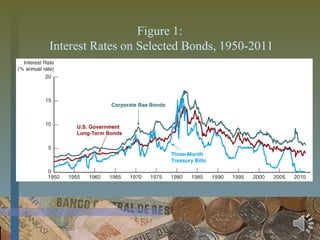
• Interest rates change over time.
– Interest rates tend to move together.
Figure 1:
Interest Rates on Selected Bonds, 1950-2011
Stock Market
• Stock: a share of ownership in a corporation.
– It is a claim on the earnings and assets of the corporation.
• Stock prices affect the economy by
– Affecting the amount of funds that corporations can raise
by selling newly issued stock to finance their business
investment projects.
– Affecting the size of people’s wealth and their
willingness to spend.
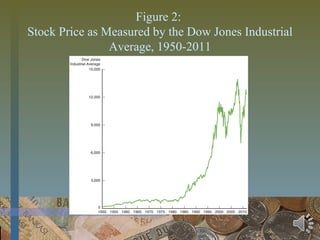
• Stock prices are extremely volatile.
Figure 2:
Stock Price as Measured by the Dow Jones Industrial
Average, 1950-2011
Foreign Exchange Market
• Foreign exchange market: one country’s currency
is exchanged with other country’s currency.
– It allows funds to move across borders from
country which have an excess funds to another
which have a shortage of funds.
• Foreign exchange rate: the price of one country’s
currency in terms of another’s.
Foreign Exchange Rate
• Foreign exchange rate affects the price of foreign
goods in the U.S. and the price of U.S. goods in
foreign countries.
– An increase in value of the U.S. dollar makes prices of
foreign-made goods cheaper for U.S. consumers and
affects American firms competing with foreign goods.
– An increase in value of the U.S. dollar makes prices of
American-made goods more expensive to foreign
consumers and affects exports of American firms.
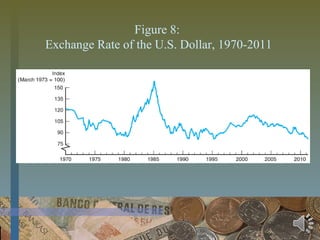
• Foreign exchange rates change over time.
Figure 8:
Exchange Rate of the U.S. Dollar, 1970-2011
Financial Institutions
• Financial institutions help and complement
financial markets to channel funds from savers to
investors.
– Ex. Investment banks, security dealers
• Financial intermediaries borrow funds from people
who have saved and in turn make loans to others.
– Ex. Banks accept deposits and make loans.
– Ex. Insurance companies, pension funds, mutual funds
Financial Crisis
• Financial crises are major disruptions in financial
markets that are characterized by sharp declines in
asset prices and the failures of many financial and
nonfinancial firms.
• Starting in August 2007, the U.S. economy was hit
by the worst financial crisis since the Great
Depression in 1930s.
– Ex. Failure of Lehman Brothers, AIG, and Wachovia Bank
• Recessions and depressions were often preceded by
financial crises.
Financial Innovation
• Financial innovation: Financial institutions
introduce new financial services.
• Financial innovation makes the financial system
more efficient.
̶ Ex. Online banking/trading, e-finance
• Financial innovation can lead to devastating
financial crises.
̶ Ex. Collapse of CDSs (Credit Default Swaps) lead to
failures of AIG.
Monetary Policy
• Money: anything that is generally accepted in
payment for goods or services or in the repayment
of debts.
• Money supply: the quantity of money in an
economy.
• Monetary policy: the management of money and
interest rates by the central bank
• Federal Reserve System (a.k.a. the Fed) is the
central bank of the U.S.
Money and Economy
Money can affect many economic variables by
affecting individual consumers and businesses.
• Production of goods and services in an economy:
Business cycle
• Prices of goods and services in an economy:
Inflation
• Interest rates, stock prices, and foreign exchange
rates
Money and Business Cycle
• Aggregate output: total production of goods and
services in an economy.
• Business cycle: the upward (expansion) and
downward (recession) movement of aggregate
output through time.
• Unemployment rate: a percentage of unemployed
workers in the total labor force.
– Unemployment rate increases during a recession and
declines during an expansion.
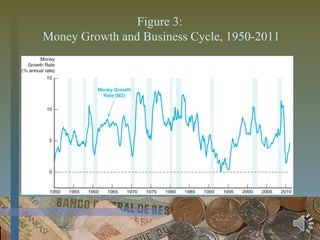
Figure 3:
Money Growth and Business Cycle, 1950-2011
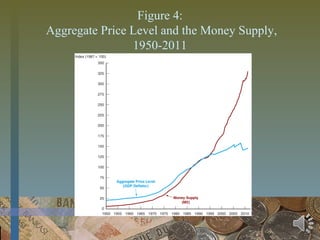
Money and Inflation
• Aggregate price level: the average price of goods
and services in an economy.
• Inflation: a continual increase in the price level.
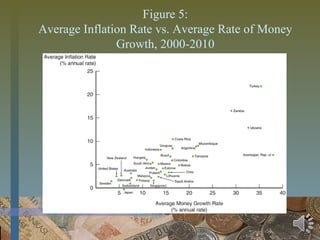
• A positive association of a continuing increase in
the money supply (money growth) and a
continuing increase in the price level (inflation).
Figure 4:
Aggregate Price Level and the Money Supply,
1950-2011
Figure 5:
Average Inflation Rate vs. Average Rate of Money
Growth, 2000-2010
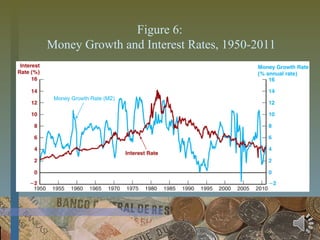
Money and Interest Rates
• Prior to 1980, the rate of money growth and the
interest rate on long-term Treasure bonds were
closely tied
• Since then, the relationship is less clear but still an
important determinant of interest rates
Figure 6:
Money Growth and Interest Rates, 1950-2011
Fiscal Policy
Fiscal policy is government spending
and taxation
• Budget deficit is the excess of expenditures over
revenues for a particular year
• Budget surplus is the excess of revenues over
expenditures for a particular year
• Any deficit must be financed by borrowing
− Ex. U.S. Treasury bonds
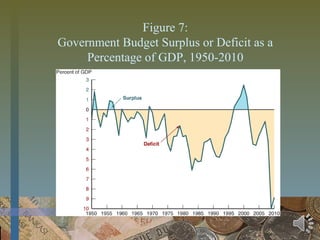
Figure 7:
Government Budget Surplus or Deficit as a
Percentage of GDP, 1950-2010
How We Study Money and Banking
Basic Analytic Framework
1. Simplified approach to the demand for assets
2. Concept of equilibrium
3. Basic supply and demand approach to understand
behavior in financial markets
4. Transactions cost and asymmetric information
approach to financial structure
How Money & Banking relates to
Other Courses
• Microeconomics – demand and supply model
• Macroeconomics – monetary policy
• Finance – present value & asset pricing
model
• Accounting – Balance sheet & T-account
Appendix:
Measuring the Economy
Two important measurements of an economy
• Aggregate output: total amount of goods and
services produced in the economy.
• Price level: a measure of average prices of goods
and services
Aggregate Output
• Gross Domestic Product (GDP): the market value
of all final goods and services produced in a
country during a year (or a quarter).
• Aggregate income: total income in an economy
during a particular year
• Aggregate output = Aggregate income
– When produced is what spent and what earned in a
whole economy.
Nominal and Real Values
Because prices change over time, economic
variables are measured in either nominal or
real.
• Nominal: values measured using current prices
• Real: quantities measured with constant prices
Nominal and Real GDP
• Nominal GDP: the value of the final goods and
services produced in a given year valued at the prices
that prevailed in that same year (current price).
• Real GDP: the value of the final goods and services
produced in a given year when valued at constant
prices (constant price).
Nominal vs. Real GDP
• The (nominal) GDP changes from one year to next
when
– the quantities of goods and services produced change or
the prices of goods and services produced change.
• Real GDP is intended to measure only changes in
quantities of goods and services produced from
one year to next by correcting the (nominal) GDP
for the price changes.
Price Level
Two commonly used measurements of the price
level of an economy:
• GDP deflator: A change in prices of all goods
and services (included in GDP) in an economy.
• Consumer Price Index (CPI): An average of
prices paid by urban consumers for a fixed
market basket of consumption goods and
services (typically purchased by urban
consumers).
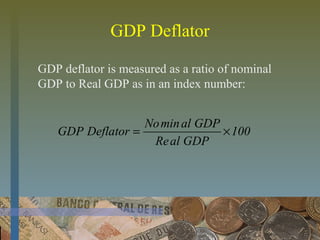
GDP Deflator
100
GDPalRe
GDPalminNo
DeflatorGDP ×=
GDP deflator is measured as a ratio of nominal
GDP to Real GDP as in an index number:
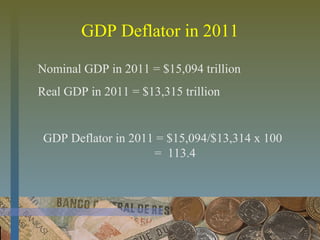
GDP Deflator in 2011
Nominal GDP in 2011 = $15,094 trillion
Real GDP in 2011 = $13,315 trillion
GDP Deflator in 2011 = $15,094/$13,314 x 100
= 113.4
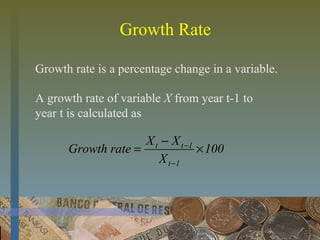
Growth Rate
Growth rate is a percentage change in a variable.
100
X
XX
rateGrowth
1t
1tt
×
−
=
−
−
A growth rate of variable X from year t-1 to
year t is calculated as
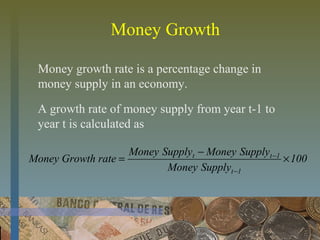
Money Growth
Money growth rate is a percentage change in
money supply in an economy.
100
SupplyMoney
SupplyMoneySupplyMoney
rateGrowthMoney
1t
1tt
×
−
=
−
−
A growth rate of money supply from year t-1 to
year t is calculated as
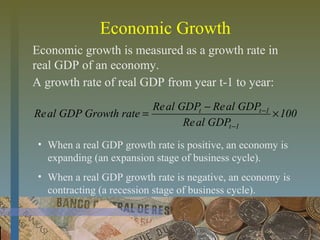
Economic Growth
Economic growth is measured as a growth rate in
real GDP of an economy.
100
GDPalRe
GDPalReGDPalRe
rateGrowthGDPalRe
1t
1tt
×
−
=
−
−
• When a real GDP growth rate is positive, an economy is
expanding (an expansion stage of business cycle).
• When a real GDP growth rate is negative, an economy is
contracting (a recession stage of business cycle).
A growth rate of real GDP from year t-1 to year:
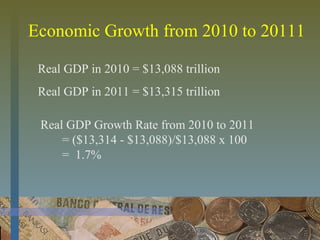
Economic Growth from 2010 to 20111
Real GDP in 2010 = $13,088 trillion
Real GDP in 2011 = $13,315 trillion
Real GDP Growth Rate from 2010 to 2011
= ($13,314 - $13,088)/$13,088 x 100
= 1.7%
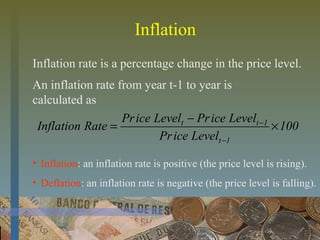
Inflation
Inflation rate is a percentage change in the price level.
100
LevelicePr
LevelicePrLevelicePr
RateInflation
1t
1tt
×
−
=
−
−
• Inflation: an inflation rate is positive (the price level is rising).
• Deflation: an inflation rate is negative (the price level is falling).
An inflation rate from year t-1 to year is
calculated as
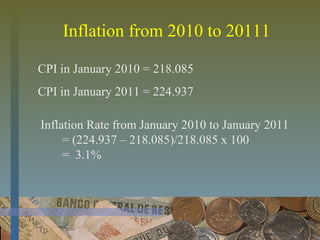
Inflation from 2010 to 20111
CPI in January 2010 = 218.085
CPI in January 2011 = 224.937
Inflation Rate from January 2010 to January 2011
= (224.937 – 218.085)/218.085 x 100
= 3.1%
Disclaimer
Please do not copy, modify, or distribute this presentation
without author’s consent.
This presentation was created and owned by
Dr. Ryoichi Sakano
North Carolina A&T State University

Econ315 Money and Banking: Learning Unit #01: Overview of Money & Banking

  • 1.
    Learning Unit #1 Overviewof Money and Banking
  • 2.
    Objectives of LearningUnit • Importance of Financial System • Three Financial Markets • Financial Institutions • Money in Economy • Economic Data of the U.S. Economy • Review of Macroeconomics
  • 3.
    Financial System • Somepeople do not have a productive use of funds, while others have a productive use of funds. • Financial system channels funds from savers (people who have an excess funds) to investors (people who have a shortage of funds). • Financial system promotes economic efficiency by allocating limited resources efficiently in economy.
  • 4.
    Financial System andEconomy Well-functioning financial system promotes • Economic growth • Stable prices • High employment • Accumulation of wealth
  • 5.
    Financial Instruments • Infinancial system, when lenders provide funds to borrowers, borrowers provide financial instruments to lenders. • Financial Instrument (a.k.a. Security, IOU): A claim on the issuer’s (borrower’s) future income or assets. • Value of financial instruments is determined by borrowers and lenders in financial markets.
  • 6.
    Three Financial Markets •Bond Market • Stock Market • Foreign Exchange Market
  • 7.
    Bond Market • Bond:A debt instrument that promises to make payments periodically for a specified period of time. – Ex. U.S. Treasury Bonds • Governments issue bonds to finance budget deficits, while large corporations issue bonds to finance large investment projects. • Bond market determines interest rates.
  • 8.
    Interest Rates • Interestrate: Cost of borrowing funds. • Interest rates affect economic activities by affecting individual’s willingness to spend. – High interest rates encourage savers to save more (lend more) and spend less. – High interest rates discourage borrowers to borrow more and spend more. – High interest rates means high costs for corporations to undertake investment projects.
  • 9.
    Interest Rates inAction • There are many different interest rates. – Different financial instruments have different interest rates. – Each interest rate is determined in each bond market. • Interest rates change over time. – Interest rates tend to move together.
  • 10.
    Figure 1: Interest Rateson Selected Bonds, 1950-2011
  • 11.
    Stock Market • Stock:a share of ownership in a corporation. – It is a claim on the earnings and assets of the corporation. • Stock prices affect the economy by – Affecting the amount of funds that corporations can raise by selling newly issued stock to finance their business investment projects. – Affecting the size of people’s wealth and their willingness to spend. • Stock prices are extremely volatile.
  • 12.
    Figure 2: Stock Priceas Measured by the Dow Jones Industrial Average, 1950-2011
  • 13.
    Foreign Exchange Market •Foreign exchange market: one country’s currency is exchanged with other country’s currency. – It allows funds to move across borders from country which have an excess funds to another which have a shortage of funds. • Foreign exchange rate: the price of one country’s currency in terms of another’s.
  • 14.
    Foreign Exchange Rate •Foreign exchange rate affects the price of foreign goods in the U.S. and the price of U.S. goods in foreign countries. – An increase in value of the U.S. dollar makes prices of foreign-made goods cheaper for U.S. consumers and affects American firms competing with foreign goods. – An increase in value of the U.S. dollar makes prices of American-made goods more expensive to foreign consumers and affects exports of American firms. • Foreign exchange rates change over time.
  • 15.
    Figure 8: Exchange Rateof the U.S. Dollar, 1970-2011
  • 16.
    Financial Institutions • Financialinstitutions help and complement financial markets to channel funds from savers to investors. – Ex. Investment banks, security dealers • Financial intermediaries borrow funds from people who have saved and in turn make loans to others. – Ex. Banks accept deposits and make loans. – Ex. Insurance companies, pension funds, mutual funds
  • 17.
    Financial Crisis • Financialcrises are major disruptions in financial markets that are characterized by sharp declines in asset prices and the failures of many financial and nonfinancial firms. • Starting in August 2007, the U.S. economy was hit by the worst financial crisis since the Great Depression in 1930s. – Ex. Failure of Lehman Brothers, AIG, and Wachovia Bank • Recessions and depressions were often preceded by financial crises.
  • 18.
    Financial Innovation • Financialinnovation: Financial institutions introduce new financial services. • Financial innovation makes the financial system more efficient. ̶ Ex. Online banking/trading, e-finance • Financial innovation can lead to devastating financial crises. ̶ Ex. Collapse of CDSs (Credit Default Swaps) lead to failures of AIG.
  • 19.
    Monetary Policy • Money:anything that is generally accepted in payment for goods or services or in the repayment of debts. • Money supply: the quantity of money in an economy. • Monetary policy: the management of money and interest rates by the central bank • Federal Reserve System (a.k.a. the Fed) is the central bank of the U.S.
  • 20.
    Money and Economy Moneycan affect many economic variables by affecting individual consumers and businesses. • Production of goods and services in an economy: Business cycle • Prices of goods and services in an economy: Inflation • Interest rates, stock prices, and foreign exchange rates
  • 21.
    Money and BusinessCycle • Aggregate output: total production of goods and services in an economy. • Business cycle: the upward (expansion) and downward (recession) movement of aggregate output through time. • Unemployment rate: a percentage of unemployed workers in the total labor force. – Unemployment rate increases during a recession and declines during an expansion.
  • 22.
    Figure 3: Money Growthand Business Cycle, 1950-2011
  • 23.
    Money and Inflation •Aggregate price level: the average price of goods and services in an economy. • Inflation: a continual increase in the price level. • A positive association of a continuing increase in the money supply (money growth) and a continuing increase in the price level (inflation).
  • 24.
    Figure 4: Aggregate PriceLevel and the Money Supply, 1950-2011
  • 25.
    Figure 5: Average InflationRate vs. Average Rate of Money Growth, 2000-2010
  • 26.
    Money and InterestRates • Prior to 1980, the rate of money growth and the interest rate on long-term Treasure bonds were closely tied • Since then, the relationship is less clear but still an important determinant of interest rates
  • 27.
    Figure 6: Money Growthand Interest Rates, 1950-2011
  • 28.
    Fiscal Policy Fiscal policyis government spending and taxation • Budget deficit is the excess of expenditures over revenues for a particular year • Budget surplus is the excess of revenues over expenditures for a particular year • Any deficit must be financed by borrowing − Ex. U.S. Treasury bonds
  • 29.
    Figure 7: Government BudgetSurplus or Deficit as a Percentage of GDP, 1950-2010
  • 30.
    How We StudyMoney and Banking Basic Analytic Framework 1. Simplified approach to the demand for assets 2. Concept of equilibrium 3. Basic supply and demand approach to understand behavior in financial markets 4. Transactions cost and asymmetric information approach to financial structure
  • 31.
    How Money &Banking relates to Other Courses • Microeconomics – demand and supply model • Macroeconomics – monetary policy • Finance – present value & asset pricing model • Accounting – Balance sheet & T-account
  • 32.
    Appendix: Measuring the Economy Twoimportant measurements of an economy • Aggregate output: total amount of goods and services produced in the economy. • Price level: a measure of average prices of goods and services
  • 33.
    Aggregate Output • GrossDomestic Product (GDP): the market value of all final goods and services produced in a country during a year (or a quarter). • Aggregate income: total income in an economy during a particular year • Aggregate output = Aggregate income – When produced is what spent and what earned in a whole economy.
  • 34.
    Nominal and RealValues Because prices change over time, economic variables are measured in either nominal or real. • Nominal: values measured using current prices • Real: quantities measured with constant prices
  • 35.
    Nominal and RealGDP • Nominal GDP: the value of the final goods and services produced in a given year valued at the prices that prevailed in that same year (current price). • Real GDP: the value of the final goods and services produced in a given year when valued at constant prices (constant price).
  • 36.
    Nominal vs. RealGDP • The (nominal) GDP changes from one year to next when – the quantities of goods and services produced change or the prices of goods and services produced change. • Real GDP is intended to measure only changes in quantities of goods and services produced from one year to next by correcting the (nominal) GDP for the price changes.
  • 37.
    Price Level Two commonlyused measurements of the price level of an economy: • GDP deflator: A change in prices of all goods and services (included in GDP) in an economy. • Consumer Price Index (CPI): An average of prices paid by urban consumers for a fixed market basket of consumption goods and services (typically purchased by urban consumers).
  • 38.
    GDP Deflator 100 GDPalRe GDPalminNo DeflatorGDP ×= GDPdeflator is measured as a ratio of nominal GDP to Real GDP as in an index number:
  • 39.
    GDP Deflator in2011 Nominal GDP in 2011 = $15,094 trillion Real GDP in 2011 = $13,315 trillion GDP Deflator in 2011 = $15,094/$13,314 x 100 = 113.4
  • 40.
    Growth Rate Growth rateis a percentage change in a variable. 100 X XX rateGrowth 1t 1tt × − = − − A growth rate of variable X from year t-1 to year t is calculated as
  • 41.
    Money Growth Money growthrate is a percentage change in money supply in an economy. 100 SupplyMoney SupplyMoneySupplyMoney rateGrowthMoney 1t 1tt × − = − − A growth rate of money supply from year t-1 to year t is calculated as
  • 42.
    Economic Growth Economic growthis measured as a growth rate in real GDP of an economy. 100 GDPalRe GDPalReGDPalRe rateGrowthGDPalRe 1t 1tt × − = − − • When a real GDP growth rate is positive, an economy is expanding (an expansion stage of business cycle). • When a real GDP growth rate is negative, an economy is contracting (a recession stage of business cycle). A growth rate of real GDP from year t-1 to year:
  • 43.
    Economic Growth from2010 to 20111 Real GDP in 2010 = $13,088 trillion Real GDP in 2011 = $13,315 trillion Real GDP Growth Rate from 2010 to 2011 = ($13,314 - $13,088)/$13,088 x 100 = 1.7%
  • 44.
    Inflation Inflation rate isa percentage change in the price level. 100 LevelicePr LevelicePrLevelicePr RateInflation 1t 1tt × − = − − • Inflation: an inflation rate is positive (the price level is rising). • Deflation: an inflation rate is negative (the price level is falling). An inflation rate from year t-1 to year is calculated as
  • 45.
    Inflation from 2010to 20111 CPI in January 2010 = 218.085 CPI in January 2011 = 224.937 Inflation Rate from January 2010 to January 2011 = (224.937 – 218.085)/218.085 x 100 = 3.1%
  • 46.
    Disclaimer Please do notcopy, modify, or distribute this presentation without author’s consent. This presentation was created and owned by Dr. Ryoichi Sakano North Carolina A&T State University