Learning Unit #3
Financial System
and
Asymmetric Information
Objectives of Learning Unit
• Function of Financial System
• Transaction Costs
• Asymmetric information
• Three Financial Services
Financial System
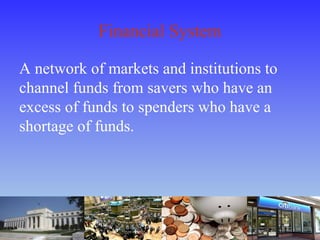
A network of markets and institutions to
channel funds from savers who have an
excess of funds to spenders who have a
shortage of funds.
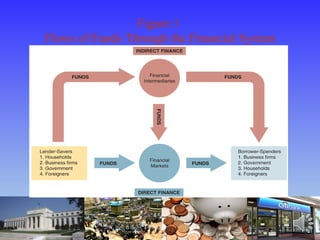
Figure 1
Flows of Funds Through the Financial System
Users of Financial System
• Lender-savers have an excess of funds, but no
productive use of funds.
• Borrower-spenders have a shortage of funds, but
productive use of funds.
• Many of households, business firms, government, and
foreigners are lender-saver as well as borrower-
spenders:
– Ex. A student owes a $10,000 student loan and own
$2,0000 in his bank account.
Two Channels in Financial System
Funds are transferred from lenders to borrowers
through
• Financial Markets (Direct finance)
• Financial Intermediaries (Indirect finance)
Flows of Funds and Financial Instruments
In the financial system
• At first, funds flow from saver-lenders to borrower-
spenders (funds are loaned out). At the same time,
financial instruments (IOUs) flow from borrower-
spenders to saver-lenders (IOUs are issued by
borrowers and acquired by savers).
• At the time of repayment, they flow backward (funds
must be paid back by borrowers to savers, and IOUs
must be returned from savers to borrowers).
Function of Financial System
Channel funds from savers who have an excess
of funds to spenders who have a shortage of
funds.
Financial system promotes economic efficiency.
– Savers have no productive investment opportunities, while
spenders have productive investment opportunities.
– Consumers can make purchases when they need them most.
Benefits of Financial System
Financial system reduces
• Transaction costs: the time and money spent trying to
exchange financial assets, goods, and services.
• Asymmetric information: One party in transaction
does not know enough about the other party to make
accurate decisions.
Transaction Costs
• If there is no financial system, where can you save
your funds? How can you find a person or an
organization to which you can lend your saving? It is
very time-consuming to find a right person or a right
organization for your need (how much to lend, when
to get back, and flexible enough to get back any time).
• If you have $100 cash that you do not need to spend
until the end of the month, how can you find a person
or an organization which needs exactly $100 and
promises to pay it back in time?
Financial System and Transaction Costs
• Financial system reduces transaction costs by
– Economies of scale: a reduction in costs per
transaction as the number of transactions increases.
– Expertise: knowledge, skill, and technology.
Agents and institutions in the financial system deal
with many users every day and develop their expertise
through experience and training, so they can complete
transactions efficiently and quickly (high productivity).
Three Financial Services
Financial system provides three financial
services:
• Liquidity (through lower transaction costs)
• Risk sharing (through lower transaction costs and
reducing problems created by asymmetric
information)
• Information (to reduce problems created by
asymmetric information)
Liquidity
• Liquidity: the relative ease and speed with
which an asset can be converted into cash.
• By reducing transaction costs and achieving
the economies of scale (through large number
of transactions), the financial system can make
it easier and quicker for users to access funds
(easy to get cash back and quickly to borrow).
Liquidity Example
• When you deposit your cash at your bank, the
bank matches your need with a borrower, so
that you can get your cash back on time.
• With large number of transaction daily, your
bank can meet changes in your need and pay
back cash to you any time (by rearranging
transactions – switching from one borrower to
another who pays back today).
Risk
• Risk is defined as the degree of uncertainty
associated with the return on an asset.
• Risk sharing: the process of reducing the
exposure of savers to risk.
• By reducing transaction costs and achieving
the economies of scale (through large number
of transactions), the financial system can
spread risk or share risk at low cost.
Risk Sharing
• Asset transformation: risky assets (issued by
borrower-spenders) are turned into less risky
assets (provided to saver-lenders).
• Diversification: Investing in a collection
(portfolio) of assets whose returns do not
always move together.
– Don’t put all your eggs in one basket!
Risk Sharing Example
• If you have $10,000 cash, you may purchase a variety
of stocks – Microsoft, GE, P&G, FedEx, Toyota,
Exxon, Bank of America, etc.
• When a price of one stock (Bank of America)
suddenly falls, a price of another stock (Exxon) may
rise and offset a loss, so that your portfolio maintains
more predictable overall return.
• Of course, if the stock market crashes, you may lose a
lot, so you may diversify your portfolio to gold, real
estate, bonds, CDs, saving account, etc.
Asymmetric Information
One party in transaction does not know enough
about the other party to make accurate decisions.
• Ex. Borrowers have some information about their
opportunities or activities that they do not disclose to
lenders.
Two Problems Created by Asymmetric Information
• Adverse Selection
• Moral Hazard
Adverse Selection
• Adverse selection: the people who are the
most undesirable from the other party’s point
of view are the ones who are most likely to
want to engage in the financial transaction.
• Adverse selection problem appears before a
transaction occurs.
Market of Lemons
Market of lemons: In a used car market, buyers of used
cars do not have a specific quality information on a
particular car, so they consider all used cars equally
lemons in their qualities and offer to pay accordingly.
As a result, owners of good quality cars do not want to
undersell their high quality cars at prices of low quality
cars, so eventually only low quality cars (lemons) are
traded in a used car market.
– If you own a lemon and want to get rid of it, will you
advertise it as lemon or a car in “good condition”?
Case of Adverse Selection
Adverse selection is a problem of distinguishing good
(low) risk applicants from bad (high) risk applicants
before making a loan or providing insurance.
• Ex. If you tell everyone that you can loan $100, who
is most likely to ask you?
─ Now think carefully! If you need money, whom
do you ask first? Stranger, bank, or parent?
─ So, if a stranger wants to borrow your $100, what
does it tell you about him? Is he more likely to be
a credible person and pay it back to you?
Adverse Selection Everywhere
• Loan: Who wants to borrow funds desperately?
Someone to whom no one wants to lend!
• Credit card: Who applies for a credit card all the time?
Someone who could not get it due to bad credit.
• Insurance: Who needs a health insurance most?
Someone who needs to see doctors often! Who needs a
flood insurance most? Someone living in flood zones!
Who needs a life insurance most? Someone who may
die soon.
• “For sale by owner”: Market of lemons!
How to Solve Adverse Selection
Financial institutions devise many tools and
mechanism to reduce the adverse selection.
 Screening: banks and insurance firms collect personal
information to make decisions.
─ Screening will directly reduce the asymmetric
information.
 Risk-based premium: High risk user pays higher
premium or interest rate.
─ Risk-based premium will discourage high risk users to
apply and compensate financial institutions in case.
Moral Hazard
• Moral hazard: the risk that one party to a
transaction will engage in activities that are
undesirable from the other party’s point of
view.
• Moral hazard problem appears after a
transaction occurs.
Principal-Agent Problem
Principal-agent problem: the managers in control (the
agent) act in their own interest rather than in the interest
of the owners (the principal) due to different sets of the
incentives.
• CEO of a corporation only cares about getting all kind
of benefits (luxury office, chauffeured limousine,
personal jet and cruiser, etc.) which may not bring
any benefits or profits to shareholders of the
corporation.
• Ex. Enron, MCI, Tyco International in early 2000s
Case of Moral Hazard
Moral hazard is a problem of monitoring and enforcing
borrowers’ activities after making a loan or providing
insurance.
• Ex. If you lend $100 to a stranger who says that he needs
$100 to buy a textbook, what is most likely to happen?
─ Now think carefully! Are you sure he is going to use
your $100 to purchase a textbook? How do you know
that he needs a textbook (or even a student at A&T)?
─ Many qualified students receive stipends from the
government or university to purchase textbooks. So, if a
stranger wants to borrow your $100in order to buy a
textbook, what does it tell you about him? Is he more
likely to be a credible person and use it for what he says?
Moral Hazard Everywhere
• Loan: How do you know how borrowers spend
borrowed funds? If someone with bad reputation
(drug addict) gets money, how is he going to spend it?
• Insurance: Once someone gets a health insurance, is he
going to keep up his health as much as before?
• Government aids: Once someone gets free medical
services at emergency room, who wants to purchase a
health insurance? If the government bails out a
gambling loss (loss from speculation), will it
discourage or encourage gamblers to engage in
activities?
How to Solve Moral Hazard
Financial institutions devise many tools and mechanism to
reduce the moral hazard.
 Monitoring & Restrictive Covenants/Provision: banks and
insurance firms monitor any risky activities and restrict
borrowers/policy-holders from engaging in risky activities.
─ Monitoring will directly reduce the asymmetric information.
 Collateral: in case of defaulting obligations, borrowers will lose
some assets.
─ Collateral imposes borrowers a cost to engage in risky
activities.
 Deductibles & coinsurance: policy-holders share some of costs.
─ Deductible and coinsurance will discourage policy-holders to
engage in risky activities and abusive use of services.
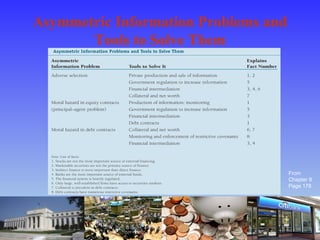
Asymmetric Information Problems and
Tools to Solve Them
From
Chapter 8
Page 178
Costs of Using Financial Services
• Users of the financial system (lender-savers and
borrower-spenders) receive the three financial
services from agents and institutions in the financial
system and pay fees for those services.
• A user fee paid by lender-savers is a lower interest
earned on their funds from the financial system
• A user fee paid by borrower-spenders is a higher
interest paid on borrowed funds to the financial
system.
User Fees Example
Ex. you have $100 cash that you do not need now.
• You may lend $100 directly to your friend, and he will pay
you 5% interest rate, so you can earn 5% interest rate on your
saving (lending).
• Alternatively, you can deposit $100 in your saving account at
Wachovia Bank and earn 3% interest rate on your saving.
Your friend may borrow $100 from Wachovia Bank and pay
8% interest rate.
• A 2% interest rate that you miss to earn and an extra 3%
interest rate that your friend pays to Wachovia Bank are user
fees paid to the financial institution (Wachovia Bank) to
receive the three financial services
Two Important Questions
1. How Financial System Transfer Funds from
Lenders to Borrowers?
2. How Financial System Provide Three
Financial Services?
These two questions must be answered in each of two
channels (Direct finance and Indirect finance) of the
financial system.
Disclaimer
Please do not copy, modify, or distribute this presentation
without author’s consent.
This presentation was created and owned by
Dr. Ryoichi Sakano
North Carolina A&T State University

Econ315 Money and Banking: Learning Unit #03: Financial System and Asymmetric Information

  • 1.
    Learning Unit #3 FinancialSystem and Asymmetric Information
  • 2.
    Objectives of LearningUnit • Function of Financial System • Transaction Costs • Asymmetric information • Three Financial Services
  • 3.
    Financial System A networkof markets and institutions to channel funds from savers who have an excess of funds to spenders who have a shortage of funds.
  • 4.
    Figure 1 Flows ofFunds Through the Financial System
  • 5.
    Users of FinancialSystem • Lender-savers have an excess of funds, but no productive use of funds. • Borrower-spenders have a shortage of funds, but productive use of funds. • Many of households, business firms, government, and foreigners are lender-saver as well as borrower- spenders: – Ex. A student owes a $10,000 student loan and own $2,0000 in his bank account.
  • 6.
    Two Channels inFinancial System Funds are transferred from lenders to borrowers through • Financial Markets (Direct finance) • Financial Intermediaries (Indirect finance)
  • 7.
    Flows of Fundsand Financial Instruments In the financial system • At first, funds flow from saver-lenders to borrower- spenders (funds are loaned out). At the same time, financial instruments (IOUs) flow from borrower- spenders to saver-lenders (IOUs are issued by borrowers and acquired by savers). • At the time of repayment, they flow backward (funds must be paid back by borrowers to savers, and IOUs must be returned from savers to borrowers).
  • 8.
    Function of FinancialSystem Channel funds from savers who have an excess of funds to spenders who have a shortage of funds. Financial system promotes economic efficiency. – Savers have no productive investment opportunities, while spenders have productive investment opportunities. – Consumers can make purchases when they need them most.
  • 9.
    Benefits of FinancialSystem Financial system reduces • Transaction costs: the time and money spent trying to exchange financial assets, goods, and services. • Asymmetric information: One party in transaction does not know enough about the other party to make accurate decisions.
  • 10.
    Transaction Costs • Ifthere is no financial system, where can you save your funds? How can you find a person or an organization to which you can lend your saving? It is very time-consuming to find a right person or a right organization for your need (how much to lend, when to get back, and flexible enough to get back any time). • If you have $100 cash that you do not need to spend until the end of the month, how can you find a person or an organization which needs exactly $100 and promises to pay it back in time?
  • 11.
    Financial System andTransaction Costs • Financial system reduces transaction costs by – Economies of scale: a reduction in costs per transaction as the number of transactions increases. – Expertise: knowledge, skill, and technology. Agents and institutions in the financial system deal with many users every day and develop their expertise through experience and training, so they can complete transactions efficiently and quickly (high productivity).
  • 12.
    Three Financial Services Financialsystem provides three financial services: • Liquidity (through lower transaction costs) • Risk sharing (through lower transaction costs and reducing problems created by asymmetric information) • Information (to reduce problems created by asymmetric information)
  • 13.
    Liquidity • Liquidity: therelative ease and speed with which an asset can be converted into cash. • By reducing transaction costs and achieving the economies of scale (through large number of transactions), the financial system can make it easier and quicker for users to access funds (easy to get cash back and quickly to borrow).
  • 14.
    Liquidity Example • Whenyou deposit your cash at your bank, the bank matches your need with a borrower, so that you can get your cash back on time. • With large number of transaction daily, your bank can meet changes in your need and pay back cash to you any time (by rearranging transactions – switching from one borrower to another who pays back today).
  • 15.
    Risk • Risk isdefined as the degree of uncertainty associated with the return on an asset. • Risk sharing: the process of reducing the exposure of savers to risk. • By reducing transaction costs and achieving the economies of scale (through large number of transactions), the financial system can spread risk or share risk at low cost.
  • 16.
    Risk Sharing • Assettransformation: risky assets (issued by borrower-spenders) are turned into less risky assets (provided to saver-lenders). • Diversification: Investing in a collection (portfolio) of assets whose returns do not always move together. – Don’t put all your eggs in one basket!
  • 17.
    Risk Sharing Example •If you have $10,000 cash, you may purchase a variety of stocks – Microsoft, GE, P&G, FedEx, Toyota, Exxon, Bank of America, etc. • When a price of one stock (Bank of America) suddenly falls, a price of another stock (Exxon) may rise and offset a loss, so that your portfolio maintains more predictable overall return. • Of course, if the stock market crashes, you may lose a lot, so you may diversify your portfolio to gold, real estate, bonds, CDs, saving account, etc.
  • 18.
    Asymmetric Information One partyin transaction does not know enough about the other party to make accurate decisions. • Ex. Borrowers have some information about their opportunities or activities that they do not disclose to lenders. Two Problems Created by Asymmetric Information • Adverse Selection • Moral Hazard
  • 19.
    Adverse Selection • Adverseselection: the people who are the most undesirable from the other party’s point of view are the ones who are most likely to want to engage in the financial transaction. • Adverse selection problem appears before a transaction occurs.
  • 20.
    Market of Lemons Marketof lemons: In a used car market, buyers of used cars do not have a specific quality information on a particular car, so they consider all used cars equally lemons in their qualities and offer to pay accordingly. As a result, owners of good quality cars do not want to undersell their high quality cars at prices of low quality cars, so eventually only low quality cars (lemons) are traded in a used car market. – If you own a lemon and want to get rid of it, will you advertise it as lemon or a car in “good condition”?
  • 21.
    Case of AdverseSelection Adverse selection is a problem of distinguishing good (low) risk applicants from bad (high) risk applicants before making a loan or providing insurance. • Ex. If you tell everyone that you can loan $100, who is most likely to ask you? ─ Now think carefully! If you need money, whom do you ask first? Stranger, bank, or parent? ─ So, if a stranger wants to borrow your $100, what does it tell you about him? Is he more likely to be a credible person and pay it back to you?
  • 22.
    Adverse Selection Everywhere •Loan: Who wants to borrow funds desperately? Someone to whom no one wants to lend! • Credit card: Who applies for a credit card all the time? Someone who could not get it due to bad credit. • Insurance: Who needs a health insurance most? Someone who needs to see doctors often! Who needs a flood insurance most? Someone living in flood zones! Who needs a life insurance most? Someone who may die soon. • “For sale by owner”: Market of lemons!
  • 23.
    How to SolveAdverse Selection Financial institutions devise many tools and mechanism to reduce the adverse selection.  Screening: banks and insurance firms collect personal information to make decisions. ─ Screening will directly reduce the asymmetric information.  Risk-based premium: High risk user pays higher premium or interest rate. ─ Risk-based premium will discourage high risk users to apply and compensate financial institutions in case.
  • 24.
    Moral Hazard • Moralhazard: the risk that one party to a transaction will engage in activities that are undesirable from the other party’s point of view. • Moral hazard problem appears after a transaction occurs.
  • 25.
    Principal-Agent Problem Principal-agent problem:the managers in control (the agent) act in their own interest rather than in the interest of the owners (the principal) due to different sets of the incentives. • CEO of a corporation only cares about getting all kind of benefits (luxury office, chauffeured limousine, personal jet and cruiser, etc.) which may not bring any benefits or profits to shareholders of the corporation. • Ex. Enron, MCI, Tyco International in early 2000s
  • 26.
    Case of MoralHazard Moral hazard is a problem of monitoring and enforcing borrowers’ activities after making a loan or providing insurance. • Ex. If you lend $100 to a stranger who says that he needs $100 to buy a textbook, what is most likely to happen? ─ Now think carefully! Are you sure he is going to use your $100 to purchase a textbook? How do you know that he needs a textbook (or even a student at A&T)? ─ Many qualified students receive stipends from the government or university to purchase textbooks. So, if a stranger wants to borrow your $100in order to buy a textbook, what does it tell you about him? Is he more likely to be a credible person and use it for what he says?
  • 27.
    Moral Hazard Everywhere •Loan: How do you know how borrowers spend borrowed funds? If someone with bad reputation (drug addict) gets money, how is he going to spend it? • Insurance: Once someone gets a health insurance, is he going to keep up his health as much as before? • Government aids: Once someone gets free medical services at emergency room, who wants to purchase a health insurance? If the government bails out a gambling loss (loss from speculation), will it discourage or encourage gamblers to engage in activities?
  • 28.
    How to SolveMoral Hazard Financial institutions devise many tools and mechanism to reduce the moral hazard.  Monitoring & Restrictive Covenants/Provision: banks and insurance firms monitor any risky activities and restrict borrowers/policy-holders from engaging in risky activities. ─ Monitoring will directly reduce the asymmetric information.  Collateral: in case of defaulting obligations, borrowers will lose some assets. ─ Collateral imposes borrowers a cost to engage in risky activities.  Deductibles & coinsurance: policy-holders share some of costs. ─ Deductible and coinsurance will discourage policy-holders to engage in risky activities and abusive use of services.
  • 29.
    Asymmetric Information Problemsand Tools to Solve Them From Chapter 8 Page 178
  • 30.
    Costs of UsingFinancial Services • Users of the financial system (lender-savers and borrower-spenders) receive the three financial services from agents and institutions in the financial system and pay fees for those services. • A user fee paid by lender-savers is a lower interest earned on their funds from the financial system • A user fee paid by borrower-spenders is a higher interest paid on borrowed funds to the financial system.
  • 31.
    User Fees Example Ex.you have $100 cash that you do not need now. • You may lend $100 directly to your friend, and he will pay you 5% interest rate, so you can earn 5% interest rate on your saving (lending). • Alternatively, you can deposit $100 in your saving account at Wachovia Bank and earn 3% interest rate on your saving. Your friend may borrow $100 from Wachovia Bank and pay 8% interest rate. • A 2% interest rate that you miss to earn and an extra 3% interest rate that your friend pays to Wachovia Bank are user fees paid to the financial institution (Wachovia Bank) to receive the three financial services
  • 32.
    Two Important Questions 1.How Financial System Transfer Funds from Lenders to Borrowers? 2. How Financial System Provide Three Financial Services? These two questions must be answered in each of two channels (Direct finance and Indirect finance) of the financial system.
  • 33.
    Disclaimer Please do notcopy, modify, or distribute this presentation without author’s consent. This presentation was created and owned by Dr. Ryoichi Sakano North Carolina A&T State University