Learning Through
Community Effort
Collaboration for Increased Project
Success


                           June 25, 2012
Best Practices

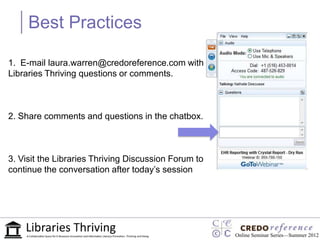
1. E-mail laura.warren@credoreference.com with
Libraries Thriving questions or comments.


2. Share comments and questions in the chatbox.


3. Visit the Libraries Thriving Discussion Forum to
continue the conversation after today‟s session


                                                      Online Seminar Series—Summer 2012
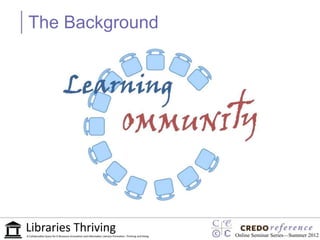
The Background


                 Online Seminar Series—Summer 2012
Top Five Reasons for
 Participating in a Learning
 Community

1. The Ideas
2. The People
3. The Connections
4. The Accountability
5. The Success

                               Online Seminar Series—Summer 2012
1. The Ideas


 Librarian-Faculty Collaboration, Library Design,
Educational Technology—what other topics would
                you like to cover?


                                      Online Seminar Series—Summer 2012
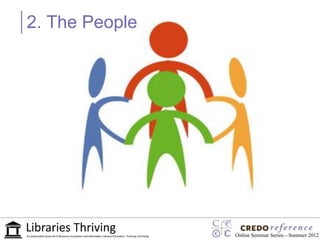
2. The People


                Online Seminar Series—Summer 2012
3. The Connections


                     Online Seminar Series—Summer 2012
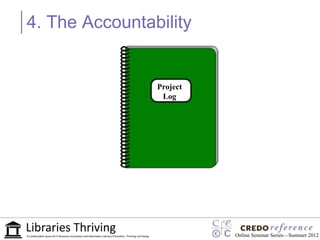
4. The Accountability


                Project
                 Log


                          Online Seminar Series—Summer 2012
5. The Success


                 Online Seminar Series—Summer 2012
LESSONS LEARNED
         Caitlin Bakker
   Wilfrid Laurier University
       cbakker@wlu.ca
Reasons for Collaboration

     • Interdependence
       • Resources
        • Expertise
         • Power
         • Politics
       • Risk-Taking
Types of Collaboration

• little c collaboration (between individuals)

• Big C Collaboration (between organizations)

• Middle ground between the two? (between
 departments and groups)
“If the academic library is at the center of
a liberal education, then librarians must
aggressively pursue options to partner
with teaching faculty and others….”

                  (Harvey & Dewald, 1997)
• Collaboration to reflect changes in higher
 education
  • The shift to considering the social construction
   of knowledge (see Nussbaum, 2008)

• Not only acting as collaborators, but facilitating
 that movement for students, faculty, etc.
Design of Physical Space
• The physical design of libraries to support the
  social dimensions of learning
• The library as building the university community
  and acting as a third place
 • Places which “exist outside the home and beyond
   the „work lots‟ of modern economic production.
   They are places where people gather primarily to
   enjoy each other‟s company (Oldenburg & Brisett,
   1982, 269)
Creation of Digital Space

• The Three Rs have been replaced by the Three
 Cs: Contributing, Collaborating, and Creating
• A means of overcoming limitations (time,
 distance, budget, etc.)
• A way of serving the enormous projected
 growth of students (263 million by 2025)
Take Away

   Librarianship is an
inherently collaborative
  profession. We need
     to embrace and
 expand on this in all of
  its manifestations in
 order to best meet the
needs of our users and
        institutions.
References

• Bennett, S. (2006). The choice for learning. Journal of Academic Librarianship, 32(1): 3-13.
• Gjelten, D. (2012). Academic library design. Presentation for Libraries Thriving. April 11, 2012.
• Hargadon, S. (2009). Educational networking: The important role web 2.0 will play in education.
    Retrieved from http://www.scribd.com/stevehargadon/d/24161189-Educational-Networking-The-
    Important-Role-Web-2-0-Will-Play-in-Education
•   Hargadon, S. (2012). Educational technology. Presentation for Libraries Thriving. May 9, 2012.
•   Harvey, K. & Dewald, N. (1997). Collaborating with faculty in preparing students for the
    asynchronous classroom. Retrieved from
    http://www.ala.org/acrl/publications/whitepapers/nashville/harveydewald
•   Oldenburg, R. & Brissett, D. (1982). The third place. Qualitative Sociology, 5(4): 265-284.
•   Nevins, K. (2012). Collaboration. Presentation for Libraries Thriving. April 24, 2012.
•   Nussbaum, E.M. (2008). Collaborative discourse, argumentation, and learning: Preface and
    literature review. Contemporary Educational Psychology, 33(3): 345-359.

Learning Through Community Effort: Collaboration for Increased Project Success

  • 1.
    Learning Through Community Effort Collaborationfor Increased Project Success June 25, 2012
  • 2.
    Best Practices 1. E-maillaura.warren@credoreference.com with Libraries Thriving questions or comments. 2. Share comments and questions in the chatbox. 3. Visit the Libraries Thriving Discussion Forum to continue the conversation after today‟s session Online Seminar Series—Summer 2012
  • 3.
    The Background Online Seminar Series—Summer 2012
  • 4.
    Top Five Reasonsfor Participating in a Learning Community 1. The Ideas 2. The People 3. The Connections 4. The Accountability 5. The Success Online Seminar Series—Summer 2012
  • 5.
    1. The Ideas Librarian-Faculty Collaboration, Library Design, Educational Technology—what other topics would you like to cover? Online Seminar Series—Summer 2012
  • 6.
    2. The People Online Seminar Series—Summer 2012
  • 7.
    3. The Connections Online Seminar Series—Summer 2012
  • 8.
    4. The Accountability Project Log Online Seminar Series—Summer 2012
  • 9.
    5. The Success Online Seminar Series—Summer 2012
  • 10.
    LESSONS LEARNED Caitlin Bakker Wilfrid Laurier University cbakker@wlu.ca
  • 11.
    Reasons for Collaboration • Interdependence • Resources • Expertise • Power • Politics • Risk-Taking
  • 12.
    Types of Collaboration •little c collaboration (between individuals) • Big C Collaboration (between organizations) • Middle ground between the two? (between departments and groups)
  • 13.
    “If the academiclibrary is at the center of a liberal education, then librarians must aggressively pursue options to partner with teaching faculty and others….” (Harvey & Dewald, 1997)
  • 14.
    • Collaboration toreflect changes in higher education • The shift to considering the social construction of knowledge (see Nussbaum, 2008) • Not only acting as collaborators, but facilitating that movement for students, faculty, etc.
  • 15.
    Design of PhysicalSpace • The physical design of libraries to support the social dimensions of learning • The library as building the university community and acting as a third place • Places which “exist outside the home and beyond the „work lots‟ of modern economic production. They are places where people gather primarily to enjoy each other‟s company (Oldenburg & Brisett, 1982, 269)
  • 16.
    Creation of DigitalSpace • The Three Rs have been replaced by the Three Cs: Contributing, Collaborating, and Creating • A means of overcoming limitations (time, distance, budget, etc.) • A way of serving the enormous projected growth of students (263 million by 2025)
  • 17.
    Take Away Librarianship is an inherently collaborative profession. We need to embrace and expand on this in all of its manifestations in order to best meet the needs of our users and institutions.
  • 18.
    References • Bennett, S.(2006). The choice for learning. Journal of Academic Librarianship, 32(1): 3-13. • Gjelten, D. (2012). Academic library design. Presentation for Libraries Thriving. April 11, 2012. • Hargadon, S. (2009). Educational networking: The important role web 2.0 will play in education. Retrieved from http://www.scribd.com/stevehargadon/d/24161189-Educational-Networking-The- Important-Role-Web-2-0-Will-Play-in-Education • Hargadon, S. (2012). Educational technology. Presentation for Libraries Thriving. May 9, 2012. • Harvey, K. & Dewald, N. (1997). Collaborating with faculty in preparing students for the asynchronous classroom. Retrieved from http://www.ala.org/acrl/publications/whitepapers/nashville/harveydewald • Oldenburg, R. & Brissett, D. (1982). The third place. Qualitative Sociology, 5(4): 265-284. • Nevins, K. (2012). Collaboration. Presentation for Libraries Thriving. April 24, 2012. • Nussbaum, E.M. (2008). Collaborative discourse, argumentation, and learning: Preface and literature review. Contemporary Educational Psychology, 33(3): 345-359.