Collaboration and Schedules in
the School Library
                   By: Patricia Reardon
Collaboration is the action of
     working with someone to
produce or create something.
Benefits of Collaboration
for the Students:
 Learning is maximized by the sharing of ideas and
  experience.
 Assignments are more meaningful and better
  planned.
 With the information literacy instruction embedded
  in subject-based curriculum the information
  becomes more relevant to the students lives and is
  better understood.
 Students develop critical thinking skills needed to
  evaluate resources
 Lessons that integrate informational technology not
  only have more opportunity to be creative and
  innovative but it also breaks the repetitiveness of
  the everyday class activities.
Benefits of Collaboration
for the Teachers:
   Two minds are better than one! Each participant
    contributes their own unique expertise and ideas to the
    development of the lesson, creating a better learning
    experiences for the students.
   Having the librarian's assistance and expertise for the
    lesson saves the teacher time and effort.
   The more communication and collaboration with the
    librarian about the curriculum subjects, the better the
    library collection will be in those subject areas.
   Teachers get expert advice and assistance in
    designing assignments that involve library resources
    and information literacy concepts.
   Faculty member gets personalized reference and
    research assistance from the librarian.
Benefits of Collaboration
for the Librarian:
   Collaboration helps demonstrate the librarian's
    instructional value to the school.
   The Library help enhance the school’s curriculum and the
    student’s academic performance.
   Librarians are better able to help students with
    assignments.
   The end results of the collaborative projects demonstrate
    the wide variety of opportunities information literacy
    offers.
   Collaborating with teachers gives the librarian more
    credibility and visibility in the academic community.
   It keeps the library active and involved in the school.
   It improves the statistics of the use of the library, which
    will help to reinforcing budget proposal justifications.
Librarian’s Understanding
of Collaboration:
   As librarians, we are all aware of the value of
    collaboration between teachers and the school
    librarian because we learned about it in our
    Library Science Program.

   And our understanding of it is essential in order
    to comply with professional school librarian
    guidelines.

   The importance of collaboration is reinforced in
    our PDE 430 forms, Pennsylvania Guidelines for
    School Library Programs, and the mission of
    school libraries.
Librarian’s Understanding of Collaboration:


   PDE 430 Form states:
     Category III - Instructional Delivery –
      Candidates performance appropriately
      demonstrate integration of disciplines within
      the educational curriculum.

   Meaning it must demonstrate evidence of
    thorough integration and facilitation of
    collaboration for instruction of information
    literacy skills and use of technology within the
    educational curriculum.
Librarian’s Understanding of Collaboration:


Pennsylvania Guidelines for School Library
Programs tells librarians to:
   Collaborate with classroom          Actively participate in the
    teachers, reading specialists        development, writing, and
    and literacy coaches to              assessment of the school or
    enhance students’ reading            district’s information literacy
    experiences, promoting reading       curriculum using the AASL’s
    for information and pleasure.        Standards for the 21st-Century
                                         Learner and its benchmarks as
                                         a framework.
   Collaborate with teachers to
    design, instruct, and assess
    student lessons or units            And then correlate the written
    promoting authentic and              information literacy curriculum
    project-based learning and           with the Common Core State
    collaborate with teachers in         Standards as collaborative
    assessing and evaluating             units of instruction are
    integrated, instructional            developed with teachers.
    activities.
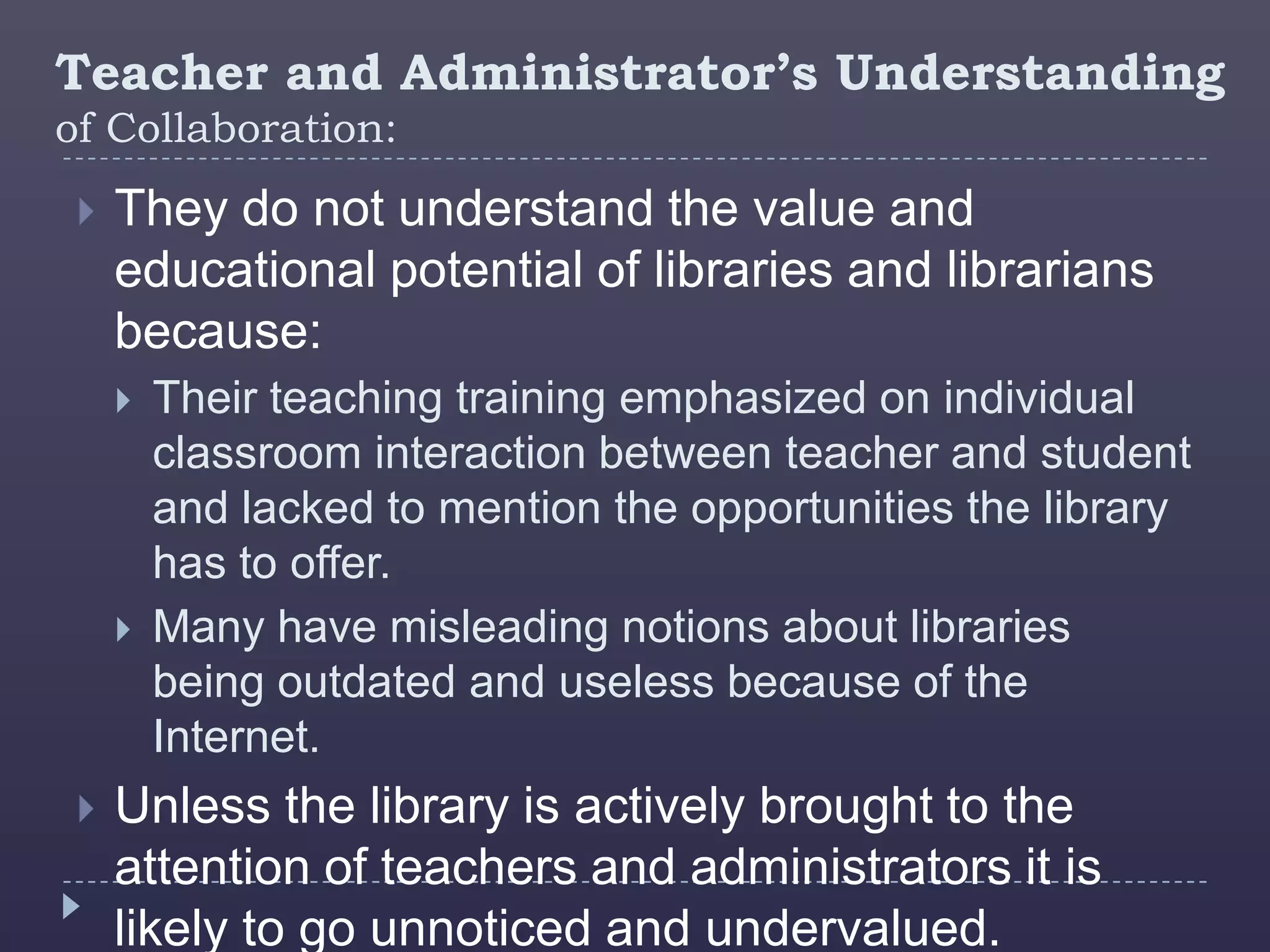
Teacher and Administrator’s Understanding
of Collaboration:
    They do not understand the value and
     educational potential of libraries and librarians
     because:
        Their teaching training emphasized on individual
         classroom interaction between teacher and student
         and lacked to mention the opportunities the library
         has to offer.
        Many have misleading notions about libraries
         being outdated and useless because of the
         Internet.
    Unless the library is actively brought to the
     attention of teachers and administrators it is
     likely to go unnoticed and undervalued.
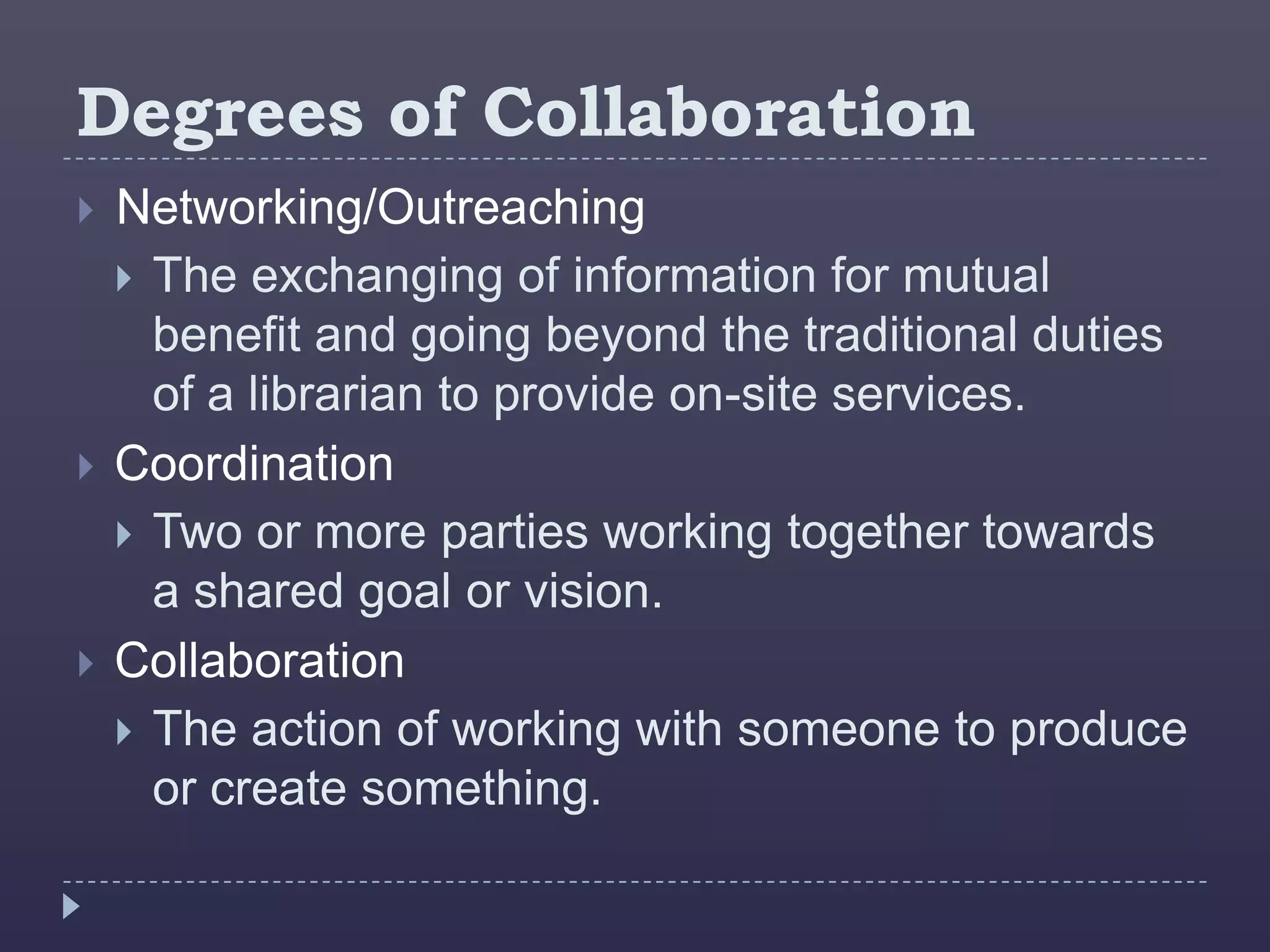
Degrees of Collaboration
   Networking/Outreaching
     The exchanging of information for mutual
      benefit and going beyond the traditional duties
      of a librarian to provide on-site services.
   Coordination
     Two or more parties working together towards
      a shared goal or vision.
   Collaboration
     The action of working with someone to produce
      or create something.
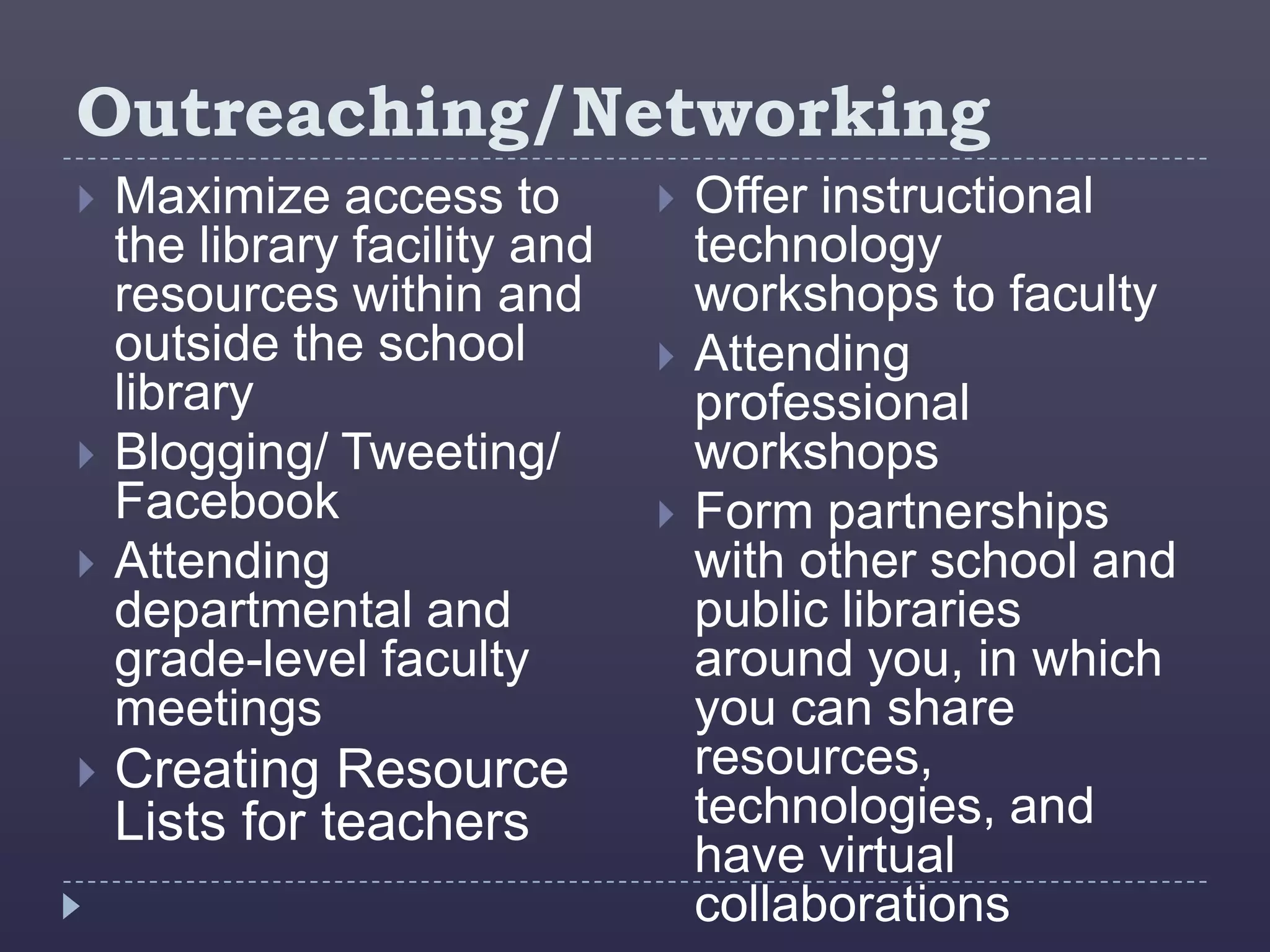
Outreaching/Networking
   Maximize access to            Offer instructional
    the library facility and       technology
    resources within and           workshops to faculty
    outside the school            Attending
    library                        professional
   Blogging/ Tweeting/            workshops
    Facebook                      Form partnerships
   Attending                      with other school and
    departmental and               public libraries
    grade-level faculty            around you, in which
    meetings                       you can share
   Creating Resource              resources,
    Lists for teachers             technologies, and
                                   have virtual
                                   collaborations
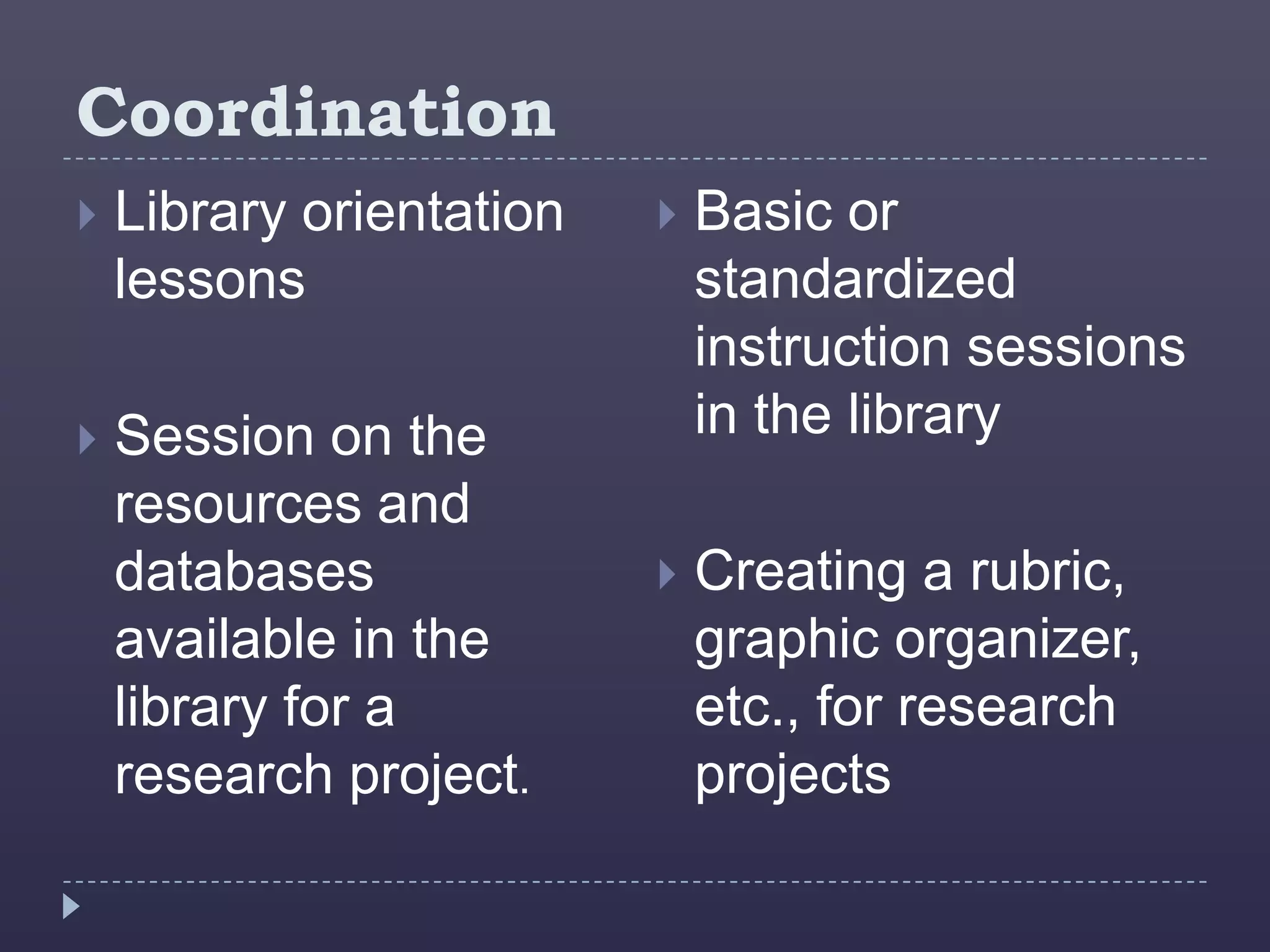
Coordination
   Library orientation      Basic or
    lessons                   standardized
                              instruction sessions
   Session on the            in the library
    resources and
    databases                Creating a rubric,
    available in the          graphic organizer,
    library for a             etc., for research
    research project.         projects
Collaboration
   Sharing short term         Collaboratively
    as well as long term        design, instruct, and
    mutual goals and            assess the learning
    benefits.                   activity.

   The librarian and the      Each participant has
    teacher(s) work as a        a unique expertise to
    team and                    contribute towards
    simultaneously teach        the lesson.
    the lesson.
Ways to Initiate Collaboration

   Always remain a good        Try to make your
    rapport with the             library schedule as
    teachers
                                 flexible and open as
                                 possible.
   Utilize every Internet
    source and
    subscription data-          Be helpful and
    base you can access
    to retrieve the latest       volunteer your
    research, theory,            expertise assistance
    model program, and           as much as possible,
    case study information       even if it does not fall
    available.
                                 under you job
                                 description.
Ways to Initiate Collaboration
   Attend department or         Offer teachers ideas
    grade-level meetings.         of instructional
                                  possibilities that
   Familiarize yourself          include collaborative
    with the curriculum for       effort between the
    each grade level.             librarian and the
                                  teacher.
                                 Volunteer to take part
   Offer the library media       of an activity or project
    center as the site for        off the teacher’s
    an "idea bank."               hands and integrate
                                  information literacy
                                  into the
                                  activity/project.
Ways to Initiate Collaboration
   Don’t expect to               Share the successes
    collaborate with all the       you’ve had with other
    faculty right away             faculty members
   First start with              As the word gets
    collaborating with the         spread around, more
    highly interested              and more faculty
    faculty                        members will want to
   Display the finished           start collaborating with
    products of the                you
    activities                    Soon enough you will
   Share the successes            have to be setting
    you’ve had with other          priorities
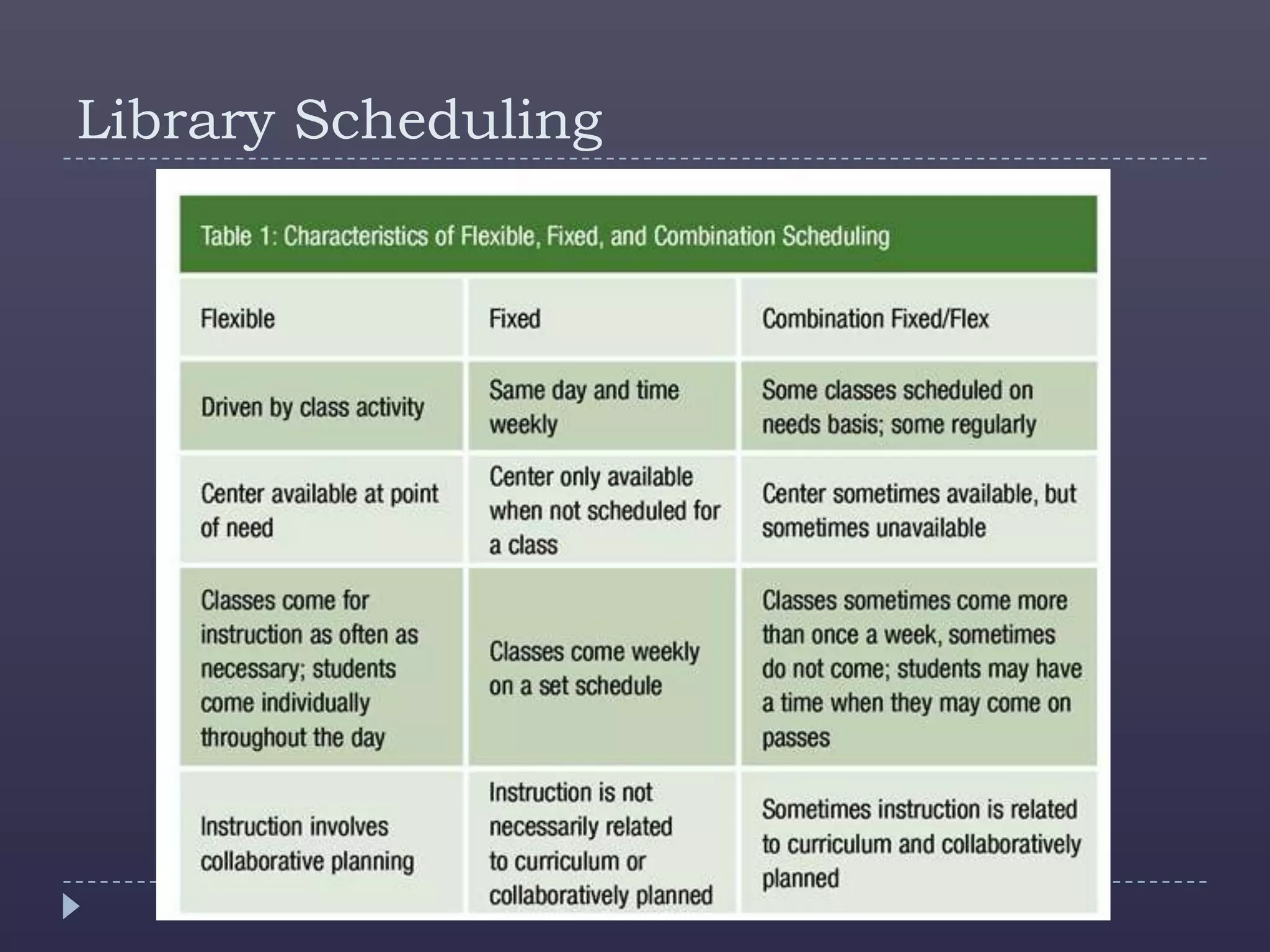
Library Scheduling
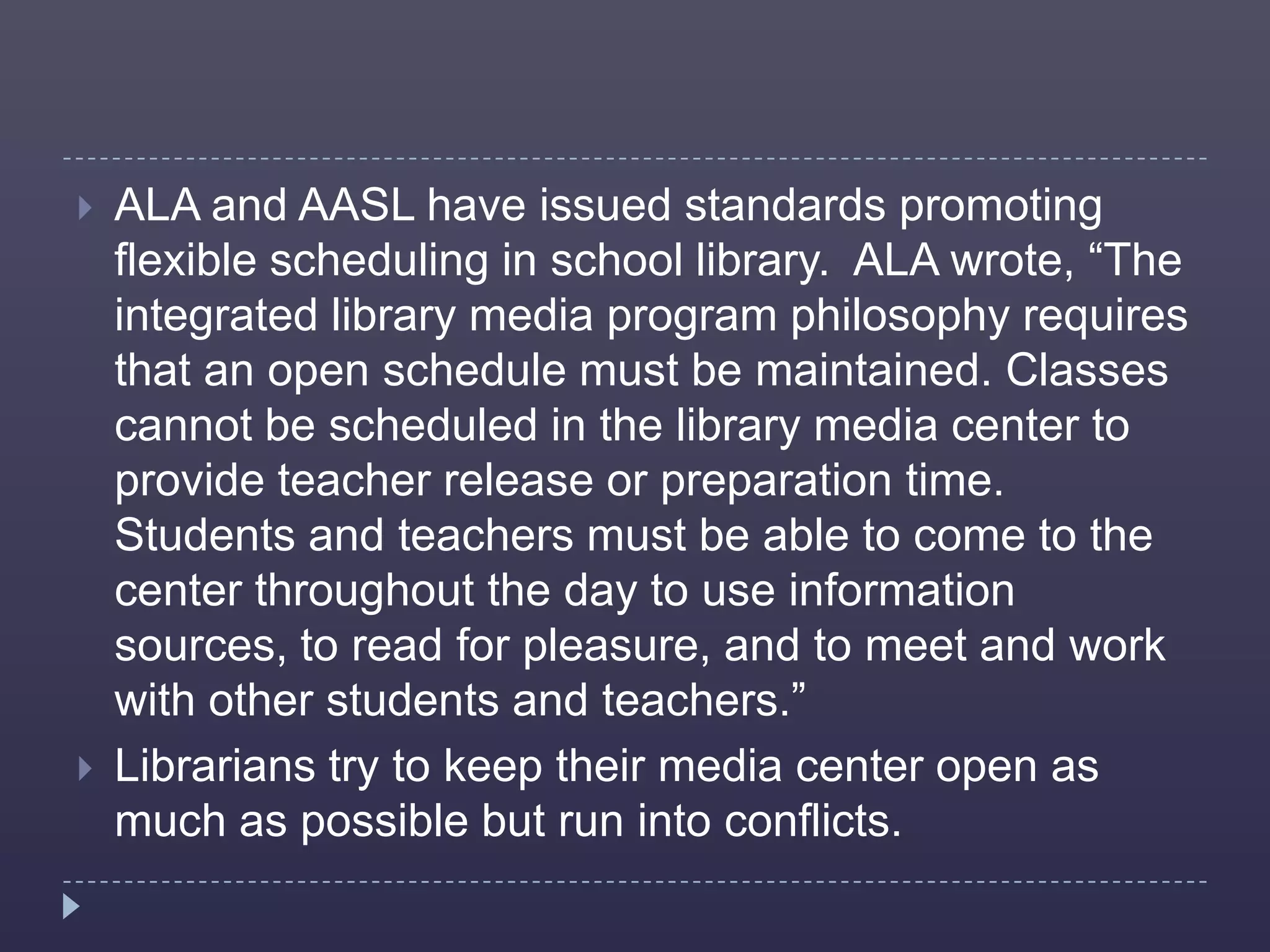
   ALA and AASL have issued standards promoting
    flexible scheduling in school library. ALA wrote, “The
    integrated library media program philosophy requires
    that an open schedule must be maintained. Classes
    cannot be scheduled in the library media center to
    provide teacher release or preparation time.
    Students and teachers must be able to come to the
    center throughout the day to use information
    sources, to read for pleasure, and to meet and work
    with other students and teachers.”
   Librarians try to keep their media center open as
    much as possible but run into conflicts.
   In spite of research and standards issued by ALA
    and AASL, there is still a large number of schools
    that do not practice flexible scheduling, particularly
    elementary schools.
   There are several different reasons for this. The
    practice of flexible scheduling fluctuates depending
    upon the grade and school.
   There are both positive and negative aspects to
    each type of schedule.
Work Cited
   Hartzell, Gary N. "The Invisible School Librarian: Why Other
    Educators Are Blind To Your Value." School Library Journal
    43.11 (1997): 24-29. ERIC. Web. 19 Mar. 2012.
   Hartzell, Gary. "Tactics For Building Influence With Teachers."
    Library Media Connection 27.1 (2008): 44. Academic Search
    Complete. Web. 19 Mar. 2012.
   Manzo, Kathleen Kenned. "Libraries Seeking Updated Role As
    Learning Center." Education Week 16.30 (1997): 1. Academic
    Search Complete. Web. 19 Mar. 2012.
   Loertscher, David. "What Flavor Is Your School Library? The
    Teacher-Librarian As Learning Leader." Teacher Librarian 34.2
    (2006): 8-12. Academic Search Complete. Web. 19 Mar. 2012.

   Pennsylvania State Library, Harrisburg. Pennsylvania
    Guidelines For School Library Media Programs. 1983. ERIC.
    Web. 20 Mar. 2012.

Collaboration and Scheduling

  • 1.
    Collaboration and Schedulesin the School Library By: Patricia Reardon
  • 2.
    Collaboration is theaction of working with someone to produce or create something.
  • 3.
    Benefits of Collaboration forthe Students:  Learning is maximized by the sharing of ideas and experience.  Assignments are more meaningful and better planned.  With the information literacy instruction embedded in subject-based curriculum the information becomes more relevant to the students lives and is better understood.  Students develop critical thinking skills needed to evaluate resources  Lessons that integrate informational technology not only have more opportunity to be creative and innovative but it also breaks the repetitiveness of the everyday class activities.
  • 4.
    Benefits of Collaboration forthe Teachers:  Two minds are better than one! Each participant contributes their own unique expertise and ideas to the development of the lesson, creating a better learning experiences for the students.  Having the librarian's assistance and expertise for the lesson saves the teacher time and effort.  The more communication and collaboration with the librarian about the curriculum subjects, the better the library collection will be in those subject areas.  Teachers get expert advice and assistance in designing assignments that involve library resources and information literacy concepts.  Faculty member gets personalized reference and research assistance from the librarian.
  • 5.
    Benefits of Collaboration forthe Librarian:  Collaboration helps demonstrate the librarian's instructional value to the school.  The Library help enhance the school’s curriculum and the student’s academic performance.  Librarians are better able to help students with assignments.  The end results of the collaborative projects demonstrate the wide variety of opportunities information literacy offers.  Collaborating with teachers gives the librarian more credibility and visibility in the academic community.  It keeps the library active and involved in the school.  It improves the statistics of the use of the library, which will help to reinforcing budget proposal justifications.
  • 6.
    Librarian’s Understanding of Collaboration:  As librarians, we are all aware of the value of collaboration between teachers and the school librarian because we learned about it in our Library Science Program.  And our understanding of it is essential in order to comply with professional school librarian guidelines.  The importance of collaboration is reinforced in our PDE 430 forms, Pennsylvania Guidelines for School Library Programs, and the mission of school libraries.
  • 7.
    Librarian’s Understanding ofCollaboration:  PDE 430 Form states:  Category III - Instructional Delivery – Candidates performance appropriately demonstrate integration of disciplines within the educational curriculum.  Meaning it must demonstrate evidence of thorough integration and facilitation of collaboration for instruction of information literacy skills and use of technology within the educational curriculum.
  • 8.
    Librarian’s Understanding ofCollaboration: Pennsylvania Guidelines for School Library Programs tells librarians to:  Collaborate with classroom  Actively participate in the teachers, reading specialists development, writing, and and literacy coaches to assessment of the school or enhance students’ reading district’s information literacy experiences, promoting reading curriculum using the AASL’s for information and pleasure. Standards for the 21st-Century Learner and its benchmarks as a framework.  Collaborate with teachers to design, instruct, and assess student lessons or units  And then correlate the written promoting authentic and information literacy curriculum project-based learning and with the Common Core State collaborate with teachers in Standards as collaborative assessing and evaluating units of instruction are integrated, instructional developed with teachers. activities.
  • 9.
    Teacher and Administrator’sUnderstanding of Collaboration:  They do not understand the value and educational potential of libraries and librarians because:  Their teaching training emphasized on individual classroom interaction between teacher and student and lacked to mention the opportunities the library has to offer.  Many have misleading notions about libraries being outdated and useless because of the Internet.  Unless the library is actively brought to the attention of teachers and administrators it is likely to go unnoticed and undervalued.
  • 10.
    Degrees of Collaboration  Networking/Outreaching  The exchanging of information for mutual benefit and going beyond the traditional duties of a librarian to provide on-site services.  Coordination  Two or more parties working together towards a shared goal or vision.  Collaboration  The action of working with someone to produce or create something.
  • 11.
    Outreaching/Networking  Maximize access to  Offer instructional the library facility and technology resources within and workshops to faculty outside the school  Attending library professional  Blogging/ Tweeting/ workshops Facebook  Form partnerships  Attending with other school and departmental and public libraries grade-level faculty around you, in which meetings you can share  Creating Resource resources, Lists for teachers technologies, and have virtual collaborations
  • 12.
    Coordination  Library orientation  Basic or lessons standardized instruction sessions  Session on the in the library resources and databases  Creating a rubric, available in the graphic organizer, library for a etc., for research research project. projects
  • 13.
    Collaboration  Sharing short term  Collaboratively as well as long term design, instruct, and mutual goals and assess the learning benefits. activity.  The librarian and the  Each participant has teacher(s) work as a a unique expertise to team and contribute towards simultaneously teach the lesson. the lesson.
  • 14.
    Ways to InitiateCollaboration  Always remain a good  Try to make your rapport with the library schedule as teachers flexible and open as possible.  Utilize every Internet source and subscription data-  Be helpful and base you can access to retrieve the latest volunteer your research, theory, expertise assistance model program, and as much as possible, case study information even if it does not fall available. under you job description.
  • 15.
    Ways to InitiateCollaboration  Attend department or  Offer teachers ideas grade-level meetings. of instructional possibilities that  Familiarize yourself include collaborative with the curriculum for effort between the each grade level. librarian and the teacher.  Volunteer to take part  Offer the library media of an activity or project center as the site for off the teacher’s an "idea bank." hands and integrate information literacy into the activity/project.
  • 16.
    Ways to InitiateCollaboration  Don’t expect to  Share the successes collaborate with all the you’ve had with other faculty right away faculty members  First start with  As the word gets collaborating with the spread around, more highly interested and more faculty faculty members will want to  Display the finished start collaborating with products of the you activities  Soon enough you will  Share the successes have to be setting you’ve had with other priorities
  • 17.
  • 18.
    ALA and AASL have issued standards promoting flexible scheduling in school library. ALA wrote, “The integrated library media program philosophy requires that an open schedule must be maintained. Classes cannot be scheduled in the library media center to provide teacher release or preparation time. Students and teachers must be able to come to the center throughout the day to use information sources, to read for pleasure, and to meet and work with other students and teachers.”  Librarians try to keep their media center open as much as possible but run into conflicts.
  • 19.
    In spite of research and standards issued by ALA and AASL, there is still a large number of schools that do not practice flexible scheduling, particularly elementary schools.  There are several different reasons for this. The practice of flexible scheduling fluctuates depending upon the grade and school.  There are both positive and negative aspects to each type of schedule.
  • 20.
    Work Cited  Hartzell, Gary N. "The Invisible School Librarian: Why Other Educators Are Blind To Your Value." School Library Journal 43.11 (1997): 24-29. ERIC. Web. 19 Mar. 2012.  Hartzell, Gary. "Tactics For Building Influence With Teachers." Library Media Connection 27.1 (2008): 44. Academic Search Complete. Web. 19 Mar. 2012.  Manzo, Kathleen Kenned. "Libraries Seeking Updated Role As Learning Center." Education Week 16.30 (1997): 1. Academic Search Complete. Web. 19 Mar. 2012.  Loertscher, David. "What Flavor Is Your School Library? The Teacher-Librarian As Learning Leader." Teacher Librarian 34.2 (2006): 8-12. Academic Search Complete. Web. 19 Mar. 2012.  Pennsylvania State Library, Harrisburg. Pennsylvania Guidelines For School Library Media Programs. 1983. ERIC. Web. 20 Mar. 2012.