Online Collaborative Issues By: Charlotte Cochran
The only person who is educated is the one who has learned how to learn...and change.   Carl Rogers
Benefits of Collaboration (Goessl, 2011) learners actively participate  teachers become learners at times, and learners sometimes teach respect is given to every member  projects and questions interest and challenge students
Benefits of Collaboration (Goessl, 2011) diversity is celebrated, and all contributions are valued students learn skills for resolving conflicts when they arise members draw upon their past experience and knowledge
goals are clearly identified and used as a guide research tools such as Internet access are made available students are invested in their own learning.  Benefits of Collaboration (Goessl, 2011)
Obstacles to Participating Collaboratively in an Online Class Bender (2003) suggests the following as barriers to participating in an online class: “ students are confused by the tangled threads of the threaded discussions format” (p. 68) “ student postings are excessively long and therefore create a disincentive for discussion” p. 68)
Bender (2003) continued When there are many students in the class, the same information may be repeated numerous times and students may not have anything original left to say The student may not be highly motivated to participate The class or the questions are not motivating enough to elicit a response
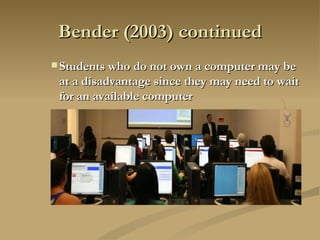
Bender (2003) continued Students who do not own a computer may be at a disadvantage since they may need to wait for an available computer
Obstacles to Participating Collaboratively in an Online Class Technology issues (Goodell & Yusko, 2005) Fear of criticism (Ardichvili, Page, & Wentling, 2003) Inability to manage time effectively (Palloff & Pratt, 2005)
How to Motivate Students to Participate Collaboratively Encourage online debates (Hodgkinson-Williams & Mostert, 2005) Anticipate problems and address them (Bender, 2003) Ask questions which promote constructive thinking (Bender, 2003)
How to Motivate Students to Participate Collaboratively Use social networking cites such as Facebook, Twitter, or MySpace to share information (Gordon, 2008)
Play devil’s advocate to help students consider a different perspective (Bender, 2003) Be encouraging to all students (Bender, 2003) Ask students to finish a sentence. Completing a sentence can stimulate discussion (Bender, 2003) How to Motivate Students to Participate Collaboratively
How to Motivate Students to Participate Collaboratively Respond promptly to questions, posts or concerns (Chamberlain & Vrasidas, 2001) Ensure that rapport with the students and a positive community has been established (Palloff & Pratt, 2003) Make suggestions to students on how to effectively manage their time (Varvel, 2001)
How to Motivate Students to Participate Collaboratively Use activities which involves students (Varvel, 2001) Provide personal feedback to let the student know their work is acknowledged and appreciated (Varvel, 2001)
How to Motivate Students to Participate Collaboratively Try to contact students every week especially in the beginning of the course to encourage participation (University of Idaho, 1995) Provide clear expectations (Hughes, 2004) Engage students in their own learning (Conrad & Donaldson, 2004)
References Ardichvili, A., Page, V., & Wentling, T. (2003). Motivation and barriers to participation in virtual knowledge-sharing communities of practice.  Journal of Knowledge Management ,  7 (1), 64-77. doi: 10.1108/13673270310463626 Bender, T. (2003).  Discussion-based online teaching to enhance student learning . Sterling, VA: Stylus Publishing.
References Chamberlain, R., & Vrasidas, C. (2001).  Creating engaging online construction . Paper presented at the 17th Annual Conference on Distance Teaching and Learning, Western Illinois University. Conrad, R., & Donaldson, J. (2004).  Engaging the online learner . San Francisco, CA: Jossey-Bass.
References Goessl, L. (2011).  Pros and cons of using Microsoft PowerPoint presentations . Retrieved February 12, 2011, from http://www.helium.com/items/976269-pros-and-cons-of-using-microsoft-powerpoint-presentations
References Goodell, J., & Yusko, B. (2005). Overcoming barriers to student participation in online discussions.  Contemporary Issues in Technology and Teacher Education , 5(1), 77-92. Retrieved from  http://www.citejournal.org/articles/v5i1currentpractice1.pdf Gordon, R. (2008).  The five biggest barriers to online participation . Retrieved February 7, 2011, from http://www.pbs.org/idealab/2008/10/the-five-biggest-barriers-to-online-participation005.html
References Hodgkinson-Williams, C., & Mostert, M. (2005). Online debating to encourage student participation in online learning environments: A qualitative case study at a South African university.  International Journal of Education and Development using Information and Communication Technology ,  1 (2), 94-104. Retrieved from ijedict.dec.uwi.edu/include/getdoc.php?id=564&article=93&mode... Hughes, J.   (2004)    Supporting the online learner   
References Palloff, R. M., & Pratt, K. (2005).  Collaborating online: Learning together in community . San Francisco, CA: Jossey-Bass. Palloff, R. M., & Pratt, K. (2003).  The virtual student: A profile and guide to working with online learners . San Francisco, CA: Jossey-Bass.   University of Idaho. (1995).  Strategies for teaching at a distance.  
References Varvel, V.   (2001, March/April)    Facilitating every student in an online course   

Online Collaborative Issues

  • 1.
    Online Collaborative IssuesBy: Charlotte Cochran
  • 2.
    The only personwho is educated is the one who has learned how to learn...and change. Carl Rogers
  • 3.
    Benefits of Collaboration(Goessl, 2011) learners actively participate teachers become learners at times, and learners sometimes teach respect is given to every member projects and questions interest and challenge students
  • 4.
    Benefits of Collaboration(Goessl, 2011) diversity is celebrated, and all contributions are valued students learn skills for resolving conflicts when they arise members draw upon their past experience and knowledge
  • 5.
    goals are clearlyidentified and used as a guide research tools such as Internet access are made available students are invested in their own learning. Benefits of Collaboration (Goessl, 2011)
  • 6.
    Obstacles to ParticipatingCollaboratively in an Online Class Bender (2003) suggests the following as barriers to participating in an online class: “ students are confused by the tangled threads of the threaded discussions format” (p. 68) “ student postings are excessively long and therefore create a disincentive for discussion” p. 68)
  • 7.
    Bender (2003) continuedWhen there are many students in the class, the same information may be repeated numerous times and students may not have anything original left to say The student may not be highly motivated to participate The class or the questions are not motivating enough to elicit a response
  • 8.
    Bender (2003) continuedStudents who do not own a computer may be at a disadvantage since they may need to wait for an available computer
  • 9.
    Obstacles to ParticipatingCollaboratively in an Online Class Technology issues (Goodell & Yusko, 2005) Fear of criticism (Ardichvili, Page, & Wentling, 2003) Inability to manage time effectively (Palloff & Pratt, 2005)
  • 10.
    How to MotivateStudents to Participate Collaboratively Encourage online debates (Hodgkinson-Williams & Mostert, 2005) Anticipate problems and address them (Bender, 2003) Ask questions which promote constructive thinking (Bender, 2003)
  • 11.
    How to MotivateStudents to Participate Collaboratively Use social networking cites such as Facebook, Twitter, or MySpace to share information (Gordon, 2008)
  • 12.
    Play devil’s advocateto help students consider a different perspective (Bender, 2003) Be encouraging to all students (Bender, 2003) Ask students to finish a sentence. Completing a sentence can stimulate discussion (Bender, 2003) How to Motivate Students to Participate Collaboratively
  • 13.
    How to MotivateStudents to Participate Collaboratively Respond promptly to questions, posts or concerns (Chamberlain & Vrasidas, 2001) Ensure that rapport with the students and a positive community has been established (Palloff & Pratt, 2003) Make suggestions to students on how to effectively manage their time (Varvel, 2001)
  • 14.
    How to MotivateStudents to Participate Collaboratively Use activities which involves students (Varvel, 2001) Provide personal feedback to let the student know their work is acknowledged and appreciated (Varvel, 2001)
  • 15.
    How to MotivateStudents to Participate Collaboratively Try to contact students every week especially in the beginning of the course to encourage participation (University of Idaho, 1995) Provide clear expectations (Hughes, 2004) Engage students in their own learning (Conrad & Donaldson, 2004)
  • 16.
    References Ardichvili, A.,Page, V., & Wentling, T. (2003). Motivation and barriers to participation in virtual knowledge-sharing communities of practice. Journal of Knowledge Management , 7 (1), 64-77. doi: 10.1108/13673270310463626 Bender, T. (2003). Discussion-based online teaching to enhance student learning . Sterling, VA: Stylus Publishing.
  • 17.
    References Chamberlain, R.,& Vrasidas, C. (2001). Creating engaging online construction . Paper presented at the 17th Annual Conference on Distance Teaching and Learning, Western Illinois University. Conrad, R., & Donaldson, J. (2004). Engaging the online learner . San Francisco, CA: Jossey-Bass.
  • 18.
    References Goessl, L.(2011). Pros and cons of using Microsoft PowerPoint presentations . Retrieved February 12, 2011, from http://www.helium.com/items/976269-pros-and-cons-of-using-microsoft-powerpoint-presentations
  • 19.
    References Goodell, J.,& Yusko, B. (2005). Overcoming barriers to student participation in online discussions. Contemporary Issues in Technology and Teacher Education , 5(1), 77-92. Retrieved from http://www.citejournal.org/articles/v5i1currentpractice1.pdf Gordon, R. (2008). The five biggest barriers to online participation . Retrieved February 7, 2011, from http://www.pbs.org/idealab/2008/10/the-five-biggest-barriers-to-online-participation005.html
  • 20.
    References Hodgkinson-Williams, C.,& Mostert, M. (2005). Online debating to encourage student participation in online learning environments: A qualitative case study at a South African university. International Journal of Education and Development using Information and Communication Technology , 1 (2), 94-104. Retrieved from ijedict.dec.uwi.edu/include/getdoc.php?id=564&article=93&mode... Hughes, J.   (2004)   Supporting the online learner  
  • 21.
    References Palloff, R.M., & Pratt, K. (2005). Collaborating online: Learning together in community . San Francisco, CA: Jossey-Bass. Palloff, R. M., & Pratt, K. (2003). The virtual student: A profile and guide to working with online learners . San Francisco, CA: Jossey-Bass. University of Idaho. (1995). Strategies for teaching at a distance.  
  • 22.
    References Varvel, V.  (2001, March/April)   Facilitating every student in an online course Â