Heads up on the eLearning Landscape Rachel Roberts [email_address]
“ eLearning has the potential to transform the way we learn. It’s about exploiting technologies and using ICT effectively across the curriculum to connect schools and communities and to support evidence-based decision making and practices in schools.” Maharey, 2006
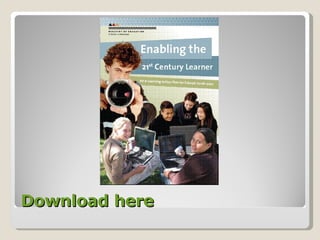
Download here
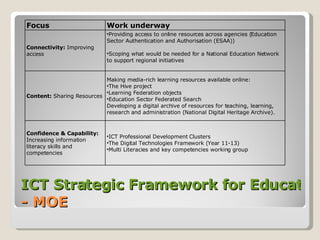
ICT Strategic Framework for Education  - MOE Focus Work underway Connectivity:  Improving access Providing access to online resources across agencies (Education Sector Authentication and Authorisation (ESAA)) Scoping what would be needed for a National Education Network to support regional initiatives Content:  Sharing Resources  Making media-rich learning resources available online: The Hive project  Learning Federation objects Education Sector Federated Search Developing a digital archive of resources for teaching, learning, research and administration (National Digital Heritage Archive). Confidence & Capability:  Increasing information literacy skills and competencies  ICT Professional Development Clusters The Digital Technologies Framework (Year 11-13) Multi Literacies and key competencies working group
Preparing our children for the 21 st  Century Has become a Global Imperative “Catching the Knowledge Wave” Jane Gilbert “The World is Flat” Thomas Friedman http://en.wikipedia.org/wiki/The_World_is_Flat   Shift Happens
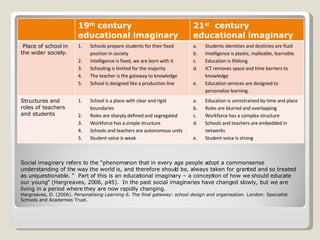
Social imaginary refers to the “phenomenon that in every age people adopt a commonsense understanding of the way the world is, and therefore should be, always taken for granted and so treated as unquestionable. “  Part of this is an educational imaginary – a conception of how we should educate our young” (Hargreaves, 2006, p45).  In the past social imaginaries have changed slowly, but we are living in a period where they are now rapidly changing.  Hargreaves, D. (2006).  Personalising Learning 6. The final gateway: school design and organisation . London: Specialist Schools and Academies Trust. 19 th  century educational imaginary 21 st   century educational imaginary Place of school in the wider society. Schools prepare students for their fixed position in society Intelligence is fixed, we are born with it Schooling is limited for the majority The teacher is the gateway to knowledge School is designed like a production line Students identities and destinies are fluid Intelligence is plastic, malleable, learnable Education is lifelong ICT removes space and time barriers to knowledge Education services are designed to personalize learning. Structures and roles of teachers and students School is a place with clear and rigid boundaries Roles are sharply defined and segregated Workforce has a simple structure Schools and teachers are autonomous units Student voice is weak Education is unrestrained by time and place Roles are blurred and overlapping Workforce has a complex structure Schools and teachers are embedded in networks Student voice is strong
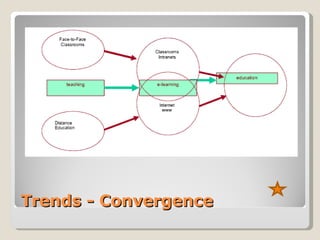
Trends - Convergence
Trends – Smaller, faster, cheaper Portable Apps  on external storage /  Faster networks
Trends – Browser based Everything can be run directly through your browser – no need for software Photoshop Express Edit video Collaborative whiteboards Office tools online  www.thinkfree.com
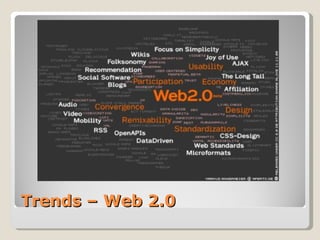
Trends – Web 2.0
What is Web 2.0?
A Selection of Web 2.0  Blogs Wikis Podcasts Social Bookmarks Flickr RSS You Tube Skype Protopage www.commoncraft.com  (gives a good overview about what a lot of these things are) Cool tools www.bardwired.blogspot.com
Where to from here? Develop a shared vision & strategy for elearning in your school Focus on pedagogies & how technology can support learning Keep your eyes on the horizon & your feet on the ground  Listen to student voice.

E Learning Landscape

  • 1.
    Heads up onthe eLearning Landscape Rachel Roberts [email_address]
  • 2.
    “ eLearning hasthe potential to transform the way we learn. It’s about exploiting technologies and using ICT effectively across the curriculum to connect schools and communities and to support evidence-based decision making and practices in schools.” Maharey, 2006
  • 3.
  • 4.
    ICT Strategic Frameworkfor Education - MOE Focus Work underway Connectivity: Improving access Providing access to online resources across agencies (Education Sector Authentication and Authorisation (ESAA)) Scoping what would be needed for a National Education Network to support regional initiatives Content: Sharing Resources Making media-rich learning resources available online: The Hive project Learning Federation objects Education Sector Federated Search Developing a digital archive of resources for teaching, learning, research and administration (National Digital Heritage Archive). Confidence & Capability: Increasing information literacy skills and competencies ICT Professional Development Clusters The Digital Technologies Framework (Year 11-13) Multi Literacies and key competencies working group
  • 5.
    Preparing our childrenfor the 21 st Century Has become a Global Imperative “Catching the Knowledge Wave” Jane Gilbert “The World is Flat” Thomas Friedman http://en.wikipedia.org/wiki/The_World_is_Flat Shift Happens
  • 6.
    Social imaginary refersto the “phenomenon that in every age people adopt a commonsense understanding of the way the world is, and therefore should be, always taken for granted and so treated as unquestionable. “ Part of this is an educational imaginary – a conception of how we should educate our young” (Hargreaves, 2006, p45). In the past social imaginaries have changed slowly, but we are living in a period where they are now rapidly changing. Hargreaves, D. (2006). Personalising Learning 6. The final gateway: school design and organisation . London: Specialist Schools and Academies Trust. 19 th century educational imaginary 21 st century educational imaginary Place of school in the wider society. Schools prepare students for their fixed position in society Intelligence is fixed, we are born with it Schooling is limited for the majority The teacher is the gateway to knowledge School is designed like a production line Students identities and destinies are fluid Intelligence is plastic, malleable, learnable Education is lifelong ICT removes space and time barriers to knowledge Education services are designed to personalize learning. Structures and roles of teachers and students School is a place with clear and rigid boundaries Roles are sharply defined and segregated Workforce has a simple structure Schools and teachers are autonomous units Student voice is weak Education is unrestrained by time and place Roles are blurred and overlapping Workforce has a complex structure Schools and teachers are embedded in networks Student voice is strong
  • 7.
  • 8.
    Trends – Smaller,faster, cheaper Portable Apps on external storage / Faster networks
  • 9.
    Trends – Browserbased Everything can be run directly through your browser – no need for software Photoshop Express Edit video Collaborative whiteboards Office tools online www.thinkfree.com
  • 10.
  • 11.
  • 12.
    A Selection ofWeb 2.0 Blogs Wikis Podcasts Social Bookmarks Flickr RSS You Tube Skype Protopage www.commoncraft.com (gives a good overview about what a lot of these things are) Cool tools www.bardwired.blogspot.com
  • 13.
    Where to fromhere? Develop a shared vision & strategy for elearning in your school Focus on pedagogies & how technology can support learning Keep your eyes on the horizon & your feet on the ground Listen to student voice.