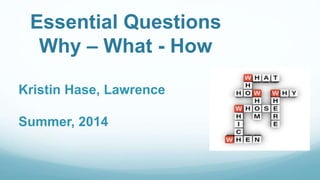
Essential Questions
Why – What - How
Kristin Hase, Lawrence
Summer, 2014
Why
What
How
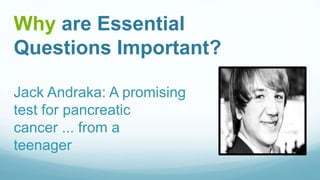
Why are Essential
Questions Important?
Jack Andraka: A promising
test for pancreatic
cancer ... from a
teenager
“It’s not that I’m really smart.
If you don’t have the
creativity to put knowledge
to use then you just have a
bunch of knowledge.”
- Jack Andraka
Why
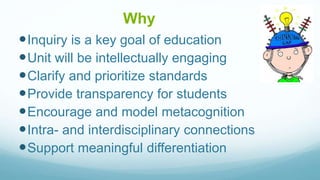
Inquiry is a key goal of education
Unit will be intellectually engaging
Clarify and prioritize standards
Provide transparency for students
Encourage and model metacognition
Intra- and interdisciplinary connections
Support meaningful differentiation
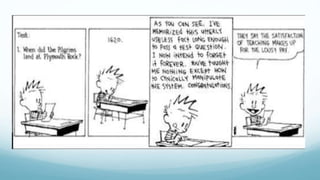
Questioning in US vs. Japan
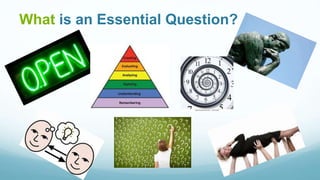
What is an Essential Question?
ACTIVITY #1 –
QUESTION SORT
Sort the questions on your table into two
piles:
 Essential Questions
 Non-Essential Questions
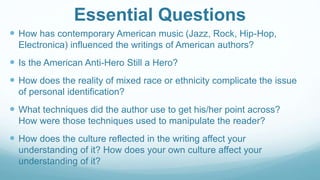
Essential Questions
 How has contemporary American music (Jazz, Rock, Hip-Hop,
Electronica) influenced the writings of American authors?
 Is the American Anti-Hero Still a Hero?
 How does the reality of mixed race or ethnicity complicate the issue
of personal identification?
 What techniques did the author use to get his/her point across?
How were those techniques used to manipulate the reader?
 How does the culture reflected in the writing affect your
understanding of it? How does your own culture affect your
understanding of it?
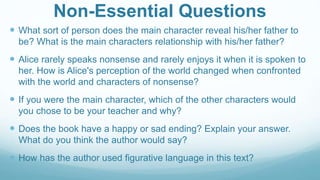
Non-Essential Questions
 What sort of person does the main character reveal his/her father to
be? What is the main characters relationship with his/her father?
 Alice rarely speaks nonsense and rarely enjoys it when it is spoken to
her. How is Alice's perception of the world changed when confronted
with the world and characters of nonsense?
 If you were the main character, which of the other characters would
you chose to be your teacher and why?
 Does the book have a happy or sad ending? Explain your answer.
What do you think the author would say?
 How has the author used figurative language in this text?
What is diabetes?
Non-Essential Questions
Students move information from one point to
the other, from the text to their paper
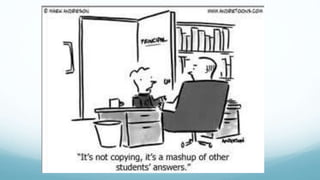
Opportunity to plagiarize
Summarize or paraphrase
No new ideas required, unoriginal, fact-based
Revise “What is diabetes?” to create
an Essential Question
Next Generation Standards related to Diabetes topic:
 MS-LS1-5. Construct a scientific explanation based on
evidence for how environmental and genetic factors
influence the growth of organisms.
 HS-LS3-2 Make and defend a claim based on evidence that
inheritable genetic variations may result from: (1) new
genetic combinations through meiosis, (2) viable errors
occurring during replication, and/or (3) mutations caused by
environmental factors.
ELA Standards related to
Diabetes topic
 CCSS.ELA-LITERACY.RI.7.8 Trace and evaluate the
argument and specific claims in a text, assessing
whether the reasoning is sound and the evidence is
relevant and sufficient to support the claims.
 CCSS.ELA-LITERACY.RI.9-10.8 Delineate and
evaluate the argument and specific claims in a text,
assessing whether the reasoning is valid and the
evidence is relevant and sufficient; identify false
statements and fallacious reasoning.
What plan could you
develop that would
reduce your likelihood of
developing diabetes?
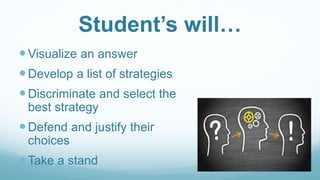
Student’s will…
Visualize an answer
Develop a list of strategies
Discriminate and select the
best strategy
Defend and justify their
choices
Take a stand
How to Create an Essential Question
from a Standard
• Unpack Standards --ID key verbs and nouns
• EXAMPLE: (ELA Anchor Standard: Determine central
ideas or themes of a text and analyze their development;
summarize the key supporting details and ideas.
• What is the central idea running through the text?
• How is that idea developed?
• What textual details support my argument about the
central idea?
How to Create an Essential Question
from Desired Understandings
• Understandings are the specific insights, inferences or
conclusions about the big ideas that you hope your students
will attain as a result of inquiry.
• Example:
• Desired Understanding = Great literature from various
cultures explores enduring themes and reveals recurrent
aspects of the human condition.
• Essential Question = How (much) can stories from other
places and times be about us?
Creating a Culture of Inquiry –
Key Ideas to Communicate
Discuss the idea on your card.
• What does it mean?
• How can you create a culture in your classroom to
support this idea?
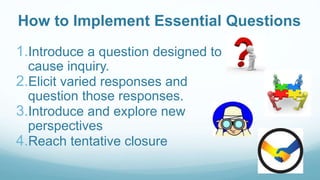
How to Implement Essential Questions
1.Introduce a question designed to
cause inquiry.
2.Elicit varied responses and
question those responses.
3.Introduce and explore new
perspectives
4.Reach tentative closure
Activity #2: Writing Essential
Questions Using a Checklist
• Use your checklist and template to create an
EQ for a unit in your course.
• EXTRA CHALLENGE: Write an EQ for a unit
you could integrate with another content area.
Today’s Objectives:
Did we accomplish our goals?
Why: Understand the importance of
Essential Questions
What: Define Essential Questions
How: Develop Essential Questions that
align with Common Core
Exit Tickets
One to take with you:
 3 things I’m taking away from this
session
 1 thing still circling around in my brain.
One to leave with us:
1.What I liked about this session:
2.Suggestions for the session:
Resources
 McTighe, G., & Wiggins, G. (2013) Essential Questions: Opening
Doors to Student Understanding. Alexandria, VA: ASCD
 Basic info on EQ – lots of sample EQ (Beginner level
information)http://www.ocmboces.org/tfiles/folder1682/OHS_Essentia
lQuestions.pdf
 EQ overview of McTighe Wiggins info – personal insights
(Intermediate level
information)http://www.huffenglish.com/understanding-by-design-
essential-questions/
 Revising EQ video– make it more meaningful to students – 7th grade
SS (Expert level information)
https://www.youtube.com/watch?v=StjLRLLAie8
Resources (cont.)
 Overview video of EQ and discussion of differentiation by McTighe and
Wiggins https://www.youtube.com/watch?v=RcC2MR6xjfc
 Grant Wiggins 1 page overview of
EQhttps://www.authenticeducation.org/ae_bigideas/article.lasso?artid=53
 Overview of EQ and checklisthttp://tech.hcesc.org/wp-
content/uploads/2011/02/Essential_Questions_Defined.pdf
 Dare to Differentiate --
overviewhttps://daretodifferentiate.wikispaces.com/file/view/essential.pdf
 Grant Wiggins video – example of EQ in the
classroomhttps://www.youtube.com/watch?v=DMYfoLDnFAc

Essential Questions

  • 1.
    Essential Questions Why –What - How Kristin Hase, Lawrence Summer, 2014
  • 2.
  • 3.
    Why are Essential QuestionsImportant? Jack Andraka: A promising test for pancreatic cancer ... from a teenager
  • 4.
    “It’s not thatI’m really smart. If you don’t have the creativity to put knowledge to use then you just have a bunch of knowledge.” - Jack Andraka
  • 5.
    Why Inquiry is akey goal of education Unit will be intellectually engaging Clarify and prioritize standards Provide transparency for students Encourage and model metacognition Intra- and interdisciplinary connections Support meaningful differentiation
  • 6.
  • 8.
    What is anEssential Question?
  • 9.
    ACTIVITY #1 – QUESTIONSORT Sort the questions on your table into two piles:  Essential Questions  Non-Essential Questions
  • 10.
    Essential Questions  Howhas contemporary American music (Jazz, Rock, Hip-Hop, Electronica) influenced the writings of American authors?  Is the American Anti-Hero Still a Hero?  How does the reality of mixed race or ethnicity complicate the issue of personal identification?  What techniques did the author use to get his/her point across? How were those techniques used to manipulate the reader?  How does the culture reflected in the writing affect your understanding of it? How does your own culture affect your understanding of it?
  • 11.
    Non-Essential Questions  Whatsort of person does the main character reveal his/her father to be? What is the main characters relationship with his/her father?  Alice rarely speaks nonsense and rarely enjoys it when it is spoken to her. How is Alice's perception of the world changed when confronted with the world and characters of nonsense?  If you were the main character, which of the other characters would you chose to be your teacher and why?  Does the book have a happy or sad ending? Explain your answer. What do you think the author would say?  How has the author used figurative language in this text?
  • 12.
  • 14.
    Non-Essential Questions Students moveinformation from one point to the other, from the text to their paper Opportunity to plagiarize Summarize or paraphrase No new ideas required, unoriginal, fact-based
  • 16.
    Revise “What isdiabetes?” to create an Essential Question Next Generation Standards related to Diabetes topic:  MS-LS1-5. Construct a scientific explanation based on evidence for how environmental and genetic factors influence the growth of organisms.  HS-LS3-2 Make and defend a claim based on evidence that inheritable genetic variations may result from: (1) new genetic combinations through meiosis, (2) viable errors occurring during replication, and/or (3) mutations caused by environmental factors.
  • 17.
    ELA Standards relatedto Diabetes topic  CCSS.ELA-LITERACY.RI.7.8 Trace and evaluate the argument and specific claims in a text, assessing whether the reasoning is sound and the evidence is relevant and sufficient to support the claims.  CCSS.ELA-LITERACY.RI.9-10.8 Delineate and evaluate the argument and specific claims in a text, assessing whether the reasoning is valid and the evidence is relevant and sufficient; identify false statements and fallacious reasoning.
  • 18.
    What plan couldyou develop that would reduce your likelihood of developing diabetes?
  • 19.
    Student’s will… Visualize ananswer Develop a list of strategies Discriminate and select the best strategy Defend and justify their choices Take a stand
  • 20.
    How to Createan Essential Question from a Standard • Unpack Standards --ID key verbs and nouns • EXAMPLE: (ELA Anchor Standard: Determine central ideas or themes of a text and analyze their development; summarize the key supporting details and ideas. • What is the central idea running through the text? • How is that idea developed? • What textual details support my argument about the central idea?
  • 21.
    How to Createan Essential Question from Desired Understandings • Understandings are the specific insights, inferences or conclusions about the big ideas that you hope your students will attain as a result of inquiry. • Example: • Desired Understanding = Great literature from various cultures explores enduring themes and reveals recurrent aspects of the human condition. • Essential Question = How (much) can stories from other places and times be about us?
  • 22.
    Creating a Cultureof Inquiry – Key Ideas to Communicate Discuss the idea on your card. • What does it mean? • How can you create a culture in your classroom to support this idea?
  • 23.
    How to ImplementEssential Questions 1.Introduce a question designed to cause inquiry. 2.Elicit varied responses and question those responses. 3.Introduce and explore new perspectives 4.Reach tentative closure
  • 24.
    Activity #2: WritingEssential Questions Using a Checklist • Use your checklist and template to create an EQ for a unit in your course. • EXTRA CHALLENGE: Write an EQ for a unit you could integrate with another content area.
  • 25.
    Today’s Objectives: Did weaccomplish our goals? Why: Understand the importance of Essential Questions What: Define Essential Questions How: Develop Essential Questions that align with Common Core
  • 26.
    Exit Tickets One totake with you:  3 things I’m taking away from this session  1 thing still circling around in my brain. One to leave with us: 1.What I liked about this session: 2.Suggestions for the session:
  • 28.
    Resources  McTighe, G.,& Wiggins, G. (2013) Essential Questions: Opening Doors to Student Understanding. Alexandria, VA: ASCD  Basic info on EQ – lots of sample EQ (Beginner level information)http://www.ocmboces.org/tfiles/folder1682/OHS_Essentia lQuestions.pdf  EQ overview of McTighe Wiggins info – personal insights (Intermediate level information)http://www.huffenglish.com/understanding-by-design- essential-questions/  Revising EQ video– make it more meaningful to students – 7th grade SS (Expert level information) https://www.youtube.com/watch?v=StjLRLLAie8
  • 29.
    Resources (cont.)  Overviewvideo of EQ and discussion of differentiation by McTighe and Wiggins https://www.youtube.com/watch?v=RcC2MR6xjfc  Grant Wiggins 1 page overview of EQhttps://www.authenticeducation.org/ae_bigideas/article.lasso?artid=53  Overview of EQ and checklisthttp://tech.hcesc.org/wp- content/uploads/2011/02/Essential_Questions_Defined.pdf  Dare to Differentiate -- overviewhttps://daretodifferentiate.wikispaces.com/file/view/essential.pdf  Grant Wiggins video – example of EQ in the classroomhttps://www.youtube.com/watch?v=DMYfoLDnFAc

Editor's Notes

  • #2 Pass out EQ definitions and checklist and template handout Welcome Introduce self Get a general idea of who is in the room: Classroom Teacher, administration, support teachers, other Knowledge of EQ EQ is a new topic, I’ve used EQ but want to learn more, I could teacher others about EQ(those that could teach EQ – give them to option of watching the video on the resource list noted as (Expert level information in another section of the room – then they can spend the time writing or revising EQ with the support of others in their group – or they can explore more of the resources) – You might suggest they watch the video clip next before breaking off https://www.youtube.com/watch?v=StjLRLLlAie8
  • #3 Our objectives for the next 1 ½ hours (Why, What and How come in separately on a click) Why –Understand the importance of EQ - Evidence of why they are good to use What –Define – make sure we are working with the same definition – EQ being used for many different questions and frameworks for planning How – Tips to help develop EQ and Time to develop EQ for your purpose - AND think about EQ that would integrate you and another content area Why, What, How – in Green – and in green on future slides to help us organize our thinking Encourage participants to create a note taking sheet Front – fold into thirds – label each section “Why, What, How” draw a line across the bottom of the page and label it “To Do” for things they want to read/watch later, people to talk to, etc. Back – graphic representation of session – if they want to do it
  • #4 5 min into presentation (Time listed in notes is incremental) Ted Talk video http://www.ted.com/talks/jack_andraka_a_promising_test_for_pancreatic_cancer_from_a_teenager.html Stop the video at 8:36
  • #5 14 min What was Jacks question that got him started on his research? THINK – jot down your thoughts PAIR – at their table SHARE – write their questions – post in the room More information about Jack and his work on 60 minutes interview Jack had a personal question and a global question He did not settle for the status quo He believed “There has to be a better way, I’m going to find it.” He had a teenage optimism mind-set He was accessing and owning information He made no excuses He saw his High School Science class as a Stifller of innovation This was an example of Problem based learning 199 rejections out of 200 = persistence – acceptance, what mindset did that researcher have?
  • #6 17 min Thinking clip art = Essential questions make our unit plans more likely to yield focused and thoughtful learning and learners. Passive learning is not allowed, thinking is required (p. 17) Each of the bullet points come in separately with a click Signals students that inquiry is a key goal of education With much knowledge made quickly obsolete in the modern world-- the ability to question is central to meaningful learning and intellectual achievement at high levels Research has shown majority of teachers’ questions are leading and low-level (p. 18) – more about this on the next slide By exploring questions, learners are engaged in constructing meaning for themselves Make it more likely that the unit will be intellectually engaging Students are acquiring knowledge and skill for more obvious and worthy reasons Learning is more intrinsically motivated Students will persist with the work required for understanding Using one’s mind to figure out how to be better at an immersive challenge is key to motivation (think video games, sports) English teacher example with 6th graders in guiding writing and peer reviews – page. 20 6th grade class – EQ used to guide students’ writing and the peer reviews: For writers = What is your purpose? Who is your audience? Where is the paper working and not working, given your purpose? The answers had to be stapled to the draft for peer review. For reviewers – To what extent did the writer achieve his/her purpose? Where were you most interested and where did you lose interest and why? The places where the reader lost interest became a teachable moment for some aspect of idea development, organization, word choice, or mechanics. Help to clarify and prioritize standards for teachers EQ’s offer a practical vehicle for prioritizing the content in the standards and enabling teachers to focus subject matter in a way that makes the key ideas more overt EQ’s helps them to stay focused, separate the intellectual wheat from the chaff and keep the most important ends – understanding and transfer—in mind Provide transparency for students EQ’s provide an organizing structure Help students make connections on their own Help students make meaning, learn effectively, and create worthy products and performances based on their inquiries Encourage and model metacognition for students Model the kinds of thinking that students need to emulate and internalize if they are to learn to high levels independently Success in any field depends upon learning to ask the right expert questions concerning strategy, attitude, and the meaning of the results—especially in the midst of uncertainty and confusion Provide opportunities for intra- and interdisciplinary connections Using transferable big ideas and companion essential questions Examples on pg. 24 To what extent do the arts and sciences reflect an era? Who is rich, who is poor, and why? To what extent should the wealth and influence of a country be measured? What can we learn from studying the past? Frame units with processed focused questions: What information will best address this questions? How do I find out what I don’t know? How will I know what to believe in the information I find? Is there another perspective I should consider? What’s the best way to show what I have learned? Support meaningful differentiation By posing the same essential questions for a class, we signal to students that we respect their intelligence and capacity to think A constant return to those questions makes it far more likely that students who struggle with the content or have fallen behind will have multiple points of contact and “reentry” with the subject matter Because the question, not the content, is the constant focus, even weak students could become sufficiently expert in a question or two to develop the kind of confidence and competence that they often do not feel in a typical course.
  • #7 22 min Each country comes in separately with a click United States Studies show that the “majority of teachers’ questions are leading and low-level” From elementary school through university levels One recent study indicated that teachers ask as many as 300-400 questions a day (Levin & Long, 1981) Tend to ask questions in rapid-fire fashion 3rd grade reading group – question asked every 43 seconds Junior high English class averaged 5 questions a minute PURPOSE of asking questions is to get an answer Japan PURPOSE of asking questions is to stimulate thought When asked what Japanese teachers talk together about; “A great deal of time is spent talking about questions we can pose to the class—which wordings work best to get students involved in thinking and discussing the material. One good question can keep a whole class going for a long time; a bad one produces little more than a simple answer.” (Stevenson & Stigler, 1992, p. 195)
  • #8 24 min Calvin the philosopher???
  • #9 25 min The answer to an EQ can’t be found on Google Each picture comes in separately with a click These statements are found on the handout with the definitions (and checklist) Open sign = Open ended – no single or final/correct answer – teacher must be open to students interpretation and focus Thinker = Thought provoking and intellectually engaging Bloom pyramid = Calls for higher order thinking Light bulb and 2 heads = Points toward important, transferable ideas within/across discipline Questions on chalkboard = Raises additional questions – sparks further inquiry Holding woman up =Requires support and justification Spiral time = Recurs over time – revisited again and again - Jay McTighe & Grant Wiggins p. 3 Talk with your group about Jack's Essential Question (should be posted in the room from earlier discussion) and how his question fulfills this definition
  • #10 33 min ACTIVITY 1: Sort the questions in the envelopes PAIR UP -- CHANGE GROUPS -- DISCUSS THE DIFFERENCES BETWEEN THE ESSENTIAL AND NON-ESSENTIAL
  • #11 38 min Answer Key REVIEW YOUR PILES AND CHECK IF YOU SORTED CORRECTLY Any discussion? Anyone make other decisions – if so – why? THEY ARE NOT ABSOLUTE! – It depends on your objective and what you are requiring of your students. TO DO Walk around and write E or NE on the Questions written earlier on Jack’s Quesions
  • #12 Answer Key
  • #13 43 min CHANGE GROUPS , DISCUSS, IS THIS AN ESSENTIAL QUESTION. WHY OR WHY NOT? Is this an Essential Question that could guide a unit of study? When you plan your lessons and activities, you should also plan your questions.
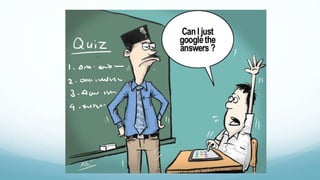
  • #14 45 min An Essential Question is not “Googleable” By googling the answer what work has the student done? – What new learning has occurred
  • #15 47 min Asking “What is Diabetes” seems like a complicated question, but being able to explain what diabetes is, does not necessarily impact a student or their life. Non-Essential Questions lead student to these understandings – there is a time and a place for these – but not as an overall focus for a unit study.
  • #16 49 min
  • #17 50 min Middle School and High School – Next Generation Science Standards that are related. Work with a small group
  • #18 ELA Standards for 7th and 9-10 grades
  • #19 55 min Here is one example Requires knowledge about diabetes Is relevant to students Requires students to research new information Ask for groups to share out their questions – if they would like to share.
  • #20 57 min ANY OTHER THINGS THEY MIGHT BE ABLE TO DO AS A RESULT OF ANSWERING THIS ESSENTIAL QUESTION?
  • #21 58 min Content/standards are the answers to be learned – to develop EQ – think about what were the questions that led to those answers – by interrogating the content in this manner, we are engaging learners in making meaning and coming to understand the content’s meaning and importance (McTighe & Wiggins) More Examples are in the book and on the websites on the resource list.
  • #22 60 min Universal by Design framework also focuses on desired understandings (UbD – created by McTighe and Wiggins) Additional information– not going into during this presentation – but if someone asks you can direct them to the book and the following pages Considering the Facets of Understanding Understanding can be assessed via various facets, or indicators – there are 6: explain, interpret, apply, shift perspective, empathize, self-assess Question starters and verbs for each of the six – can create EQ from these Example pg. 35-36 Essential Questions and Skills EQ framed around 4 categories relevant to effective skill learning 1. key concepts 2. purpose and value 3. strategy and tactics 4. context of use Academic sill areas – Example: How do you know that you comprehend what you are reading?, When should we use “fix-up” strategies? instrumental music, sports, beginning levels of world language - Example: How does torque affect power? How many EQ in a unit? Depends on integration and length of unit, generally speaking a unit of 3-4 weeks would have 2-4 EQ
  • #23 62 min Pass one card to each group (it there is a large group more than one group can have the same card)– allow time for discussion – share out whole group Statements on the cards: There’s not a single correct answer for this question. Life is about the consideration of plausible and imperfect alternatives. Everyone is entitled to an opinion, but the best opinions are supported by valid evidence and sound reason. Coming to understand important ideas is like attaining fitness: it takes work and practice over time. Inquiry is not a spectator sport; each person needs to listen actively and participate. If and when I or others challenge your comment, it doesn’t mean we don’t like you or don’t value your contribution. We’re testing the strength of the idea. Considering another point of view in an open-minded way might help you clarify and expand your thinking and understanding. Making mistakes is an expected part of learning. If you never risk making a mistake, you’re not likely to improve. That’s why we question answers—in order to improve them.
  • #24 67 min Each picture comes in separately on a click 4 Phase Explorable via text, a research project, a lab, a problem an issue, or a simulation in which the question comes to life Questioning techniques elicit the widest possible array of different plausible, yet imperfect answers probe the original question Many strategies given in the book including: Think-Pair-Share, Socratic Seminar, Class Survey (many ways to do this electronically), Random calling, Devil’s advocate, New text, data or phenomena Extend inquiry or call into question tentative conclusions Elicit and compare new answers to previous answers Generalize findings, new insights and remaining questions( p. 45) There is also an 8 Phase Implementation guide in the book as well
  • #25 69 min Encourage participants to work in groups – by grade level and course – help them group. Explain the template – sample filled out for the Diabetes question – blank for them to use. Hand out large paper for them to write their question for all to see – great way to share with the rest of the group – can spark ideas for others to tweak to meet their needs. Gallery Walk
  • #26 85 min Check with participants on achieving the goals.
  • #27 Pass out exit tickets – blank index cards: One card: for them to take with them Have them draw a triangle – answer “3 Things I’m taking away from this session.” Have them draw a circle – answer “What is still circling around in my brain.” Second card: Have them answer: 1. What I liked about this session 2. Suggestions for the session or future topics you would like to explore
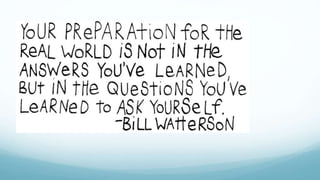
  • #28 Creator of Calvin and Hobbs