Learning Process
and
Innovation theories
Hiroki MIZOKAMI
Contents
01
02
03
04
05
Learning Process and
Innovation Theories
Double-Loop Learning
SECI Model
Design Thinking
Innovation Journey by
Framing
01 Learning Process and Innovation Theories
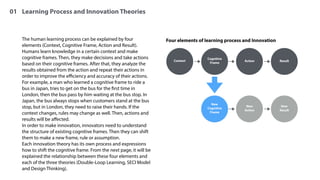
The human learning process can be explained by four
elements (Context, Cognitive Frame, Action and Result).
Humans learn knowledge in a certain context and make
cognitive frames. Then, they make decisions and take actions
based on their cognitive frames. After that, they analyze the
results obtained from the action and repeat their actions in
order to improve the efficiency and accuracy of their actions.
For example, a man who learned a cognitive frame to ride a
bus in Japan, tries to get on the bus for the first time in
London, then the bus pass by him waiting at the bus stop. In
Japan, the bus always stops when customers stand at the bus
stop, but in London, they need to raise their hands. If the
context changes, rules may change as well. Then, actions and
results will be affected.
In order to make innovation, innovators need to understand
the structure of existing cognitive frames. Then they can shift
them to make a new frame, rule or assumption.
Each innovation theory has its own process and expressions
how to shift the cognitive frame. From the next page, it will be
explained the relationship between these four elements and
each of the three theories (Double-Loop Learning, SECI Model
and Design Thinking).
Four elements of learning process and Innovation
Context
Cognitive
Frame
Action Result
New
Cognitive
Frame
New
Action
New
Result
02 Double-Loop Learning
By Chris Argyris
[Double-Loop Learning]
Single loop learning tries to solve problems according to
already existing assumptions and action framework.
Double loop learning is to abandon the existing cognitive
frame and incorporate a new way of thinking and action
framework. In 1978, American business theorist Chris Argyris
and Donald Schon proposed in "Organizational Learning"
concept. Organizations are difficult to survive adapting to the
environment with single loop learning alone. They unlearn
stereotypes in the past successful experiences themselves,
learn new knowledge and framework from the outside by
double loop, and iterate and strengthen it by single loop
learning. It is said that only organizations that can repeat this
cycle can continue to maintain competitive advantage.
Single Loop Learning
Context Assumption Action Result
Following the assumptions
Double Loop Learning
Context Assumption Action Result
Changing the assumptions
New
Assumption
New
Action
New
Result
03 SECI Model
By Ikujiro Nonaka
[SECI Model]
SECI model is a model of knowledge creation proposed by
Ikujiro Nonaka. It represents the process of knowledge transfer
that creates the spiral of "SECI model" "tacit knowledge" and
"explicit knowledge". It tries to shift the existing cognitive
frame by unlocking tacit knowledge learned from context.
SECI model has four steps.
• “Socialization(Empathy)" (tacit to tacit)
• “Externalization(Dialogue)" (tacit to explicit)
• “Combination(Linking)" (explicit to explicit)
• “Internalization(Action)" (Explicit to Tacit)
It is created while spirally moving the knowledge transfer
process, returning to the initial "Socialization", and constantly
repeating this cycle.
Knowledge Spiral
Context
Cognitive
Frame
Action Result
Interaction between tacit and explicit knowledge
Socialization
Empathy
Externalization
Dialogue
Combination
Linking
Socialization
Empathy
Result
04 Design Thinking
by Stanford University
[Design Thinking / Human Centered Design]
Design thinking is said to be the word that IDEO 's David Kelley
and Tim Brown created with Roger Martin in the 1990' s. It is
said that working on problem solving with a practical user-
centered approach leads to innovation.
Although there are various kinds of design thinking recently, it
tries to shift the existing cognitive frame by“User Insight”from
empathizing people. In design thinking advocated by Stanford
University, there are five processes.
• Empathize: Work to fully understand the experience of the
user for whom you are designing.
• Define: Process and synthesize the findings from your
empathy work in order to form a user point of view that you
will address with your design.
• Ideate: Explore a wide variety of possible solutions through
generating a large quantity of diverse possible solutions.
• Prototype: Transform your ideas into a physical form.
• Test: Try out high-resolution products and use observations
and feedback.
Design Thinking by Stanford University
Context
Cognitive
Frame
Action Result
Human Centered Design
Empathize
Define Ideate Prototype Test
New
Assumption
from
User Insight
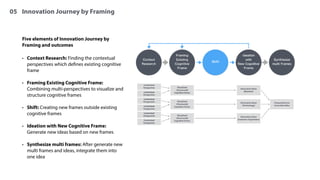
05 Innovation Journey by Framing
• Context Research: Finding the contextual
perspectives which defines existing cognitive
frame
• Framing Existing Cognitive Frame:
Combining multi-perspectives to visualize and
structure cognitive frames
• Shift: Creating new frames outside existing
cognitive frames
• Ideation with New Cognitive Frame:
Generate new ideas based on new frames
• Synthesize multi frames: After generate new
multi frames and ideas, integrate them into
one idea
Five elements of Innovation Journey by
Framing and outcomes
Learning Process
and
Innovation theories
Hiroki MIZOKAMI

Learning Process and Innovation Theories

  • 1.
  • 2.
    Contents 01 02 03 04 05 Learning Process and InnovationTheories Double-Loop Learning SECI Model Design Thinking Innovation Journey by Framing
  • 3.
    01 Learning Processand Innovation Theories The human learning process can be explained by four elements (Context, Cognitive Frame, Action and Result). Humans learn knowledge in a certain context and make cognitive frames. Then, they make decisions and take actions based on their cognitive frames. After that, they analyze the results obtained from the action and repeat their actions in order to improve the efficiency and accuracy of their actions. For example, a man who learned a cognitive frame to ride a bus in Japan, tries to get on the bus for the first time in London, then the bus pass by him waiting at the bus stop. In Japan, the bus always stops when customers stand at the bus stop, but in London, they need to raise their hands. If the context changes, rules may change as well. Then, actions and results will be affected. In order to make innovation, innovators need to understand the structure of existing cognitive frames. Then they can shift them to make a new frame, rule or assumption. Each innovation theory has its own process and expressions how to shift the cognitive frame. From the next page, it will be explained the relationship between these four elements and each of the three theories (Double-Loop Learning, SECI Model and Design Thinking). Four elements of learning process and Innovation Context Cognitive Frame Action Result New Cognitive Frame New Action New Result
  • 4.
    02 Double-Loop Learning ByChris Argyris [Double-Loop Learning] Single loop learning tries to solve problems according to already existing assumptions and action framework. Double loop learning is to abandon the existing cognitive frame and incorporate a new way of thinking and action framework. In 1978, American business theorist Chris Argyris and Donald Schon proposed in "Organizational Learning" concept. Organizations are difficult to survive adapting to the environment with single loop learning alone. They unlearn stereotypes in the past successful experiences themselves, learn new knowledge and framework from the outside by double loop, and iterate and strengthen it by single loop learning. It is said that only organizations that can repeat this cycle can continue to maintain competitive advantage. Single Loop Learning Context Assumption Action Result Following the assumptions Double Loop Learning Context Assumption Action Result Changing the assumptions New Assumption New Action New Result
  • 5.
    03 SECI Model ByIkujiro Nonaka [SECI Model] SECI model is a model of knowledge creation proposed by Ikujiro Nonaka. It represents the process of knowledge transfer that creates the spiral of "SECI model" "tacit knowledge" and "explicit knowledge". It tries to shift the existing cognitive frame by unlocking tacit knowledge learned from context. SECI model has four steps. • “Socialization(Empathy)" (tacit to tacit) • “Externalization(Dialogue)" (tacit to explicit) • “Combination(Linking)" (explicit to explicit) • “Internalization(Action)" (Explicit to Tacit) It is created while spirally moving the knowledge transfer process, returning to the initial "Socialization", and constantly repeating this cycle. Knowledge Spiral Context Cognitive Frame Action Result Interaction between tacit and explicit knowledge Socialization Empathy Externalization Dialogue Combination Linking Socialization Empathy Result
  • 6.
    04 Design Thinking byStanford University [Design Thinking / Human Centered Design] Design thinking is said to be the word that IDEO 's David Kelley and Tim Brown created with Roger Martin in the 1990' s. It is said that working on problem solving with a practical user- centered approach leads to innovation. Although there are various kinds of design thinking recently, it tries to shift the existing cognitive frame by“User Insight”from empathizing people. In design thinking advocated by Stanford University, there are five processes. • Empathize: Work to fully understand the experience of the user for whom you are designing. • Define: Process and synthesize the findings from your empathy work in order to form a user point of view that you will address with your design. • Ideate: Explore a wide variety of possible solutions through generating a large quantity of diverse possible solutions. • Prototype: Transform your ideas into a physical form. • Test: Try out high-resolution products and use observations and feedback. Design Thinking by Stanford University Context Cognitive Frame Action Result Human Centered Design Empathize Define Ideate Prototype Test New Assumption from User Insight
  • 7.
    05 Innovation Journeyby Framing • Context Research: Finding the contextual perspectives which defines existing cognitive frame • Framing Existing Cognitive Frame: Combining multi-perspectives to visualize and structure cognitive frames • Shift: Creating new frames outside existing cognitive frames • Ideation with New Cognitive Frame: Generate new ideas based on new frames • Synthesize multi frames: After generate new multi frames and ideas, integrate them into one idea Five elements of Innovation Journey by Framing and outcomes
  • 8.