Centre for Innovation The Hague
              Learning Innovation

              ICTO Symposium 2012


Copyright © 2012 Universiteit Leiden All Rights Reserved.
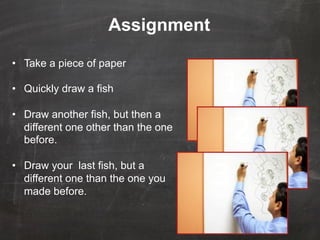
Assignment

•  Take a piece of paper

•  Quickly draw a fish                1
•  Draw another fish, but then a
   different one other than the one
   before.                                2
                                      3
•  Draw your last fish, but a
   different one than the one you
   made before.
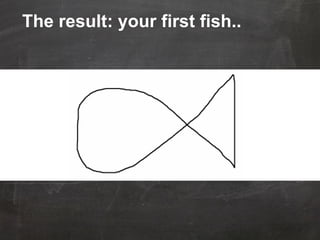
The result: your first fish..
Does this mean that no one is creative?


>  NO! This means that we are pre-programmed in our thinking paterns
>  When we realize this we can start braking these paterns
>  Thinking through gets us the most creative resuls, so quantity= quality!
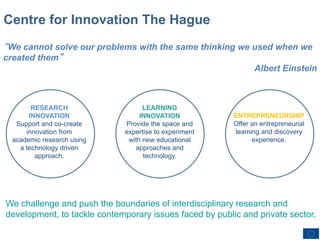
Centre for Innovation The Hague
“We cannot solve our problems with the same thinking we used when we
created them”
                                                        Albert Einstein


          RESEARCH                                                LEARNING
         INNOVATION                                              INNOVATION           ENTREPRENEURSHIP
     Support and co-create                                  Provide the space and     Offer an entrepreneurial
        innovation from                                     expertise to experiment   learning and discovery
    academic research using                                  with new educational           experience.
      a technology driven                                      approaches and
           approach.                                              technology.


 We challenge and push the boundaries of interdisciplinary research and
 development, to tackle contemporary issues faced by public and private sector.

Copyright © 2012 Universiteit Leiden All Rights Reserved.
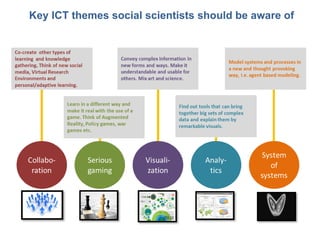
Key ICT themes social scientists should be aware of


Copyright © 2012 Universiteit Leiden All Rights Reserved.
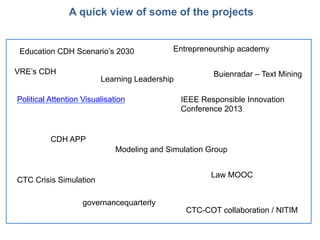
A quick view of some of the projects


        Education CDH Scenario’s 2030                                 Entrepreneurship academy

     VRE’s CDH                                                                   Buienradar – Text Mining
                                                Learning Leadership

      Political Attention Visualisation                                 IEEE Responsible Innovation
                                                                        Conference 2013


                       CDH APP
                                                        Modeling and Simulation Group


                                                                                Law MOOC
      CTC Crisis Simulation

                                       governancequarterly
                                                                          CTC-COT collaboration / NITIM

Copyright © 2012 Universiteit Leiden All Rights Reserved.
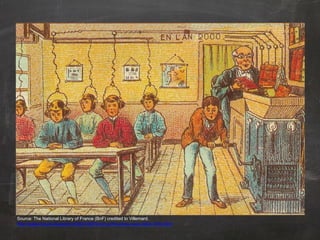
Source: The National Library of France (BnF) credited to Villemard.
http://paleo-future.blogspot.nl/2007/09/french-prints-show-year-2000-1910.html
Why Learning Innovation?

Weak influence of research findings on academic educational
practice caused by:
    •  the low status of educational research, hampered by a lack
       of strict methodological rigor, frameworks and norms of
       research, and
    •  the fact that the produced knowledge is not applied in the
       field, as universities do not emphasize on educational
       research (Tierney and Holley, 2008)
Socio economic: Push to do more with less; No time and money to
invest in better
Internal: Low priority given to teaching/learning (research more
important)


The Challenge
Develop effective and new ways of learning while maintaining
flexibility to shift and change with the curve and staying ahead.
Stay Ahead of The curve
What will our future look
          like?
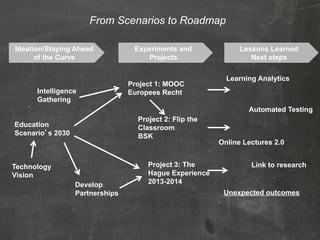
From Scenarios to Roadmap

Ideation/Staying Ahead            Experiments and              Lessons Learned
      of the Curve                   Projects                     Next steps

                                                           Learning Analytics
                                 Project 1: MOOC
      Intelligence               Europees Recht
      Gathering
                                                                 Automated Testing
                                   Project 2: Flip the
Education                          Classroom
Scenario’s 2030                    BSK
                                                         Online Lectures 2.0


Technology                            Project 3: The              Link to research
Vision                                Hague Experience
                  Develop             2013-2014
                  Partnerships                            Unexpected outcomes
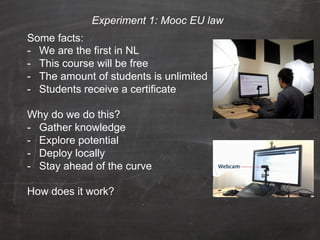
Experiment 1: Mooc EU law
Some facts:
-  We are the first in NL
-  This course will be free
-  The amount of students is unlimited
-  Students receive a certificate

Why do we do this?
-  Gather knowledge
-  Explore potential
-  Deploy locally
-  Stay ahead of the curve

How does it work?
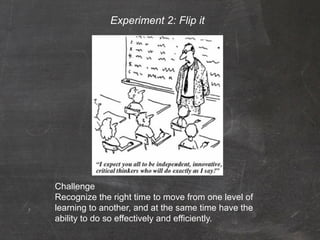
Experiment 2: Flip it


Challenge
Recognize the right time to move from one level of
learning to another, and at the same time have the
ability to do so effectively and efficiently.
Next Steps


    •  Further experiment with technology
       themes in relation to learning
    •  Explore link research and education
    •  Enable this space for experiments and
       inspiration in new way of learning

Copyright © 2012 Universiteit Leiden All Rights Reserved.
Q&A

CFITH icto symposium 23 okt

  • 1.
    Centre for InnovationThe Hague Learning Innovation ICTO Symposium 2012 Copyright © 2012 Universiteit Leiden All Rights Reserved.
  • 2.
    Assignment •  Take apiece of paper •  Quickly draw a fish 1 •  Draw another fish, but then a different one other than the one before. 2 3 •  Draw your last fish, but a different one than the one you made before.
  • 3.
    The result: yourfirst fish..
  • 4.
    Does this meanthat no one is creative? >  NO! This means that we are pre-programmed in our thinking paterns >  When we realize this we can start braking these paterns >  Thinking through gets us the most creative resuls, so quantity= quality!
  • 5.
    Centre for InnovationThe Hague “We cannot solve our problems with the same thinking we used when we created them” Albert Einstein RESEARCH LEARNING INNOVATION INNOVATION ENTREPRENEURSHIP Support and co-create Provide the space and Offer an entrepreneurial innovation from expertise to experiment learning and discovery academic research using with new educational experience. a technology driven approaches and approach. technology. We challenge and push the boundaries of interdisciplinary research and development, to tackle contemporary issues faced by public and private sector. Copyright © 2012 Universiteit Leiden All Rights Reserved.
  • 6.
    Key ICT themessocial scientists should be aware of Copyright © 2012 Universiteit Leiden All Rights Reserved.
  • 7.
    A quick viewof some of the projects Education CDH Scenario’s 2030 Entrepreneurship academy VRE’s CDH Buienradar – Text Mining Learning Leadership Political Attention Visualisation IEEE Responsible Innovation Conference 2013 CDH APP Modeling and Simulation Group Law MOOC CTC Crisis Simulation governancequarterly CTC-COT collaboration / NITIM Copyright © 2012 Universiteit Leiden All Rights Reserved.
  • 8.
    Source: The NationalLibrary of France (BnF) credited to Villemard. http://paleo-future.blogspot.nl/2007/09/french-prints-show-year-2000-1910.html
  • 9.
    Why Learning Innovation? Weakinfluence of research findings on academic educational practice caused by: •  the low status of educational research, hampered by a lack of strict methodological rigor, frameworks and norms of research, and •  the fact that the produced knowledge is not applied in the field, as universities do not emphasize on educational research (Tierney and Holley, 2008) Socio economic: Push to do more with less; No time and money to invest in better Internal: Low priority given to teaching/learning (research more important) The Challenge Develop effective and new ways of learning while maintaining flexibility to shift and change with the curve and staying ahead.
  • 10.
    Stay Ahead ofThe curve What will our future look like?
  • 11.
    From Scenarios toRoadmap Ideation/Staying Ahead Experiments and Lessons Learned of the Curve Projects Next steps Learning Analytics Project 1: MOOC Intelligence Europees Recht Gathering Automated Testing Project 2: Flip the Education Classroom Scenario’s 2030 BSK Online Lectures 2.0 Technology Project 3: The Link to research Vision Hague Experience Develop 2013-2014 Partnerships Unexpected outcomes
  • 12.
    Experiment 1: MoocEU law Some facts: -  We are the first in NL -  This course will be free -  The amount of students is unlimited -  Students receive a certificate Why do we do this? -  Gather knowledge -  Explore potential -  Deploy locally -  Stay ahead of the curve How does it work?
  • 13.
    Experiment 2: Flipit Challenge Recognize the right time to move from one level of learning to another, and at the same time have the ability to do so effectively and efficiently.
  • 14.
    Next Steps •  Further experiment with technology themes in relation to learning •  Explore link research and education •  Enable this space for experiments and inspiration in new way of learning Copyright © 2012 Universiteit Leiden All Rights Reserved.
  • 15.