Copyright © 2015, Performance Support Systems, Inc. Sharing authorized for educational purposes only.
www.ProStarCoach.com
10 Things Every Learner
Needs to KNOW and DO
By
Dennis E. Coates, Ph.D. and Meredith M. Bell
Copyright © 2015, Performance Support Systems, Inc. Sharing authorized for educational purposes only.
www.ProStarCoach.com
IMPROVING SKILLS
5 Things You Need to KNOW
1. KNOWING what to do isn’t the same as DOING it.
You can learn what to do through classroom instruction,
books, videos, and articles. But this aspect of learning is only
the beginning. Acquiring knowledge doesn’t guarantee that
you’ll actually apply it when you need to.
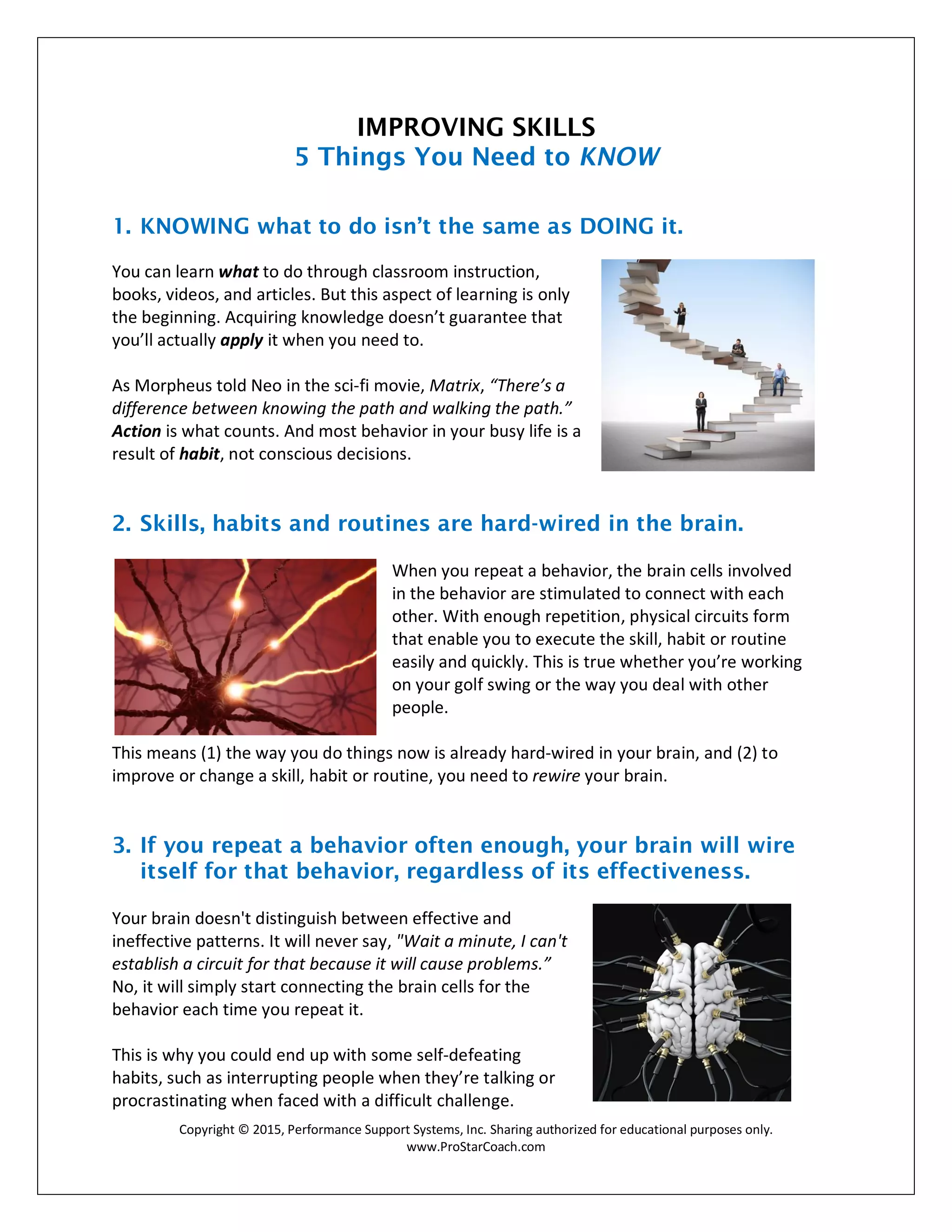
As Morpheus told Neo in the sci-fi movie, Matrix, “There’s a
difference between knowing the path and walking the path.”
Action is what counts. And most behavior in your busy life is a
result of habit, not conscious decisions.
2. Skills, habits and routines are hard-wired in the brain.
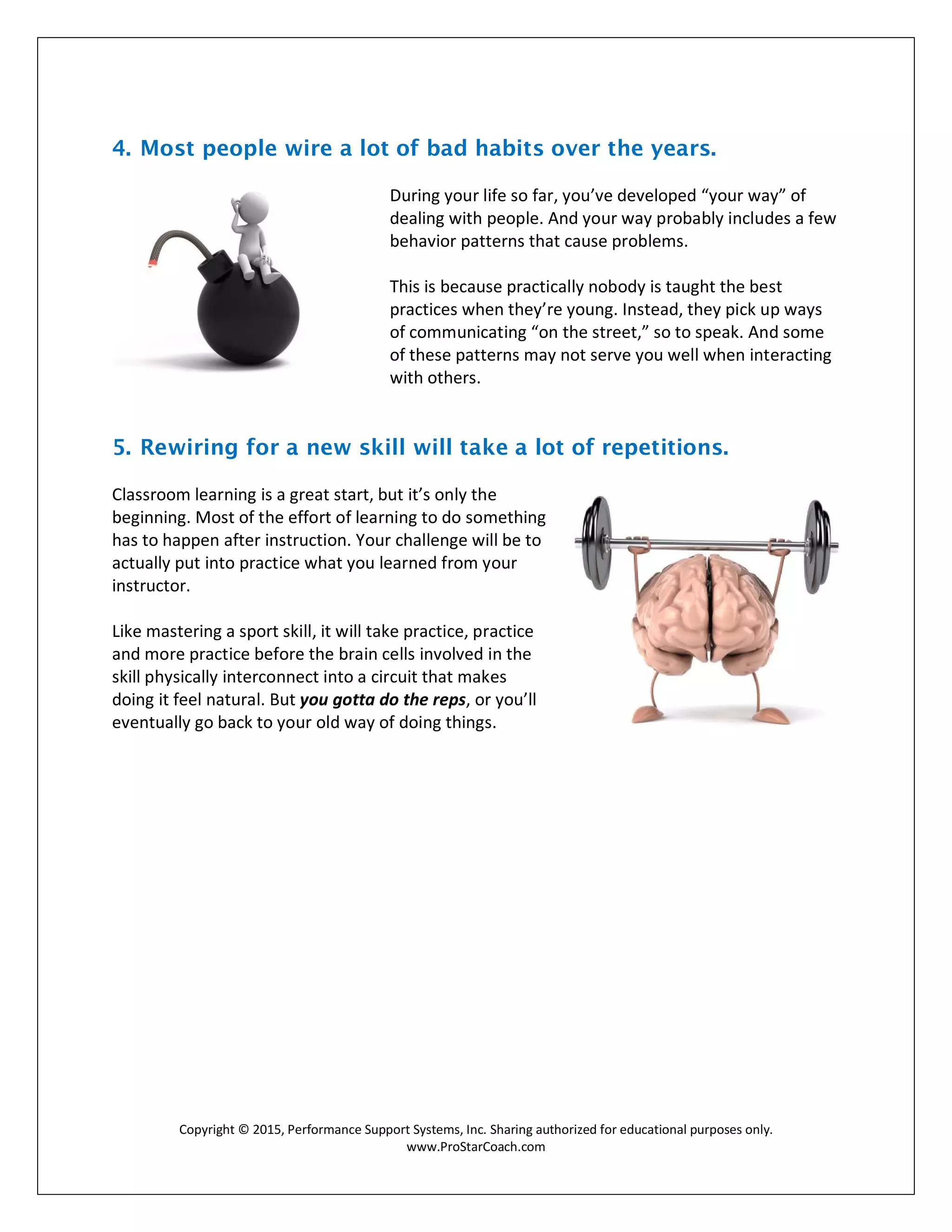
When you repeat a behavior, the brain cells involved
in the behavior are stimulated to connect with each
other. With enough repetition, physical circuits form
that enable you to execute the skill, habit or routine
easily and quickly. This is true whether you’re working
on your golf swing or the way you deal with other
people.
This means (1) the way you do things now is already hard-wired in your brain, and (2) to
improve or change a skill, habit or routine, you need to rewire your brain.
3. If you repeat a behavior often enough, your brain will wire
itself for that behavior, regardless of its effectiveness.
Your brain doesn't distinguish between effective and
ineffective patterns. It will never say, "Wait a minute, I can't
establish a circuit for that because it will cause problems.”
No, it will simply start connecting the brain cells for the
behavior each time you repeat it.
This is why you could end up with some self-defeating
habits, such as interrupting people when they’re talking or
procrastinating when faced with a difficult challenge.
Copyright © 2015, Performance Support Systems, Inc. Sharing authorized for educational purposes only.
www.ProStarCoach.com
4. Most people wire a lot of bad habits over the years.
During your life so far, you’ve developed “your way” of
dealing with people. And your way probably includes a few
behavior patterns that cause problems.
This is because practically nobody is taught the best
practices when they’re young. Instead, they pick up ways
of communicating “on the street,” so to speak. And some
of these patterns may not serve you well when interacting
with others.
5. Rewiring for a new skill will take a lot of repetitions.
Classroom learning is a great start, but it’s only the
beginning. Most of the effort of learning to do something
has to happen after instruction. Your challenge will be to
actually put into practice what you learned from your
instructor.
Like mastering a sport skill, it will take practice, practice
and more practice before the brain cells involved in the
skill physically interconnect into a circuit that makes
doing it feel natural. But you gotta do the reps, or you’ll
eventually go back to your old way of doing things.
Copyright © 2015, Performance Support Systems, Inc. Sharing authorized for educational purposes only.
www.ProStarCoach.com
IMPROVING SKILLS
5 Things You Need to DO
1. Take responsibility for your own learning.
People around you may encourage you to change. And an
instructor can show you how to improve.
But only you can make this happen. Only you can do the work to
rewire your brain for a new skill or habit.
2. Accept that at first you’ll have failures and setbacks, and
don’t give up.
Even if you value what you learned
and fully intend to implement it, at
first you may forget to do so. You’ll
have to make a conscious effort;
but even if you do, the skill may
feel awkward and ineffective.
Almost everyone experiences this
kind of frustration at first, because
the habits you already have get in the way of the new habits you’re trying to adopt. You
may think, “This doesn’t feel right. I don’t think this is going to work for me.”
Discouraged, you might be tempted to give up trying.
The key is to persist past this “crunch point.” If
you keep trying, you’ll forget less often. Your
efforts will start to achieve results.
Keep trying and eventually your “failure rate” will
approach zero. The new habit will become
dominant, and you’ll find yourself performing the
new, improved skill without consciously deciding
to do it.
Copyright © 2015, Performance Support Systems, Inc. Sharing authorized for educational purposes only.
www.ProStarCoach.com
3. Focus on one skill or habit at a time.
If you’re ambitious, you may want to correct several behavior
patterns all at once. This would be a mistake. It’s hard enough to
apply one new skill repeatedly. Trying to work on several skills
simultaneously will water down your efforts. You won’t get
enough reps to improve any of them.
So focus on one area until it starts to feel natural and you’re
having success. Master the skill, and then you can focus on
improving something else.
4. Learn from your mistakes.
Your early efforts may be discouraging, but you can use these
experiences to improve. Ask yourself: What happened? Why
did it happen that way? What were the consequences? What
should I consider doing differently to get better results?
There are lessons to be learned from any experience, if you
take time to reflect on it.
5. Get help.
Ask people who care about your development—your instructor,
a coach, a boss, other people who are learning with you, or even
a member of your family—to help you stay focused, encourage
you and hold you accountable.
This kind of support can accelerate your learning. Ask for their
input, ideas and feedback. Ask them whether they’ve noticed
improvement. Get their suggestions about how you can perform
better.

Learning New Skills

  • 1.
    Copyright © 2015,Performance Support Systems, Inc. Sharing authorized for educational purposes only. www.ProStarCoach.com 10 Things Every Learner Needs to KNOW and DO By Dennis E. Coates, Ph.D. and Meredith M. Bell
  • 2.
    Copyright © 2015,Performance Support Systems, Inc. Sharing authorized for educational purposes only. www.ProStarCoach.com IMPROVING SKILLS 5 Things You Need to KNOW 1. KNOWING what to do isn’t the same as DOING it. You can learn what to do through classroom instruction, books, videos, and articles. But this aspect of learning is only the beginning. Acquiring knowledge doesn’t guarantee that you’ll actually apply it when you need to. As Morpheus told Neo in the sci-fi movie, Matrix, “There’s a difference between knowing the path and walking the path.” Action is what counts. And most behavior in your busy life is a result of habit, not conscious decisions. 2. Skills, habits and routines are hard-wired in the brain. When you repeat a behavior, the brain cells involved in the behavior are stimulated to connect with each other. With enough repetition, physical circuits form that enable you to execute the skill, habit or routine easily and quickly. This is true whether you’re working on your golf swing or the way you deal with other people. This means (1) the way you do things now is already hard-wired in your brain, and (2) to improve or change a skill, habit or routine, you need to rewire your brain. 3. If you repeat a behavior often enough, your brain will wire itself for that behavior, regardless of its effectiveness. Your brain doesn't distinguish between effective and ineffective patterns. It will never say, "Wait a minute, I can't establish a circuit for that because it will cause problems.” No, it will simply start connecting the brain cells for the behavior each time you repeat it. This is why you could end up with some self-defeating habits, such as interrupting people when they’re talking or procrastinating when faced with a difficult challenge.
  • 3.
    Copyright © 2015,Performance Support Systems, Inc. Sharing authorized for educational purposes only. www.ProStarCoach.com 4. Most people wire a lot of bad habits over the years. During your life so far, you’ve developed “your way” of dealing with people. And your way probably includes a few behavior patterns that cause problems. This is because practically nobody is taught the best practices when they’re young. Instead, they pick up ways of communicating “on the street,” so to speak. And some of these patterns may not serve you well when interacting with others. 5. Rewiring for a new skill will take a lot of repetitions. Classroom learning is a great start, but it’s only the beginning. Most of the effort of learning to do something has to happen after instruction. Your challenge will be to actually put into practice what you learned from your instructor. Like mastering a sport skill, it will take practice, practice and more practice before the brain cells involved in the skill physically interconnect into a circuit that makes doing it feel natural. But you gotta do the reps, or you’ll eventually go back to your old way of doing things.
  • 4.
    Copyright © 2015,Performance Support Systems, Inc. Sharing authorized for educational purposes only. www.ProStarCoach.com IMPROVING SKILLS 5 Things You Need to DO 1. Take responsibility for your own learning. People around you may encourage you to change. And an instructor can show you how to improve. But only you can make this happen. Only you can do the work to rewire your brain for a new skill or habit. 2. Accept that at first you’ll have failures and setbacks, and don’t give up. Even if you value what you learned and fully intend to implement it, at first you may forget to do so. You’ll have to make a conscious effort; but even if you do, the skill may feel awkward and ineffective. Almost everyone experiences this kind of frustration at first, because the habits you already have get in the way of the new habits you’re trying to adopt. You may think, “This doesn’t feel right. I don’t think this is going to work for me.” Discouraged, you might be tempted to give up trying. The key is to persist past this “crunch point.” If you keep trying, you’ll forget less often. Your efforts will start to achieve results. Keep trying and eventually your “failure rate” will approach zero. The new habit will become dominant, and you’ll find yourself performing the new, improved skill without consciously deciding to do it.
  • 5.
    Copyright © 2015,Performance Support Systems, Inc. Sharing authorized for educational purposes only. www.ProStarCoach.com 3. Focus on one skill or habit at a time. If you’re ambitious, you may want to correct several behavior patterns all at once. This would be a mistake. It’s hard enough to apply one new skill repeatedly. Trying to work on several skills simultaneously will water down your efforts. You won’t get enough reps to improve any of them. So focus on one area until it starts to feel natural and you’re having success. Master the skill, and then you can focus on improving something else. 4. Learn from your mistakes. Your early efforts may be discouraging, but you can use these experiences to improve. Ask yourself: What happened? Why did it happen that way? What were the consequences? What should I consider doing differently to get better results? There are lessons to be learned from any experience, if you take time to reflect on it. 5. Get help. Ask people who care about your development—your instructor, a coach, a boss, other people who are learning with you, or even a member of your family—to help you stay focused, encourage you and hold you accountable. This kind of support can accelerate your learning. Ask for their input, ideas and feedback. Ask them whether they’ve noticed improvement. Get their suggestions about how you can perform better.