Things We’ve Learned Since
By
Mike Rother
and Jeff Liker
November 2018
1
If you’ve ever made a VS map,
this SlideShare is for you
2
2019 is the 20th Anniversary
of the Book Learning to See
In 1999, LTS kicked off worldwide
interest in Value Stream Mapping.
VSM has become the tool for
analyzing & designing work flows
at the door-to-door system level, and
LTS is a widely-used instruction manual.
3
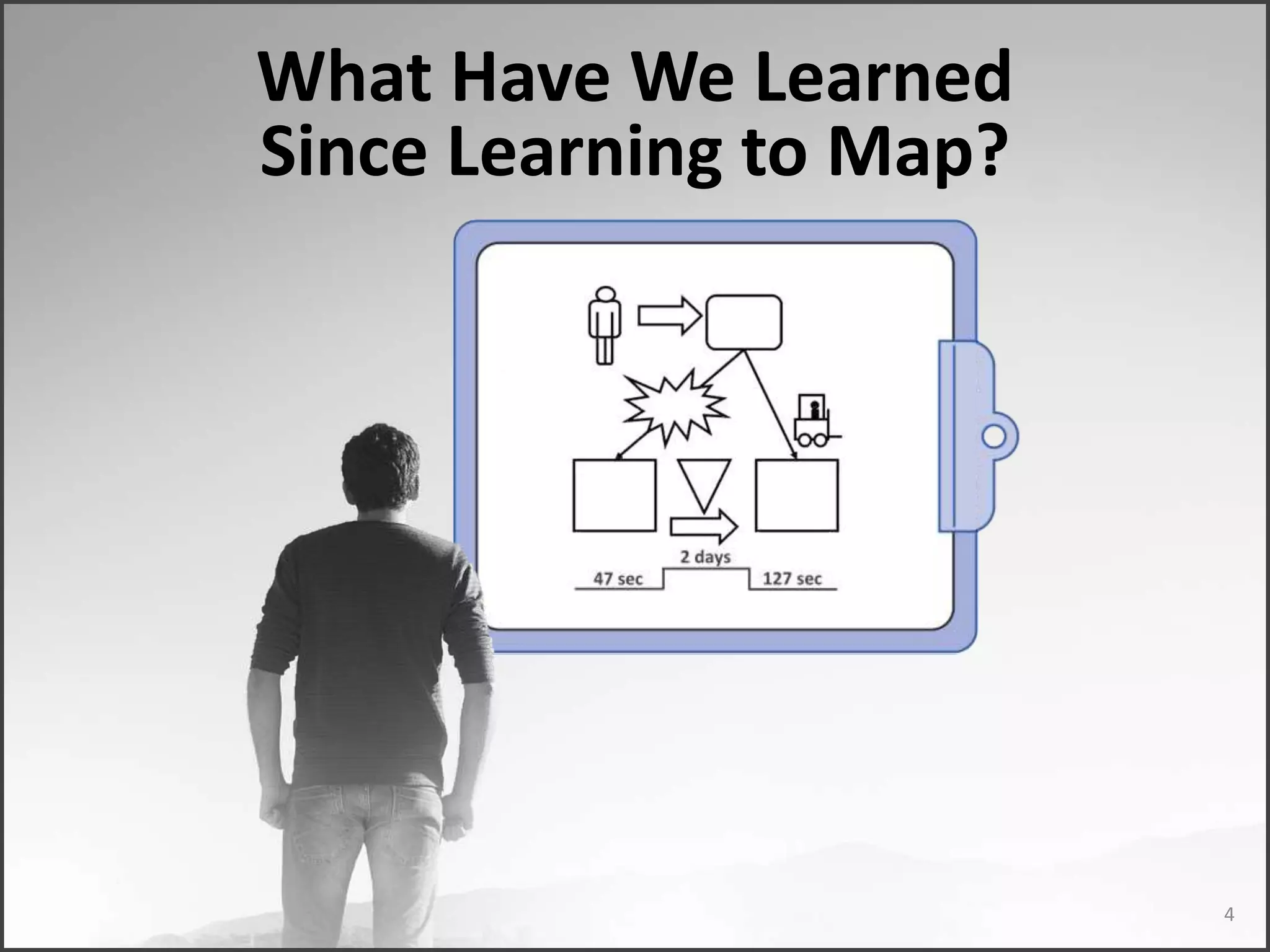
What Have We Learned
Since Learning to Map?
4
A Lot of VSM Information
Has Been About How to Do VS Mapping
A different issue is not how to do
better mapping, but rather ... what do
you do with a future-state map?
5
How do you make what your map depicts real??
A significant area of learning for us has
been how to turn future-state VS maps
into reality, rather than wallpaper.
6
A future-state map provides a
high-level picture of an imagined
material and information flow
7
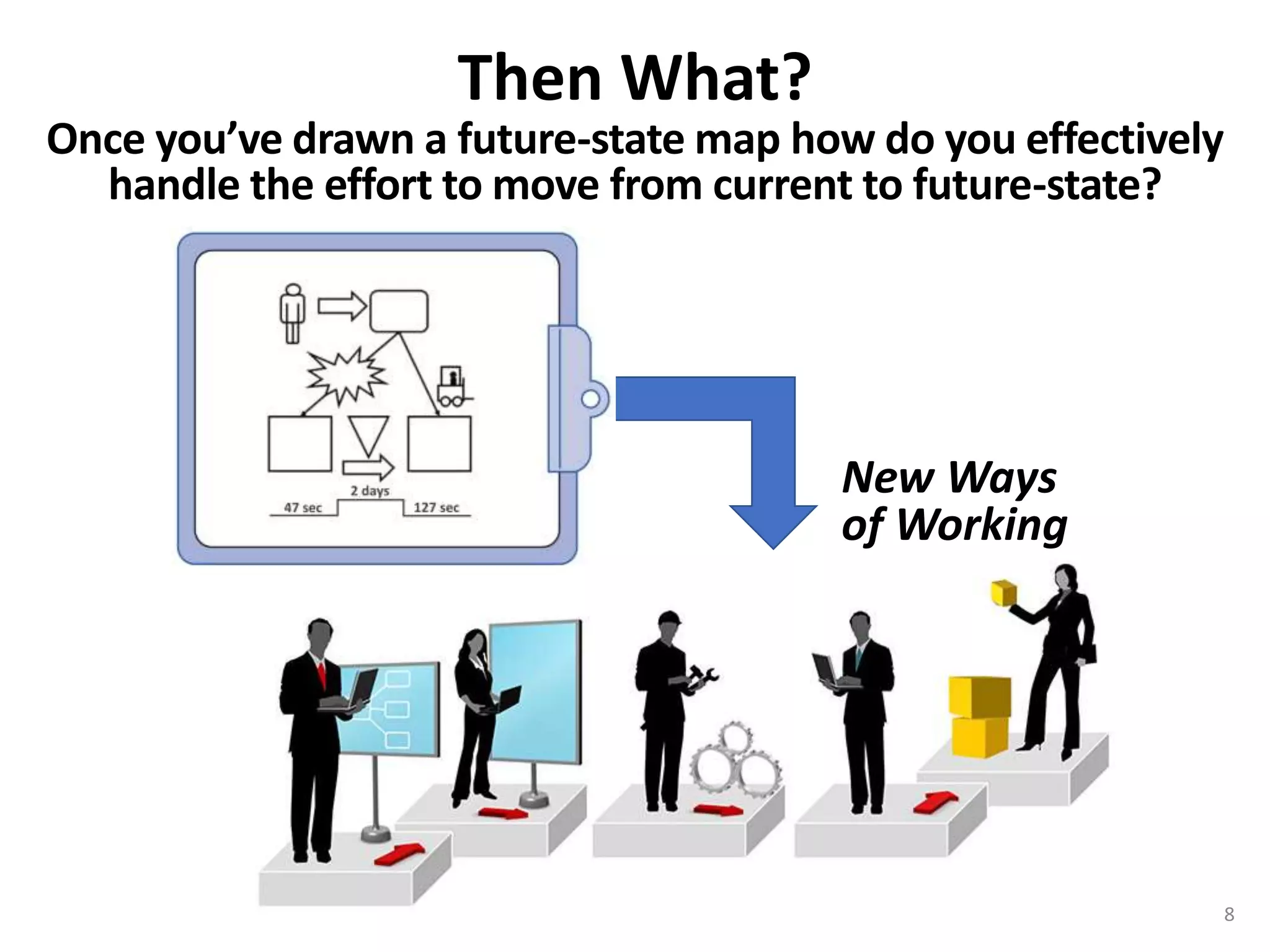
Then What?
New Ways
of Working
Once you’ve drawn a future-state map how do you effectively
handle the effort to move from current to future-state?
8
We convert our imagined future into a
list of implementation actions. Ironically
these action-item lists are made at the
point of maximum uncertainty about
how the implementation will actually go.
Problem #1:
An action list is only a
prediction, and a poor
one at that
9
A value stream design involves multiple
departments, processes and people.
It’s more complicated than modifying a single process.
Problem #2:
10
So Much Can (and will) Go Wrong
11
Taleb,N.N.(2012).Antifragile:Thingsthatgainfromdisorder.
NewYork:RandomHouse.
What Do You Do?
Here’s Nassim Nicholas Taleb on Dealing with Uncertainty
Outperformance arises
from optionality rather
than intelligence.*
Translation: Instead of trying to know in advance what is
going to happen, position yourself in such a way that you
have options to test. The advantage of optionality is that
as the world grows increasingly difficult to predict, you
can thrive in spite of not knowing the future.
*
12
"Let'stryitandsee"
It’s Scientific Thinking!
Source: Toyota Kata Practice Guide 13
What you learn in one step can
influence what you do in the next step
Scientific Thinking is Like
Navigating with a Compass
Scientific thinking may be the best means we
have for navigating through complex, dynamic,
unpredictable territory toward challenging goals
such as a future-state value stream design
You’ve defined a direction, but
the path to your future state,
and even what your future
state ends up looking like, is
not entirely predictable.
14
“We place the highest value on actual
implementation and taking action. There
are many things one doesn’t understand
and therefore we ask them why don’t
you just go ahead and take action: try
to do something? You realize how little
you know and you face your own failures
and redo it again and at the second trial
you realize another mistake or another
thing you didn’t like so you can redo it
once again. So by constant improvement
or, should I say, the improvement based
upon action, one can rise to the higher
level of practice and knowledge.”
-- Fujio Cho, former President, Toyota Motor Company
(as quoted in The Toyota Way)
In 2004 The Toyota Way
Described the Approach
15
In 2009 Toyota Kata
Gave Us a Way to Practice It
The Improvement Kata and
Coaching Kata gave us practical
scientific-thinking practice
routines for navigating
the way to our
desired future.
16
1A future-state map is
sometimes even called
a “Challenge Map.”
It’s a Great Match
Source: Toyota Kata Practice Guide
VSM helps you define direction
Toyota Kata helps you builds skills to get there
17
Conduct Experiments
to Get There
Value Stream Mapping provides a shared
picture of delivering customer value
Source: Toyota Kata Practice Guide 18
Challenge
Toyota Kata helps teams practice an
effective means for getting there
Source: Toyota Kata Practice Guide 19
Challenge
It’s just like what we found at Toyota
Everyone in an organization doesn’t do VSM,
but everyone benefits from practicing Toyota Kata
Setting direction with
VSM is the responsibility
of a few people
Practicing the Improvement
Kata and Coaching Kata
involves everyone 20
Challenge
We need both a sense of direction, and
team scientific-thinking skills for moving there
(A)
A direction,
through value
stream mapping
(B)
Working
scientifically with
the Improvement
Kata to get there
Lesson Learned
21
1999 2004 2009 2018
20 Years of Learning & Sharing - So Far
2015
First Annual
Kata Summit
22
Be Part of What’s Next!
23
And thank you for joining us on the trip!
24

VSM and Toyota Kata

  • 1.
    Things We’ve LearnedSince By Mike Rother and Jeff Liker November 2018 1
  • 2.
    If you’ve evermade a VS map, this SlideShare is for you 2
  • 3.
    2019 is the20th Anniversary of the Book Learning to See In 1999, LTS kicked off worldwide interest in Value Stream Mapping. VSM has become the tool for analyzing & designing work flows at the door-to-door system level, and LTS is a widely-used instruction manual. 3
  • 4.
    What Have WeLearned Since Learning to Map? 4
  • 5.
    A Lot ofVSM Information Has Been About How to Do VS Mapping A different issue is not how to do better mapping, but rather ... what do you do with a future-state map? 5 How do you make what your map depicts real??
  • 6.
    A significant areaof learning for us has been how to turn future-state VS maps into reality, rather than wallpaper. 6
  • 7.
    A future-state mapprovides a high-level picture of an imagined material and information flow 7
  • 8.
    Then What? New Ways ofWorking Once you’ve drawn a future-state map how do you effectively handle the effort to move from current to future-state? 8
  • 9.
    We convert ourimagined future into a list of implementation actions. Ironically these action-item lists are made at the point of maximum uncertainty about how the implementation will actually go. Problem #1: An action list is only a prediction, and a poor one at that 9
  • 10.
    A value streamdesign involves multiple departments, processes and people. It’s more complicated than modifying a single process. Problem #2: 10
  • 11.
    So Much Can(and will) Go Wrong 11
  • 12.
    Taleb,N.N.(2012).Antifragile:Thingsthatgainfromdisorder. NewYork:RandomHouse. What Do YouDo? Here’s Nassim Nicholas Taleb on Dealing with Uncertainty Outperformance arises from optionality rather than intelligence.* Translation: Instead of trying to know in advance what is going to happen, position yourself in such a way that you have options to test. The advantage of optionality is that as the world grows increasingly difficult to predict, you can thrive in spite of not knowing the future. * 12
  • 13.
    "Let'stryitandsee" It’s Scientific Thinking! Source:Toyota Kata Practice Guide 13 What you learn in one step can influence what you do in the next step
  • 14.
    Scientific Thinking isLike Navigating with a Compass Scientific thinking may be the best means we have for navigating through complex, dynamic, unpredictable territory toward challenging goals such as a future-state value stream design You’ve defined a direction, but the path to your future state, and even what your future state ends up looking like, is not entirely predictable. 14
  • 15.
    “We place thehighest value on actual implementation and taking action. There are many things one doesn’t understand and therefore we ask them why don’t you just go ahead and take action: try to do something? You realize how little you know and you face your own failures and redo it again and at the second trial you realize another mistake or another thing you didn’t like so you can redo it once again. So by constant improvement or, should I say, the improvement based upon action, one can rise to the higher level of practice and knowledge.” -- Fujio Cho, former President, Toyota Motor Company (as quoted in The Toyota Way) In 2004 The Toyota Way Described the Approach 15
  • 16.
    In 2009 ToyotaKata Gave Us a Way to Practice It The Improvement Kata and Coaching Kata gave us practical scientific-thinking practice routines for navigating the way to our desired future. 16
  • 17.
    1A future-state mapis sometimes even called a “Challenge Map.” It’s a Great Match Source: Toyota Kata Practice Guide VSM helps you define direction Toyota Kata helps you builds skills to get there 17 Conduct Experiments to Get There
  • 18.
    Value Stream Mappingprovides a shared picture of delivering customer value Source: Toyota Kata Practice Guide 18 Challenge
  • 19.
    Toyota Kata helpsteams practice an effective means for getting there Source: Toyota Kata Practice Guide 19 Challenge
  • 20.
    It’s just likewhat we found at Toyota Everyone in an organization doesn’t do VSM, but everyone benefits from practicing Toyota Kata Setting direction with VSM is the responsibility of a few people Practicing the Improvement Kata and Coaching Kata involves everyone 20 Challenge
  • 21.
    We need botha sense of direction, and team scientific-thinking skills for moving there (A) A direction, through value stream mapping (B) Working scientifically with the Improvement Kata to get there Lesson Learned 21
  • 22.
    1999 2004 20092018 20 Years of Learning & Sharing - So Far 2015 First Annual Kata Summit 22
  • 23.
    Be Part ofWhat’s Next! 23
  • 24.
    And thank youfor joining us on the trip! 24

Editor's Notes

  • #15 Map means you already know the way. Compass mean you know where you’re headed, but not exactly how you will get there.