UNIVERSIDAD AUTÓNOMA
DEL CARMEN
TICS APLICADAS A LA
ENSEÑANZA DEL INGLÉS
Alumna: Emily Mayo Clemente
Maestro: Rafael Ferrer Méndez
Activity
1.9
Computer Assisted
Language Learning
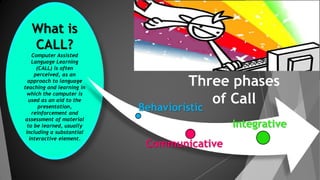
What is
CALL?
Computer Assisted
Language Learning
(CALL) is often
perceived, as an
approach to language
teaching and learning in
which the computer is
used as an aid to the
presentation,
reinforcement and
assessment of material
to be learned, usually
including a substantial
interactive element.
Behavioristic
Communicative
Integrative
Three phases
of Call
• Conceived in the 1950s and implemented in the 1960s and '70s, was
based on the then-dominant behaviorist theories of learning.
• Programs of this phase entailed repetitive language drills and can be referred to as "drill
and practice" (or, more pejoratively, as "drill and kill").
The rationale behind drill and practice
was not totally spurious. That rationale is
as follows:
 Repeated exposure to the same material is beneficial
or even essential to learning
 A computer is ideal for carrying out repeated drills
 A computer can present such material on an
individualized basis0
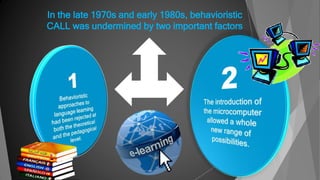
In the late 1970s and early 1980s, behavioristic
CALL was undermined by two important factors
Proponents of this approach felt that
the drill and practice programs of the
previous decade did not allow enough
authentic communication to be of much
value.
There were a variety of programs to provide skill practice,
but in a non-drill format:
Courseware
for paced
reading
Text
reconstruction
Language
games
•Another CALL model used for
communicative activities involves the
computer as stimulus.
•The third model of computers in
communicative CALL involves the
computer as tool or, as sometimes
called, the computer as workhorse.
MULTIMEDIA
 Multimedia technology - exemplified today by the
CD-ROM - allows a variety of media (text,
graphics, sound, animation, and video) to be
accessed on a single machine.
 Hypermedia provides a number of advantages for
language learning.
 Skills are easily integrated, since the variety of
media make it natural to combine reading,
writing, speaking and listening in a single activity.
INTERNET
 Using the World Wide Web (WWW),
students can search through millions of files
around the world within minutes to locate and
access authentic materials.
 For the first time, language learners can
communicate directly, inexpensively, and
conveniently with other learners or speakers
of the target language 24 hours a day, from
school, work, or home.
 It also allows not only one-to-one
communication, but also one-to-many,
allowing a teacher or student to share a
message with a small group, the whole class,
a partner class, or an international discussion
list of hundreds or thousands of people.
Integrative
approaches to CALL
are based on two
important
technological
developments of
the last decade -
multimedia
computers and the
Internet.
SOURCES:
Warschauer M. (1996) "Computer Assisted Language Learning: an
Introduction". Retrieved on September 10, 2016 From:
http://www.ict4lt.org/en/warschauer.htm

CALL

  • 1.
    UNIVERSIDAD AUTÓNOMA DEL CARMEN TICSAPLICADAS A LA ENSEÑANZA DEL INGLÉS Alumna: Emily Mayo Clemente Maestro: Rafael Ferrer Méndez Activity 1.9
  • 2.
  • 3.
    What is CALL? Computer Assisted LanguageLearning (CALL) is often perceived, as an approach to language teaching and learning in which the computer is used as an aid to the presentation, reinforcement and assessment of material to be learned, usually including a substantial interactive element. Behavioristic Communicative Integrative Three phases of Call
  • 4.
    • Conceived inthe 1950s and implemented in the 1960s and '70s, was based on the then-dominant behaviorist theories of learning. • Programs of this phase entailed repetitive language drills and can be referred to as "drill and practice" (or, more pejoratively, as "drill and kill"). The rationale behind drill and practice was not totally spurious. That rationale is as follows:  Repeated exposure to the same material is beneficial or even essential to learning  A computer is ideal for carrying out repeated drills  A computer can present such material on an individualized basis0
  • 5.
    In the late1970s and early 1980s, behavioristic CALL was undermined by two important factors
  • 6.
    Proponents of thisapproach felt that the drill and practice programs of the previous decade did not allow enough authentic communication to be of much value. There were a variety of programs to provide skill practice, but in a non-drill format: Courseware for paced reading Text reconstruction Language games •Another CALL model used for communicative activities involves the computer as stimulus. •The third model of computers in communicative CALL involves the computer as tool or, as sometimes called, the computer as workhorse.
  • 7.
    MULTIMEDIA  Multimedia technology- exemplified today by the CD-ROM - allows a variety of media (text, graphics, sound, animation, and video) to be accessed on a single machine.  Hypermedia provides a number of advantages for language learning.  Skills are easily integrated, since the variety of media make it natural to combine reading, writing, speaking and listening in a single activity. INTERNET  Using the World Wide Web (WWW), students can search through millions of files around the world within minutes to locate and access authentic materials.  For the first time, language learners can communicate directly, inexpensively, and conveniently with other learners or speakers of the target language 24 hours a day, from school, work, or home.  It also allows not only one-to-one communication, but also one-to-many, allowing a teacher or student to share a message with a small group, the whole class, a partner class, or an international discussion list of hundreds or thousands of people. Integrative approaches to CALL are based on two important technological developments of the last decade - multimedia computers and the Internet.
  • 8.
    SOURCES: Warschauer M. (1996)"Computer Assisted Language Learning: an Introduction". Retrieved on September 10, 2016 From: http://www.ict4lt.org/en/warschauer.htm