learning analytics
what are learning analytics?
    related fields of study
 processes       resources
 a model for learning analytics
      where are we now?
     implementation tips
references      literature review
learning analytics are:
  the ability to “scale the real-time use of learning
  analytics by students, instructors and academic
  advisors to improve student success”

            - Next Generation: Learning Challenges

                     next page: learning analytics involves

main page
learning analytics involves:
     1. the development of new processes and tools
        aimed at improving learning and teaching for
        individual students and instructors

     2. the integration of these tools and processes
        into the practice of teaching and learning
                         next page: related fields of study

main page                                     related links
related fields of study
   business intelligence

            web analytics
                 academic analytics
                        action analytics
main page
business intelligence:
   a well-established process in the business world
   whereby decision makers integrate strategic
   thinking with information technology to be able
   to synthesize “vast amounts of data into
   powerful, decision making capabilities”
                                        - Baker, 2007

                                next page: web analytics

main page
web analytics:
 “the collection, analysis and reporting of Web site
 usage by visitors and customers of a web site” in
 order to “better understand the effectiveness of
 online initiatives and other changes to the web site
 in an objective, scientific way through
 experimentation, testing, and measurement”
                                     - McFadden, 2005
                          next page: academic analytics
main page                                  related links
academic analytics:
  the application of the principles and tools of
  business intelligence to how institutions
  gather, analyze, and use data to improve student
  success
                     -Campbell and Oblinger, 2007 &
                             Goldstein and Katz, 2005
                             next page: action analytics

main page                                   related links
action analytics:
  involves deploying academic analytics “ to provide
  actionable intelligence, service-oriented
  architectures, mash-ups of information/content
  and services. proven models of course/curriculum
  reinvention, and changes in faculty practice that
  improve performance and reduce costs
                                    - Norris et al, 2008

                    next page: learning analytics processes
main page
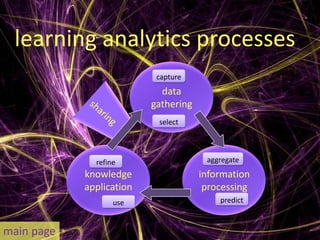
learning analytics processes
                           capture
                            data
                          gathering
                           select


              refine                   aggregate
            knowledge                 information
            application                processing
                   use                    predict


main page
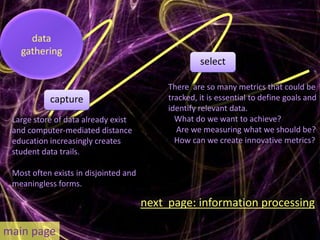
data
   gathering
                                                     select

                                            There are so many metrics that could be
           capture                          tracked, it is essential to define goals and
                                            identify relevant data.
 Large store of data already exist            What do we want to achieve?
 and computer-mediated distance               Are we measuring what we should be?
 education increasingly creates               How can we create innovative metrics?
 student data trails.

 Most often exists in disjointed and
 meaningless forms.

                                       next page: information processing

main page
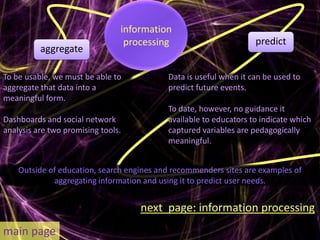
information
                                 processing                        predict
          aggregate

To be usable, we must be able to           Data is useful when it can be used to
aggregate that data into a                 predict future events.
meaningful form.
                                           To date, however, no guidance it
Dashboards and social network              available to educators to indicate which
analysis are two promising tools.          captured variables are pedagogically
                                           meaningful.


    Outside of education, search engines and recommenders sites are examples of
             aggregating information and using it to predict user needs.


                                    next page: information processing
main page
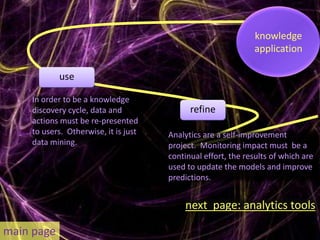
knowledge
                                                              application

            use

    In order to be a knowledge
    discovery cycle, data and               refine
    actions must be re-presented
    to users. Otherwise, it is just   Analytics are a self-improvement
    data mining.                      project. Monitoring impact must be a
                                      continual effort, the results of which are
                                      used to update the models and improve
                                      predictions.


                                          next page: analytics tools

main page
When institutions work together and
            share, duplication is reduced and
            improvements are increased.

            Sharing data, models and innovations,
            therefore, has the potential to improve
            learning for everyone.


                                         next page: analytics tools


main page
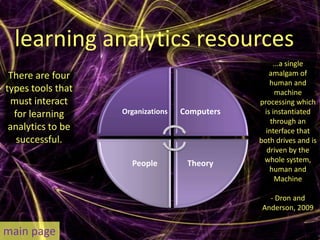
learning analytics resources
                                                    ...a single
 There are four                                   amalgam of
                                                  human and
types tools that                                     machine
 must interact                                 processing which
  for learning     Organizations   Computers    is instantiated
                                                   through an
 analytics to be                                 interface that
   successful.                                 both drives and is
                                                 driven by the
                     People         Theory      whole system,
                                                  human and
                                                     Machine

                                                 - Dron and
                                               Anderson, 2009


main page
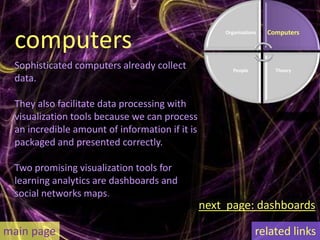
computers                                                          Computers
                                                    Organizations


 Sophisticated computers already collect               People         Theory
 data.

 They also facilitate data processing with
 visualization tools because we can process
 an incredible amount of information if it is
 packaged and presented correctly.

 Two promising visualization tools for
 learning analytics are dashboards and
 social networks maps.
                                                next page: dashboards

main page                                                       related links
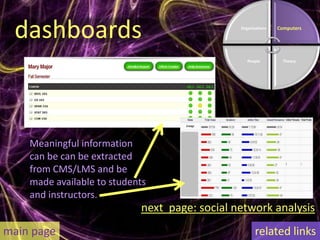
dashboards                                    Organizations   Computers


                                                  People         Theory


    Meaningful information
    can be can be extracted
    from CMS/LMS and be
    made available to students
    and instructors.
                            next page: social network analysis
main page                                             related links
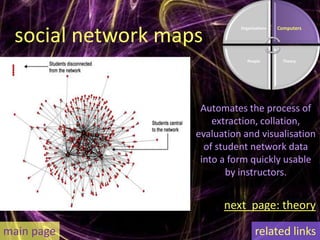
social network maps
                             Organizations   Computers


                                People         Theory


                    Automates the process of
                       extraction, collation,
                   evaluation and visualisation
                     of student network data
                    into a form quickly usable
                          by instructors.


                         next page: theory

main page                           related links
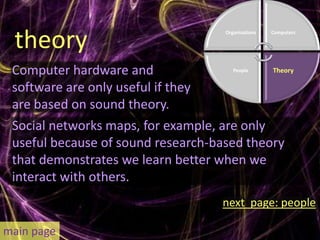
theory
                                      Organizations   Computers


 Computer hardware and                       Theory
                                         People


 software are only useful if they
 are based on sound theory.
 Social networks maps, for example, are only
 useful because of sound research-based theory
 that demonstrates we learn better when we
 interact with others.
                                      next page: people

main page
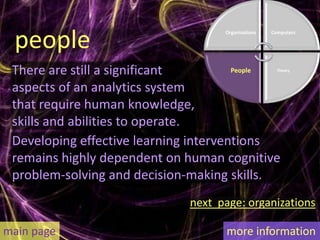
people
                                    Organizations   Computers


 There are still a significant         People         Theory


 aspects of an analytics system
 that require human knowledge,
 skills and abilities to operate.
 Developing effective learning interventions
 remains highly dependent on human cognitive
 problem-solving and decision-making skills.
                              next page: organizations

main page                            more information
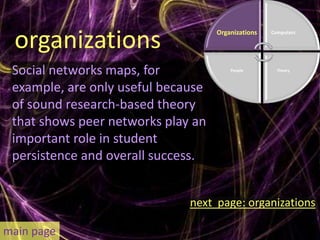
organizations                      Organizations   Computers


 Social networks maps, for              People        Theory


 example, are only useful because
 of sound research-based theory
 that shows peer networks play an
 important role in student
 persistence and overall success.


                              next page: organizations

main page
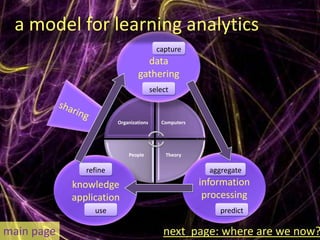
a model for learning analytics
                                          capture
                                  data
                                gathering
                                        select


                        Organizations      Computers


                            People           Theory


               refine                                    aggregate
            knowledge                                  information
            application                                 processing
                 use                                        predict

main page                                   next page: where are we now?
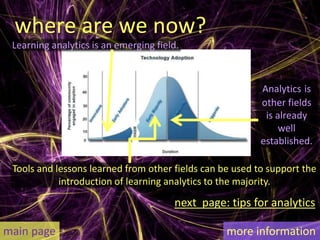
where are we now?
 Learning analytics is an emerging field.


                                                          Analytics is
                                                          other fields
                                                           is already
                                                               well
                                                          established.

 Tools and lessons learned from other fields can be used to support the
            introduction of learning analytics to the majority.

                                       next page: tips for analytics

main page                                         more information
implementation tips
 1. Learn from others disciplines in which analytics
    is an established field
 2. Find out what you are already measuring
 3. Combine web-based data with traditional
    evaluation, assessment and demographic data
 4. Good communication skills are essential
 5. Change is hard for everyone and rarely
    welcome - tread lightly and offer support
                                 next page: references
main page
references
Arnold, K. E. (2010). Signals: Applying Academic Analytics, EDUCAUSE Quarterly 33(1).
Retrieved October 1, 2010 from
http://www.educause.edu/EDUCAUSE+Quarterly/EDUCAUSEQuarterlyMagazineVolum/Si
gnalsApplyingAcademicAnalyti/199385

 Astin, A. (1993). What Matters in College? Four Critical Years Revisited. San Francisco:
Jossey-Bass.

Baker, B. (2007). A conceptual framework for making knowledge actionable through
capital formation. D.Mgt. dissertation, University of Maryland University College, United
States -- Maryland. Retrieved October 19, 2010, from ABI/INFORM Global.(Publication No.
AAT 3254328).

Dron, J. and Anderson, T. (2009). On the design of collective applications, Proceedings of
the 2009 International Conference on Computational Science and Engineering , Volume
04, pp. 368-374.

Goldstein, P. J. and Katz, R. N. (2005). Academic Analytics: The Uses of Management
Information and Technology in Higher Education, ECAR Research Study Volume 8.
Retrieved October 1, 2010 from http://www.educause.edu/ers0508

                                                     next page: references (cont’d)
references (continued)
McFadden, C. (2005). Optimizing the Online Business Channel with Web Analytics [blog
post]. Retrieved October 5, 2010 from
http://www.webanalyticsassociation.org/members/blog_view.asp?id=533997&post=8932
8&hhSearchTerms=definition+and+of+and+web+and+analytics

NextGeneration: Learning Challenges (n.d.). Learning Analytics [website]. Retrieved
October 12, 2010 from http://nextgenlearning.com/the-challenges/learning-analytics

Norris, D., Baer, L., Leonard, J., Pugliese, L. and Lefrere, P. (2008). Action Analytics:
Measuring and Improving Performance That Matters in Higher Education, EDUCAUSE
Review 43(1). Retrieved October 1, 2010
from http://www.educause.edu/EDUCAUSE+Review/EDUCAUSEReviewMagazineVolume4
3/ActionAnalyticsMeasuringandImp/162422

Zhang, H. and Almeroth, K. (2010). Moodog: Tracking Student Activity in Online Course
Management Systems. Journal of Interactive Learning Research, 21(3), 407-429.
Chesapeake, VA: AACE. Retrieved October 5, 2010 from http://0-
www.editlib.org.aupac.lib.athabascau.ca/p/32307.

Learning Analytics Oer

  • 1.
  • 2.
    what are learninganalytics? related fields of study processes resources a model for learning analytics where are we now? implementation tips references literature review
  • 3.
    learning analytics are: the ability to “scale the real-time use of learning analytics by students, instructors and academic advisors to improve student success” - Next Generation: Learning Challenges next page: learning analytics involves main page
  • 4.
    learning analytics involves: 1. the development of new processes and tools aimed at improving learning and teaching for individual students and instructors 2. the integration of these tools and processes into the practice of teaching and learning next page: related fields of study main page related links
  • 5.
    related fields ofstudy business intelligence web analytics academic analytics action analytics main page
  • 6.
    business intelligence: a well-established process in the business world whereby decision makers integrate strategic thinking with information technology to be able to synthesize “vast amounts of data into powerful, decision making capabilities” - Baker, 2007 next page: web analytics main page
  • 7.
    web analytics: “thecollection, analysis and reporting of Web site usage by visitors and customers of a web site” in order to “better understand the effectiveness of online initiatives and other changes to the web site in an objective, scientific way through experimentation, testing, and measurement” - McFadden, 2005 next page: academic analytics main page related links
  • 8.
    academic analytics: the application of the principles and tools of business intelligence to how institutions gather, analyze, and use data to improve student success -Campbell and Oblinger, 2007 & Goldstein and Katz, 2005 next page: action analytics main page related links
  • 9.
    action analytics: involves deploying academic analytics “ to provide actionable intelligence, service-oriented architectures, mash-ups of information/content and services. proven models of course/curriculum reinvention, and changes in faculty practice that improve performance and reduce costs - Norris et al, 2008 next page: learning analytics processes main page
  • 10.
    learning analytics processes capture data gathering select refine aggregate knowledge information application processing use predict main page
  • 11.
    data gathering select There are so many metrics that could be capture tracked, it is essential to define goals and identify relevant data. Large store of data already exist What do we want to achieve? and computer-mediated distance Are we measuring what we should be? education increasingly creates How can we create innovative metrics? student data trails. Most often exists in disjointed and meaningless forms. next page: information processing main page
  • 12.
    information processing predict aggregate To be usable, we must be able to Data is useful when it can be used to aggregate that data into a predict future events. meaningful form. To date, however, no guidance it Dashboards and social network available to educators to indicate which analysis are two promising tools. captured variables are pedagogically meaningful. Outside of education, search engines and recommenders sites are examples of aggregating information and using it to predict user needs. next page: information processing main page
  • 13.
    knowledge application use In order to be a knowledge discovery cycle, data and refine actions must be re-presented to users. Otherwise, it is just Analytics are a self-improvement data mining. project. Monitoring impact must be a continual effort, the results of which are used to update the models and improve predictions. next page: analytics tools main page
  • 14.
    When institutions worktogether and share, duplication is reduced and improvements are increased. Sharing data, models and innovations, therefore, has the potential to improve learning for everyone. next page: analytics tools main page
  • 15.
    learning analytics resources ...a single There are four amalgam of human and types tools that machine must interact processing which for learning Organizations Computers is instantiated through an analytics to be interface that successful. both drives and is driven by the People Theory whole system, human and Machine - Dron and Anderson, 2009 main page
  • 16.
    computers Computers Organizations Sophisticated computers already collect People Theory data. They also facilitate data processing with visualization tools because we can process an incredible amount of information if it is packaged and presented correctly. Two promising visualization tools for learning analytics are dashboards and social networks maps. next page: dashboards main page related links
  • 17.
    dashboards Organizations Computers People Theory Meaningful information can be can be extracted from CMS/LMS and be made available to students and instructors. next page: social network analysis main page related links
  • 18.
    social network maps Organizations Computers People Theory Automates the process of extraction, collation, evaluation and visualisation of student network data into a form quickly usable by instructors. next page: theory main page related links
  • 19.
    theory Organizations Computers Computer hardware and Theory People software are only useful if they are based on sound theory. Social networks maps, for example, are only useful because of sound research-based theory that demonstrates we learn better when we interact with others. next page: people main page
  • 20.
    people Organizations Computers There are still a significant People Theory aspects of an analytics system that require human knowledge, skills and abilities to operate. Developing effective learning interventions remains highly dependent on human cognitive problem-solving and decision-making skills. next page: organizations main page more information
  • 21.
    organizations Organizations Computers Social networks maps, for People Theory example, are only useful because of sound research-based theory that shows peer networks play an important role in student persistence and overall success. next page: organizations main page
  • 22.
    a model forlearning analytics capture data gathering select Organizations Computers People Theory refine aggregate knowledge information application processing use predict main page next page: where are we now?
  • 23.
    where are wenow? Learning analytics is an emerging field. Analytics is other fields is already well established. Tools and lessons learned from other fields can be used to support the introduction of learning analytics to the majority. next page: tips for analytics main page more information
  • 24.
    implementation tips 1.Learn from others disciplines in which analytics is an established field 2. Find out what you are already measuring 3. Combine web-based data with traditional evaluation, assessment and demographic data 4. Good communication skills are essential 5. Change is hard for everyone and rarely welcome - tread lightly and offer support next page: references main page
  • 25.
    references Arnold, K. E.(2010). Signals: Applying Academic Analytics, EDUCAUSE Quarterly 33(1). Retrieved October 1, 2010 from http://www.educause.edu/EDUCAUSE+Quarterly/EDUCAUSEQuarterlyMagazineVolum/Si gnalsApplyingAcademicAnalyti/199385 Astin, A. (1993). What Matters in College? Four Critical Years Revisited. San Francisco: Jossey-Bass. Baker, B. (2007). A conceptual framework for making knowledge actionable through capital formation. D.Mgt. dissertation, University of Maryland University College, United States -- Maryland. Retrieved October 19, 2010, from ABI/INFORM Global.(Publication No. AAT 3254328). Dron, J. and Anderson, T. (2009). On the design of collective applications, Proceedings of the 2009 International Conference on Computational Science and Engineering , Volume 04, pp. 368-374. Goldstein, P. J. and Katz, R. N. (2005). Academic Analytics: The Uses of Management Information and Technology in Higher Education, ECAR Research Study Volume 8. Retrieved October 1, 2010 from http://www.educause.edu/ers0508 next page: references (cont’d)
  • 26.
    references (continued) McFadden, C.(2005). Optimizing the Online Business Channel with Web Analytics [blog post]. Retrieved October 5, 2010 from http://www.webanalyticsassociation.org/members/blog_view.asp?id=533997&post=8932 8&hhSearchTerms=definition+and+of+and+web+and+analytics NextGeneration: Learning Challenges (n.d.). Learning Analytics [website]. Retrieved October 12, 2010 from http://nextgenlearning.com/the-challenges/learning-analytics Norris, D., Baer, L., Leonard, J., Pugliese, L. and Lefrere, P. (2008). Action Analytics: Measuring and Improving Performance That Matters in Higher Education, EDUCAUSE Review 43(1). Retrieved October 1, 2010 from http://www.educause.edu/EDUCAUSE+Review/EDUCAUSEReviewMagazineVolume4 3/ActionAnalyticsMeasuringandImp/162422 Zhang, H. and Almeroth, K. (2010). Moodog: Tracking Student Activity in Online Course Management Systems. Journal of Interactive Learning Research, 21(3), 407-429. Chesapeake, VA: AACE. Retrieved October 5, 2010 from http://0- www.editlib.org.aupac.lib.athabascau.ca/p/32307.