Fostering Student Learning
through Formative Assessment-
Based Participation Grades
Carolyn Ives, Coordinator, Learning and Faculty Development
Centre for Excellence in Learning and Teaching (CELT)
Thompson Rivers University
My Challenge
•Beginning place: A first year writing course on
MWF from 8-9, with no final exam
•Standard practice in my department was class
discussion with a percentage of the term grade
tied to participation
My Challenge
•How do I keep students engaged and attending
throughout the term in cold, dark Edmonton?
AND
•How essential is assigning a student participation
grade for student success in this course?
Participation and Engagement
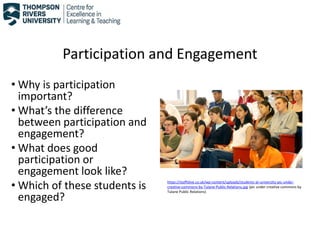
• Why is participation
important?
• What’s the difference
between participation and
engagement?
• What does good
participation or
engagement look like?
• Which of these students is
engaged?
https://staffslive.co.uk/wp-content/uploads/students-at-university-pic-under-
creative-commons-by-Tulane-Public-Relations.jpg (pic under creative commons by
Tulane Public Relations)
Participation and Engagement
•Meaningful engagement may be
happening, even when it isn’t visible
(Rogers 12)
Challenges in Evaluating Participation
•What challenges do faculty face in trying to
evaluate class participation?
•With all these challenges, why do faculty assign
grades to participation at all?
Motivating Students to Participate?
• So, then, what can we do
to both encourage and
grade helpful
participation and
engagement?
(pic under Creative Commons)
My Options?
•Return to my course’s learning outcomes
•Co-create and use a rubric
•Create equivalent alternatives
•Use formative assessment strategies instead
to measure engagement instead of observe
student participation
My Choice: Using Formative Assessment
• I allocated a certain number of grades for
“participation” in the term and a certain number
to each activity
• I opted to give full marks for completion for some
activities and to grade others
• I renamed the assessment in my course outline
“in-class work” rather than “participation”
(Ives 2014)
Why Use Formative Assessment to Grade Participation?
• Not as subjective as strict observation
• It includes all of the benefits of formative assessment
generally
• It encourages attendance
• It allows even very shy students to earn participation
grades
• When it scaffolds into summative evaluation,
students see the value of it and are likely to
participate in a meaningful way
Why Use Formative Assessment to Grade Participation?
• It allows learners to demonstrate knowledge in
multiple ways
• It provides tangible evidence of student engagement
(or not) and learning (or not)
• It encourages students to reflect on their own
learning, especially if you use formative assessment
techniques that require self-evaluation
• You can also use the formative assessment activities
as feedback for how the course is progressing
So What Happened?
•Near perfect attendance—even on the last day
of class!
•Improved student writing skills
•Improved quality of class discussion
•Increased student focus on learning
Summary
• Participation can be a challenge to grade
• Formative assessment is a good option for assessing
engagement instead of participation, as it can help to
create a culture of self-reflection and assessment
that is focused on learning rather than on only
grades
• EXIT TICKET: Please write any question(s) or
suggestion(s) on an index card, and if you’ve
provided an e-mail address on the sign-in sheet, I’ll
respond to all questions via e-mail.
Resources
• Auster, C. J., and MacRone, M. (1994). The classroom as a negotiated social setting: An empirical study of the effects of faculty member’s
behaviors on students’ participation. Teaching Sociology, 22 (4), 289-300.
• Czekanski, Kathleen E. and Zane Robinson Wolf. (2013). Encouraging and evaluating class participation. Journal of University Teaching & Learning
Practice, 10 (1). Retrieved 7 July 2013 from ERIC database.
• Dallimore, E. J., Hertenstein, J. H., and Platt, M. B. (2004). Classroom participation and discussion effectiveness: Student-generated strategies.
Communication Education, 53 (1), 103-115.
• Fluckiger, J., Tixier y Virgil, Y., Pasco, R., and Danielson, K. (2010). Formative feedback: Involving students as partners in assessment to enhance
learning. College Teaching, 58, 136-140.
• Freeman, S., Hauk, D., and Wenderoth, M.P. (2011). Increased course structure improves performance in introductory biology. Cell Biology
Education—Life Sciences Education, 10 (Summer), 175-186.
• Ives, C. (2014). Daydreaming or deep in thought? Using formative assessment to evaluate student participation. Faculty Focus, March 24th.
Available online at http://www.facultyfocus.com/articles/effective-teaching-strategies/daydreaming-deep-thought-using-formative-assessment-
evaluate-student-participation/.
• Katz, S. N. (2010). Beyond crude measurement and consumerism. Academe, 96 (5). Available online at www.aaup.org
• Mainkar, A.V. (2008). A student-empowered system for measuring and weighing participation in class discussion. Journal of Management
Education, 32 (1), 23-37.
• Robertson, K. (2012). A journal club workshop that teaches undergraduates a systematic method for reading, interpreting and presenting primary
literature. Journal of College Science Teaching, 41 (6), 20-26.
• Rogers, Susan L. (2013). Calling the question: Do college instructors actually grade participation? College Teaching, 61, 11-22. Retrieved 7 July
2013 from ERIC database.
• Wagner, T. (2010). The Global Achievement Gap: Why Even Our Best Schools Don’t Teach the New Survival Skills Our Children Need & and What
We Can Do About It. New York: Basic Books.
• Weimer, M. (2013). The assessment movement: Revisiting faculty resistance. Faculty Focus, January 18th. Available online at
http://www.facultyfocus.com/articles/educational-assessment/the-assessment-movement-revisiting-faculty-resistance
• Weimer, M. and Walvoord, B. (2013). Grading Strategies for the College Classroom. Madison, WI: Magna. (several articles)
• www.facultyfocus.com/articles (several articles, most by Maryellen Weimer and one by Katherine Robertson)

Fostering Student Learning through Formative Assessment-Based Participation Grades

  • 1.
    Fostering Student Learning throughFormative Assessment- Based Participation Grades Carolyn Ives, Coordinator, Learning and Faculty Development Centre for Excellence in Learning and Teaching (CELT) Thompson Rivers University
  • 2.
    My Challenge •Beginning place:A first year writing course on MWF from 8-9, with no final exam •Standard practice in my department was class discussion with a percentage of the term grade tied to participation
  • 3.
    My Challenge •How doI keep students engaged and attending throughout the term in cold, dark Edmonton? AND •How essential is assigning a student participation grade for student success in this course?
  • 4.
    Participation and Engagement •Why is participation important? • What’s the difference between participation and engagement? • What does good participation or engagement look like? • Which of these students is engaged? https://staffslive.co.uk/wp-content/uploads/students-at-university-pic-under- creative-commons-by-Tulane-Public-Relations.jpg (pic under creative commons by Tulane Public Relations)
  • 5.
    Participation and Engagement •Meaningfulengagement may be happening, even when it isn’t visible (Rogers 12)
  • 6.
    Challenges in EvaluatingParticipation •What challenges do faculty face in trying to evaluate class participation? •With all these challenges, why do faculty assign grades to participation at all?
  • 7.
    Motivating Students toParticipate? • So, then, what can we do to both encourage and grade helpful participation and engagement? (pic under Creative Commons)
  • 8.
    My Options? •Return tomy course’s learning outcomes •Co-create and use a rubric •Create equivalent alternatives •Use formative assessment strategies instead to measure engagement instead of observe student participation
  • 9.
    My Choice: UsingFormative Assessment • I allocated a certain number of grades for “participation” in the term and a certain number to each activity • I opted to give full marks for completion for some activities and to grade others • I renamed the assessment in my course outline “in-class work” rather than “participation” (Ives 2014)
  • 10.
    Why Use FormativeAssessment to Grade Participation? • Not as subjective as strict observation • It includes all of the benefits of formative assessment generally • It encourages attendance • It allows even very shy students to earn participation grades • When it scaffolds into summative evaluation, students see the value of it and are likely to participate in a meaningful way
  • 11.
    Why Use FormativeAssessment to Grade Participation? • It allows learners to demonstrate knowledge in multiple ways • It provides tangible evidence of student engagement (or not) and learning (or not) • It encourages students to reflect on their own learning, especially if you use formative assessment techniques that require self-evaluation • You can also use the formative assessment activities as feedback for how the course is progressing
  • 12.
    So What Happened? •Nearperfect attendance—even on the last day of class! •Improved student writing skills •Improved quality of class discussion •Increased student focus on learning
  • 13.
    Summary • Participation canbe a challenge to grade • Formative assessment is a good option for assessing engagement instead of participation, as it can help to create a culture of self-reflection and assessment that is focused on learning rather than on only grades • EXIT TICKET: Please write any question(s) or suggestion(s) on an index card, and if you’ve provided an e-mail address on the sign-in sheet, I’ll respond to all questions via e-mail.
  • 14.
    Resources • Auster, C.J., and MacRone, M. (1994). The classroom as a negotiated social setting: An empirical study of the effects of faculty member’s behaviors on students’ participation. Teaching Sociology, 22 (4), 289-300. • Czekanski, Kathleen E. and Zane Robinson Wolf. (2013). Encouraging and evaluating class participation. Journal of University Teaching & Learning Practice, 10 (1). Retrieved 7 July 2013 from ERIC database. • Dallimore, E. J., Hertenstein, J. H., and Platt, M. B. (2004). Classroom participation and discussion effectiveness: Student-generated strategies. Communication Education, 53 (1), 103-115. • Fluckiger, J., Tixier y Virgil, Y., Pasco, R., and Danielson, K. (2010). Formative feedback: Involving students as partners in assessment to enhance learning. College Teaching, 58, 136-140. • Freeman, S., Hauk, D., and Wenderoth, M.P. (2011). Increased course structure improves performance in introductory biology. Cell Biology Education—Life Sciences Education, 10 (Summer), 175-186. • Ives, C. (2014). Daydreaming or deep in thought? Using formative assessment to evaluate student participation. Faculty Focus, March 24th. Available online at http://www.facultyfocus.com/articles/effective-teaching-strategies/daydreaming-deep-thought-using-formative-assessment- evaluate-student-participation/. • Katz, S. N. (2010). Beyond crude measurement and consumerism. Academe, 96 (5). Available online at www.aaup.org • Mainkar, A.V. (2008). A student-empowered system for measuring and weighing participation in class discussion. Journal of Management Education, 32 (1), 23-37. • Robertson, K. (2012). A journal club workshop that teaches undergraduates a systematic method for reading, interpreting and presenting primary literature. Journal of College Science Teaching, 41 (6), 20-26. • Rogers, Susan L. (2013). Calling the question: Do college instructors actually grade participation? College Teaching, 61, 11-22. Retrieved 7 July 2013 from ERIC database. • Wagner, T. (2010). The Global Achievement Gap: Why Even Our Best Schools Don’t Teach the New Survival Skills Our Children Need & and What We Can Do About It. New York: Basic Books. • Weimer, M. (2013). The assessment movement: Revisiting faculty resistance. Faculty Focus, January 18th. Available online at http://www.facultyfocus.com/articles/educational-assessment/the-assessment-movement-revisiting-faculty-resistance • Weimer, M. and Walvoord, B. (2013). Grading Strategies for the College Classroom. Madison, WI: Magna. (several articles) • www.facultyfocus.com/articles (several articles, most by Maryellen Weimer and one by Katherine Robertson)