STUDENT PEER ASSESSMENT
ESSENTIALS
What you need to know before implementing this
approach
Bosung KIM, Jason MYERS, and Isabeau IQBAL.
Centre for Teaching, Learning and Technology, UBC
BC Campus Symposium (October 24, 2018)
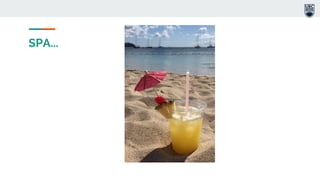
SPA...
Student Peer Assessment (SPA) - (in groups of 3-4)
Introduce yourself (name and affiliation)
Respond to question depending on umbrella colour:
● Pink: 1 thing that makes you nervous when you think about
implementing SPA
● Yellow: 1 question about SPA
● Blue: 1 thing that intrigues you about SPA
● Green: 1 thing you think is true about student peer
assessment
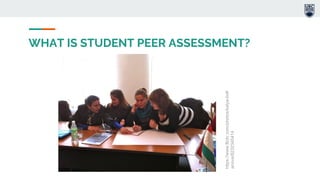
WHAT IS STUDENT PEER ASSESSMENT?
https://www.flickr.com/photos/katya-bolt
anova/8232345414
SESSION OBJECTIVES
By the end of the session, learners will be able to:
● Describe several research-based approaches for the successful
implementation of student peer assessment.
● Recall some benefits and challenges of above strategies.
● Plan their own next steps as it relates to student PA.
AGENDA
1 | Welcome, introduction to session
2 | Using SPA in your work: why + benefits + technologies
3 | Challenges
4 | Practical guidelines for implementation
5 | Your next steps + session close
USING SPA IN YOUR TEACHING/WORK
In groups of 2-3:
1. Introduce yourself (name, affiliation and teaching context)
2. Why use SPA in your teaching? (if possible, think of a
specific reason)
In a few minutes, we will ask you to report out 1 idea or question that stood
out from your conversation. Please nominate a spokesperson.
Why are UBC instructors using peer assessment?
● Writing and critical review in large classes
● Think critically about work other than their own
● Build community, engage students in peer learning
● Increase the amount of feedback students receive
● Actively engage with an audience
● Accountability in group work
Why use peer assessment - Benefits
Providing feedback is a learning opportunity
“While rating peers texts using rubrics and scoring criteria can improve
students writing skills in certain contexts, students consistently benefit
more from providing feedback to peers more than any other activities that
are part of the peer review process (Lu and Law 2012; Wooley et al.
2008).”
- Patchan and Schunn 2015
Why use peer assessment - Benefits
critically reflect on the work of others and their own
“First, students reported that reviewing involves a comparative process
wherein they evaluate each peer assignment against an internal
representation of their own work. According to the students, this
comparison triggers a reflective process, where they use the feedback they
generate for others to update their thinking about their own assignment.”
- Nicol, Thomson and Breslin, 2013
Why use peer assessment - Benefits
Increase student agency
“...if formative assessment is exclusively in the hands of teachers, then it is
difficult to see how students can become empowered and develop the
self‐regulation skills needed to prepare them for learning outside
university and throughout life (Boud, 2000).”
- Nicol and Macfarlane-Dick, 2007
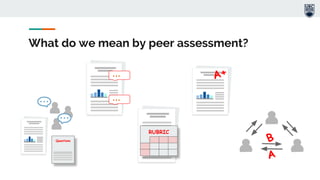
What do we mean by peer assessment?
A+…
…
RUBRIC
Questions B
A
Which approach is right for my course?
● What are the learning goals you want to achieve?
● What is the context?
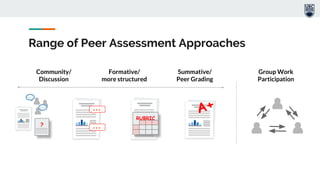
Range of Peer Assessment Approaches
Community/
Discussion
Formative/
more structured
Summative/
Peer Grading
Group Work
Participation
?
…
…
RUBRIC
A+
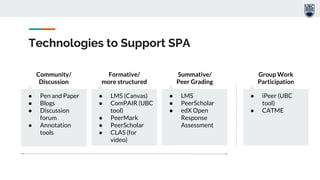
Technologies to Support SPA
Community/
Discussion
● Pen and Paper
● Blogs
● Discussion
forum
● Annotation
tools
Formative/
more structured
Summative/
Peer Grading
● LMS (Canvas)
● ComPAIR (UBC
tool)
● PeerMark
● PeerScholar
● CLAS (for
video)
● LMS
● PeerScholar
● edX Open
Response
Assessment
● iPeer (UBC
tool)
● CATME
Group Work
Participation
What challenges do you anticipate?
CHALLENGES
● TIME - Time-consuming endeavour for both students and instructors,
especially the first few times.
(Topping 1998)
● ACCEPTANCE - Students may feel uneasy about assessing their peers
or may not accept that their peers are able to assess them.
(Carvalho 2013, K. Cho, Schunn, & Wilson, 2006, Topping 1998)
● INEXPERIENCE - Students may not be able to provide meaningful
feedback unless they have proper guidance and training.
(Cho and Schunn 2007, Patchan and Schunn 2015)
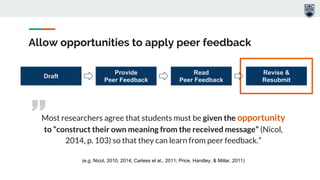
Allow opportunities to apply peer feedback
Draft
Revise &
Resubmit
Read
Peer Feedback
Provide
Peer Feedback
”Most researchers agree that students must be given the opportunity
to “construct their own meaning from the received message” (Nicol,
2014, p. 103) so that they can learn from peer feedback.”
(e.g. Nicol, 2010, 2014; Carless et al., 2011; Price, Handley, & Millar, 2011)
”
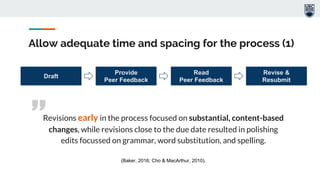
Allow adequate time and spacing for the process (1)
Revisions early in the process focused on substantial, content-based
changes, while revisions close to the due date resulted in polishing
edits focussed on grammar, word substitution, and spelling.
(Baker, 2016; Cho & MacArthur, 2010).
Draft
Revise &
Resubmit
Read
Peer Feedback
Provide
Peer Feedback
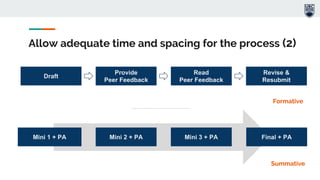
Allow adequate time and spacing for the process (2)
Formative
Mini 1 + PA Final + PAMini 3 + PAMini 2 + PA
Summative
Draft
Revise &
Resubmit
Read
Peer Feedback
Provide
Peer Feedback
”
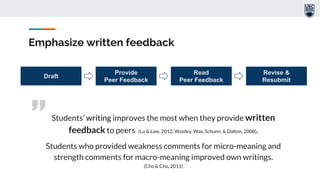
Emphasize written feedback
Students’ writing improves the most when they provide written
feedback to peers (Lu & Law, 2012; Wooley, Was, Schunn, & Dalton, 2008).
Students who provided weakness comments for micro-meaning and
strength comments for macro-meaning improved own writings.
(Cho & Cho, 2011)
Draft
Revise &
Resubmit
Read
Peer Feedback
Provide
Peer Feedback
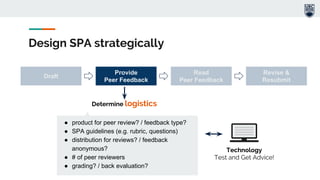
Design SPA strategically
Determine logistics
● product for peer review? / feedback type?
● SPA guidelines (e.g. rubric, questions)
● distribution for reviews? / feedback
anonymous?
● # of peer reviewers
● grading? / back evaluation?
Draft
Revise &
Resubmit
Read
Peer Feedback
Provide
Peer Feedback
Technology
Test and Get Advice!
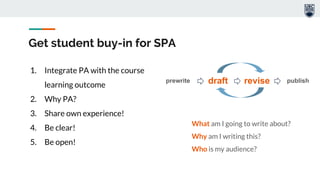
Get student buy-in for SPA
What am I going to write about?
Why am I writing this?
Who is my audience?
publishreviseprewrite draft
1. Integrate PA with the course
learning outcome
2. Why PA?
3. Share own experience!
4. Be clear!
5. Be open!
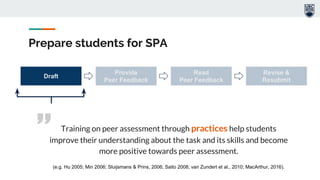
Prepare students for SPA
” Training on peer assessment through practices help students
improve their understanding about the task and its skills and become
more positive towards peer assessment.
(e.g. Hu 2005; Min 2006; Sluijsmans & Prins, 2006; Saito 2008; van Zundert et al., 2010; MacArthur, 2016).
Draft
Revise &
Resubmit
Read
Peer Feedback
Provide
Peer Feedback
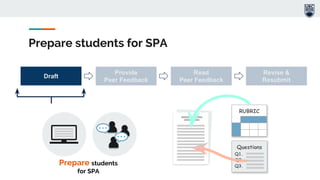
Prepare students for SPA
Prepare students
for SPA
Draft
Revise &
Resubmit
Read
Peer Feedback
Provide
Peer Feedback
Questions
Q1.
Q2.
Q3.
RUBRIC
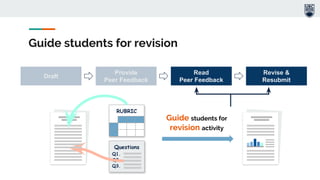
Guide students for revision
Questions
Q1.
Q2.
Q3.
RUBRIC
Guide students for
revision activity
Draft
Revise &
Resubmit
Read
Peer Feedback
Provide
Peer Feedback
OPPORTUNITIES: 15% Solutions
Assuming you want to further explore SPA, then
What can you do?
(2 minutes individually)
OPPORTUNITIES: 15% Solutions
1. Share in your pair/group. Each person takes 1-2
minutes. [no feedback or questions]
2. Provide mini-consultations to one another, one
person at a time [~3 minutes per person]
a. What was your most important take-away from
today as it relates to SPA?”
b. “What SPA-related question is top of mind for
you at the end of this session?”
1-MINUTE PAPER
Bosung Kim bosung.kim@ubc.ca
Jason Myers jason.myers@ubc.ca
Isabeau Iqbal isabeau.iqbal@ubc.ca
Thank you!
This work is licensed under a Creative Commons
Attribution-NonCommercial-ShareAlike 4.0 International License. Please attribute the
UBC Centre for Teaching, Learning and Technology.

Student Peer Assessment Essentials

  • 1.
    STUDENT PEER ASSESSMENT ESSENTIALS Whatyou need to know before implementing this approach Bosung KIM, Jason MYERS, and Isabeau IQBAL. Centre for Teaching, Learning and Technology, UBC BC Campus Symposium (October 24, 2018)
  • 2.
  • 3.
    Student Peer Assessment(SPA) - (in groups of 3-4) Introduce yourself (name and affiliation) Respond to question depending on umbrella colour: ● Pink: 1 thing that makes you nervous when you think about implementing SPA ● Yellow: 1 question about SPA ● Blue: 1 thing that intrigues you about SPA ● Green: 1 thing you think is true about student peer assessment
  • 4.
    WHAT IS STUDENTPEER ASSESSMENT? https://www.flickr.com/photos/katya-bolt anova/8232345414
  • 5.
    SESSION OBJECTIVES By theend of the session, learners will be able to: ● Describe several research-based approaches for the successful implementation of student peer assessment. ● Recall some benefits and challenges of above strategies. ● Plan their own next steps as it relates to student PA.
  • 6.
    AGENDA 1 | Welcome,introduction to session 2 | Using SPA in your work: why + benefits + technologies 3 | Challenges 4 | Practical guidelines for implementation 5 | Your next steps + session close
  • 7.
    USING SPA INYOUR TEACHING/WORK In groups of 2-3: 1. Introduce yourself (name, affiliation and teaching context) 2. Why use SPA in your teaching? (if possible, think of a specific reason) In a few minutes, we will ask you to report out 1 idea or question that stood out from your conversation. Please nominate a spokesperson.
  • 8.
    Why are UBCinstructors using peer assessment? ● Writing and critical review in large classes ● Think critically about work other than their own ● Build community, engage students in peer learning ● Increase the amount of feedback students receive ● Actively engage with an audience ● Accountability in group work
  • 9.
    Why use peerassessment - Benefits Providing feedback is a learning opportunity “While rating peers texts using rubrics and scoring criteria can improve students writing skills in certain contexts, students consistently benefit more from providing feedback to peers more than any other activities that are part of the peer review process (Lu and Law 2012; Wooley et al. 2008).” - Patchan and Schunn 2015
  • 10.
    Why use peerassessment - Benefits critically reflect on the work of others and their own “First, students reported that reviewing involves a comparative process wherein they evaluate each peer assignment against an internal representation of their own work. According to the students, this comparison triggers a reflective process, where they use the feedback they generate for others to update their thinking about their own assignment.” - Nicol, Thomson and Breslin, 2013
  • 11.
    Why use peerassessment - Benefits Increase student agency “...if formative assessment is exclusively in the hands of teachers, then it is difficult to see how students can become empowered and develop the self‐regulation skills needed to prepare them for learning outside university and throughout life (Boud, 2000).” - Nicol and Macfarlane-Dick, 2007
  • 12.
    What do wemean by peer assessment? A+… … RUBRIC Questions B A
  • 13.
    Which approach isright for my course? ● What are the learning goals you want to achieve? ● What is the context?
  • 14.
    Range of PeerAssessment Approaches Community/ Discussion Formative/ more structured Summative/ Peer Grading Group Work Participation ? … … RUBRIC A+
  • 15.
    Technologies to SupportSPA Community/ Discussion ● Pen and Paper ● Blogs ● Discussion forum ● Annotation tools Formative/ more structured Summative/ Peer Grading ● LMS (Canvas) ● ComPAIR (UBC tool) ● PeerMark ● PeerScholar ● CLAS (for video) ● LMS ● PeerScholar ● edX Open Response Assessment ● iPeer (UBC tool) ● CATME Group Work Participation
  • 16.
    What challenges doyou anticipate?
  • 17.
    CHALLENGES ● TIME -Time-consuming endeavour for both students and instructors, especially the first few times. (Topping 1998) ● ACCEPTANCE - Students may feel uneasy about assessing their peers or may not accept that their peers are able to assess them. (Carvalho 2013, K. Cho, Schunn, & Wilson, 2006, Topping 1998) ● INEXPERIENCE - Students may not be able to provide meaningful feedback unless they have proper guidance and training. (Cho and Schunn 2007, Patchan and Schunn 2015)
  • 18.
    Allow opportunities toapply peer feedback Draft Revise & Resubmit Read Peer Feedback Provide Peer Feedback ”Most researchers agree that students must be given the opportunity to “construct their own meaning from the received message” (Nicol, 2014, p. 103) so that they can learn from peer feedback.” (e.g. Nicol, 2010, 2014; Carless et al., 2011; Price, Handley, & Millar, 2011)
  • 19.
    ” Allow adequate timeand spacing for the process (1) Revisions early in the process focused on substantial, content-based changes, while revisions close to the due date resulted in polishing edits focussed on grammar, word substitution, and spelling. (Baker, 2016; Cho & MacArthur, 2010). Draft Revise & Resubmit Read Peer Feedback Provide Peer Feedback
  • 20.
    Allow adequate timeand spacing for the process (2) Formative Mini 1 + PA Final + PAMini 3 + PAMini 2 + PA Summative Draft Revise & Resubmit Read Peer Feedback Provide Peer Feedback
  • 21.
    ” Emphasize written feedback Students’writing improves the most when they provide written feedback to peers (Lu & Law, 2012; Wooley, Was, Schunn, & Dalton, 2008). Students who provided weakness comments for micro-meaning and strength comments for macro-meaning improved own writings. (Cho & Cho, 2011) Draft Revise & Resubmit Read Peer Feedback Provide Peer Feedback
  • 22.
    Design SPA strategically Determinelogistics ● product for peer review? / feedback type? ● SPA guidelines (e.g. rubric, questions) ● distribution for reviews? / feedback anonymous? ● # of peer reviewers ● grading? / back evaluation? Draft Revise & Resubmit Read Peer Feedback Provide Peer Feedback Technology Test and Get Advice!
  • 23.
    Get student buy-infor SPA What am I going to write about? Why am I writing this? Who is my audience? publishreviseprewrite draft 1. Integrate PA with the course learning outcome 2. Why PA? 3. Share own experience! 4. Be clear! 5. Be open!
  • 24.
    Prepare students forSPA ” Training on peer assessment through practices help students improve their understanding about the task and its skills and become more positive towards peer assessment. (e.g. Hu 2005; Min 2006; Sluijsmans & Prins, 2006; Saito 2008; van Zundert et al., 2010; MacArthur, 2016). Draft Revise & Resubmit Read Peer Feedback Provide Peer Feedback
  • 25.
    Prepare students forSPA Prepare students for SPA Draft Revise & Resubmit Read Peer Feedback Provide Peer Feedback Questions Q1. Q2. Q3. RUBRIC
  • 26.
    Guide students forrevision Questions Q1. Q2. Q3. RUBRIC Guide students for revision activity Draft Revise & Resubmit Read Peer Feedback Provide Peer Feedback
  • 27.
    OPPORTUNITIES: 15% Solutions Assumingyou want to further explore SPA, then What can you do? (2 minutes individually)
  • 28.
    OPPORTUNITIES: 15% Solutions 1.Share in your pair/group. Each person takes 1-2 minutes. [no feedback or questions] 2. Provide mini-consultations to one another, one person at a time [~3 minutes per person]
  • 29.
    a. What wasyour most important take-away from today as it relates to SPA?” b. “What SPA-related question is top of mind for you at the end of this session?” 1-MINUTE PAPER
  • 30.
    Bosung Kim bosung.kim@ubc.ca JasonMyers jason.myers@ubc.ca Isabeau Iqbal isabeau.iqbal@ubc.ca Thank you! This work is licensed under a Creative Commons Attribution-NonCommercial-ShareAlike 4.0 International License. Please attribute the UBC Centre for Teaching, Learning and Technology.