


Colleen Young
Learning and Teaching
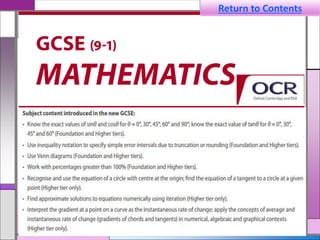
GCSE Mathematics
Table of Contents
Some thoughts and ideas for
your classroom...
Slides include hyperlinks to
further information.
Many images also have
hyperlinks Hyperlinks here
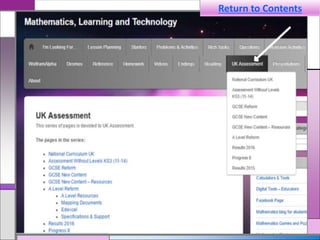
Return to Contents
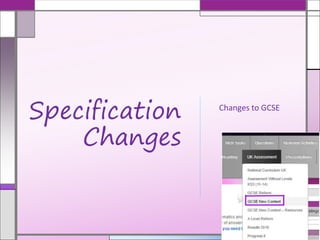
Changes to GCSE
Specification
Changes
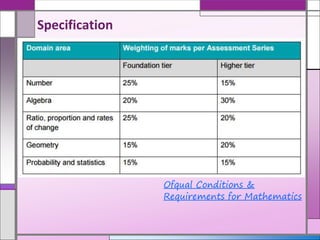
Specification
Ofqual Conditions &
Requirements for Mathematics
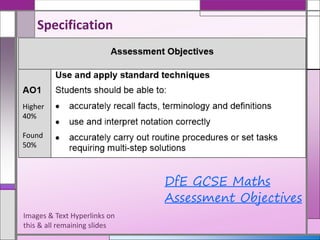
Higher
40%
Found
50%
DfE GCSE Maths
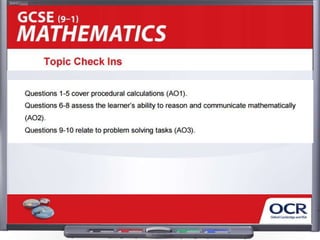
Assessment Objectives
Images & Text Hyperlinks on
this & all remaining slides
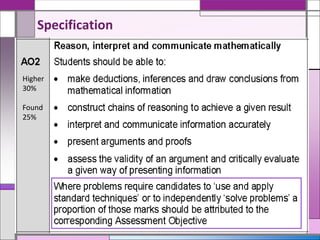
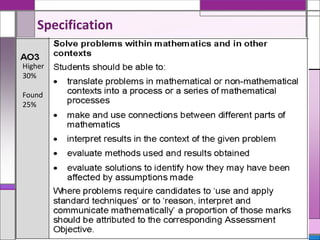
Specification
Specification
Higher
30%
Found
25%
Higher
30%
Found
25%
Specification
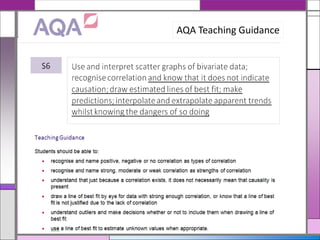
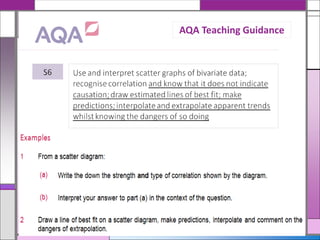
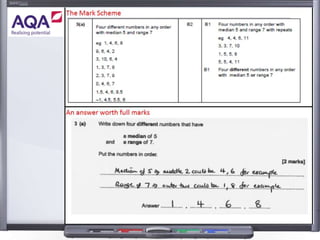
AQA Teaching Guidance
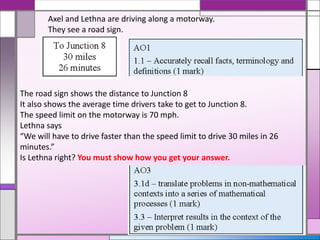
Axel and Lethna are driving along a motorway.
They see a road sign.
The road sign shows the distance to Junction 8
It also shows the average time drivers take to get to Junction 8.
The speed limit on the motorway is 70 mph.
Lethna says
“We will have to drive faster than the speed limit to drive 30 miles in 26
minutes.”
Is Lethna right? You must show how you get your answer.
Return to Contents
What’s a problem
anyway?
Developing a
problem solving
classroom
Problem
Solving
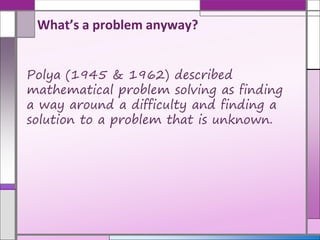
Polya (1945 & 1962) described
mathematical problem solving as finding
a way around a difficulty and finding a
solution to a problem that is unknown.
What’s a problem anyway?
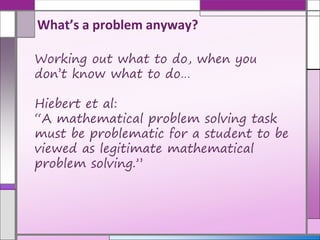
Working out what to do, when you
don’t know what to do…
Hiebert et al:
“A mathematical problem solving task
must be problematic for a student to be
viewed as legitimate mathematical
problem solving.”
What’s a problem anyway?
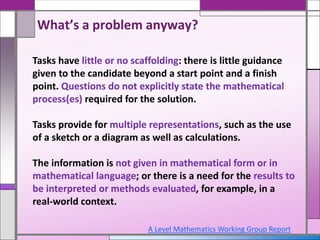
Tasks have little or no scaffolding: there is little guidance
given to the candidate beyond a start point and a finish
point. Questions do not explicitly state the mathematical
process(es) required for the solution.
Tasks provide for multiple representations, such as the use
of a sketch or a diagram as well as calculations.
The information is not given in mathematical form or in
mathematical language; or there is a need for the results to
be interpreted or methods evaluated, for example, in a
real-world context.
A Level Mathematics Working Group Report
What’s a problem anyway?
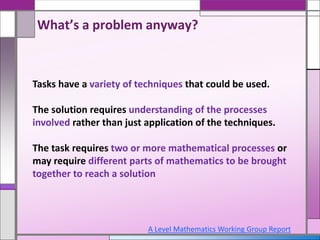
Tasks have a variety of techniques that could be used.
The solution requires understanding of the processes
involved rather than just application of the techniques.
The task requires two or more mathematical processes or
may require different parts of mathematics to be brought
together to reach a solution
What’s a problem anyway?
A Level Mathematics Working Group Report
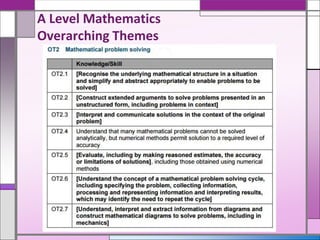
A Level Mathematics
Overarching Themes
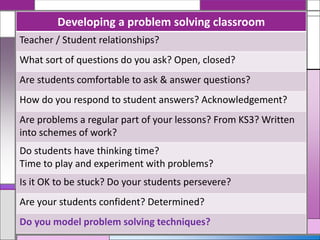
Developing a problem solving classroom
Teacher / Student relationships?
What sort of questions do you ask? Open, closed?
Are students comfortable to ask & answer questions?
How do you respond to student answers? Acknowledgement?
Are problems a regular part of your lessons? From KS3? Written
into schemes of work?
Do students have thinking time?
Time to play and experiment with problems?
Is it OK to be stuck? Do your students persevere?
Are your students confident? Determined?
Do you model problem solving techniques?
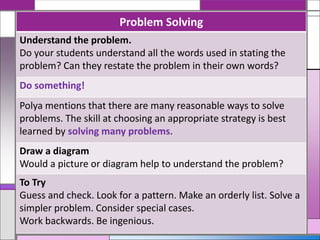
Problem Solving
Understand the problem.
Do your students understand all the words used in stating the
problem? Can they restate the problem in their own words?
Do something!
Polya mentions that there are many reasonable ways to solve
problems. The skill at choosing an appropriate strategy is best
learned by solving many problems.
Draw a diagram
Would a picture or diagram help to understand the problem?
To Try
Guess and check. Look for a pattern. Make an orderly list. Solve a
simpler problem. Consider special cases.
Work backwards. Be ingenious.
Your classroom …
Always remember the importance of good
teacher / student relationships.
Ultimately, when you know your students
and your students trust you, you can ignore
all the “rules” of feedback.
Without that relationship, all the research in
the world won’t matter.
(Wiliam, 2014).
Dylan Wiliam on Feedback
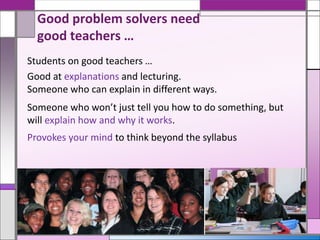
Students on good teachers …
Good at explanations and lecturing.
Someone who can explain in different ways.
Someone who won’t just tell you how to do something, but
will explain how and why it works.
Provokes your mind to think beyond the syllabus
Good problem solvers need
good teachers …
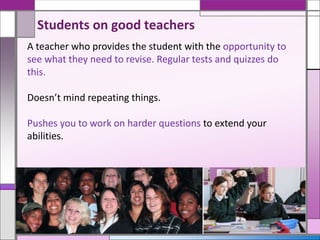
A teacher who provides the student with the opportunity to
see what they need to revise. Regular tests and quizzes do
this.
Doesn’t mind repeating things.
Pushes you to work on harder questions to extend your
abilities.
Students on good teachers
Patient.
Understanding.
Approachable.
Firm but kind.
Someone you can feel comfortable with.
Recognises achievements.
Genuinely caring about the students.
Someone who knows who you are.
Someone who you know won’t judge you.
Good teachers ...
Students on good teachers
Simon Singh on Mathematics Teaching
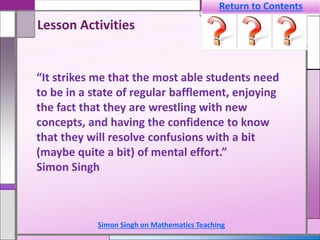
“It strikes me that the most able students need
to be in a state of regular bafflement, enjoying
the fact that they are wrestling with new
concepts, and having the confidence to know
that they will resolve confusions with a bit
(maybe quite a bit) of mental effort.”
Simon Singh
Lesson Activities
Return to Contents
For GCSE 9-1
from exam boardsTeaching
Ideas &
Resources
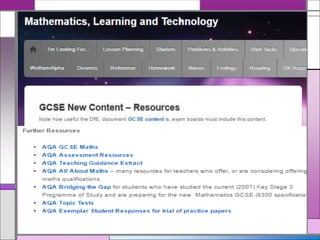
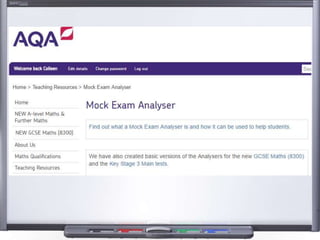
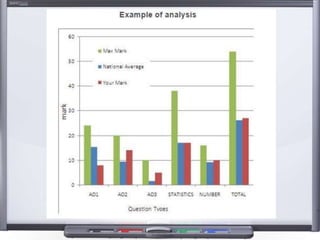
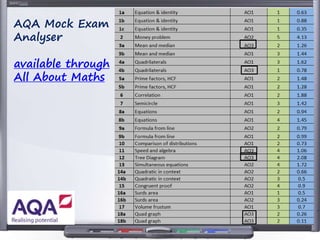
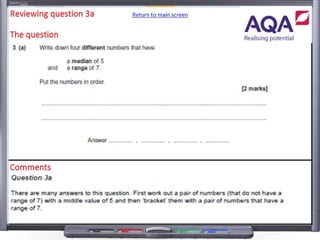
AQA Mock Exam
Analyser
available through
All About Maths
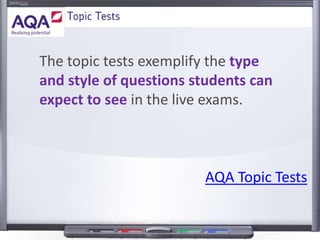
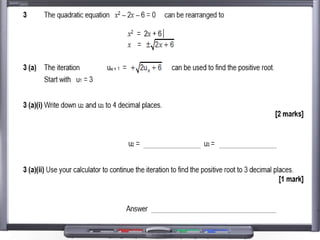
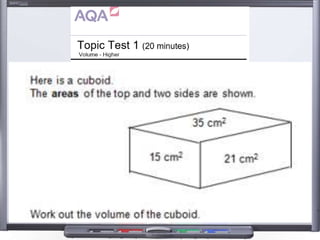
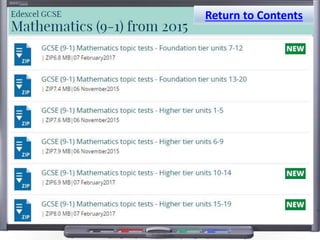
The topic tests exemplify the type
and style of questions students can
expect to see in the live exams.
AQA Topic Tests
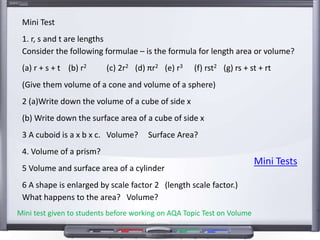
Mini Test
1. r, s and t are lengths
Consider the following formulae – is the formula for length area or volume?
(a) r + s + t (b) r2 (c) 2r2 (d) πr2 (e) r3 (f) rst2 (g) rs + st + rt
(Give them volume of a cone and volume of a sphere)
2 (a)Write down the volume of a cube of side x
(b) Write down the surface area of a cube of side x
3 A cuboid is a x b x c. Volume? Surface Area?
4. Volume of a prism?
5 Volume and surface area of a cylinder
6 A shape is enlarged by scale factor 2 (length scale factor.)
What happens to the area? Volume?
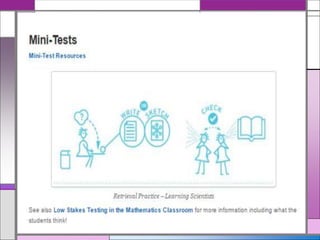
Mini Tests
Mini test given to students before working on AQA Topic Test on Volume
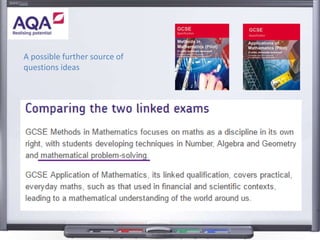
A possible further source of
questions ideas
Return to Contents
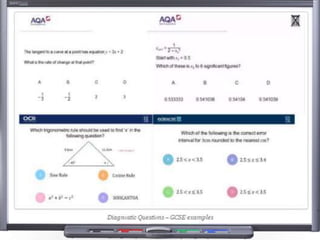
For GCSE 9-1
Diagnostic
Questions
Teaching
Ideas &
Resources
Return to Contents
For GCSE 9-1
Further ResourcesTeaching
Ideas &
Resources
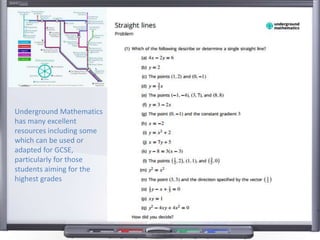
Underground Mathematics
has many excellent
resources including some
which can be used or
adapted for GCSE,
particularly for those
students aiming for the
highest grades
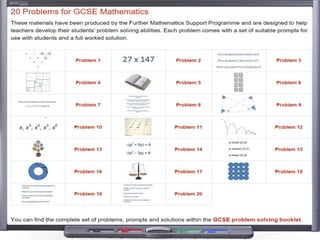
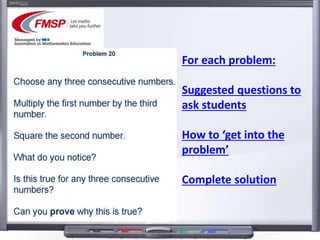
For each problem:
Suggested questions to
ask students
How to ‘get into the
problem’
Complete solution
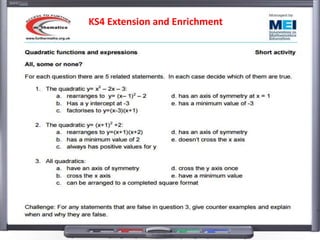
KS4 Extension and Enrichment
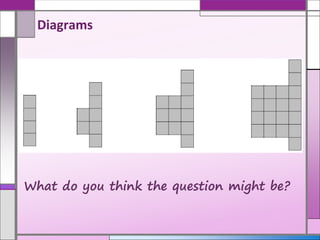
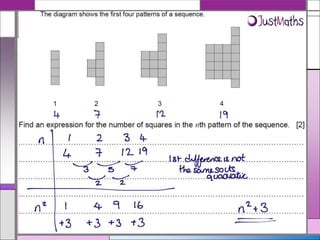
What do you think the question might be?
Diagrams
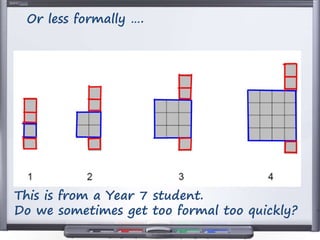
Or less formally ….
This is from a Year 7 student.
Do we sometimes get too formal too quickly?
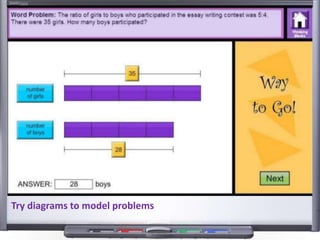
Try diagrams to model problems
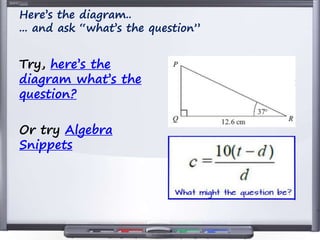
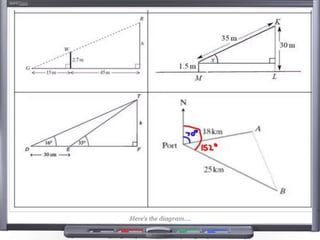
Here’s the diagram..
... and ask “what’s the question”
Try, here’s the
diagram what’s the
question?
Or try Algebra
Snippets
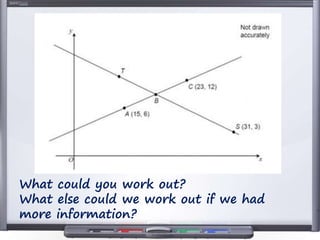
What could you work out?
What else could we work out if we had
more information?
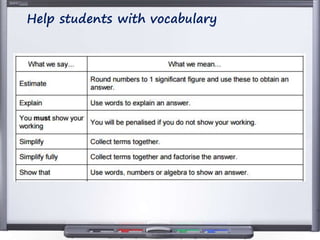
Help students with vocabulary
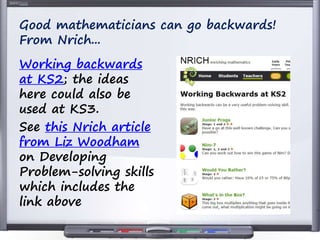
Good mathematicians can go backwards!
From Nrich...
Working backwards
at KS2; the ideas
here could also be
used at KS3.
See this Nrich article
from Liz Woodham
on Developing
Problem-solving skills
which includes the
link above
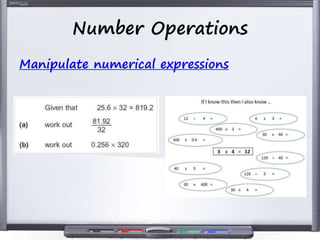
Number Operations
Manipulate numerical expressions
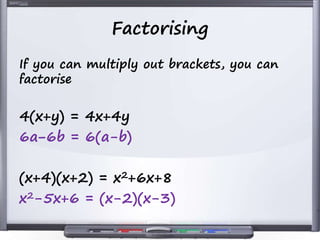
Factorising
If you can multiply out brackets, you can
factorise
4(x+y) = 4x+4y
6a−6b = 6(a-b)
(x+4)(x+2) = x2+6x+8
x2-5x+6 = (x-2)(x-3)
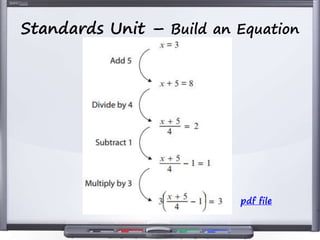
Standards Unit – Build an Equation
pdf file
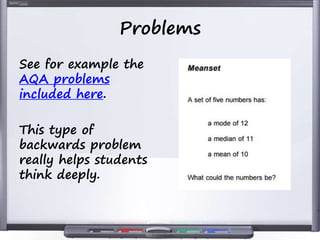
Problems
See for example the
AQA problems
included here.
This type of
backwards problem
really helps students
think deeply.
Learn it both ways!
Learn everything from right to left as well
as left to right!
If you know your laws of indices you should
recognise that x10 = x1 × x9
For every derivative you know, you also
know an integral!
.......and so on...and on....and on!
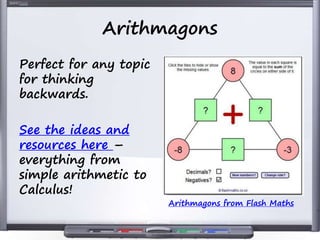
Arithmagons
Perfect for any topic
for thinking
backwards.
See the ideas and
resources here –
everything from
simple arithmetic to
Calculus!
Arithmagons from Flash Maths
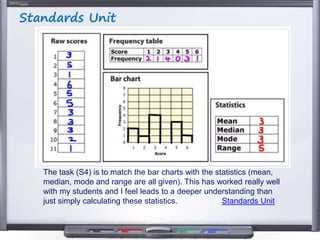
Standards Unit
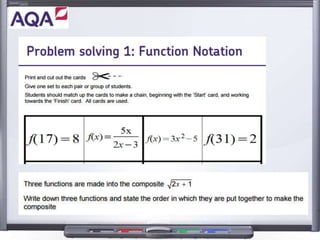
The task (S4) is to match the bar charts with the statistics (mean,
median, mode and range are all given). This has worked really well
with my students and I feel leads to a deeper understanding than
just simply calculating these statistics. Standards Unit
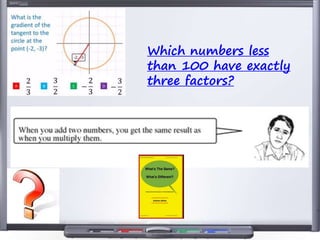
Which numbers less
than 100 have exactly
three factors?
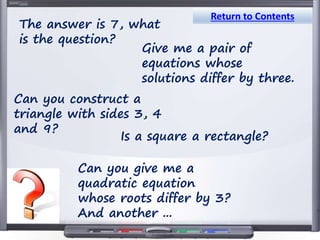
The answer is 7, what
is the question?
Give me a pair of
equations whose
solutions differ by three.
Can you construct a
triangle with sides 3, 4
and 9?
Is a square a rectangle?
Can you give me a
quadratic equation
whose roots differ by 3?
And another ...
Return to Contents
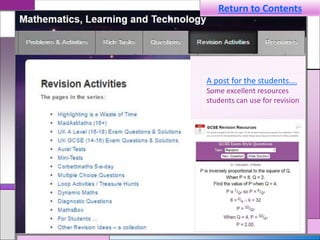
Many ideas for
revisionRevision
Activities
A post for the students….
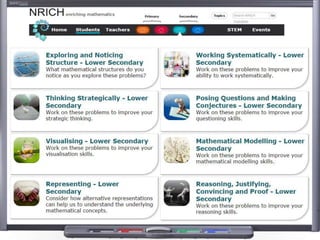
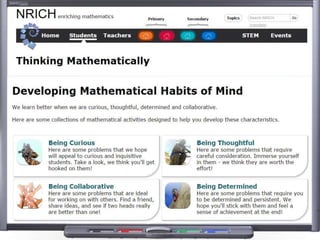
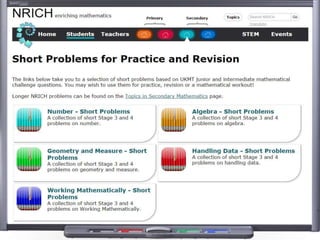
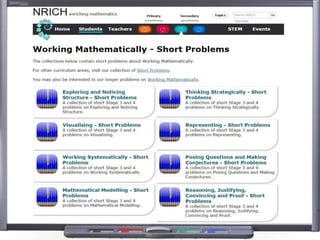
Some excellent resources
students can use for revision
Return to Contents
The importance of
recallMaking it
Stick
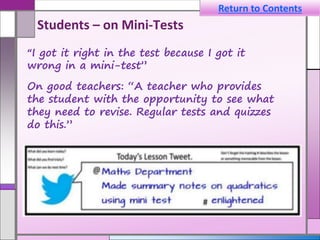
Students – on Mini-Tests
“I got it right in the test because I got it
wrong in a mini-test”
On good teachers: “A teacher who provides
the student with the opportunity to see what
they need to revise. Regular tests and quizzes
do this.”
Return to Contents
Mathematics for Students Mathematics, Learning and Technology
Colleen Young

Learning & Teaching GCSE Mathematics

  • 1.
    Colleen Young Learning andTeaching GCSE Mathematics
  • 2.
  • 3.
    Some thoughts andideas for your classroom... Slides include hyperlinks to further information. Many images also have hyperlinks Hyperlinks here
  • 4.
  • 5.
  • 6.
  • 7.
    Higher 40% Found 50% DfE GCSE Maths AssessmentObjectives Images & Text Hyperlinks on this & all remaining slides Specification
  • 8.
  • 9.
  • 10.
  • 11.
  • 15.
    Axel and Lethnaare driving along a motorway. They see a road sign. The road sign shows the distance to Junction 8 It also shows the average time drivers take to get to Junction 8. The speed limit on the motorway is 70 mph. Lethna says “We will have to drive faster than the speed limit to drive 30 miles in 26 minutes.” Is Lethna right? You must show how you get your answer.
  • 16.
  • 17.
    What’s a problem anyway? Developinga problem solving classroom Problem Solving
  • 18.
    Polya (1945 &1962) described mathematical problem solving as finding a way around a difficulty and finding a solution to a problem that is unknown. What’s a problem anyway?
  • 19.
    Working out whatto do, when you don’t know what to do… Hiebert et al: “A mathematical problem solving task must be problematic for a student to be viewed as legitimate mathematical problem solving.” What’s a problem anyway?
  • 20.
    Tasks have littleor no scaffolding: there is little guidance given to the candidate beyond a start point and a finish point. Questions do not explicitly state the mathematical process(es) required for the solution. Tasks provide for multiple representations, such as the use of a sketch or a diagram as well as calculations. The information is not given in mathematical form or in mathematical language; or there is a need for the results to be interpreted or methods evaluated, for example, in a real-world context. A Level Mathematics Working Group Report What’s a problem anyway?
  • 21.
    Tasks have avariety of techniques that could be used. The solution requires understanding of the processes involved rather than just application of the techniques. The task requires two or more mathematical processes or may require different parts of mathematics to be brought together to reach a solution What’s a problem anyway? A Level Mathematics Working Group Report
  • 22.
  • 23.
    Developing a problemsolving classroom Teacher / Student relationships? What sort of questions do you ask? Open, closed? Are students comfortable to ask & answer questions? How do you respond to student answers? Acknowledgement? Are problems a regular part of your lessons? From KS3? Written into schemes of work? Do students have thinking time? Time to play and experiment with problems? Is it OK to be stuck? Do your students persevere? Are your students confident? Determined? Do you model problem solving techniques?
  • 24.
    Problem Solving Understand theproblem. Do your students understand all the words used in stating the problem? Can they restate the problem in their own words? Do something! Polya mentions that there are many reasonable ways to solve problems. The skill at choosing an appropriate strategy is best learned by solving many problems. Draw a diagram Would a picture or diagram help to understand the problem? To Try Guess and check. Look for a pattern. Make an orderly list. Solve a simpler problem. Consider special cases. Work backwards. Be ingenious.
  • 25.
    Your classroom … Alwaysremember the importance of good teacher / student relationships. Ultimately, when you know your students and your students trust you, you can ignore all the “rules” of feedback. Without that relationship, all the research in the world won’t matter. (Wiliam, 2014). Dylan Wiliam on Feedback
  • 26.
    Students on goodteachers … Good at explanations and lecturing. Someone who can explain in different ways. Someone who won’t just tell you how to do something, but will explain how and why it works. Provokes your mind to think beyond the syllabus Good problem solvers need good teachers …
  • 27.
    A teacher whoprovides the student with the opportunity to see what they need to revise. Regular tests and quizzes do this. Doesn’t mind repeating things. Pushes you to work on harder questions to extend your abilities. Students on good teachers
  • 28.
    Patient. Understanding. Approachable. Firm but kind. Someoneyou can feel comfortable with. Recognises achievements. Genuinely caring about the students. Someone who knows who you are. Someone who you know won’t judge you. Good teachers ... Students on good teachers
  • 29.
    Simon Singh onMathematics Teaching “It strikes me that the most able students need to be in a state of regular bafflement, enjoying the fact that they are wrestling with new concepts, and having the confidence to know that they will resolve confusions with a bit (maybe quite a bit) of mental effort.” Simon Singh Lesson Activities Return to Contents
  • 30.
    For GCSE 9-1 fromexam boardsTeaching Ideas & Resources
  • 47.
    AQA Mock Exam Analyser availablethrough All About Maths
  • 50.
    The topic testsexemplify the type and style of questions students can expect to see in the live exams. AQA Topic Tests
  • 52.
    Mini Test 1. r,s and t are lengths Consider the following formulae – is the formula for length area or volume? (a) r + s + t (b) r2 (c) 2r2 (d) πr2 (e) r3 (f) rst2 (g) rs + st + rt (Give them volume of a cone and volume of a sphere) 2 (a)Write down the volume of a cube of side x (b) Write down the surface area of a cube of side x 3 A cuboid is a x b x c. Volume? Surface Area? 4. Volume of a prism? 5 Volume and surface area of a cylinder 6 A shape is enlarged by scale factor 2 (length scale factor.) What happens to the area? Volume? Mini Tests Mini test given to students before working on AQA Topic Test on Volume
  • 54.
    A possible furthersource of questions ideas
  • 57.
  • 58.
  • 63.
  • 64.
    For GCSE 9-1 FurtherResourcesTeaching Ideas & Resources
  • 71.
    Underground Mathematics has manyexcellent resources including some which can be used or adapted for GCSE, particularly for those students aiming for the highest grades
  • 74.
    For each problem: Suggestedquestions to ask students How to ‘get into the problem’ Complete solution
  • 75.
  • 76.
    What do youthink the question might be? Diagrams
  • 78.
    Or less formally…. This is from a Year 7 student. Do we sometimes get too formal too quickly?
  • 79.
    Try diagrams tomodel problems
  • 80.
    Here’s the diagram.. ...and ask “what’s the question” Try, here’s the diagram what’s the question? Or try Algebra Snippets
  • 82.
    What could youwork out? What else could we work out if we had more information?
  • 83.
  • 84.
    Good mathematicians cango backwards! From Nrich... Working backwards at KS2; the ideas here could also be used at KS3. See this Nrich article from Liz Woodham on Developing Problem-solving skills which includes the link above
  • 85.
  • 86.
    Factorising If you canmultiply out brackets, you can factorise 4(x+y) = 4x+4y 6a−6b = 6(a-b) (x+4)(x+2) = x2+6x+8 x2-5x+6 = (x-2)(x-3)
  • 87.
    Standards Unit –Build an Equation pdf file
  • 88.
    Problems See for examplethe AQA problems included here. This type of backwards problem really helps students think deeply.
  • 89.
    Learn it bothways! Learn everything from right to left as well as left to right! If you know your laws of indices you should recognise that x10 = x1 × x9 For every derivative you know, you also know an integral! .......and so on...and on....and on!
  • 90.
    Arithmagons Perfect for anytopic for thinking backwards. See the ideas and resources here – everything from simple arithmetic to Calculus! Arithmagons from Flash Maths
  • 91.
    Standards Unit The task(S4) is to match the bar charts with the statistics (mean, median, mode and range are all given). This has worked really well with my students and I feel leads to a deeper understanding than just simply calculating these statistics. Standards Unit
  • 96.
    Which numbers less than100 have exactly three factors?
  • 97.
    The answer is7, what is the question? Give me a pair of equations whose solutions differ by three. Can you construct a triangle with sides 3, 4 and 9? Is a square a rectangle? Can you give me a quadratic equation whose roots differ by 3? And another ... Return to Contents
  • 98.
  • 99.
    A post forthe students…. Some excellent resources students can use for revision Return to Contents
  • 100.
  • 102.
    Students – onMini-Tests “I got it right in the test because I got it wrong in a mini-test” On good teachers: “A teacher who provides the student with the opportunity to see what they need to revise. Regular tests and quizzes do this.” Return to Contents
  • 103.
    Mathematics for StudentsMathematics, Learning and Technology Colleen Young