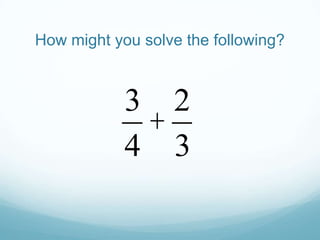
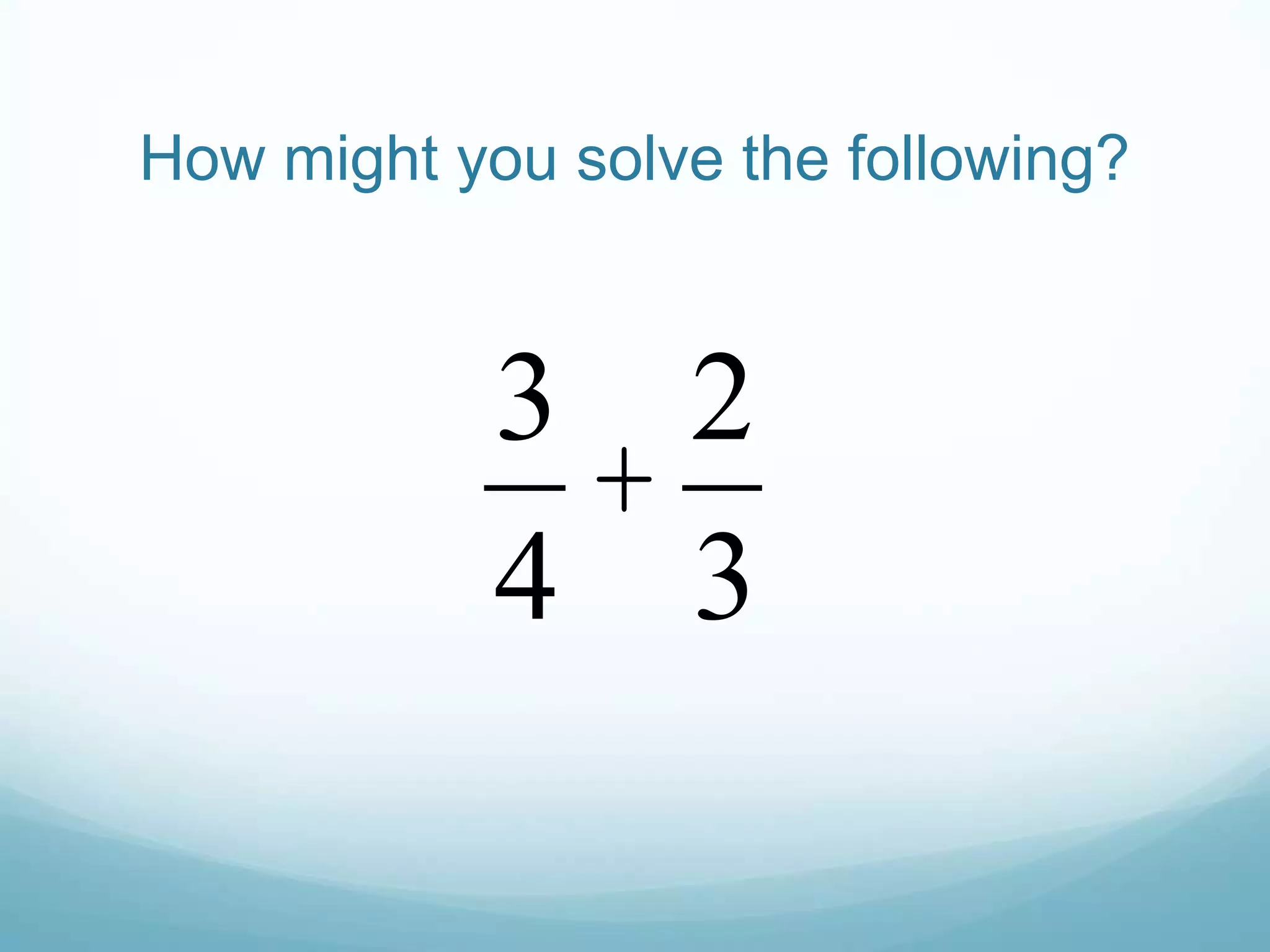
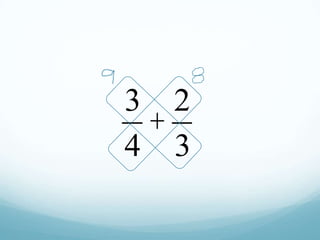
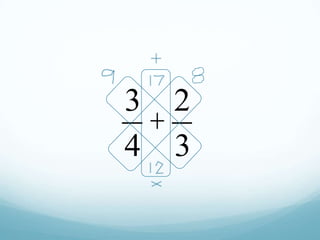
How might you solve the following?

3 2
+
4 3
Practicing the
Mathematical Practices
Modeling to Develop
Mathematical Habits of Mind

Oregon Math Leaders Annual Conference
McMinnville, Oregon
Nicole Miller Rigelman
Portland State University
rigelman@pdx.edu
Overview
 Modeling as a means to support reasoning and sense
making

 What research says about modeling and how students
learn

 Example: using multiple representations to support sense
making

 Students experiences with models and tools

 Considering what else models can do…
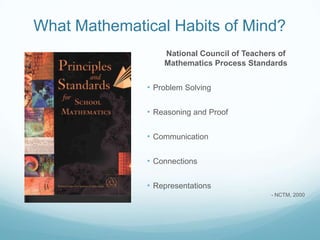
What Mathematical Habits of Mind?
National Council of Teachers of
Mathematics Process Standards

• Problem Solving
• Reasoning and Proof
• Communication
• Connections
• Representations
- NCTM, 2000
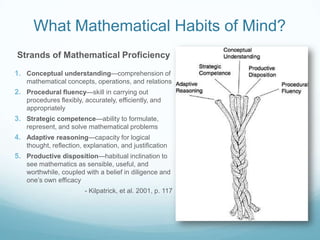
What Mathematical Habits of Mind?
Strands of Mathematical Proficiency
1. Conceptual understanding—comprehension of
mathematical concepts, operations, and relations

2. Procedural fluency—skill in carrying out
procedures flexibly, accurately, efficiently, and
appropriately

3. Strategic competence—ability to formulate,
represent, and solve mathematical problems

4. Adaptive reasoning—capacity for logical
thought, reflection, explanation, and justification

5. Productive disposition—habitual inclination to
see mathematics as sensible, useful, and
worthwhile, coupled with a belief in diligence and
one’s own efficacy
- Kilpatrick, et al. 2001, p. 117
Standards for
Mathematical Practice
1. Make sense of problems and persevere in solving them.
2. Reason abstractly and quantitatively.
3. Construct viable arguments and critique the reasoning of others.
4. Model with mathematics.
5. Use appropriate tools strategically.
6. Attend to precision.
7. Look for and make use of structure.
8. Look for and express regularity in repeated reasoning.
- Common Core State Standards
Standards for
Mathematical Practice
1. Make sense of problems and persevere in solving them.
2. Reason abstractly and quantitatively.
3. Construct viable arguments and critique the reasoning of others.
4. Model with mathematics.
5. Use appropriate tools strategically.
6. Attend to precision.
7. Look for and make use of structure.
8. Look for and express regularity in repeated reasoning.
- Common Core State Standards
Why a focus on modeling?
Mathematically proficient students…
- model with mathematics
- use appropriate tools strategically
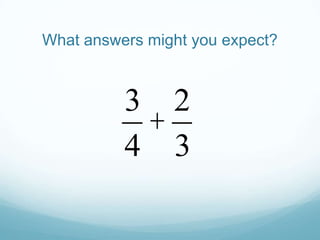
What answers might you expect?

3 2
+
4 3
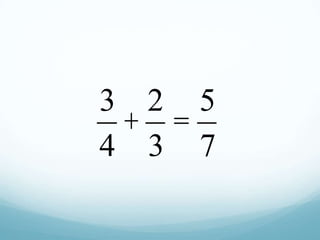
3 2 5
+ =
4 3 7
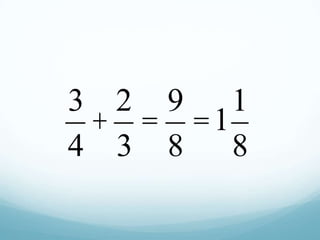
3 2 9 1
+ = =1
4 3 8 8
3 2
+
4 3
3 2
+
4 3
Three Responses to a Problem
1. Answer getting

2. Making sense of the problem situation
3. Making sense of the mathematics you can learn from
working on the problem
- Daro, 2012
3 2
+
4 3

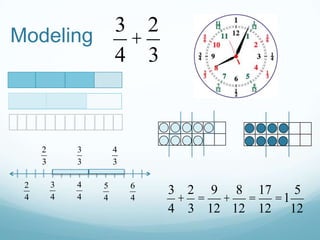
Modeling

2
3
2
4

3
3
3
4

4
4

4
3
5
4

6
4

3 2 9 8 17
5
+ = + = =1
4 3 12 12 12 12
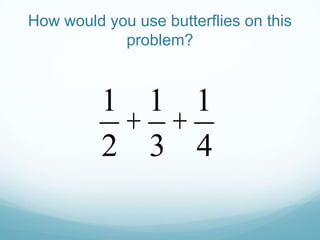
How would you use butterflies on this
problem?

1 1 1
+ +
2 3 4
Why a focus on modeling?
Mathematically proficient students…
- model with mathematics
- use appropriate tools strategically
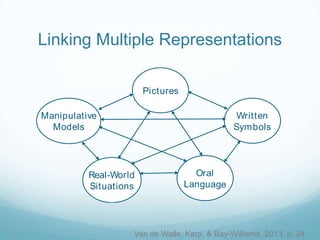
Linking Multiple Representations
 The learner who can, for a particular mathematical
problem, move fluidly among different mathematical
representations has access to a perspective on the
mathematics in the problem that is greater than the
perspective any one representation can provide.
 Driscoll, 1999
Linking Multiple Representations
 Research has shown that children who have difficultly
translating a concept from one representation to
another are the same children who have difficulty
solving problems and understanding computations.

 Strengthening the ability to move between and among
these representations improves the growth of children’s
concepts.
 Lesh, Post, & Behr, 1987
Linking Multiple Representations
Pictures
Manipulative
Models

Written
Sym bols

Real-World
Situations

Oral
Language

Van de Walle, Karp, & Bay-Williams, 2013, p. 24
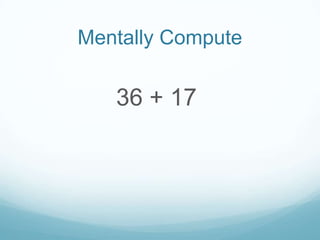
Mentally Compute

36 + 17
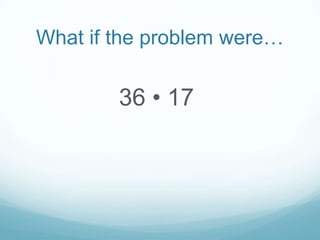
What if the problem were…

36 • 17
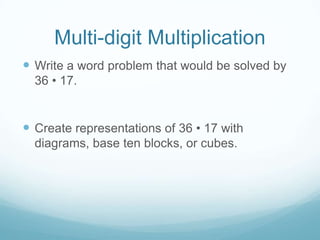
Multi-digit Multiplication
 Write a word problem that would be solved by
36 • 17.

 Create representations of 36 • 17 with
diagrams, base ten blocks, or cubes.
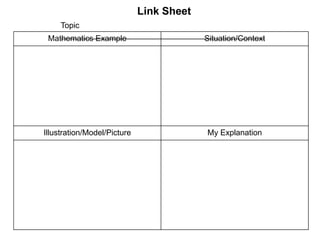
Link Sheet
Topic
______________________________________________
Mathematics Example
Situation/Context

Illustration/Model/Picture

My Explanation
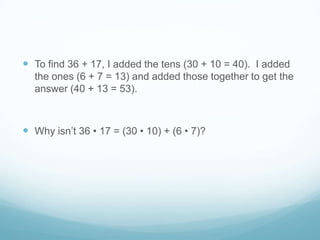
 To find 36 + 17, I added the tens (30 + 10 = 40). I added
the ones (6 + 7 = 13) and added those together to get the
answer (40 + 13 = 53).

 Why isn’t 36 • 17 = (30 • 10) + (6 • 7)?
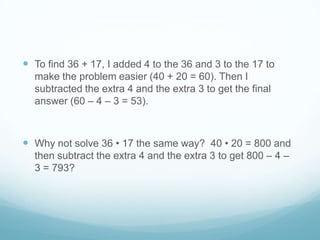
 To find 36 + 17, I added 4 to the 36 and 3 to the 17 to
make the problem easier (40 + 20 = 60). Then I
subtracted the extra 4 and the extra 3 to get the final
answer (60 – 4 – 3 = 53).

 Why not solve 36 • 17 the same way? 40 • 20 = 800 and
then subtract the extra 4 and the extra 3 to get 800 – 4 –
3 = 793?
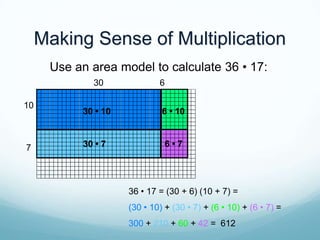
Making Sense of Multiplication
Use an area model to calculate 36 • 17:
30

10

7

6

30 • 10

6 • 10

30 • 7

6•7

36 • 17 = (30 + 6) (10 + 7) =
(30 • 10) + (30 • 7) + (6 • 10) + (6 • 7) =
300 + 210 + 60 + 42 = 612
Making Sense of Multiplication
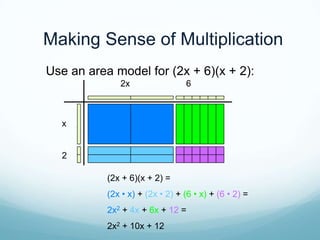
Use an area model for (2x + 6)(x + 2):
2x

6

x

2

4x
(2x + 6)(x + 2) =

(2x • x) + (2x • 2) + (6 • x) + (6 • 2) =
2x2 + 4x + 6x + 12 =
2x2 + 10x + 12
Making Sense of Multiplication
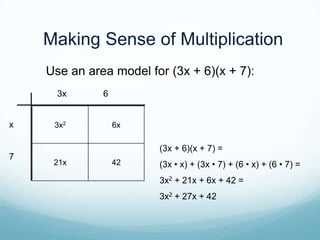
Use an area model for (3x + 6)(x + 7):
3x

x

7

3x2

6

6x

(3x + 6)(x + 7) =
21x

42

(3x • x) + (3x • 7) + (6 • x) + (6 • 7) =
3x2 + 21x + 6x + 42 =

3x2 + 27x + 42
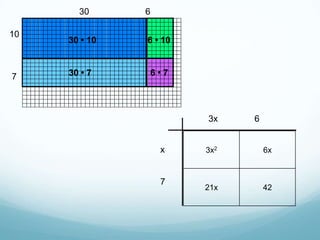
30
10

7

6

30 • 10

6 • 10

30 • 7

6•7

3x

x

7

6

3x2

6x

21x

42
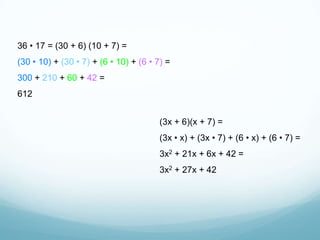
36 • 17 = (30 + 6) (10 + 7) =
(30 • 10) + (30 • 7) + (6 • 10) + (6 • 7) =
300 + 210 + 60 + 42 =
612
(3x + 6)(x + 7) =
(3x • x) + (3x • 7) + (6 • x) + (6 • 7) =
3x2 + 21x + 6x + 42 =
3x2 + 27x + 42
 ―We want our standards to be higher which
means deeper not wider. So we shouldn’t be
worried about getting the width of the
standards, that’s what cover means; we should
be worried about depth, that’s what learn
means.‖
- Daro, 2012

Practicing the Mathematical Practices

  • 1.
    How might yousolve the following? 3 2 + 4 3
  • 2.
    Practicing the Mathematical Practices Modelingto Develop Mathematical Habits of Mind Oregon Math Leaders Annual Conference McMinnville, Oregon Nicole Miller Rigelman Portland State University rigelman@pdx.edu
  • 3.
    Overview  Modeling asa means to support reasoning and sense making  What research says about modeling and how students learn  Example: using multiple representations to support sense making  Students experiences with models and tools  Considering what else models can do…
  • 4.
    What Mathematical Habitsof Mind? National Council of Teachers of Mathematics Process Standards • Problem Solving • Reasoning and Proof • Communication • Connections • Representations - NCTM, 2000
  • 5.
    What Mathematical Habitsof Mind? Strands of Mathematical Proficiency 1. Conceptual understanding—comprehension of mathematical concepts, operations, and relations 2. Procedural fluency—skill in carrying out procedures flexibly, accurately, efficiently, and appropriately 3. Strategic competence—ability to formulate, represent, and solve mathematical problems 4. Adaptive reasoning—capacity for logical thought, reflection, explanation, and justification 5. Productive disposition—habitual inclination to see mathematics as sensible, useful, and worthwhile, coupled with a belief in diligence and one’s own efficacy - Kilpatrick, et al. 2001, p. 117
  • 6.
    Standards for Mathematical Practice 1.Make sense of problems and persevere in solving them. 2. Reason abstractly and quantitatively. 3. Construct viable arguments and critique the reasoning of others. 4. Model with mathematics. 5. Use appropriate tools strategically. 6. Attend to precision. 7. Look for and make use of structure. 8. Look for and express regularity in repeated reasoning. - Common Core State Standards
  • 7.
    Standards for Mathematical Practice 1.Make sense of problems and persevere in solving them. 2. Reason abstractly and quantitatively. 3. Construct viable arguments and critique the reasoning of others. 4. Model with mathematics. 5. Use appropriate tools strategically. 6. Attend to precision. 7. Look for and make use of structure. 8. Look for and express regularity in repeated reasoning. - Common Core State Standards
  • 8.
    Why a focuson modeling? Mathematically proficient students… - model with mathematics - use appropriate tools strategically
  • 9.
    What answers mightyou expect? 3 2 + 4 3
  • 10.
    3 2 5 += 4 3 7
  • 11.
    3 2 91 + = =1 4 3 8 8
  • 12.
  • 13.
  • 14.
    Three Responses toa Problem 1. Answer getting 2. Making sense of the problem situation 3. Making sense of the mathematics you can learn from working on the problem - Daro, 2012
  • 15.
    3 2 + 4 3 Modeling 2 3 2 4 3 3 3 4 4 4 4 3 5 4 6 4 32 9 8 17 5 + = + = =1 4 3 12 12 12 12
  • 16.
    How would youuse butterflies on this problem? 1 1 1 + + 2 3 4
  • 17.
    Why a focuson modeling? Mathematically proficient students… - model with mathematics - use appropriate tools strategically
  • 18.
    Linking Multiple Representations The learner who can, for a particular mathematical problem, move fluidly among different mathematical representations has access to a perspective on the mathematics in the problem that is greater than the perspective any one representation can provide.  Driscoll, 1999
  • 19.
    Linking Multiple Representations Research has shown that children who have difficultly translating a concept from one representation to another are the same children who have difficulty solving problems and understanding computations.  Strengthening the ability to move between and among these representations improves the growth of children’s concepts.  Lesh, Post, & Behr, 1987
  • 20.
    Linking Multiple Representations Pictures Manipulative Models Written Symbols Real-World Situations Oral Language Van de Walle, Karp, & Bay-Williams, 2013, p. 24
  • 21.
  • 22.
    What if theproblem were… 36 • 17
  • 23.
    Multi-digit Multiplication  Writea word problem that would be solved by 36 • 17.  Create representations of 36 • 17 with diagrams, base ten blocks, or cubes.
  • 24.
  • 25.
     To find36 + 17, I added the tens (30 + 10 = 40). I added the ones (6 + 7 = 13) and added those together to get the answer (40 + 13 = 53).  Why isn’t 36 • 17 = (30 • 10) + (6 • 7)?
  • 26.
     To find36 + 17, I added 4 to the 36 and 3 to the 17 to make the problem easier (40 + 20 = 60). Then I subtracted the extra 4 and the extra 3 to get the final answer (60 – 4 – 3 = 53).  Why not solve 36 • 17 the same way? 40 • 20 = 800 and then subtract the extra 4 and the extra 3 to get 800 – 4 – 3 = 793?
  • 27.
    Making Sense ofMultiplication Use an area model to calculate 36 • 17: 30 10 7 6 30 • 10 6 • 10 30 • 7 6•7 36 • 17 = (30 + 6) (10 + 7) = (30 • 10) + (30 • 7) + (6 • 10) + (6 • 7) = 300 + 210 + 60 + 42 = 612
  • 28.
    Making Sense ofMultiplication Use an area model for (2x + 6)(x + 2): 2x 6 x 2 4x (2x + 6)(x + 2) = (2x • x) + (2x • 2) + (6 • x) + (6 • 2) = 2x2 + 4x + 6x + 12 = 2x2 + 10x + 12
  • 29.
    Making Sense ofMultiplication Use an area model for (3x + 6)(x + 7): 3x x 7 3x2 6 6x (3x + 6)(x + 7) = 21x 42 (3x • x) + (3x • 7) + (6 • x) + (6 • 7) = 3x2 + 21x + 6x + 42 = 3x2 + 27x + 42
  • 30.
    30 10 7 6 30 • 10 6• 10 30 • 7 6•7 3x x 7 6 3x2 6x 21x 42
  • 31.
    36 • 17= (30 + 6) (10 + 7) = (30 • 10) + (30 • 7) + (6 • 10) + (6 • 7) = 300 + 210 + 60 + 42 = 612 (3x + 6)(x + 7) = (3x • x) + (3x • 7) + (6 • x) + (6 • 7) = 3x2 + 21x + 6x + 42 = 3x2 + 27x + 42
  • 32.
     ―We wantour standards to be higher which means deeper not wider. So we shouldn’t be worried about getting the width of the standards, that’s what cover means; we should be worried about depth, that’s what learn means.‖ - Daro, 2012

Editor's Notes

  • #5 NCTM (2000). Principles and Standards for School Mathematics. Reston, VA: Author.
  • #6 Kilpatrick J, Swafford J, Findell B (Eds.). (2001). Adding it up: Helping children learn mathematics. Washington, DC: National Academy Press.
  • #7 Standards authors paying attention to what mathematicians do and how students do… provide a definition of mathematical expertise but with efforts to connect specifically to content standards in ways that previous “process” standards had notbeginner, novice, apprentice, expertdevelopment happens over time and in complex ways, it is not just something you learnIt’s the way knowledge comes together, its attitude and habits, ways of working with math and others…
  • #8 Standards authors paying attention to what mathematicians do and how students do… provide a definition of mathematical expertise but with efforts to connect specifically to content standards in ways that previous “process” standards had notbeginner, novice, apprentice, expertdevelopment happens over time and in complex ways, it is not just something you learnIt’s the way knowledge comes together, its attitude and habits, ways of working with math and others…
  • #9 The SMP describe the thinking processes, habits of mind and dispositions that students need to develop a deep, flexible, and enduring understanding of mathematics; in this sense they are also a means to an end while in some cases also describing the mathematics that students need to learn.Define the content of students’ mathematical character (Daro, 2012). Develop this character by MODELING this character…Online video: http://vimeo.com/30914739
  • #15 Phil Daro - Against "Answer-Getting"Online video: http://vimeo.com/30924981
  • #17 Easiest fraction problem on TIMSSIn most high performing countries 80-90% of the students got this right, in the US is was about 20%
  • #18 The SMP describe the thinking processes, habits of mind and dispositions that students need to develop a deep, flexible, and enduring understanding of mathematics; in this sense they are also a means to an end while in some cases also describing the mathematics that students need to learn.
  • #19 Driscoll, M. (1999). Fostering algebraic thinking: A guide for teachers, grades 6-10. Portsmouth, NH: Heinemann.
  • #20 Lesh, R., Post, T., & Behr, M. (1987). Representations and translations among representations inmathematics learning and problem solving. In C. Janvier (Ed.), Problems of Representationin the Teaching and Learning of Mathematics (pp. 33-40). Hillsdale, NY: Lawrence ErlbaumAssociates.
  • #21 Van de Walle, J. A., Karp, K. S, & Bay-Williams, J. M. with Wray, J. (2013). Elementary and middle school mathematics: Teaching developmentally – 8th Edition, Boston: Pearson Education.The deeper you go, the closer and more connected the mathematics gets. As a result the mathematics learning transfers from one situation to the next.
  • #25 Adapted from Shield, M. J., & Swinson, K. V. (1996). “The link sheet: A communication aid for clarifying and developing mathematical ideas and processes.” In P. C. Elliott & M. J. Kenney (Eds.), Communication in Mathematics, K-12 and Beyond: 1996 Yearbook (pp. 35-39). Reston, VA: NCTM.
  • #33 Phil Daro - The Formative Principles of the Common Core StandardsOnline video: http://vimeo.com/30914739