Common
Core Math
David Lai
Christine Cho
Objectives
 Investigate Mathematical Practices
 Investigate Domains and Cluster
Standards for Number and Operations
Base Ten.
 Understand Grade Level Progression
CCSS Math Paradigm Shift
 Equip students with expertise that will help
them succeed in doing and using
mathematics not only across K-12
mathematics curriculum but also in their
college and career work.
 College instructors rate the Mathematical
Practices as being of higher value for
students to master in order to succeed in
their courses than any of the content
standards themselves.
CCSS Math Paradigm Shift
 Develop deep understanding in
mathematics using:
 Conceptual Understanding
 Procedural Fluency
 Deliberate attention and implementation
on the CCSS Mathematical Practices.
CCSS Math Paradigm Shift
 How should students engage with
mathematics tasks and interact with their
fellow students?
 How well do we engage to develop students’
engagement in mathematics reflecting the
CCSS mathematical Practices?
 Standards for mathematical practices are not
a checklist of teachers to dos, but rather they
are processes and proficiencies for students
to experience and demonstrate as they
master the content standards
Organization of Mathematical
Practices
 Overarching Habits of Mind
 Reasoning and Explaining
 Modeling and Using Tools
 Seeing Structure and Generalizing
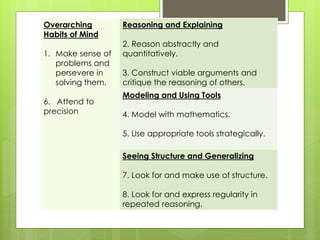
Organization of Mathematical
Practices
Overarching
Habits of Mind
1. Make sense of
problems and
persevere in
solving them.
6. Attend to
precision
Reasoning and Explaining
2. Reason abstractly and
quantitatively.
3. Construct viable arguments and
critique the reasoning of others.
Modeling and Using Tools
4. Model with mathematics.
5. Use appropriate tools strategically.
Seeing Structure and Generalizing
7. Look for and make use of structure.
8. Look for and express regularity in
repeated reasoning.
Overarching Habits of Mind
 Use problem solving tasks and activities to
challenge students to persevere.
 Design lessons where students will need to
struggle to find the answers.
 We want students to overcome
challenges on their own rather than giving
them the answers.
Overarching Habits of Mind
MP 1: Make sense of problems
and persevere in solving them.
 Students make conjectures about the
meaning of a solution and plan a solution
pathway.
 Students try special cases or simpler forms to
gain insight. (They hypothesize and test
conjectures.)
 Students monitor and evaluate their progress
and discuss with others.
 Students understand multiple approaches
and ask the questionm “Does this solution
make sense?”
Team Planning Questions That
Promote CCSS Mathematical
Practice 1
 As we develop common tasks and problems to be
used during the unit, we should consider: 1. Is the
problem interesting to students?
 Does the problem involve meaningful mathematics?
 Does the problem provide an opportunity for
students to apply and extend mathematics?
 Is the problem challenging for students?
 Does the problem support the use of multiple
strategies or solution pathways?
 Will students’ interactions with the problem and peers
reveal information about their mathematics
understanding?
Overarching Habits of Mind
MP 6: Attend to Precision
 Students communicate precisely to others.
 Students use clear definitions of terms in
discussing their reasoning.
 Students express numerical answers with a
degree of precision appropriate for the
problem context.
 Students calculate accurately and efficiently.
 Students are careful about specifying units of
measure and using proper labels.
Team Planning Questions That
Promote CCSS Mathematical
Practice 6
 What is the essential student vocabulary for this
unit, and how will our team assess it?
 What are the expectations for precision in student
solution pathways, explanations, and labels during
this unit?
 How will students be expected to accurately
describe the procedures they use to solve tasks
and problems in class?
 Will student work as it relates to in- and out-of-class
problems and tasks require students to perform
calculations carefully and appropriately?
 Will students’ team and whole-class discussions
reveal an accurate use of mathematics?
Math Progression K-5
Number and Operations in Base Ten
Kindergarten – Number
and Operations in Base Ten
 In Kindergarten, teachers help children
lay the foundation for understanding:
 Base-ten system by drawing special
attention to 10.
 Children learn to view the whole numbers
11 through 19 as ten ones and some more
ones.
 Decompose 10 into pairs such as (1 9), (2
8), (3 7) and find the number that makes
10 when added to a given number such
as 3
First – Number and
Operations Base Ten
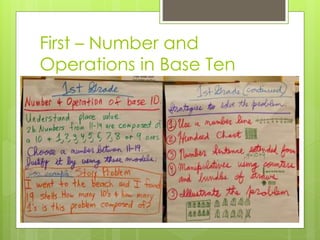
 In first grade, students learn to view ten
ones as a unit called a ten.
 Compose and decompose this unit
flexibly.
 View numbers 11 to 19 as composed of
one ten and some ones allows
development of efficient, general base-
ten methods for addition and subtraction.
 Students see a two-digit numeral as
representing some tens and they add and
subtract using this understanding.
First – Number and
Operations in Base Ten
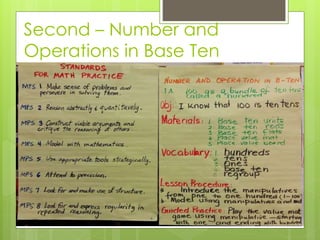
Second – Number and
Operations in Base Ten
 At Grade 2, students extend their base-
ten understanding to hundreds:
 Add and subtract within 1000, with
composing and decomposing, and they
understand and explain the reasoning of
the processes they use. They become
fluent with addition and subtraction within
100.
Second – Number and
Operations in Base Ten
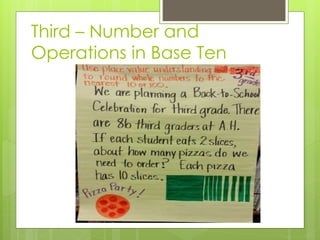
Third – Number and
Operations in Base Ten
 At Grade 3, the major focus is
multiplication, with addition and
subtraction is limited to maintenance of
fluency within 1000 for some students and
building fluency to within 1000 for others.
Third – Number and
Operations in Base Ten
Fourth – Number and
Operations in Base Ten
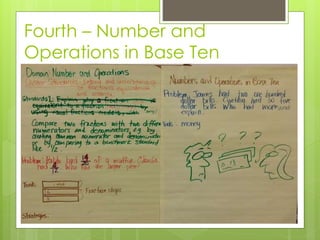
 At Grade 4, students extend their work in
the base-ten system.
 Use standard algorithms to fluently add
and subtract.
 Use methods based on place value and
properties of operations supported by
suitable representations to multiply and
divide with multi-digit numbers.
Fourth – Number and
Operations in Base Ten
Fifth – Number and
Operations in Base Ten
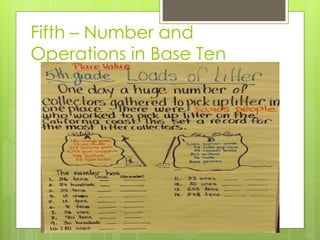
 In Grade 5, students extend their understanding
of the base-ten system to decimals to the
thousandths place, building on their Grade 4
work with tenths and hundredths.
 Become fluent with the standard multiplication
algorithm with multi-digit whole numbers.
 Reason about dividing whole numbers with two-
digit divisors, and
 Reason about adding, subtracting, multiplying,
and dividing decimals to hundredths.
Fifth – Number and
Operations in Base Ten

Ccss math

  • 1.
  • 2.
    Objectives  Investigate MathematicalPractices  Investigate Domains and Cluster Standards for Number and Operations Base Ten.  Understand Grade Level Progression
  • 3.
    CCSS Math ParadigmShift  Equip students with expertise that will help them succeed in doing and using mathematics not only across K-12 mathematics curriculum but also in their college and career work.  College instructors rate the Mathematical Practices as being of higher value for students to master in order to succeed in their courses than any of the content standards themselves.
  • 4.
    CCSS Math ParadigmShift  Develop deep understanding in mathematics using:  Conceptual Understanding  Procedural Fluency  Deliberate attention and implementation on the CCSS Mathematical Practices.
  • 5.
    CCSS Math ParadigmShift  How should students engage with mathematics tasks and interact with their fellow students?  How well do we engage to develop students’ engagement in mathematics reflecting the CCSS mathematical Practices?  Standards for mathematical practices are not a checklist of teachers to dos, but rather they are processes and proficiencies for students to experience and demonstrate as they master the content standards
  • 6.
    Organization of Mathematical Practices Overarching Habits of Mind  Reasoning and Explaining  Modeling and Using Tools  Seeing Structure and Generalizing
  • 7.
    Organization of Mathematical Practices Overarching Habitsof Mind 1. Make sense of problems and persevere in solving them. 6. Attend to precision Reasoning and Explaining 2. Reason abstractly and quantitatively. 3. Construct viable arguments and critique the reasoning of others. Modeling and Using Tools 4. Model with mathematics. 5. Use appropriate tools strategically. Seeing Structure and Generalizing 7. Look for and make use of structure. 8. Look for and express regularity in repeated reasoning.
  • 8.
    Overarching Habits ofMind  Use problem solving tasks and activities to challenge students to persevere.  Design lessons where students will need to struggle to find the answers.  We want students to overcome challenges on their own rather than giving them the answers.
  • 9.
    Overarching Habits ofMind MP 1: Make sense of problems and persevere in solving them.  Students make conjectures about the meaning of a solution and plan a solution pathway.  Students try special cases or simpler forms to gain insight. (They hypothesize and test conjectures.)  Students monitor and evaluate their progress and discuss with others.  Students understand multiple approaches and ask the questionm “Does this solution make sense?”
  • 10.
    Team Planning QuestionsThat Promote CCSS Mathematical Practice 1  As we develop common tasks and problems to be used during the unit, we should consider: 1. Is the problem interesting to students?  Does the problem involve meaningful mathematics?  Does the problem provide an opportunity for students to apply and extend mathematics?  Is the problem challenging for students?  Does the problem support the use of multiple strategies or solution pathways?  Will students’ interactions with the problem and peers reveal information about their mathematics understanding?
  • 11.
    Overarching Habits ofMind MP 6: Attend to Precision  Students communicate precisely to others.  Students use clear definitions of terms in discussing their reasoning.  Students express numerical answers with a degree of precision appropriate for the problem context.  Students calculate accurately and efficiently.  Students are careful about specifying units of measure and using proper labels.
  • 12.
    Team Planning QuestionsThat Promote CCSS Mathematical Practice 6  What is the essential student vocabulary for this unit, and how will our team assess it?  What are the expectations for precision in student solution pathways, explanations, and labels during this unit?  How will students be expected to accurately describe the procedures they use to solve tasks and problems in class?  Will student work as it relates to in- and out-of-class problems and tasks require students to perform calculations carefully and appropriately?  Will students’ team and whole-class discussions reveal an accurate use of mathematics?
  • 13.
    Math Progression K-5 Numberand Operations in Base Ten
  • 14.
    Kindergarten – Number andOperations in Base Ten  In Kindergarten, teachers help children lay the foundation for understanding:  Base-ten system by drawing special attention to 10.  Children learn to view the whole numbers 11 through 19 as ten ones and some more ones.  Decompose 10 into pairs such as (1 9), (2 8), (3 7) and find the number that makes 10 when added to a given number such as 3
  • 15.
    First – Numberand Operations Base Ten  In first grade, students learn to view ten ones as a unit called a ten.  Compose and decompose this unit flexibly.  View numbers 11 to 19 as composed of one ten and some ones allows development of efficient, general base- ten methods for addition and subtraction.  Students see a two-digit numeral as representing some tens and they add and subtract using this understanding.
  • 16.
    First – Numberand Operations in Base Ten
  • 17.
    Second – Numberand Operations in Base Ten  At Grade 2, students extend their base- ten understanding to hundreds:  Add and subtract within 1000, with composing and decomposing, and they understand and explain the reasoning of the processes they use. They become fluent with addition and subtraction within 100.
  • 18.
    Second – Numberand Operations in Base Ten
  • 19.
    Third – Numberand Operations in Base Ten  At Grade 3, the major focus is multiplication, with addition and subtraction is limited to maintenance of fluency within 1000 for some students and building fluency to within 1000 for others.
  • 20.
    Third – Numberand Operations in Base Ten
  • 21.
    Fourth – Numberand Operations in Base Ten  At Grade 4, students extend their work in the base-ten system.  Use standard algorithms to fluently add and subtract.  Use methods based on place value and properties of operations supported by suitable representations to multiply and divide with multi-digit numbers.
  • 22.
    Fourth – Numberand Operations in Base Ten
  • 23.
    Fifth – Numberand Operations in Base Ten  In Grade 5, students extend their understanding of the base-ten system to decimals to the thousandths place, building on their Grade 4 work with tenths and hundredths.  Become fluent with the standard multiplication algorithm with multi-digit whole numbers.  Reason about dividing whole numbers with two- digit divisors, and  Reason about adding, subtracting, multiplying, and dividing decimals to hundredths.
  • 24.
    Fifth – Numberand Operations in Base Ten