Marco Calzolari / Agile Reloaded / 2015
(A PRIMER)
Marco Calzolari
2-2015
LEAN USER EXPERIENCE
Marco Calzolari / Agile Reloaded / 2015
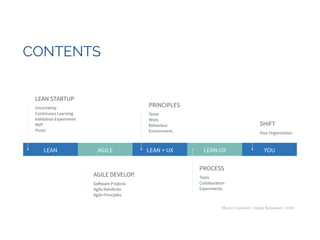
CONTENTS
LEAN AGILE LEAN + UX LEAN UX YOU
LEAN STARTUP
Uncertainty

Continuous Learning

Validation Experiment

MVP

Pivot!
AGILE DEVELOP.
Software Projects

Agile Manifesto

Agile Principles
PRINCIPLES
Team

Work

Behaviour

Environment
SHIFT
Your Organization
PROCESS
Tools

Collaboration

Experiments
Marco Calzolari / Agile Reloaded / 2015
LEAN UX MYTHS
Marco Calzolari / Agile Reloaded / 2015Marco Calzolari / Agile Reloaded / 2015
Regular UX ≠ Waterfall Process
Lean UX ≠ Minimal UX
Lean UX ≠ No Upfront Analysis
Lean UX ≠ A Whole New Thing
Lean UX ≠ Faster UX Process
LEAN UX MYTHS
Marco Calzolari / Agile Reloaded / 2015
LEAN (STARTUP) CONCEPTS
Marco Calzolari / Agile Reloaded / 2015
Taiichi Ohno (⼤大野 耐)
Marco Calzolari / Agile Reloaded / 2015
CRISIS
COMPETITION
MARKET
MONEY


PEOPLE

CUSTOMERS

VALUES
Marco Calzolari / Agile Reloaded / 2015
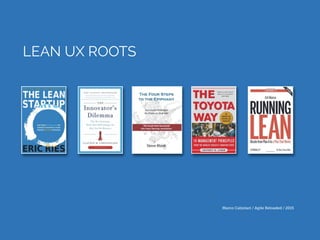
LEAN UX ROOTS
Marco Calzolari / Agile Reloaded / 2015
“ A human institution designed to
create a new product or service under
conditions of extreme uncertainty ”
Eric Ries
(Entrepreneur, Author)
STARTUP
Marco Calzolari / Agile Reloaded / 2015
Uncertainty
Marco Calzolari / Agile Reloaded / 2015
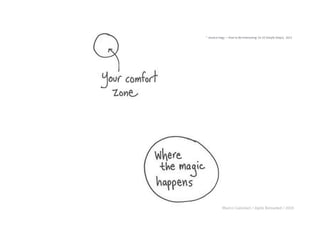
* Jessica Hagy — How to Be Interesting: (In 10 Simple Steps), 2013
Marco Calzolari / Agile Reloaded / 2015
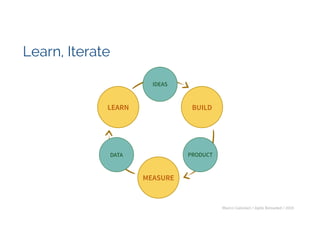
Learn, Iterate
Marco Calzolari / Agile Reloaded / 2015
DATA PRODUCT
IDEAS
BUILDLEARN
MEASURE
Learn, Iterate
Marco Calzolari / Agile Reloaded / 2015
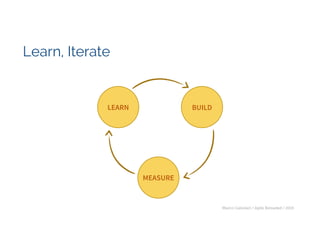
BUILDLEARN
MEASURE
Learn, Iterate
Marco Calzolari / Agile Reloaded / 2015
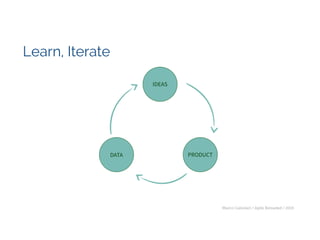
DATA PRODUCT
IDEAS
Learn, Iterate
Marco Calzolari / Agile Reloaded / 2015
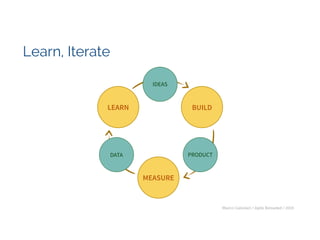
DATA PRODUCT
IDEAS
BUILDLEARN
MEASURE
Learn, Iterate
Marco Calzolari / Agile Reloaded / 2015
Hypothesis
CAN WE BUILD THIS (PRODUCT)?
Marco Calzolari / Agile Reloaded / 2015
Hypothesis
SHOULD
CAN WE BUILD THIS (PRODUCT)?
Marco Calzolari / Agile Reloaded / 2015
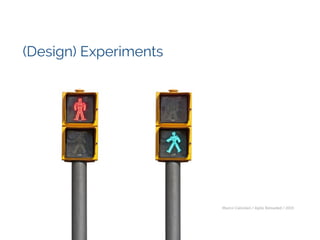
(Design) Experiments
Marco Calzolari / Agile Reloaded / 2015
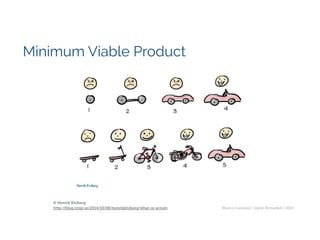
Minimum Viable Product
© Henrik Kniberg

http://blog.crisp.se/2014/10/08/henrikkniberg/what-is-scrum
Marco Calzolari / Agile Reloaded / 2015
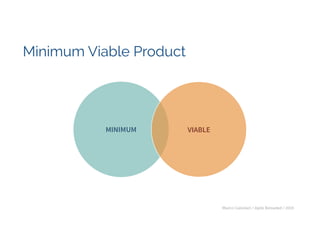
MINIMUM VIABLE
Minimum Viable Product
Marco Calzolari / Agile Reloaded / 2015
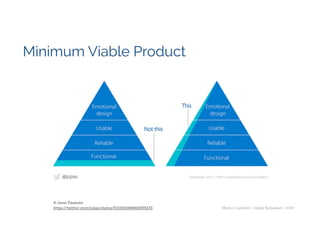
Minimum Viable Product
© Jussi Pasanen

https://twitter.com/jopas/status/515301088660959233
Marco Calzolari / Agile Reloaded / 2015
PIVOT!
Marco Calzolari / Agile Reloaded / 2015
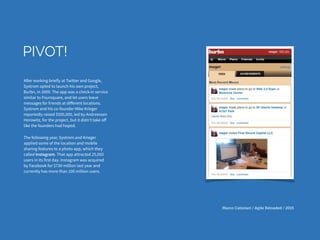
PIVOT!
After working briefly at Twitter and Google,
Systrom opted to launch his own project,
Burbn, in 2009. The app was a check-in service
similar to Foursquare, and let users leave
messages for friends at different locations.
Systrom and his co-founder Mike Krieger
reportedly raised $500,000, led by Andreessen
Horowitz, for the project, but it didn't take off
like the founders had hoped.
The following year, Systrom and Krieger
applied some of the location and mobile
sharing features to a photo app, which they
called Instagram. That app attracted 25,000
users in its first day. Instagram was acquired
by Facebook for $730 million last year and
currently has more than 100 million users.
Marco Calzolari / Agile Reloaded / 2015
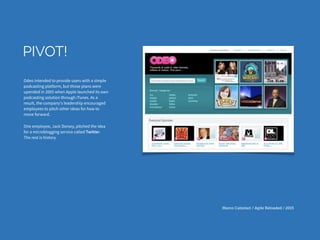
PIVOT!
Odeo intended to provide users with a simple
podcasting platform, but those plans were
upended in 2005 when Apple launched its own
podcasting solution through iTunes. As a
result, the company's leadership encouraged
employees to pitch other ideas for how to
move forward.
One employee, Jack Dorsey, pitched the idea
for a microblogging service called Twitter. 

The rest is history.
Marco Calzolari / Agile Reloaded / 2015
PIVOT!
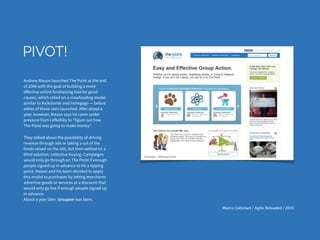
Andrew Mason launched The Point at the end
of 2006 with the goal of building a more
effective online fundraising tool for good
causes, which relied on a crowfunding model
similar to Kickstarter and Indiegogo — before
either of these sites launched. After about a
year, however, Mason says he came under
pressure from Lefkofsky to "figure out how
The Point was going to make money”.
They talked about the possibility of driving
revenue through ads or taking a cut of the
funds raised on the site, but then settled on a
third solution: collective buying. Campaigns
would only go through on The Point if enough
people signed up in advance to hit a tipping
point. Mason and his team decided to apply
this model to purchases by letting merchants
advertise goods or services at a discount that
would only go live if enough people signed up
in advance. 

About a year later, Groupon was born.
Marco Calzolari / Agile Reloaded / 2015
PIVOT!
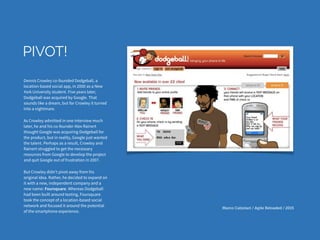
Dennis Crowley co-founded Dodgeball, a
location-based social app, in 2000 as a New
York University student. Five years later,
Dodgeball was acquired by Google. That
sounds like a dream, but for Crowley it turned
into a nightmare.
As Crowley admitted in one interview much
later, he and his co-founder Alex Rainert
thought Google was acquiring Dodgeball for
the product, but in reality, Google just wanted
the talent. Perhaps as a result, Crowley and
Rainert struggled to get the necessary
resources from Google to develop the project
and quit Google out of frustration in 2007.
But Crowley didn't pivot away from his
original idea. Rather, he decided to expand on
it with a new, independent company and a
new name: Foursquare. Whereas Dodgeball
had been built around texting, Foursquare
took the concept of a location-based social
network and focused it around the potential
of the smartphone experience.
Marco Calzolari / Agile Reloaded / 2015
PIVOT!
http://mashable.com/2013/06/17/startup-pivots/
http://thenextweb.com/insider/2011/09/13/10-great-tech-company-pivots/
http://www.fastcompany.com/3001984/pinterest-pivot
http://www.businessinsider.com/how-twitter-was-founded-2011-4
http://www.forbes.com/sites/jasonnazar/2013/10/08/14-famous-business-pivots/
Marco Calzolari / Agile Reloaded / 2015
AGILE DEVELOPMENT
Marco Calzolari / Agile Reloaded / 2015
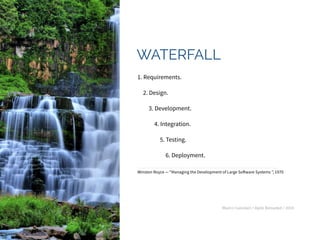
WATERFALL
1. Requirements. 

2. Design. 

3. Development.

4. Integration. 

5. Testing.

6. Deployment.
Winston Royce — “Managing the Development of Large Software Systems ”, 1970
AGILE
Marco Calzolari / Agile Reloaded / 2015
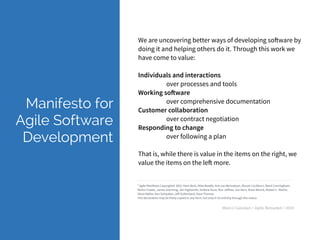
We are uncovering better ways of developing software by
doing it and helping others do it. Through this work we
have come to value:
Individuals and interactions
over processes and tools
Working software
over comprehensive documentation
Customer collaboration
over contract negotiation
Responding to change
over following a plan
That is, while there is value in the items on the right, we
value the items on the left more.
* Agile Manifesto Copyright© 2001: Kent Beck, Mike Beedle, Arie van Bennekum, Alistair Cockburn, Ward Cunningham,
Martin Fowler, James Grenning, Jim Highsmith, Andrew Hunt, Ron Jeffries, Jon Kern, Brian Marick, Robert C. Martin,
Steve Mellor, Ken Schwaber, Jeff Sutherland, Dave Thomas
This declaration may be freely copied in any form, but only in its entirety through this notice.
Manifesto for
Agile Software
Development
Marco Calzolari / Agile Reloaded / 2015
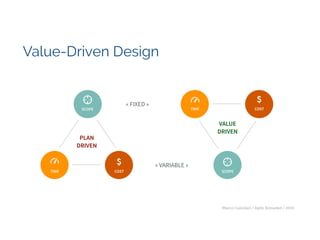
Value-Driven Design
TIME COST
SCOPE
VALUE
DRIVEN
« FIXED »
« VARIABLE »
TIME COST
SCOPE
PLAN
DRIVEN
Marco Calzolari / Agile Reloaded / 2015
LEAN UX PRINCIPLES
Marco Calzolari / Agile Reloaded / 2015
LEAN UX

Principles
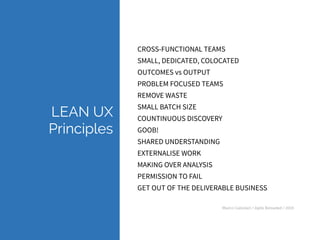
CROSS-FUNCTIONAL TEAMS
SMALL, DEDICATED, COLOCATED
OUTCOMES vs OUTPUT
PROBLEM FOCUSED TEAMS
REMOVE WASTE
SMALL BATCH SIZE
COUNTINUOUS DISCOVERY
GOOB!
SHARED UNDERSTANDING
EXTERNALISE WORK
MAKING OVER ANALYSIS
PERMISSION TO FAIL
GET OUT OF THE DELIVERABLE BUSINESS
Marco Calzolari / Agile Reloaded / 2015
LEAN UX PROCESS
Marco Calzolari / Agile Reloaded / 2015
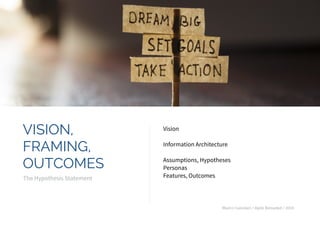
VISION,

FRAMING,

OUTCOMES
The Hypothesis Statement
Vision
Information Architecture


Assumptions, Hypotheses
Personas
Features, Outcomes
Marco Calzolari / Agile Reloaded / 2015
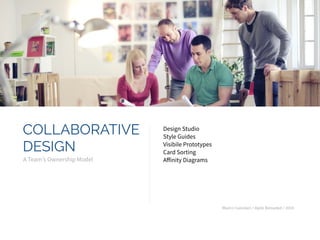
COLLABORATIVE
DESIGN
A Team’s Ownership Model
Design Studio
Style Guides
Visibile Prototypes
Card Sorting
Affinity Diagrams
Marco Calzolari / Agile Reloaded / 2015
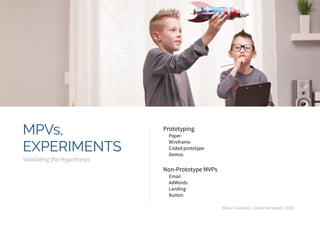
MPVs,

EXPERIMENTS
Validating the Hypothesis
Prototyping
Paper
Wireframe
Coded prototype
Demos
Non-Prototype MVPs
Email
AdWords
Landing

Button
Marco Calzolari / Agile Reloaded / 2015
ORGANIZATIONAL SHIFTS
Marco Calzolari / Agile Reloaded / 2015
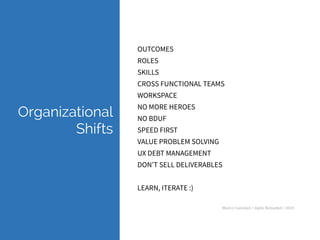
Organizational

Shifts
OUTCOMES
ROLES
SKILLS
CROSS FUNCTIONAL TEAMS
WORKSPACE
NO MORE HEROES
NO BDUF
SPEED FIRST
VALUE PROBLEM SOLVING
UX DEBT MANAGEMENT
DON’T SELL DELIVERABLES
LEARN, ITERATE :)
Marco Calzolari / Agile Reloaded / 2015
R.O.T.I.
Return Of Time Invested
0 Lost Principle: No Benefit for Time Invested
1 a little better than 0
2 Break-Even: Benefit Equal to Time Invested
3 a little less than 4
4 High Return: Benefit Greater than Time Invested
Marco Calzolari / Agile Reloaded / 2015
THANK YOU VERY MUCH
@marcocalzolari
linkedin.com/in/marcocalzolari

Lean UX

  • 1.
    Marco Calzolari /Agile Reloaded / 2015 (A PRIMER) Marco Calzolari 2-2015 LEAN USER EXPERIENCE
  • 2.
    Marco Calzolari /Agile Reloaded / 2015 CONTENTS LEAN AGILE LEAN + UX LEAN UX YOU LEAN STARTUP Uncertainty
 Continuous Learning
 Validation Experiment
 MVP
 Pivot! AGILE DEVELOP. Software Projects
 Agile Manifesto
 Agile Principles PRINCIPLES Team
 Work
 Behaviour
 Environment SHIFT Your Organization PROCESS Tools
 Collaboration
 Experiments
  • 3.
    Marco Calzolari /Agile Reloaded / 2015
  • 4.
    Marco Calzolari /Agile Reloaded / 2015 LEAN UX MYTHS
  • 5.
    Marco Calzolari /Agile Reloaded / 2015Marco Calzolari / Agile Reloaded / 2015 Regular UX ≠ Waterfall Process Lean UX ≠ Minimal UX Lean UX ≠ No Upfront Analysis Lean UX ≠ A Whole New Thing Lean UX ≠ Faster UX Process LEAN UX MYTHS
  • 6.
    Marco Calzolari /Agile Reloaded / 2015 LEAN (STARTUP) CONCEPTS
  • 7.
    Marco Calzolari /Agile Reloaded / 2015 Taiichi Ohno (⼤大野 耐) Marco Calzolari / Agile Reloaded / 2015 CRISIS COMPETITION MARKET MONEY
 
 PEOPLE
 CUSTOMERS
 VALUES
  • 8.
    Marco Calzolari /Agile Reloaded / 2015 LEAN UX ROOTS
  • 9.
    Marco Calzolari /Agile Reloaded / 2015 “ A human institution designed to create a new product or service under conditions of extreme uncertainty ” Eric Ries (Entrepreneur, Author) STARTUP
  • 10.
    Marco Calzolari /Agile Reloaded / 2015 Uncertainty
  • 11.
    Marco Calzolari /Agile Reloaded / 2015 * Jessica Hagy — How to Be Interesting: (In 10 Simple Steps), 2013
  • 12.
    Marco Calzolari /Agile Reloaded / 2015 Learn, Iterate
  • 13.
    Marco Calzolari /Agile Reloaded / 2015 DATA PRODUCT IDEAS BUILDLEARN MEASURE Learn, Iterate
  • 14.
    Marco Calzolari /Agile Reloaded / 2015 BUILDLEARN MEASURE Learn, Iterate
  • 15.
    Marco Calzolari /Agile Reloaded / 2015 DATA PRODUCT IDEAS Learn, Iterate
  • 16.
    Marco Calzolari /Agile Reloaded / 2015 DATA PRODUCT IDEAS BUILDLEARN MEASURE Learn, Iterate
  • 17.
    Marco Calzolari /Agile Reloaded / 2015 Hypothesis CAN WE BUILD THIS (PRODUCT)?
  • 18.
    Marco Calzolari /Agile Reloaded / 2015 Hypothesis SHOULD CAN WE BUILD THIS (PRODUCT)?
  • 19.
    Marco Calzolari /Agile Reloaded / 2015 (Design) Experiments Marco Calzolari / Agile Reloaded / 2015
  • 20.
    Marco Calzolari /Agile Reloaded / 2015 Minimum Viable Product © Henrik Kniberg
 http://blog.crisp.se/2014/10/08/henrikkniberg/what-is-scrum
  • 21.
    Marco Calzolari /Agile Reloaded / 2015 MINIMUM VIABLE Minimum Viable Product
  • 22.
    Marco Calzolari /Agile Reloaded / 2015 Minimum Viable Product © Jussi Pasanen
 https://twitter.com/jopas/status/515301088660959233
  • 23.
    Marco Calzolari /Agile Reloaded / 2015 PIVOT!
  • 24.
    Marco Calzolari /Agile Reloaded / 2015 PIVOT! After working briefly at Twitter and Google, Systrom opted to launch his own project, Burbn, in 2009. The app was a check-in service similar to Foursquare, and let users leave messages for friends at different locations. Systrom and his co-founder Mike Krieger reportedly raised $500,000, led by Andreessen Horowitz, for the project, but it didn't take off like the founders had hoped. The following year, Systrom and Krieger applied some of the location and mobile sharing features to a photo app, which they called Instagram. That app attracted 25,000 users in its first day. Instagram was acquired by Facebook for $730 million last year and currently has more than 100 million users.
  • 25.
    Marco Calzolari /Agile Reloaded / 2015 PIVOT! Odeo intended to provide users with a simple podcasting platform, but those plans were upended in 2005 when Apple launched its own podcasting solution through iTunes. As a result, the company's leadership encouraged employees to pitch other ideas for how to move forward. One employee, Jack Dorsey, pitched the idea for a microblogging service called Twitter. 
 The rest is history.
  • 26.
    Marco Calzolari /Agile Reloaded / 2015 PIVOT! Andrew Mason launched The Point at the end of 2006 with the goal of building a more effective online fundraising tool for good causes, which relied on a crowfunding model similar to Kickstarter and Indiegogo — before either of these sites launched. After about a year, however, Mason says he came under pressure from Lefkofsky to "figure out how The Point was going to make money”. They talked about the possibility of driving revenue through ads or taking a cut of the funds raised on the site, but then settled on a third solution: collective buying. Campaigns would only go through on The Point if enough people signed up in advance to hit a tipping point. Mason and his team decided to apply this model to purchases by letting merchants advertise goods or services at a discount that would only go live if enough people signed up in advance. 
 About a year later, Groupon was born.
  • 27.
    Marco Calzolari /Agile Reloaded / 2015 PIVOT! Dennis Crowley co-founded Dodgeball, a location-based social app, in 2000 as a New York University student. Five years later, Dodgeball was acquired by Google. That sounds like a dream, but for Crowley it turned into a nightmare. As Crowley admitted in one interview much later, he and his co-founder Alex Rainert thought Google was acquiring Dodgeball for the product, but in reality, Google just wanted the talent. Perhaps as a result, Crowley and Rainert struggled to get the necessary resources from Google to develop the project and quit Google out of frustration in 2007. But Crowley didn't pivot away from his original idea. Rather, he decided to expand on it with a new, independent company and a new name: Foursquare. Whereas Dodgeball had been built around texting, Foursquare took the concept of a location-based social network and focused it around the potential of the smartphone experience.
  • 28.
    Marco Calzolari /Agile Reloaded / 2015 PIVOT! http://mashable.com/2013/06/17/startup-pivots/ http://thenextweb.com/insider/2011/09/13/10-great-tech-company-pivots/ http://www.fastcompany.com/3001984/pinterest-pivot http://www.businessinsider.com/how-twitter-was-founded-2011-4 http://www.forbes.com/sites/jasonnazar/2013/10/08/14-famous-business-pivots/
  • 29.
    Marco Calzolari /Agile Reloaded / 2015 AGILE DEVELOPMENT
  • 30.
    Marco Calzolari /Agile Reloaded / 2015 WATERFALL 1. Requirements. 
 2. Design. 
 3. Development.
 4. Integration. 
 5. Testing.
 6. Deployment. Winston Royce — “Managing the Development of Large Software Systems ”, 1970 AGILE
  • 31.
    Marco Calzolari /Agile Reloaded / 2015 We are uncovering better ways of developing software by doing it and helping others do it. Through this work we have come to value: Individuals and interactions over processes and tools Working software over comprehensive documentation Customer collaboration over contract negotiation Responding to change over following a plan That is, while there is value in the items on the right, we value the items on the left more. * Agile Manifesto Copyright© 2001: Kent Beck, Mike Beedle, Arie van Bennekum, Alistair Cockburn, Ward Cunningham, Martin Fowler, James Grenning, Jim Highsmith, Andrew Hunt, Ron Jeffries, Jon Kern, Brian Marick, Robert C. Martin, Steve Mellor, Ken Schwaber, Jeff Sutherland, Dave Thomas This declaration may be freely copied in any form, but only in its entirety through this notice. Manifesto for Agile Software Development
  • 32.
    Marco Calzolari /Agile Reloaded / 2015 Value-Driven Design TIME COST SCOPE VALUE DRIVEN « FIXED » « VARIABLE » TIME COST SCOPE PLAN DRIVEN
  • 33.
    Marco Calzolari /Agile Reloaded / 2015 LEAN UX PRINCIPLES
  • 34.
    Marco Calzolari /Agile Reloaded / 2015 LEAN UX
 Principles CROSS-FUNCTIONAL TEAMS SMALL, DEDICATED, COLOCATED OUTCOMES vs OUTPUT PROBLEM FOCUSED TEAMS REMOVE WASTE SMALL BATCH SIZE COUNTINUOUS DISCOVERY GOOB! SHARED UNDERSTANDING EXTERNALISE WORK MAKING OVER ANALYSIS PERMISSION TO FAIL GET OUT OF THE DELIVERABLE BUSINESS
  • 35.
    Marco Calzolari /Agile Reloaded / 2015 LEAN UX PROCESS
  • 36.
    Marco Calzolari /Agile Reloaded / 2015 VISION,
 FRAMING,
 OUTCOMES The Hypothesis Statement Vision Information Architecture 
 Assumptions, Hypotheses Personas Features, Outcomes
  • 37.
    Marco Calzolari /Agile Reloaded / 2015 COLLABORATIVE DESIGN A Team’s Ownership Model Design Studio Style Guides Visibile Prototypes Card Sorting Affinity Diagrams
  • 38.
    Marco Calzolari /Agile Reloaded / 2015 MPVs,
 EXPERIMENTS Validating the Hypothesis Prototyping Paper Wireframe Coded prototype Demos Non-Prototype MVPs Email AdWords Landing
 Button
  • 39.
    Marco Calzolari /Agile Reloaded / 2015 ORGANIZATIONAL SHIFTS
  • 40.
    Marco Calzolari /Agile Reloaded / 2015 Organizational
 Shifts OUTCOMES ROLES SKILLS CROSS FUNCTIONAL TEAMS WORKSPACE NO MORE HEROES NO BDUF SPEED FIRST VALUE PROBLEM SOLVING UX DEBT MANAGEMENT DON’T SELL DELIVERABLES LEARN, ITERATE :)
  • 41.
    Marco Calzolari /Agile Reloaded / 2015 R.O.T.I. Return Of Time Invested 0 Lost Principle: No Benefit for Time Invested 1 a little better than 0 2 Break-Even: Benefit Equal to Time Invested 3 a little less than 4 4 High Return: Benefit Greater than Time Invested
  • 42.
    Marco Calzolari /Agile Reloaded / 2015 THANK YOU VERY MUCH @marcocalzolari linkedin.com/in/marcocalzolari