Research Methods in UX
UXMad
9/19/13
Schedule
● Socializing/Mingling
● Intros/Announcements
○ Jobs/Opportunities
● Brief Presentation
○ Why research?
○ What research is
○ A few methods
● Workshop!
● Afterparty?
About Me
Brad Orego
me@bradorego.com
@bradorego
B.S. in Computer Science, B.A. in Psychology
UX Lead at Nextt
UXMad Meetup Co-Organizer
Entrepreneur
Dancer, Curler, Ultimate-er, Cyclist, Beer-batter pancake blogger
Why research?
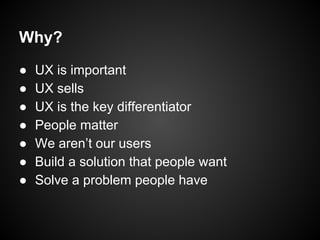
Why?
● UX is important
● UX sells
● UX is the key differentiator
● People matter
● We aren’t our users
● Build a solution that people want
● Solve a problem people have
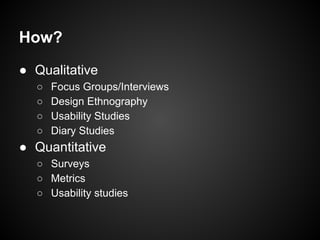
How?
● Qualitative
○ Focus Groups/Interviews
○ Design Ethnography
○ Usability Studies
○ Diary Studies
● Quantitative
○ Surveys
○ Metrics
○ Usability studies
Details!
Qualitative
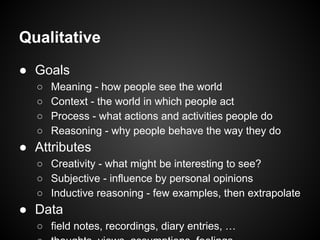
Qualitative
● Goals
○ Meaning - how people see the world
○ Context - the world in which people act
○ Process - what actions and activities people do
○ Reasoning - why people behave the way they do
● Attributes
○ Creativity - what might be interesting to see?
○ Subjective - influence by personal opinions
○ Inductive reasoning - few examples, then extrapolate
● Data
○ field notes, recordings, diary entries, …
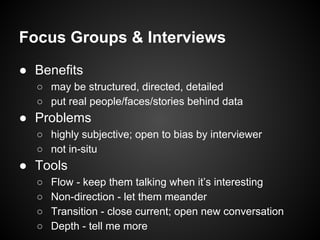
Focus Groups & Interviews
● Benefits
○ may be structured, directed, detailed
○ put real people/faces/stories behind data
● Problems
○ highly subjective; open to bias by interviewer
○ not in-situ
● Tools
○ Flow - keep them talking when it’s interesting
○ Non-direction - let them meander
○ Transition - close current; open new conversation
○ Depth - tell me more
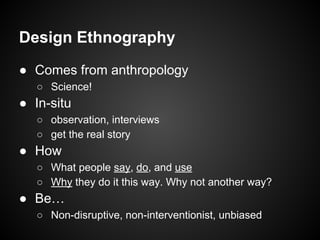
Design Ethnography
● Comes from anthropology
○ Science!
● In-situ
○ observation, interviews
○ get the real story
● How
○ What people say, do, and use
○ Why they do it this way. Why not another way?
● Be…
○ Non-disruptive, non-interventionist, unbiased
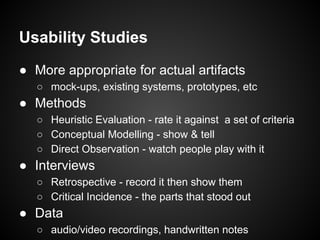
Usability Studies
● More appropriate for actual artifacts
○ mock-ups, existing systems, prototypes, etc
● Methods
○ Heuristic Evaluation - rate it against a set of criteria
○ Conceptual Modelling - show & tell
○ Direct Observation - watch people play with it
● Interviews
○ Retrospective - record it then show them
○ Critical Incidence - the parts that stood out
● Data
○ audio/video recordings, handwritten notes
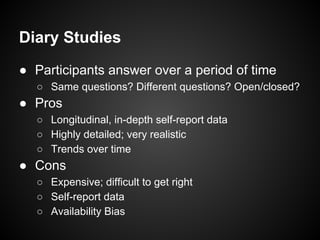
Diary Studies
● Participants answer over a period of time
○ Same questions? Different questions? Open/closed?
● Pros
○ Longitudinal, in-depth self-report data
○ Highly detailed; very realistic
○ Trends over time
● Cons
○ Expensive; difficult to get right
○ Self-report data
○ Availability Bias
Numbers!
Quantitative
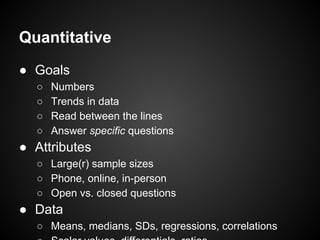
Quantitative
● Goals
○ Numbers
○ Trends in data
○ Read between the lines
○ Answer specific questions
● Attributes
○ Large(r) sample sizes
○ Phone, online, in-person
○ Open vs. closed questions
● Data
○ Means, medians, SDs, regressions, correlations
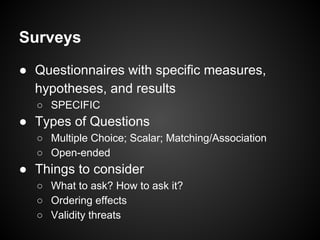
Surveys
● Questionnaires with specific measures,
hypotheses, and results
○ SPECIFIC
● Types of Questions
○ Multiple Choice; Scalar; Matching/Association
○ Open-ended
● Things to consider
○ What to ask? How to ask it?
○ Ordering effects
○ Validity threats
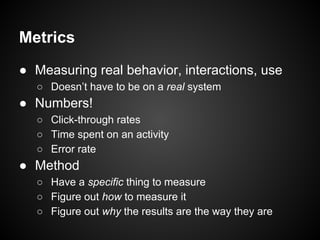
Metrics
● Measuring real behavior, interactions, use
○ Doesn’t have to be on a real system
● Numbers!
○ Click-through rates
○ Time spent on an activity
○ Error rate
● Method
○ Have a specific thing to measure
○ Figure out how to measure it
○ Figure out why the results are the way they are
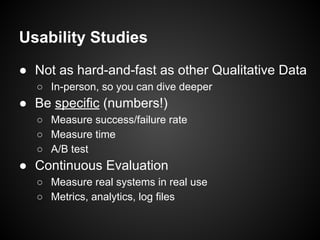
Usability Studies
● Not as hard-and-fast as other Qualitative Data
○ In-person, so you can dive deeper
● Be specific (numbers!)
○ Measure success/failure rate
○ Measure time
○ A/B test
● Continuous Evaluation
○ Measure real systems in real use
○ Metrics, analytics, log files
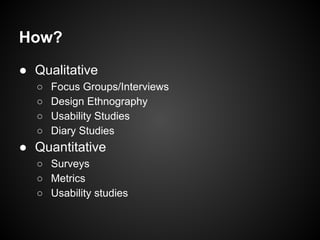
How?
● Qualitative
○ Focus Groups/Interviews
○ Design Ethnography
○ Usability Studies
○ Diary Studies
● Quantitative
○ Surveys
○ Metrics
○ Usability studies
Now what?
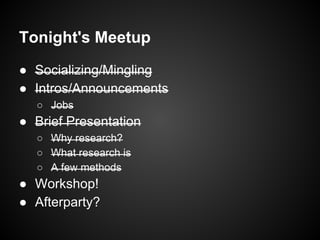
Tonight's Meetup
● Socializing/Mingling
● Intros/Announcements
○ Jobs
● Brief Presentation
○ Why research?
○ What research is
○ A few methods
● Workshop!
● Afterparty?
Workshop!
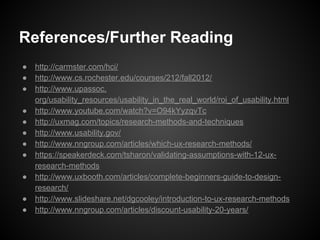
References/Further Reading
● http://carmster.com/hci/
● http://www.cs.rochester.edu/courses/212/fall2012/
● http://www.upassoc.
org/usability_resources/usability_in_the_real_world/roi_of_usability.html
● http://www.youtube.com/watch?v=O94kYyzqvTc
● http://uxmag.com/topics/research-methods-and-techniques
● http://www.usability.gov/
● http://www.nngroup.com/articles/which-ux-research-methods/
● https://speakerdeck.com/tsharon/validating-assumptions-with-12-ux-
research-methods
● http://www.uxbooth.com/articles/complete-beginners-guide-to-design-
research/
● http://www.slideshare.net/dgcooley/introduction-to-ux-research-methods
● http://www.nngroup.com/articles/discount-usability-20-years/

Research Methods in UX

  • 1.
    Research Methods inUX UXMad 9/19/13
  • 2.
    Schedule ● Socializing/Mingling ● Intros/Announcements ○Jobs/Opportunities ● Brief Presentation ○ Why research? ○ What research is ○ A few methods ● Workshop! ● Afterparty?
  • 3.
  • 4.
    Brad Orego me@bradorego.com @bradorego B.S. inComputer Science, B.A. in Psychology UX Lead at Nextt UXMad Meetup Co-Organizer Entrepreneur Dancer, Curler, Ultimate-er, Cyclist, Beer-batter pancake blogger
  • 5.
  • 6.
    Why? ● UX isimportant ● UX sells ● UX is the key differentiator ● People matter ● We aren’t our users ● Build a solution that people want ● Solve a problem people have
  • 7.
    How? ● Qualitative ○ FocusGroups/Interviews ○ Design Ethnography ○ Usability Studies ○ Diary Studies ● Quantitative ○ Surveys ○ Metrics ○ Usability studies
  • 8.
  • 9.
    Qualitative ● Goals ○ Meaning- how people see the world ○ Context - the world in which people act ○ Process - what actions and activities people do ○ Reasoning - why people behave the way they do ● Attributes ○ Creativity - what might be interesting to see? ○ Subjective - influence by personal opinions ○ Inductive reasoning - few examples, then extrapolate ● Data ○ field notes, recordings, diary entries, …
  • 10.
    Focus Groups &Interviews ● Benefits ○ may be structured, directed, detailed ○ put real people/faces/stories behind data ● Problems ○ highly subjective; open to bias by interviewer ○ not in-situ ● Tools ○ Flow - keep them talking when it’s interesting ○ Non-direction - let them meander ○ Transition - close current; open new conversation ○ Depth - tell me more
  • 11.
    Design Ethnography ● Comesfrom anthropology ○ Science! ● In-situ ○ observation, interviews ○ get the real story ● How ○ What people say, do, and use ○ Why they do it this way. Why not another way? ● Be… ○ Non-disruptive, non-interventionist, unbiased
  • 12.
    Usability Studies ● Moreappropriate for actual artifacts ○ mock-ups, existing systems, prototypes, etc ● Methods ○ Heuristic Evaluation - rate it against a set of criteria ○ Conceptual Modelling - show & tell ○ Direct Observation - watch people play with it ● Interviews ○ Retrospective - record it then show them ○ Critical Incidence - the parts that stood out ● Data ○ audio/video recordings, handwritten notes
  • 13.
    Diary Studies ● Participantsanswer over a period of time ○ Same questions? Different questions? Open/closed? ● Pros ○ Longitudinal, in-depth self-report data ○ Highly detailed; very realistic ○ Trends over time ● Cons ○ Expensive; difficult to get right ○ Self-report data ○ Availability Bias
  • 14.
  • 15.
    Quantitative ● Goals ○ Numbers ○Trends in data ○ Read between the lines ○ Answer specific questions ● Attributes ○ Large(r) sample sizes ○ Phone, online, in-person ○ Open vs. closed questions ● Data ○ Means, medians, SDs, regressions, correlations
  • 16.
    Surveys ● Questionnaires withspecific measures, hypotheses, and results ○ SPECIFIC ● Types of Questions ○ Multiple Choice; Scalar; Matching/Association ○ Open-ended ● Things to consider ○ What to ask? How to ask it? ○ Ordering effects ○ Validity threats
  • 17.
    Metrics ● Measuring realbehavior, interactions, use ○ Doesn’t have to be on a real system ● Numbers! ○ Click-through rates ○ Time spent on an activity ○ Error rate ● Method ○ Have a specific thing to measure ○ Figure out how to measure it ○ Figure out why the results are the way they are
  • 18.
    Usability Studies ● Notas hard-and-fast as other Qualitative Data ○ In-person, so you can dive deeper ● Be specific (numbers!) ○ Measure success/failure rate ○ Measure time ○ A/B test ● Continuous Evaluation ○ Measure real systems in real use ○ Metrics, analytics, log files
  • 19.
    How? ● Qualitative ○ FocusGroups/Interviews ○ Design Ethnography ○ Usability Studies ○ Diary Studies ● Quantitative ○ Surveys ○ Metrics ○ Usability studies
  • 20.
  • 21.
    Tonight's Meetup ● Socializing/Mingling ●Intros/Announcements ○ Jobs ● Brief Presentation ○ Why research? ○ What research is ○ A few methods ● Workshop! ● Afterparty?
  • 22.
  • 23.
    References/Further Reading ● http://carmster.com/hci/ ●http://www.cs.rochester.edu/courses/212/fall2012/ ● http://www.upassoc. org/usability_resources/usability_in_the_real_world/roi_of_usability.html ● http://www.youtube.com/watch?v=O94kYyzqvTc ● http://uxmag.com/topics/research-methods-and-techniques ● http://www.usability.gov/ ● http://www.nngroup.com/articles/which-ux-research-methods/ ● https://speakerdeck.com/tsharon/validating-assumptions-with-12-ux- research-methods ● http://www.uxbooth.com/articles/complete-beginners-guide-to-design- research/ ● http://www.slideshare.net/dgcooley/introduction-to-ux-research-methods ● http://www.nngroup.com/articles/discount-usability-20-years/